Burr vs Blade Grinder: What Particle Size Does to Your Cup
Did you know that using the wrong type of coffee grinder can result in a bitter and inconsistent brew? Investing in the right grinder can make a significant difference in the quality and flavor of your coffee. In this article, we’ll explore the key differences between burr and blade grinders, helping you determine which one is the best choice for your perfect cup of coffee.
Key Takeaways
- Burr grinders produce a more consistent and uniform grind size, resulting in better coffee extraction and flavor.
- Blade grinders create an uneven grind, leading to bitter and inconsistent coffee.
- Burr grinders offer more precise control over grind size, allowing you to customize the brew for different coffee styles.
- High-quality burr grinders have longer-lasting burrs, ensuring consistent performance for years to come.
- Burr grinders are generally more expensive than blade grinders, but the investment pays off in better-tasting coffee.
Understanding the Difference Between Burr and Blade Grinders
Blade Grinders: How They Work and Their Limitations
Blade grinders are a common and affordable option for coffee enthusiasts, especially those new to fresh coffee. These grinders work by using a spinning blade, similar to a blender, to chop up the coffee beans. But, this method produces an inconsistent grind size, with some particles being ultra-fine while others remain large chunks. This uneven grind leads to an imbalanced flavor profile, with bitter notes from the fine grounds and sour notes from the coarse grounds. Also, blade grinders generate more heat during the grinding process, which can negatively impact the coffee’s aroma and taste.
The limitations of blade grinders are well-known in the coffee community. The inconsistent grind size results in uneven grind size and inconsistent coffee flavor, as the fine particles extract faster than the coarse ones. This can make it challenging to achieve the optimal extraction and balance in your coffee.
By comparison, burr grinders are widely recognized for their consistency, quality, and overall uniformity. Burr grinders use two abrasive surfaces, called burrs, to crush the beans into a more uniform size. This method produces a much more consistent grind, allowing for better control over the extraction process and resulting in a more balanced and flavorful cup of coffee.
The Advantages of Using a Burr Grinder
If you’re serious about brewing a delightful cup of coffee at home, investing in a burr grinder can make all the difference. Burr grinders are widely recognized as the superior option for coffee enthusiasts, offering a range of distinct advantages over their blade counterparts.
One of the primary benefits of a burr grinder is its ability to produce a consistent grind size. These grinders use two revolving abrasive surfaces, called burrs, to crush the beans into a uniform particle size. The adjustable distance between the burrs allows you to precisely control the grind, from coarse for French press to fine for espresso. This consistent grind ensures even extraction, leading to a more balanced and flavorful cup of coffee.
Burr grinders also generate less heat during the grinding process, preserving the coffee’s natural oils and aromas. This preservation of the bean’s essential compounds results in a richer, more aromatic brew. Also, the versatility of burr grinders allows you to fine-tune the grind size, making them suitable for a variety of brewing methods, from drip coffee to pour-over.
Compared to blade grinders, which can create an uneven, inconsistent grind, burr grinders offer superior control and durability. This translates to a more reliable and consistent coffee-making experience, allowing you to hone your barista skills and enjoy the true flavor profile of your favorite beans.
Investing in a burr grinder may initially cost more than a blade grinder, but the benefits it provides in terms of consistent grind size, better coffee flavor, and versatility for different brew methods make it a worthwhile investment for any coffee enthusiast.
Burr vs. Blade Grinders: Which One Produces the Best Coffee?
For brewing the perfect cup of coffee, the grinder you choose can make all the difference. While both burr and blade grinders have their merits, burr grinders are widely recognized as the superior option for producing the best-tasting coffee.
The key advantage of burr grinders lies in their ability to produce a consistent, adjustable grind size. This consistent grind size allows for optimal extraction, resulting in a balanced, subtle flavor profile. By comparison, the inconsistent grind produced by blade grinders can lead to uneven extraction, resulting in bitter, sour, or watery coffee.
Burr grinders also offer greater versatility, as their adjustability makes them well-suited for a variety of brewing methods, from espresso to French press. This ensures that you can fine-tune your grind to match the specific requirements of your chosen brewing technique, unlocking the full potential of your coffee beans.
| Feature | Burr Grinders | Blade Grinders |
|---|---|---|
| Grind Quality | Consistent, adjustable grind size for optimal extraction | Inconsistent grind size leading to uneven extraction |
| Flavor Profile | Balanced, subtle flavors | Potentially bitter, sour, or watery |
| Versatility | Suitable for a variety of brewing methods | Limited versatility |
| Cost | Generally more expensive | More affordable |
While burr grinders are generally more expensive than blade grinders, the investment is well worth it for coffee enthusiasts seeking a superior drinking experience. The consistent grind quality and versatility of burr grinders make them the clear choice for producing the best-tasting coffee.
“Burr grinders are the industry standard for consistently producing high-quality, flavorful coffee.”
Types of Burr Grinders: Conical vs. Flat
For coffee grinders, burr grinders reign supreme over their blade counterparts. Within the burr grinder category, two main types stand out: conical and flat. Each offers unique advantages that cater to the preferences and needs of coffee enthusiasts.
Conical Burr Grinders
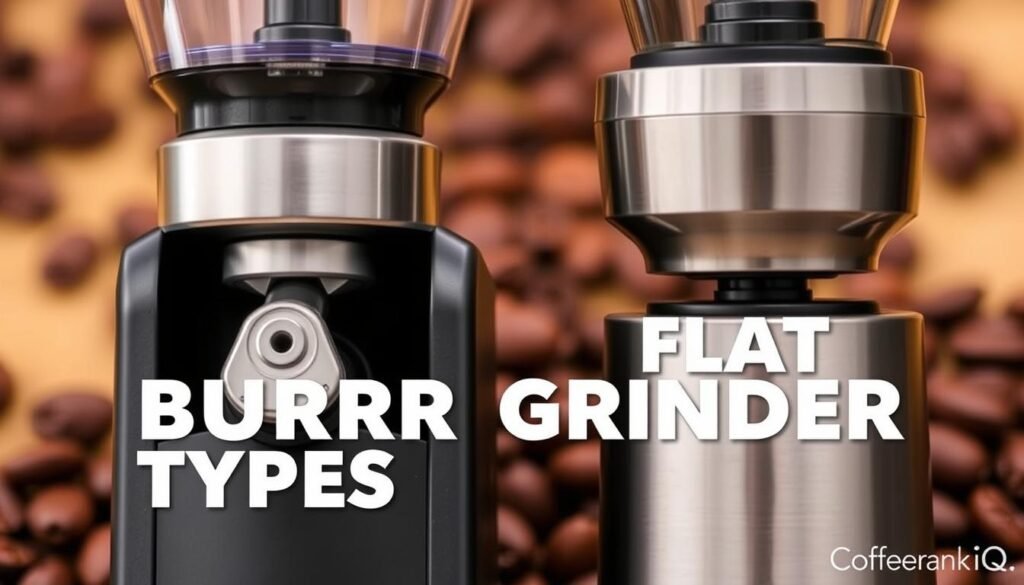
Conical burr grinders feature a cone-shaped center burr with an outer serrated burr. This design helps produce a consistent, well-ground coffee that is both energy-efficient and heat-resistant. Conical burr grinders are an industry standard, known for their ability to deliver a superior grind quality that is ideal for a variety of brewing methods, from espresso to pour-over and French press.
Flat Burr Grinders
By comparison, flat burr grinders use two donut-shaped burrs that face each other. This design results in a more uniform grind, which can be particularly beneficial for brewing methods like espresso that require a precise and consistent particle size. But, flat burr grinders tend to be louder and generate more heat during the grinding process compared to their conical counterparts.
In the end, both conical and flat burr grinders offer exceptional grind quality and control, with the specific type often coming down to personal preference and brewing needs. Factors like energy efficiency, heat generation, and noise level may also play a role in the decision-making process.
As the coffee industry continues to evolve, manufacturers are developing innovative technologies to address common challenges associated with burr grinders, such as reducing noise and grind retention. Whether you choose a conical or flat burr grinder, you can be assured of a superior coffee experience that surpasses the limitations of blade grinders.
Factors to Consider When Choosing a Grinder
When selecting the perfect coffee grinder for your home or office, there are several key factors to consider. Grind consistency is key, as a uniform particle size ensures even extraction and optimal flavor. The adjustability of the grind size is also key, as different brewing methods require varying grind levels.
The type of burr grinder, whether conical or flat, can significantly impact grind quality and suitability for specific brew methods. Conical burr grinders are known for their energy efficiency and heat resistance, making them a popular choice for both professional and home baristas. Flat burr grinders, on the other hand, provide a more one-note flavor due to their evenly ground coffee, which some coffee enthusiasts prefer for its creative potential.
Also, the grinder mechanism, whether manual or electric, can affect the price, size, and noise level of the device. Manual burr grinders offer a more affordable option, allowing for brewing 1-2 cups at a time, while electric grinders, ranging from $60 to $2,300, provide greater convenience and speed.
| Feature | Conical Burr Grinder | Flat Burr Grinder |
|---|---|---|
| Grind Quality | Consistent, with less fines | Extremely consistent, with minimal fines |
| Flavor Profile | Richer, more subtle flavors | More one-note, but can highlight certain flavors |
| Efficiency | More energy-efficient and heat-resistant | Require more power, but produce less heat |
| Versatility | Suitable for a wide range of brewing methods | Particularly well-suited for espresso and filter coffee |
By carefully weighing these factors, you can choose the coffee grinder that will improve your daily brew and provide the best possible coffee experience, whether you’re a seasoned barista or a passionate home coffee enthusiast.
“Investing in the best quality grinder within one’s budget is key to avoid a bad cup of coffee.”
Burr vs Blade Grinder: What Particle Size Does to Extraction
Run a blade grinder for ten seconds and tip the result onto a white plate. You will see a pile of dust, a pile of chunks the size of lentils, and not much in between. That spread is the whole burr vs blade grinder argument in one picture, because every particle size in the pile brews at its own speed.
Barista Hustle measured this directly. In a cupping bowl test, they sieved grounds into three groups and tracked how fast each one gave up its flavor. After only 15 seconds, particles under 250 microns had reached a 22% extraction yield. Particles between 250 and 500 microns sat just below 19%. The boulders, anything caught by a 500 micron sieve, managed just over 14%. The same test found that water only works about 100 microns into each particle, roughly the thickness of a human hair, so a big chunk keeps an untouched core no matter how long it sits.
That is why a blade grinder cup tastes bitter and sour at the same time. The fines race past a good extraction into harsh, drying bitterness. The boulders barely get started and add a thin, sour edge. Changing the brew time cannot fix both groups at once. A burr grinder narrows the spread so most of the coffee extracts at the same pace. That narrower pile is what the extra money buys.
Conical vs Flat Burrs on a Real Counter
Most hand grinders use conical burrs, because a cone fits neatly inside a narrow body and cuts well at the slow speed of a hand crank. Flat burrs turn up more often in electric grinders built around espresso and single dosing. For a buyer, burr alignment and fine enough adjustment steps decide more than burr shape. If espresso is the goal, start with our best espresso grinder guide, which is built around the adjustment spec that decides your shot.
Steel vs Ceramic Burrs
Ceramic burrs are very hard, resist wear, and never rust, which is why they show up in affordable hand grinders such as the Hario Skerton and the Porlex. The catch is brittleness. A small stone hiding in a bag of beans can chip a ceramic burr, where steel would more likely take a dent. Steel burrs can be machined with sharper cutting edges and tighter tolerances, which is why most electric grinders use them. For French press, cold brew, and everyday pour over, a well built ceramic hand grinder does the job. For espresso, the grinders people trust run on steel.
Grind Size Chart by Brew Method
The micron ranges below come from the Honest Coffee Guide grind size chart, which describes where most of the grounds should land for each method. Every grinder makes some particles outside these ranges. A good burr grinder keeps that overflow small. A blade grinder can spread one batch across several rows of this table.
| Brew method | Grind setting | Looks like | Approximate range (microns) |
|---|---|---|---|
| Turkish coffee | Extra fine | Flour or powdered sugar | 40 to 220 |
| Espresso | Fine | Fine table salt | 180 to 380 |
| AeroPress | Fine to medium, recipe dependent | Table salt to fine sand | 320 to 960 |
| Pour over | Medium fine | Fine sand | 410 to 930 |
| Drip coffee maker | Medium | Beach sand | 300 to 900 |
| French press | Coarse | Coarse sea salt | 690 to 1,300 |
| Cold brew | Extra coarse | Cracked peppercorns | 800 and up, to about 1,400 |
Espresso’s window is 200 microns wide. A blade grinder has no setting, only a stopwatch, so it cannot aim at a window that narrow.
How to Get Better Coffee From a Blade Grinder
If a blade grinder is what you own today, these habits shrink the spread.
- Grind one brew at a time. A packed chamber leaves the top layer untouched while the bottom turns to dust. A shallow layer keeps every bean near the blade.
- Pulse instead of holding the button. Short bursts of a second or two, with a pause between, let the pieces settle back down into the blade’s path.
- Shake between pulses. Hold the lid on and give the grinder a quick shake, like a small cocktail shaker. Big chunks drop to the bottom where the blade can reach them.
- Sift out the dust. Tap the grounds through a fine mesh tea strainer and toss what falls through. For pour over, this one step removes a lot of the bitterness. Put any boulders back for one more pulse.
- Grind a little coarser than you think. The fines will still show up, so a coarser target keeps them from taking over the flavor.
When a Blade Grinder Is Fine
A blade grinder earns its drawer space for immersion brewing. French press and cold brew use coarse grounds and long contact times, so the boulders have time to catch up, and a mesh screen or paper filter handles part of the dust. It also beats a bag of pre-ground coffee that has been open for two weeks, as our whole bean vs ground coffee guide explains.
It is the wrong tool for espresso and a frustrating one for pour over, where small grind changes should produce small taste changes. If you want burr consistency without spending much, a hand grinder is the cheapest honest upgrade; our best manual coffee grinder picks cover pour over, espresso, and travel. For electric picks at every budget, see the best coffee grinder roundup, and the Coffee Rank IQ homepage has the rest of our brewing guides.
More Burr vs Blade Grinder Questions
Can you make espresso with a blade grinder?
Not reliably, because espresso needs most of the grounds inside a window of roughly 180 to 380 microns and a blade grinder cannot hold a range that tight. Shots swing from sour to bitter from one pull to the next.
Should you sift coffee from a blade grinder?
Yes, a quick pass through a fine mesh tea strainer is the single biggest improvement a blade grinder owner can make. It removes the dust behind most of the bitterness for the price of a strainer.
Conclusion
In the pursuit of the perfect cup of coffee, the choice between a burr grinder and a blade grinder is a critical one. Burr grinders, with their ability to produce a consistent, adjustable grind size, are the clear winner for brewing high-quality, flavorful coffee. The uniform particle size they provide allows for optimal extraction and a balanced taste profile, whether you’re making espresso, pour-over, or French press.
While burr grinders may be more expensive than their blade counterparts, the investment is well worth it for coffee enthusiasts seeking a superior drinking experience. By carefully considering the factors that matter most to you, such as grind consistency, grind size control, and versatility for different brewing methods, you can select the grinder that will improve your daily brew and bring out the best in your favorite coffee beans.
In the end, the decision between burr grinders vs. blade grinders comes down to your personal preferences and the importance you place on coffee quality. For those who truly appreciate the nuances of flavor and seek a more consistent, balanced cup, a burr grinder is the clear choice. It’s a decision that can transform your coffee experience and help you open up the full potential of your favorite roasts.
FAQ
What are the main differences between burr grinders and blade grinders?
Burr grinders use two revolving abrasive surfaces to grind the coffee beans into a consistent, adjustable particle size, while blade grinders use a spinning blade to chop the beans into an inconsistent grind. Burr grinders produce a more uniform grind, leading to better flavor extraction and a more balanced, subtle coffee taste.
Why are burr grinders considered superior to blade grinders?
Burr grinders offer several advantages over blade grinders, including: – Consistent, adjustable grind size for optimal extraction – Preservation of the coffee’s natural oils and aromas – Versatility for use with a variety of brewing methods – Balanced, flavorful coffee due to even extraction
What are the different types of burr grinders?
There are two main types of burr grinders: conical and flat. Conical burr grinders feature a cone-shaped center burr with an outer serrated burr, while flat burr grinders use two donut-shaped burrs that face each other. Both designs offer superior grind quality and control compared to blade grinders, with the specific type often coming down to personal preference and brewing needs.
What factors should I consider when choosing a coffee grinder?
When selecting a coffee grinder, important factors to consider include: – Grind consistency – Adjustability of the grind size – Type of burr grinder (conical or flat) – Grinder mechanism (manual or electric) – Price point – Footprint and noise level
Which one produces the best coffee – a burr grinder or a blade grinder?
Burr grinders are widely recognized as the superior choice for producing the best-tasting coffee. The consistent, adjustable grind size they provide allows for optimal extraction, resulting in a balanced, subtle flavor profile. By comparison, the inconsistent grind produced by blade grinders can lead to uneven extraction, resulting in bitter, sour, or watery coffee.
Keep reading
- A Beginner's Guide to Using a Pour-Over Coffee Maker
- Best Ways to Clean a Coffee Maker for Beginners
- Coffee Makers with Built-In Grinders: Complete Convenience
- Complete Guide to Using Keurig K-Cafe Coffee Maker
More in How to Coffee guides for beginners, or start from the Coffee Rank iQ homepage.