Kona Coffee Labels: Why a 10% Blend Is Legal
Quick Answer
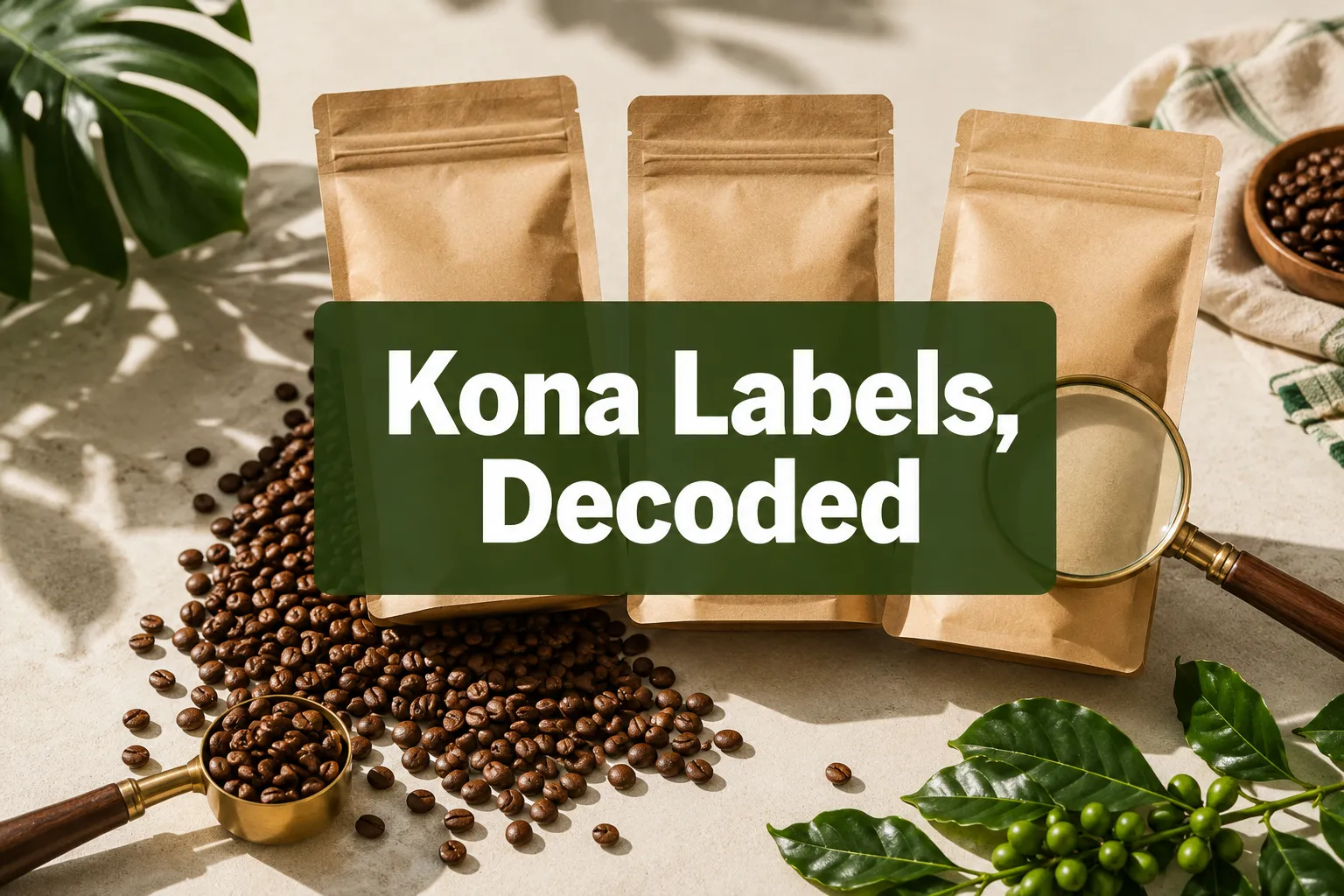
A bag labeled "10% Kona Blend" is legal in Hawaii because state law currently allows a roaster to use a Hawaii geographic origin name as long as at least 10% of the coffee by weight actually came from that region. That threshold sits in Hawaiʻi Revised Statutes §486-120.6, and it applies through June 30, 2027. On July 1, 2027, the minimum rises to 51% under Act 198 of 2024 . Until then, a bag can say Kona on the front while 90% of what you grind comes from somewhere else entirely.
Key Takeaways
- The legal minimum is 10% through June 30, 2027. Hawaiʻi Revised Statutes §486-120.6(d)(2) bars a geographic origin claim below that percentage .
- It becomes 51% on July 1, 2027. Act 198, signed by Governor Josh Green on July 3, 2024, raises the bar for Kona and for Kaʻū, Kauaʻi, Maui, Oʻahu, and Hawaiʻi island origins .
- A compliant blend label must state the percentage, use the words "Coffee Blend," and carry a "Contains:" list of the remaining origins in descending order, with foreign coffee allowed to be grouped as "Foreign-grown Coffee" .
- The identity statement has size rules. On packages of 16 ounces or less it must be at least one-and-a-half times the federal net-weight type size, or three-sixteenths of an inch, whichever is smaller, printed on the front panel above the net weight .
- Hawaii's own legislature said the quiet part out loud. HB2298 findings note that a 10% blend is 90% other coffee and that Kona character is "often undetectable" at that concentration .
- 100% Kona is genuinely expensive. Based on direct-from-farm and specialty retailer listings observed online on November 6, 2026, roasted 100% Kona commonly advertises around $45 to $75 per pound. Treat that as an observed range, not a formal price survey.
- The practical rule: if the front panel does not say "100% Kona Coffee," assume it is a blend and price it accordingly.
What makes kona coffee taste different from regular coffee?
Kona's flavor profile comes from a short strip of volcanic slope on the west side of Hawaii island, roughly 1,000 to 2,500 feet up, where morning sun gives way to reliable afternoon cloud cover. That cloud cover acts like free shade, slowing cherry ripening. Slower ripening usually means denser beans and more developed sugars.

The region is also tiny. Kona's growing belt is measured in miles, not provinces, and most farms are small holdings that pick selectively by hand across several passes. Hand picking means fewer underripe and overripe cherries in the lot, which shows up in the cup as cleaner sweetness and less harsh bitterness.
Roasters and importers commonly describe Kona as medium bodied, low in acidity relative to East African coffees, with notes of milk chocolate, brown sugar, toasted nut, and a soft floral top . That is reported descriptive language from the trade, not a tasting conducted by this publication.
What that means for your brewing: Kona rewards a lighter hand. Because the acidity is gentle, over-extraction flattens it into something generic fast. A medium grind size, water temperature around 200°F, and a standard 1:16 brew ratio tend to keep the sweetness forward. If you want the full method, read our guide to brewing Kona coffee.
Decision rule: if you mostly drink dark roast with milk and sugar, Kona's delicate character will largely disappear. Save your money.
Kona Coffee: How Hawaii's Label Law Actually Works
Hawaii's coffee labeling law governs roasted coffee, instant coffee, and prepackaged ready-to-drink coffee beverages that contain Hawaii-grown and Hawaii-processed coffee . It is a truth-in-labeling statute, not a quality grade, and it is why "kona coffee" on a supermarket shelf can mean two very different products.
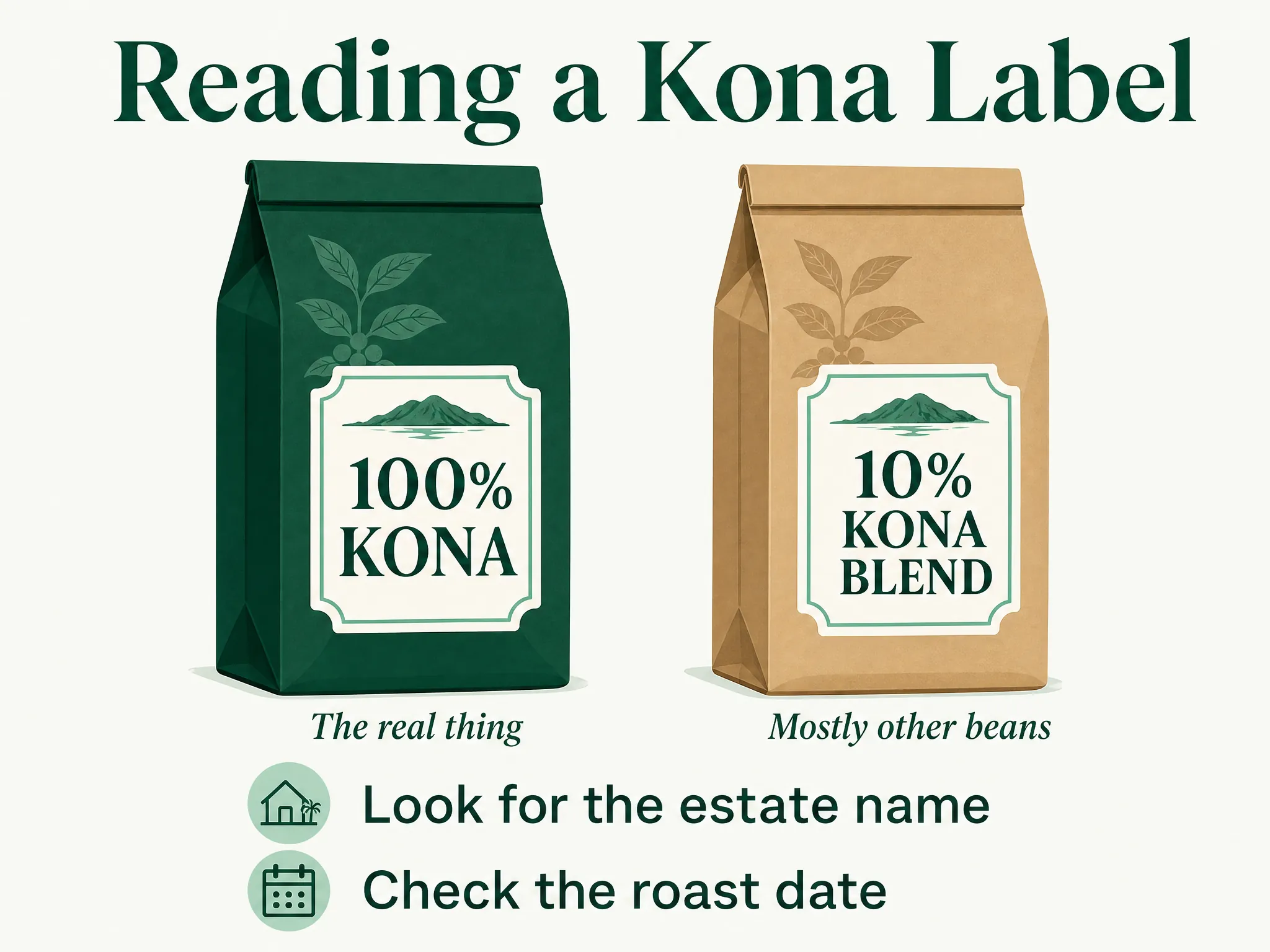
Here is what the current statute requires of a blend sold with the Kona name:
- At least 10% Kona coffee by weight, through June 30, 2027 .
- An identity statement on the front panel showing the Hawaii-origin percentage, placed above the net weight statement with no intervening material .
- The words "Coffee Blend" as part of that identity statement .
- A "Contains:" statement listing the other origins and their percentages in descending order. Non-Hawaii coffee may generally be aggregated as "Foreign-grown Coffee" .
- Minimum type size for the identity statement on packages of 16 ounces or less: one-and-a-half times the federally required net-weight type, or three-sixteenths of an inch, whichever is smaller .
So a legal label looks like "10% Kona Coffee Blend" with a Contains line underneath. What it is not allowed to look like is a bag that just says "Kona" in big letters with the word blend hidden on the back seam.
Roasters outside Hawaii are a different matter. Hawaii's statute binds products sold in Hawaii; enforcement against a mainland roaster depends on federal and state consumer protection law rather than §486-120.6. That gap is a real part of why questionable Kona-branded product keeps appearing online.
What does "10 percent kona coffee" mean, and why is only 10% legal?
It means exactly what it says: one tenth of the coffee in the bag, by weight, came from the Kona districts. The other 90% can be any origin the roaster chose, often an inexpensive Central or South American or Southeast Asian lot.
It is legal because of a compromise written in 1991. Act 289 created the blend category, permitting products with at least 10% Kona and less than 100% to be sold as "Kona coffee blend," "Kona blend coffee," or "blended Kona coffee," with the minimum percentage disclosed on the front panel . Before that, the Kona name on a mostly-not-Kona product sat in a grey zone. The 10% rule traded brand dilution for disclosure.
Three decades later, Hawaii's legislature decided the trade was a bad one. The findings in HB2298 state plainly that a 10% blend may contain 90% coffee from elsewhere and that Kona flavor is often undetectable at that level, which could lead buyers to believe they were drinking the specialty coffee of the region . The bill passed and became Act 198 in 2024, with the 51% minimum operative July 1, 2027 .
Edge case worth knowing: the change is not Kona-only. Act 198 lifts the threshold for Kaʻū, Kauaʻi, Maui, Oʻahu, and Hawaiʻi island names too . Expect a wave of reformulated or discontinued Hawaiian blends in late 2026 and 2027.
A 2026 article in Agriculture and Human Values framed the whole fight as a geographic indication dispute over who captures the value of a place name: growers, processors, retailers, or downstream brand owners . Growers generally want stricter protection because the premium should return to the farm. Some small roasters and retailers argue a 51% floor makes their existing products uneconomic and may push them to drop Kona lines altogether .
What's the difference between 100% kona coffee and a kona blend?
A 100% Kona bag contains only Kona-grown coffee. A kona blend contains the legal minimum or more, and the rest is undisclosed-origin filler in practice, since "Foreign-grown Coffee" is an allowed catch-all . The price difference is enormous. The flavor difference is usually obvious to anyone who has tasted both side by side.
| Option | What’s in the bag | Observed price per lb (Nov 6, 2026) | Best for |
|---|---|---|---|
| 100% Kona, estate | Single farm, named lot, often Extra Fancy or Fancy grade | ~$55 to $85 | Filter brewing, gifts, tasting comparisons |
| 100% Kona, co-op or mixed lot | All Kona, multiple farms pooled | ~$45 to $60 | A first honest taste of Kona |
| 10% Kona blend | 90% other origins, legal through June 30, 2027 | ~$12 to $25 | Souvenirs, large-batch drip, not much else |
| Other Hawaiian single origin | Kaʻū, Maui, Kauaʻi, Molokaʻi lots | ~$25 to $55 | Similar sweetness, lower price, less hype |
| Mainland alternative | Washed Guatemala Huehuetenango, Colombia Huila, Brazil pulped natural | ~$16 to $28 | Daily drinking with a comparable soft, chocolatey profile |
Prices are an observed range from direct-farm and specialty retailer listings viewed online on November 6, 2026. Labeled as an estimate, not a formal market survey. Harvest size, grade, and shipping move these numbers.
Why is kona coffee so expensive?
Four reasons, and none of them are marketing. Land, labor, scale, and demand.
- Land. Kona's coffee belt is a narrow strip of volcanic slope with limited plantable acreage and Hawaii real estate prices attached to every acre.
- Labor. Harvesting happens by hand over multiple passes, at US wages, with no mechanical stripping. That is the single biggest cost line on most Kona farms.
- Scale. Hawaii's total coffee output is small enough that the state tracks production and exports in its own agency reports . Small volume means no economy of scale on milling, drying, or freight.
- Demand. The Kona name carries a premium, which is precisely the value the geographic indication fight is about .
Add the coffee berry borer and coffee leaf rust pressure that Hawaii growers have managed in recent years, and the cost per finished pound stays high. The honest summary: you are paying for a hand-picked coffee grown on expensive land in a place with the highest production costs in the coffee world.
How can I tell if kona coffee is real?
Read the front panel first and the price second. Those two checks catch most of the problems.
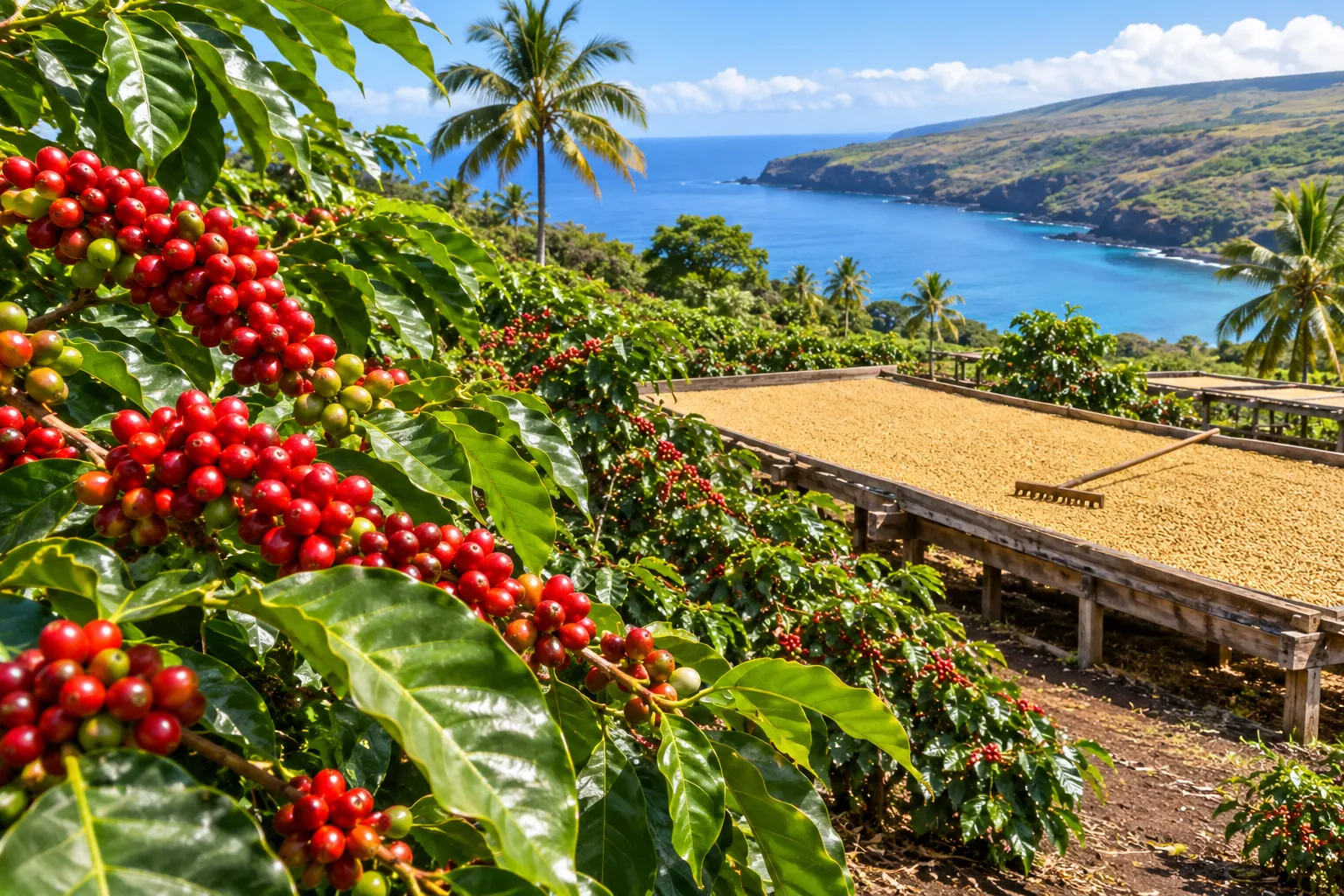
A five-point label check:
- Look for the exact words "100% Kona Coffee." Not "Kona Style," not "Kona Roast," not "Kona Premium." Those first two phrases contain no legal promise about origin.
- Find the percentage. A compliant blend must state its Hawaii-origin percentage in the identity statement on the front panel, above the net weight .
- Find "Coffee Blend." If it appears anywhere on the bag, you are holding a blend, regardless of how large the word Kona is printed .
- Read the "Contains:" line. Legal blend labels list the other origins in descending order, often ending in "Foreign-grown Coffee" .
- Check the farm name, district, and roast date. Real 100% Kona almost always names a farm or mill and a district such as Holualoa, Captain Cook, Honaunau, or Kealakekua. A roast date within four weeks is a good sign for any coffee.
Price sanity check: if a one-pound bag of "Kona" costs $14, it is a blend, a mislabeled product, or stale. The math does not work at US harvest wages.
Common giveaway: bags sold with a tourist photo of a beach, no farm name, no roast date, and the word Kona in script. That is a souvenir, not a lot of coffee.
What to watch out for: blend pricing games and counterfeit labels
Three patterns show up repeatedly, and all three are legal or hard to police.
The blend sold at single-origin prices. A 10% blend costs the roaster roughly a tenth of the Kona input of a pure bag, yet some are priced like premium specialty coffee. Compare the per-pound price against the table above before you buy.
The vanishing disclosure. Hawaii's type-size rule exists because disclosures used to shrink into the seam. The statute now sets the minimum height and forbids intervening material between the identity statement and the net weight . Out-of-state sellers are not always following it.
"Kona Style" and "Kona Roast." These are flavor or roast-level descriptions, not origin claims. A bag can carry them with zero Hawaiian coffee inside. The Kona Coffee Farmers Association has argued for years that low-percentage blends and look-alike naming dilute the region's reputation and confuse buyers, and it supported the move to a 51% floor.
Online marketplace listings. Third-party sellers mix legitimate farm product with repackaged mystery bags. Buying direct from a farm website or an established specialty roaster removes most of that risk.
Is kona coffee worth buying if it's just a blend?
For most buyers, no. At 10%, Hawaii's own legislature concluded the Kona character is often undetectable . You are paying a naming premium for a cup that tastes like whatever makes up the other 90%.
A blend makes sense in three narrow situations:
- You want a cheap, pleasant souvenir and you know what you are buying.
- The blend is 30% or higher and priced like a mid-tier specialty coffee.
- You brew large-batch drip for a crowd and want something smooth rather than distinctive.
Do you actually need authentic Kona? Only if you want to taste what Kona specifically does. If you want a soft, chocolatey, low-acid cup for daily drinking, a $20 washed Colombia or Guatemala gets you most of the way there. If you want to understand why an origin earned its reputation, buy 100% Kona once, brew it carefully, and decide for yourself. That single comparison teaches more than ten articles.
Worth knowing before you spend: an expensive origin will not rescue a bad grind. A cheap blade grinder shreds beans into uneven fragments that over-extract and under-extract in the same brew. If you are upgrading anything, a burr grinder beats a fancier bean every time. Our notes on how to choose coffee beans cover the order of priorities.
Where can I find 100% pure Kona beans?
Buy direct from Kona beans farms or from roasters who name the farm and the mill. Hawaii island's Kona districts have hundreds of small growers, many selling roasted coffee from their own websites with harvest year and grade listed.
What to look for in a seller:
- A named farm or estate and a Kona district on the label
- A stated grade such as Extra Fancy, Fancy, or Peaberry
- A visible roast date, ideally roasted to order
- Clear language: "100% Kona beans," with no blend wording anywhere
- Honest grade pricing, since Peaberry and Extra Fancy sell above standard lots
Mainland specialty roasters who buy Kona lots are also a reasonable route, often at slightly lower prices than estate direct because they roast at volume. Subscription services occasionally feature Hawaiian lots; if you like rotating through origins, a discovery service such as Bean Box is a lower-commitment way to taste comparisons.
Check the current price before you commit, and compare at least two farms. Kona pricing varies more by grade and harvest than by brand prestige.
Is Kona beans better than other Hawaiian coffees, and what are good alternatives?
Not automatically. Kona has the oldest reputation and the largest marketing footprint, but Kaʻū coffees from the southern slopes of Mauna Loa have won international cupping recognition repeatedly, and Maui, Molokaʻi, and Kauaʻi lots can be excellent and cheaper.
Alternatives organized by what you actually want:
- Same island, lower price: Kaʻū, Maui Mokka, or Kauaʻi lots. Often $20 to $30 less per pound than comparable Kona. A Kauai coffee variety pack is a cheap way to sample the state without the Kona markup.
- Similar soft, chocolate-and-nut profile: washed Guatemala Antigua or Huehuetenango, Colombia Huila, or a quality Brazil pulped natural. See our medium roast recommendations.
- Comparable prestige, different character: Jamaica Blue Mountain, which carries its own certification scheme and its own premium .
- Rotating discovery: a subscription that ships small single origin lots so you can taste several regions before paying $60 a pound for one.
Common mistakes people make when buying Kona beans
- Reading the big word and ignoring the small one. "Kona" is the brand. "Blend" is the fact.
- Assuming a Hawaii airport or hotel gift shop bag is pure. Many are 10% blends, correctly labeled, bought in a hurry.
- Buying pre-ground. Kona's gentle aromatics fade fast. Grind fresh or do not bother paying the premium.
- Buying dark roast Kona. A dark roast masks the origin character you just paid for. Medium is the usual recommendation.
- Ignoring the roast date. A six-month-old bag of 100% Kona is worse than a fresh $18 Colombia.
- Storing it badly. Oxygen and heat undo the farm's work in two weeks. A proper airtight storage container is a cheaper upgrade than a better bean.
- Brewing it like a dark roast. Too fine a grind size and boiling water will bury the sweetness.
FAQ

Conclusion
The 10% rule is not a loophole someone found. It is a 1991 compromise, written into Hawaii law as Act 289 and still operative in §486-120.6 until June 30, 2027, that traded dilution of the Kona name for mandatory disclosure on the front of the bag . Hawaii's legislature has since decided the trade was a poor one, and on July 1, 2027 the floor moves to 51% .
Until then, your protection is literacy. Three steps:
- Read the front panel. If it does not say "100% Kona beans," it is a blend. Check the percentage and the "Contains:" line.
- Price-check against the table above. A sub-$25 pound of Kona is almost certainly mostly not Kona.
- Decide what you actually want. Buy one pound of 100% Kona direct from a named farm and brew it as a pour over at a 1:16 ratio. Or skip the premium and buy an excellent Kaʻū, Guatemala, or Colombia for a third of the price.
Either answer is defensible. Paying Kona money for a bag that is 90% something else is the only outcome worth avoiding. Next step: if you do buy the real thing, read the brewing method before you open the bag.
Better Coffee Starts With Better Answers.