
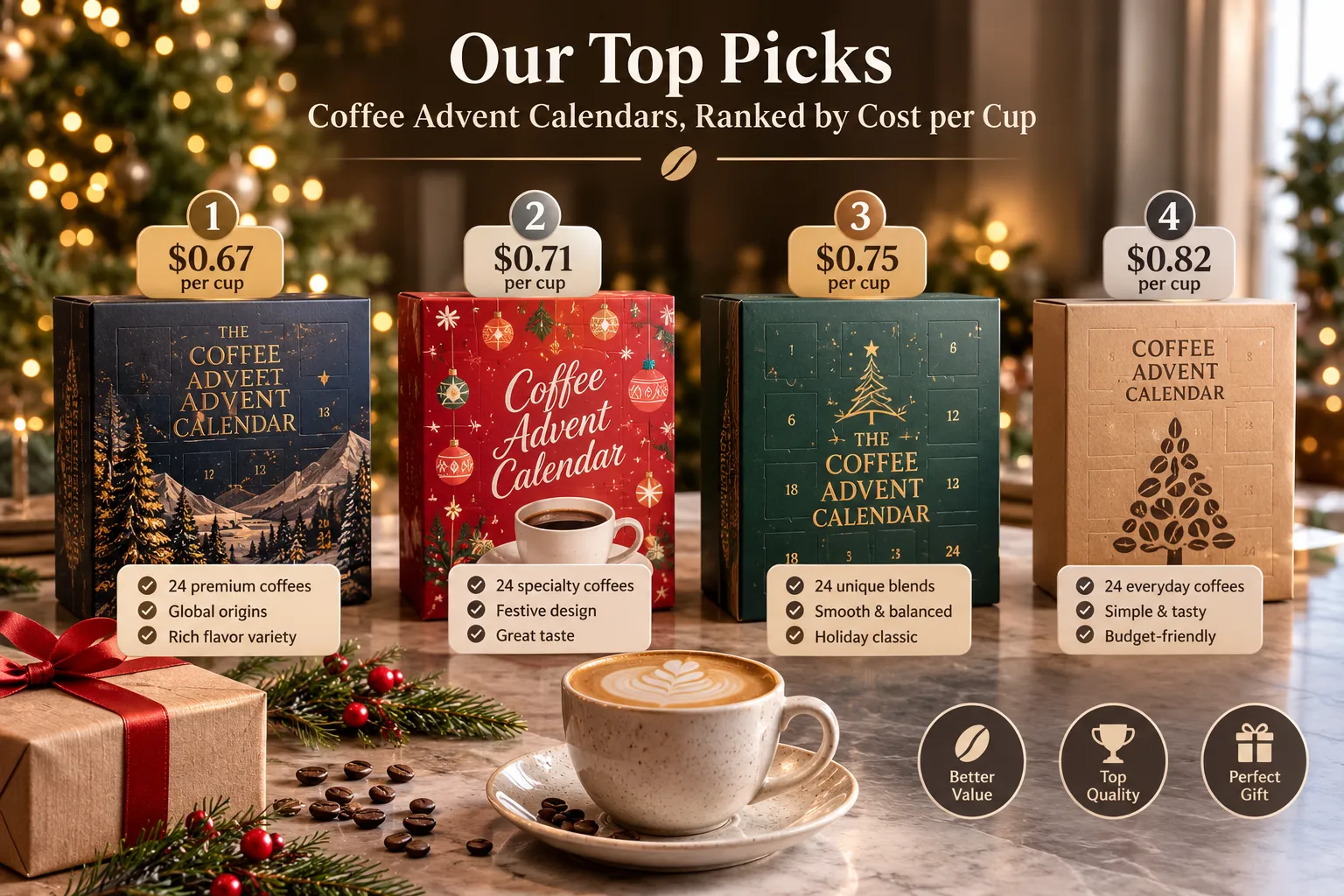
Coffee Advent Calendar Picks, Ranked by Cost per Cup
Quick Answer
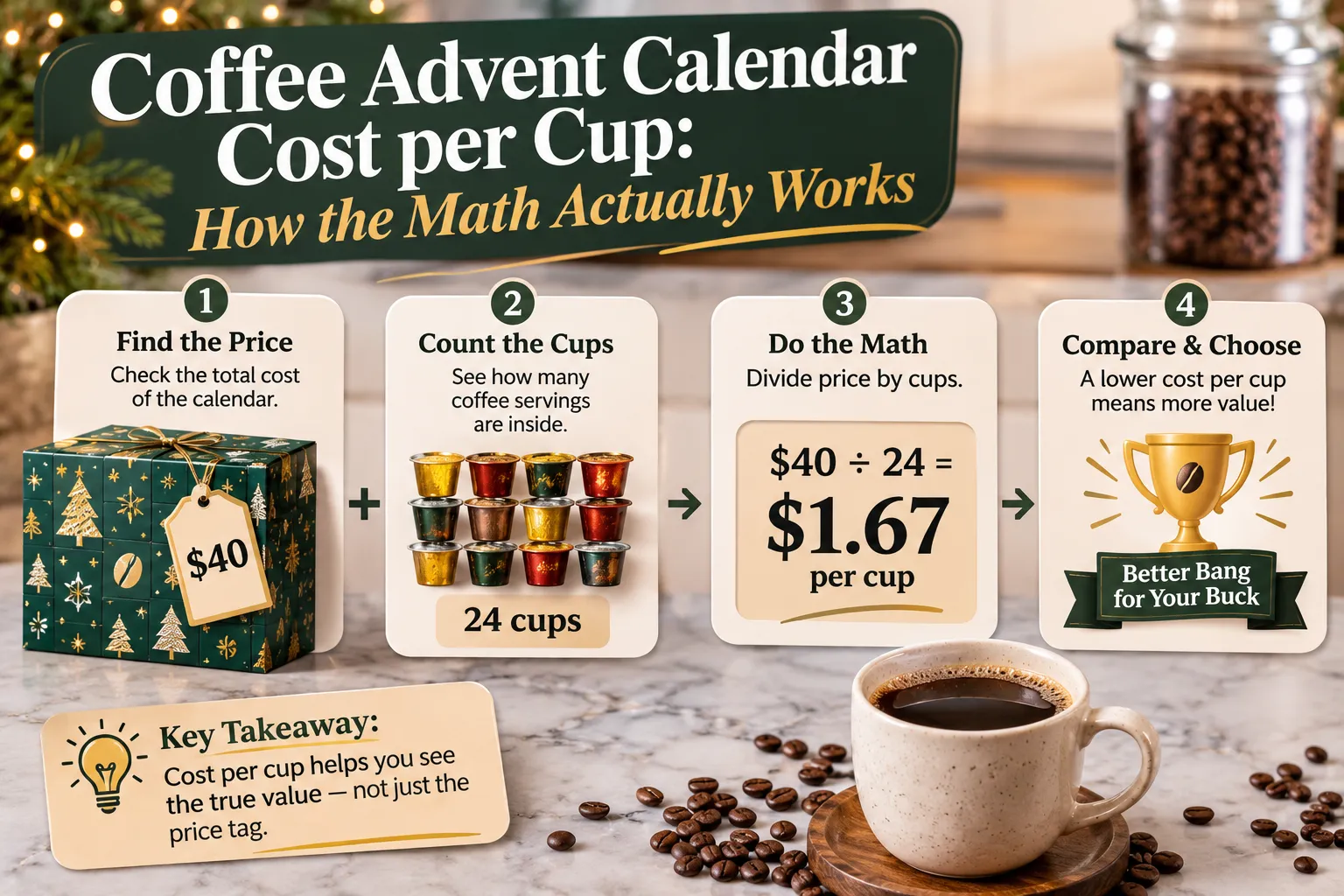
The cheapest coffee advent calendar per cup in November 2026 is Keurig's 24-count Cups of Cheer at $32.99 list, or roughly $1.37 per pod, dropping to about $0.94 per pod at its displayed promotional price of $22.49 . The most expensive per serving is the Cometeer frozen capsule calendar at $129, which works out to $5.38 per capsule. The specialty calendar that makes the most sense mathematically is Onyx, because each of its 24 doors holds about 2 ounces of whole beans, enough for roughly three cups, not one.
That gap is the whole story. One door does not equal one cup, and most price comparisons quietly pretend it does.
Key Takeaways
- Keurig Cups of Cheer: $32.99 for 24 pods, about $1.37 per pod, or $0.94 at the promoted $22.49 price . Not all 24 doors are coffee, though. Cocoa and latte beverages are mixed in.
- Nespresso Swarovski Original: roughly $50 for 24 capsules, about $2.08 per capsule .
- Nespresso Swarovski Vertuo: roughly $55, about $2.29 per capsule . Original and Vertuo capsules are not interchangeable.
- Onyx 2026 Advent Calendar: about $220 at regular price, $189 early-bird as reported. At roughly 72 brewed cups from 24 two-ounce packets, that is $2.63 to $3.06 per cup .
- Door County Coffee: $69.99 for 24 bags of about 1.5 ounces each, roughly $2.92 per full pot .
- Cometeer: $129 for 24 frozen capsules, $5.38 per capsule, or $4.13 at the reported $99 subscriber price.
- Across 11 U.S.-priced calendars tracked in early November 2026, prices ranged from about $30 to $220, median near $55 .
What is a coffee advent calendar?
A coffee advent calendar is a December countdown box with 24 sealed doors, each holding a single coffee item: a whole bean packet, a ground sachet, a pod, a capsule, or a frozen concentrate puck. You open one per day from December 1 through Christmas Eve.
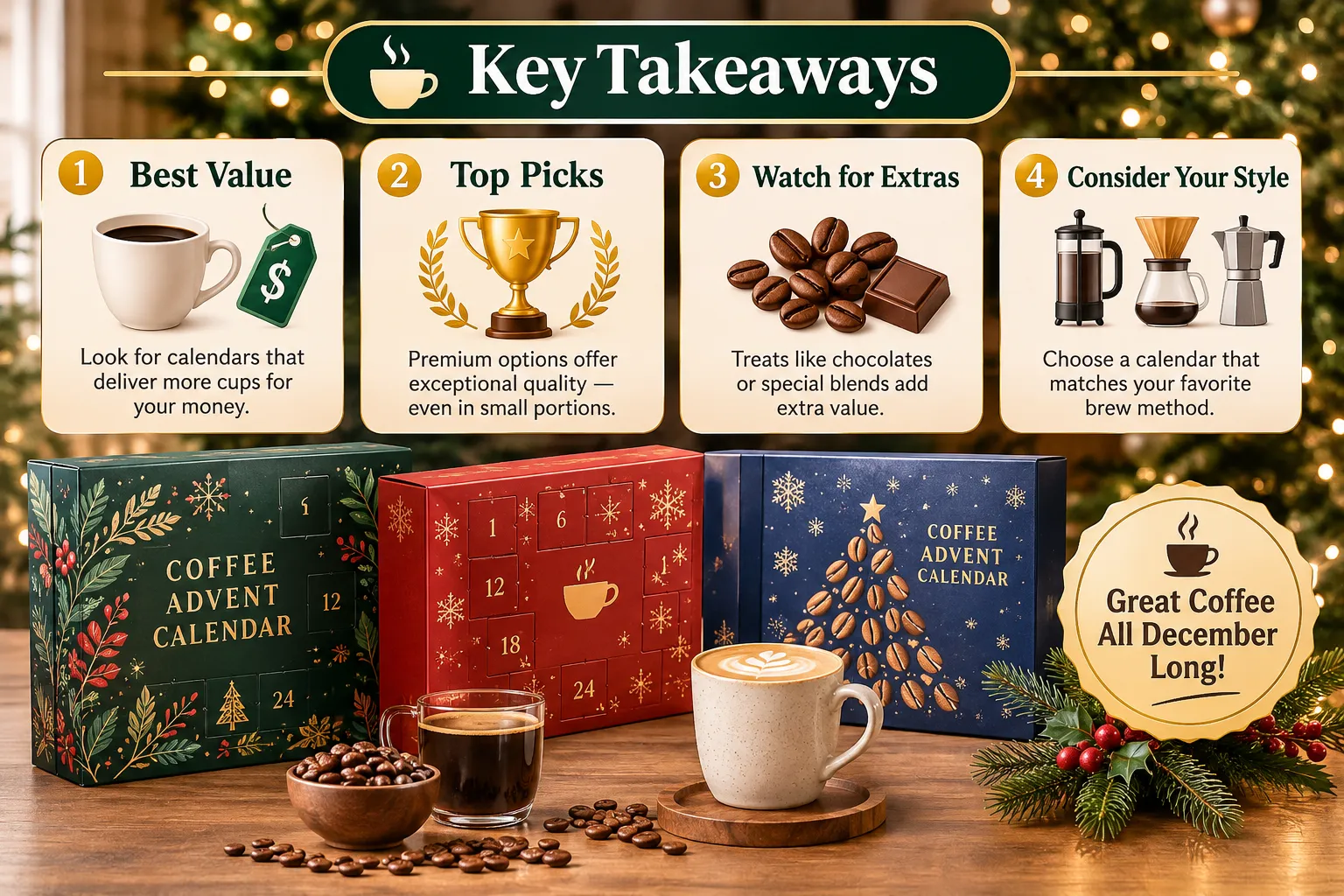
The format splits into four types, and the type decides your cost per cup more than the brand does.
- Whole bean calendars. Usually 1.5 to 2 ounces per door. Onyx, Door County, and most independent roasters sit here. You need a grinder. You also get multiple cups per door, which is why they look expensive and often are not.
- Pod calendars. Keurig's K-Cup version. One pod, one mug, no grinder, no scale, no thinking.
- Capsule calendars. Nespresso. Espresso-sized shots, locked to your machine system.
- Frozen concentrate. Cometeer only, at this point. Capsules ship and store frozen, then dissolve in hot water or milk.
A fifth category exists if you count the craft and sampler calendars sold on marketplaces, which vary wildly in quantity and roast date transparency .
)
How much does a coffee advent calendar cost in 2026?
Expect $30 to $220. A November 2 comparison of U.S.-priced coffee advent calendars found that spread across 11 products, with a median near $55 . Pod and supermarket calendars cluster at the bottom, specialty whole bean calendars at the top.
Three price bands worth knowing:
| Band | Typical price | What you get |
|---|---|---|
| Budget | $22 to $40 | Pods or ground sachets, often mixed with cocoa and flavored drinks |
| Middle | $50 to $90 | Nespresso capsules, large-format bagged coffee, regional roasters |
| Specialty | $120 to $220 | Single origin whole beans, named producers, roast dates, 24 distinct coffees |
The middle band is the busiest and the hardest to judge, because the serving sizes stop matching each other. That is where cost per cup earns its keep.
Which coffee advent calendar has the best value per cup?
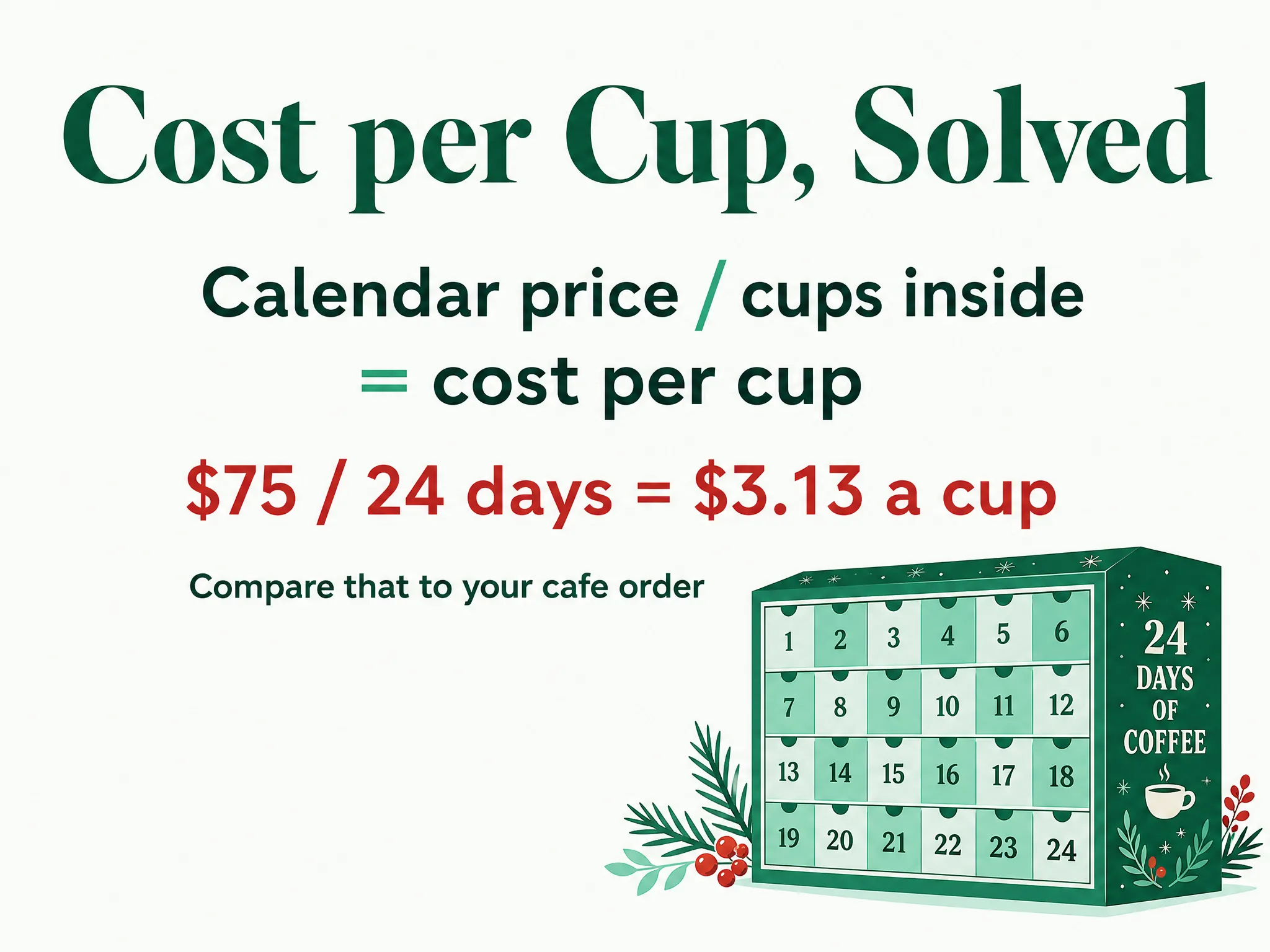
Keurig wins on raw arithmetic. Onyx wins on cost per cup of actual specialty coffee. Below is the full ranked list, cheapest per cup first, using prices checked in early November 2026. Every figure here is a calculation from published prices and published serving sizes, not a tasting result.
1. Keurig Cups of Cheer, 24 K-Cups
- Price: $32.99 list, $22.49 displayed promotional price in early November 2026
- Servings: 24 pods
- Cost per cup: $1.37 list, $0.94 promo
- Format: K-Cup pods, mixed coffee, cocoa, and latte beverages
- Suits: Anyone with a Keurig who wants a cheap daily surprise and does not care that door 11 is hot chocolate
The caveat matters. The assortment is not 24 coffees . If roughly a third of the doors are cocoa or latte-style mixes, your true cost per coffee climbs toward $2.00 at list price. Still the cheapest entry in the category, and the only one where a sale price drops you under a dollar a cup.
2. Nespresso Swarovski Original, 24 capsules
- Price: approximately $50
- Servings: 24 capsules
- Cost per cup: $2.08
- Format: Nespresso Original line espresso capsules
- Suits: Original-line machine owners who want short espresso and a gift-grade box
Nespresso introduced Swarovski-branded calendars for 2026, reported at roughly $50 for Original . The serving is an espresso, not a mug, so compare it against café espresso prices rather than drip. Decorative value is a real part of what you pay for here, and that is a fair trade if you were buying a gift anyway.
3. Nespresso Swarovski Vertuo, 24 capsules
- Price: approximately $55
- Servings: 24 capsules
- Cost per cup: $2.29
- Format: Vertuo capsules, larger brew volumes
- Suits: Vertuo owners only
Buy the wrong one and it is a $55 paperweight. Original and Vertuo capsules do not fit each other's machines. Check the machine on your counter before checkout, not after. If Vertuo is your system, our guide to the Nespresso Vertuo machine covers the capsule sizes you will be pulling.
4. Onyx Coffee Lab 2026 Advent Calendar at early-bird $189
- Price: $189 early-bird as reported; regular price approximately $220
- Servings: 24 packets of 2 ounces (about 56 to 57 grams) of whole beans
- Cost per cup: $2.63 at $189, based on a review estimate of roughly 72 cups
- Format: Whole bean, single origin and blends, grinder required
- Suits: Pour over and espresso drinkers who already own a burr grinder and a scale
This is where the one-door-one-cup assumption falls apart. A review of the Onyx calendar calculated roughly 72 cups from the 24 packets, assuming about three cups per packet, producing an estimated $2.63 per cup at the early-bird price. Onyx states each 2-ounce packet brews approximately 24 ounces of coffee . Treat each door as a single serving and you get a scary $7.88. Brew it the way the packet is sized and you land near the Nespresso range with far better coffee.
5. Door County Coffee, 24 bags
- Price: $69.99
- Servings: 24 bags of about 1.5 ounces each, each enough for a full pot
- Cost per pot: $2.92
- Format: Ground or bagged coffee, flavored and classic blends
- Suits: Households brewing a drip pot every morning, two or more drinkers
Per pot, this is the best large-format deal on the list. Per mug, it depends entirely on how many cups you pour. Four mugs from a pot puts you at roughly 73 cents a cup, which beats everything here. One mug and a half-wasted carafe puts you at $2.92. If you are brewing full pots, our scoops of coffee per cup chart will keep your brew ratio honest across different carafe sizes.
6. Onyx Coffee Lab at regular $220
- Price: approximately $220
- Servings: 24 packets, estimated 72 cups
- Cost per cup: $3.06 at three cups per packet; roughly $4.58 at two generous cups per packet
- Format: Whole bean specialty
- Suits: Buyers who want 24 distinct specialty coffees and will actually brew all of them
Same box, different ranking, purely because of price and how you brew. If you pull doubles on an espresso machine or pour generous 12-ounce mugs, your yield drops and so does the value. Onyx remains the most interesting calendar on this list in terms of coffee variety, but at $220 the math only works if you respect the packet size.
7. Cometeer at subscriber price $99
- Price: $99 reported subscriber price
- Servings: 24 frozen capsules
- Cost per cup: $4.13
- Format: Frozen flash-frozen coffee concentrate
- Suits: People with freezer space and no grinder, no kettle, and no patience
8. Cometeer at standard $129
- Price: $129
- Servings: 24 frozen capsules
- Cost per cup: $5.38
- Format: Frozen concentrate, melts in hot water, milk, or over ice
- Suits: Iced latte drinkers and office desks
Most expensive per serving on this list, and the lowest equipment burden among the specialty options. Food & Wine noted the calendar needs no grinder and no coffee machine. The trade is storage: it arrives frozen and has to stay that way until you open each door. If your freezer is already full of December food, that is a genuine problem.
Honorable mentions worth checking
European and independent calendars rotate stock quickly and often do not publish U.S. pricing. Crema's coffee advent calendar and Recent Coffee's version both run whole bean formats with a similar 2026 structure , and Fabrica Coffee Roasters sells a Christmas calendar with multiple roast selections . Etsy sellers list craft coffee calendars with 24 single origin sachets, though roast date disclosure varies by seller . If a listing will not tell you the gram weight per door, you cannot compute cost per cup, and you should treat that silence as information.
Coffee advent calendar comparison table
Prices checked early November 2026. Cost per cup is calculated from published price divided by published or estimated servings.
| Calendar | Price | Servings | Cost per cup | Format |
|---|---|---|---|---|
| Keurig Cups of Cheer (promo) | $22.49 | 24 pods | $0.94 | K-Cup pods |
| Keurig Cups of Cheer (list) | $32.99 | 24 pods | $1.37 | K-Cup pods |
| Nespresso Swarovski Original | ~$50 | 24 capsules | $2.08 | Espresso capsules |
| Nespresso Swarovski Vertuo | ~$55 | 24 capsules | $2.29 | Vertuo capsules |
| Onyx (early-bird) | $189 | ~72 cups | $2.63 | Whole bean, 2 oz doors |
| Door County Coffee | $69.99 | 24 pots | $2.92 / pot | 1.5 oz bags |
| Onyx (regular) | ~$220 | ~72 cups | $3.06 | Whole bean, 2 oz doors |
| Cometeer | $129 | 24 capsules | $5.38 | Frozen concentrate |
Are coffee advent calendars actually worth it?
As pure coffee value, no. As a 24-day tasting flight with a built-in schedule, often yes. A $220 specialty calendar at roughly $3.06 per cup still undercuts a $5.50 café latte, and it gives you 24 different coffees instead of one house blend on repeat.
Three honest ways to judge it:
- Against your home brewing cost. A 12-ounce bag of good single origin at $20 yields about 20 cups, near $1.00 per cup. Almost every coffee advent calendar loses that comparison. You are paying for variety and packaging.
- Against café prices. Six dollars for a drink you did not choose, five days a week, is the baseline the Café Escapee is escaping. Every calendar on this list beats it.
- Against a gift budget. If you were going to spend $60 on a present anyway, a calendar at $2.50 per cup is a reasonable gift that gets used.
Decision rule: if you drink one coffee a day and already buy whole beans, a calendar is a treat, not a saving. If you buy café drinks three or more times a week, any calendar under $3 per cup reduces your December spend.
Coffee advent calendar vs coffee subscription: which is cheaper?
A subscription is cheaper per cup almost every time. Calendars charge for 24 separate packages, 24 seals, and a printed box. Subscriptions ship coffee in 10 or 12 ounce bags with far less packaging per gram.
Rough comparison at specialty quality:
- Onyx calendar at $220: 48 ounces of whole bean, about $4.58 per ounce.
- Typical specialty subscription: a 12-ounce bag at $19 to $24 works out to roughly $1.60 to $2.00 per ounce.
That is more than double the per-ounce cost for the calendar. What the calendar buys you is 24 distinct coffees instead of two or three, each in a quantity you can finish before the beans flatten. For a steady monthly option, compare the Blue Bottle subscription cost breakdown and the Stumptown subscription tips before committing to a calendar price.
)
Coffee box subscription as an alternative
A rotating discovery box subscription gives you the same variety idea without the December deadline. You get two or three coffees a month, year round, usually at $18 to $30 per shipment. The downside is pacing: a 12-ounce bag opened on day one is losing aroma by day fourteen, while a calendar's 2-ounce packet stays sealed until the morning you brew it.
That sealed-until-use detail is the single best argument for the calendar format, and it almost never appears in the marketing.
What should I look for when choosing a coffee advent calendar?
Check five things before you pay: grams per door, roast date, whether all 24 doors are coffee, grind type, and ship date.
A short checklist:
- Grams or ounces per door. No weight listed, no cost per cup. Walk away or budget conservatively.
- Roast date. Specialty roasters usually print one. Supermarket calendars rarely do. Beans roasted in September and opened on December 20 will taste flat compared with the first door.
- Coffee count. Keurig's assortment includes cocoa and latte beverages . Lovely for some households, a miscount for others.
- Whole bean vs ground vs pod. Whole bean needs a burr grinder. Ground is fixed to whatever brewer the roaster assumed.
- Ship date and arrival. The Onyx 2026 calendar was reported shipping from November 16 . Order late and December 1 arrives before the box does.
Common mistake: buying a whole bean calendar as a gift for someone who owns a blade grinder or no grinder at all. The coffee is excellent and the result is not. If that is the recipient, a pod or capsule calendar does more for them.
Biggest mistakes people make buying coffee advent calendars
The most expensive mistake is treating one door as one cup when the door holds 56 grams of beans. That single assumption triples the apparent cost of the best calendars on the market.
Others worth avoiding:
- Buying for the wrong machine. Vertuo capsules do not fit Original machines. Check first.
- Waiting until December. These are limited seasonal runs. Specialty roasters sell out, and shipping cutoffs land in mid-November for December 1 delivery.
- Ignoring freezer or counter space. Cometeer ships frozen. A 24-door wooden box takes real counter room.
- Assuming a sale price is a discount. Compare the promoted price against the per-cup cost of the coffee you already buy, not against the list price on the box.
- Opening every packet early. Partly a willpower issue, partly a freshness one. Each sealed door is doing a job.
- Buying flavored assortments for someone who drinks black coffee. Door County and several supermarket calendars lean heavily flavored.
How do you keep coffee advent calendar beans fresh through December?
Keep each door sealed until the morning you brew it, grind only what you need, and store any leftover grounds from a 2-ounce packet in an airtight container away from heat and light. Whole beans in an unopened packet hold up far better than beans sitting in a hopper.
Practical steps for a whole bean calendar:
- Open on the day. The packet is nitrogen-flushed or at minimum sealed. Breaking that seal on December 3 for a coffee you plan to drink on December 19 wastes the aroma compounds you paid for.
- Weigh before you grind. A 56-gram packet at a 1:16 brew ratio gives you three 300ml cups. Grind 18 to 19 grams at a time.
- Reseal with a clip and a jar. A one-way valve bag inside an airtight coffee storage container is the simplest protection for the remaining two days of beans.
- Skip the freezer for small amounts. Repeated freeze and thaw cycles on a 2-ounce packet invite condensation. Freezing suits unopened bulk, not a packet you will finish in 72 hours.
- Match grind size to method. Coarser for french press, medium for pour over, fine for espresso. If you are switching methods day to day, our french press coffee ratio guide sets a reliable starting point.
Edge case: calendars that ship pre-ground. There is nothing you can do about grind staling before purchase, so drink those earlier in the month and expect the last doors to taste softer.
Do coffee advent calendars come with a grinder?
No. None of the major 2026 coffee advent calendars include a grinder. The 24 doors hold coffee only. If you buy a whole bean calendar, a burr grinder is a separate purchase and a required one.
Your options if you do not own one:
- Buy a hand grinder. Decent manual burr grinders start around $40 to $60 and handle 20 grams in under a minute.
- Pick a format that skips grinding. Keurig pods, Nespresso capsules, and Cometeer frozen capsules all work with no grinder at all.
- Ask the roaster to grind. Some calendars offer a ground option at checkout. You lose freshness across 24 days, but you gain a working calendar.
- Grind at the shop. Not realistic for 24 separate 2-ounce packets with 24 different brew methods.
Blade grinders produce uneven particles, which means some grounds over-extract into bitterness while others under-extract into sourness, in the same cup. For a specialty calendar that is a waste of the coffee. If you need a machine that handles both grinding and brewing, see our espresso machines with a built-in grinder comparison.
)
How many cups of coffee does an advent calendar make?
Between 24 and about 96 cups, depending entirely on format. Pod and capsule calendars make exactly 24. Whole bean calendars with 2-ounce doors make roughly 72. Large-format bagged calendars like Door County make 24 pots, which could be 96 mugs or more.
| Format | Doors | Coffee per door | Cups |
|---|---|---|---|
| K-Cup pods | 24 | 1 pod | 24 |
| Nespresso capsules | 24 | 1 shot | 24 |
| Cometeer frozen | 24 | 1 capsule | 24 |
| Onyx whole bean | 24 | ~56 g | ~72 |
| Door County bags | 24 | ~1.5 oz | 24 pots |
The arithmetic for whole bean: 56 grams at a 1:16 brew ratio yields about 900ml of coffee, which is three 300ml cups or two very large mugs. Onyx states roughly 24 ounces of brewed coffee per packet , landing in the same range.
Best the calendar for beginners
Start with Keurig at $32.99 if you own a Keurig, or a Nespresso calendar at $50 to $55 if you own a Nespresso. Beginners should avoid whole bean calendars unless they already grind at home, because 24 different single origins with 24 different ideal grind settings is a steep first week.
What makes a calendar beginner-friendly:
- No grinder required.
- Consistent serving size so you learn what you like without variables.
- Printed tasting notes on each door, which give you vocabulary for what you are drinking.
- A low enough price that an unloved flavor costs you a dollar, not six.
If the goal is learning rather than convenience, pair a mid-priced calendar with our coffee education hub and read the processing method on each packet before you brew. Washed, natural, and honey processing will taste measurably different from the same farm, and 24 consecutive mornings is an unusually good way to notice that.
the calendar for decaf or non espresso drinkers
Decaf-only the calendars are rare in the U.S. market. Most 2026 options are caffeinated, and the practical workaround is a roaster that offers a decaf substitution at checkout or a build-your-own calendar from marketplace sellers .
For non-espresso drinkers:
- Whole bean calendars are the most flexible. A 56-gram packet works in a pour over, french press, Aeropress, or drip machine. Nothing forces you into espresso.
- Cometeer suits iced and milk drinks. Each capsule dissolves in hot water, milk, or over ice, so it covers cold drinkers without a cold brew setup.
- Nespresso is the least flexible. It makes espresso and lungo. That is the design.
- Door County suits drip households with no espresso equipment at all.
Worth knowing on the decaf question: decaf is not caffeine free. Our piece on how much caffeine is actually in decaf covers the real milligram ranges, which matters if you are buying a calendar for someone avoiding caffeine for medical reasons rather than preference.
Can you buy the calendars year round?
Mostly no. the calendars are seasonal products released between September and November, and specialty versions sell out before December. A few marketplace sellers list them year round, and European retailers sometimes carry leftover stock into January at a discount .
Timing notes for 2026:
- Onyx was reported shipping from November 16, 2026 . Order before early November if you want all 24 doors by December 1.
- Keurig and supermarket calendars typically restock through November and discount after December 10, which is too late to be useful.
- Post-Christmas clearance is real but the coffee inside will be several months past its roast date.
If you miss the window, a two or three month coffee subscription covers the same variety idea without the deadline. The countdown is the part you cannot buy in February.
Who should buy which the calendar
- You own a Keurig and want cheap daily novelty: Keurig Cups of Cheer, $32.99, $1.37 per pod. Accept that some doors are cocoa.
- You own a Nespresso Original machine: the Swarovski Original calendar at about $50, $2.08 per capsule.
- You own a Vertuo: the Vertuo version at about $55, $2.29 per capsule. Check the machine first.
- You own a burr grinder and a scale and care about origin: Onyx, $189 to $220, $2.63 to $3.06 per cup. The best coffee on this list and the best specialty value if you brew the packets properly.
- Your household drinks full pots: Door County, $69.99, $2.92 per pot and potentially under $1 per mug.
- You want good coffee with zero equipment: Cometeer, $129, $5.38 per capsule. You are paying for the freezer-to-cup convenience, and that is a legitimate thing to pay for.
What to watch out for
Sellouts. Specialty calendars are produced in limited runs. Onyx, Cometeer, and independent roasters routinely sell through before Thanksgiving. If a calendar is in stock on December 5, ask why.
Shipping cutoffs. A calendar that arrives December 4 means you open four doors on day one, which defeats the point. Build in a week of buffer, especially for frozen shipments that require a delivery day you are home.
Stale beans. A calendar roasted in October and opened on December 23 is nine to ten weeks past roast. Whole bean in sealed single-serve packets holds up reasonably well. Pre-ground does not. Ask for the roast date before buying anything in the specialty band.
Promotional pricing that is really list pricing. Keurig's $22.49 was a displayed promotional price against a $32.99 list in early November 2026 . Prices move. Check the current price before you buy and recompute cost per cup with the number actually on the page.
Serving size games. A calendar advertising "24 coffees" that holds 10 grams per door gives you 24 weak cups, not 24 good ones. Ten grams is roughly half a standard pour over dose.
FAQ
Conclusion
The verdict: Keurig Cups of Cheer wins on cost per cup at $0.94 to $1.37, and Onyx wins on cost per cup of coffee worth drinking slowly, at $2.63 to $3.06 once you count the full 72 cups. Cometeer is the most convenient and the most expensive, at $5.38 per capsule. Nespresso sits in a tidy middle at $2.08 to $2.29 if you own the right machine.
The number that should decide your purchase is not the box price. It is grams per door divided by your usual dose. Do that one piece of arithmetic before checkout and the rankings on every other roundup will look different to you.
Next step: find the gram weight listed on the calendar you are considering, divide it by the dose you normally use (18 grams is standard for pour over), and multiply by 24. That number is your real cup count. Then compare the current price against it. Better Coffee Starts With Better Answers, and the answer here is usually hiding in the serving size.
Affiliate disclosure: Coffee Rank IQ earns commission on some retailer links. Prices listed were checked in early November 2026 from published retailer pages and reported comparisons, and they change. All cost-per-cup figures are calculations from published prices and published or estimated serving sizes, not results from hands-on testing of these calendars.