
Coffee Cupping at Home: The SCA Method, Kitchen Gear
Quick Answer
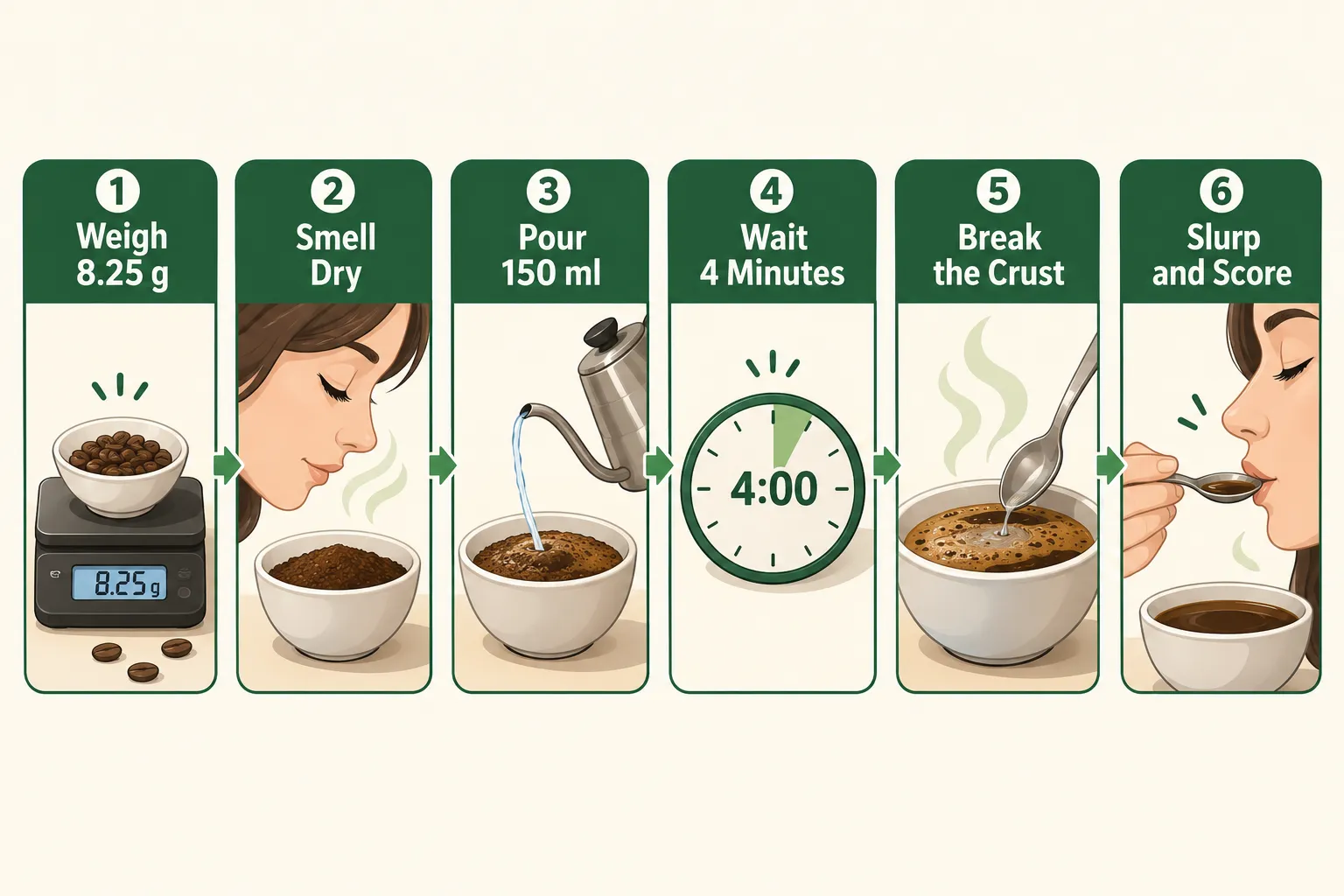
Coffee cupping at home works with a soup spoon, a scale, and six matching bowls. The Specialty Coffee Association's preparation standard uses 8.25 grams of medium-coarse coffee per 150 ml of water just off the boil, a four minute steep, then breaking the crust with a spoon and slurping as the liquid cools . Total cost to start: roughly $40 to $90 if you already own a kettle. A session takes 30 to 45 minutes.
Key Takeaways
- The SCA's preparation ratio is 8.25 g coffee per 150 ml water, which works out to a 1:18.2 brew ratio .
- The SCA formally adopted three new Coffee Value Assessment standards on August 19, 2026: SCA-102 (physical preparation), SCA-103 (descriptive), and SCA-104 (affective). They replace the 2004 cupping protocol and form .
- The CVA descriptive form uses a check-all-that-apply structure and 15-point intensity scales; the affective form uses a 9-point liking scale .
- The SCA reports roughly 800 early adopters took part in testing before the standards were finalized.
- You do not need branded cupping bowls. Six identical 7 to 9 oz ceramic bowls and one soup spoon cover the mechanics.
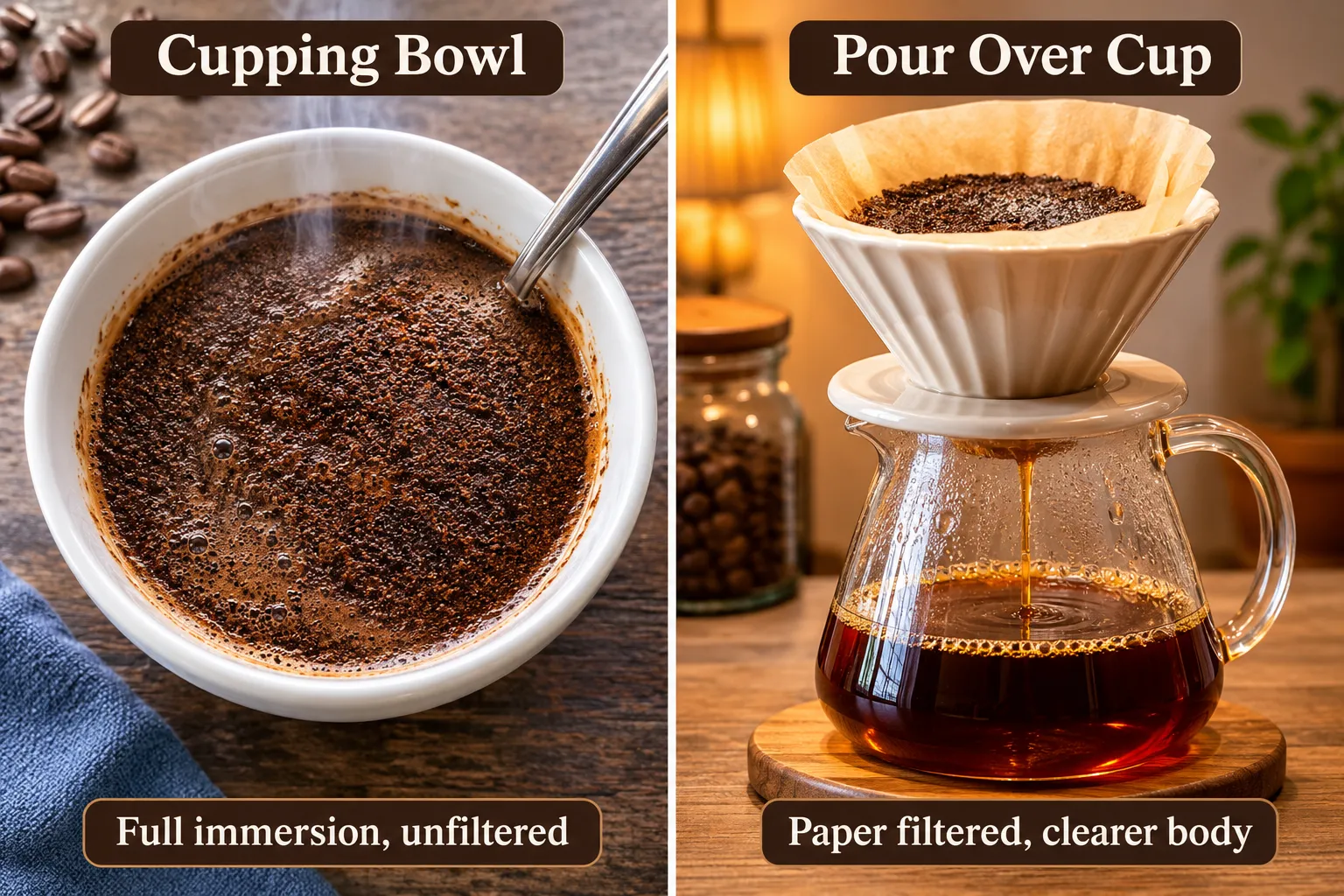
- Cupped coffee tastes different from your pour over because there is no paper filter, so more oils and fine particles stay in the cup.
- Cupping alone works. Three to five people is better, mostly because disagreement teaches you more than agreement.
What exactly is coffee cupping, and why do people do it?
Coffee cupping is a standardized tasting method where coffee is steeped in a bowl rather than brewed through a filter, so every sample gets identical treatment and differences come from the beans, not the technique. Buyers, roasters, and competition judges use it to grade lots and decide what to purchase .
The logic is simple. If you compare an Ethiopian natural brewed in a V60 against a Colombian washed pulled as espresso, you are comparing two brew methods wearing bean costumes. Cupping removes that variable. Same grind size, same water temperature, same brew ratio, same four minutes. Whatever tastes different actually is different.
Home brewers do it for a narrower reason: to find out what they like. After three sessions most people can say something more useful than "this one's good." They can say "I like washed Kenyans and I do not like dark roast blends," and then stop wasting money.
How do I do coffee cupping at home with the SCA method?
Follow this sequence. Times are from the first pour on each bowl, so pour in a consistent order and track it.
Before you start
- Pick 3 to 6 coffees. Check the roast date on each bag. Beans 4 to 20 days off roast behave most predictably.
- Weigh 8.25 g of whole beans per bowl. If your scale only reads whole grams, use 8 g and scale water to 145 ml.
- Heat water to about 200F (93C). Off the boil by 30 seconds is close enough with a standard kettle.
- Rinse all bowls with hot water so cold ceramic does not steal heat.
The session
| Time | Step | What to do |
|---|---|---|
| 0:00 | Grind | Medium-coarse, slightly finer than French press. Grind each sample right before pouring. |
| 0:00 | Dry fragrance | Nose directly over the grounds. Sniff twice, note first impressions. |
| 0:00 | Pour | 150 ml water per bowl, saturating all grounds. Start a timer on bowl one. |
| 0:00-4:00 | Steep | Do not stir. A crust of grounds forms on the surface. |
| 3:00 | Wet aroma | Lean in close over the intact crust, before you touch it. |
| 4:00 | Breaking the crust | Push the crust back three times with the spoon, nose about an inch above. This is the strongest aroma moment of the whole session. |
| 4:30 | Skim | Lift off remaining foam and floating grounds with two spoons. Rinse the spoon between bowls. |
| 8:00-10:00 | First slurp | Around 160F. Slurp sharply off the spoon so the coffee aerates across your palate. |
| 10:00-25:00 | Keep tasting | Revisit each bowl as it cools. Score at roughly 140F, 120F, and near room temperature. |
Most defects and most sweetness show up in the last ten minutes, when the liquid is cool. Beginners quit too early and miss both.
Record as you go. Under the 2026 CVA framework, you first write down what you taste using shared descriptive categories and intensity ratings, then separately record how much you like it . Keeping those apart stops an early "ugh" from flattening your whole description.
Common decision rule: if two coffees score the same on liking but one has far more aroma intensity, buy the aromatic one. It will survive milk, cooling, and a mediocre morning better.
What equipment do I actually need for coffee cupping?
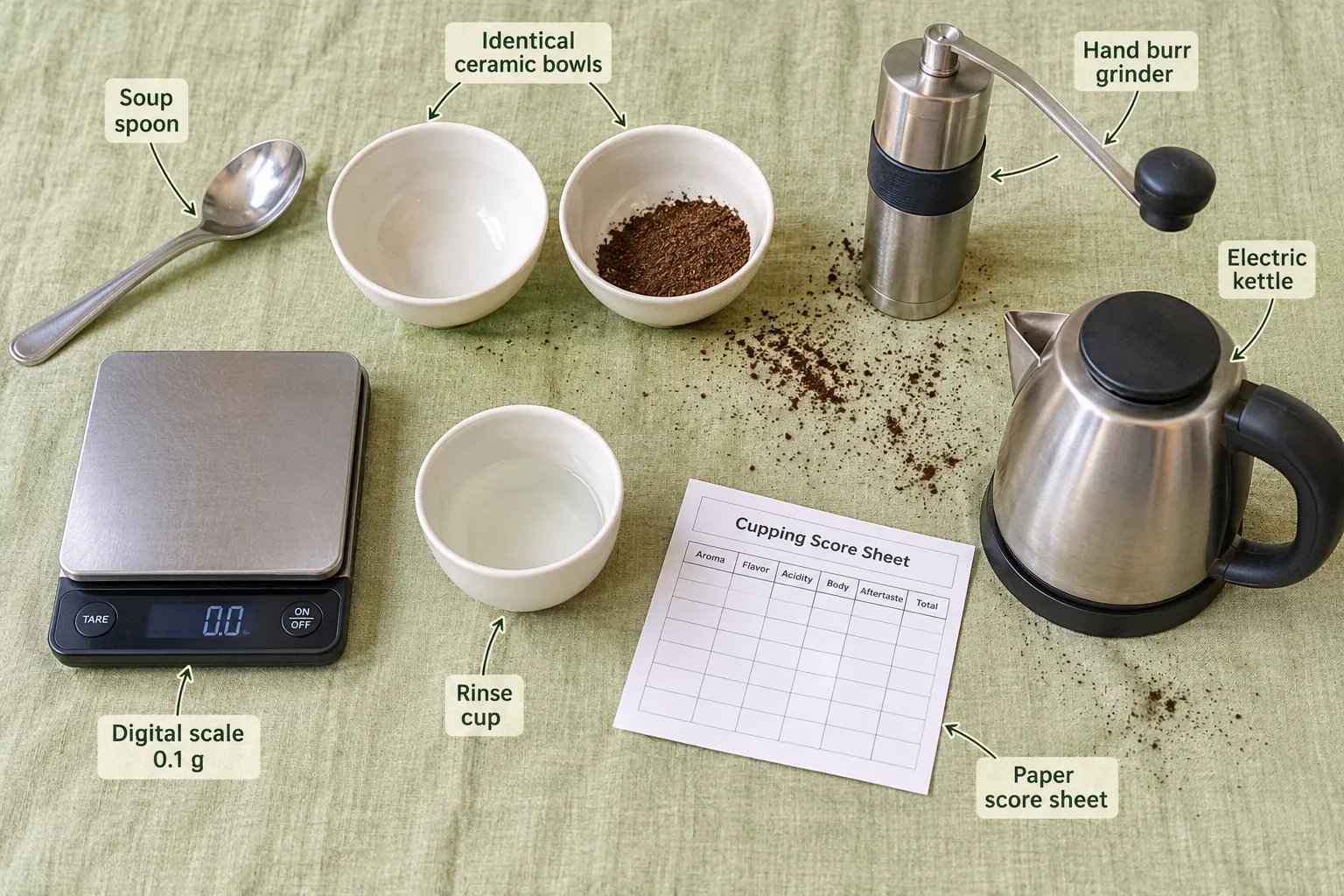
Five things: a scale, a grinder, a kettle, matching bowls, and a spoon. Everything else is optional.
- Digital scale, 0.1 g resolution. Non-negotiable. 8.25 g is a precise number and eyeballing it defeats the exercise. Compare the models on our coffee scale and grinder guide if yours only reads whole grams.
- Burr grinder. A blade grinder produces boulders and dust at the same time, which changes extraction between bowls. Hand burr grinders start around $40 and are genuinely fine here, though grinding six samples is a forearm workout.
- Kettle. Any kettle. Cupping does not need a gooseneck because you are flooding a bowl, not drawing spirals. Save the gooseneck for pour over brewing.
- Bowls. Six to eight identical, 7 to 9 oz, straight-sided, wide-mouthed. Ceramic or tempered glass.
- Cupping spoon. A round soup spoon from your drawer works. Dedicated cupping spoons are thinner-edged and hold more liquid, which makes slurping easier. Around $8 to $25.
- Rinse cup. Hot water, to clean the spoon between bowls. A mug is fine.
- Score sheet. Paper and pen, or a digital CVA tool. In July 2026 the SCA noted that TheBeanGeek and Quantify CVA had added digital CVA forms, which make it easier to compare sessions over time .
Skip: cupping tables, lazy susans, dedicated aroma kits, and the Le Nez du Café flavor kit at $400. None of them fix an untrained palate.
How much does it cost to get started with coffee cupping?
Expect $40 to $90 for a basic setup if you already own a kettle and a scale, or $150 to $250 if you need a grinder too. Beans are the ongoing cost.
Kitchen raid ($0 to $25): soup spoon, six cereal bowls, existing kettle and scale. Buy nothing but a $12 spoon if you want one.
Starter ($90 to $140): hand burr grinder (~$45 to $80), 0.1 g scale (~$25), dedicated cupping spoon (~$15), eight matching bowls (~$20).
Serious ($350+): electric burr grinder with repeatable settings (~$250 to $400), variable-temperature kettle (~$90), eight proper 7 oz cupping bowls (~$60).
The real recurring expense: four 10 oz bags of single origin coffee at $17 to $24 each runs about $80 per session's worth of beans, though you only use 50 g and the rest is your week's drinking. Subscriptions that ship multiple small origins, like the Onyx Coffee Lab subscription, suit cupping better than a single 12 oz bag.
Can I use regular mugs, or do I need special cupping bowls?
Use bowls over mugs. Mugs work in a pinch, but a narrow opening traps aroma and makes breaking the crust awkward with a spoon.
What actually matters:
- Identical volume and shape across all vessels. Different wall thickness means different cooling rates, and cooling rate changes perceived sweetness and acidity.
- Wide mouth, 3 to 3.5 inches. You need room to get your nose and a spoon in at the same time.
- Straight or gently sloped sides. Grounds should settle flat on the bottom.
- 5 to 7 oz capacity minimum for a 150 ml pour with headroom.
Cereal bowls, ramekins, and small soup bowls all qualify. Tulip-shaped specialty mugs do not. If you are buying anyway, our coffee mug guide covers shape and heat retention, which is the same physics.
Edge case: clear glass bowls let you watch the grounds settle, which is genuinely useful for spotting uneven grind. They also lose heat faster than ceramic, so your tasting window shrinks by a couple of minutes.
What grind size and water temperature should I use for cupping?
Medium-coarse, around 70 to 75% of particles passing a US 20 mesh sieve under SCA guidance, with water at roughly 200F (93C) poured directly onto the grounds . In kitchen terms: slightly finer than French press, coarser than drip.
Why those numbers hold up:
- Too fine and the crust sinks early, over-extraction turns everything bitter, and your four minute window produces four different results across six bowls.
- Too coarse and everything tastes thin and sour, and real quality differences disappear under generic weakness.
- Water above 205F scalds delicate aromatics, especially in light roasts. Below 195F and you under-extract sweetness.
Grind each sample immediately before pouring. Ground coffee loses volatile aromatics fast, and if sample one has been sitting in the grinder for eight minutes while you weigh sample six, you have handicapped it.
Water chemistry matters too. The SCA recommends roughly 150 ppm total dissolved solids. Distilled water tastes hollow because minerals carry flavor compounds. Hard tap water mutes acidity. Filtered tap is usually the right answer.
How long does a coffee cupping session take, and does it work alone?
Budget 45 minutes for four coffees, including setup. Active tasting is about 20 minutes. Cupping alone absolutely works, and most people's first dozen sessions should be solo.
Realistic timing:
| Stage | Four coffees | Eight coffees |
|---|---|---|
| Setup and weighing | 8 min | 14 min |
| Grinding and dry fragrance | 5 min | 10 min |
| Steep plus crust break | 6 min | 8 min |
| Tasting across the cooling curve | 20 min | 30 min |
| Cleanup | 6 min | 10 min |
| Total | ~45 min | ~72 min |
Solo gets you honest notes with nobody's opinion leaking into yours. The drawback is calibration drift. Nothing tells you whether your "medium acidity" matches anyone else's.
Group of 3 to 5 is where the learning accelerates. Score silently first, then compare. The disagreements are the lesson. One person tastes blackcurrant, another tastes tomato, and you discover you were both describing the same compound.
More than six people and bowls get crowded, spoons get confused, and the coffee goes cold.
What's the difference between coffee cupping and just tasting coffee?
Cupping controls every variable except the coffee and forces you to record observations in a fixed order. Casual tasting does neither. That is the whole difference, and it is bigger than it sounds.
| Coffee cupping | Everyday tasting | |
|---|---|---|
| Brew method | Full immersion, unfiltered | Whatever you own |
| Ratio | Fixed 8.25 g / 150 ml | Varies |
| Comparison | Side by side, same moment | Sequential, from memory |
| Recording | Score sheet, fixed categories | Mental note, usually lost |
| Temperature | Tasted across a cooling range | One temperature, usually hot |
| Goal | Describe, then evaluate | Enjoy |
Side-by-side is the part people underestimate. Human palates are poor at absolute judgment and good at comparison. You cannot reliably say a coffee has "high acidity" in isolation. Put it next to two others and the ranking becomes obvious in one slurp.
Why does my cupped coffee taste different from when I brew it?
Because there is no paper filter. Cupping leaves oils, lipids, and fine particles in the cup, which adds body and carries flavor compounds a paper filter would trap.
Four causes, in order of effect:
- No paper filter. Paper absorbs coffee oils and diterpenes. Cupping keeps them, so the result feels heavier and often tastes slightly more bitter and more aromatic than the same bean through a V60.
- Weaker concentration. A 1:18.2 brew ratio sits on the lighter side of most pour over recipes, which often land between 1:15 and 1:17. Weaker extraction exposes flaws that a stronger brew masks.
- Immersion, not percolation. Full immersion extracts evenly, so you taste the bean's average character rather than the peaks a pour over can produce.
- You are paying attention. Not trivial. Scoring forces you to notice things you would otherwise drink straight past.
Practical use: if a coffee cups beautifully but disappoints in your chosen brew method, the bean is fine and your recipe needs work. Adjust grind size first, brew ratio second.
How do I actually identify flavor notes when coffee cupping?
Start with broad categories and narrow down. Nobody's palate opens with "white peach and jasmine." It opens with "fruity," then "stone fruit," then eventually "peach."
The CVA descriptive form uses a check-all-that-apply structure built on standardized categories, which exists precisely so tasters stop inventing private vocabulary nobody else can interpret . Use the same discipline at home.
Work down this ladder:
- Family: fruity, floral, sweet, nutty/cocoa, spicy, roasted, green/vegetative, sour/fermented, chemical.
- Branch: fruity splits into berry, dried fruit, citrus, stone fruit, tropical.
- Specific: citrus splits into lemon, lime, grapefruit, orange.
Stop at whatever level you can defend. "Berry" beaten with confidence is more useful than "boysenberry" guessed.
Rate intensity separately from liking. The 2026 affective standard uses a 9-point liking scale while the descriptive standard uses 15-point intensity scales . This separation lets you write "acidity intensity 11, liking 4," which translates to: loudly acidic, and not for me. That sentence is worth more than a single 86 score.
Three habits that speed this up:
- Taste the fruit itself. Buy a lemon, a dried fig, a square of 70% chocolate. Sensory memory needs references.
- Write before you discuss. Group suggestion is contagious.
- Track aftertaste separately. Finish length is often the clearest difference between a $14 bag and a $24 bag.
Our guide to choosing coffee beans covers how processing method shapes which families you should expect.
What common mistakes do people make when cupping coffee?
The three most common: grinding all samples at once, tasting only while the coffee is hot, and scoring before describing.
- Grinding everything upfront. The first sample loses aromatics while you prepare the rest. Grind per bowl.
- Quitting at ten minutes. Sweetness and defects both emerge below 120F. The cool end of the session is where the information lives.
- Judging before describing. Deciding you like a coffee in the first slurp colors every note afterward. The CVA two-stage approach exists to counter exactly this .
- Dirty spoon. Carrying grounds from bowl three into bowl four contaminates the sample. Rinse every time.
- Unlabeled bowls. Mark the base with tape, or use a card under each bowl. Everyone eventually loses track.
- Mismatched roast dates. Comparing a bean roasted three days ago against one roasted five weeks ago measures freshness, not origin. Store samples properly between sessions in a sealed coffee container.
- Too many samples. Palate fatigue hits hard after six. Four is a good home number.
- Strong coffee breath, perfume, or toothpaste. Mint destroys a session. Cup before breakfast or two hours after.
Is coffee cupping worth doing at home, or is it just for professionals?
It is worth doing at home, with one honest caveat: it will not make your daily cup taste better by itself. It will make your buying smarter, which is where the money actually is.
Worth it if you:
- Buy from multiple roasters or run a subscription and want to know which origins you actually prefer.
- Keep buying coffees that sound great on the bag and disappoint in the cup.
- Enjoy the mechanics of extraction and want a controlled way to test variables.
Probably skip it if you:
- Drink one coffee you already love and have no plans to change.
- Take all your coffee with milk and sugar, which flattens most of what cupping reveals.
- Do not own a burr grinder and have no intention of buying one.
The misconception worth correcting: cupping is often described as a way to find "the best" coffee. The SCA itself moved away from that framing. The old protocol's limitation was compressing a complex sensory experience into one quality score, and the CVA framework was built to give a higher-resolution picture across physical, descriptive, affective, and extrinsic perspectives . Cupping is a measurement tool for your own preference, not a verdict machine.
What should I be looking for when I cup coffee?
Six attributes, in this order: fragrance and aroma, flavor, aftertaste, acidity, sweetness, and mouthfeel. Record intensity for each, then record liking separately.
- Fragrance and aroma, dry grounds, then the wet crust, then the moment of breaking the crust. Three separate data points.
- Flavor, what registers mid-slurp, while the coffee is on your tongue.
- Aftertaste, how long it lasts and whether it stays pleasant. Count seconds.
- Acidity, brightness and structure, not sourness. Think lemon versus flat. Note quality and intensity.
- Sweetness, most obvious as the coffee cools below 130F. Underdeveloped or defective coffees go flat here.
- Mouthfeel, thin, silky, syrupy, gritty. Cupping exaggerates body because nothing filters the oils.
- Uniformity and defects, if you prepared multiple bowls of the same coffee, do they match? Taint in one bowl points to a defective bean in the lot.
A practical quick example: an Ethiopian washed might land at acidity intensity 12, sweetness 8, body 5, with jasmine and lemon in the descriptive boxes. A Brazilian natural might land at acidity 5, sweetness 12, body 11, with peanut and cocoa. Neither is better. One suits a pour over, the other suits espresso and milk.
FAQ
Conclusion
Coffee cupping at home does not require a lab, a certification, or a $400 aroma kit. It requires 8.25 grams of coffee, 150 ml of water at 200F, four minutes, a spoon, and the patience to keep tasting after the bowl goes lukewarm. The SCA's 2026 CVA standards formalized something home brewers can borrow directly: describe first, judge second .
Here is what it changes for a home brewer. Once you have cupped four coffees side by side, you stop buying beans based on bag copy and start buying based on what you measured. That is a different relationship with your coffee budget.
Next step: pick three single origins with different processing methods, one washed, one natural, one honey, and cup them this weekend. Use cereal bowls and a soup spoon. Write down what you smell when you break the crust, before you taste anything. Better Coffee Starts With Better Answers, and your own score sheet is the most relevant answer you will ever get.
Cupping Dose Calculator
Based on the SCA preparation ratio of 8.25 g coffee per 150 ml water.
Ratio source: SCA preparation guidance, 8.25 g / 150 ml (1:18.2). Grind medium-coarse, water about 200F.Total: ‘+(per*b).toFixed(1)+’ g coffee and ‘+(v*b)+’ ml water for ‘+b+’ bowl’+(b>1?’s’:”)+’.
Brew ratio 1:18.2. Add about 15% extra water for kettle and rinsing loss.’; });