How to Make Espresso Without a Machine: 4 Methods I Use
Quick answer
You can make espresso-strength coffee without a machine using a moka pot, an AeroPress, a French press, or instant espresso powder, but none of these methods reach the 9 bars of pressure that defines true espresso. A moka pot gets closest, brewing around 1 to 1.5 bars through steam pressure, which is why coffee professionals call the result "espresso-style" rather than espresso. This guide covers how to make espresso without a machine using all four methods, plus the grind, dose, and water temperature that make each one taste right.
Key takeaways
- True espresso needs about 9 bars of pressure. Hand tools max out around 1 to 4 bars, so the result is strong, concentrated coffee, not lab-grade espresso.
- The moka pot is the closest substitute. It uses steam pressure and a metal filter, and the Bialetti Moka Express remains the reference model most guides compare against.
- AeroPress espresso needs a fine grind and a short brew. A 1:2 ratio (18g coffee to 36g water) pressed hard produces a thick, strong shot in under a minute.
- French press concentrate is the weakest substitute. It has no pressure system at all, so it tastes like strong immersion coffee, not espresso.
- Instant espresso powder is not brewed espresso. It is dehydrated coffee dissolved in hot water, useful for baking and quick drinks but not a real substitute in a cup meant to be sipped.
- Grind size matters more than the tool. Espresso-style brewing needs a grind close to fine table salt, finer than drip, finer than French press.
- Bitterness usually means over-extraction. Grind too fine for the method, water too hot, or brew time too long are the three usual causes.
- Total time is short. Every method here finishes in 1 to 5 minutes, faster than most drip coffee.
How to Make Espresso Without a Machine
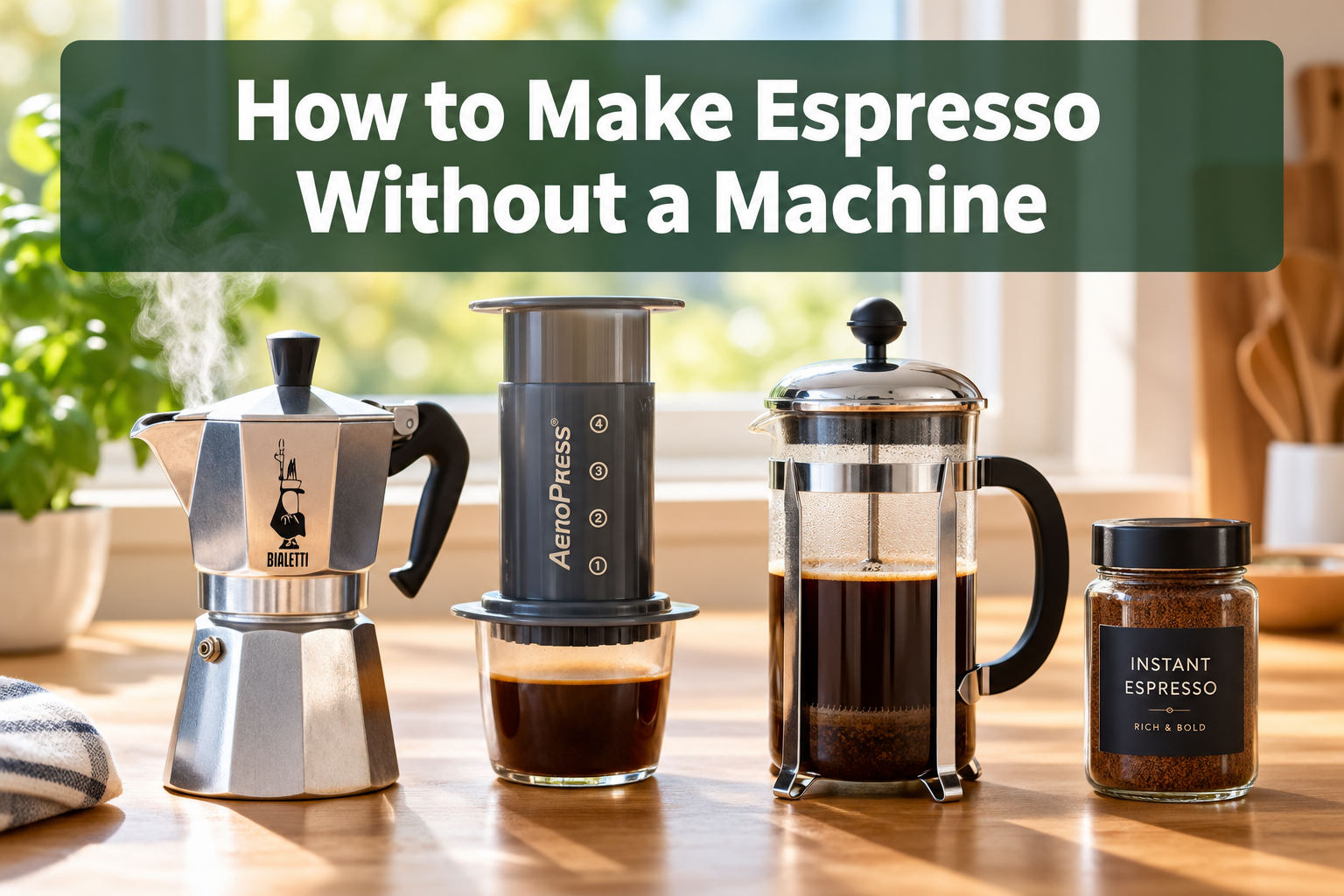
You make espresso without a machine by forcing hot water through finely ground coffee using pressure from steam, a hand pump, or manual force, then judging the result by strength rather than by the crema an electric pump produces. The four tools that do this at home are a moka pot, an AeroPress, a French press, and instant espresso powder mixed with hot water. Each gets you a different distance toward the real thing.
I keep all four in rotation depending on the morning. The moka pot lives on my stove for a proper stovetop shot. The AeroPress travels with me because it packs flat. The French press comes out when I want a bigger cup and don't care about pressure at all. Instant espresso powder sits in the cabinet for the mornings when I'm making a tiramisu, not a drink.
None of these four methods produce a shot with the same crema or mouthfeel as a 9-bar espresso machine, and any article that promises otherwise is stretching the truth. What they produce is genuinely strong, concentrated coffee close enough to espresso for a cappuccino, a latte, or a straight shot when you don't own a machine. If you want to understand where real espresso ends and these substitutes begin, our guide on whether you can make espresso with regular coffee without a machine breaks down the extraction gap in more detail.
What Is Espresso and Why Does It Need Pressure
Espresso is coffee brewed by forcing hot water through very finely ground, tightly packed coffee at roughly 9 bars of pressure, extracting oils, sugars, and CO2 into a small, concentrated shot with a layer of crema on top. The pressure is not decoration. It is the mechanism that pulls flavor and body out of the grounds in 25 to 30 seconds instead of the several minutes drip coffee takes.
Can you make espresso with just hot water and coffee grounds, no tool at all? No. Without pressure, hot water poured over grounds just makes weak, muddy coffee, because gravity alone cannot force water through a bed of fine grounds fast enough to extract espresso-style flavor. You need some kind of mechanical push.
What pressure do you need to extract espresso properly? A commercial or home espresso machine runs at 9 bars. A moka pot tops out around 1 to 1.5 bars from steam buildup. An AeroPress generates maybe 1 to 2 bars from arm pressure. None of the four methods in this guide come close to 9 bars, which is the honest reason none of them are technically espresso, even when the cup tastes strong and dark.
Is Espresso Without a Machine Actually Espresso?
No, and any honest guide to how to make espresso without a machine should say so upfront. What you get from a moka pot, AeroPress, French press, or instant powder is espresso-style coffee: concentrated, strong, and dark, but missing the true crema and micro-foam texture that only 9-bar extraction produces.
What's the difference between strong coffee and espresso, then? Strength alone doesn't make espresso. Espresso is defined by the brewing method (high pressure, short time, fine grind) as much as by taste. A French press can be brewed strong enough to taste bold, but it's still an immersion brew with a coarser grind and a longer contact time, so it lacks the syrupy body and crema of real espresso.
Set your expectations here and the rest gets easier. If you want an espresso substitute for a latte or an americano, these methods work well. If you want the exact texture a barista pulls from a portafilter, you need an actual machine. Our advanced espresso machine buying guide covers what that step up actually costs and delivers.
Method 1: How to Use a Moka Pot to Make Espresso on the Stove
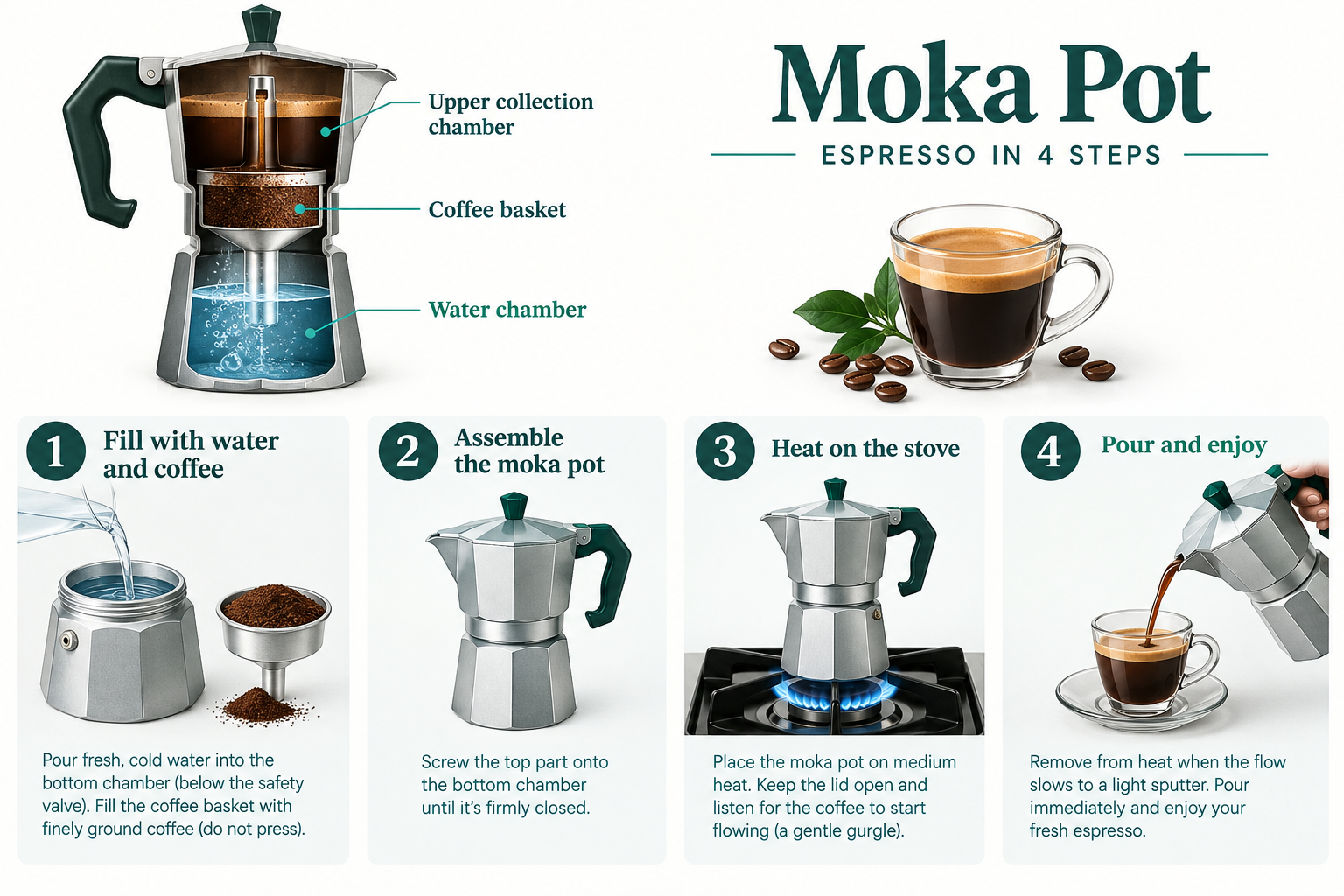
A moka pot makes the closest thing to stovetop espresso by boiling water in a bottom chamber, forcing steam pressure up through a coffee basket, and collecting the brewed coffee in a top chamber. It's the method most coffee writers recommend first when covering how to make espresso on the stove.
Here's the method I use with a Bialetti Moka Express, widely considered the best stovetop espresso maker and the model most other moka pots copy:
- Fill the bottom chamber with hot water up to the safety valve, not higher.
- Fill the metal filter basket with medium-fine ground coffee, level but not tamped hard.
- Screw the top chamber on tight and set the pot on medium-low heat.
- Listen for a hissing, gurgling sound as coffee starts pushing into the top chamber.
- Pull it off the heat the moment the flow turns pale and sputters, usually 4 to 5 minutes total.
Starting with hot rather than cold water shortens the time the grounds sit over direct heat, which cuts down on the bitter, scorched flavor moka pots are known for. Pulling the pot early, before the last thin, hissing pour, also keeps bitterness down since that final stage pulls mostly harsh compounds. If you want more detail on getting this right every time, our guide to using a stovetop espresso maker for beginners walks through grind adjustments and heat control.
Method 2: AeroPress Espresso
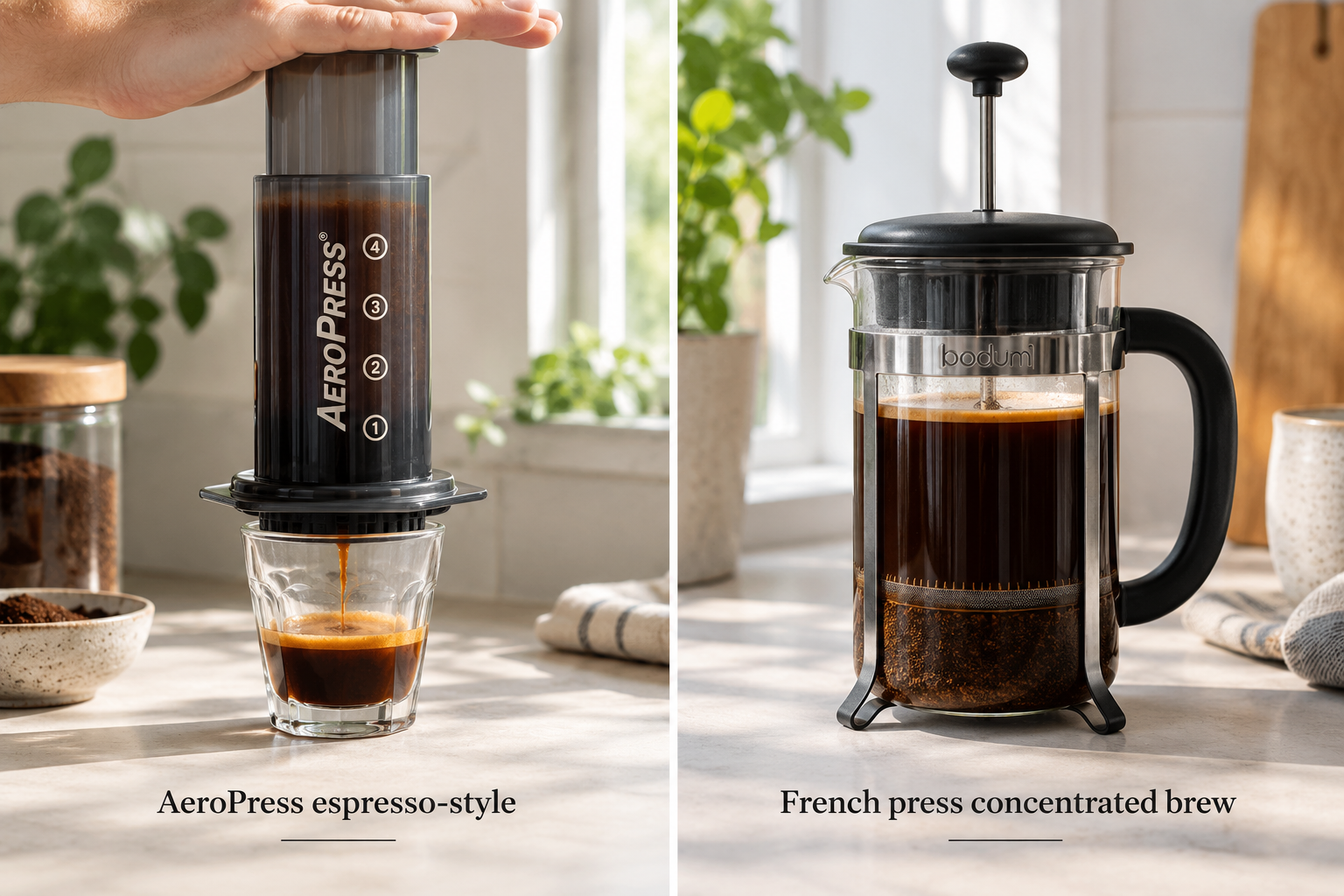
AeroPress espresso is made by brewing a small, strong dose of coffee with hot water in the AeroPress chamber, then forcing it through a paper filter with hand pressure in under a minute. It's the fastest of the four methods and the easiest to control for consistency.
The ratio I use for AeroPress espresso: 18 grams of finely ground coffee to 36 grams of water heated to about 195 to 200°F, following the general water temperature range most espresso-style brewing guides recommend. Steep for 20 to 30 seconds, stir once, then press slowly and firmly for 20 to 25 seconds. The result is a small, syrupy cup that holds up well under steamed milk.
The AeroPress owes a lot of its espresso-style reputation to how tight its seal is against the plunger, which builds more resistance than a French press ever can. That resistance is the closest a hand tool gets to real pump pressure, even though it's still far below 9 bars.
Method 3: French Press Concentrated Brew
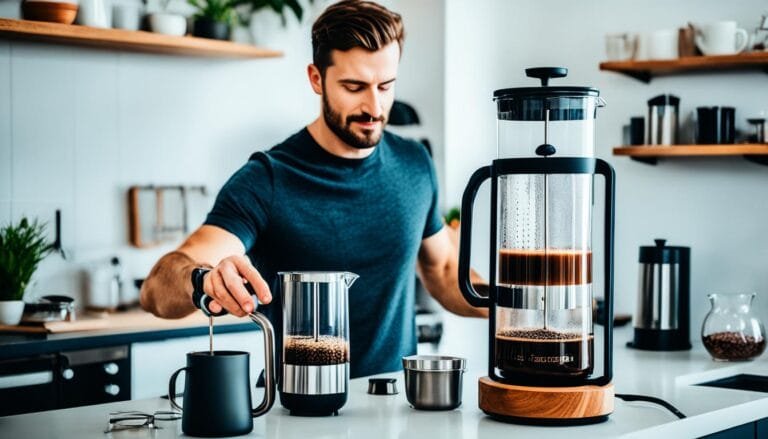
You can make espresso-style coffee with a French press by using a much higher coffee-to-water ratio than normal and steeping it briefly, but this is the weakest substitute of the four because a French press applies no pressure at all. Can you make espresso with a French press in any real sense? Not by the technical definition, but you can get a strong, full-bodied concentrate close enough for milk drinks.
Use about 1 part coffee to 4 parts water (far stronger than the usual 1:15 French press ratio), coarse-fine grind, and steep for 4 minutes before plunging slowly. A Bodum press, one of the most common French press brands in US kitchens, handles this ratio fine since the mesh filter doesn't clog the way it can with an over-fine grind.
AeroPress vs French press for espresso comes down to pressure and grind tolerance. The AeroPress accepts a fine, near-espresso grind and adds real hand pressure. The French press needs a coarser grind to avoid sediment and adds zero pressure, so its "espresso" is really just very strong immersion coffee. If you're choosing between the two for a milk-based drink, the AeroPress wins on texture almost every time.
Method 4: Instant Espresso Powder and Strong Drip
Instant espresso powder makes an espresso-flavored drink by dissolving dehydrated, concentrated coffee directly into hot water, but it does not count as real espresso since nothing is extracted through pressure or fresh grounds. It's the fastest way to get an espresso-style shot and the least like the real thing.
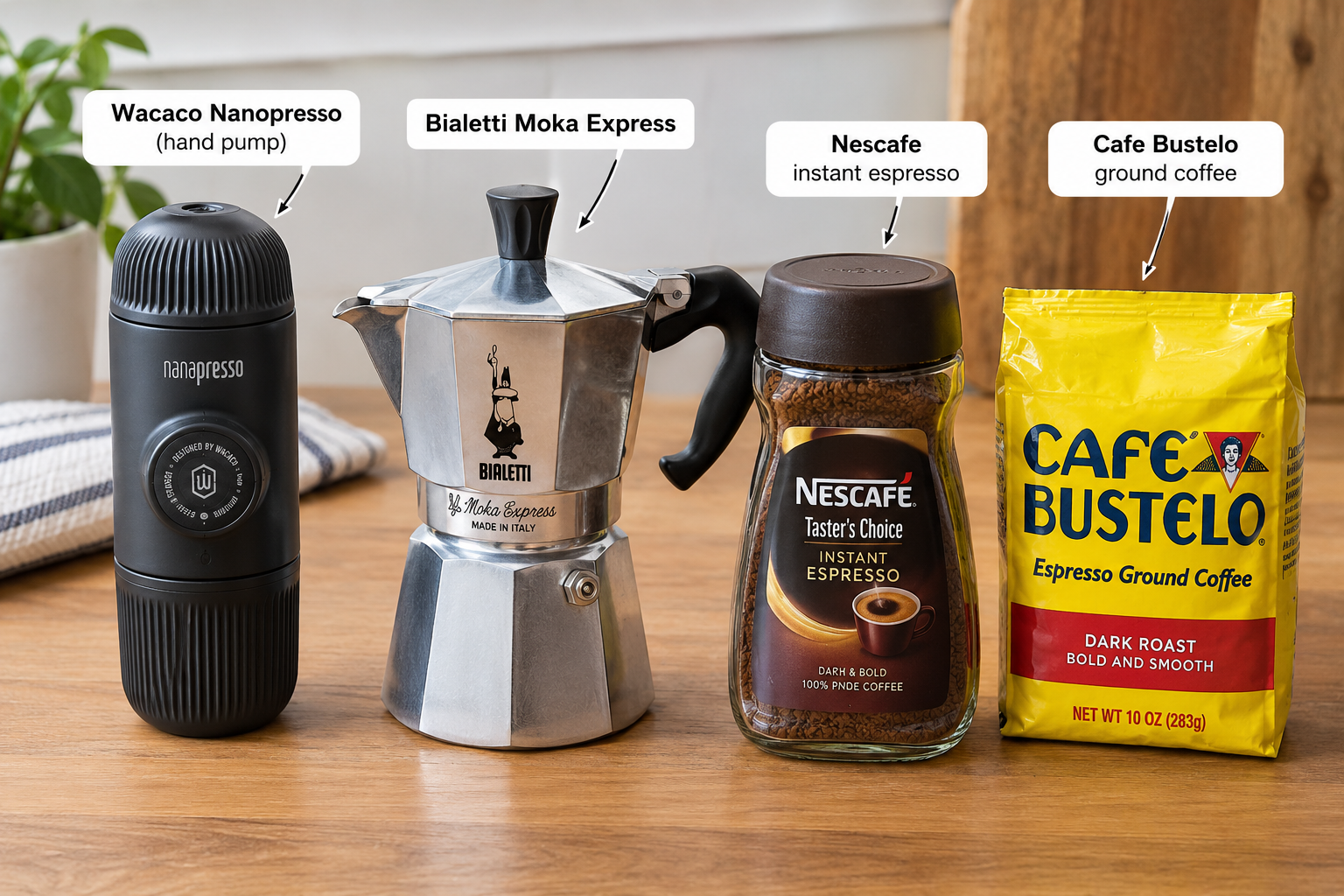
How to make espresso with instant coffee: dissolve 1 to 2 teaspoons of instant espresso powder in 1 to 2 ounces of hot water (about 195°F), stirred until fully dissolved. Nescafe makes a dedicated espresso-style instant product, and it works fine in a pinch for a mocha, an affogato, or a baking recipe that calls for espresso powder. Cafe Bustelo, more commonly sold as a finely ground stovetop coffee, is a different product; it's excellent brewed in a moka pot but isn't an instant powder.
Does instant espresso powder count as real espresso? No. It's dehydrated brewed coffee, concentrated and reconstituted. It skips grind size, extraction time, and pressure entirely, so the flavor reads as flat and one-note next to a moka pot or AeroPress shot, even though it's genuinely useful for convenience or recipes.
A milk frother run on hot, strong drip coffee is a similar shortcut. It won't extract anything new, but it will foam milk to sit on top of a strong cup and fake the visual, if not the taste, of a café drink.
Best Manual Espresso Makers That Don't Need Electricity
The best manual espresso makers that skip electricity entirely are the Bialetti Moka Express, the AeroPress, and the Wacaco Nanopresso, each suited to a different budget and use case. All three show up repeatedly across current buying guides as the standard picks for stovetop and portable brewing.
- Bialetti Moka Express: stovetop only, needs a heat source, produces the strongest and most "espresso-like" cup of the three, easy to find replacement parts for.
- AeroPress: no heat source built in (you still need hot water), fastest cleanup, most portable, most forgiving of grind size.
- Wacaco Nanopresso: a genuine hand-pump espresso maker that reaches closer to real espresso pressure than any other tool on this list, built for travel and camping rather than daily kitchen use.
Cheapest way to make espresso at home without equipment: strong French press coffee or instant espresso powder. Both need almost nothing you don't already own, a kettle and a jar of powder or a press you likely already have. A moka pot and AeroPress cost more upfront but deliver a noticeably closer result to actual espresso, so the "cheapest" option and the "best-tasting" option are not the same choice. For a broader look at portable options built for camping and travel, see our roundup of portable espresso machines for camping trips.
Grind Size and Dose for Espresso Without a Machine
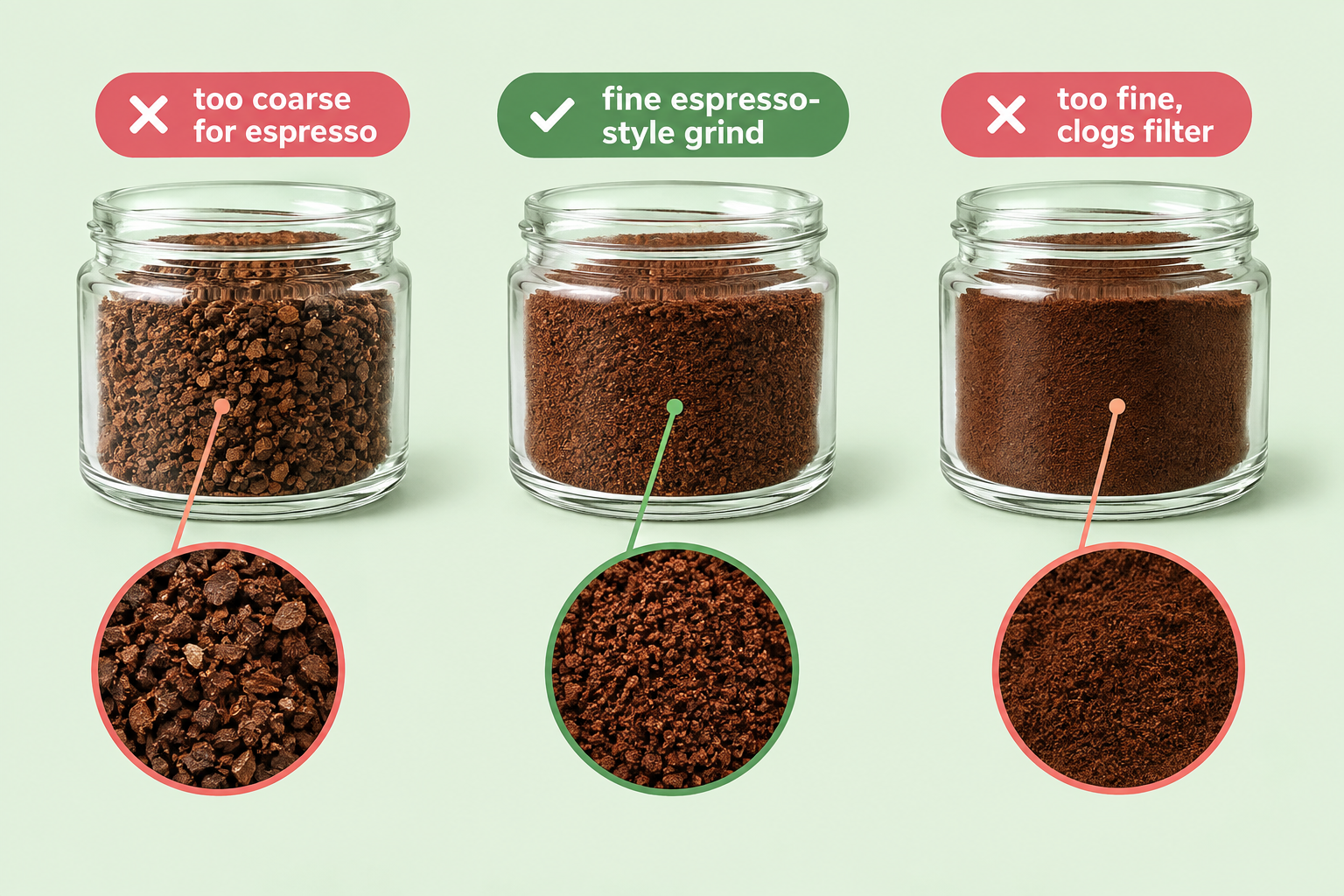
How much finer do you need to grind coffee for espresso without a machine? Aim for a grind close to fine table salt, noticeably finer than drip coffee and finer than a standard French press grind, but slightly coarser than the powder-fine grind used in true espresso machines.
- Moka pot: medium-fine, similar to fine sea salt.
- AeroPress: fine, close to table salt, similar to what many home espresso machines use.
- French press concentrate: medium-coarse, coarser than the other two despite the strong ratio, to avoid sediment and over-extraction.
- Instant espresso powder: not applicable, since nothing is ground.
Doses that work in practice: 18 to 20 grams for a moka pot single basket, 18 grams for AeroPress at a 1:2 ratio, and roughly 1 part coffee to 4 parts water for a French press concentrate. A cheap burr grinder makes a real difference here, since blade grinders produce uneven particles that extract unevenly no matter how careful you are with time and temperature. Our grind guide for espresso machines covers particle size in more depth if you want to dial in a specific grinder.
Can You Make Espresso in a Coffee Maker?
No, a standard drip coffee maker cannot make espresso, because it brews at atmospheric pressure with a longer contact time and a coarser grind, producing filtered coffee rather than a concentrated extraction. Some drip machines advertise an "espresso" or "bold" setting, but that setting just changes the brew ratio, not the pressure.
If you want espresso-strength coffee from a drip machine, brew it at a much higher coffee-to-water ratio (closer to 1:8 instead of the usual 1:16) and treat the result as strong drip coffee, not espresso. It'll work in a latte in a pinch, but the texture and crema still won't be there. For the actual mechanics of what a real machine adds, our piece on what coffee you can make with an espresso machine is a useful next read.
How Long It Takes and Why It Tastes Bitter
How long does it take to make espresso without a machine? Each of the four methods finishes in 1 to 5 minutes: AeroPress in under a minute, moka pot in 4 to 5 minutes on the stove, French press in about 4 minutes of steep time, and instant powder in seconds.
Why does my homemade espresso taste bitter? Three usual causes, in order of likelihood:
- Grind too fine for the method. A moka pot grind that's too fine chokes the basket, forcing water through too slowly and pulling harsh, over-extracted flavor.
- Heat too high. A moka pot brewed on high heat scorches the grounds against the metal basket before the water finishes flowing through.
- Left on the heat too long. Letting a moka pot hiss and sputter past the point of pale, thin flow pulls mostly bitter compounds with little sweetness left to balance them.
The fix for all three is usually the same: pull back on heat, coarsen the grind slightly, and stop the brew earlier than instinct says to.
Comparing the 4 Methods
| Method | Time | Grind | Closest to real espresso? |
|---|---|---|---|
| Moka pot | 4 to 5 min | Medium-fine | Yes, closest overall |
| AeroPress | Under 1 min | Fine | Close, best texture |
| French press concentrate | 4 min | Medium-coarse | No, no pressure at all |
| Instant espresso powder | Seconds | Not applicable | No, not brewed |
FAQ
Is it possible to make real espresso without a machine?
No. Real espresso requires roughly 9 bars of pressure, which only an espresso machine or a hand-pump tool like the Wacaco Nanopresso gets close to. Everything else produces espresso-style coffee, not true espresso.
What's the closest substitute for espresso without a machine?
A moka pot, using a model like the Bialetti Moka Express, gets closest because it uses steam pressure and a metal filter basket, similar in concept to a scaled-down espresso machine.
Can I use regular ground coffee for these methods?
Yes, but grind size still matters. A moka pot and AeroPress need a finer grind than standard drip coffee for the best extraction. Coarse pre-ground coffee will taste thin and weak in either method.
Does instant espresso powder work in a latte?
It works for flavor and convenience, dissolving into hot milk without any brewing step, but the texture will be flatter than a shot pulled from a moka pot or AeroPress.
Why does my moka pot coffee taste burnt?
High heat and letting the pot run past the point of pale, thin flow are the two most common causes. Lower the heat and pull it off the stove earlier.
Can a French press really substitute for espresso in a cappuccino?
It can work in a pinch if brewed at a strong 1:4 ratio, but expect a thinner, less syrupy result than a moka pot or AeroPress shot under steamed milk.
Conclusion
If you're deciding how to make espresso without a machine, start with what you already own. A moka pot on the stove gets the closest to real espresso flavor and texture. An AeroPress is faster and nearly as strong, with the easiest cleanup of the four. A French press works as a backup when you want volume over precision. Instant espresso powder earns its place in the pantry for recipes and quick fixes, not as a daily substitute.
Pick one method, dial in the grind and ratio above, and give it two or three tries before judging it. The first cup rarely matches the recipe; the third usually does. Better coffee starts with better answers, and in this case, the answer is picking the tool that matches your morning, not chasing a crema these tools were never built to make.
Keep Exploring Coffee Rank IQ
- Coffee Rank IQ home: reviews, brewing guides, and coffee science
- How to Make an Iced Latte at Home Without Watery Regret
- Best Espresso Machine for Beginners: 7 Picks That Forgive Mistakes
- Best Super Automatic Espresso Machine: Read the Cleaning Specs First
- Best Semi Automatic Espresso Machine for Real Home Kitchens
References
- www.goodhousekeeping.com/food-recipes/cooking/a35952377/how-to-make-espresso
- www.homesandgardens.com/kitchens/how-to-make-espresso
- brewingcoffees.com/how-to-make-espresso-without-a-machine
- www.roastycoffee.com/how-to-make-espresso
- www.coffeeness.de/en/moka-pot
- www.businessinsider.com/guides/kitchen/best-stovetop-espresso-maker
- www.cnn.com/cnn-underscored/reviews/best-moka-pots
- www.wikihow.com/Make-Espresso-Without-a-Machine
- www.feastographyblog.com/blog/making-espresso-without-machine
- coffeevoila.com/how-to-make-espresso-without-a-machine