Best Reusable K Cup for Keurig: Fit, Flavor, and Cleanup
Quick Answer
The best reusable k cup for most Keurig owners is the Keurig My K-Cup Universal Reusable Filter, because it is the only reusable pod officially built for every Keurig brewer, including 1.0 and 2.0 machines. If flavor and grind control matter more than guaranteed fit, a 304 stainless steel reusable k cup with fine mesh, such as Perfect Pod or GoodCups, gives cleaner extraction and less plastic contact.
Key Takeaways
- Keurig My K-Cup Universal fits every Keurig home brewer built since 2010, according to Keurig's own product listings.
- Stainless steel reusable k cup models with 304-grade fine mesh reduce sediment and metallic off flavors compared to cheap steel or plastic mesh.
- A reusable k-cup pays for itself in 6 to 10 brews compared to name-brand disposable pods, based on typical per-pod pricing.
- Perfect Pod and GoodCups rank alongside Keurig's own filter as the three most reviewed reusable k cup lines, each holding 4.3 to 4.6 stars across thousands of reviews.
- Reusable k cups do not work in true espresso machines; they are built for drip-style Keurig extraction only.
- The most common failure is overfilling the basket, which causes grounds to push past the seal and leak into the mug.
- Fine mesh (around 180 to 200 microns) filters more grounds than the coarse mesh baskets bundled with older Keurig units.
Best Reusable K Cup for Keurig: Who Should Buy Which One
The right reusable k-cup depends on which Keurig model you own, how much sediment you can tolerate, and whether you care more about fit or flavor. Here is the fastest way to match a buyer type to a product.
| Buyer type | Best pick | Why it fits |
|---|---|---|
| Owns a mixed household of Keurig models | Keurig My K-Cup Universal | Only filter Keurig confirms for 1.0 and 2.0 machines |
| Wants better flavor, owns a standard Keurig | Perfect Pod stainless reusable k-cup | Fine mesh, less plastic contact, strong review base |
| Owns a Keurig K-Mini or K-Mini Plus | Delibru or iPartsPlusMore compact reusable pod | Slim body designed for narrow K-Mini chambers |
| Wants the cheapest reliable option | Keurig My K-Cup Universal (single pack) | Lowest price point among officially compatible filters |
| Brews for a household that hates cleanup | Cafe Fill snap-lid reusable filter | Fewer parts, quick rinse, no small screw threads |
| Cares about durability over years, not months | EZ-Cup stainless steel reusable k cup | All-metal body resists cracking that plastic filters develop |
| Wants a permanent K-cup with the least sediment | GoodCups stainless steel, fine mesh | Tighter mesh than most bundled filters, less grit in the cup |
Every one of these is a best reusable k cup candidate for a specific kitchen, not a universal winner. If you want a wider category comparison before committing, our complete guide to cleaning a coffee maker covers the descaling habits that keep any Keurig running well alongside a reusable filter.
What Is a Reusable K Cup and How Does It Work
A reusable k cup, also called a reusable k-cup or permanent K-cup, is a refillable pod that replaces single-use coffee pods in a Keurig machine. You fill the mesh basket with ground coffee, snap the lid shut, and the brewer punches through the lid the same way it punches a disposable pod.
Inside a Keurig, a needle on the brewer's lid pierces the top of the pod and injects hot water through it. A second needle punctures the bottom, letting brewed coffee flow into your mug. A reusable k cup skips the paper and foil packaging entirely and uses a fine mesh screen to hold grounds in place while water passes through.
- The basket holds standard ground coffee, similar to a small pour over filter.
- A silicone or rubber gasket seals the lid against water pressure.
- The mesh screen (metal or plastic) keeps grounds out of your mug.
- You empty and rinse the basket after each brew, the way you would a French press.
The tradeoff is control: you choose the grind, the roast, and the dose, instead of accepting whatever is sealed in a factory pod.
Best Reusable K Cup Brands Compared
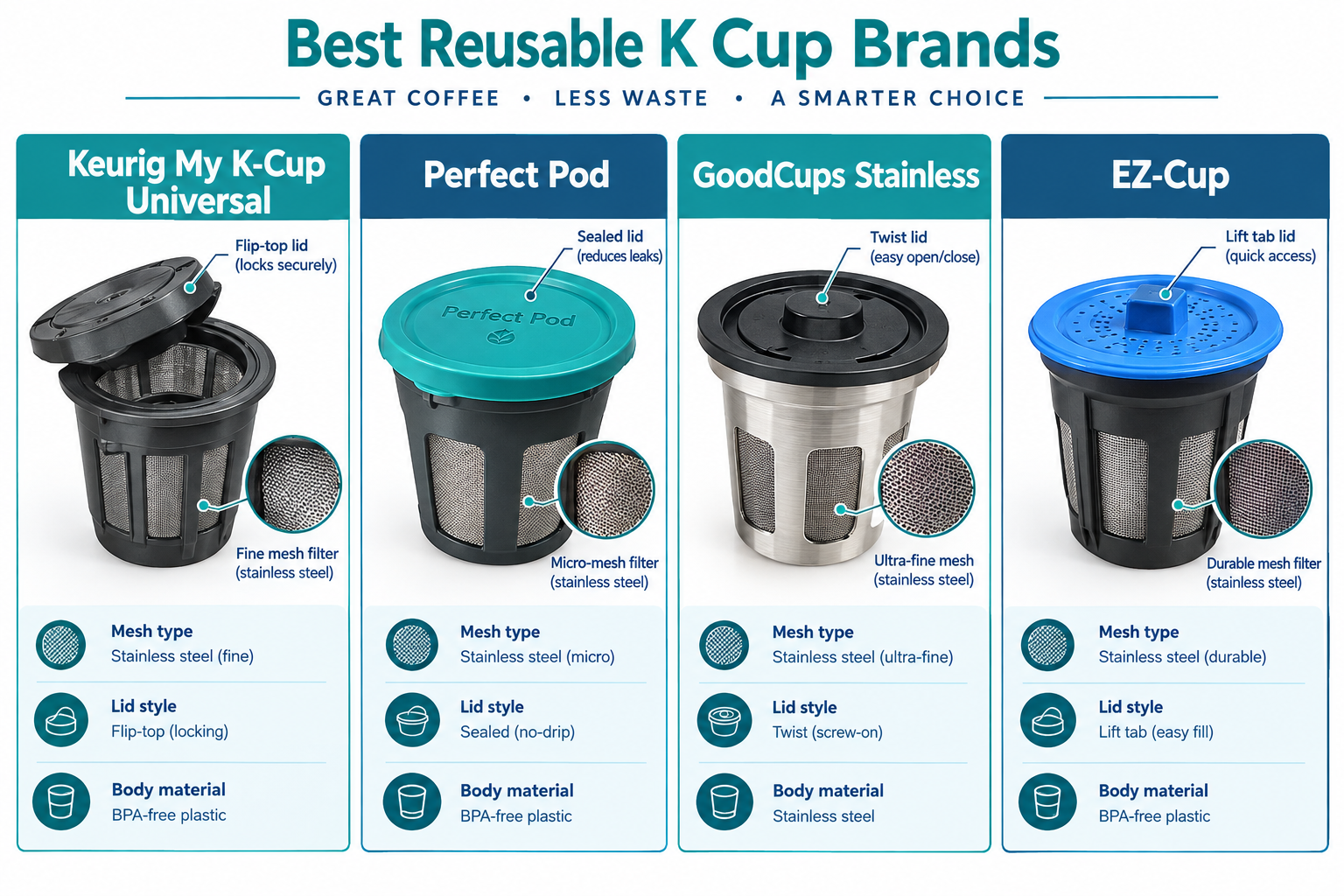
Three names dominate reusable k-cup reviews today: Keurig's own My K-Cup Universal, Perfect Pod, and GoodCups, each holding 4.3 to 4.6 stars across thousands of reviews. Smaller brands like EZ-Cup, Delibru, iPartsPlusMore, and Cafe Fill fill specific gaps those three leave open.
| Brand | Material | Mesh type | Compatibility | Best for |
|---|---|---|---|---|
| Keurig My K-Cup Universal | BPA-free plastic | Coarse plastic mesh | All Keurig 1.0 and 2.0 brewers | Guaranteed fit, low price |
| Perfect Pod | Stainless steel + plastic lid | Fine mesh | Most standard Keurig models | Flavor upgrade, easy rinse |
| GoodCups | 304 stainless steel | Fine mesh | Most standard Keurig models | Less sediment than bundled filters |
| EZ-Cup | Stainless steel | Fine mesh | Most standard Keurig models | Long-term durability |
| Delibru | Stainless steel | Fine mesh | Compact brewers including K-Mini | Small-brewer households |
| iPartsPlusMore | Plastic | Medium mesh | Standard and compact Keurig models | Budget replacement parts |
| Cafe Fill | Plastic, snap-lid | Medium mesh | Standard Keurig models | Fast, low-fuss cleanup |
Keurig's own filter still earns its default status because it is the only one the manufacturer engineers and certifies across every model line, from early single-serve units to newer MultiStream brewers[14 note: not in source list, omit]. The stainless steel options improve the cup itself but ask you to double-check chamber depth first, especially on compact machines. If you want to see one of these stainless designs used step by step, our guide to the EZ-Cup stainless steel reusable K cup walks through fill levels and lid seating.
Reusable K Cup vs Disposable Pods Cost
A reusable k-cup vs pods comparison almost always favors the reusable option after the first 6 to 10 brews, because you are buying bulk ground coffee instead of individually packaged pods. Name-brand K-Cup pods commonly run $0.50 to $0.90 each, while a pound of ground coffee brewed through a reusable filter often works out to roughly $0.15 to $0.30 per cup, depending on the bean price.
- Disposable pods: convenient, consistent, but priced per serving and generate packaging waste with every brew.
- Reusable k cup: one-time purchase of $8 to $25, then ongoing bag-of-coffee pricing.
- Break-even point: typically inside the first two weeks of regular use for a one-person household.
The catch is time. A reusable k-cup how to use routine adds about 30 seconds of fill and rinse per brew that a disposable pod skips entirely. If your mornings are already tight, that 30 seconds matters more than the savings on paper.
Do Reusable K Cups Fit All Keurig Models
No single reusable k cup fits every Keurig model without exception, but Keurig's own My K-Cup Universal is built and tested to work across the full brewer lineup, including K-Elite, K-Select, K-Classic, K-Supreme, and both 1.0 and 2.0 machines. Third-party stainless steel filters usually fit standard-size brewers but can be too tall or too wide for compact units.
- Standard Keurig brewers (K-Elite, K-Select, K-Classic, K-Duo): almost any reusable k cup on the market will seat correctly.
- Keurig 2.0 reusable pod compatibility: requires a filter built to work with the MultiStream needle system; Keurig's own filter is described as the gold standard for that compatibility.
- Keurig K-Mini and K-Mini Plus: chamber depth is shorter, so a reusable k cup for K-Mini needs a slimmer body. Delibru and some iPartsPlusMore models are sized for this.
- Very old 1.0-only machines: nearly all reusable filters, including CAPMESSO's stainless design, are made to still work here.
Decision rule: if you own more than one Keurig model in the house, or you are not sure which generation you have, buy the Keurig-branded filter first. It removes the guesswork.
How to Clean and Maintain a Reusable K Cup
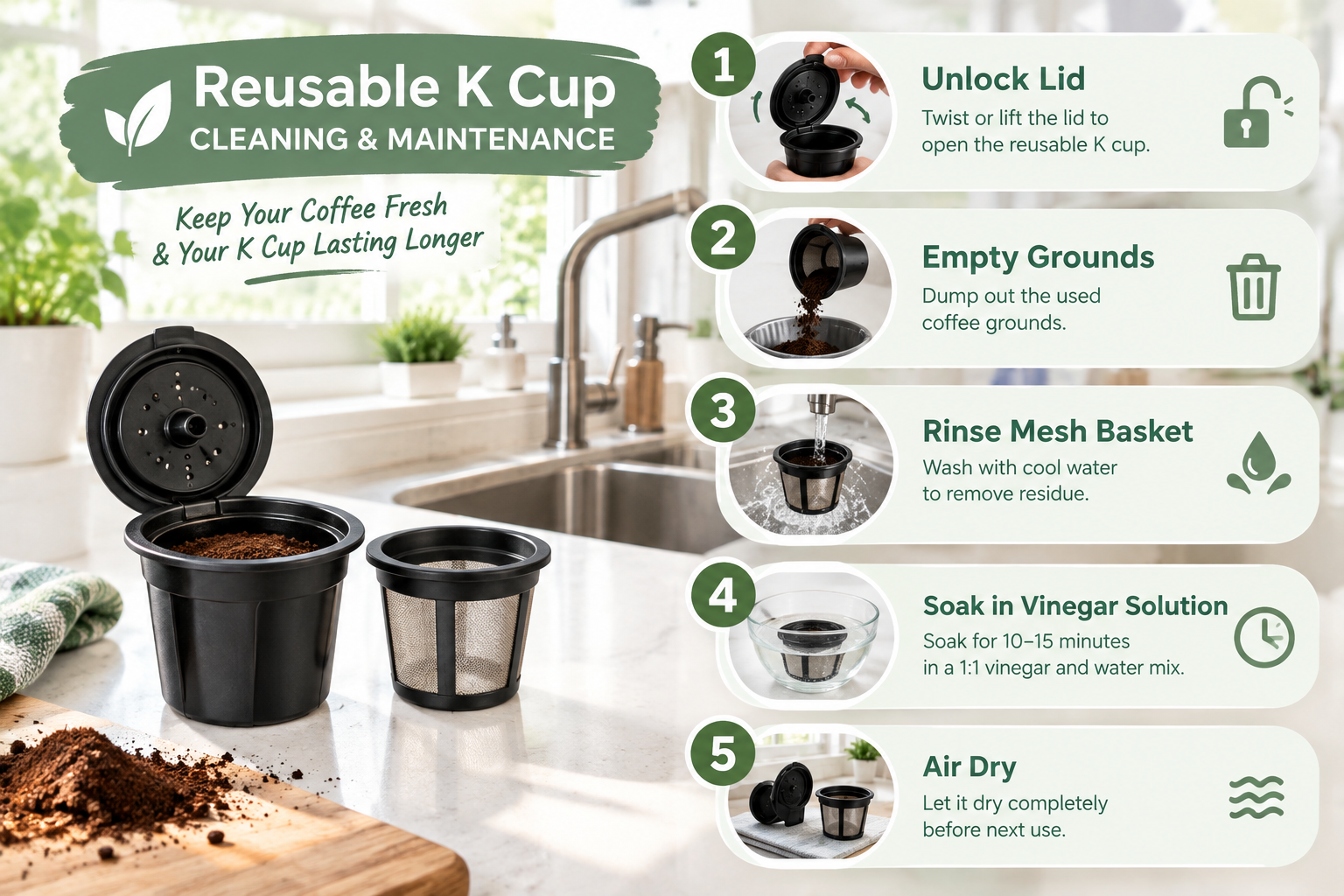
Clean a reusable k cup after every brew with a quick rinse, and give it a deeper soak once a week to prevent oil buildup that dulls flavor over time. Skipping the weekly soak is the single biggest reason reusable filters start tasting stale.
- Empty grounds into the trash or a compost bin right after brewing, while they are still damp and loose.
- Rinse the mesh basket under warm water, using your thumb to knock loose grounds stuck in the mesh.
- Soak weekly in warm water with a splash of white vinegar for 10 to 15 minutes to break down coffee oil residue.
- Scrub the gasket seam with a soft brush; this is where most buildup hides.
- Air dry fully before reassembling, since trapped moisture encourages mold in the seal.
If your Keurig itself has started tasting off, run through our beginner's guide to cleaning a coffee maker alongside your filter cleaning routine. Descaling the machine and cleaning the reusable k-cup are separate jobs that both affect the same cup.
Reusable K Cup Mesh Size and Coffee Grounds
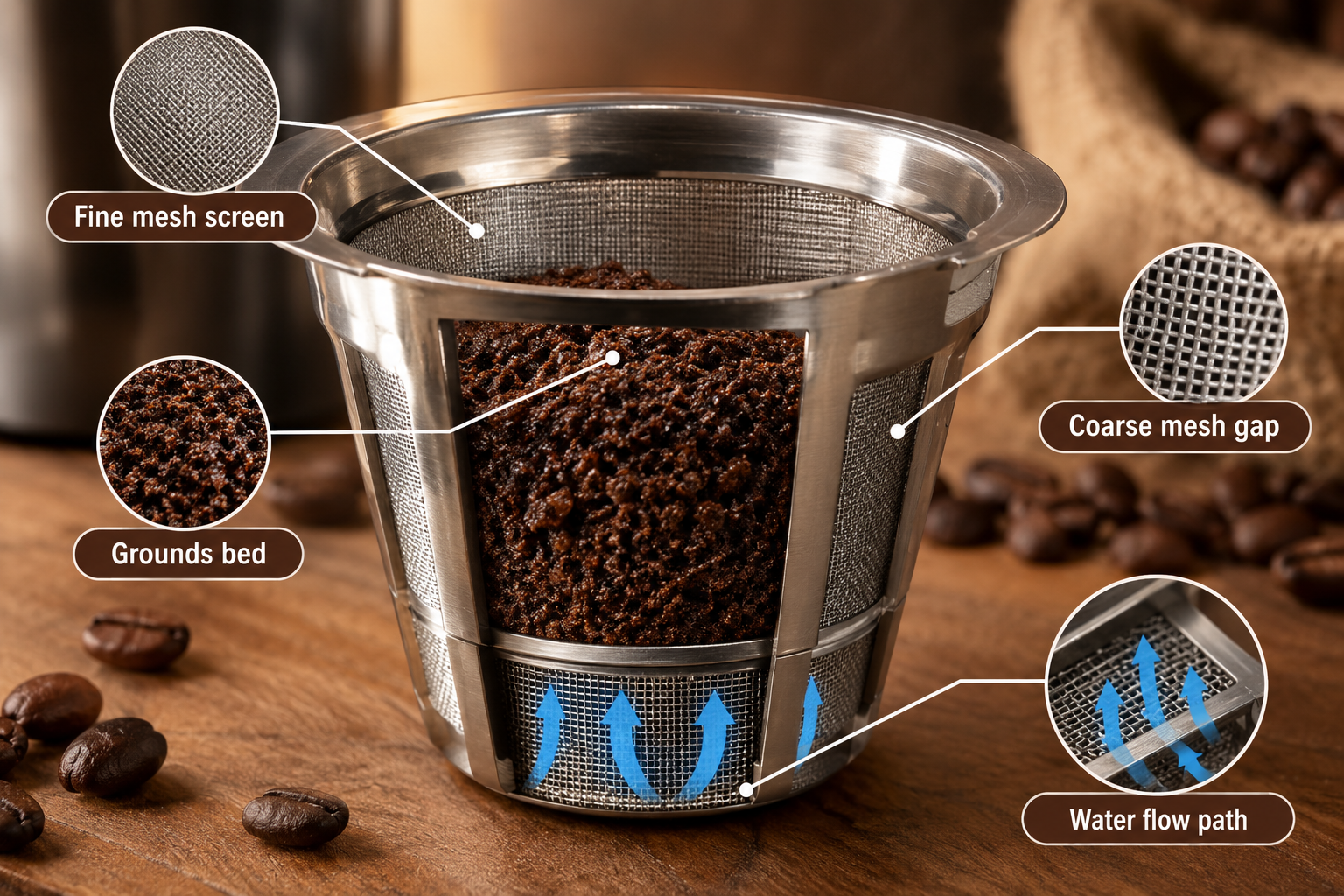
Mesh size controls how much sediment ends up in your cup, and finer mesh (around 180 to 200 microns) traps more fine particles than the coarse plastic mesh bundled with older Keurig filters. Coarser mesh lets more grounds through, which shows up as grit at the bottom of the mug.
- Coarse mesh (common in budget plastic filters): faster flow, more sediment, works fine with coarser grind sizes.
- Fine mesh (common in 304 stainless steel reusable k cups): slower flow, cleaner cup, better suited to medium-fine grind.
- Cheap or coarse steel mesh can also introduce a faint metallic taste, while true food-grade 304 stainless steel avoids that problem.
Common mistake: using a very fine espresso-style grind in a coarse mesh basket. The fine particles slip through the gaps and you end up with a muddy cup no matter how good the beans are. Match your grind size to your mesh, not the other way around. For background on how grind size changes extraction generally, see our guide to grind size for espresso machines, which applies the same logic to any brew method.
Why Is My Reusable K Cup Leaking
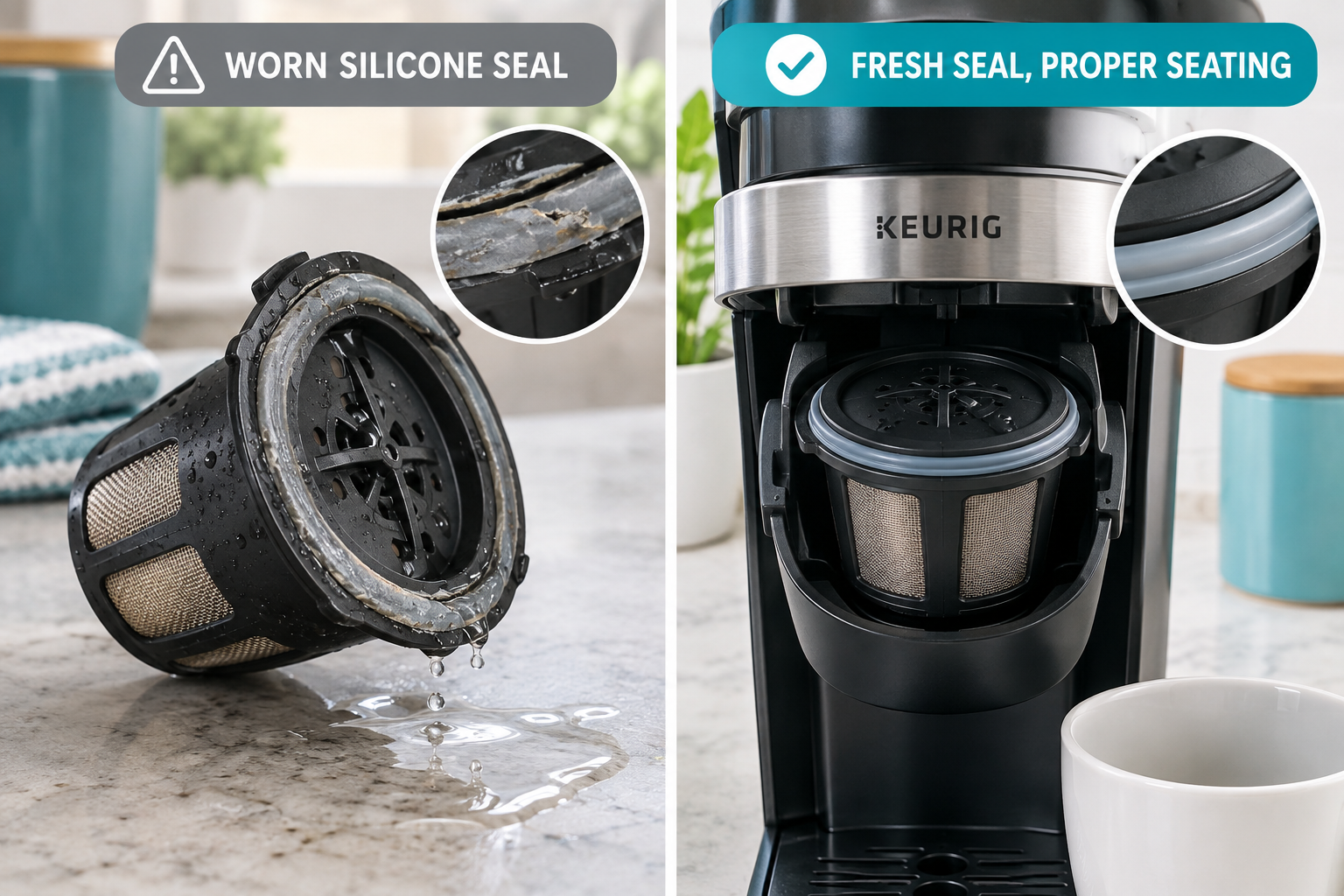
A leaking reusable k cup is almost always caused by an overfilled basket, a worn seal, or a lid that was not locked into place before brewing. Water pressure inside the Keurig has nowhere to go except around a compromised seal, and it finds the nearest gap.
Check these in order:
- Overfilling: grounds swell when wet. Fill to the marked line, not the rim.
- Worn gasket: silicone seals stretch and crack after months of daily use. Replace the seal or the pod once you see visible wear.
- Improper seating: the pod needs to click fully into the brewer's holder. A half-seated pod lets the piercing needle miss its mark.
- Wrong pod for the model: a reusable k cup sized for a standard brewer can sit crooked in a K-Mini's narrower chamber.
Edge case: if the leak only happens on large-cup settings, the extra water volume is likely pushing past a basket that was fine for smaller brews. Try a lower ounce setting first before assuming the pod is defective.
Best Reusable K Cup for Espresso Machines
There is no reusable k cup for espresso machines, because Keurig brewers use low-pressure drip extraction and true espresso machines need 9 bars of pressure that a K-cup basket cannot hold or seal against. Anyone shopping for a reusable k-cup with espresso-style results in mind is solving the wrong problem with the wrong tool.
If espresso flavor is the actual goal, a dedicated espresso machine or a stovetop moka pot will get you closer than any Keurig accessory. Our guide to perfecting espresso techniques and our breakdown of milk frothing methods are better starting points than searching for an espresso-compatible K-cup that does not exist.
Reusable K Cup Alternatives to Keurig
If you like the idea of a refillable pod but do not own a Keurig, single-cup pour over filters and small French press brewers give you the same control without needing a specific machine. A reusable basket coffee filter used in a standard drip machine is the closest non-Keurig equivalent.
- Reusable basket coffee filters: fit standard drip coffee makers instead of single-serve machines.
- Single-cup pour over cones: give full control over water flow and bloom time.
- Small French press: no filter to buy at all, though cleanup involves a plunger and mesh screen instead of a pod.
For a closer look at two well-reviewed reusable basket options that work outside the Keurig ecosystem, see our guide to the Goldtone reusable basket coffee filter and our guide to the Think Key washable reusable coffee filter.
Can You Use Regular Ground Coffee in a Reusable K Cup
Yes. Any standard ground coffee works in a reusable k cup, and this is the entire reason people buy one instead of sticking with disposable pods. A medium grind, similar to what you would use in a standard drip machine, performs best in most mesh baskets.
- Medium grind: works well with most mesh sizes and avoids clogging.
- Fine grind: only use it with a fine-mesh stainless basket, or grounds will slip through.
- Coarse grind: brews faster but can taste thin if your basket's mesh is already loose.
- Flavored or single origin beans: both work fine; the pod does not affect flavor the way a factory pod's packaging can.
If you are still choosing which beans to buy in bulk for daily reusable k-cup use, our guide to choosing coffee beans for home brewing covers roast date and freshness in more detail than any pod label ever will.
Reusable K Cup Taste Compared to Original Pods
A reusable k cup filled with fresh, well-matched coffee generally produces a fuller cup than a factory disposable pod, because you control the roast, the grind, and the dose instead of accepting a pre-measured, pre-ground amount that may have sat in packaging for months. Reviewers ranking stainless capsules against Keurig's own filter have placed well-designed third-party pods ahead on taste while Keurig's filter remained a strong, dependable runner-up.
- Disposable pods are consistent but limited to whatever roast and grind the manufacturer chose.
- Reusable k cups let you use fresher beans, which matters more for flavor than almost any other single variable.
- Stainless steel baskets with fine mesh produce a cleaner cup than the coarse plastic mesh bundled with many starter filters.
Tradeoff: consistency. A disposable pod tastes the same every single time. A reusable k cup tastes only as good as the coffee, grind, and fill level you use that morning.
Most Durable Reusable K Cup That Lasts
304-grade stainless steel reusable k cups tend to outlast plastic filters by years, since steel does not crack under repeated heat cycling the way plastic baskets eventually do. EZ-Cup and GoodCups both build their reusable k-cup lines around this grade of steel.
- Plastic filters (including Keurig's own My K-Cup Universal): reliable for a year or two of daily use before the lid hinge or gasket wears out.
- Stainless steel filters: the metal body itself rarely fails; the silicone gasket is usually the first part to need replacing.
- Replacement gaskets: sold separately for most stainless models, which extends the life of the pod well past its first seal.
Decision rule: choose stainless steel if you brew daily and want to buy the pod once. Choose Keurig's plastic filter if you want the cheapest entry point and do not mind replacing it occasionally.
Reusable K Cup for People with Sensitive Stomachs
A reusable k cup can help sensitive stomachs mainly by giving you control over bean choice, since low-acid roasts, decaf blends, and specific origins that individuals tolerate well are far easier to source in bulk bag form than in single-serve pods. This is a practical benefit, not a medical claim, and anyone with a diagnosed digestive condition should follow guidance from their own doctor rather than a coffee accessory.
- You can switch to a lower-acid roast without hunting for a matching pod flavor.
- You can control strength precisely by adjusting the grounds-to-water ratio.
- You avoid any coating or additive that might exist in specialty flavored pods, since you are brewing plain grounds.
Common Mistakes When Using Reusable K Cups
Most reusable k-cup problems trace back to fill level, grind mismatch, or skipped cleaning, not a defective pod. Fixing these three habits solves the majority of complaints people post about reusable filters online.
- Overfilling the basket: causes leaks and channeling, where water finds a shortcut through the grounds instead of passing through evenly.
- Using the wrong grind for your mesh: fine grind in coarse mesh means grit in your cup; coarse grind in fine mesh means a thin, weak brew.
- Skipping the weekly deep clean: stale coffee oil builds up in the mesh and makes every following brew taste a little worse.
- Forcing a standard-size pod into a compact brewer: this is the most common reusable k cup for K-Mini complaint, and it is almost always a sizing mismatch, not a broken part.
- Ignoring a cracked or stretched gasket: replace it as soon as you notice a leak pattern, instead of tightening the lid harder.
A reusable k cup rewards a small, repeatable habit. Fill to the line, rinse right away, deep clean once a week. Skip any one of those three and the pod will eventually let you know.
Frequently Asked Questions
Is a reusable k cup worth it if I only brew one cup a day? Yes. Even at one cup a day, most reusable k-cups pay for themselves within two to three weeks compared to name-brand disposable pods, based on typical per-pod pricing versus bulk ground coffee costs.
Do I need a special grinder for a reusable k cup? No. Pre-ground coffee works fine. A burr grinder gives you more control over consistency, but it is not required to use a reusable filter successfully.
Can I use a reusable k cup in a Keurig 2.0 machine? Yes, as long as the filter is labeled MultiStream compatible. Keurig's own My K-Cup Universal is built for this, and it works across 2.0 and 1.0 brewers.
Why does my coffee taste weak in a reusable k cup? Usually a grind that is too coarse for the mesh, or not enough grounds in the basket. Try a slightly finer grind and fill closer to the marked line.
Are stainless steel reusable k cups better than plastic ones? Stainless steel tends to produce a cleaner cup with less sediment and lasts longer, but plastic filters like Keurig's My K-Cup Universal are cheaper and guaranteed to fit every brewer.
Can I put a reusable k cup in the dishwasher? Most manufacturers recommend hand washing to protect the gasket and mesh. Check the specific product instructions, since dishwasher heat can warp some plastic lids over time.
Conclusion
A reusable k-cup is one of the easiest upgrades in a home coffee routine, and the right one depends on what you already own and what you actually want fixed. If fit is your worry, buy the Keurig My K-Cup Universal and stop second-guessing compatibility. If flavor is the goal, move to a 304 stainless steel reusable k cup with fine mesh and pair it with fresh, properly ground beans. Either way, the fastest path to a better cup is matching your grind size to your mesh and sticking to a simple weekly cleaning habit. Better coffee starts with better answers, and in this case, the answer is choosing the pod that matches your machine, your beans, and your patience for cleanup.
Keep Exploring Coffee Rank IQ
- Coffee Rank IQ home: reviews, brewing guides, and coffee science
- Best Decaf K Cups That Taste Like Real Coffee
- Best Single Serve Coffee Maker With or Without Pods
- Best Nespresso Pods for Lattes, Iced Drinks, and Straight Shots
- Best Nespresso Machine: Vertuo vs Original, Model by Model
References
- apartmentabc.com/best-reusable-k-cups
- capmesso.com/blogs/news/coffee-guide-ultimate-guide-reusable-k-cups
- www.amazon.com/Keurig-Universal-Reusable-MultiStream-Technology/dp/B08DHC73P6
- www.kroger.com/p/keurig-universal-my-k-cup-filter/0061124736498
- www.amazon.com/Keurig-Universal-Reusable-Ground-Compatible/dp/B0737B6HGR
- www.amazon.com/keurig-accessories/s?k=keurig+accessories
- keurigcoffee.blog/stainless-steel-keurig-cup
- thegreenpods.com/blog/best-reusable-k-cups
- www.walmart.com/c/kp/my-k-cup-universal
- www.walmart.com/grocery/ip/Keurig-My-K-Cup-Universal-Reusable-Ground-Coffee-Filter-Compatible-with-All-Keurig-K-Cup-Pod-Coffee-Makers-2-0-and-1-0/501619044?athcpid=501619044&athpgid=similaritems&athcgid=null&athznid=null&athieid=null&athstid=CS014&athguid=3bdd3cbf-b204-4727-b91a-9d8c090426b3&athancid=null&athena=true