
Vietnamese Coffee Maker: How the Phin Makes It Sweeter
A Vietnamese coffee maker, called a phin, is a small metal drip filter that sits right on top of your glass. Hot water seeps through a packed bed of grounds for about five minutes, and what lands in the glass is a short, dense, very strong coffee. That strength is the trick. It can carry a thick spoonful of sweetened condensed milk and a glass full of ice without tasting like sweet milk with a rumor of coffee in it.
So the phin makes Vietnamese coffee sweeter by making it stronger first. No paper, no plug, no pump: four pieces of stainless steel or aluminum and a kettle. Below: how the brewer works, the ca phe sua da recipe with real numbers, a drip fixer for when the timing goes wrong, which beans taste right, cleaning, what to watch for, and how it stacks up against a moka pot, an AeroPress, a French press and a pour over.
Quick Answer
A Vietnamese coffee maker (phin) is a four-part metal drip filter that brews one strong cup directly into your glass. Use about 14 g of medium-fine coffee and roughly 120 ml of water just off the boil, bloom for 30 seconds, then let it drip for four to five minutes onto two tablespoons of sweetened condensed milk. Stir and pour over ice. A Vietnamese coffee maker needs no paper filters and no power, and it lasts for years.
Vietnamese Coffee Maker at a Glance
| Spec | Vietnamese coffee maker (phin) |
|---|---|
| Parts | Filter plate, brewing chamber, press insert, lid |
| Press type | Gravity insert (rests on the grounds) or screw-down insert (adjustable) |
| Materials | Stainless steel or aluminum; no paper filter needed |
| Common sizes | Single-serve phins brew about 120 ml; larger ones reach 300 ml and beyond |
| Dose | About 14 g (2 tablespoons); a standard phin holds about 15 g at most |
| Water | About 120 ml, just off the boil (96°C / 205°F) |
| Bloom | 20 to 30 ml of water, then wait 20 to 30 seconds |
| Drip time | About 4 to 5 minutes for the main pour |
| Grind | Between medium and fine, gritty like table salt |
| Condensed milk | About 2 tablespoons (30 ml) for an iced glass, adjusted to taste |
| Power needed | None beyond a kettle |
Brew figures from the CoffeeGeek Vietnamese iced coffee guide and Nguyen Coffee Supply’s phin filter explainer.
Who Should Buy a Vietnamese Coffee Maker
Buy one if your favorite coffee order is sweet, strong and iced. The phin was built for exactly that drink, and nothing on a kitchen counter makes it more faithfully. It also suits anyone who wants a brewer with no moving parts, no filters to restock and nothing to plug in. It slips into a drawer, packs into a camping kit, and asks for nothing except hot water and five minutes.
It is a good second brewer, too. If you already own a drip machine for weekday mornings, a phin gives you a completely different cup for the weekend: thick, bittersweet and built for ice. For the money, few brewers change what you drink as much.
Skip it if you make coffee for three people at once. A standard phin brews one glass, and lining up three phins on three mugs is charming exactly once. Skip it if you love light, floral single origins; a pour over shows those flavors more clearly. And skip it if waiting five minutes for a small cup sounds like punishment. The slow drip is the point, but it is still slow.
How a Vietnamese Coffee Maker Works
The phin stacks in four parts. At the bottom is the filter plate, a wide perforated disk that rests across the rim of your glass. The brewing chamber, a small metal cup with a perforated floor, sits on the plate. Inside the chamber goes the press insert, a flat perforated disk that sits on top of the grounds. A lid covers everything while it drips, and when you lift the brewer off the glass, the lid flips over and becomes a tray for the wet phin.
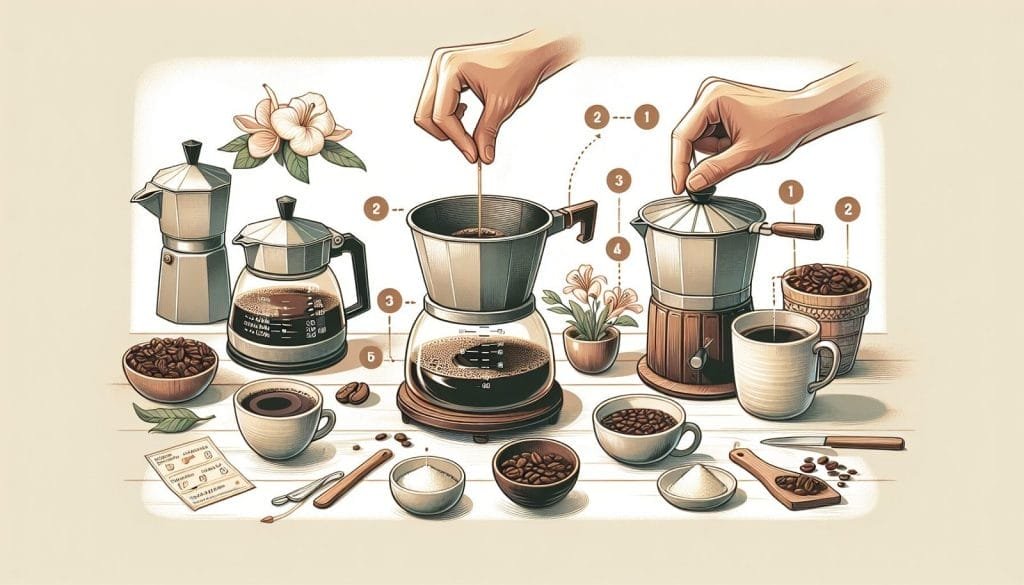
Water pours onto the press insert, trickles through its holes, saturates the grounds, and then has to work its way through the packed coffee bed and out the tiny holes in the chamber floor. That resistance is what stretches the brew to four or five minutes. A paper filter does the same job in a pour over, but here the coffee bed itself slows the flow.
Gravity insert or screw-down insert
The press insert comes in two styles, and they change how much control you have.
- Gravity insert. The disk simply rests on the grounds under its own weight. It lets gas escape as fresh coffee blooms, so it suits freshly roasted beans. Nguyen Coffee Supply, a Vietnamese-American roaster, prefers this style. The trade-off is that the grind does all the work of controlling the drip.
- Screw-down insert. A threaded post in the chamber lets you twist the disk down onto the grounds and set how tightly the bed is packed. That makes it forgiving with pre-ground coffee. CoffeeGeek’s method is to tighten until you feel the coffee push back, then loosen exactly one full turn.
If you are buying your first phin and plan to use pre-ground coffee, the screw-down style gives you a second dial to turn when the timing is off. If you grind fresh, a gravity phin is simpler and harder to overtighten.
Sizes and materials
The classic single-serve phin brews about 120 ml, roughly a 4 oz pour of concentrate. Larger phins brew 300 ml or more for a carafe or two glasses. Stainless steel phins are heavier and shrug off years of daily use. Aluminum phins are lighter and cheaper, but they dent and discolor more easily.
Why the Phin Makes Vietnamese Coffee Sweeter
The math is simple. CoffeeGeek’s recipe uses 14 g of coffee for about 120 ml of water, a ratio near 1:8.5. A typical pour over runs closer to 1:16, as our pour over coffee ratio guide lays out. So the phin brew is roughly twice as concentrated before any milk or ice touches it.
That concentration lets condensed milk do its job. Sweetened condensed milk is milk with much of the water cooked off and sugar added, so it is thick, caramel-toned and very sweet. Stir two tablespoons into a weak coffee and you get dessert. Stir it into a phin brew and the coffee stays in charge, then the ice melts it down to a drinkable strength.
The habit has practical roots. Coffee arrived in Vietnam in 1857 with French missionaries, and fresh milk was hard to come by and harder to keep in a tropical climate. Canned condensed milk needed no refrigeration and kept far longer, so it became the default. The bean helped too. Vietnam is the second largest coffee producer in the world after Brazil, and Robusta makes up about 97 percent of its output, according to Wikipedia’s summary of Vietnamese coffee production. Robusta has more chlorogenic acid and less sugar and fat than Arabica, so it tastes harsher and more bitter. A spoonful of condensed milk rounds that edge off.
The Ca Phe Sua Da Recipe
Ca phe sua da means coffee, milk, ice. These numbers follow CoffeeGeek’s recipe for a standard single-serve phin.
- Set up the glass. Spoon about 2 tablespoons (30 ml) of sweetened condensed milk into a heatproof glass. Use a glass with a rim narrower than the filter plate so the phin sits flat.
- Heat the water. Bring water to a boil and let it rest a moment, to about 96°C (205°F). Rinse the phin with a splash of hot water to warm the metal.
- Add the coffee. Put 14 g of ground coffee, about two rounded tablespoons, into the chamber. Shake it gently so the bed is level. A lopsided bed sends water down one side and leaves the other side underbrewed.
- Set the insert. Rest a gravity insert on the grounds. For a screw-down insert, tighten until you feel resistance, then back it off one full turn.
- Bloom. Pour 20 to 30 ml of water, just enough to wet the grounds, and wait 20 to 30 seconds while they swell and release gas.
- Fill. Pour another 90 to 100 ml, filling the chamber to the top, and cover with the lid.
- Wait. The first drops should appear within a couple of minutes, and the drip should finish at about the five-minute mark. If the chamber empties in under two minutes, the grind is too coarse.
- Stir and ice. Lift the phin onto its upturned lid, stir the coffee and condensed milk together until no streaks remain, then pour it over a tall glass of ice.

Grind is the setting that decides everything else. Aim between medium and fine, close to what you would use in a moka pot, with a texture like table salt. Espresso grind clogs the holes and stalls the drip; a pour over grind runs straight through. Our coffee grind size chart shows where that sits on the scale.

Other Drinks From the Same Brewer
Ca phe sua nong (hot, with milk)
The hot version uses a lighter dose. CoffeeGeek suggests 8 to 10 g of coffee per 100 ml of water, 15 to 20 ml of condensed milk, and a drip of about three to four minutes. Pre-warm the cup, since a small hot drink cools quickly while it drips.
Ca phe den (black)
Skip the milk and you have ca phe den, black coffee. Served over ice it becomes ca phe den da. Plenty of drinkers add a little sugar instead of milk. Without condensed milk the bean choice shows much more, so a black phin cup is where a better coffee pays off.
Egg coffee
Hanoi’s ca phe trung tops phin coffee with a thick foam of egg yolk whipped with condensed milk. The story usually credited is that Nguyen Van Giang, a bartender at the Metropole hotel in Hanoi, created it in 1946 when milk was scarce, then went on to open Cafe Giang. At home, whisk a yolk with a tablespoon or two of condensed milk until pale and fluffy, then spoon it over a hot phin brew.
Choosing Beans for Your Phin
For the classic taste, use a dark roast Robusta or a Robusta-heavy blend. Robusta brings the bitterness and heavy body that condensed milk was paired with in the first place, and it carries roughly 2.2 to 2.7 percent caffeine by weight against 1.2 to 1.5 percent for Arabica. If you are not sure what is in your bag, our guide on how to tell Robusta from Arabica walks through the label clues.
Trung Nguyen is the brand most people meet first. It was founded in 1996 in Buon Ma Thuot, in Dak Lak Province, the center of Vietnam’s Central Highlands coffee country, and it sells ground coffee lines meant for phin brewing. Vietnamese-American roasters such as Nguyen Coffee Supply sell single-origin Robusta from Vietnam for drinkers who want a cleaner version of the same profile.
Then there is the yellow can. Cafe Du Monde’s coffee with chicory comes from New Orleans, not Vietnam, but it became a Vietnamese-American staple after refugees arrived in the 1970s and found its dark, bitter roast closer to home than American diner coffee. Atlas Obscura reports that Cafe Du Monde began selling the tins to Asian grocery stores after noticing its Vietnamese employees mailing them to family. Most coffee roasted in Vietnam is sold without chicory, so treat the can as its own tradition. It tastes good in a phin either way.
Arabica works too. A dark roast Arabica brews a smoother, less bitter cup that needs less condensed milk. A light roast Arabica tends to taste sour and thin at this strength, so save those beans for a pour over.
Cleaning and Caring for a Phin
- Let the phin cool for a minute on its upturned lid. The chamber gets hot enough to sting.
- Lift out the press insert and knock the spent puck into the trash or compost. The packed bed usually drops out in one piece.
- Rinse the chamber, insert and plate under warm water, spraying from underneath to push grounds out of the holes.
- Wash with a drop of dish soap and a soft brush once a day. Nguyen Coffee Supply notes the phin has hardly any crevices, so a gentle rinse with soap is usually enough.
- Dry every part before stacking. Hand wash aluminum phins; dishwasher detergent dulls and darkens aluminum.
Every few weeks, soak the parts in warm water with a spoonful of baking soda or a coffee equipment cleaner to dissolve built-up oils. If drips start running slower for no reason, clogged holes are the usual cause, and a soak plus a stiff brush clears them.
Five Features We Love
- No paper, no power. Nothing to restock and nothing to plug in. A kettle, a campfire pot or an office hot water tap all work.
- It brews right on the glass. No carafe, no extra dish. The cup you drink from is the cup it drips into.
- The lid doubles as a drip tray. Flip it over and park the wet phin on it. Small detail, clean counter.
- Concentrate made for ice. The short, strong brew holds up to condensed milk and a full glass of ice, which is why ca phe sua da tastes like coffee to the last sip.
- It lasts. A stainless phin is a few pieces of stamped metal with nothing to wear out. Nguyen Coffee Supply says a metal phin can last for decades, and we believe it.
What to Watch Out For
- Grind sensitivity. A small change in grind can move the drip from two minutes to eight. Expect a few tries to dial in a new bag.
- It cools while it drips. Five minutes in an open glass takes heat out of a small hot drink. Pre-warm the phin and cup.
- One glass at a time. A single-serve phin makes a single serving. Bigger phins exist, but a crowd still waits.
- Cheap phins vary. Thin aluminum dents easily, and a bent plate or a loose insert lets grounds into the glass. Stainless costs a little more and stays flat.
- Glass fit. The filter plate has to span the rim. Wide mugs can swallow it and tall narrow glasses can tip, so check your glassware.
Phin Pros and Cons
| Pros | Cons |
|---|---|
| No paper filters, no electricity | Brews one glass at a time |
| Strong concentrate for iced and sweet drinks | Grind sensitive; timing takes practice |
| Tiny, light and packable | Drink cools during a hot brew |
| Few parts, easy to rinse | Cheap aluminum versions dent and leak grounds |
| Lasts for years with basic care | Not the best brewer for light roasts |
Vietnamese Coffee Maker vs the Alternatives
| Option | Best for | Trade-off |
|---|---|---|
| Vietnamese coffee maker (phin) | Strong single glasses, iced coffee with condensed milk | One cup at a time, slow drip |
| Moka pot | Espresso-style concentrate on the stove | Needs a burner; easy to scorch |
| AeroPress | Fast, flexible single cups and travel | Uses paper or a metal disc; plastic body |
| French press | Full-bodied coffee for several people | Silt in the cup; less concentrated |
| Pour over | Clarity for light and floral coffees | Needs a gooseneck kettle and a steady hand |
The closest substitute is a moka pot. It also makes a short, strong brew that takes condensed milk well, and it does it faster, but it needs a stove and can turn bitter if it overheats. Our guide to using a moka pot covers the timing. An AeroPress can mimic a phin brew with a fine grind and a short, strong recipe, and it handles more styles. A French press serves more people but makes a weaker, siltier cup that condensed milk overwhelms.
For the rest of the brewers in that table, the Coffee Rank IQ brewing method guides walk through recipes, ratios and the gear that makes each one easier.
As an Amazon Associate, Coffee Rank IQ earns from qualifying purchases.
The Verdict
A Vietnamese coffee maker is one of the least expensive upgrades you can make to an iced coffee habit. It takes up less room than a mug, needs nothing but hot water, and makes the strong, bittersweet concentrate that ca phe sua da depends on. Grind between medium and fine, use 14 g of coffee and about 120 ml of water, and aim for a five-minute drip onto condensed milk. Buy stainless if you want one that stays flat for years, and pick a screw-down insert if you plan to use pre-ground coffee. Pour over fans will still want their dripper for light roasts. Anyone who loves a sweet, strong glass of iced coffee will use the phin more than they expect.
FAQ
Keep reading
- What Is a Sweet Coffee With Milk Called?
- Coffee Grind Size Chart: Settings for Every Brew Method
- How to Use a Moka Pot
- Coffee Ice Cubes: The Fix for Watery Iced Coffee
- Robusta or Arabica: How to Tell
Start from the Coffee Rank iQ homepage for more guides.
Vietnamese Coffee Maker: The Short Version
A Vietnamese coffee maker is a four-part metal filter that drips one strong glass of coffee in about five minutes, with no paper and no power. Use 14 g of medium-fine coffee and 120 ml of water just off the boil, let the phin drip onto two tablespoons of condensed milk, stir, and pour over ice for classic ca phe sua da.