Heat Exchanger Espresso Machine vs Thermoblock vs Dual Boiler: Which Heating System Fits Your Mornings
Quick Answer
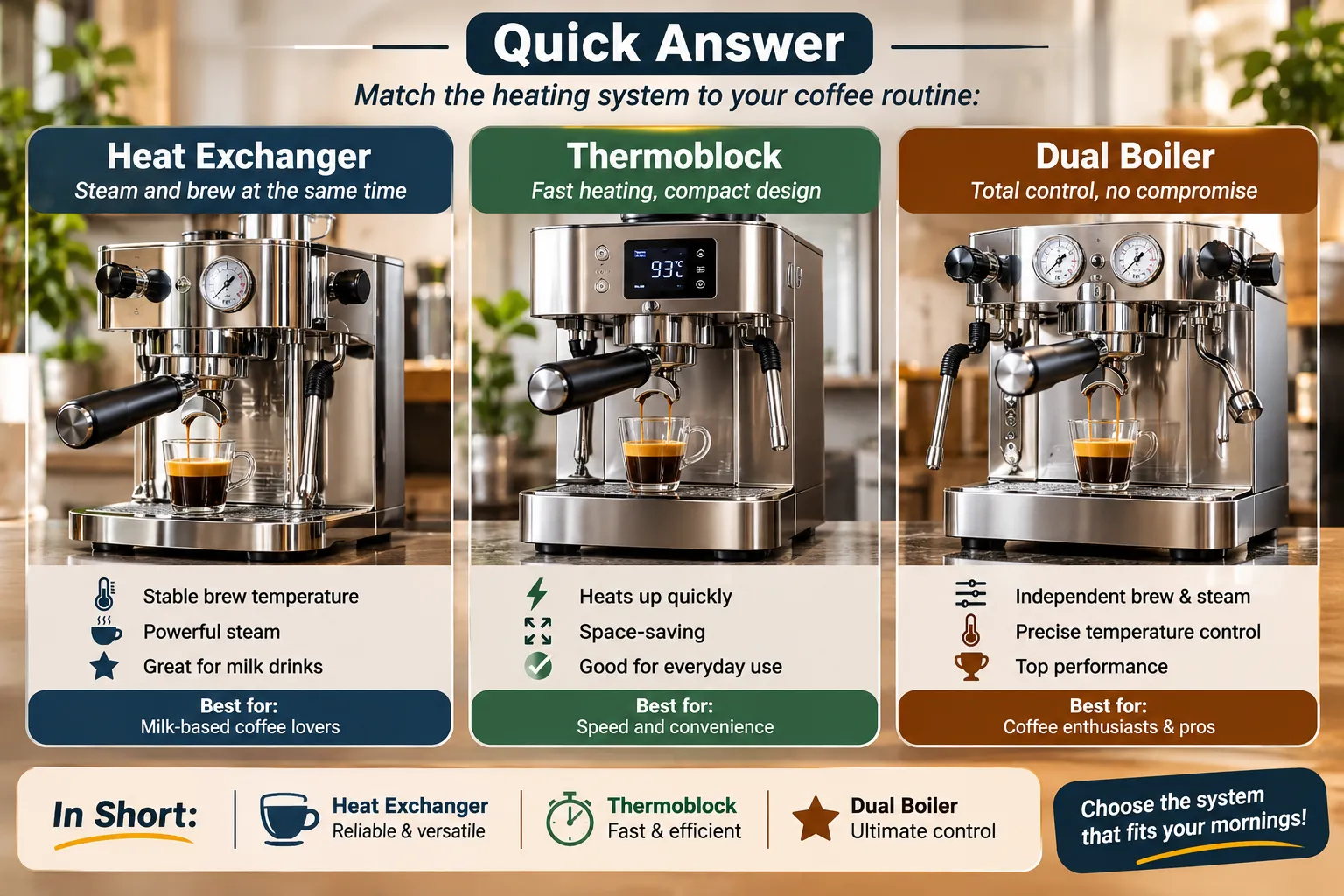
A heat exchanger espresso machine brews and steams at the same time from one boiler, which makes it the fastest architecture for back to back milk drinks without jumping to a dual boiler price. A thermoblock (or Breville's ThermoJet) heats water on demand in seconds and suits one or two drinks a morning. A dual boiler gives you an adjustable brew temperature that steaming cannot disturb, which matters most for light roasts and guest-sized drink runs. Pick by how many milk drinks you make in a row, not by spec-sheet prestige.
Key Takeaways
- Thermoblock is the speed king from cold. Breville lists a 3 second startup for the Bambino Plus at $499.95 on its US product page, checked November 2026 [Breville].
- A heat exchanger espresso machine needs real warm-up time. Most E61 group head designs want 20 to 30 minutes before the brass group is thermally settled, because the group is heated by a thermosiphon loop rather than an element .
- Only two architectures let you steam while brewing: heat exchanger and dual boiler .
- PID matters more than boiler count for temperature stability. Whole Latte Love reports older pressurestat HX machines can swing roughly 5 to 10 degrees, while PID-controlled HX systems may hold boiler temperature to about 1 degree, with some modern designs brewing accurately without a cooling flush [Whole Latte Love].
- Entry prices, checked November 2026: De'Longhi All-in-One (thermoblock) $349.95; Breville Bambino Plus (ThermoJet) $499.95; Porsche x La Marzocco Linea Micra (compact dual boiler) from $2,125.
- Hybrids now blur the lines. The Turin Legato V2, Diletta Mio and Quick Mill Silvano Evo pair a brew boiler with a steam thermoblock to cut heat-up time, with less steam endurance than a full steam boiler .
- Single boiler espresso machines like the Gaggia Classic Pro still work, but you wait roughly 40 to 60 seconds switching from brewing to steaming, plus a cooldown before the next shot .
What is a heat exchanger espresso machine and how does it work?
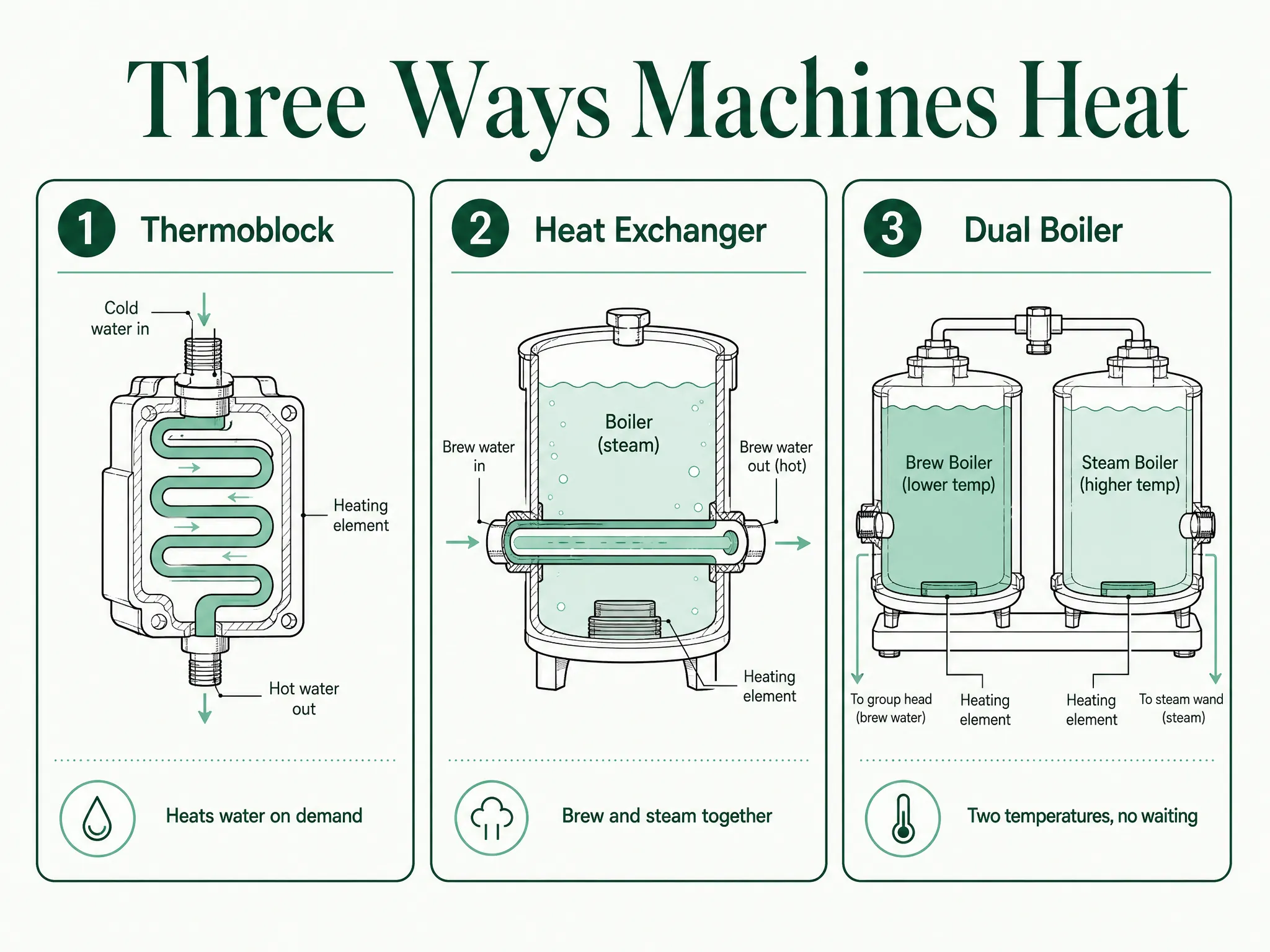
A heat exchanger espresso machine uses one boiler held at steam temperature, with a separate narrow tube running through that boiler. Fresh water from the reservoir travels through the tube, picks up heat on the way, and arrives at the group head at brewing temperature. The boiler stays hot for steam. The brew water never sits in it.
)
That single design choice is why the architecture exists. Steam wants roughly 250 to 260°F of water temperature. Espresso wants roughly 195 to 205°F. A single boiler can only be at one of those at a time. The exchanger tube solves the conflict by heating brew water in transit instead of storing it .
Most traditional HX machines pair this with an E61 group head, a 1961 Faema design that circulates boiler water through the group in a continuous thermosiphon loop. The group itself becomes a heat reservoir. Lovely for stability once hot, slow to get there, and the reason idle water in the exchanger can creep above brewing temperature .
Decision rule: if you regularly make two or more milk drinks in a row and want espresso-level temperature control without a dual boiler budget, a heat exchanger espresso machine is the architecture built for exactly that pattern.
Heat exchanger espresso machine vs thermoblock: which is better?
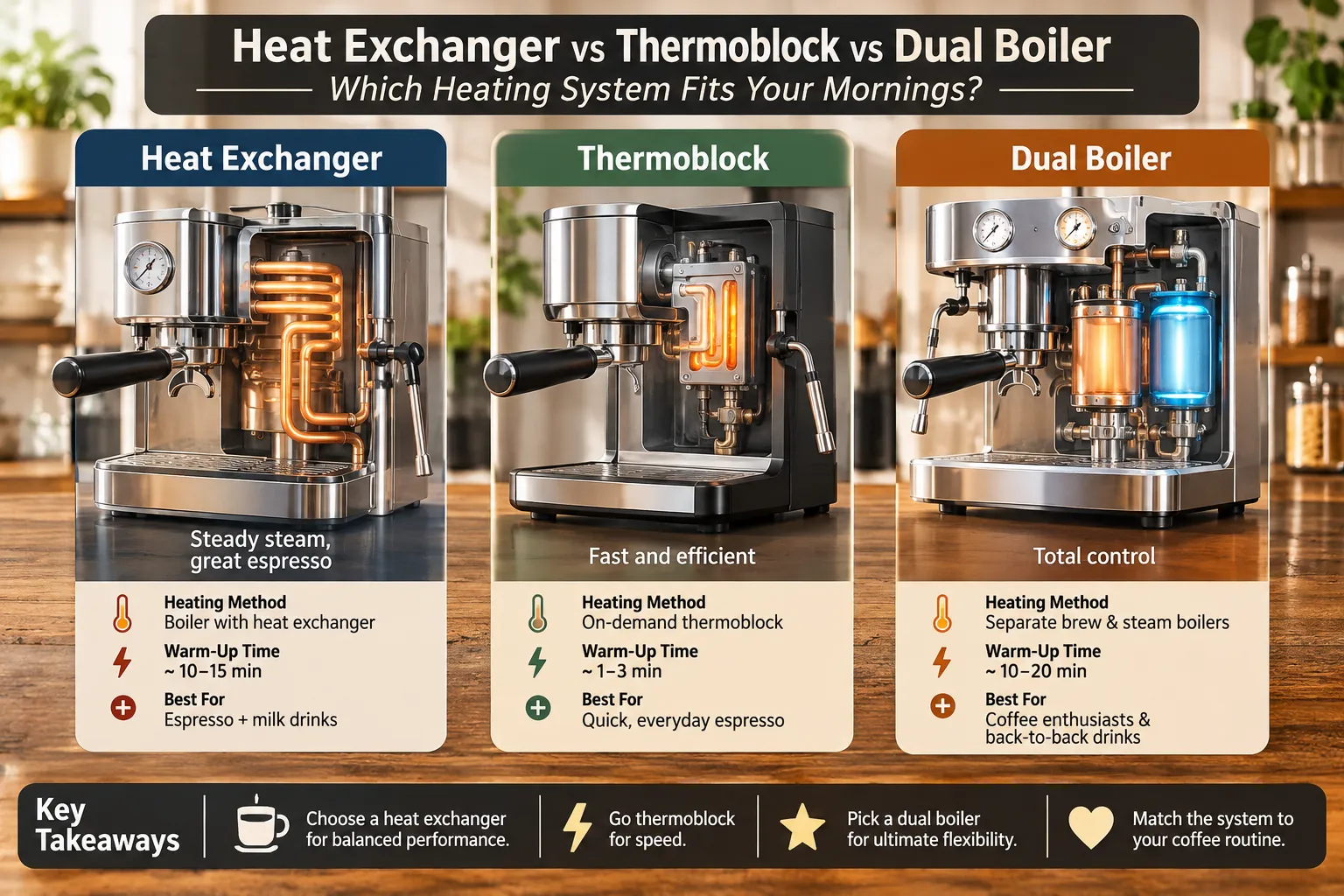
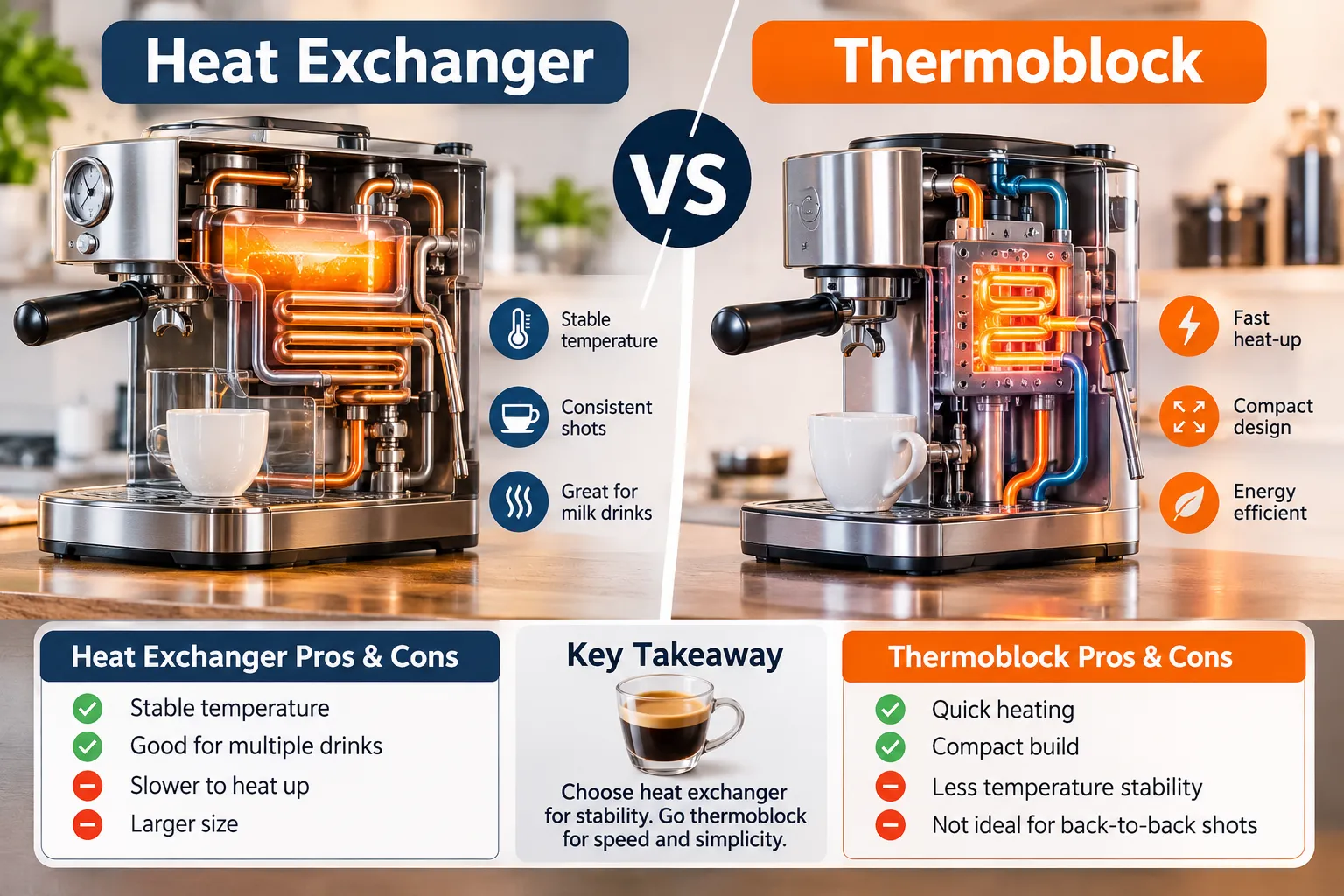
For one or two drinks on a weekday, a thermoblock wins on time and price. For three milk drinks in ten minutes, a heat exchanger espresso machine wins on steam power and recovery, and it is not close.
)
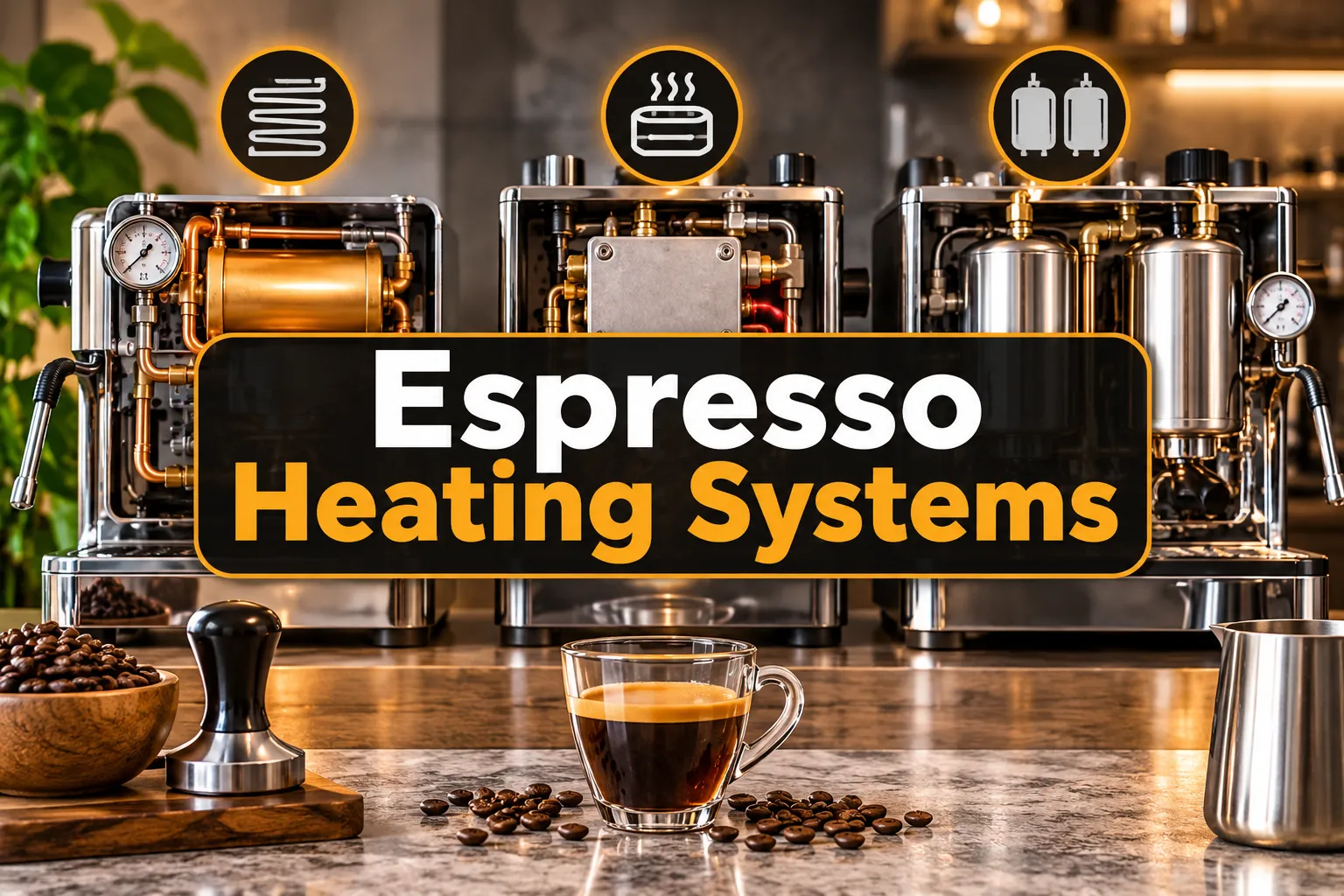
A thermoblock heats water only as it flows through a heated metal block, so there is no reservoir to bring up to temperature. That explains the tiny footprint and the instant start. It also explains the weakness: less stored thermal mass means flow rate, sensor placement and control software carry the whole burden of consistency .
ThermoJet heating is Breville's faster version of the same idea. The company lists 600 W ThermoJet heating, PID control, a 15 bar pump and 9 bar extraction on the Bambino Plus, and claims it is up to 44.3% more energy efficient than a conventional thermoblock based on internal testing in September 2026. That is a manufacturer claim, not independent lab work, so treat it as directional.
The thermoblock vs boiler question comes down to steam endurance. A thermoblock steams in bursts and usually needs a few seconds to switch modes. An HX steam boiler holds 1.8 litres or more of pressurised water and will texture milk for four cappuccinos without flinching.
Common mistake: buying a thermoblock machine for a household of four coffee drinkers, then discovering the steam wand needs a breather between jugs.
Still shopping the entry tier? Our roundup of the best espresso machine for beginners covers the thermoblock class in detail.
Heat exchanger vs dual boiler espresso machine: what actually changes
A dual boiler separates the two thermal jobs. One boiler sits near brewing temperature, a second sits at steaming temperature, and changing one does not directly change the other. On a heat exchanger espresso machine, brew temperature is an indirect result of the steam boiler's pressure, so raising steam power also raises brew water temperature .
What that means in practice:
| Behaviour | Heat exchanger | Dual boiler |
|---|---|---|
| Set a brew temperature by number | Indirect, via boiler pressure | Direct, usually to the degree |
| Steam while brewing | Yes | Yes |
| Light roast friendly | Workable with flushes | Easier, higher temps on demand |
| Switching coffees mid-week | Slower to adjust | Minutes |
| Typical weight and size | Large | Largest, heaviest |
Whole Latte Love's technical comparison still identifies dual boilers as the more stable and adjustable architecture, with the premium mattering most for light-roast espresso, repeated shots, and anyone who wants a numerical brew-temperature workflow. The same testing argues modern PID-controlled HX machines should not be dismissed as inconsistent, and its Scace measurements found some HX designs brewing accurately without a traditional cooling flush [Whole Latte Love].
Compact dual boilers are also becoming lifestyle products rather than countertop laboratories. The Porsche x La Marzocco Linea Micra collaboration released October 30, 2026 starts at $2,125 and ships with a two litre reservoir, app control, an electric brew paddle and a convertible portafilter [Hypebeast].
Choose a dual boiler if you buy rotating single origin light roasts and want to dial temperature by degree. Choose an HX if you buy a consistent medium or dark espresso roast and care more about steam volume than about typing in 201.5°F.
Heat exchanger vs single boiler espresso machine
A single boiler espresso machine heats one small boiler and alternates between brewing and steaming. The Gaggia Classic Pro is the reference example. You pull the shot, flip the steam switch, wait, steam the milk, then wait again for the boiler to drop back to brew temperature before the next shot.
Realistic timings for that class:
- Cold start to first shot: 5 to 10 minutes
- Brew to steam switch: roughly 40 to 60 seconds
- Steam back to brew: 3 to 5 minutes, or a cooling flush to speed it up
For a single flat white that sequence is fine. For four drinks it becomes a juggling act with a timer. The heat exchanger espresso machine removes the switch entirely, which is the real upgrade people feel on day one.
If a single boiler is where your budget lands, our Gaggia Classic Pro walkthrough covers the temperature-surfing routine that makes it behave.
Can you steam while brewing, and how long is the warm-up?
Yes on a heat exchanger and yes on a dual boiler. No on a single boiler, and generally no on a thermoblock, which heats water for one circuit at a time. Steam while brewing is the single feature that separates the two tiers .
)
Espresso machine heat up time, cold start to first good shot, by architecture:
- Thermoblock / ThermoJet: 3 to 30 seconds. Breville lists 3 seconds for the Bambino Plus [Breville].
- Single boiler: 5 to 10 minutes.
- Heat exchanger with E61: 20 to 30 minutes, because the brass group needs to saturate with heat through the thermosiphon .
- Dual boiler: 15 to 25 minutes, less on smaller units with insulated boilers.
A plug timer solves the HX wait. Set it for 25 minutes before your alarm and the machine is settled when you reach the kitchen.
Heat exchanger espresso machine temperature surfing
On most traditional HX designs, water sitting in the exchanger during idle periods gets hotter than brewing temperature. The fix is a cooling flush: run water through the group for a couple of seconds until the sputtering stops, pause 15 to 30 seconds, then lock in and brew .
The routine:
- Open the brew lever over the drip tray.
- Listen. Hissing and spitting means the water is too hot.
- Close the lever when the stream runs quiet and smooth.
- Wait 15 to 30 seconds for the group to recover.
- Lock the portafilter and pull.
Flush length varies by machine and by how long it sat idle. Five minutes between drinks needs barely a flush. Three hours needs a longer one. Some PID-controlled modern HX designs reduce or remove the flush entirely, so check the model's documentation before assuming [Whole Latte Love].
How much does a heat exchanger espresso machine cost, and which models suit home use?
Heat exchanger machines generally occupy the upper-middle of the home market, above thermoblock machines and below full dual boilers. Prices move constantly, so verify before buying.

)
| Machine | System | Price (Nov 2026) | Best for |
|---|---|---|---|
| De’Longhi All-in-One | Thermoblock | $349.95 | Drip, cold brew and espresso in one box |
| Breville Bambino Plus | ThermoJet | $499.95 | One or two milk drinks, fast |
| Nuova Simonelli Oscar II | Heat exchanger | Check current price | Steam-heavy households, compact HX |
| Turin Legato V2 / Diletta Mio | Hybrid boiler + steam thermoblock | Check current price | Shorter warm-up, moderate steam needs |
| Porsche x La Marzocco Linea Micra | Dual boiler | From $2,125 | Light roasts, temperature control, small counters |
Affiliate disclosure: Coffee Rank IQ earns commission from some retailer links. Prices listed were checked November 2026 against manufacturer or publisher sources and change without notice.
The Oscar II is the usual first HX recommendation for home because it is narrower than most E61 machines while keeping a proper steam boiler. Our Oscar II setup guide covers its flush behaviour.
Five features worth paying for
- E61 group head. Heavy brass that buffers temperature swing between shots, which is why so many HX machines use it. Payoff: shot two tastes like shot one.
- PID on the steam boiler. Replaces a mechanical pressurestat and tightens boiler control to around 1 degree on some designs [Whole Latte Love]. Payoff: shorter, more predictable cooling flushes.
- Rotary or quiet vibration pump with a pressure gauge. Payoff: you can see when a puck is choking before you taste it.
- A full-size 1.8 L or larger steam boiler. Payoff: four cappuccinos in a row without waiting.
- Plumbable or large reservoir with front access. Payoff: no lifting the tank out under a cabinet. Measure the space above the machine before you buy.
What to watch out for
- Warm-up time. 20 to 30 minutes is not a rumour. Without a plug timer, an HX is a weekend machine.
- Counter and cabinet clearance. E61 machines are tall and deep.
- The flush learning curve. Expect two weeks of mediocre shots while you learn the routine.
- Grinder dependency. An HX machine with a $90 blade-adjacent grinder makes worse coffee than a Bambino with a decent burr set. Budget for the espresso grinder first.
- Service access. Ask where the nearest technician is before spending four figures.
Heat exchanger espresso machine pros and cons
Pros
- Steam and brew at the same time, no mode switching
- Large steam boiler with professional-grade milk texturing
- Fresh brew water on every shot, never recirculated boiler water
- Usually cheaper than an equivalent dual boiler
- Mostly E61-based, so parts and gaskets are widely available
Cons
- Long warm-up, typically 20 to 30 minutes
- Brew temperature is set indirectly through boiler pressure
- Cooling flush required on many traditional designs
- Heavy, tall, and power hungry
- Less suited to frequent light-roast temperature changes
Is a heat exchanger espresso machine good for beginners?
It can be, if the beginner is patient and mostly drinks milk-based coffee with a consistent roast. It is a poor first machine for someone who wants a drink thirty seconds after walking into the kitchen.
Buy a heat exchanger espresso machine if you make three or more milk drinks a day, you already own a burr grinder, and you can leave the machine on a timer.
Buy a thermoblock machine if you make one or two drinks, your counter is small, and your mornings are short. The Bambino Plus class is the clear winner for that pattern. See our best semi automatic espresso machine picks for the shortlist.
Buy a dual boiler if you rotate light roast single origins and want to type a brew temperature instead of guessing.
Skip all three and buy a super automatic if nobody in the household wants to tamp. Our best super automatic espresso machine guide handles that case honestly, including what you give up in cup quality.
Gift buyers: a heat exchanger espresso machine is a poor surprise gift unless the recipient has asked for one by name. A good grinder is the safer present.
Heat exchanger espresso machine maintenance and cleaning
Treat it like a small commercial machine, because that is essentially what it is. The maintenance load is higher than a thermoblock and similar to a dual boiler.
Daily: purge and wipe the steam wand immediately after each use, backflush with water, rinse the basket and portafilter.
Weekly: chemical backflush with espresso machine detergent through a blind basket, soak the portafilter and baskets, clean the drip tray and shower screen.
Every 3 to 6 months: remove and clean the shower screen and dispersion block, inspect the group gasket, check water softener or filter cartridges.
Descaling: depends almost entirely on your water. Soft or filtered water can stretch intervals to a year or more; hard water needs attention every few months. Many HX boilers are copper or brass, so follow the manufacturer's instruction rather than a generic vinegar recipe. Our coffee machine descaling guide covers safe products and frequency.
Using filtered, mineral-balanced water is the single cheapest way to extend the life of any boiler machine.
Why is my an HX machine producing bad shots?
Nine times out of ten the cause is flush timing, grind, or a machine that has not finished warming up. Work through them in that order before suspecting a fault.
Common problems and solutions:
- Burnt, bitter, ashy shots. Water is too hot. Lengthen the cooling flush, or wait 20 seconds after flushing before locking in.
- Sour, thin, under-extracted shots. Water too cool, often from over-flushing or brewing too soon after a flush. Shorten the flush. Also check grind size.
- Shots good in the morning, bad after lunch. The machine idled. A longer idle needs a longer flush.
- Weak steam pressure. Boiler pressure set low, a scaled steam wand tip, or a pressurestat drifting. Check the gauge against the manufacturer's target.
- Water hammering or sputtering at the group constantly. Possible thermosiphon restriction or scale. This is a service item.
- Shot gushes in 12 seconds. Grind finer and check your dose. The machine is almost never the problem here.
- Pressure gauge climbing above target. Pressurestat failing or scale on the sensing line. Turn the machine off and have it checked.
A documented shot log helps more than any gadget: note flush length, dose, grind setting, yield and time. Five entries usually reveal the pattern. For deeper diagnosis, see our guide to espresso troubleshooting and solutions.
Cold start to first good shot
Typical home wait time by heating system
Thermoblock figure reflects Breville’s listed 3 second ThermoJet startup (manufacturer claim, November 2026). Other ranges are typical home values and vary by model and room temperature.
FAQ

Conclusion
Heating systems are a drink-pattern decision, not a prestige ladder. One or two drinks a morning on a small counter: thermoblock, and the Bambino Plus class at $499.95 is the sane buy. Three or more milk drinks back to back with a consistent medium roast: a an HX machine, with a plug timer and a flush routine. Rotating light roasts with a numbers-driven workflow: dual boiler, starting with the compact models.
Next step: count the milk drinks your household makes in a single sitting this week. That number, not the spec sheet, tells you which machine to shortlist. Then compare the models, check the current price, and budget for the grinder before the machine. Better Coffee Starts With Better Answers.