French Press Coffee Ratio: The Grams, Cups, and Scoops That Work
Quick Answer: The most reliable french press coffee ratio is 1:15, meaning 1 gram of coffee for every 15 grams (or milliliters) of water. For a standard 450 ml french press, that works out to about 30 grams of coffee, roughly 4.5 tablespoons. Adjust down to 1:14 for a stronger cup or up to 1:17 for something lighter, and always start with a coarse, even grind and a four-minute steep.
Key Takeaways
- The french press coffee ratio most brew guides settle on is 1:15 (1 gram coffee per 15 grams water), with a usable range of 1:14 to 1:17.
- A typical 450 to 500 ml french press needs 30 to 33 grams of coffee, or about 4 to 4.5 tablespoons.
- A full 1 liter (34 oz) press takes roughly 60 to 67 grams of coffee.
- Weak coffee usually means too little coffee, water that's gone cold, or a grind that's too fine and clogging the plunger.
- Steep time stays close to 4 minutes across most ratios; changing the dose changes strength more reliably than changing the clock.
- A coffee scoop holds about 10 to 11 grams, so a 4-cup press needs roughly 6 to 6.5 scoops at a medium 1:15 brew.
- Grind size matters as much as the ratio itself: fine grounds slip through the mesh and taste muddy no matter how careful the measurement is.
- Pre-ground coffee works fine in a french press as long as it's ground coarse, not for drip or espresso.
French Press Coffee Ratio
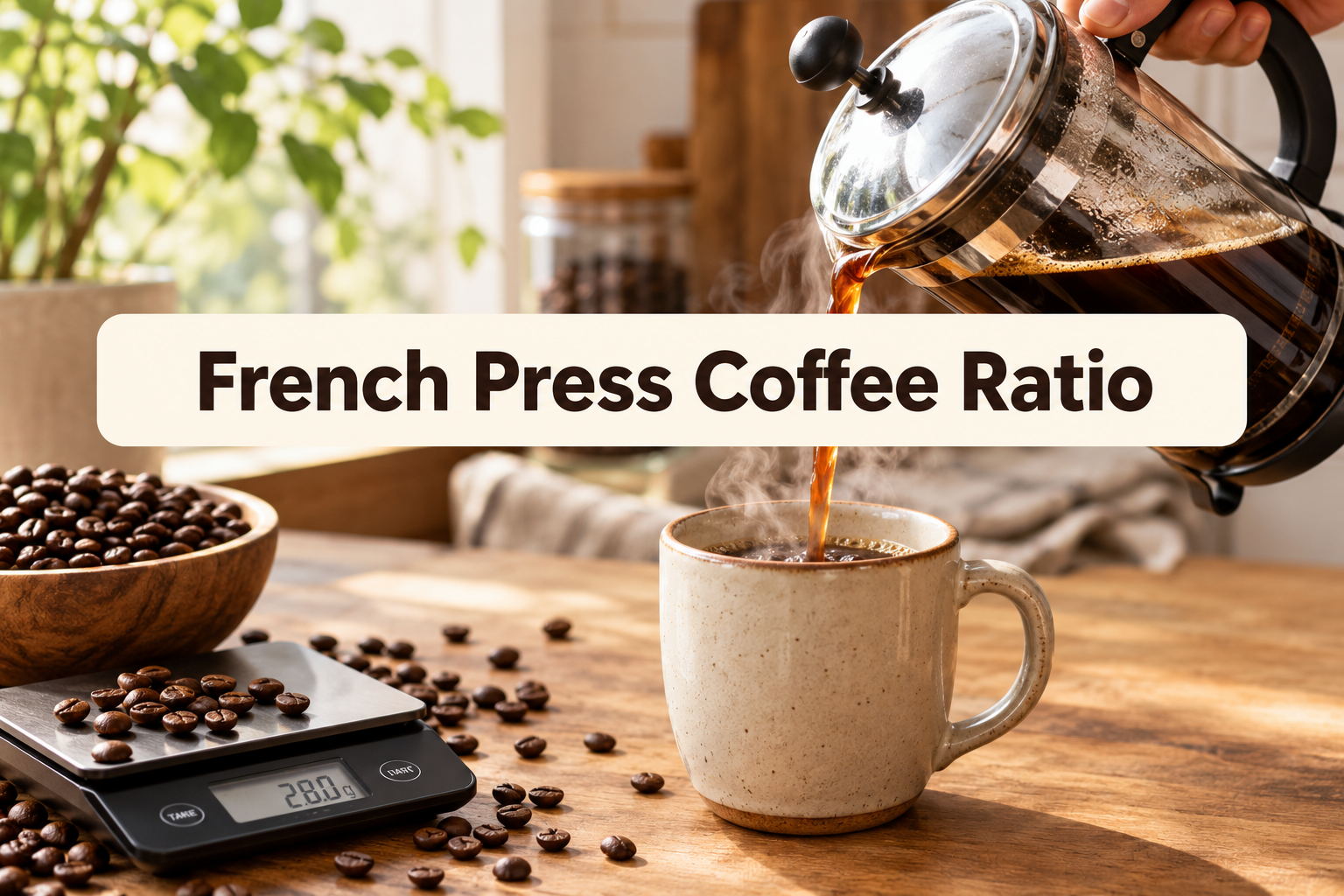
The french press coffee ratio that most 2026 brew guides agree on is 1:15, or 1 gram of coffee for every 15 grams of water. That single number is the starting point for almost every recipe you'll find, and it produces a cup that's full-bodied without tipping into bitterness.
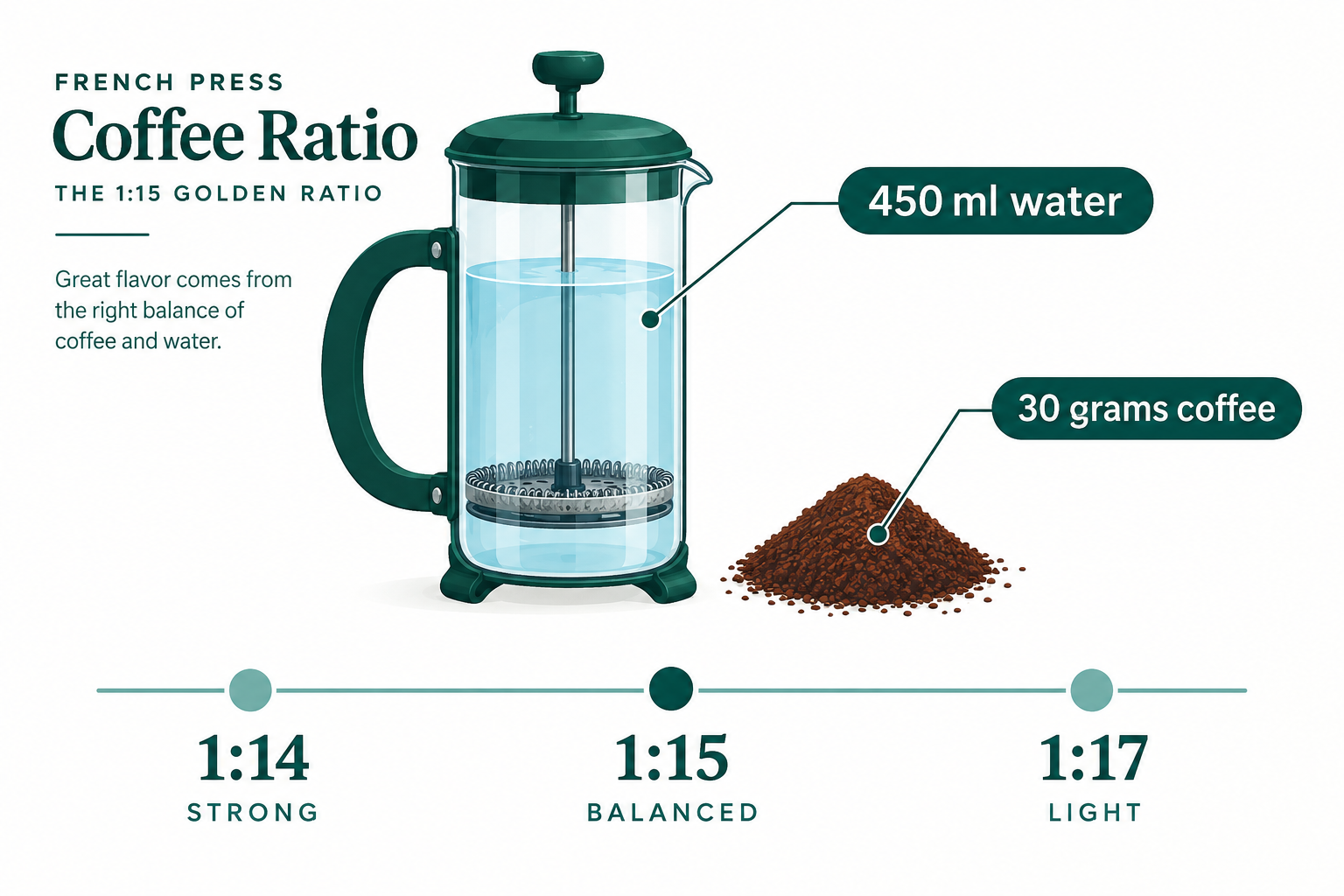
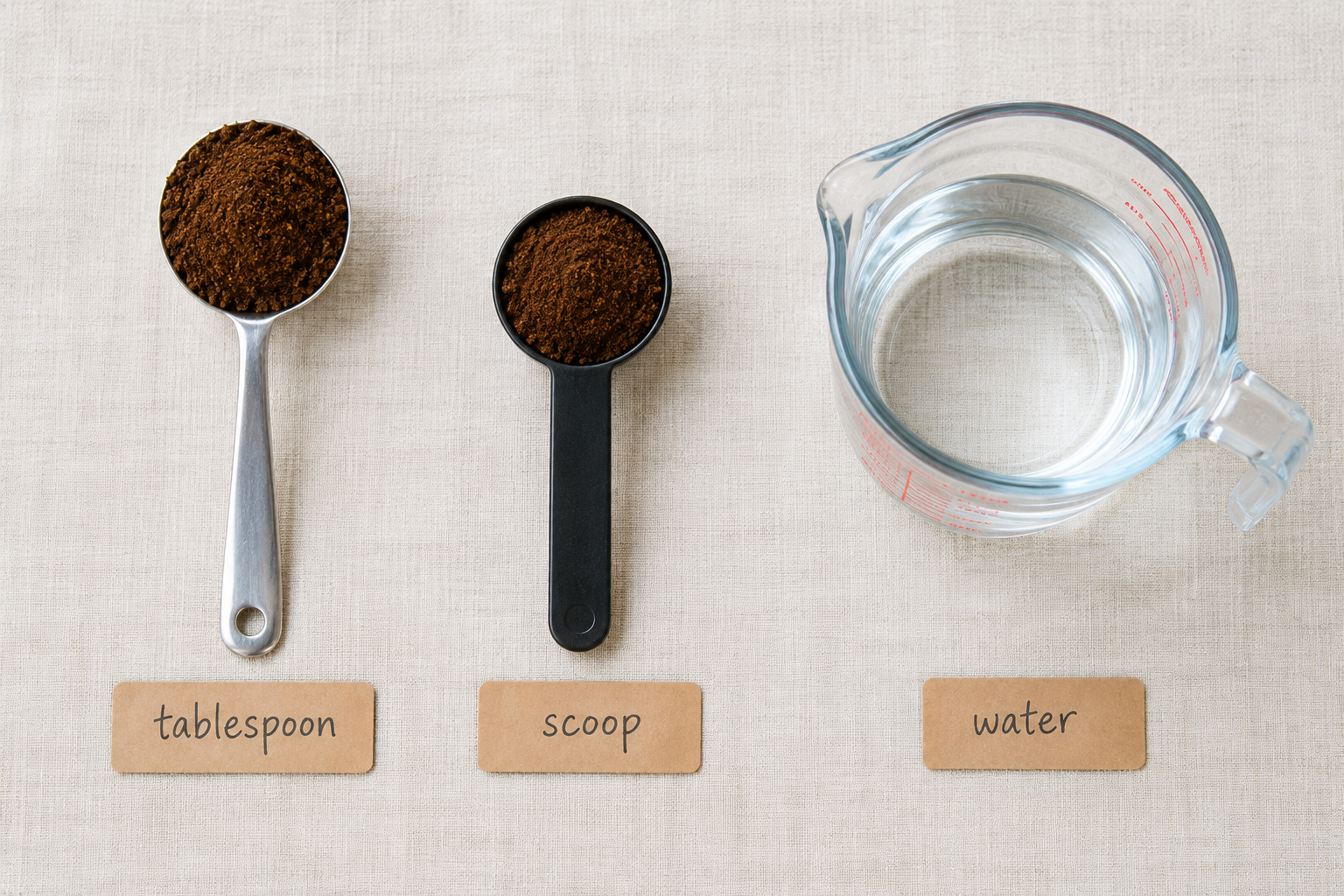
Coffee measurement works in weight, not volume, because beans vary in density. A tablespoon of a light, airy roast weighs less than a tablespoon of a dense, oily dark roast, even though the scoop looks identical. Weighing coffee on a kitchen scale removes that guesswork and is the single biggest upgrade you can make if you've been eyeballing scoops for years.
That said, 1:15 is a target, not a rule carved in stone. Coffee professionals and brew calculators generally work within a 1:14 to 1:17 range, adjusting the dose based on roast, bean freshness, and personal taste. Lower ratios like 1:14 mean more coffee relative to water, producing a heavier, richer cup. Higher ratios like 1:17 stretch the same beans further and taste cleaner and lighter. Neither one is wrong. They're just different destinations from the same map.
If you want a deeper walkthrough of the full brewing process, not just the numbers, our beginners guide to using a french press for coffee covers pouring technique and plunge timing in more detail.
How Many Grams of Coffee for French Press
The grams of coffee you need for a french press depends entirely on the size of your carafe, but the math is simple once you know the ratio: divide the water weight in grams by 15, and that's your coffee dose. A 300 ml press needs about 20 grams; a 1 liter press needs about 67 grams.
Most french press carafes are sold by "cup" count, but those cups are usually 4 oz (120 ml) each, not the 8 oz mug you're picturing. That mismatch is the most common source of confusion when a recipe says "use this much per cup."
French Press Coffee Ratio for 2 Cups
A 2-cup french press (roughly 240 to 280 ml of water) needs about 16 to 19 grams of coffee at a 1:15 ratio. That's close to 2.5 tablespoons, and it makes one generous mug rather than two small ones, since "2 cups" refers to the small 4 oz cup measure printed on most carafes.
4 Cup French Press Coffee Ratio
The 4 cup french press coffee ratio is the most common one home brewers ask about, since a 4-cup press (about 450 to 500 ml) is the standard size sold at most retailers, including Bodum's Chambord line. At 1:15, that's 30 to 33 grams of coffee, or roughly 4 to 4.5 tablespoons. This size makes about two full 8 oz mugs, which is why it's the default recipe on nearly every french press box.
French Press Coffee Ratio for 8 Cup Pot
An 8-cup french press holds close to 1 liter (34 oz) of water. At the standard 1:15 ratio, that calls for about 60 to 67 grams of coffee, roughly 13 level tablespoons. If you're brewing for a household or a small gathering, this is the size that stops you from running the plunger twice.
How to Make French Press Coffee for One
Making french press coffee for one person usually means using a smaller press (300 to 350 ml) or filling a larger carafe only partway. At 1:15, a single 300 ml serving needs about 20 grams of coffee, which is roughly 3 heaping tablespoons or 2 standard coffee scoops. Compact models like the Espro P3 or Fellow Clara, both built with double-mesh filtration to reduce sediment, work well for single servings without wasting water on a half-empty carafe.
For step-by-step brewing beyond the ratio itself, our guide to perfecting your french press coffee recipe walks through pouring, blooming, and plunge timing in order.
French Press Coffee Ratio: Cups, Tablespoons, and Scoops
If you don't own a scale, tablespoons and scoops get you close enough. One level tablespoon of coarsely ground coffee weighs roughly 5 to 6 grams, and a standard plastic coffee scoop holds about 10 to 11 grams. Use the table below as a quick reference.
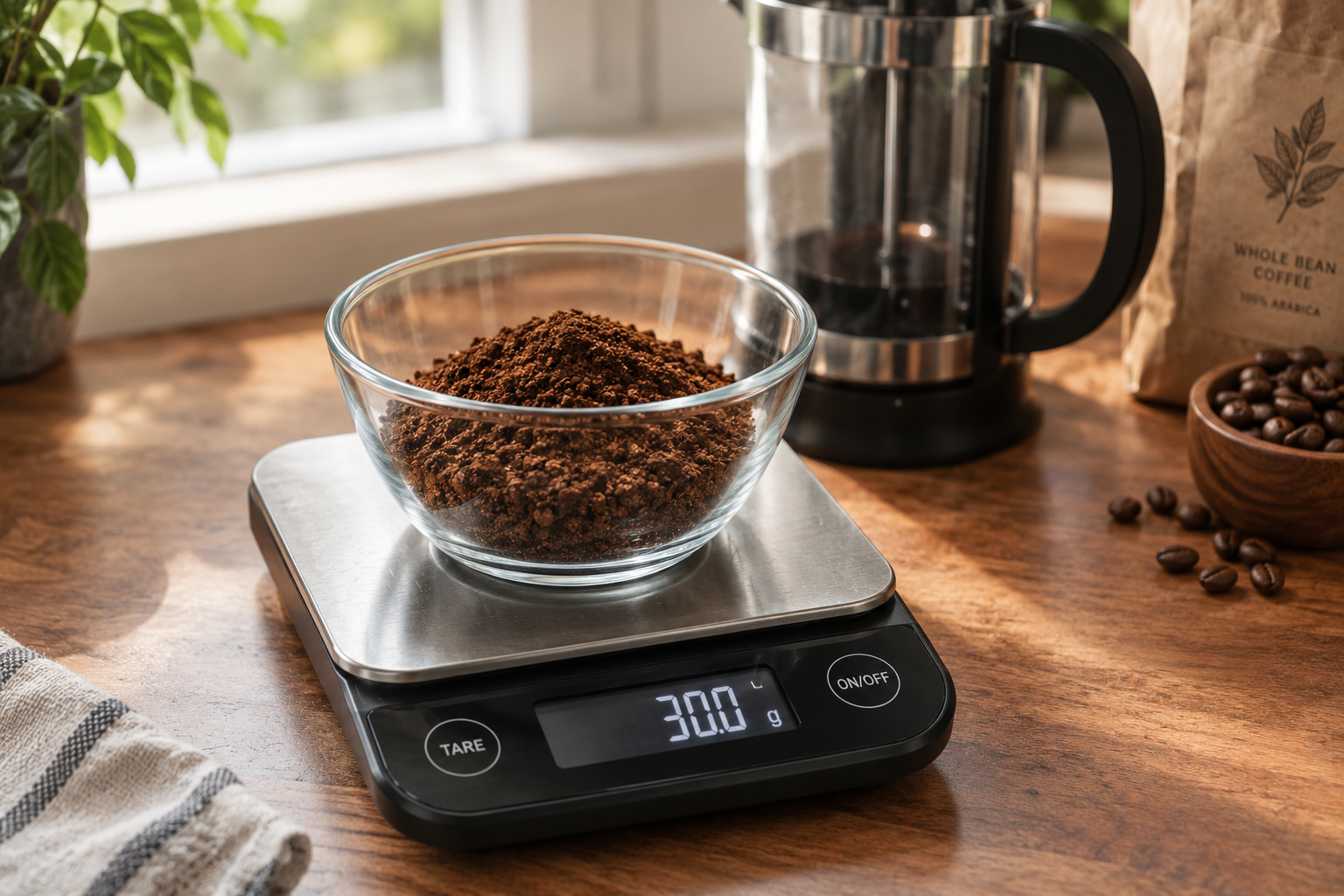
| Water amount | Coffee (grams, 1:15) | Tablespoons | Scoops |
|---|---|---|---|
| 240 ml (1 cup) | 16 g | 3 tbsp | 1.5 scoops |
| 450 ml (4 cups) | 30 g | 5 tbsp | 3 scoops |
| 700 ml (6 cups) | 47 g | 8 tbsp | 4.5 scoops |
| 1,000 ml (8 cups) | 67 g | 13 tbsp | 6.5 scoops |
Metric vs Imperial Measurements
Metric measurements (grams and milliliters) are more accurate than imperial ones (cups and tablespoons) because 1 gram of water equals 1 milliliter, which makes ratio math a simple division problem. Cups and tablespoons vary by how tightly you pack the scoop, which is why two people using "the same recipe" can end up with noticeably different strength.
A simple rule of thumb from current brew calculators: take your water weight in grams and divide by 16 for a balanced cup, then nudge the number up or down by 2 to 3 grams to land anywhere between 1:15 and 1:17 depending on preference. A french press coffee ratio calculator does this math instantly and is worth using at least once to calibrate your eye for scoops afterward.
Common Ratio Mistakes: Weak Coffee, Too Much Coffee, and Overloaded Presses
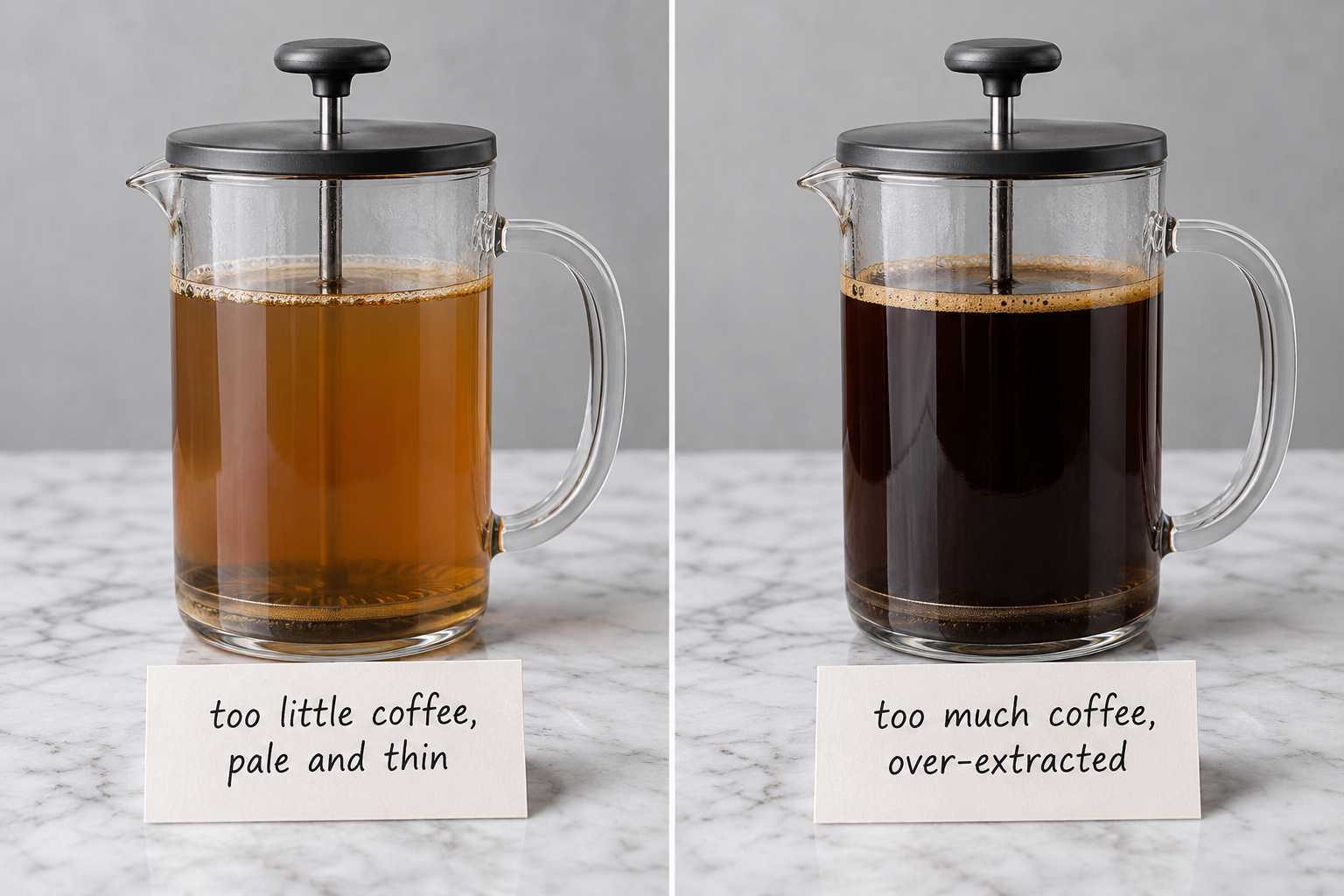
Weak french press coffee almost always comes from too little coffee relative to water, water that dropped below brewing temperature before you poured, or grounds so fine they clog the mesh filter and stop the steep from working properly.
Here's what actually causes a thin cup:
- Under-dosing. Eyeballing a scoop instead of weighing it typically shorts the ratio by 15 to 20%.
- Water that's cooled too much. Extraction slows dramatically below 195°F, leaving sugars and oils in the grounds instead of in your cup.
- Grind too fine. Fine particles clog the filter, so you end up plunging fast and pouring off a shorter steep than intended.
- Stale beans. Coffee loses aromatic compounds within two to three weeks of the roast date, and stale beans simply have less flavor to extract, even at the correct ratio.
On the other end, using too much coffee in a french press produces a cup that tastes bitter, chalky, and muddy rather than strong. Once the ratio drops much past 1:12, the water can't fully extract or dissolve everything in the grounds, so you get over-extracted bitterness sitting on top of under-extracted sourness at the same time. More coffee isn't the same as better coffee; it just changes where the imbalance shows up.
Decision rule: if your coffee tastes sour or weak, add 2 to 3 grams of coffee before you touch anything else. If it tastes bitter or harsh, remove 2 to 3 grams first, then check your grind size.
French Press Ratio for Strong Coffee vs Mild (and Espresso-Strength Brews)
For strong coffee, use a tighter ratio like 1:14, meaning more coffee per liter of water. For a mild, easy-drinking cup, move toward 1:16 or 1:17. Neither direction changes the brew time much; both still work within the standard 4-minute steep.
Roast level plays into this too. Very light filter roasts often taste best closer to 1:14.5-1:15, since a slightly lower ratio helps pull out sweetness and fruit notes that a lighter roast tends to hide. Medium and darker roasts generally land well at 1:15 to 1:16, since they already carry more body and less acidity to balance.
French press coffee will never taste identical to espresso, and that's a mechanism issue, not a ratio issue. Espresso forces hot water through finely packed grounds under roughly 9 bars of pressure in under 30 seconds, extracting oils and crema that a gravity-based immersion method like a french press simply can't replicate. If you're chasing espresso-style intensity from a french press, the closest you'll get is a 1:12 to 1:13 ratio with a shorter 2.5 to 3 minute steep, but expect a heavier, muddier cup rather than a true shot. If espresso is really what you're after, our guide on what coffee you can make with an espresso machine is a better starting point than pushing a french press past its design.
Can You Use Pre-Ground Coffee in a French Press
Yes, pre-ground coffee works in a french press as long as it's ground coarse, similar to sea salt or breadcrumbs. Pre-ground coffee sold specifically for drip machines or espresso is ground too fine and will clog the mesh filter, leaving grit in your cup and a slow, uneven plunge.
Check the bag before you buy: some roasters, including Starbucks, sell french-press-specific grinds alongside their whole bean and drip options. If the label doesn't specify a grind size for immersion brewing, whole beans and a burr grinder give you far more control, and freshly ground coffee also holds more aroma since ground coffee stales within days rather than weeks. Our guide to grinding coffee beans for a perfect brew breaks down exactly what "coarse" should look and feel like.
How Long to Steep French Press Coffee (Brew Time by Ratio)
The standard french press brew time is 4 minutes from the moment hot water hits the grounds to the moment you press the plunger, and that stays roughly constant whether you're brewing at 1:14 or 1:17. Changing the coffee dose is a more reliable way to adjust strength than stretching the clock.
That said, small time adjustments do have a role:
- 0 to 30 seconds: Bloom. Pour a small amount of water, let the grounds swell and release trapped gas.
- 30 seconds to 4 minutes: Add the rest of the water and let it steep undisturbed.
- 4 to 4:30 minutes: Press the plunger slowly and evenly.
- Immediately after: Pour off the coffee. Letting it sit on the grounds after pressing keeps extracting and turns bitter within 10 to 15 minutes.
If you push the steep to 5 or 6 minutes to compensate for a lighter ratio, expect more bitterness rather than more strength, since you're extracting compounds you don't actually want more of.
Does Grind Size Change the French Press Coffee Ratio
Grind size doesn't change the ratio itself, but it changes how effectively that ratio extracts, which is why the same 1:15 dose can taste completely different depending on the grind. A coarse, even grind is what makes 1:15 taste balanced in the first place.
Too fine a grind over-extracts quickly, pulling out bitter compounds and clogging the metal mesh filter so much sediment slips into the cup. Too coarse a grind under-extracts, tasting thin and sour even at a strong 1:14 ratio, because the water passes through without enough contact time to dissolve the good stuff. A burr grinder set to a coarse, consistent size does more for cup quality than fine-tuning the ratio by a gram or two. If your current grinder can't hold a consistent coarse setting, our advanced coffee grinders guide compares models built specifically for immersion brewing.
French Press Coffee Ratio for Cold Brew
French press cold brew uses a much stronger ratio than hot brewing, typically 1:8 to 1:10, because cold water extracts far more slowly and needs a longer steep to compensate. A common recipe is 60 to 70 grams of coarse coffee per 500 ml of cold water, steeped in the fridge for 12 to 18 hours before pressing.
Since cold water pulls out less bitterness and acidity than hot water, a stronger ratio doesn't taste harsh the way it would at 195°F. Most people dilute the finished concentrate with water, milk, or ice at a 1:1 ratio before drinking, so the "brewing ratio" and the "drinking ratio" end up quite different.
Best French Press Ratio for Different Coffee Beans and Machines
The best ratio shifts slightly depending on the bean's origin and processing method, since those factors change how much natural sugar and acidity there is to extract. A washed, single-origin light roast often shines closer to 1:15, showing off clarity and brightness, while a natural-processed or darker roast can handle 1:14 without turning muddy, since it already carries more body to support the extra dose.
The carafe itself matters less than the ratio, but not zero. A Bodum Chambord, the classic glass-and-chrome design most people picture when they hear "french press," holds heat reasonably well but has no insulation, so brewing in a cold kitchen can pull water below ideal temperature mid-steep. The Espro P3 uses a double-filter system that traps more fine sediment, which lets you lean slightly stronger, closer to 1:14, without as much grit in the final cup. The Fellow Clara adds a vacuum-insulated body, holding water temperature steady for the full steep, which matters most if you tend to get distracted between pouring and pressing.
If you're still deciding between beans, our buyers guide to choosing the right coffee beans for your recipes breaks down origin and roast level in more depth, and our advanced coffee brewing equipment buying guide covers carafe materials and filter types side by side.
Quick Ratio Calculator
French Press Coffee Ratio Calculator
FAQ
What is the best coffee to water ratio for french press? Most guides settle on 1:15 (1 gram coffee per 15 grams water) as the balanced default, with a working range of 1:14 for strong to 1:17 for light.
How many grams of coffee do I need for a 4-cup french press? About 30 to 33 grams for a 450 to 500 ml press, which is roughly 4 to 4.5 tablespoons.
Can I use tablespoons instead of a scale for my french press ratio? Yes. One level tablespoon of coarse grounds weighs about 5 to 6 grams, so 5 tablespoons gets you close to 30 grams for a standard 4-cup brew.
Why does my french press coffee taste weak even at 1:15? Check your grind first. Grounds that are too fine can clog the filter and shorten your effective steep time, and cooled water under 195°F under-extracts even at a correct ratio.
How long should I steep french press coffee? Four minutes total, including a 30-second bloom, works across most ratios from 1:14 to 1:17.
Does the french press coffee ratio change for cold brew? Yes. Cold brew uses a much stronger 1:8 to 1:10 ratio steeped 12 to 18 hours, since cold water extracts far more slowly than hot water.
Conclusion
The french press coffee ratio isn't a single fixed number, it's a small range you calibrate to your beans and your taste. Start at 1:15, weigh your coffee if you can, keep the steep near 4 minutes, and grind coarse enough that the filter can actually do its job. From there, nudge the dose up for strength or down for clarity, and let the cup itself tell you which direction to go next time.
Keep Exploring Coffee Rank IQ
- Coffee Rank IQ home: reviews, brewing guides, and coffee science
- Best Coffee Scale for Pour Over and Espresso…Timer Included
- How Many Scoops of Coffee per Cup? A Chart for 1 to 12 Cups
- Best Gooseneck Kettle: The Pour Control Most Kettles Miss
- Best French Press: Why the Filter Matters More Than the Glass
References
- French Press Brew Guide
- French Press Coffee Guide
- How Much Coffee For French Press Perfect Ratios For 2026
- French Press Calculator
- French Press
- Best French Press Method
- French Press Ratio
- How Many Grams Of Coffee Beans For A French Press
- French Press Measurements
- Coffee To Water Ratio
- French Press Coffee Ratio
- French Press Ratio Coffee To Water
- How Many Grams Of Coffee Per French Press
- How Many Scoops Of Coffee For A French Press
- French Press The Optimal Brew Ratio