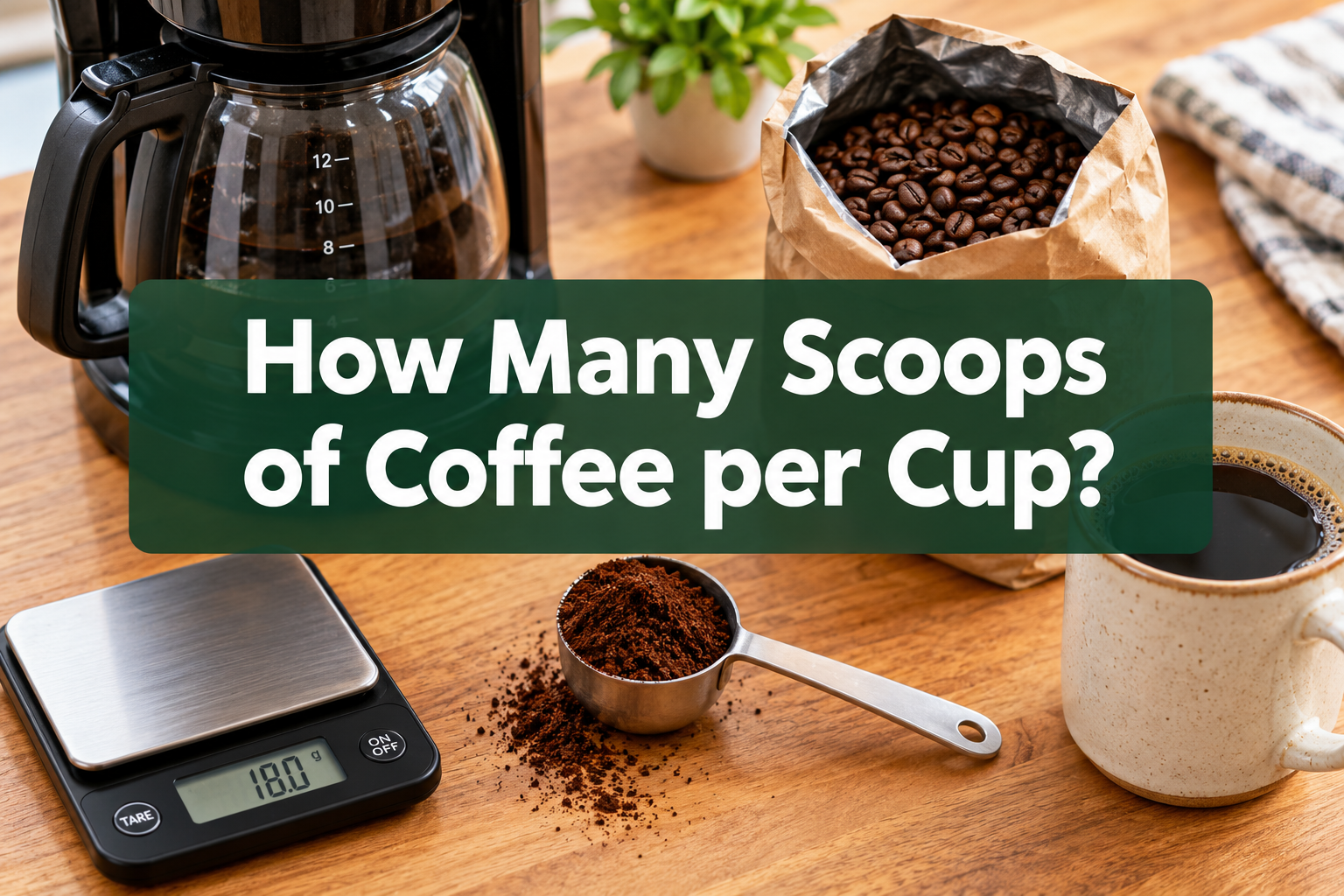
How Many Scoops of Coffee per Cup? A Chart for 1 to 12 Cups
Quick answer: For a standard drip coffee maker, use 1 scoop of ground coffee (about 2 tablespoons, or 10 grams) for every 6 fluid ounces of water. That means how many scoops of coffee per cup breaks down to a simple 1-to-1 rule: 1 cup on your machine's water line equals 1 scoop, 6 cups equals 6 scoops, and 12 cups equals 12 scoops. Adjust up to 1.5 or 2 scoops per cup if you like your coffee stronger, and keep in mind that a coffee maker's "cup" is usually 5 to 6 ounces, not the 8 to 12 ounce mug on your counter.
Key takeaways
- The base rule: 1 scoop (2 level tablespoons, roughly 10 grams) per 6 ounces of water is the standard answer to how many scoops of coffee per cup for drip brewing.
- A "cup" on your coffee maker is smaller than a mug. Most machines measure in 5 to 6 ounce cups, not the 8 to 12 ounce mug you drink from.
- The coffee to water ratio behind the scoop rule sits near 1:16 to 1:18 by weight, matching the SCA Golden Cup standard.
- For 12 cups, that's 12 scoops, or about 120 grams of ground coffee, for a full 72 ounce pot.
- Heaping scoops are the top cause of bitter, over-extracted coffee. Level scoops keep results repeatable.
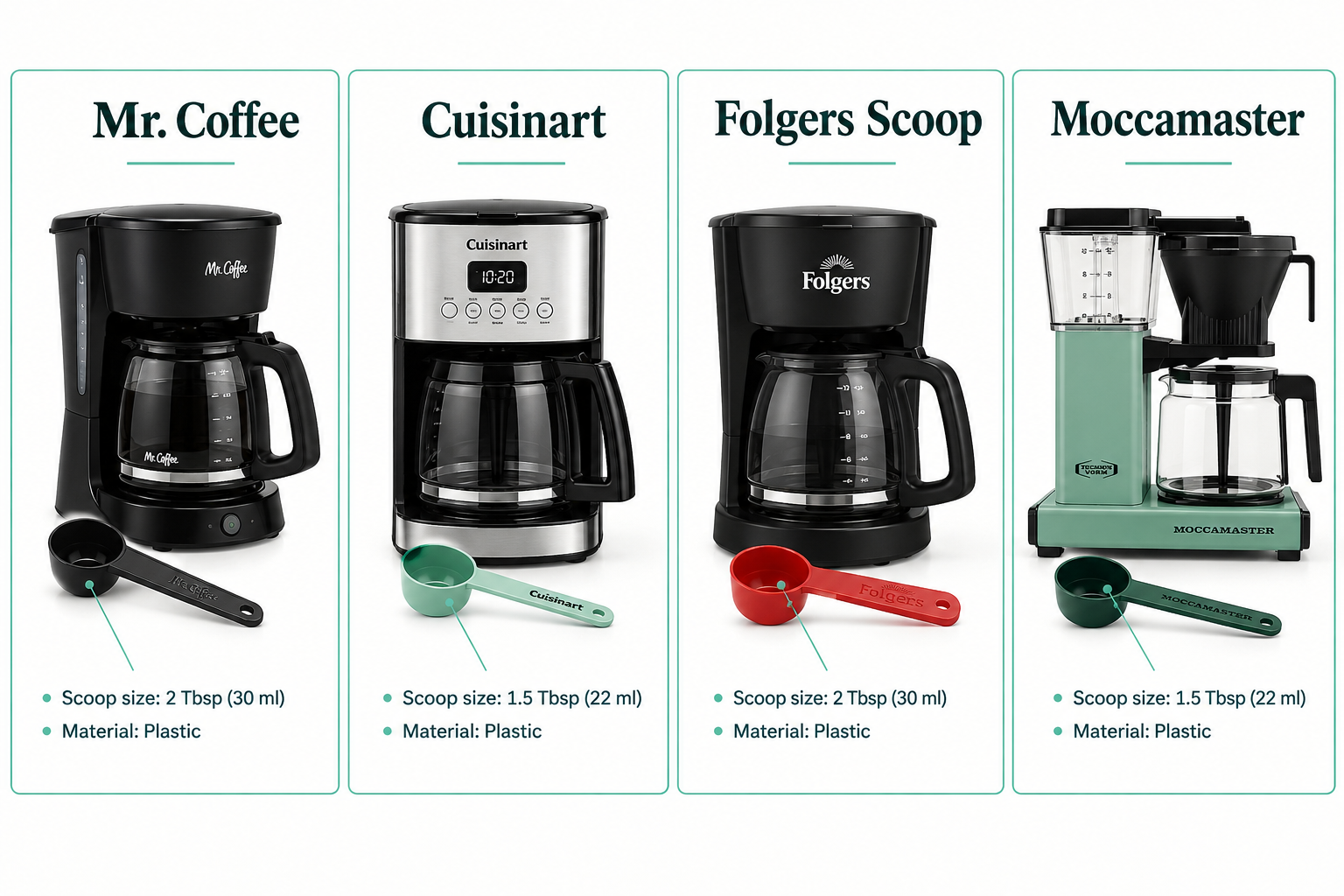
- Scoop size is not universal. Mr. Coffee, Cuisinart, and the Folgers scoop are all close to 2 tablespoons, but small differences add up over 12 cups.
- You don't need a scoop at all. A tablespoon, a kitchen scale, or even a measuring cup will get you the same result.
- Espresso doesn't use scoops the same way drip coffee does. Espresso is dosed by weight in grams, not by scoop.
How many scoops of coffee per cup
The direct answer to how many scoops of coffee per cup is 1 standard scoop, or 2 level tablespoons of ground coffee, for every 6 ounces of water your machine calls a "cup." This is the number that shows up across home brewing guides and matches the ratio used by coffee makers from Mr. Coffee to Cuisinart.
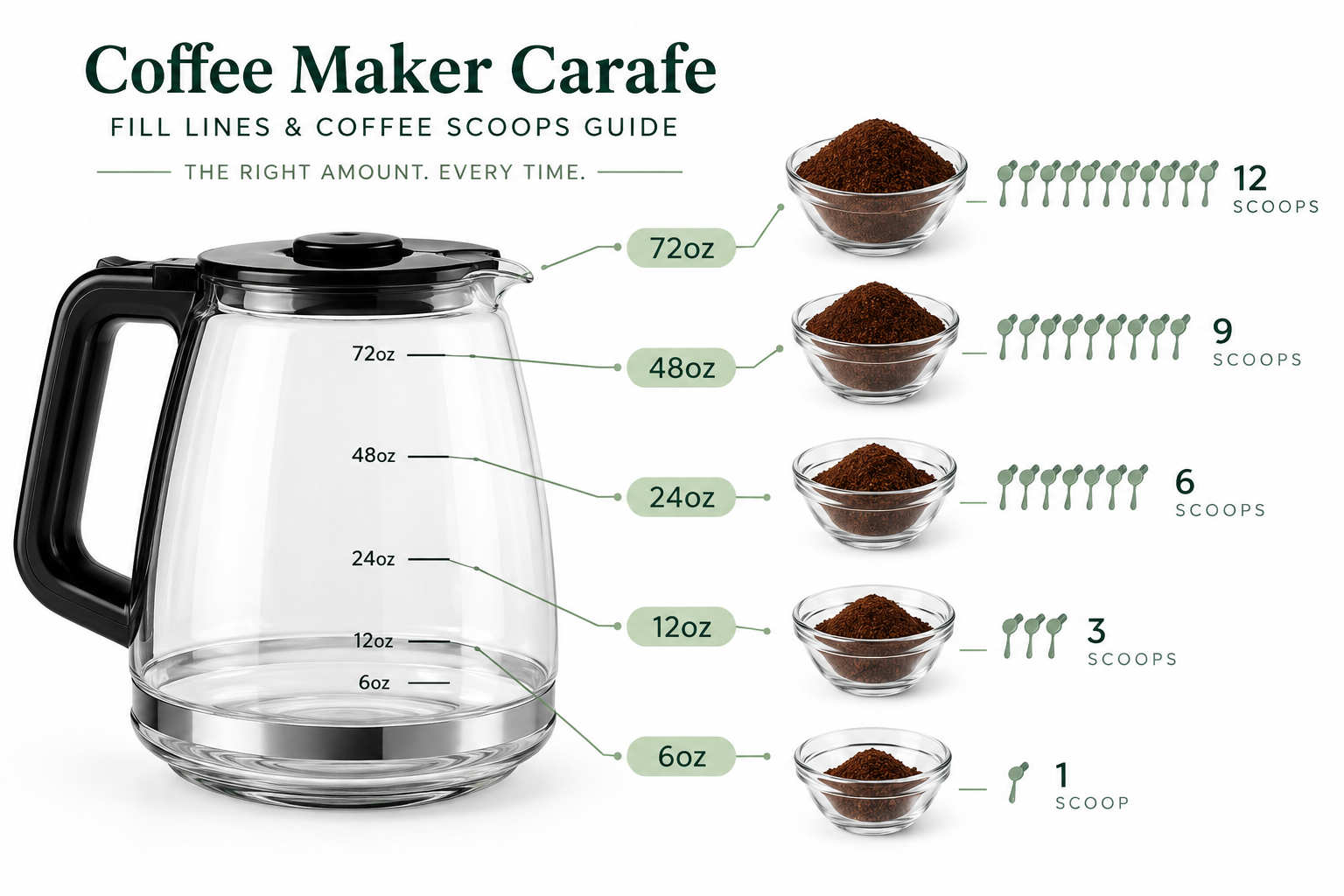
The math scales in a straight line. Double the water, double the coffee. That's why a chart works better than trying to keep in mind a formula while you're half awake at 6 a.m.
| Cups (6 oz each) | Water | Scoops (2 tbsp) | Approx. grams |
|---|---|---|---|
| 1 cup | 6 oz | 1 scoop | 10 g |
| 2 cups | 12 oz | 2 scoops | 20 g |
| 4 cups | 24 oz | 4 scoops | 40 g |
| 6 cups | 36 oz | 6 scoops | 60 g |
| 8 cups | 48 oz | 8 scoops | 80 g |
| 10 cups | 60 oz | 10 scoops | 100 g |
| 12 cups | 72 oz | 12 scoops | 120 g |
This 1-scoop-per-cup rule is the starting point, not a law. Some drinkers prefer 1.5 scoops per cup for a fuller body, especially with darker roasts that lose some perceived strength during roasting. If you're brewing for a crowd on a 12 cup machine and want it strong, 14 to 16 scoops instead of 12 is a normal adjustment, not a mistake. The rest of this guide explains why the ratio works, how to measure it without a scoop, and where the common mistakes happen.
What is a standard coffee scoop size
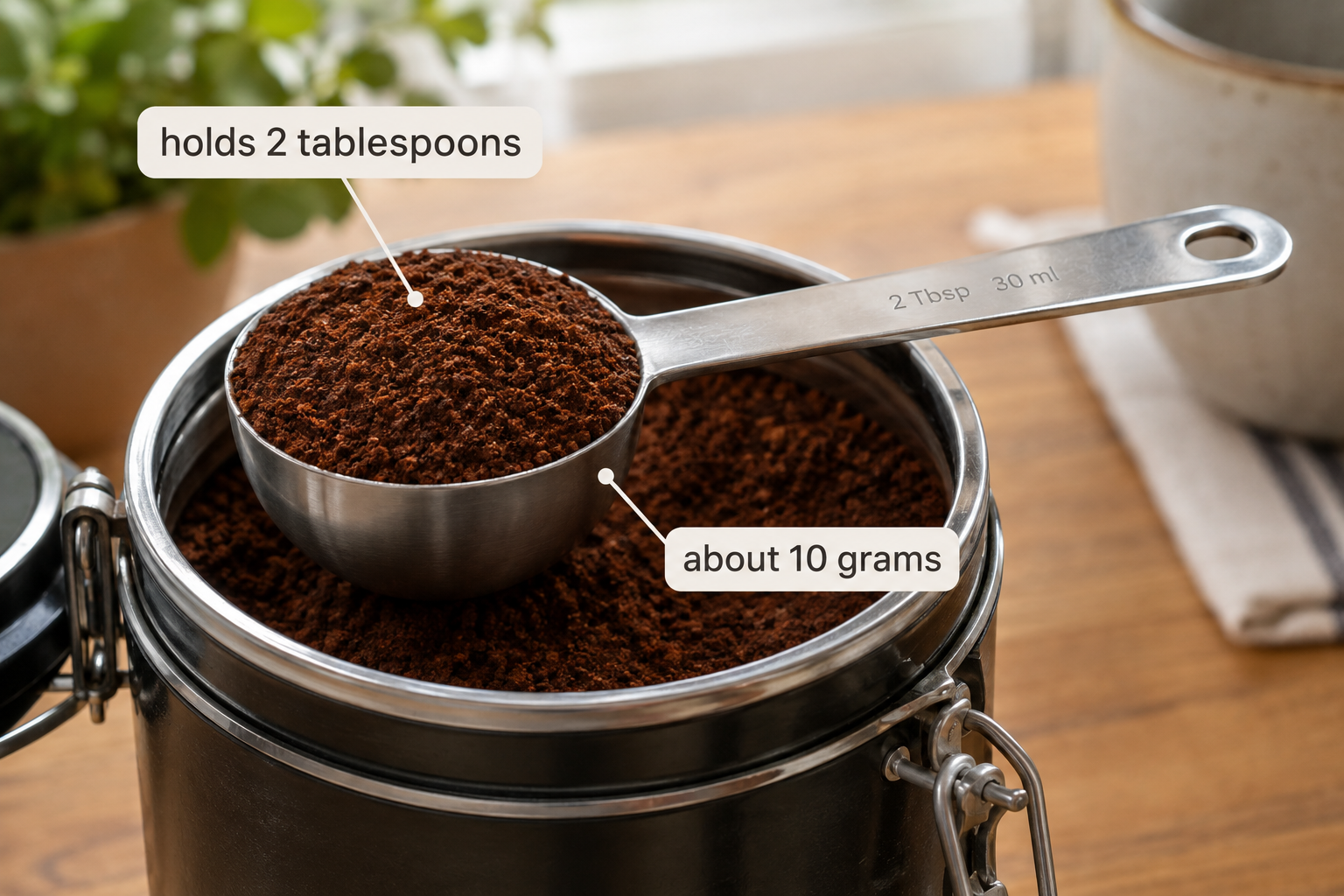
A standard coffee scoop holds 2 level tablespoons of ground coffee, which weighs approximately 10 to 10.6 grams for a medium grind. That's the size bundled with most drip machines and printed on most coffee bag scoops, including the classic Folgers scoop found in plastic canisters at the grocery store.
Not every scoop is identical. A scoop's actual volume depends on:
- Grind size: finer grounds pack more densely into the same scoop, so a scoop of fine espresso grind weighs more than a scoop of coarse cold brew grind.
- Bean density: darker roasts lose mass and expand during roasting, so a scoop of dark roast can weigh slightly less than the same scoop of light roast.
- Fill technique: a level scoop and a heaping scoop are not the same measurement, even from the identical scoop.
Decision rule: if your bag didn't come with a scoop, any tablespoon works. Two level tablespoons equals one scoop, every time, regardless of brand.
Coffee to water ratio for different cup sizes
The coffee to water ratio is the real variable behind every scoop recommendation, and it typically runs between 1:15 and 1:18 by weight for drip coffee. A tighter ratio like 1:15 gives a stronger cup; a looser ratio like 1:18 gives a lighter one.
Here's how that ratio translates by cup size, using the 6 ounce "coffee maker cup" as the base unit:
- 1:18 (Golden Cup standard): about 10 grams of coffee per 6 oz cup, or 1 scoop.
- 1:16 (everyday balanced cup): closer to 11 to 12 grams per 6 oz, or a slightly generous scoop.
- 1:15 (strong cup): roughly 13 to 14 grams per 6 oz, closer to 1.5 scoops.
The Specialty Coffee Association's Brewing Control Chart, last formally revised in March 2019 and still the reference point for professional brewing, defines the ideal zone as roughly 55 to 60 grams of coffee per liter of water. Converted to household terms, that lands almost exactly on the 1 scoop per 6 ounce rule this guide uses throughout.
How many grams of coffee per cup
For a standard 8 ounce drinking mug rather than a 6 ounce machine cup, aim for about 15 grams of ground coffee, which works out to roughly 3 level tablespoons or 1.5 standard scoops. That's a 1:16 ratio, a common target for a balanced, not-too-strong pour.
Mixing up "machine cup" (6 oz) and "drinking mug" (8 to 12 oz) is the single most common reason home brewers think their coffee maker's instructions are wrong. The instructions aren't wrong. The cup size is just smaller than you assumed.
Does scoop size matter for coffee flavor
Yes. Scoop size sets the coffee to water ratio, and that ratio is one of the biggest levers on strength, body, and bitterness. Too little coffee for the water produces a thin, sour cup from under-extraction. Too much produces a heavy, bitter cup from over-extraction.
Extraction is the process of water pulling soluble flavor compounds out of ground coffee. The compounds that dissolve first, sugars and fruit acids, and the compounds that dissolve last, bitter tannins, both scale with how much coffee sits in the water and for how long. Change the scoop count and you change how much material is available to extract, which changes the balance of those flavors in the final cup.
Grind size, water temperature, and brew time also affect extraction, which is why two people using "1 scoop per cup" can still get different results. The scoop number is a starting point. The best grind of coffee for an espresso machine is a good example of how grind changes the outcome even when the dose stays the same.
How to measure coffee without a scoop
You don't need a dedicated scoop to answer how many scoops of coffee per cup for your own brewing. Two level tablespoons equal one scoop, so any kitchen tablespoon does the same job.
Three reliable substitutes:
- Tablespoons: 2 level tablespoons = 1 scoop = about 10 grams.
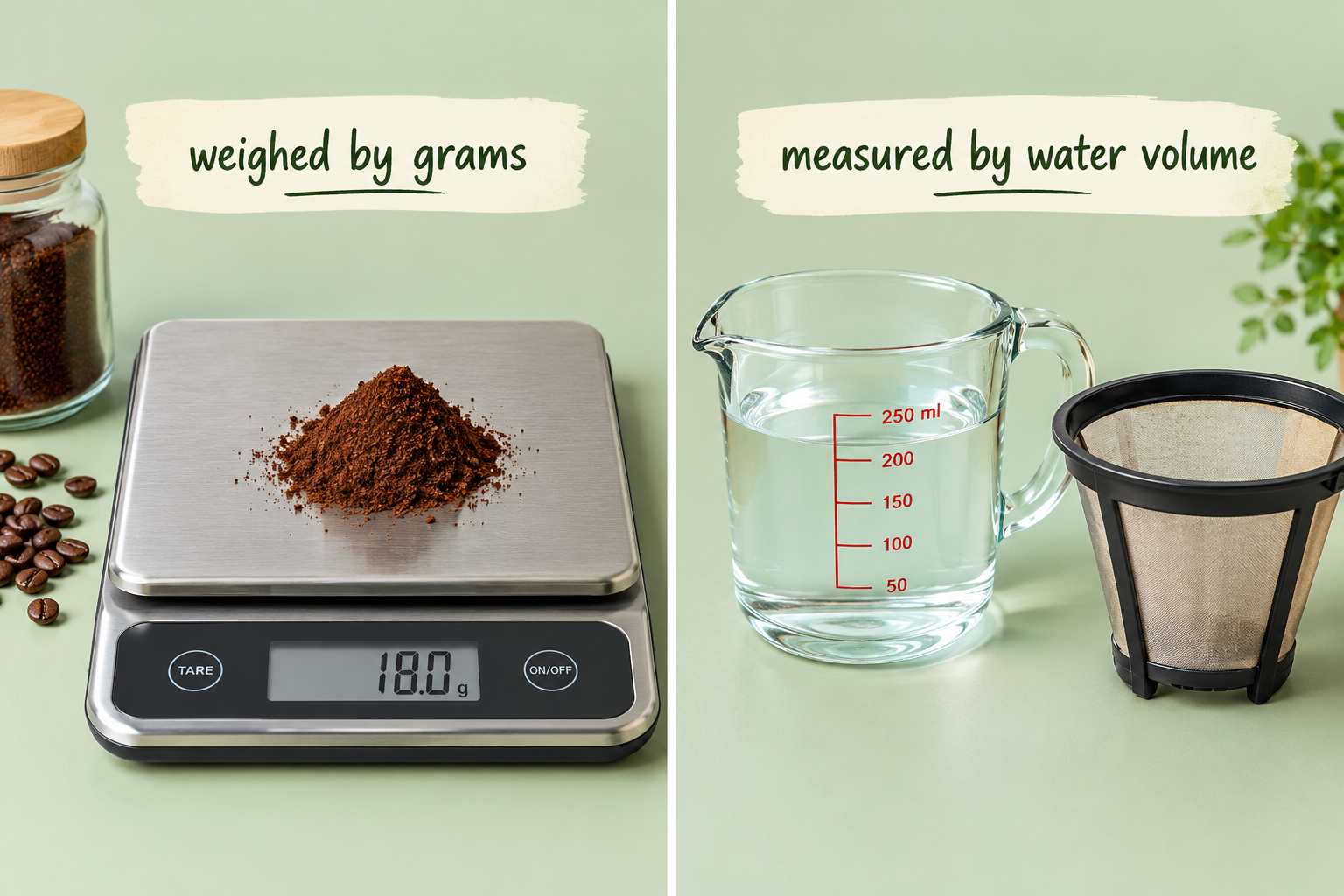
- A kitchen scale: weigh directly in grams for the most accurate result, especially useful with a manual brewer like a pour over dripper.
- A measuring cup for water, then eyeball the ratio: less precise, but workable if you already know your usual scoop count.
Common mistake: using a random spoon from the drawer as if it were a tablespoon. Regular teaspoons and soup spoons vary in volume, so a "spoonful" isn't a repeatable unit the way a measured tablespoon is.
Why does my coffee taste weak with one scoop
Weak coffee from a single scoop usually comes from one of three things: a machine "cup" that's smaller than you think, a grind that's too coarse, or beans that have gone stale past their roast date.
Work through it in this order:
- Check your machine's cup line. If you filled to what you think is "4 cups" but it's actually poured to the 24 oz line using 8 oz assumptions, you've diluted the ratio.
- Check the grind. Coarse grind extracts less per gram of coffee than medium grind, so the same scoop count tastes weaker with coarser grounds.
- Check the bag date. Coffee loses aromatic compounds within weeks of grinding, and even whole bean coffee fades within a couple of months after roasting.
- Bump the ratio. Move from 1 scoop per 6 oz to 1.25 or 1.5 scoops per 6 oz and taste again.
Can you use too much coffee per cup
Yes, and the result is bitterness, not extra caffeine benefit worth the tradeoff. Too much coffee for the water pulls excess bitter compounds into the cup and can produce a harsh, dry finish rather than a stronger, better-tasting one.
There's no hard safety ceiling for how many scoops of coffee per cup you can use. The limit is flavor. Most brewing guides put the upper edge of a reasonable ratio around 1:14 to 1:15, meaning roughly 2 scoops per 6 oz cup before the coffee starts tasting muddy rather than bold. If you want more caffeine without more bitterness, brew normally and reduce your water intake elsewhere, rather than pushing the ratio past what tastes good.
Best coffee scoop size for espresso vs drip
Drip coffee uses a scoop measured in tablespoons; espresso uses a dose measured in grams on a scale, and the two aren't interchangeable. A standard drip scoop (2 tbsp, about 10 g) is meant for 6 oz of water. A single espresso shot uses about 7 to 9 grams of finely ground coffee, and a double shot uses 14 to 18 grams, packed into a portafilter basket rather than measured with a scoop at all.
The reason comes down to grind and pressure. Espresso forces hot water through tightly packed, very fine grounds at high pressure in under 30 seconds, so the dose has to be exact to the gram to avoid a thin or choked shot. Drip coffee has minutes of contact time with a coarser grind, which gives the scoop measurement more room for error.
If you're deciding between machines, our guide on how many espresso shots equal a cup of coffee in caffeine walks through how the two brewing styles compare beyond just the dose.
How many scoops for a 12 cup coffee maker
For a full 12 cup coffee maker, use 12 scoops of ground coffee, or about 120 grams, for the full 72 ounce carafe. That's the direct answer to how many scoops of coffee for 12 cups on a standard drip machine using the 6 oz cup measurement most manufacturers, including Mr. Coffee and Cuisinart, print on the water tank.
If you prefer weighing over scooping, how much ground coffee for 12 cups comes out to roughly 110 to 130 grams depending on whether you're brewing toward a 1:18 or a 1:15 ratio. Start at 120 grams and adjust from there.
How many scoops of coffee for 8 cups (Mr. Coffee and similar machines)
For 8 cups, use 8 scoops, or about 80 grams of ground coffee, for 48 ounces of water. How much coffee for 8 cups on a Mr. Coffee machine follows the same 1-scoop-per-cup math as any other drip brewer, since Mr. Coffee's cup markings also use the standard 5 to 6 oz measurement.
How many scoops of coffee for 6 cups
Use 6 scoops, or roughly 60 grams, for 36 ounces of water. This is a common size for smaller households and single-carafe Cuisinart models.
How many scoops of coffee for 4 cups
Use 4 scoops, or roughly 40 grams, for 24 ounces of water. In tablespoons, that's about 8 tablespoons of ground coffee total.
If you're counting how many tablespoons of coffee per cup for drip brewing rather than scoops, the conversion is simple: 2 tablespoons per cup, so 4 cups needs 8 tablespoons, 8 cups needs 16 tablespoons, and 12 cups needs 24 tablespoons.
Heaping vs level scoop: what's the difference
A level scoop is filled flush with the rim and gives a consistent, repeatable measurement. A heaping scoop is piled above the rim and can add 20 to 40 percent more coffee than a level scoop, which throws off your intended ratio without you realizing it.
The fix is simple: use a level scoop as your baseline, then add coffee deliberately in known increments (an extra half scoop, an extra tablespoon) if you want it stronger. That way the change is a choice, not an accident of how firmly you tapped the scoop against the bag.
How to adjust coffee strength without changing scoop amount
You can change how strong your coffee tastes without touching the scoop count by adjusting grind size, brew time, or water temperature instead of the coffee to water ratio itself.
- Grind finer for a bolder, more extracted cup from the same dose.
- Grind coarser to lighten a cup that tastes too heavy.
- Use hotter water (around 195-205°F) for fuller extraction; cooler water pulls less flavor from the same grounds.
- Extend contact time slightly on manual brewers like a pour over, since more time in contact with water increases extraction.
- Choose a different roast or origin. A dark roast reads as "stronger" in flavor even at the same caffeine level as a light roast, because roasting changes bitterness and body, not just color.
This matters if you've already dialed in how many scoops of coffee per cup you like and don't want to keep re-measuring. Small brewing changes give you a strength dial that doesn't disturb a ratio you've already gotten right.
Does coffee scoop size vary by brand
Yes, slightly. Most bundled scoops land close to 2 tablespoons, but small differences between brands add up once you're brewing a full 12 cup pot.
- Mr. Coffee: ships a plastic scoop close to 2 tablespoons, matched to its 5 oz cup markings.
- Cuisinart: similar sizing, close to 2 tablespoons, though some Cuisinart models use a slightly shallower scoop.
- Folgers scoop: the familiar red plastic scoop found in Folgers canisters measures very close to 2 tablespoons and is one of the most common "found" scoops in American kitchens, even when used with a different brand of coffee.
- Moccamaster: this Dutch brand typically doesn't include a scoop at all and leans on brewers weighing coffee in grams, which lines up with the precision brewing philosophy behind machines built to meet European Coffee Brewing Centre standards.
- SCA Golden Cup: not a scoop at all, but a certification standard from the Specialty Coffee Association defining the accepted ratio window (roughly 1:16 to 1:18) that most consumer scoop guidelines are quietly built around.
Decision rule: if you switch coffee brands but keep using your old scoop, recheck your first pot for strength. The scoop, not the coffee, may be the reason your usual measurement suddenly tastes different. For a deeper look at how machines and grinders affect this, see our advanced coffee brewing equipment buying guide.
How many scoops for cold brew vs hot coffee
Cold brew needs more coffee per cup of water than hot drip coffee, often close to double, because cold water extracts flavor more slowly and the result is usually diluted after steeping. A common cold brew starting point is roughly 4 scoops (about 40 grams) per 24 oz of cold water, compared to 4 scoops per the same 24 oz in hot drip, but cold brew is typically brewed as a concentrate and cut with water or ice before drinking.
The difference comes from time and temperature, not from the scoop rule changing. Cold water extracts less per hour than hot water, so cold brew compensates with a longer steep (12 to 24 hours) and a heavier dose rather than heat. Our advanced cold brew coffee methods guide breaks down exact ratios for concentrate versus ready-to-drink batches.
What if I don't have a measuring scoop
If you don't have a scoop, use 2 level tablespoons per 6 ounces of water as your substitute measurement, since that's exactly what a standard scoop holds. A tablespoon from a kitchen drawer is just as accurate as a bundled plastic scoop, as long as you keep it level.
If you also don't have measuring spoons, a rough eyeball method works in a pinch: a level tablespoon of ground coffee looks like a small, rounded mound, roughly the size of half a golf ball. It's not exact, but it beats guessing at random. For repeatable results long-term, a $10 kitchen scale removes the guesswork entirely and lets you measure by grams instead, which is the same approach professional baristas and machines like the Moccamaster are built around.
FAQ
How many scoops of coffee per cup should I use for a full 12 cup pot? Use 12 scoops (about 120 grams) for a full 12 cup pot, based on the standard 1 scoop per 6 oz rule most drip machines use.
How many tablespoons of coffee per cup for drip brewing? Use 2 level tablespoons per 6 oz cup. That's the same measurement as 1 standard scoop.
How much coffee for 8 cups on a Mr. Coffee machine? Use 8 scoops, or about 80 grams, for 48 ounces of water, since Mr. Coffee's cup lines follow the standard 6 oz measurement.
Why does my coffee taste weak even though I used the right number of scoops? Check whether your grind is too coarse, your beans are past their roast date, or your machine's "cup" line is smaller than the mug you're picturing. Any of these can weaken a technically correct scoop count.
Do I need to change my scoop count for cold brew? Not exactly. Cold brew usually uses a similar or slightly higher scoop count per water volume, but it's brewed as a concentrate and diluted afterward, so the finished strength ends up different from hot drip.
Is a heaping scoop the same as a level scoop? No. A heaping scoop can hold 20 to 40 percent more coffee than a level scoop, which throws off your intended coffee to water ratio without you changing anything else.
Conclusion
The scoop-per-cup rule is simple because it's built on a ratio that professional brewers already trust: roughly 1 scoop, or 2 tablespoons, per 6 ounces of water, sitting inside the SCA's accepted brewing range. Once you know that number, every cup size from 1 to 12 is just multiplication, and every strength adjustment becomes a small, deliberate change instead of a guess.
Start with the chart above, measure level scoops, and taste before you add more. If the cup still isn't right after adjusting the ratio, check your grind size and your roast date next. Better coffee starts with better answers, not a bigger scoop.
Comparing coffee makers or grinders before you commit to a scoop routine? Compare the models to see which one fits your counter and your cup count.
Coffee scoop calculator
Keep Exploring Coffee Rank IQ
- Coffee Rank IQ home: reviews, brewing guides, and coffee science
- Best Coffee Scale for Pour Over and Espresso…Timer Included
- French Press Coffee Ratio: The Grams, Cups, and Scoops That Work
- Best Gooseneck Kettle: The Pour Control Most Kettles Miss
- How to Make Coffee Without a Coffee Maker: 6 Methods I Trust
References
- static1.squarespace.com/static/587af1d4db29d69a1a226b95/t/60aece65e4f2134d99f6e646/1622068839009/SCA+Brewing+Chart+-+Revised+March+2019-US-Letter.pdf
- mycoffeeexplorer.com/blog/coffee-to-water-ratio-guide
- fond.kitchen/glossary/brew-ratio
- www.roastycoffee.com/measure-coffee
- bostonbeancoffee.com/2026/06/01/how-many-scoops-of-coffee-do-you-need-per-cup-home-office-brewing-guide
- coffee.foodnutrify.com/guides/coffee-per-cup
- www.gigacalculator.com/calculators/coffee-to-water-ratio-calculator.php
- www.roastcc.com/learn/coffee-brewing-ratios