
Coffee Jitters: Why Genes and Dose Decide
Quick Answer
Coffee jitters happen when caffeine blocks adenosine receptors in your brain and triggers an adrenaline response, producing tremor, a racing heart, and restlessness. Two things decide whether you feel it: how much caffeine you took in, and how your body handles it. The FDA and Mayo Clinic put 400 mg a day, roughly four 8 oz cups of brewed coffee, in the range most healthy adults tolerate . Gene variants in CYP1A2 (clearance speed) and ADORA2A (receptor sensitivity) help explain why your friend sleeps fine after an espresso at 9 pm and you do not .
Key Takeaways
- 400 mg of caffeine per day is the amount Mayo Clinic cites as generally safe for healthy adults, about four 8 oz brewed coffees .
- A meta-analysis of 546 healthy participants found caffeine raised anxiety measures with a standardized mean difference of 0.94, climbing to 2.86 at high doses, with intake above 400 mg flagged as the sharper risk zone.
- CYP1A2 rs762551 sorts people into faster and slower caffeine metabolizers. Slow metabolizers hold higher blood caffeine for longer at the same dose .
- ADORA2A rs5751876 sits closer to the feeling itself. It encodes the adenosine A2A receptor and has been linked to caffeine-related anxiety and sleep disruption .
- Caffeine's half-life in healthy adults is commonly cited around 5 hours, so a 2 pm cup can still be half-present at 7 pm .
- An October 2026 analysis of 26 commercial coffee products found caffeine concentrations from 4.10 to 26.40 g/kg, meaning two identical-looking cups can carry very different doses.
- Coffee jitters usually fade in 2 to 6 hours without treatment. Palpitations that keep returning, or any chest pain, belong in front of a doctor, not a blog post.
What causes coffee jitters?
Coffee jitters are a stimulant response, not nerves. Caffeine blocks adenosine, the molecule that accumulates during the day and tells your brain it is tired. With that brake off, neural firing increases and the adrenal system releases more adrenaline .

That adrenaline is the part you actually notice. The hands shake slightly. The heart beats faster. Thoughts come quicker than you can use them. The FDA lists jitters, anxiety, palpitations, insomnia, nausea, and raised blood pressure among possible caffeine effects, and clinicians describe the same cluster .
Three ordinary conditions make it worse on any given morning:
- Empty stomach. Caffeine reaches peak blood levels faster with nothing to slow absorption.
- Short sleep. Adenosine pressure is already high, so the blocking effect feels sharper, and you tend to drink more to compensate.
- Stacked doses. Two cups in forty minutes behaves very differently from two cups four hours apart.
The shakes are pharmacology plus timing. Not weakness, not a character flaw, and not evidence you should quit coffee.
Coffee jitters
Here is the full answer to the question most people are actually asking. Coffee jitters are caused by a dose of caffeine that exceeds what your nervous system tolerates in that moment, and your personal threshold is shaped partly by inherited differences in caffeine clearance and receptor sensitivity. Dose is the lever you control. Genetics sets where the lever starts.
The misconception worth correcting: many people assume coffee jitters mean they are "sensitive to coffee" as a fixed trait, so they quit entirely. That skips the simpler variable. A systematic review published in October 2026 concluded caffeine has a dose-dependent anxiogenic effect, meaning anxiety-type responses rise as the dose rises. Before deciding coffee is off the table, find out what you are actually drinking. A 20 oz café drip can hold more than double an 8 oz home brew.
The second half of the misconception is the opposite error: blaming genetics for nothing. Gene variants are real risk modifiers, documented in peer-reviewed work, but they are not diagnoses and they do not predict your reaction with precision .
So the practical frame is: measure the dose, then adjust for how your body responds. Not the other way round.
How much caffeine before you get jitters?
Most healthy adults tolerate up to 400 mg of caffeine a day, roughly four 8 oz cups of brewed coffee, according to Mayo Clinic . Jitters in sensitive people can begin well below that, sometimes around 100 to 200 mg in a single sitting, especially on an empty stomach.
The meta-analysis of 546 healthy participants is the useful datapoint here. Low doses produced a moderate increase in anxiety measures; high doses produced a much larger one, and doses above 400 mg were singled out as particularly associated with anxiety. That is a dose-response curve, not a cliff edge.
Serving size is where people get caught out. Caffeine content varies widely by brew method, bean, and cup volume.
| Drink | Typical serving | Approx. caffeine | Jitter risk |
|---|---|---|---|
| Brewed drip coffee | 8 oz | ~95 mg | Moderate |
| Espresso | 1 oz single shot | ~64 mg | Low per shot, fast onset |
| Cold brew concentrate, diluted | 12 oz | ~150-200 mg | High |
| Large café drip | 20 oz | ~240 mg+ | High |
| Decaf brewed coffee | 8 oz | ~2-5 mg | Very low |
Figures are typical ranges reported by Mayo Clinic and Cleveland Clinic . Actual content varies by bean, roast, grind size, and brew ratio. An October 2026 analysis of 26 commercial coffee products measured caffeine from 4.10 to 26.40 g/kg, a sixfold spread.
Decision rule: if you get coffee jitters regularly, weigh your dose before blaming your genes. Start by learning how many scoops of coffee per cup you are actually using and check your brew ratio.
Does genetics affect caffeine sensitivity?
Yes, and the research points to two genes doing two different jobs. CYP1A2 governs how fast your liver clears caffeine. ADORA2A governs how strongly your brain reacts to it. A systematic review of 22 studies found CYP1A2 variants were more often tied to cognitive and metabolic effects, while ADORA2A variants were more often tied to anxiety and sleep disturbance .
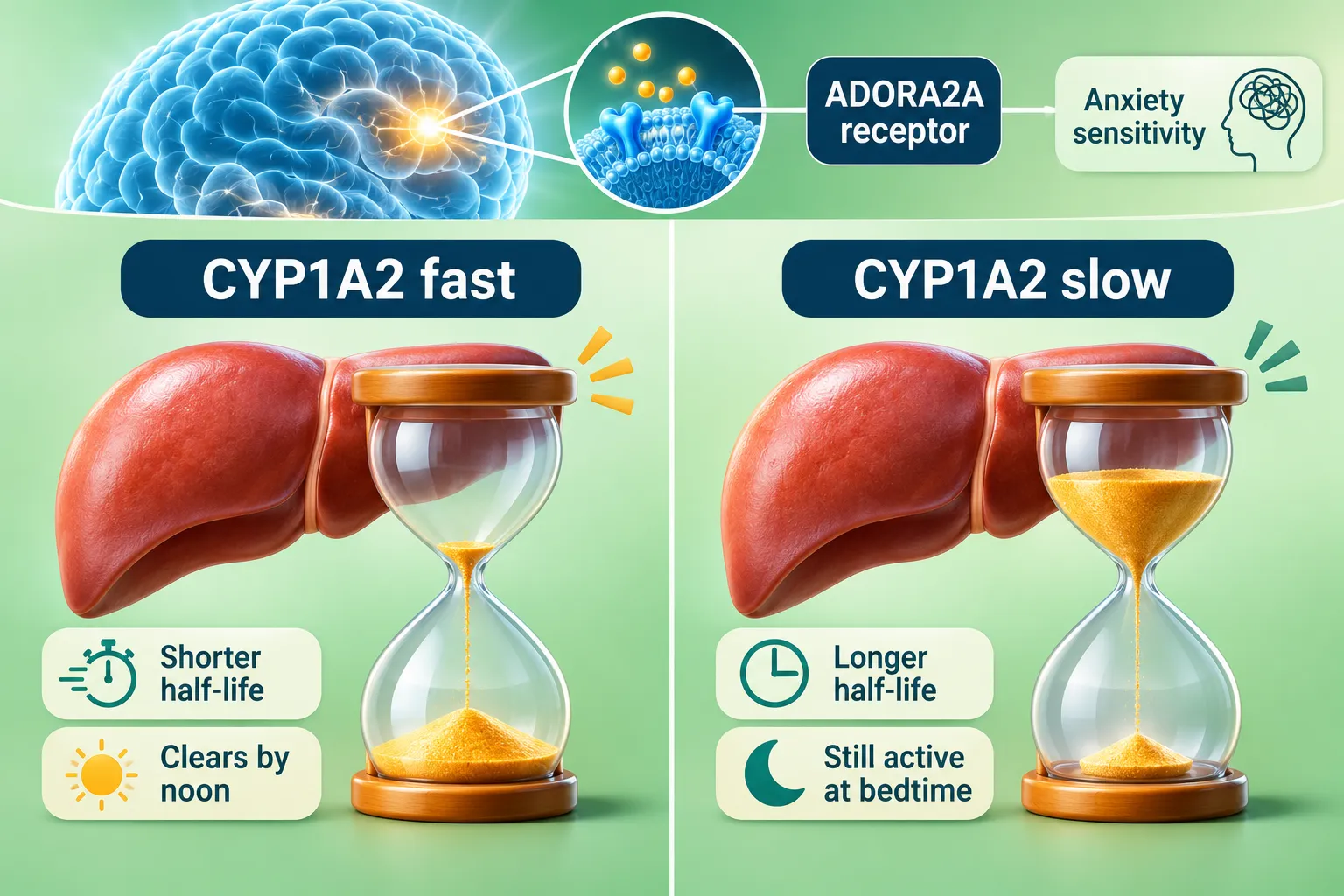
CYP1A2 and the slow caffeine metabolizer
The CYP1A2 rs762551 variant is the one most studied. People classified as a slow caffeine metabolizer keep higher blood caffeine concentrations for longer after the same cup, which can mean more sleep disruption and a longer tail of restlessness . A 2026 review in European Journal of Medical Research summarizing CYP1A2 pharmacogenetics also lists the non-genetic modifiers that matter just as much: smoking speeds clearance, oral contraceptives and pregnancy slow it, and liver function, age, and several medications shift it too .
ADORA2A gene caffeine sensitivity
The ADORA2A gene encodes the adenosine A2A receptor, caffeine's main brain target. Variants including rs5751876 have been associated with differences in caffeine-induced anxiety, alertness, and sleep quality . Earlier work, including Alsene and colleagues in 2003, reported that carriers of certain ADORA2A genotypes experienced more anxiety after a 150 mg caffeine dose than non-carriers. Sample sizes in this literature are small and findings are not perfectly consistent, so treat genotype as a risk modifier, not a label .
Limitation worth stating plainly: these are association studies in modest samples. They explain part of the variation between people, not all of it. Direct-to-consumer gene tests reporting your "caffeine sensitivity" are reading the same imperfect evidence .
Why do some people get jittery from coffee and others don't?
Four stacked reasons, in rough order of effect size:
- Dose per kilogram of body weight. A 200 mg cup hits a 55 kg person harder than a 95 kg one.
- Habitual intake. Regular drinkers develop partial tolerance to the arousal effect .
- Clearance speed. CYP1A2 status plus smoking, medication, and hormonal factors .
- Receptor sensitivity. ADORA2A variation, which shows up as subjective anxiety rather than measurable clearance .
Add baseline anxiety, sleep debt, and whether you ate breakfast, and the between-person spread stops being mysterious.
How to stop coffee jitters fast, and five fixes that actually hold
There is no antidote that pulls caffeine out of your blood. What you can do is dilute the experience and wait out the half-life. Water, a walk, and some food blunt the peak; the rest is time .
In the moment:
- Drink a glass or two of water. Caffeine is mildly diuretic, and dehydration makes shakiness feel worse.
- Eat something with protein and fat. Food slows absorption of anything still in your stomach.
- Move. A ten minute walk burns off circulating adrenaline better than sitting still and monitoring your pulse.
- Breathe slowly for two minutes. Longer exhale than inhale. It does not clear caffeine, but it reduces the anxiety loop stacked on top.
- Stop drinking more caffeine for the rest of the day, including tea, cola, and chocolate.
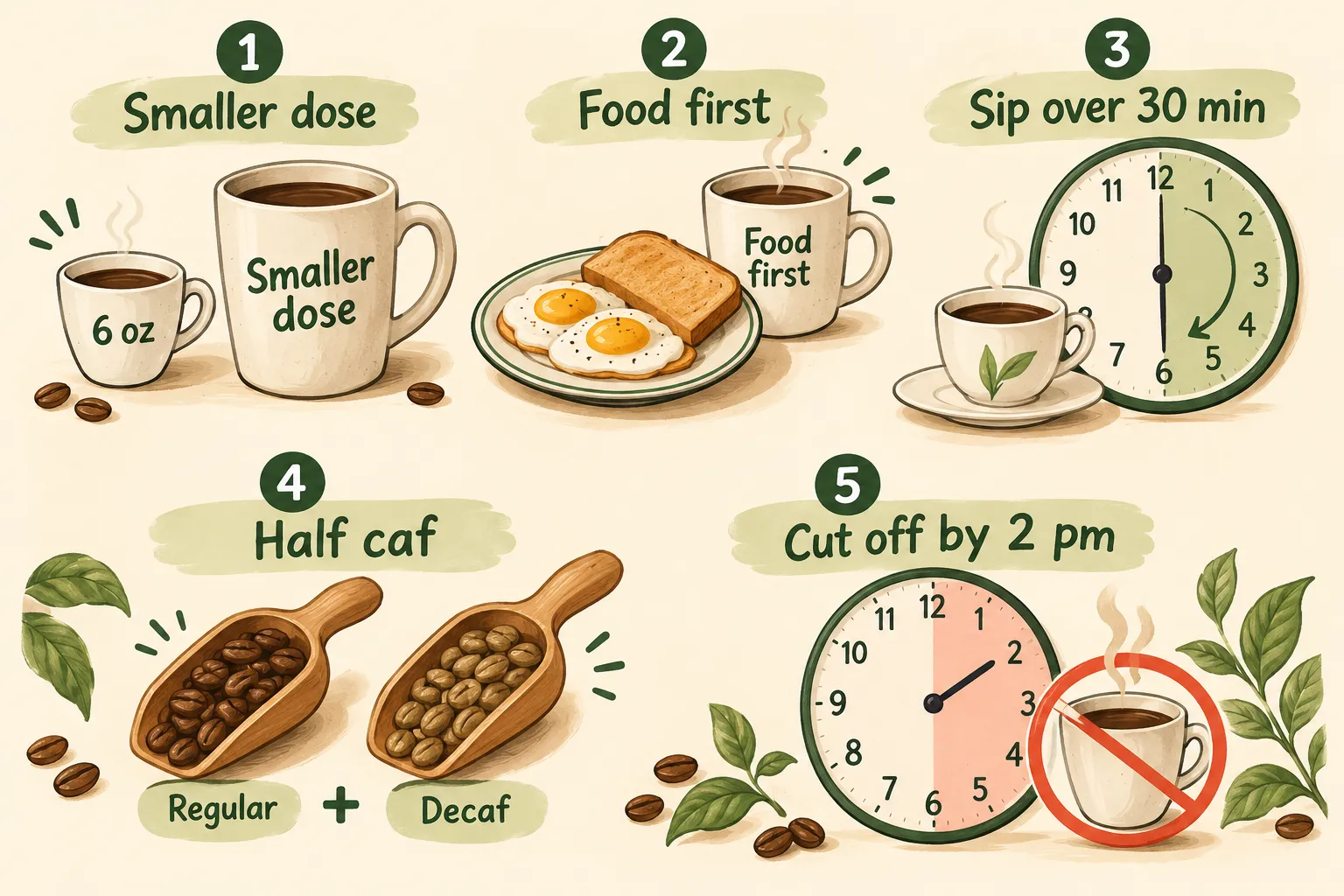
Five changes that prevent coffee jitters:
- Smaller dose. Drop from a 12 oz mug to 6 or 8 oz. This single change fixes jitters for most people.
- Food first. Coffee after breakfast, not instead of it.
- Slower sipping. Spread one cup over 30 minutes rather than 8. Lower peak concentration, same total alertness.
- Half caf. Blend 50% decaf into your regular grounds. You keep the ritual, the aroma, and the tasting notes, and halve the dose.
- Timing. With a ~5 hour half-life , a 2 pm cutoff means roughly a quarter of the caffeine remains at bedtime. If you suspect you are a slow caffeine metabolizer, move that cutoff to noon.
Supplements or foods that help with jitters
L-theanine, an amino acid found in tea leaves, is the most commonly discussed option; it is frequently paired with caffeine and often reported to smooth the edge, though evidence quality varies and it is not a treatment for anything. Food, water, magnesium-rich meals, and a proper night's sleep do more reliable work. Avoid stacking caffeine with other stimulants, including pre-workout powders and energy drinks. Check with your doctor before adding supplements, especially if you take medication for blood pressure, thyroid, or anxiety.
How long do coffee jitters usually last, and can you build tolerance?
Coffee jitters typically peak 30 to 60 minutes after drinking and ease within 2 to 6 hours. Caffeine's half-life in healthy adults is often cited around 5 hours, so half the dose is still circulating at that point and a quarter at ten hours . Slow metabolizers sit at the long end of that range.
Tolerance is real but partial. Daily drinkers adapt to some of caffeine's arousal and blood pressure effects, and systematic review authors note habitual intake changes the acute response . What tolerance does not do is cancel the dose-response relationship. Push the dose high enough and the tremor returns, whether you drink coffee daily or not.
A side note most people learn the hard way: building tolerance also builds withdrawal. Headache, fatigue, and low mood for two to five days are the usual cost of a sudden stop . Taper instead, using the half caf trick.
Are coffee jitters bad for your heart, and should you worry about palpitations?
For healthy adults, moderate coffee intake is not generally linked to heart harm, and jitters alone are a stimulant effect rather than evidence of damage . Palpitations that recur, come with chest pain, breathlessness, dizziness, or fainting, or that happen without caffeine, need a medical opinion rather than a diet tweak.
A July 2026 American Heart Association scientific statement reviewed high-dose caffeine, including the amounts found in some energy drinks, and reported that the evidence base is limited but generally points to cardiovascular harm at those levels. That distinction matters. A drip coffee and a 300 mg energy drink with added stimulants are not the same exposure.
If you have a diagnosed arrhythmia, hypertension, an anxiety disorder, or you are pregnant, talk to your own doctor about a caffeine ceiling. They can account for your medications, which coffee writing cannot.
Coffee jitters versus anxiety: how to tell the difference
Coffee jitters follow the cup and fade with the caffeine. Anxiety has triggers, context, and a timeline of its own. The practical test is timing.
| Clue | Points to coffee jitters | Points to anxiety |
|---|---|---|
| Onset | 20 to 60 minutes after a cup | No reliable link to drinking |
| Duration | Fades within a few hours | Persists through the day or returns |
| Caffeine-free days | Symptoms largely absent | Symptoms continue |
| Physical signs | Hand tremor, fast pulse, frequent urination | Worry, rumination, muscle tension, avoidance |
The two also overlap. Caffeine can amplify existing anxiety, which is exactly what the dose-response review describes. If cutting caffeine for a fortnight changes little, the issue is likely not your coffee, and a clinician is the right next step.
Good coffee alternatives that don't cause jitters
If reducing dose is not enough, there are options that keep the ritual intact. Decaf is the closest match: modern decaf retains most of the aroma compounds and delivers roughly 2 to 5 mg of caffeine per cup .
- Quality decaf, brewed well. Fresh beans and a correct brew ratio make more difference than the decaffeination itself. Buy by roast date.
- Half caf blends. Easiest compromise for people who miss the cup more than the stimulant.
- Roasted barley or chicory drinks. Caffeine-free, with roasty bitterness. Demand is growing: Lotte Mart in South Korea reported caffeine-free coffee product sales up 70% from July through October 2026.
- Herbal infusions. No caffeine, no coffee flavor, but useful for an afternoon habit.
Retail data backs the shift. SPINS figures reported by Food Dive in autumn 2026 showed decaf beans and grounds up 5.3% year over year and ready-to-drink decaf up 25.7%, though analysts noted decaf is unlikely to displace regular coffee.
Whatever you choose, brewing it properly matters. Our essential guide to coffee brewing and the best coffee grinder guide cover grind size and extraction, and if you are weighing a break entirely, see why not drinking coffee can be good for you.
Estimate your caffeine dose and clearance
Estimates only, using typical caffeine figures from Mayo Clinic and Cleveland Clinic and a simple half-life model. Not medical advice.
About ‘+at10+’ mg would remain 10 hours after your last cup at this clearance speed. If that last cup is late afternoon, expect some sleep disruption.’; var o=document.getElementById(‘cgOut’);o.innerHTML=msg;o.style.display=’block’; });
FAQ
Conclusion
the shakes are a dose problem wearing a genetics costume. The genetics are real, documented in CYP1A2 and ADORA2A research, and they explain why your threshold differs from the person next to you . But dose is the variable you can measure this week, and for most people it is the one doing the damage.
Next step: weigh your coffee tomorrow morning. Find out whether your "one cup" is 95 mg or 240 mg before you change anything else. Then adjust one lever at a time, starting with volume. If palpitations persist or you have a diagnosed heart or anxiety condition, bring the number to your doctor instead of guessing.
Better Coffee Starts With Better Answers, and in this case the answer starts with a scale.