Coffee and Gallstones: Why Drinkers Get Fewer
Quick Answer
People who drink coffee and gallstones show up together less often than chance would predict. A 2015 meta-analysis in Alimentary Pharmacology & Therapeutics pooled cohort and case-control data and found coffee intake associated with roughly 17% lower odds of gallstone disease . The leading explanation is that caffeine triggers cholecystokinin, a gut hormone that makes the gallbladder contract and push bile out. That is an association from observational data, not proof that coffee prevents anything, and anyone with diagnosed gallstones should talk to a doctor before changing their habits.
Key Takeaways
- A 2015 meta-analysis in Alimentary Pharmacology & Therapeutics found coffee drinking associated with about 17% lower gallstone disease risk across pooled studies .
- The Harvard Health Professionals Follow-up Study (46,008 men, published in JAMA 1999) reported that men drinking 4 or more cups daily had lower risk of symptomatic gallstone disease, with a dose-response pattern for caffeine .
- In that same Harvard analysis, decaffeinated coffee showed no comparable association, pointing at caffeine rather than coffee in general .
- The proposed mechanism is cholecystokinin (CCK) release, which makes the gallbladder squeeze and reduces how long bile sits still .
- A 2026 systematic review of Mendelian randomization studies in Nutrition Research Reviews (Pham, Kassaw, Mulugeta, Zhou and Hyppönen) found gallstone disease among the outcomes where a possible protective genetic signal held up, though it appeared most clearly after adjusting for BMI and smoking .
- A November 2026 prospective cohort of 76,731 Swedish adults in the British Journal of Nutrition found no association between each extra daily cup and non-gallstone-related acute pancreatitis (HR 0.97, 95% CI 0.92 to 1.03) .
- Nobody has run a randomized trial assigning people to drink coffee for gallstone outcomes. Every number above describes association, not causation.
Coffee and Gallstones: What the Research Actually Shows
The strongest single number for coffee and gallstones comes from the 2015 pooled analysis published in Alimentary Pharmacology & Therapeutics, which combined prospective cohorts and case-control studies and reported coffee intake associated with roughly a 17% reduction in gallstone disease odds . That is the figure most health articles repeat without naming its origin.
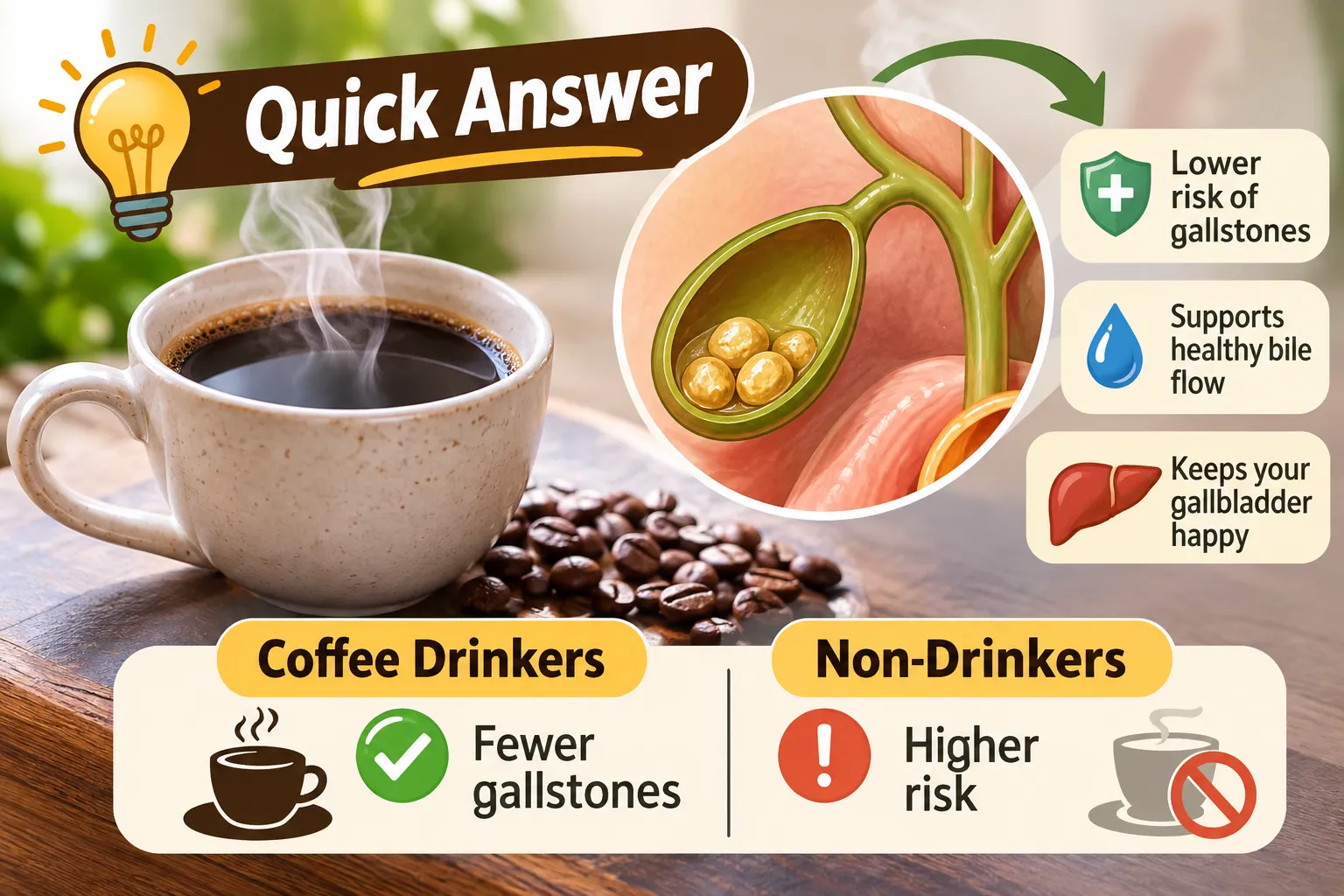
What was measured, and what it means:
- Design: pooled observational studies, mostly self-reported coffee intake from food frequency questionnaires.
- Outcome: gallstone disease, usually defined as ultrasound-detected stones or cholecystectomy (gallbladder removal surgery).
- Pattern: heavier drinkers generally showed lower risk than light drinkers, a dose-response shape that strengthens the case without proving it.
- Limitation: people who drink a lot of coffee differ from people who do not. They smoke more, weigh differently, eat differently, and move differently. Statistical adjustment helps. It does not erase the problem.
The Harvard Health Professionals Follow-up Study, published in JAMA in 1999, is the most cited individual cohort. It tracked 46,008 men over a decade and found that those consuming 4 or more cups per day had a lower rate of symptomatic gallstone disease, with risk falling as total caffeine intake rose . That caffeine gradient is why the caffeine gallstone study framing stuck.
Then there is the genetic angle. The 2026 systematic review of Mendelian randomization studies by Pham and colleagues in Nutrition Research Reviews used genetic variants linked to coffee intake as a proxy for lifetime consumption, which sidesteps some lifestyle confounding . Their broad finding was sobering: many of coffee's reported benefits weaken under genetic analysis. Gallstone disease was one of the outcomes where a protective signal survived, though it showed most clearly after adjustment for BMI and smoking, or when the analysis looked only at symptomatic cases. The authors also warned that coffee-related gene variants are pleiotropic, meaning they also influence smoking, body weight and lipid levels on their own .
The honest sentence is "coffee consumption is associated with lower gallstone risk." Not "coffee prevents gallstones." The difference is a randomized trial nobody has run.
How Does Coffee Reduce Gallstone Risk?
The main hypothesis is mechanical. Caffeine prompts the release of cholecystokinin, a hormone secreted by the small intestine that signals the gallbladder to contract and empty bile into the digestive tract . More frequent emptying means bile spends less time sitting still.
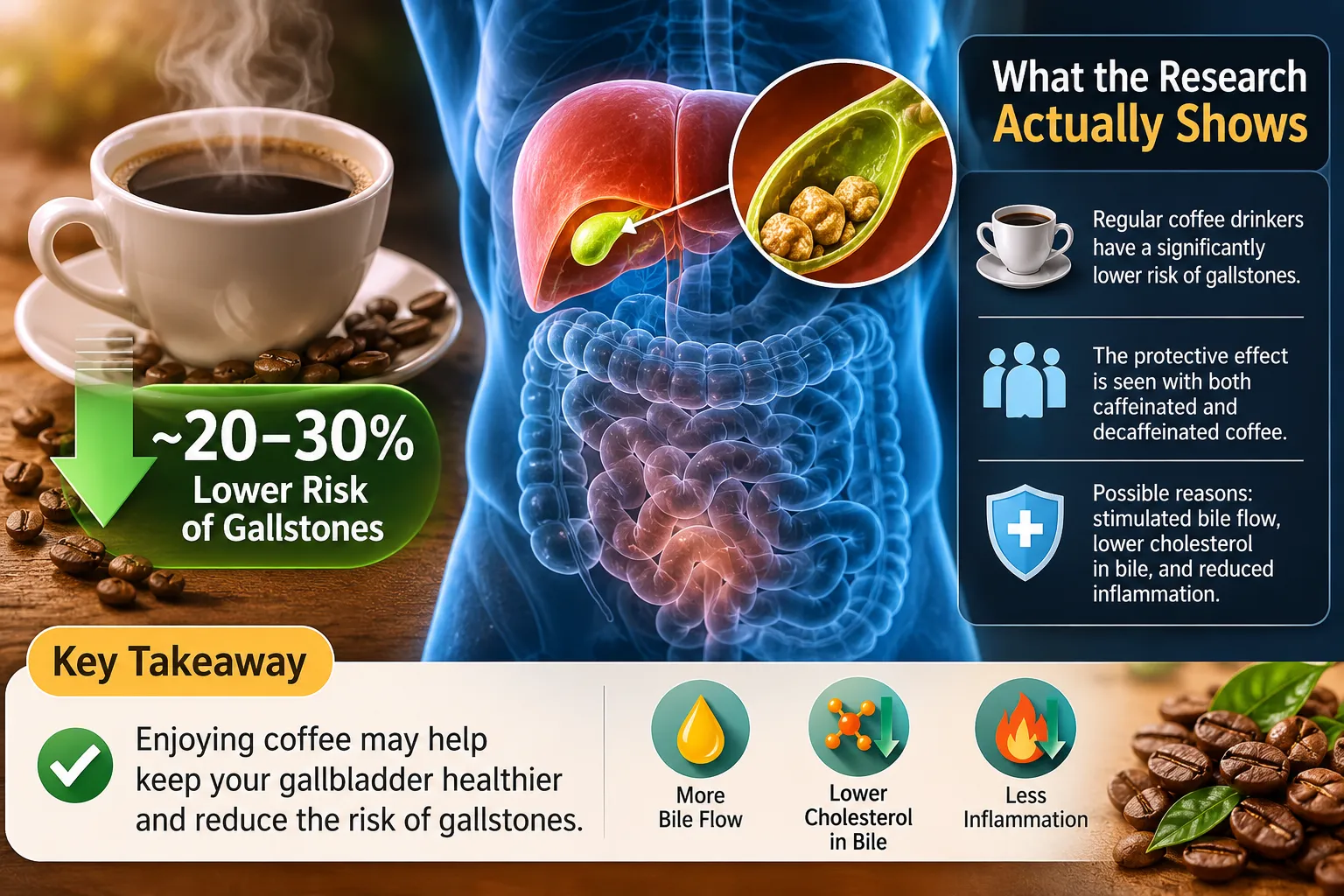
Why that matters for gallstone risk factors:
- Bile is a concentrated mix of cholesterol, bile salts and pigments.
- When bile sits in the gallbladder for long stretches (bile stasis), cholesterol can crystallize.
- Crystals clump into stones over months and years.
- Regular contraction interrupts step 2.
A 2022 gastrointestinal review indexed by PubMed describes this cholecystokinin coffee pathway, along with possible effects on bile cholesterol content and intestinal transit, as biologically plausible rather than clinically proven . Plausible mechanism plus consistent observational association is a reasonable case. It is not the same as a demonstrated cause.
Edge case worth knowing: the same contraction that may help early on can hurt later. If a stone already sits in the cystic or bile duct, a forceful squeeze can produce the classic right-upper-abdomen pain of biliary colic.
Does Caffeine Affect Bile Production, or Just Bile Flow?
Mostly flow, based on current evidence. The clearest documented effect of caffeine on the gallbladder coffee relationship is motility: the gallbladder contracts and bile moves . Changes to how much bile the liver makes, or to its cholesterol saturation, are less well established in humans.
That distinction matters practically. If coffee's benefit works through movement rather than chemistry, then the timing of your cup (with or near a meal, when the gallbladder would contract anyway) may matter less than the simple habit of drinking it regularly.
Does Decaf Coffee Work the Same Way?
Probably not, based on the available data. In the Harvard cohort of 46,008 men, decaffeinated coffee did not show the same association with lower symptomatic gallstone disease that caffeinated coffee did . Risk tracked with total caffeine intake, which points the finger at caffeine rather than at chlorogenic acids or other coffee compounds.
Two cautions before you switch back to full-strength:
- Decaf drinkers are often a smaller subgroup in these cohorts, so the statistical power to detect a modest effect is lower. Absence of evidence is not strong evidence of absence.
- If you avoid caffeine for sleep, anxiety, blood pressure or pregnancy, a possible gallstone association is a poor reason to reverse that decision.
How Much Coffee Is Linked to Lower Gallstone Risk?
The cohort data points to 2 to 4 cups a day or more as the range where associations appear most consistently, with the Harvard analysis finding its clearest signal at 4 or more cups daily . A "cup" in these studies usually means a standard 8 ounce brewed coffee, not a 20 ounce café order.
| Daily intake | What the cohorts suggest | Practical note |
|---|---|---|
| 0 to 1 cup | Reference group, no observed association | Light drinkers were the comparison baseline |
| 2 to 3 cups | Lower risk in several cohorts | A common realistic home-brew habit |
| 4+ cups | Clearest association in the Harvard men's cohort | Watch total caffeine, sleep and blood pressure |
| Decaf, any amount | No comparable association found | Caffeine appears to be the active variable |
Decision rule: if you already drink 2 to 3 cups and feel fine, the data gives you no reason to change. If you drink none and dislike coffee, nothing here justifies forcing it. Our piece on whether it is okay not to drink coffee covers that side honestly.
Can Coffee Actually Cause Gallstones?
No good evidence suggests coffee causes gallstones. The direction of association across pooled studies runs the other way . The real confusion comes from a different experience: people with existing stones sometimes feel pain after coffee.
An October 2026 Korean medical report described exactly this, explaining that coffee-stimulated gallbladder contraction can produce pain when a stone obstructs the cystic or bile duct. Gastroenterology commentary published the same month made the same point: coffee is not a treatment, and people with known stones may hurt after drinking it. The pain is a sign the stone is already there, not a sign the coffee built it.
The misconception this article corrects: "Coffee gave me a gallbladder attack, so coffee causes gallstones." Coffee may have triggered the contraction that made an existing stone announce itself. Stones take months to years to form. One espresso did not do it.
Can You Drink Coffee If You Have Gallstones?
That is a question for your doctor, and the answer depends on your symptoms. Many people with silent, incidentally found gallstones drink coffee without trouble. Others with symptomatic disease notice reliable pain after coffee or fatty meals and choose to stop.
Signs that warrant a medical appointment rather than a brewing adjustment:
- Steady pain in the right upper abdomen lasting 30 minutes or more
- Pain radiating to the right shoulder blade
- Nausea or vomiting after fatty meals
- Yellowing of the skin or eyes, fever, or dark urine
Those last ones can indicate a blocked duct or infection. That is an urgent care situation, not a coffee question.
Is Coffee Safe for Your Gallbladder Generally?
For most healthy adults without gallbladder disease, moderate coffee intake has not been linked to gallbladder harm in the large cohorts. The November 2026 prospective cohort in the British Journal of Nutrition, covering 76,731 Swedish men and women, found each additional daily cup unassociated with non-gallstone-related acute pancreatitis (adjusted HR 0.97, 95% CI 0.92 to 1.03) . A confidence interval straddling 1.0 means no detectable effect in either direction.
Worth adding: not every dataset finds coffee relevant. A June 2026 gallstone risk prediction model published in Frontiers in Nutrition, built on a Western China population, did not identify coffee as a significant differentiating factor . Population, diet and measurement methods change what shows up.
Can You Drink Coffee After Gallbladder Removal Surgery?
Most people resume coffee after cholecystectomy once their surgical team clears them, often within days. Without a gallbladder, bile drips continuously from the liver into the intestine rather than being stored and released in bursts, so the CCK contraction mechanism no longer applies.
Two things people report in the months after surgery:
- Looser stools or urgency, which caffeine can worsen because it speeds intestinal transit.
- Better tolerance over time as the body adapts.
If coffee bothers you post-surgery, try a smaller volume, drink it with food, or switch temporarily to a lighter brew. A pour over at a leaner brew ratio gives you a gentler cup than a dense espresso without giving up the ritual. Your surgeon's guidance beats any article, including this one.
Is Green Tea as Effective as Coffee for Gallstone Prevention?
The evidence for green tea and gallstones is thinner and less consistent than the coffee data. Green tea contains caffeine, typically 20 to 45 mg per cup versus roughly 95 mg in 8 ounces of brewed coffee, so if caffeine drives the CCK effect, green tea delivers less of it per serving.
| Drink | Approx. caffeine per 8 oz | Gallstone evidence |
|---|---|---|
| Brewed coffee | ~95 mg | Strongest, 17% lower odds in pooled analysis |
| Espresso (1 oz shot) | ~63 mg | Covered within general coffee intake data |
| Green tea | ~25 to 45 mg | Limited and inconsistent for gallstone outcomes |
| Decaf coffee | ~2 to 5 mg | No comparable association found |
Green tea has its own supported benefits. Gallstone risk reduction is not currently one of them at the same evidence level.
What Other Foods and Drinks Are Linked to Lower Gallstone Risk?
A gallbladder friendly diet tends to look like general cardiometabolic advice, because the same factors drive both. Known gallstone risk factors include obesity, rapid weight loss, high triglycerides, female sex, pregnancy, older age and family history.
Patterns associated with lower gallstone risk in observational research:
- Steady body weight. Crash dieting and rapid loss are documented risk factors because bile cholesterol saturation rises.
- Dietary fiber from whole grains, legumes and vegetables.
- Unsaturated fats instead of a very low-fat pattern. Some fat at meals prompts normal gallbladder emptying.
- Regular meals. Long fasting windows mean long bile stasis.
- Physical activity.
A 2024 review of gallbladder supplements and natural approaches notes that most popular remedies lack strong clinical support . Treat "gallbladder flush" protocols with skepticism and your doctor's input.
Why Do Some Coffee Drinkers Still Get Gallstones?
Because a 17% relative reduction in odds is a shift in probability, not a shield. If your baseline risk is driven by genetics, rapid weight loss, pregnancy or metabolic factors, four cups a day will not cancel them.
Think of it the way you would think of grind size in a brew. Grind size matters, and it will not rescue stale beans or bad water. Coffee is one variable among many in a system with several stronger ones.
Is It Too Late to Start Drinking Coffee to Prevent Gallstones?
If you already have stones, the mechanism described here would not dissolve them, and starting coffee specifically for that reason is not supported. Guidance published by Coffee & Health suggests any benefit is most plausible during the early stages of stone formation, when regular emptying could limit prolonged bile stasis.
Which gives a simple reading: coffee is a habit, not an intervention. If you like it, enjoy it. If you have symptoms, see a clinician. The brewing side of your life is more productively spent on choosing beans you actually enjoy and checking the roast date.
Sourced numbers at a glance
.cg-gs{font-family:system-ui,-apple-system,”Segoe UI”,Roboto,sans-serif;background:#F5FAF8;color:#23372F;padding:18px;border-radius:10px;max-width:760px;margin:0 auto} .cg-gs h3{color:#14231D;margin:0 0 12px;font-size:1.1rem} .cg-gs table{width:100%;border-collapse:collapse;font-size:.92rem} .cg-gs th{background:#1F6B4A;color:#fff;text-align:left;padding:8px} .cg-gs td{padding:8px;border-bottom:1px solid #E8F2EE;vertical-align:top} .cg-gs tr:nth-child(even) td{background:#E8F2EE} .cg-gs.n{font-weight:700;color:#145037;white-space:nowrap} .cg-gs p{font-size:.78rem;color:#23372F;margin:10px 0 0} @media(max-width:520px){.cg-gs td,.cg-gs th{font-size:.82rem;padding:6px}}Coffee and gallstones: the cited figures
| Figure | What it describes | Source |
|---|---|---|
| ~17% lower | Pooled odds of gallstone disease among coffee drinkers | Meta-analysis, Aliment Pharmacol Ther, 2015 |
| 46,008 | Men followed for symptomatic gallstone disease | Health Professionals Follow-up Study, JAMA, 1999 |
| 4+ cups/day | Intake level with clearest association in that cohort | JAMA, 1999 |
| 76,731 | Swedish adults in pancreatitis cohort | Br J Nutr, Nov 2026 |
| HR 0.97 | Per extra cup/day, non-gallstone acute pancreatitis (CI 0.92-1.03) | Br J Nutr, Nov 2026 |
| 0 | Randomized trials assigning coffee for gallstone outcomes | Mendelian review, Nutr Res Rev, 2026 |
All figures are observational or genetic-inference associations. They do not establish that coffee prevents gallstones.
FAQ
Conclusion
The coffee and gallstones story holds up as a consistent association: roughly 17% lower pooled odds , a dose-response pattern in a 46,008-man cohort , a plausible CCK contraction mechanism , and a genetic analysis where the signal survived while many other coffee claims did not . What it lacks is a randomized trial. So the correct conclusion for your morning cup is modest and useful at the same time: your 2 or 3 cups are not working against your gallbladder, and on the available evidence they may sit alongside slightly lower risk.
Next step: if you have ever had steady pain under your right ribs after a fatty meal, book an appointment and mention it, rather than adjusting your brew ratio. If you have no symptoms, spend the energy on something you can actually taste. Our guide to what makes a coffee healthier is a better use of a Tuesday than a gallbladder flush.
Better Coffee Starts With Better Answers.