Nispira Cold Drip Tower Guide: Drip Rate, Dose, and Fixes
In “The Complete Guide to Making Perfect Cold Brew with Nispira Luxury Ice Cold Brew Dripper Coffee Maker,” you will discover the careful process of crafting the complete cold brew coffee. This complete guide walks you through each step, from selecting the finest coffee beans to mastering the Nispira Luxury Ice Cold Brew Dripper Coffee Maker’s unique features. You’ll learn essential tips for achieving the perfect extraction rate and flavor profile, ensuring that your cold brew drinks are consistently delightful. Whether you’re a seasoned barista or a coffee enthusiast, this guide provides all the knowledge you need to improve your cold brew experience to a professional level.
Making Cold Brew with the Nispira Luxury Ice Cold Brew Dripper
Have you ever wondered how to make the perfect cold brew at home? ! This guide is your complete resource for brewing cold coffee that rivals the best coffee shops. Today, we’ll focus on the Nispira Luxury Ice Cold Brew Dripper Coffee Maker, a tool that’s as elegant as it is effective.
Introduction to Cold Brew Coffee
Cold brew coffee is distinguished by its smooth, rich flavor and lower acidity compared to traditional hot brews. It’s created by steeping coffee grounds in cold water over an extended period, minimizing the bitter compounds often released at high temperatures.
What is Cold Brew Coffee?
Cold brew is not simply iced coffee. While iced coffee is brewed hot and then cooled over ice, cold brew involves brewing with cold water from the start. This method extracts flavors more slowly, resulting in a less acidic and more full-bodied coffee.
Benefits of Cold Brew Coffee
Cold brew comes with numerous advantages. Here are a few:
- Lower Acidity: Cold brew’s lower acidity makes it gentler on your stomach.
- Smooth Taste: The long brewing process results in a smoother, more subtle flavor profile.
- Versatile: Cold brew can be enjoyed black, with milk, or as a base for various coffee drinks.
Understanding the Nispira Luxury Ice Cold Brew Dripper Coffee Maker
The Nispira Luxury Ice Cold Brew Dripper Coffee Maker is a specialized tool designed to perfect the art of cold brewing. Let’s dive deeper into what makes this coffee maker unique.
Key Features
The Nispira Luxury Ice Cold Brew Dripper Coffee Maker stands out due to its high-quality materials and innovative design.
| Feature | Description |
|---|---|
| Material | High-quality glass and stainless steel |
| Capacity | Can brew up to 600ml at once |
| Adjustable Drip Speed | Control the flow rate for optimal extraction |
| Aesthetics | Sleek and elegant design suitable for any kitchen |
Why Choose Nispira?
Nispira’s cold brew dripper offers precision and elegance. It allows for detailed control over the brewing process, enabling you to fine-tune your coffee to your specific taste preferences. Also, its aesthetic appeal doesn’t hurt!
The Science Behind Cold Brew with Nispira
To achieve the best results, it’s important to understand the science behind cold brewing, especially when using the Nispira Coffee Maker.
Coffee-to-Water Ratio
The coffee-to-water ratio can significantly affect the taste and strength of your cold brew.
Nispira’s own guidance is 12 grams of coffee per 120 ml of brewed coffee, a 1:10 ratio. The dose table further down scales that to every chamber size.
Drip Speed and Extraction Time
The drip speed controls how fast water passes through the coffee grounds. Nispira allows you to adjust this for the perfect extraction.
- Standard Drip Rate: 1 drop per second
- Extraction Time: Typically between 8-12 hours
Grind Size
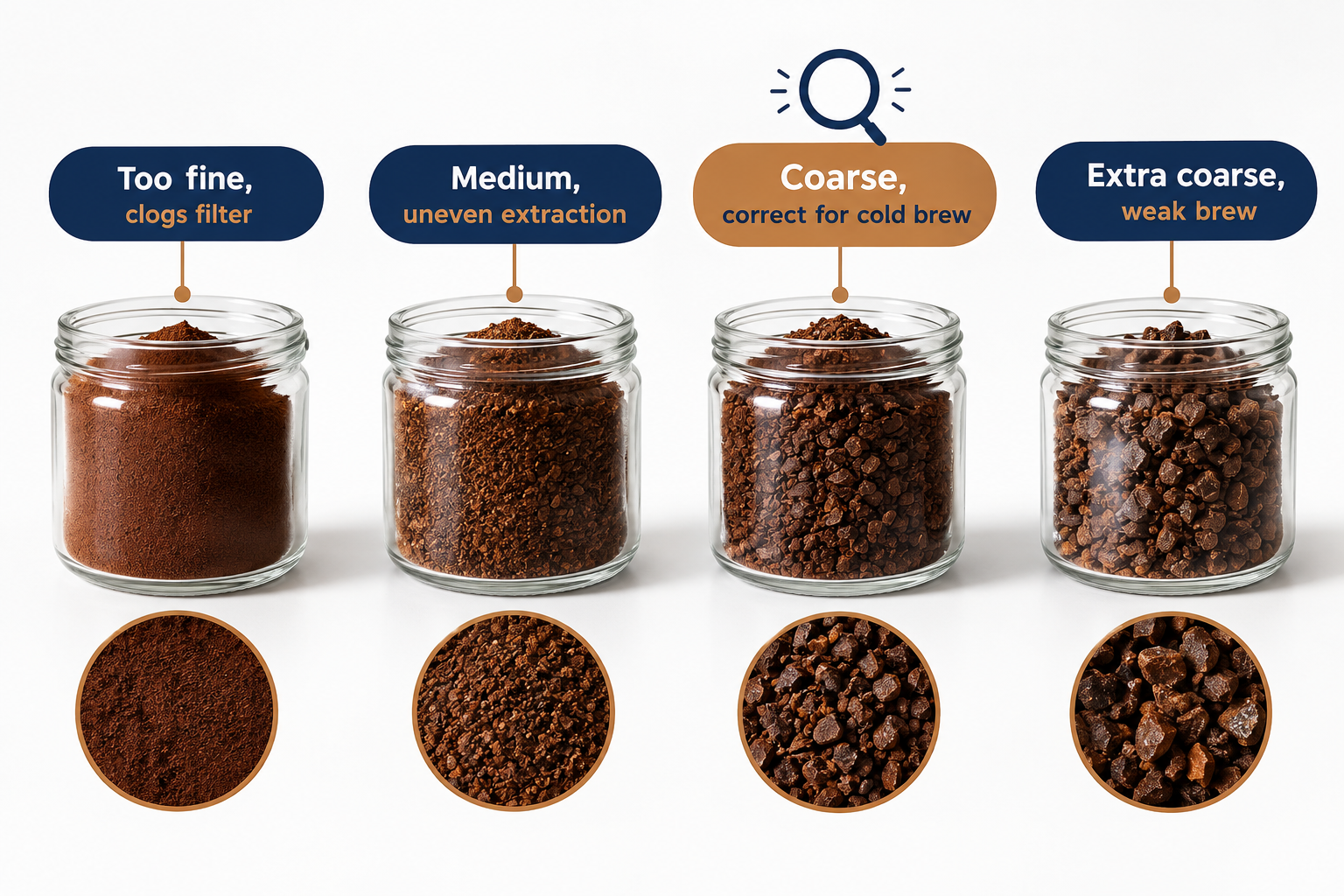
The grind size for cold brew should be coarser than for hot brews. A medium-coarse grind is ideal.
Temperature
Using ice-cold water ensures the coffee extracts slowly, avoiding bitterness and retaining subtle flavors.
Which Nispira Cold Drip Tower Are You Looking At?
Nispira sells at least four cold drip towers that look almost identical in product photos. They share one layout: a glass chamber on top for ice and cold water, a middle glass chamber that holds the coffee, an adjustable valve that meters water onto the grounds, and a glass carafe at the bottom that catches the finished coffee. The differences are the frame, the size, and the filter that comes in the box.
The feature table earlier in this guide lists 600 ml, which is right for most of the line. The Luxury model is the exception worth knowing about. Nispira’s own store lists the Luxury at 1,000 ml, in stainless steel and borosilicate glass, with silver and rose gold finishes, while Walmart lists a 600 ml Luxury in copper. Check the capacity on the listing before you buy, because it changes the dose, the batch time, and the height of the tower.
| Nispira model | Frame | Capacity | Worth knowing |
|---|---|---|---|
| Luxury | Stainless steel (silver, rose gold, copper) | 1,000 ml or 600 ml, depending on listing | Borosilicate glass; Nispira quotes 8 to 12 hours per batch for the 1,000 ml version |
| Modern | Stainless steel (silver, rose gold) | 600 ml | Same three-chamber layout; the budget pick of the metal-frame towers |
| Retro | Wood (brown or gray) | 600 ml | About 20 inches tall and 7.5 inches wide; ships with a stainless steel filter screen |
| Clear | Clear acrylic | 600 ml | 18 x 6 x 4.5 inches; comes with a stainless filter disc and paper filters |
Prices we found in September 2026 ran from $75.99 for a silver Modern at Coffee Beanery to $99.99 for a brown Retro on Etsy, so the frame is mostly a style choice. Pick the one you want to look at every morning.
Then measure. Standard kitchen design leaves about 18 inches between the counter and the upper cabinets. A 20 inch Retro will not stand under that, and even the 18 inch Clear leaves no room to pour ice into the top chamber. A drip tower lives at the end of a counter, on a shelf with open air above it, or on a bar cart. Plan that spot before the box arrives.
Slow Drip vs Immersion Cold Brew: What Changes in the Cup
Most home cold brew is immersion. You dump coarse grounds into a jar or a Toddy-style bucket, pour in all the water at once, and walk away for 12 to 24 hours. The grounds and water sit together the whole time, and you filter out a concentrate that needs water or milk before it tastes right.
A Nispira cold drip tower works the other way around. Water leaves the top chamber one drop at a time, falls onto a bed of grounds, trickles through it once, and exits into the carafe. Fresh water keeps arriving, so the coffee at the bottom of the bed is always meeting water that has not already picked up a load of flavor. The result is a thinner, clearer drink that is ready to pour.
When Coffee Review tested a Nispira Ice Drip Coffee Maker in 2017, reviewer Howard Bryman described immersion concentrate as “a rich, almost syrupy brew” and the slow drip cup as lighter in body. His Nispira batch came out “smooth but with some character; a body reminiscent of, but heartier than, tea.” That tea comparison tells you more than any spec sheet. If you want a heavy, chocolatey base for milk and syrup, a tower is the wrong tool.
| Factor | Slow drip tower (Nispira) | Immersion maker |
|---|---|---|
| How water meets coffee | Drips through the bed once, from the top | Grounds soak in all the water at once |
| Brew time | About 90 minutes to 12 hours, set by the valve | 12 to 24 hours of steeping |
| What comes out | Ready to drink, straight or over ice | Concentrate you dilute |
| Body | Light, close to strong tea | Heavy, almost syrupy |
| Flavor | Clearer; fruit and floral notes in lighter roasts show up | Sweet and round; chocolate and caramel notes lead |
| Hands-on time | Setup, valve checks, a top-up or two | Stir, wait, filter |
| Batch size | 600 ml or 1,000 ml per run | Often bigger; a Toddy batch uses 12 ounces of coffee |
| Best in the glass | Black over ice | With milk, syrup, or cold foam |
A word on the acidity claims that follow cold brew around. In a 2018 study in Scientific Reports, Niny Rao and Megan Fuller at Thomas Jefferson University brewed six coffees hot and cold. The pH of both came out between 4.85 and 5.13. Hot coffee did contain more total titratable acid, which is why cold brew tastes less sharp. Their cold brew was a 7 hour immersion at room temperature, not a drip tower, so read it as a general guide. Cold brew tastes softer because fewer acids make it into the cup, and its pH sits right next to hot coffee’s.
How to Brew With a Nispira Cold Drip Tower, Step by Step
Coffee Review’s test unit arrived with no instructions, and the reviewer called dialing it in frustrating, given how much time and coffee each test batch eats. The recipe below starts from Nispira’s current guidance and fills in the steps the box leaves out.
Dose and water
Nispira recommends 12 grams of coffee per 120 ml of brewed coffee, which is a 1:10 ratio, or about 60 grams for a full 600 ml carafe. Weigh both the coffee and the ice and water together. Coffee grounds hang on to roughly twice their own weight in water, so expect a little less out than you put in.
| Ice and cold water in the top chamber | Ground coffee (1:10) | Approximate coffee in the carafe |
|---|---|---|
| 300 g | 30 g | About 240 ml |
| 500 g | 50 g | About 400 ml |
| 600 g | 60 g | About 480 ml |
| 1,000 g (Luxury 1,000 ml) | 100 g | About 800 ml |
If 1:10 tastes too intense straight, Coffee Review’s working recipe was lighter: 40 grams of coffee to 500 grams of water and ice. Our cold brew ratio guide explains why tower ratios run so much weaker than immersion concentrate ratios, and a coffee scale with a built-in timer handles both the weighing and the drop counting below.
The brew
- Grind medium. Nispira calls for a normal drip grind, adjusted finer for some coffees. Coffee Review settled on a coarse grind. Start at the setting you would use for a drip machine and adjust by one or two clicks per batch, based on the troubleshooting notes further down.
- Seat the filter. Place the paper disc or stainless screen in the bottom of the coffee chamber. Rinse a paper filter with cold water first so it seals flat and does not add a papery taste.
- Add the grounds and level them. Tap the chamber on your palm until the bed is flat. A sloped bed sends water down the low side.
- Pre-wet the bed. Pour about 50 ml of your measured cold water evenly over the grounds and stir gently so every particle is damp. Dry coffee repels the first drops, and each drop then drills its own hole straight to the filter.
- Cap it with paper. If you have a spare paper disc, lay it on top of the wet bed. It spreads each drop across the surface instead of letting it hit one spot for six hours.
- Load the top chamber. Nispira says to use fresh ice made from filtered water and to skip bagged grocery ice or cubes that have been sitting in the freezer. A mix of about half ice and half cold water by weight keeps the water cold for hours and gives the valve something to drip from right away.
- Set the valve to 40 drops a minute. That is Nispira’s starting rate, or one drop every 1.5 seconds. Start a timer and count for a full 60 seconds. Some cafés run closer to one drop per second; use that if your batches come out thin.
- Check at 15 minutes and again at one hour. The rate slows as the top chamber empties, because there is less water pressing on the valve. Open the valve a hair each time you check to bring it back to 40.
- Time the batch. After 30 minutes, note how much coffee sits in the carafe. If you have 40 ml and expect about 480 ml, you are looking at roughly six hours. Coffee Review’s coarse grind filled its carafe past the 400 ml line in a little over 90 minutes, and Nispira quotes 8 to 12 hours for the 1,000 ml Luxury, so almost any time in that range can be normal.
- Serve it straight. Tower coffee is meant to be poured over ice as is. Taste before adding water. Store what is left in a sealed glass bottle in the fridge.
Troubleshooting a Cold Drip Tower
Almost every drip tower problem traces back to three dials: the valve, the grind, and how evenly the water reaches the coffee. Change one at a time, or you will never know which fix worked.
| Problem | Likely cause | Fix |
|---|---|---|
| Drips too fast or runs in a thin stream | Valve open too far, grind too coarse, or a full top chamber pushing hard at the start | Close the valve slightly and recount after 5 minutes. Next batch, grind one step finer. |
| Stops dripping | An ice shard or coffee fines in the valve, or the top chamber is nearly empty | Open the valve fully for two seconds to clear it, then reset to 40 drops. Top up with cold water if the level is low. |
| Water pools on top of the grounds | Grind too fine, so water arrives faster than it can pass through | Slow the valve for this batch. Grind coarser next time. |
| Weak or sour | Too fast, too coarse, too little coffee, or water tunneling through one spot | Slow to 40 drops a minute, grind finer, move the dose toward 1:10, and pre-wet the full bed. |
| Bitter, woody, or harsh | Very slow drip on a fine grind, stale beans, or an unrinsed paper filter | Speed the valve up slightly, grind coarser, rinse the filter, and use beans roasted within the last month. |
| Dry patches or a crater in the bed | Channeling: drops keep landing in the same place | Level the bed, pre-wet it completely, and lay a paper disc on top. |
| Flat, stale, or “freezer” taste | Old ice that has absorbed freezer odors | Make fresh ice from filtered water the night before. |
One more cause hides in plain sight: the tower itself. If the frame wobbles, drops land off-center and the bed extracts unevenly. Coffee Review questioned the Nispira’s long-term durability, and the Cold Brew Queen review site lists leaks and an unstable frame among its cons. Set the tower on a flat, solid surface and check that each glass piece sits square in its ring before you open the valve.
Cleaning and Care for Glass, Steel, and Wood
A tower has more parts than a mason jar, and all of them are fragile in their own way. Nispira’s care note is short: take the tower apart and rinse each piece with warm water, and avoid harsh detergents. Here is what that looks like in practice.
Glass chambers and carafe
- Knock the spent grounds into the compost while they are still damp. Dried grounds cement themselves to the filter.
- Rinse every glass piece in warm water with a drop of mild dish soap and a soft bottle brush. Skip abrasive pads, which leave scratches that trap coffee oil.
- Borosilicate glass handles temperature swings better than ordinary glass, but do not pour hot water into a chamber that just held ice. Let it reach room temperature first.
- Coffee Review described the Nispira’s upper reservoir and coffee chamber glass as “quite thin.” Wash one piece at a time, dry it on a towel, and never nest the chambers inside each other.
- For a brown film that soap will not lift, soak the glass for 20 minutes in warm water with a spoonful of baking soda or a coffee equipment cleaning powder.
Valve and filters
- Run warm water through the valve with it fully open, then open and close it a few times under the tap to flush out fines.
- Scrub the stainless filter screen on both sides with a soft brush and hold it up to a light. Blocked holes show up as dark spots, and they are a common reason a batch starts to stall.
- Paper filter discs are single use. Keep a stack on hand; the tower is useless without one.
Wooden frame (Retro)
- Wipe drips off the wood right away with a damp cloth, then dry it. Coffee stains unfinished wood fast.
- Never soak the frame or put it in the dishwasher. Water swells the joints.
- Rub in a little food-safe mineral oil when the wood starts to look pale or dry, then buff off the excess.
- Set a small tray under the carafe so a missed drip lands on the tray and never reaches the base.
Stainless frame (Luxury and Modern)
- Wipe with a soft, damp cloth and dry it to avoid water spots.
- Keep scouring powder away from the rose gold and copper finishes. A colored finish scratches before the steel under it does.
Storage deserves a mention. Coffee Review wrote that the Nispira “requires a safe and secluded place to stand.” That means away from the counter edge, away from a cabinet door that swings into it, and out of reach of a cat who likes to knock tall things over.
Drip Tower or Immersion Maker: Who Should Buy Which
A Nispira cold drip tower is a lovely object and a demanding one. It rewards the person who enjoys the process and punishes the person who wanted a quart of cold coffee by Monday.
Buy a drip tower if you
- Drink cold coffee black and want to taste the difference between an Ethiopian and a Colombian.
- Like lighter roasts, where the clarity of slow drip shows off fruit and floral notes.
- Are home for a few hours on brew day to check the valve.
- Have a spot with open space above it and no toddlers underneath it.
- Want the brewer to be a centerpiece. A tower dripping on a bar cart does draw a crowd.
Buy an immersion maker if you
- Want a week of concentrate from one batch.
- Take cold brew with milk, syrup, or cold foam. Concentrate stands up to dilution; tower coffee gets lost.
- Want to set it at night and ignore it until morning.
- Share a small kitchen with kids, pets, or clumsy roommates.
If the second list sounds like you, our best cold brew coffee maker picks cover the immersion brewers that make big, forgiving batches. Plenty of people end up owning both: an immersion jar for weekday volume and a tower for weekends and guests. You can find the rest of our cold coffee brewing guides on the Coffee Rank IQ home page.
Nispira Cold Drip FAQ
How long does a Nispira cold drip tower take to brew?
Plan on anywhere from about 90 minutes to 12 hours. Coffee Review filled its carafe past 400 ml in a little over 90 minutes with a coarse grind, while Nispira quotes 8 to 12 hours for the 1,000 ml Luxury. The valve setting and grind size decide where you land in that range.
What drip rate should I set on a Nispira?
Start at 40 drops per minute, which is one drop every 1.5 seconds and matches Nispira’s own guidance. Count for a full minute with a timer, recheck at 15 minutes and one hour, and open the valve slightly as the top chamber empties.
How much coffee goes in a 600 ml Nispira?
Use about 60 grams of medium ground coffee for a full 600 ml batch. That follows Nispira’s recommendation of 12 grams of coffee per 120 ml, a 1:10 ratio. Drop to 40 or 50 grams if you prefer a lighter cup.
Do I need to dilute cold drip coffee?
Usually not. Slow drip coffee is meant to be served straight or over ice, while immersion cold brew comes out as a concentrate. Taste it first, then add a splash of water only if it is stronger than you like.
Can I put hot water in the Nispira’s top chamber?
No. Nispira labels the Luxury for cold brew only, and hot water in thin glass that has just held ice risks a crack. Use ice and cold filtered water every time.
Keep reading
- Best Ways To Use Oxo Good Grips Cold Brew Coffee Maker
- The Complete Guide To Using The OXO Brew 8-Cup Coffee Maker
- Advanced Cold Brew Coffee Methods
- Beginner's Guide To Cold Brew Coffee
More in Coffee filters, or start from the Coffee Rank iQ homepage.