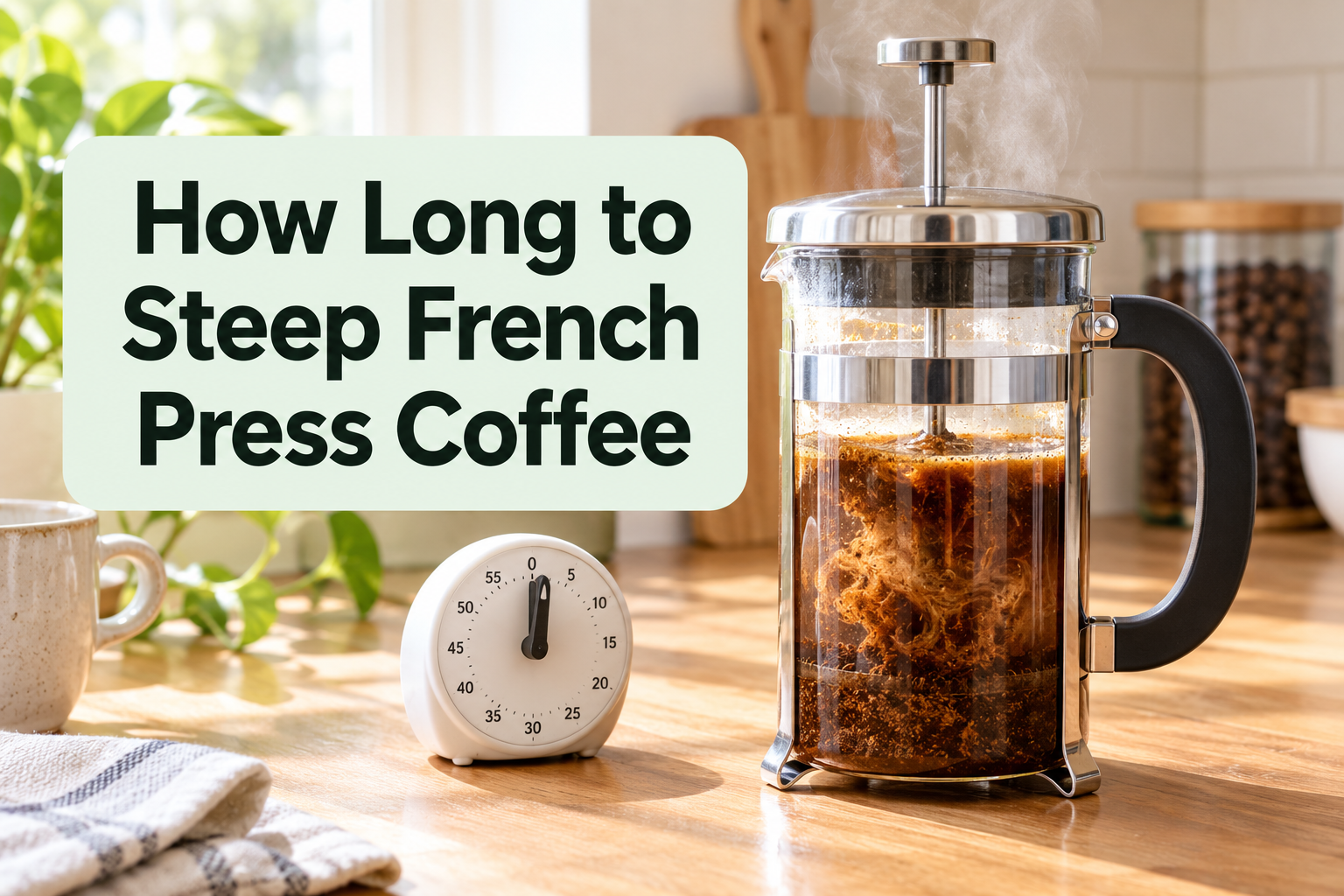
How Long to Steep French Press Coffee: Beyond the 4 Minute Rule
Quick Answer
Steep french press coffee for about 4 minutes using a coarse grind, a 1:15 coffee to water ratio, and water around 200°F. That number is a starting point built on specific assumptions, not a fixed law. Change the grind, the roast, or the water temperature and the ideal steep time shifts by 30 seconds to a full minute in either direction. Knowing how long to steep french press coffee for your setup, not just the default, is what separates a flat cup from a balanced one.
Key Takeaways
- 4 minutes is the reference steep time, built around a coarse grind and 1:15 ratio
- Steep time and total brew time are different things; the plunge adds extra contact time
- Water temperature between 195°F and 205°F is the working range, with 200°F as the target
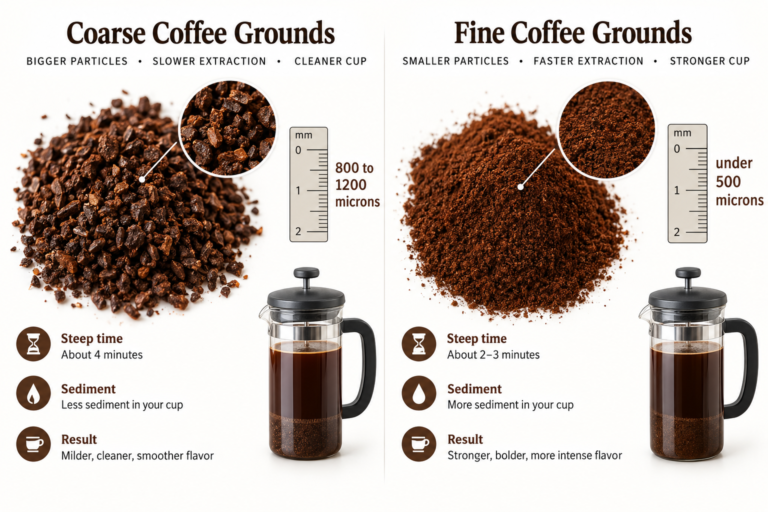
- Coarse grind (roughly 800 to 1,200 microns) needs the full 4 minutes; finer grind needs less
- Extraction follows a curve: sourness fades first, sweetness peaks in the middle, bitterness builds late
- Light roasts often taste better steeped slightly longer with hotter water; dark roasts prefer the opposite
- Cold brew in a french press needs 12 to 24 hours, not minutes, because cold water extracts far slower
- Over-steeped coffee can be rescued by pouring it off the grounds immediately, even before you're ready to drink it
How Long to Steep French Press Coffee: The Direct Answer
Steep french press coffee for 4 minutes at a 1:15 ratio, using a coarse grind and water close to 200°F. That's the number printed on most bags of coffee and repeated across brewing guides published through 2026, and it works as a dependable default because it matches the most common grind size, ratio, and water temperature home brewers actually use.
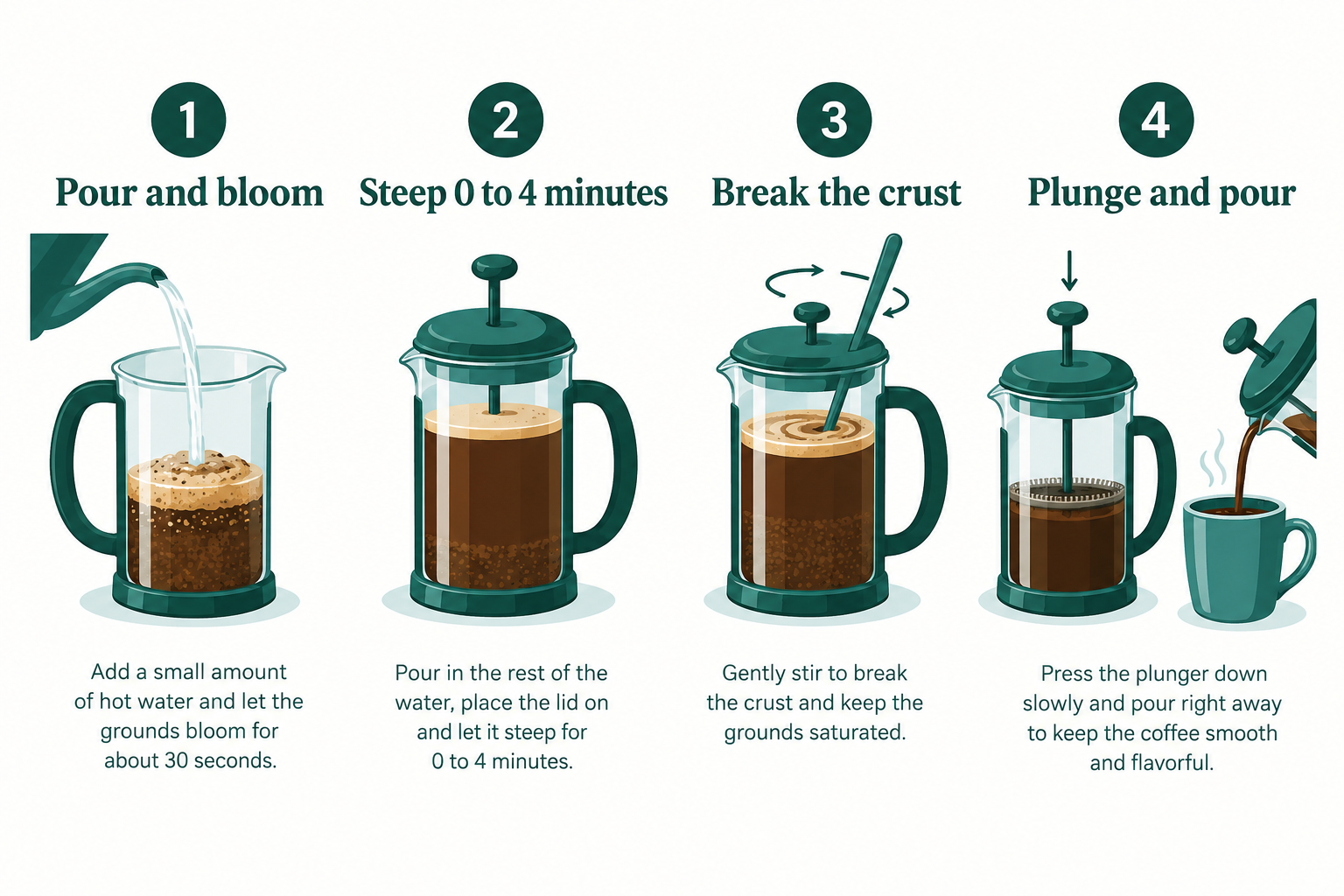
The question "how long should coffee steep in a french press" only has one clean answer if you fix the other variables. Change any of them and the ideal time moves:
- Finer grind than the standard coarse setting: cut steep time to 3 to 3.5 minutes, since smaller particles release flavor faster and oversteeping turns bitter sooner
- Coarser grind than usual: extend to 4.5 or 5 minutes, since bigger particles resist extraction longer
- Lower ratio (more coffee per water, like 1:12): shorten the steep slightly to avoid a heavy, muddy cup
- Higher ratio (less coffee per water, like 1:17): lengthen the steep slightly to pull enough flavor from a smaller dose of grounds
For a first attempt, 4 minutes with coarse grounds is still the smartest place to start. If you want the full walkthrough on setting up the brew itself, the Beginners Guide To Using A French Press For Coffee covers the equipment side in more detail.
Steep Time vs Brew Time: What's Actually Different in a French Press
Steep time is the minutes your grounds sit in contact with water before you touch the plunger. Brew time is longer: it includes the steep, the slow push of the plunger, and but long the coffee sits in the carafe before you pour it. Mixing these two up is why some home brewers think they're following the 4 minute rule while actually going closer to 6.
Here's the practical breakdown:
| Phase | What's happening | Typical length |
|---|---|---|
| Bloom | Hot water first hits the grounds, releasing CO2 | 30 seconds |
| Steep | Grounds sit fully immersed in water | 3 to 5 minutes |
| Plunge | Mesh filter separates grounds from liquid | 15 to 30 seconds |
| Standing time | Coffee sits in the carafe before pouring | Should be near zero |
Once you plunge, most grounds settle below the mesh screen, but the seal isn't perfect. Fine particles can still drift through and keep releasing flavor into the liquid above. That's why the standard advice is to pour the coffee out of the carafe right after plunging instead of leaving it to "keep warm" while you pour a second cup later.
Why Does French Press Take 4 Minutes? The Extraction Science Behind the Number
French press lands on 4 minutes because that's roughly where the balance of acids, sugars, and bitter compounds peaks before bitterness starts to dominate the cup. Extraction isn't one event, it's a sequence, and 4 minutes sits in the window where most of that sequence has finished without tipping into the harsher stage.
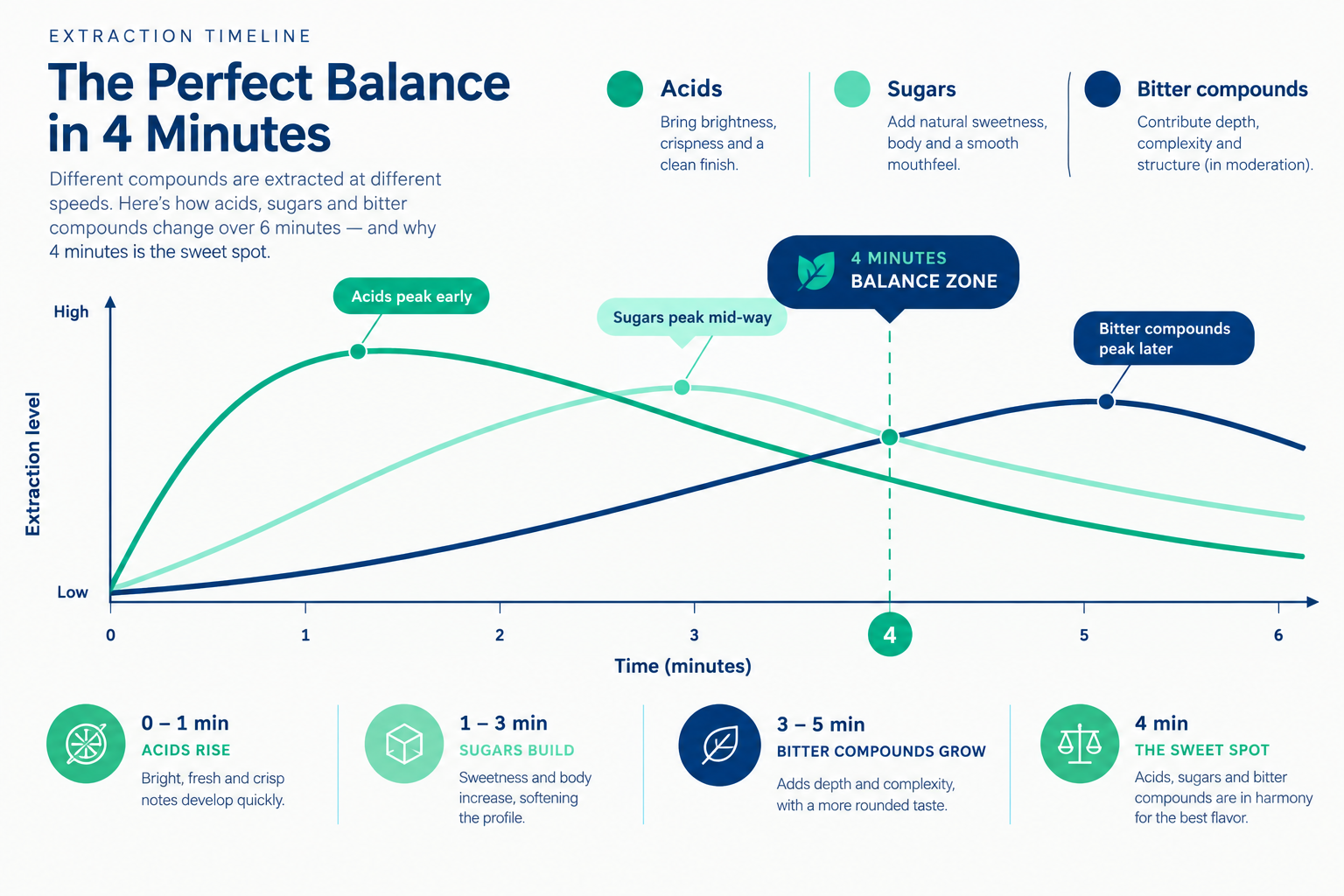
Coffee compounds don't dissolve at the same speed. Research on brewing chemistry describes a rough order of release:
- Acids dissolve fastest, giving early brightness and tang in the first 1 to 2 minutes
- Sugars follow next, building sweetness and body through minutes 2 to 4
- Bitter compounds, including larger, harder to dissolve molecules, release last and keep building the longer the grounds sit in water
At 4 minutes with a coarse grind, you've generally pulled enough acid and sugar to build a rounded cup, without yet crossing deep into the bitter-heavy stage. That's the entire logic behind french press brew time defaults, and it's also why the number isn't sacred. It's a midpoint calculated for one specific grind and ratio, not a universal chemical constant.
What Happens If You Steep for 3 Minutes Instead of 4 Minutes
A 3 minute steep usually under-extracts the coffee, which means it tastes thinner, more sour, and less sweet than a 4 minute cup made with the same grind and ratio. Sugars haven't fully dissolved yet, so the acids that came out early are more noticeable without enough body to balance them. If you're using a coarse grind and still landing on a sour, watery cup at 4 minutes, the fix is usually a finer grind or a longer steep, not both at once.
Can You Steep French Press Coffee Too Long
Yes. Past about 5 to 6 minutes, especially with a fine grind or very hot water, extraction moves deeper into the bitter, astringent compounds and the cup can start tasting hollow, dry, or ashy. This connects to a concept called immersion equilibrium: once most of the soluble compounds in the grounds have dissolved, extra time adds diminishing returns for flavor and increasing returns for bitterness. After roughly 4 to 5 minutes, you're not gaining much more of the good stuff, you're mostly collecting more of the harsh stuff.
Does Water Temperature Affect French Press Steep Time?
Yes, water temperature and steep time work as a pair, not separately. Hotter water extracts faster, so it generally needs a slightly shorter steep, while cooler water extracts slower and can handle a slightly longer one. The standard french press water temperature range is 195°F to 205°F, with 200°F as a practical target, which is just off a full boil.
A simple way to hit that range without a thermometer: bring water to a full boil, then let it sit off the heat for 30 to 45 seconds before pouring over the grounds.
Roast level changes how this plays out:
- Light roasts are denser and more resistant to extraction, so they often do better with water on the hotter end (around 205°F) and a steep at the longer end of the 4 minute window
- Dark roasts are more porous from longer roasting and extract faster, so slightly cooler water (closer to 195°F) paired with a shorter steep, around 3.5 minutes, helps avoid pulling out excess bitterness
If your kettle only does a rolling boil with no temperature control, the 30 to 45 second rest matters more than any gadget. Water that's too hot for too long is one of the fastest ways to turn a good bean bitter.
How to Know When French Press Coffee Is Done Steeping
The most reliable way to know your coffee is done steeping is a kitchen timer started the moment you finish pouring water over the grounds, not a guess based on color or smell. Aroma and color shift throughout the steep, but they're not precise enough to replace a timer when you're trying to repeat a good result.
A dependable routine looks like this:
- Start the timer as soon as the pour finishes
- At around 4 minutes, stir gently or break the surface crust with a spoon
- Skim off any foam and floating grounds if you want a cleaner cup
- Let it settle for another 30 seconds to 1 minute
- Plunge slowly and evenly
- Pour immediately, don't let the brewed coffee sit on the grounds
James Hoffmann, a coffee educator known for detailed brewing demonstrations, has popularized breaking the crust and skimming the foam before the final plunge. Plenty of home brewers now treat that step as standard practice because it removes floating fines that would otherwise end up in the cup. It's a small habit that makes the difference between a slightly gritty finish and a cleaner one, without changing how long to steep french press coffee in the first place.
Grind Size, Ratio, and Steep Time: Coarse vs Fine Grounds in a French Press
Coarse grounds need close to the full 4 minutes because their larger surface area releases flavor slowly; finer grounds extract faster and can turn bitter, muddy, or over-strong well before the 4 minute mark. French press grind size sits at roughly 800 to 1,200 microns, close to sea salt, and that size assumption is baked into the standard steep time.
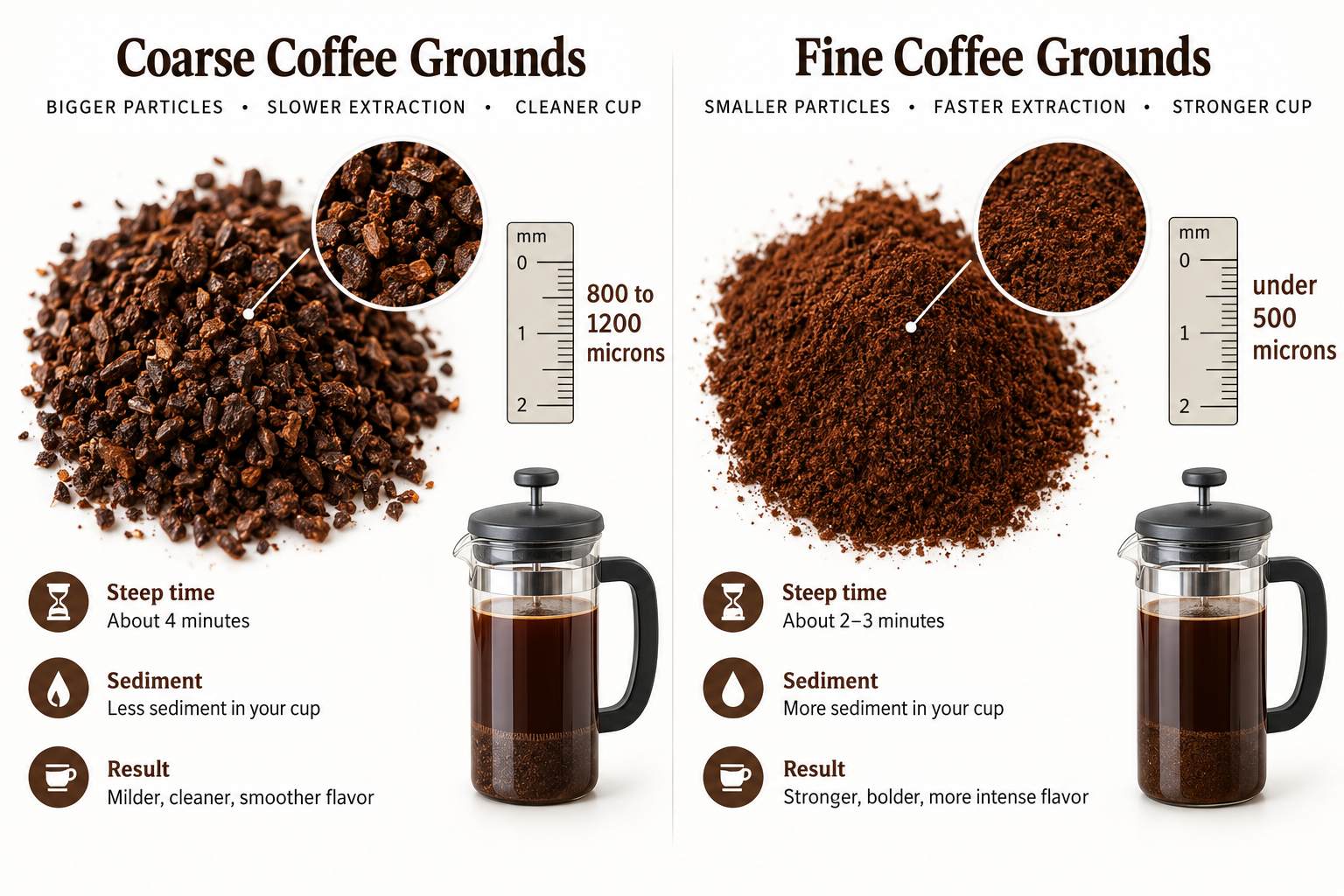
Grind size and ratio work together, and neither one exists in isolation:
- Coarse grind, 1:15 ratio: the baseline, works with a full 4 minute steep
- Coarse grind, tighter ratio (1:12): shorten steep slightly to avoid over-strength
- Medium-coarse grind: drop steep to around 3.5 minutes to prevent bitterness and sediment
- Fine grind: not recommended for french press; it clogs the mesh, passes through as sediment, and over-extracts fast
The french press coffee ratio most guides recommend is 1:15 to 1:16, meaning 1 gram of coffee for every 15 to 16 grams of water. A common real-world measurement is 30 grams of coffee to 450 to 480 grams of water for a standard carafe. If you want a starting point without doing math by hand, use a french press coffee ratio calculator like the one below to get a steep time and ratio pairing based on your roast and grind.
.cg-wrap{font-family:system-ui,-apple-system,Roboto,sans-serif;max-width:480px;margin:0 auto;background:#F5FAF8;border:1px solid #E8F2EE;border-radius:10px;padding:20px;} .cg-wrap h3{color:#14231D;margin-top:0;font-size:18px;} .cg-row{margin-bottom:12px;} .cg-row label{display:block;font-size:14px;color:#23372F;margin-bottom:4px;font-weight:600;} .cg-row select{width:100%;padding:8px;border-radius:6px;border:1px solid #61BDA1;font-size:14px;background:#fff;} .cg-btn{background:#1F6B4A;color:#fff;border:none;padding:10px 16px;border-radius:6px;font-size:14px;cursor:pointer;width:100%;font-weight:600;} .cg-btn:hover{background:#145037;} .cg-result{margin-top:14px;padding:12px;background:#E8F2EE;border-radius:8px;font-size:14px;color:#14231D;display:none;} .cg-result strong{color:#1F6B4A;}French Press Steep Time Calculator
For more ways to fine-tune your recipe once the ratio is set, the Top Ways To Perfect Your French Press Coffee Recipe guide walks through adjustments beyond steep time. And if your grinder is inconsistent, uneven particle sizes will throw off every steep time calculation, so it's worth checking the Top 10 Advanced Coffee Grinding Methods guide before troubleshooting anything else.
French Press Steep Time for Different Coffee Bean Types
Bean origin, processing, and roast date all shift how fast a coffee extracts, so the same 4 minute steep won't taste identical across every bag. Washed beans tend to extract predictably within the standard window, while some naturally processed or very fresh single origin light roasts are denser and can benefit from the longer end of the 4 to 4.5 minute range. Dark roast blends built for french press, like French roast or Italian roast styles, extract faster and often taste cleaner at 3.5 minutes.
Roast date matters too. Coffee that's several weeks past roasting has released most of its trapped CO2, which changes how water moves through the grounds during the bloom and steep. If your cup tastes flatter than it used to from the same bag, check how old it actually is; the What Is The Coffee 1 Week Rule guide explains why freshness windows matter for extraction. For a broader look at how roast level itself changes brewing behavior, see the Beginners Guide To Understanding Different Coffee Roasts.
What's the Shortest You Can Steep a French Press
Practically, 3 minutes is close to the reliable floor for a normal coarse grind. Below that, even a fine grind rarely dissolves enough soluble material to taste like more than lightly flavored hot water. Very short steeps under 2 minutes are sometimes used for quick, weak "cowboy style" brews, but they trade almost all body and sweetness for speed.
French Press Steep Time for Cold Brew vs Hot Brew
Cold brew in a french press needs hours, not minutes, because cold water dissolves coffee compounds far slower than hot water does. A typical cold brew steep runs 12 to 24 hours at room temperature or in the refrigerator, using a coarse grind and a stronger ratio, often around 1:8, since the result is usually diluted with water or milk afterward.
Hot brewing's 4 minute window only works because heat speeds up dissolution dramatically. Drop the water temperature from 200°F down to room temperature or colder, and the same chemical reactions that took 4 minutes now take most of a day. This is also why you can't shortcut cold brew by using hot water for a few minutes and calling it done; the flavor profile is genuinely different, not just faster or slower. For a side-by-side look at how different immersion and pour methods compare, the Complete Guide To Different Coffee Brewing Techniques For Beginners covers where cold brew and french press overlap and where they don't.
Does French Press Steep Time Actually Change the Taste?
Yes, and it changes taste faster than most other brewing methods because french press is full immersion with no paper filter slowing things down or catching fine particles. A pour over filters out most oils and fine sediment as water passes through; a french press keeps everything in contact until you plunge, so every extra 30 seconds of steep time has a more direct effect on the cup.
That's part of why the question of how long to steep french press coffee gets asked so often. Small time changes produce noticeable taste changes:
- Add 30 seconds: usually more body, more sweetness, a slightly heavier mouthfeel
- Add another 60 seconds beyond that: bitterness and astringency start to show up
- Cut 30 seconds: brighter, lighter cup, sometimes thinner if it goes too far
If you're used to a filtered method and want to see how differently steep time behaves there, the Complete Beginners Guide To Pour Over Coffee is a useful comparison point, since pour over is far more forgiving on timing than a full immersion brew.
How to Fix Over-Steeped French Press Coffee
If your french press coffee already tastes bitter or hollow, pour it out of the carafe into a mug or thermos right away, even before you're ready to drink it. The grounds keep extracting as long as they're in contact with liquid, plunged or not, so separating the coffee from the grounds is the only real way to stop it.
For the batch you already have:
- Dilute with a small splash of hot water to soften harsh, over-extracted notes
- Add milk, cream, or a sweetener to mask bitterness if you're drinking it anyway
- Don't try to "fix" it by adding more coffee grounds; that adds strength, not balance
For next time:
- Cut your steep time by 30 seconds and taste again before adjusting further
- Check your grind; a grind that's finer than intended will over-extract even at 4 minutes
- Confirm you're pouring immediately after plunging, not letting the carafe sit on the counter for 10 minutes while you deal with something else
Do Expensive French Presses Steep Faster Than Cheap Ones?
No. Price doesn't change steep time, because steeping is driven by chemistry, not mechanics. A $15 plastic and glass french press and a $150 double-wall steel one both need the same 4 minutes for the same grind, ratio, and water temperature, since grind size and time control extraction, not the carafe material.
What price does change is everything around the steep:
- Heat retention: insulated steel carafes, similar in concept to models from brands like Fellow, hold water temperature more steadily through the steep than uninsulated glass, which matters more in a cold kitchen where glass can lose several degrees over 4 minutes
- Mesh filter quality: tighter, better-fitted mesh on higher-end presses lets less sediment through during the plunge, giving a cleaner cup at the same steep time
- Plunge feel: smoother plungers are easier to press evenly, which affects how much fine sediment gets pushed through the mesh, though it doesn't change the chemistry of extraction itself
A classic glass press, similar to Bodum's long-running Chambord design, gives you the same extraction chemistry as a premium steel model. What you're paying for above that baseline is durability, heat retention, and a cleaner cup from better filtration, not a faster or different steep.
FAQ
How long should coffee steep in a french press? About 4 minutes for a coarse grind at a 1:15 ratio with water near 200°F. Adjust down for finer grinds or dark roasts, and up for coarser grinds or light roasts.
What happens if I steep french press coffee for 5 minutes instead of 4? Expect more body and a stronger cup, with a real risk of noticeable bitterness starting to show, especially with anything finer than a coarse grind.
Do I need a timer to brew french press correctly? Yes, a timer removes the guesswork. Aroma and color aren't precise enough to repeat a good steep time consistently across brews.
Can I steep french press coffee overnight for cold brew? Yes. Cold brew steeps 12 to 24 hours with cold or room temperature water and a coarse grind, using a stronger ratio like 1:8 since it's usually diluted afterward.
Why does my french press coffee taste bitter every time? The most common causes are a grind that's too fine, a steep time that's too long, water that's too hot, or letting brewed coffee sit on the grounds after plunging instead of pouring right away.
Does breaking the crust or stirring change the steep time? It doesn't change how long you steep, but it does make extraction more even by breaking up the foam layer and helping grounds interact with water more consistently across the carafe.
Conclusion
Four minutes is a solid default, not a rule carved into the carafe. How long to steep french press coffee for your specific setup depends on grind size, roast level, water temperature, and the ratio you're using, and each of those variables nudges the ideal time by 30 seconds or more in either direction. Start at 4 minutes with a coarse grind and a 1:15 ratio, taste the result, then adjust by small increments instead of guessing blind. Write down what you change so the next cup builds on the last one instead of starting over. Better coffee starts with better answers, and in a french press, most of those answers come from a timer and a little attention to what's actually in the carafe.
Keep Exploring Coffee Rank IQ
- Coffee Rank IQ home: reviews, brewing guides, and coffee science
- Best French Press: Why the Filter Matters More Than the Glass
- French Press vs Pour Over: Which Cup Fits Your Morning?
- AeroPress vs French Press: Body, Cleanup, and Cost Compared
- French Press Coffee Ratio: The Grams, Cups, and Scoops That Work
References
- beanbrewdigest.com/brewing-methods/how-long-to-let-french-press-sit
- www.alibaba.com/product-insights/why-does-coffee-from-a-french-press-taste-richer-brewing-science-explained.html
- lifetips.alibaba.com/kitchen-hacks/how-to-use-a-french-press
- en.wikipedia.org/wiki/French_press
- beanbrewdigest.com/brewing-methods/how-does-a-french-press-coffee-machine-work
- coffeebumper.com/info/how-long-should-i-brew-coffee-with-french-press
- dabov.us/blog/the-science-behind-french-press-brewing-extraction-and-flavor
- baristalife.co/blogs/blog/french-press-brewing-time-guide
- coffeeproathome.com/science-french-press-brewing
- beanbrewdigest.com/brewing-methods/how-do-you-get-the-best-results-from-a-french-press