9 Espresso Accessories, Ranked by the Problem They Fix
A $9.99 needle tool fixes more bad shots than a $600 machine upgrade. That is the uncomfortable arithmetic of home espresso, and it explains why espresso accessories outsell almost everything else in the coffee aisle. A scale, a properly sized tamper, and a tool that looks like a hairbrush for coffee grounds will do more for your morning cappuccino than another hundred watts of boiler.
This ranking is organized by problem, not by price. Sour shots. Bitter shots. Grounds across the counter. Milk that foams like dish soap. Each accessory below earns its spot because it addresses one identifiable failure, and each entry tells you when you can skip it.
Key Takeaways
- A 0.1 gram scale is the highest-value fix for inconsistency. Tamp & Pour listed the Timemore Black Mirror Basic 3 at $59 on November 4, 2026 .
- A WDT tool (a cluster of fine needles that breaks up clumps) costs about $9.99 on Amazon as of November 5, 2026, and targets channeling directly .
- Tamper fit beats tamper pressure. A 58 mm tamper cannot prepare a 54 mm Breville basket. Tamp & Pour referenced roughly $42 for a Breville-compatible 53.3 mm model and about $56 for a Normcore 58.5 mm in November 2026 .
- A puck screen runs about $13.99. For tighter 54 mm systems, a roughly 0.8 mm screen is recommended over a 1.7 mm one to avoid headspace problems .
- A stainless milk frothing pitcher sits near $8.49 on Amazon, with over 12,000 reviews logged on November 5, 2026. Cheapest meaningful upgrade on this list.
- A Breville knock box was listed at $33.95 on November 5, 2026, and solves the noise-and-mess problem nobody mentions before you buy a machine.
- Multi-piece espresso accessories kits ran $27.74 to $42.29 on Amazon as of November 5, 2026, which is good value only if the sizes match your portafilter.
Espresso Accessories
Espresso accessories are the small tools that sit between your grinder and your cup: scales, tampers, distribution tools, funnels, screens, pitchers, knock boxes, cleaning brushes, and alternate portafilters. They do not heat water and they do not grind beans. What they do is control the variables your machine cannot control for you.
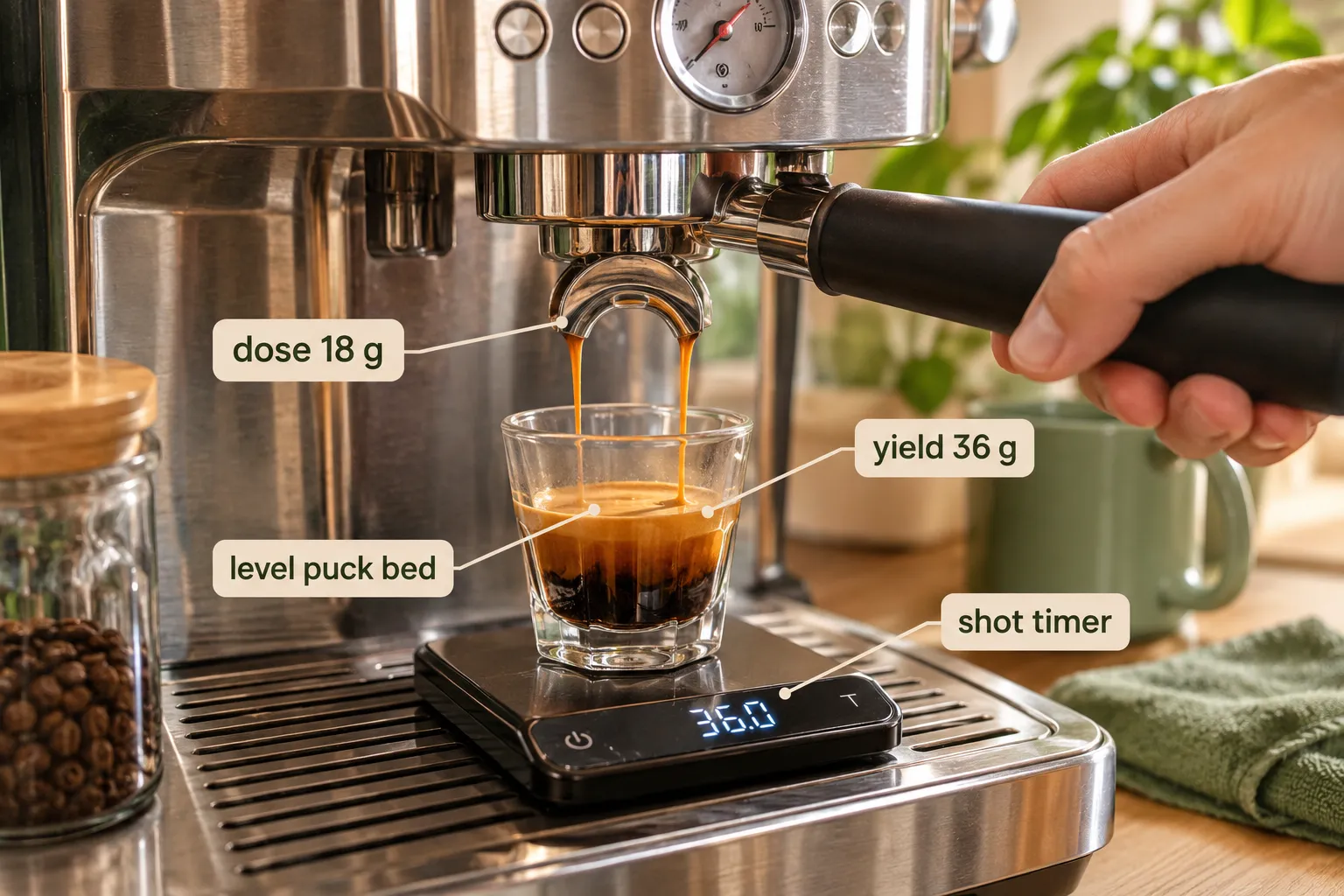
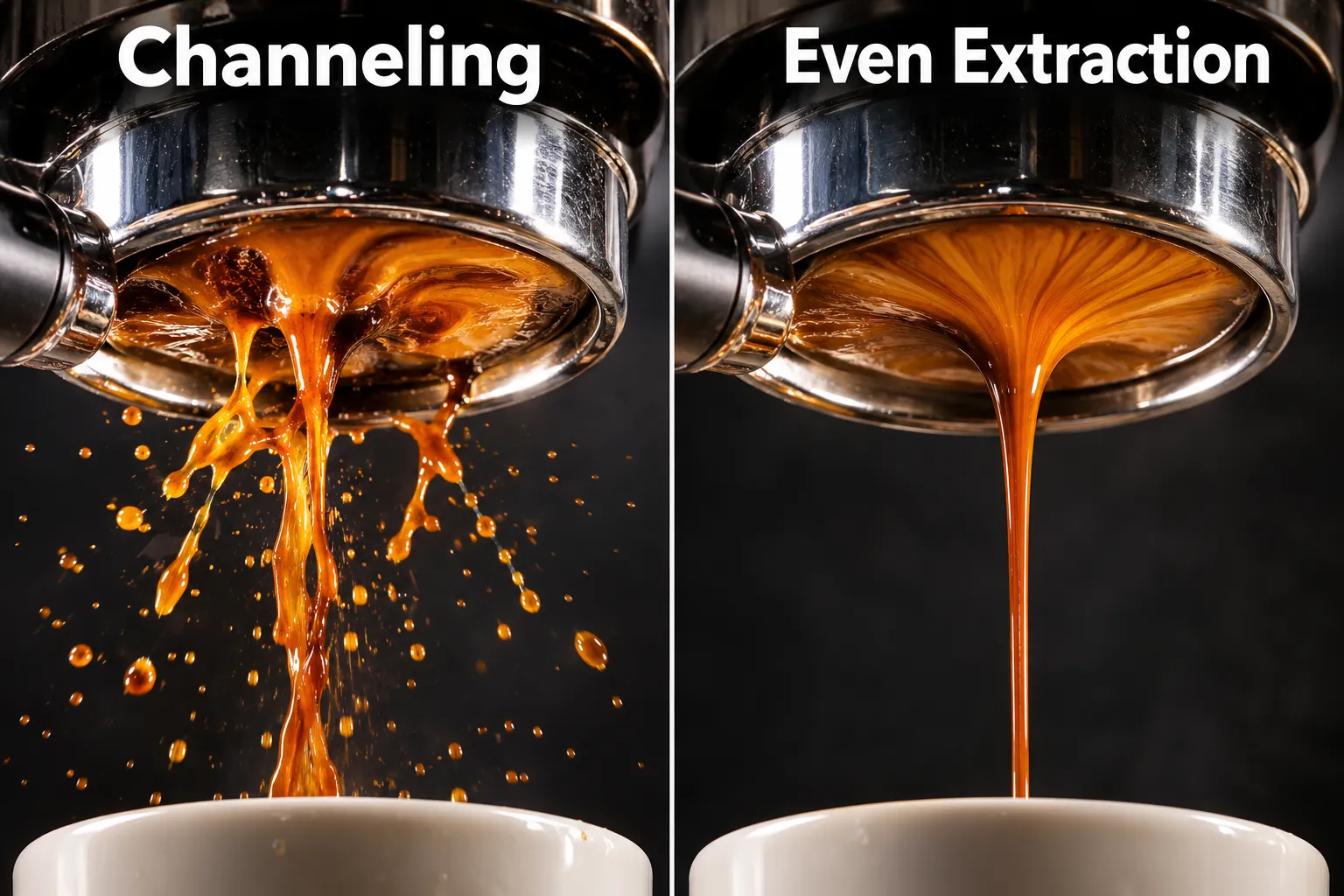
That distinction matters because of how espresso actually works. Hot water at roughly nine bars of pressure takes the path of least resistance through a compressed bed of coffee. If one part of that bed is looser than another, water rushes through the gap. This is called channeling. The water that found the easy route over-extracts a narrow column of grounds and under-extracts everything else, and the cup arrives both bitter and sour at the same time. People taste that and blame their beans. Usually it is the puck.
So the question "why is my espresso coming out bitter or weak" almost always resolves into four causes: grind size, dose, distribution, and extraction time. Bitter and hollow usually means over-extraction, often from grinding too fine or running too long a shot. Weak and sour usually means the water moved too fast, either through a coarse grind or a channeled puck. Espresso accessories give you a way to isolate each of those variables instead of guessing.
Which also answers a fair question: can you make good espresso without any accessories? Yes, occasionally. You can also parallel park without mirrors. The machine will produce a drinkable shot on a good day, but you will have no reliable way to repeat it tomorrow. If you want repeatability, you need measurement and distribution tools, and a solid starting grinder matters more than any of them.
One more framing point before the list. If you are weighing a $300 to $1,500 setup, budget roughly 10 to 15 percent of the machine price for espresso machine accessories. On a $700 machine that is $70 to $105, which covers a scale, a tamper that fits, a WDT tool, and a pitcher. Spending more than that before you have pulled 50 shots rarely improves anything.
)
1. A 0.1 Gram Scale Fixes Inconsistency
Problem fixed: your shots are different every single morning and you cannot explain why.
Espresso is a ratio. You put in a weight of dry coffee and you take out a weight of liquid. A common starting point is 18 grams in, 36 grams out, in about 25 to 30 seconds. That is a 1:2 brew ratio. Without a scale you are measuring by eye, which means you are measuring crema volume, and crema volume lies. A fresh roast produces thick foam that can make 20 grams of liquid look like 40.
Tamp & Pour's accessories guide, published November 4, 2026, puts weighing both dose and output at the top of its priority order for consistency, ahead of tampers and distribution tools . Their recommended model, the Timemore Black Mirror Basic 3, was listed at $59 on that date .
What to look for: 0.1 gram resolution, a built-in timer, a response time under about one second, and a footprint small enough to sit under your drip tray. Many 58 mm machines have less than 85 mm of clearance, so measure before you buy.
Do you need a scale for making espresso at home? If your machine is a volumetric super-automatic that doses for you, less so. For any semi-automatic with a manual lever or button, it is the single accessory that converts guesswork into a recipe you can write down and repeat. It is also the only way to dial in a shot in a structured way: hold dose constant, change one thing, taste, record.
Named pick: Timemore Black Mirror Basic 3, $59 as listed by Tamp & Pour on November 4, 2026 . Check the current price before buying.
2. A WDT Tool Fixes Channeling at the Source
Problem fixed: sour, thin shots with visible side-spray from the basket.
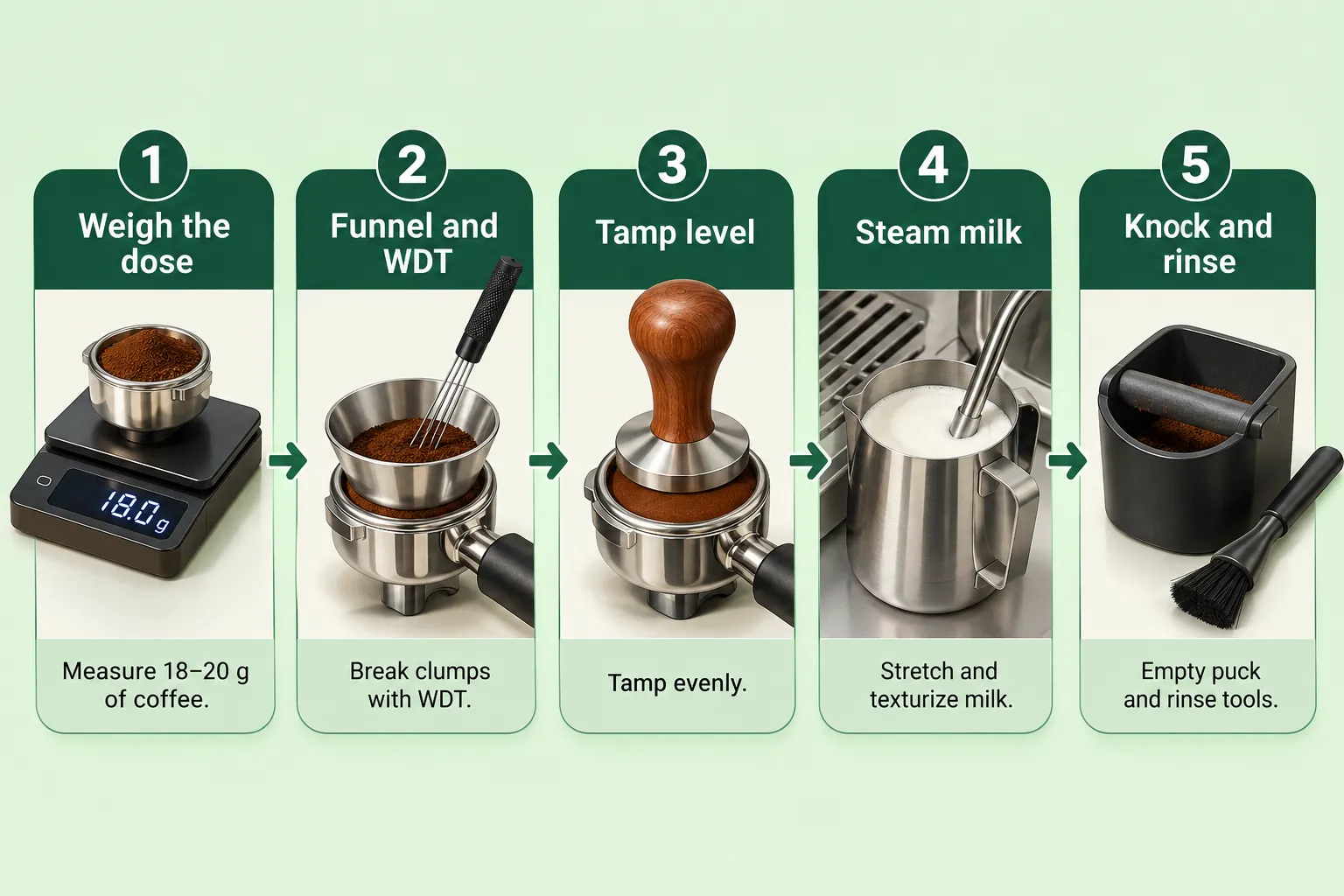
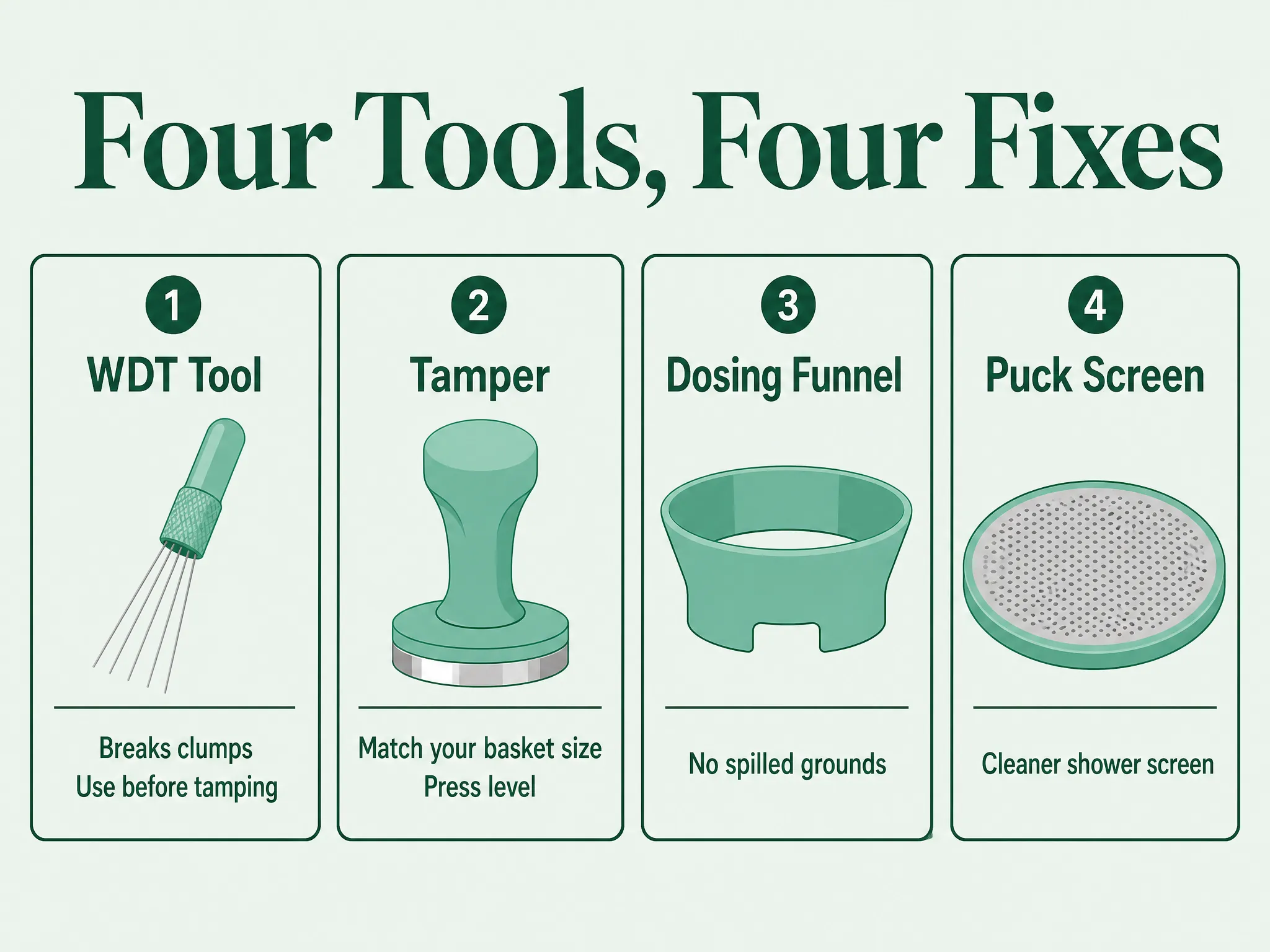
A WDT tool is a handle holding several very fine needles, usually between 0.3 mm and 0.5 mm thick. You stir the dry grounds in the basket before tamping. The needles break apart clumps and even out density so water meets consistent resistance across the whole bed.
Clumping is not a defect you can grind away. Burr grinders produce static, and static makes fine particles stick together into pellets. Those pellets sit in the puck like pebbles in sand. BrewSift's espresso accessories coverage frames WDT precisely as a clump-management tool rather than a flavor-improvement device, and notes the strongest case is freshly ground coffee from a grinder prone to static or clumping .
That framing also tells you when to skip it. Pre-ground coffee, pressurized baskets, and milk-heavy drinks all reduce the audible benefit. A flat white hides small extraction differences well. A straight ristretto does not.
Technique matters more than the tool. Stir in small circles at the bottom of the bed, then work upward, then level the surface gently. Ten to fifteen seconds is plenty. Aggressive stirring compacts the grounds against the basket wall and creates the exact problem you are trying to remove.
A palm distributor is sometimes sold as a WDT replacement. It is not quite the same thing. A distributor flattens the top surface and can move grounds sideways, but it may not break clumps sitting below the surface. Tamp & Pour draws this distinction and puts distribution before tamping in the workflow . If you own both, use the needles first.
Named pick: a basic needle WDT tool, around $9.99 on Amazon as of November 5, 2026, with 2,000-plus monthly purchases logged on that date. Best return per dollar in this entire list.
3. A Correctly Sized Espresso Tamper Fixes the Loose Outer Ring
Problem fixed: water escaping around the edge of the puck instead of through it.
What does a tamper actually do for espresso? It compresses loose grounds into a single uniform bed so the water meets even resistance. That is the whole job. It does not "pack flavor in." It removes air gaps.
Fit is the part people get wrong. Tamp & Pour is blunt about it: a 58 mm tamper cannot correctly prepare a 54 mm Breville basket . If the base is undersized, a ring of coffee around the perimeter stays loose, and that ring becomes a highway for water. If it is oversized, it binds and will not seat. Measure your basket's internal diameter, not the portafilter's advertised size. A "58 mm" machine usually takes a 58.5 mm tamper. A "54 mm" Breville usually takes 53.3 mm.
Calibrated tampers, which click or spring at a set pressure, are consistency and ergonomics tools. They give beginners and shared households a repeatable stopping point and spare your wrist. Tamp & Pour treats calibrated pressure as secondary to correct fit, and notes a spring will not rescue a wrong grind size, a wrong dose, or an uneven bed . That is the right order of operations.
Price reference from that same guide, checked November 2026: roughly $56 for a Normcore 58.5 mm and about $42 for a Breville-compatible 53.3 mm . On Amazon, a Normcore tamper was listed at $42 on November 5, 2026, with 3,391 reviews. Compare the models by base diameter first and finish second.
One technique note. Level matters more than force. Thirty pounds of crooked tamping is worse than fifteen pounds of flat tamping. Look at the puck surface from the side before you lock in.
)
4. A Bottomless Portafilter Fixes Your Diagnosis, Not Your Shot
Problem fixed: you know something is wrong but you cannot see what.
A bottomless portafilter has no spouts. The basket's underside is exposed, so you watch extraction happen. An even puck produces a slow bloom of dark droplets that merge into a single centered stream. A channeled puck sprays sideways, splits into separate jets, or fires one aggressive fast stream from a corner.
Tamp & Pour describes it as a diagnostic instrument rather than an improvement . That is accurate and worth absorbing. The device itself changes nothing about extraction. It changes what you can observe, which then tells you whether to adjust distribution, tamping, dose, or grind size.
Should you get a portafilter basket insert or go bottomless? Depends on your stage. If you are still learning, bottomless is more informative because the feedback is immediate and visual. If you regularly pull two drinks at once and want split spouts, keep the stock portafilter for daily use and swap to bottomless when a shot tastes wrong. Many people own both.
There is a honeymoon period. Once you consistently build even pucks, the bottomless stops telling you anything new, and it starts spraying your counter when you make a mistake. That is the trade. Expect to pay roughly $35 to $55 depending on size and machine fitment, with 54 mm and 58 mm the two common standards .
Pair it with a precision basket if your machine shipped with a pressurized one. Pressurized (dual-wall) baskets create artificial resistance so that almost any grind produces crema. They are forgiving and they also make a bottomless portafilter useless, because the resistance comes from the basket, not the coffee.
5. A Dosing Funnel Fixes Grounds on the Counter
Problem fixed: mess, lost dose, and a weight that no longer matches your recipe.
A dosing funnel is a metal ring that sits on the rim of the portafilter, widening the target while you grind or pour. Simple. Slightly boring. It saves roughly 0.3 to 0.8 grams per shot for most people, which on an 18 gram dose is a measurable ratio error you would otherwise never notice.
It also protects the portafilter rim. Grounds trapped on that rim stop the gasket sealing properly, which is one common and very fixable answer to "why does my espresso machine leak water." Water weeping from the group head during a shot usually means either a dirty rim, a worn group gasket, or an over-filled basket pressing against the shower screen. The funnel addresses the first. A gasket replacement, typically every 9 to 18 months of daily use, addresses the second.
Magnetic funnels hold position while you stir with a WDT tool, which is the main reason to pay a little more. Expect $10 to $18 for a decent one, and check whether it fits inside your 54 mm basket wall or sits over the 58 mm rim, because the two designs are not interchangeable .
This is also the accessory most likely to arrive in a kit. If you are buying an espresso accessories kit, the funnel is frequently the piece that justifies the bundle price.
6. A Milk Frothing Pitcher Fixes Foam That Should Be Microfoam
Problem fixed: big bubbles, dry foam, no latte art, a cappuccino that tastes like warm air.
Steaming milk is an airflow problem solved by geometry. You introduce a short burst of air near the surface, then submerge the tip slightly and spin the milk into a vortex that breaks those bubbles into microfoam, which is foam with bubbles too small to see individually. Milk that holds its texture for two minutes instead of collapsing in ten seconds is almost always a pitcher-and-technique result, not a machine result.
Pitcher size matters more than brand. For a single 6 to 8 ounce latte, a 12 ounce pitcher works. For two drinks, use 20 ounces. Fill to just below the spout base, roughly one third to one half capacity, so the milk has room to expand. Too much milk in too large a pitcher means the steam wand tip sits too deep and you get heat without texture.
A sharp, narrow spout gives you control over pour placement, which is the difference between a blob and a rosetta. If latte art is the goal, read through the steaming and latte art guidance before blaming the pitcher.
Named pick: a basic stainless frothing pitcher was listed at $8.49 on Amazon on November 5, 2026, with 12,593 reviews. For under nine dollars, it is the least controversial purchase in the category. A thermometer clip or a pitcher with an etched fill line helps beginners stop around 140 to 150 degrees Fahrenheit, past which milk proteins begin to lose sweetness.
)
7. A Knock Box Fixes the Puck Disposal Problem
Problem fixed: wet coffee pucks clogging your sink, noise at 6 a.m., and a bent portafilter rim.
Nobody shopping for a first machine thinks about puck disposal. Everybody who owns one thinks about it by week two. A spent puck is a compressed disc of wet grounds that does not rinse down a drain, sticks to trash bags, and crumbles across the counter when you tap the portafilter against a bin edge.
A knock box is a container with a padded crossbar. You knock the portafilter against the bar, the puck drops out intact, and the rubber absorbs the impact that would otherwise deform your basket or wake the house. That padding is the actual engineering. A plastic tub is not a knock box.
Sustainability has reached this corner of the category too. On March 10, 2026, the Specialty Coffee Association recognized OutIn's Espresso Grounds Container as a Best New Product. It uses hand-pressed air to eject the puck quietly, is made from a recycled coffee-grounds composite, and supports OutIn baskets plus standard 51 mm and 58 mm bottomless portafilters. Spouted portafilters still require the traditional knock bar. The stated aims are less noise, less basket wear, and reduced virgin plastic use.
Named pick: the Breville knock box was listed at $33.95 on Amazon on November 5, 2026. Look for a removable bar for cleaning and a non-slip base, since a knock box that slides on granite defeats its purpose.
Small bonus: spent pucks are a decent nitrogen source for compost, and a knock box collects them in a form that is easy to tip into a garden bin.
8. A Puck Screen Fixes Shower Screen Grime and Soggy Pucks
Problem fixed: coffee residue baked onto the group head, and a puck that shatters when you knock it out.
A puck screen is a thin perforated metal disc placed on top of the tamped coffee. It reduces direct contact between grounds and the shower screen, so less residue builds up where you cannot easily reach. It also helps the puck stay intact for disposal and can make cleaning routines shorter.
The marketing around puck screens oversells them. Portafilter Co.'s fitment guidance is useful here, and it is specific: for tighter Breville 54 mm systems, an approximately 0.8 mm screen is recommended rather than automatically fitting a 1.7 mm one . Thickness consumes headspace, which is the gap between the puck surface and the shower screen. Lose too much and the portafilter becomes hard to lock in, or the screen presses the puck in a way that works against you.
They also do not fix bad puck preparation. If you are channeling, a screen will not stop it. Distribution and grind size will. Treat it as a cleanliness and convenience accessory with mild consistency benefits, which is exactly where the evidence places it .
Named pick: a Normcore puck screen was listed at $13.99 on Amazon on November 5, 2026. Check your basket size and your available headspace first. Mesh screens clog faster than sintered designs and want a rinse after every few shots.
9. A Cleaning Kit Fixes Bitterness You Cannot Grind Away
Problem fixed: a persistent rancid, ashy edge in every cup regardless of beans.
Coffee oils oxidize. They collect in the group head, on the shower screen, inside the basket perforations, and in the three-way valve of a semi-automatic machine. Old oil tastes like old oil, and it transfers into every shot. People chase this flavor with new beans for months.
A proper cleaning setup is modest: a group head brush with heat-resistant bristles, a blind basket (a basket with no holes) for backflushing, an espresso machine detergent such as a Cafiza-type powder, and a small brush for the steam wand tip. Together these usually run $18 to $30 across the listed accessory retailers .
A workable routine: wipe the steam wand and purge it after every milk drink, flush the group head after every shot, brush the shower screen daily, and backflush with detergent weekly if your machine has a three-way solenoid valve. Single-boiler machines without that valve should not be chemically backflushed, so check your manual. Descale on the schedule your manufacturer specifies and your water hardness demands.
This also ties back to leaks. A machine that drips from the group head after a shot is often normal pressure release through the solenoid. A machine that sprays during the shot has a seal, rim, or over-dose issue. A machine that puddles underneath usually has a loose drip tray hose or a tired water tank seal. Regular cleaning makes the difference between those causes easy to spot. There is a fuller breakdown in our espresso equipment maintenance guide.
Named pick: any backflush detergent plus a group brush. Unglamorous, and the most consequential $25 you will spend after year one.
)
The Buy Order on a $50 Budget
Fifty dollars is a real constraint and a useful one. It forces priority.
Spend it like this. WDT tool, $9.99. Milk frothing pitcher, $8.49. Dosing funnel, roughly $12. That is about $30 and covers distribution, milk, and mess. Put the remaining $20 toward a scale fund, because the scale is the biggest single upgrade and the hardest to substitute. A $25 kitchen scale with 1 gram resolution is a tolerable bridge for dosing beans, though it is too slow and too coarse for weighing output.
If your machine shipped with a tamper, use it until you confirm the diameter is wrong. Many Breville models include a 54 mm tamper that is slightly undersized for the basket, which is worth checking with calipers or a ruler before you spend $42 replacing it.
Skip for now: puck screen, bottomless portafilter, calibrated tamper, dosing cups, distribution wedges. All useful later. None of them fix a problem you have at the $50 stage.
For espresso accessories for beginners on a budget, the honest sequence is measure, distribute, then refine. In that order. The most important thing to upgrade first on an espresso machine, if the machine itself is adequate, is almost always the grinder, then the scale. A blade grinder chops beans into wildly uneven fragments, which means fines over-extract while boulders barely extract at all. No tamper rescues that. A burr grinder crushes beans between two surfaces at a set distance and produces a narrow particle range, which is the precondition for everything else on this list. If you are choosing between a $150 burr grinder and $150 of espresso accessories, buy the grinder.
Comparison Table: Accessory, Problem, Price, Pick
| Accessory | Problem fixed | Price (Nov 2026) | Named pick |
|---|---|---|---|
| 0.1 g scale | Inconsistent brew ratio | $59 | Timemore Black Mirror Basic 3 |
| WDT tool | Clumps and channeling | $9.99 | Basic needle WDT |
| Espresso tamper | Loose outer ring in puck | $42 | Normcore, sized to basket |
| Bottomless portafilter | Invisible channeling | $35 to $55 | Size-matched 54 or 58 mm |
| Dosing funnel | Spilled grounds, lost dose | $10 to $18 | Magnetic ring funnel |
| Milk frothing pitcher | Bubbly, dry milk foam | $8.49 | 12 oz stainless pitcher |
| Knock box | Messy, noisy puck disposal | $33.95 | Breville knock box |
| Puck screen | Shower screen residue | $13.99 | Normcore, 0.8 mm for 54 mm |
| Cleaning kit | Rancid oil bitterness | $18 to $30 | Group brush plus backflush detergent |
Prices checked November 2026. Affiliate disclosure: Coffee Rank IQ may earn a commission from purchases made through links on this page, at no extra cost to you.
What to Watch Out For
The 25-piece kit trap. Multi-piece espresso accessories kits were listed on Amazon between $27.74 and $42.29 on November 5, 2026. Some are excellent value. Others pad the count with a plastic measuring spoon, three stickers, a cheap cloth, and a tamper mat, then call it 25 pieces. Count the items you would buy individually. If a kit contains a usable tamper, a funnel, a WDT tool, and a pitcher for $35, that is a fair deal. If the tamper is aluminum and the wrong diameter, you have bought a $35 funnel.
Wrong sizes for your machine. This is the most common and most expensive mistake. Portafilter standards include 51 mm, 53 to 54 mm, and 58 mm, and the correct tamper diameter is usually a fraction smaller than the nominal size. Breville's 54 mm machines generally want 53.3 mm tampers, and Tamp & Pour flags the 58 mm-on-54 mm mismatch specifically . Measure your basket's internal diameter before ordering anything that has to fit inside it.
Gimmick territory. Which espresso accessories are actually worth it versus decorative? Scales, WDT tools, correctly sized tampers, pitchers, and cleaning supplies earn their place through a measurable mechanism. Leveling wedges that only touch the surface, decorative tamper handles, and novelty shot glasses do not change extraction. Pressurized baskets marketed as upgrades are usually a step backward for anyone with a decent grinder.
Common mistakes with the tools themselves. Over-stirring with a WDT tool and compacting the bed. Tamping hard but crooked. Using a 1.7 mm puck screen in a basket with no headspace. Filling the frothing pitcher past the spout. Backflushing with detergent on a machine that has no three-way valve. Each of these turns a helpful accessory into a new problem.
Lifestyle pricing exists. On October 30, 2026, Porsche and La Marzocco released their second collaboration, including a limited Linea Micra listed at €5,790 and a Pico grinder at €1,550, with matching cups, towels, coasters, and canisters, capped at 911 units across two colorways plus 150 units in a Germany-exclusive color. Beautiful objects. They are collectibles with espresso function, priced accordingly, and nothing in that bundle extracts coffee better than a $42 tamper that fits.
Bundles are becoming standard. Meraki advertised its integrated machine at $1,799 in October 2026, down from $1,999, with a six-piece $210 Upgrader Kit containing a calibrated tamper, 14 ounce pitcher, WDT tool, dosing funnel, shot cup, and puck screen. The direction of travel is clear: brands are selling a prepared workflow rather than a bare machine. Price the kit against buying the same six items separately before you assume it saves money.
FAQ

Conclusion
Buy three things first: a 0.1 gram scale, a WDT tool, and a tamper that matches your basket diameter. That is roughly $110 at November 2026 prices, and it addresses measurement, distribution, and compression, which are the three variables behind most bad home shots. Everything else on this list refines a process those three establish.
Next step: measure your basket's internal diameter today, write it on a sticky note, and keep it with you when you shop. Half the money wasted on espresso accessories is spent on gear that physically does not fit. Better Coffee Starts With Better Answers, and that one starts with a ruler.
Affiliate disclosure: Coffee Rank IQ may earn a commission from purchases made through links in this article. Prices were checked in November 2026 and change often. This article is based on published product specifications, retailer listings, and documented accessory guides rather than hands-on laboratory testing.
Espresso Accessory Budget Planner
Enter your machine price and basket size for a suggested buy order. Prices checked November 2026.
Guidance only. Confirm fitment and current pricing before purchase.