

Ethiopian Coffee: Yirgacheffe, Sidamo and Guji Compared
Ethiopian Coffee in One Sentence: Floral Yirgacheffe, Broad Sidamo, Stone Fruit Guji
Ethiopian coffee from Yirgacheffe usually leans floral and citric, Sidamo covers the widest range from berry naturals to clean washed cups, and Guji sits higher up with peach, apricot and a heavier body. That is the short version. The longer version is that the processing method on the bag often predicts flavor better than the region name does, and the 2025/26 season pushed more Ethiopian lots into natural processing than usual. Both of those facts change what you should buy.
Key Takeaways
- The USDA Foreign Agricultural Service forecast Ethiopia's MY 2026/27 production at 12.10 million 60-kg bags, up 4.7% from 11.56 million the prior year, with exports forecast at 7.13 million bags .
- StoneX analyst Alexis Rubinstein reported on September 11, 2026 that localized weather irregularities may have cut yields by 5 to 7% in parts of Yirgacheffe, Gedeb and Guji, hitting high-end washed lots harder than national volume .
- Red cherry prices in Yirgacheffe reportedly reached 220 to 250 birr per kilogram in December 2025, close to four times the previous season, according to USDA FAS reporting from May 20, 2026 .
- That cost pressure pushed farmers to dry cherries at home, so washed Yirgacheffe and washed Guji got scarcer while natural lots got more common .
- Typical washed Yirgacheffe grows at roughly 1,700 to 2,200 meters; Guji generally sits at 1,800 to 2,300 meters, per Ethio Coffee's regional comparison updated March 12, 2026 .
- Guji only became its own trade designation at the Ethiopia Commodity Exchange in 2010; before that it was grouped under Sidamo .
- Region is a starting point. Lot, washing station, altitude, cultivar and drying conditions decide the cup.
Ethiopian Coffee: What Those Three Names Actually Refer To
Yirgacheffe, Sidamo and Guji are trade designations, not flavor guarantees. Each names a growing area with shared geography and shared habits, and each contains hundreds of washing stations whose output varies.
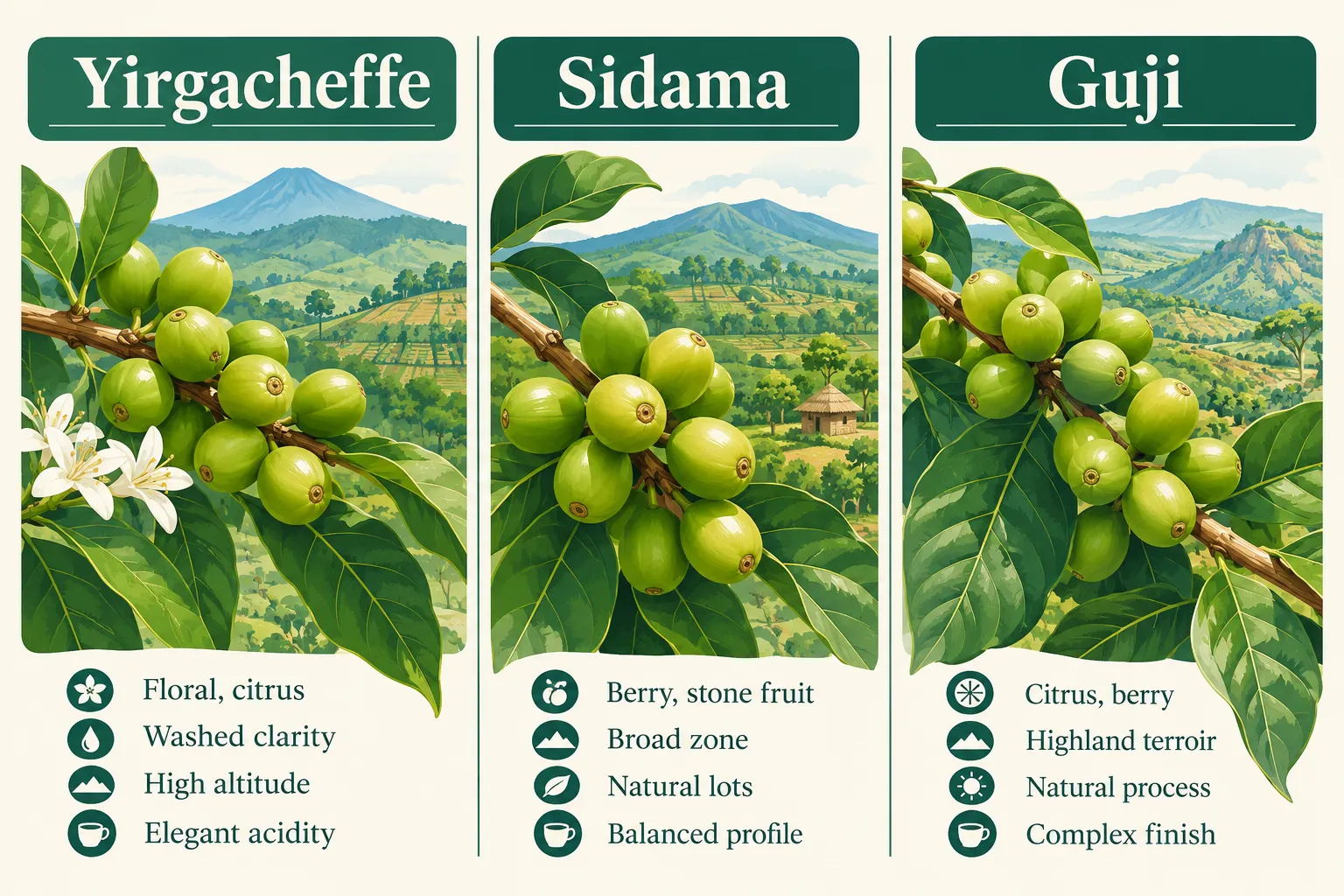
Yirgacheffe sits in the Gedeo area. Sidamo refers to Sidama Regional State. Guji is in Oromia. Historical administrative boundaries mean Yirgacheffe has sometimes been discussed inside a broader Sidamo context, but the trade treats it as separate, and Guji split off as its own designation in 2010 .
The varieties matter too. Most of what you buy is labeled "heirloom," which is a trade shorthand for the enormous pool of landrace Arabica types growing across southern Ethiopia, plus selected JARC releases such as 74110 and 74112. Ethiopia is the genetic home of Arabica, so "heirloom varieties" covers more diversity than a single word in Colombia or Brazil ever could. That diversity is one reason two bags from the same district can taste like different species.
One practical decision rule: if a bag lists only the country and region, treat it as a blend of many farms. If it lists a washing station, a harvest year and a processing method, you are looking at a traceable lot, and the tasting notes on the bag have a better chance of matching your cup.
What's the Difference Between Yirgacheffe and Sidamo Coffee?
Washed yirgacheffe coffee is the narrower, more floral style; sidamo coffee is the broader category that includes both fruit-forward naturals and clean washed cups.
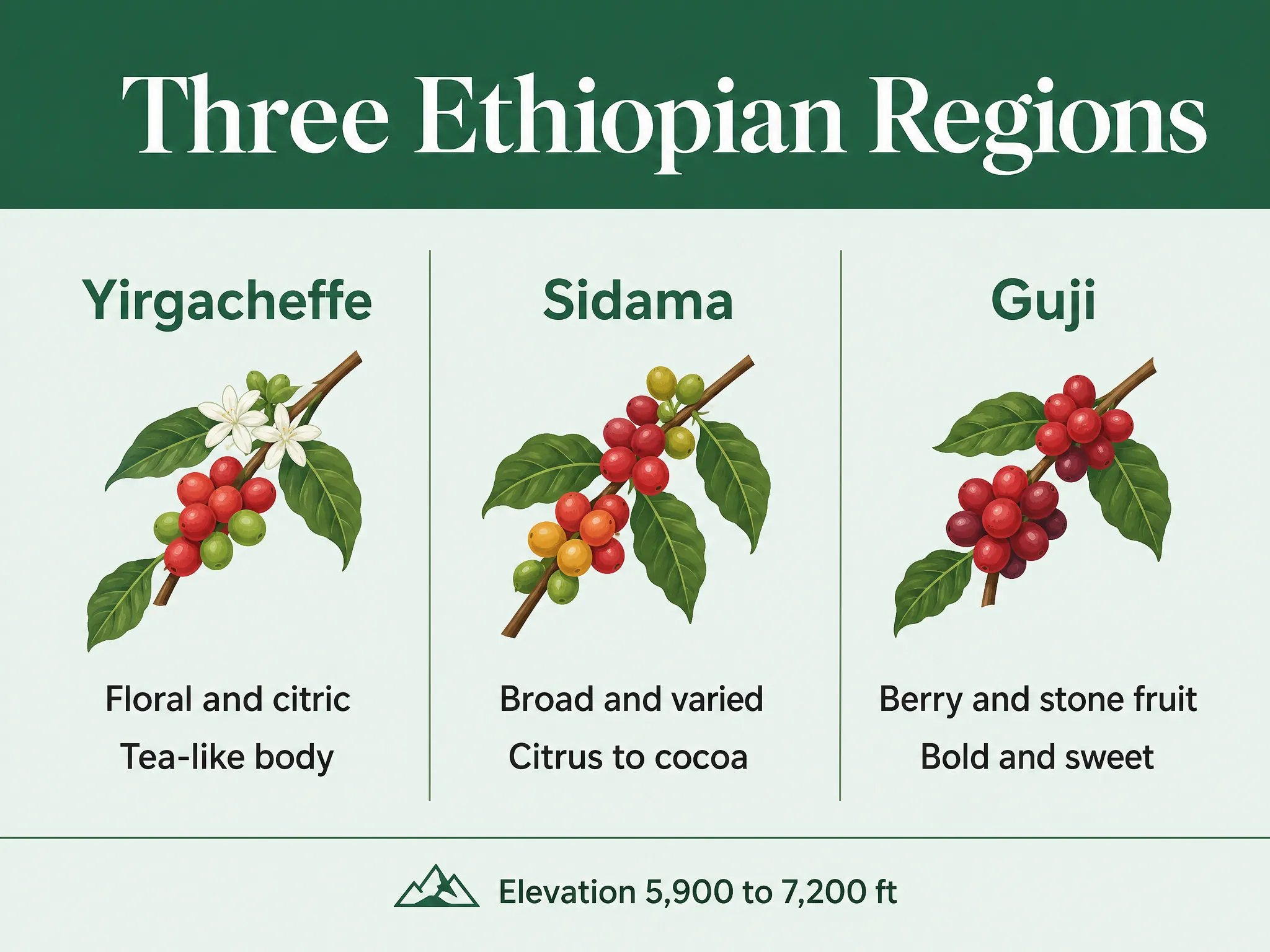
Roasters commonly describe washed Yirgacheffe lots from Kochere and Wenago as jasmine, bergamot, lemon and black tea, with a light, silky body . The acidity reads as bright and lemony rather than juicy. Milk tends to smother it.
Sidamo refuses to be that tidy. Lots from Bensa, Chire, Dale and Aleta Wondo swing from blueberry and strawberry naturals with wine-like acidity to washed coffees closer to citrus, jasmine and honey . That spread is why Sidamo turns up in espresso blends so often. It can supply fruit without demanding a whole menu built around it.
Choose Yirgacheffe if you want the clearest floral tea character in your filter cup. Choose Sidamo if you want fruit with more sweetness and body, or you are buying for a household that also makes lattes.
Common mistake: assuming "Yirgacheffe" on a dark roast bag will taste floral. Past a certain roast level, those delicate aromatics are gone and you are paying a premium for caramelized sugar. If you like darker profiles, read our take on how to choose a coffee roast before spending on a specialty origin lot.
Is Guji or Sidamo Coffee More Fruity?
Natural Guji is usually the more intense and more structured fruit; natural Sidamo is usually the brighter berry. Neither wins by default, because processing swings the result more than the border does.
Guji lots from Hambela, Shakiso and Uraga are commonly associated with peach, apricot, jasmine, tropical fruit and a syrupy body . The higher altitude band, roughly 1,800 to 2,300 meters, slows cherry maturation, which is the standard agronomic explanation for denser beans and more concentrated sugars. Guji's extra weight is why so many espresso bars pick it for single origin shots.
Sidamo naturals usually read as blueberry and strawberry with a wine edge . Lighter on the tongue, louder on the nose.
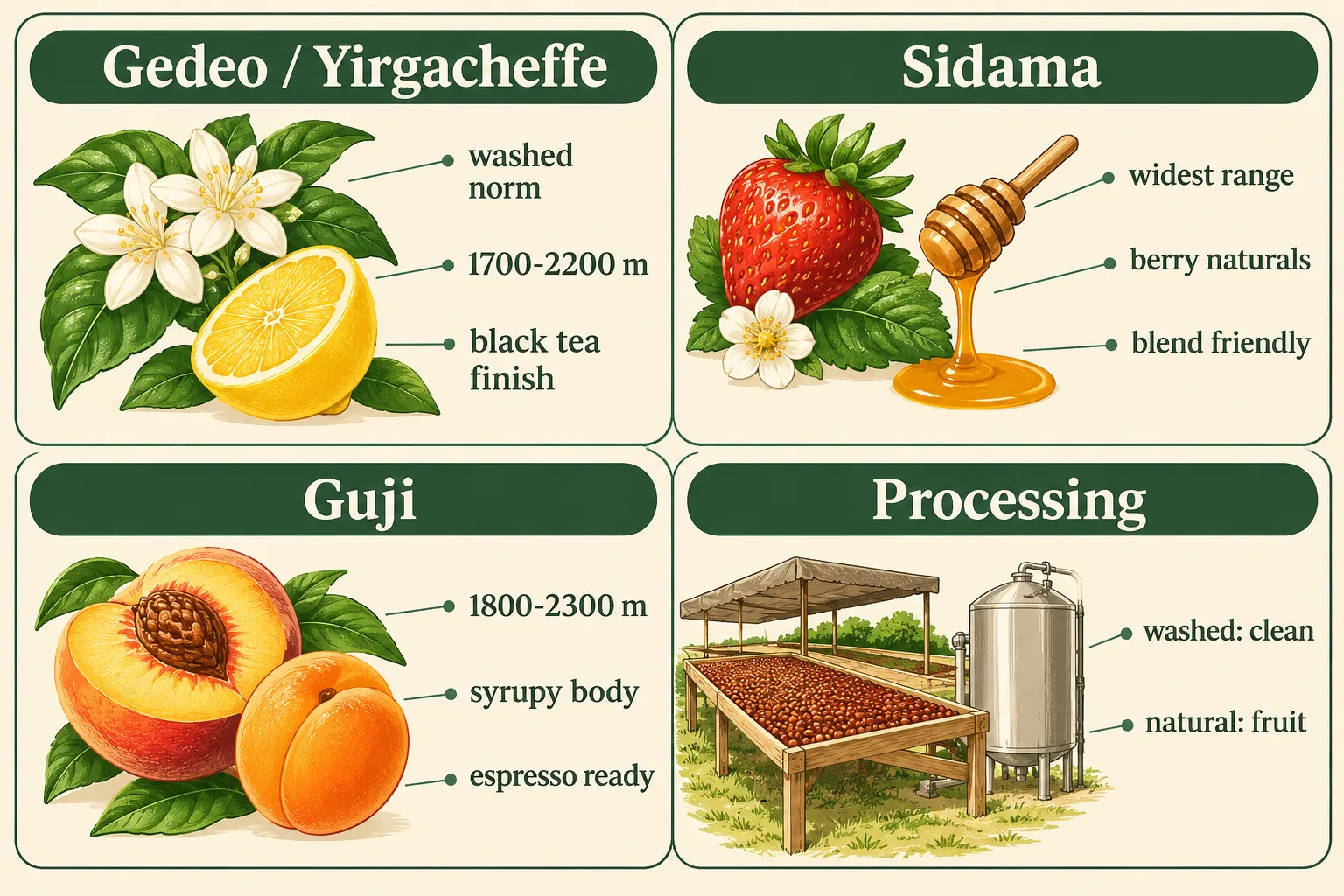
A natural-processed Guji will almost always taste fruitier than a washed Sidamo. A washed Sidamo may sit very close to a washed Guji in a blind cupping. The washed vs natural process difference does more work than the regional label.
If you only read one word on an Ethiopian coffee bag before buying, read the processing method, not the region.
Edge case: honey and anaerobic lots from Guji have become common at specialty roasters. They blur the line further, often landing somewhere between tropical candy and fermented stone fruit. Great fun, not a good first purchase.
How Do You Brew Ethiopian Coffee to Get the Best Flavor?
Brew light roast Ethiopian coffee as a pour over at a 1:16 brew ratio, water near 203F, with a medium-fine grind size and a 45 second bloom. That setup gets the aromatics out without dragging in harshness.
A workable starting recipe for a single cone:
- Weigh 22 g of whole beans and grind medium-fine on a burr grinder. Blade grinders produce uneven particles, which pulls bitterness and sourness into the same cup.
- Rinse the paper filter with hot water, then discard the rinse water.
- Heat water to 200 to 205F. Off boil by 30 seconds is close enough if you lack a thermometer.
- Pour 60 g of water and let the bed bloom for 45 seconds. Carbon dioxide escaping from fresh grounds pushes water away, and the bloom clears it.
- Pour in two or three steady additions to 352 g total. Target a 2:45 to 3:15 total brew time.
Troubleshooting is simple. Thin and sour means grind finer or raise water temperature. Dry and bitter means grind coarser or reduce contact time. Flat and dull usually means stale beans rather than a technique failure.
Ethiopian coffee also makes excellent cold brew, though the floral top notes fade and the berry notes carry. Use a coarser grind, a 1:8 ratio, and 16 hours in the fridge. For method tradeoffs across equipment, see our comparison of coffee brewing methods, and if your grinder is the weak link, our grinder buying guide explains which burr sets suit pour over versus espresso.
Espresso note: washed Yirgacheffe at espresso ratios often tastes thin and aggressively acidic. Natural Guji handles it better because of the heavier body.
Why Is Yirgacheffe So Expensive Compared to Other Ethiopian Coffee Regions?
Yirgacheffe costs more because demand for its floral washed profile is high, the growing area is small, and production costs there rose sharply in the 2025/26 season.
USDA FAS reporting dated May 20, 2026 described red cherry prices in Yirgacheffe reaching 220 to 250 birr per kilogram in December 2025, nearly four times the previous season's level. Sidama picking labor reportedly doubled from 5 to 10 birr per kilogram, and inland transport costs rose after fuel prices increased by more than 30% . Those are reported market figures, not audited farm accounts, and birr conversion rates moved considerably across the period, so treat them as direction rather than precision.
The second pressure is processing. Washed coffee requires a wet mill, water, fermentation tanks and working capital to buy cherries. With cherry prices that high, many wet mills bought less, and farmers dried cherries at home instead . Less washed coffee reached the market. Washed Yirgacheffe is exactly the product that shortage hits.
Add the StoneX observation from September 11, 2026 that weather irregularities may have trimmed yields 5 to 7% in parts of Yirgacheffe, Gedeb and Guji, with high-end washed lots most affected , and the price makes sense. A single estimate from one analyst is not a verified harvest count, which is worth remembering before treating it as fact.
Which Ethiopian Coffee Is Best for Beginners, and Where Can You Buy It?
Start with a natural-processed Sidamo or Guji from a US roaster with a visible roast date. Those lots are sweeter and more forgiving than washed Yirgacheffe, and the fruit is obvious enough that you notice what makes Ethiopian coffee different.
Ethiopian coffee is widely available in the US. It is one of the most common specialty origins on American roaster menus, and Ethiopia's largest export destinations include the US, Germany, Saudi Arabia and, increasingly, China. USDA FAS reported roughly 670,000 bags worth $274 million shipped to China in MY 2024/25, up 264.1% year over year . Rarity is not the problem. Choosing well is.
Where to buy, in order of practicality:
- A local roaster with a posted roast date. Freshest option, no shipping delay.
- A subscription, if you want rotation without research. Our coffee subscription comparison breaks down which services actually publish origin detail.
- Direct from a specialty roaster's site, filtering for "Ethiopia" plus "natural" or "washed."
What to check before paying: roast date within the last three weeks, a named region or washing station, a stated processing method, and whole bean rather than pre-ground. If a bag lists none of those, it is a commodity blend wearing a nice name. For deeper buying criteria, see how to choose the best coffee beans for home brewing.
Storage: once opened, keep beans in an opaque airtight container at room temperature and finish them within two to three weeks. Light roast Ethiopian lots actually improve for about 7 to 14 days after roasting as carbon dioxide escapes, then slide. The freezer works for long-term storage in sealed portions, but repeated thawing does not.
Region by Region: Elevation, Flavor Profile and Processing Norms
Each of the three designations has a typical altitude band, a dominant processing habit and a reported flavor signature. Here is each one on its own terms, based on Ethio Coffee's regional comparison updated March 12, 2026 .
Yirgacheffe
Elevation: roughly 1,700 to 2,200 meters in the Gedeo Zone. Processing norm: washed dominates the reputation, though naturals exist and are increasing. Reported profile: jasmine, bergamot, lemon, black tea, light silky body. Kochere and Wenago are the subregions most often tied to clean floral and citrus cups, though buyers should check the specific lot rather than trusting the subregion name .
Best use: filter brewing, light roasts, drinkers who like tea more than chocolate.
Sidamo
Elevation: broadly 1,500 to 2,200 meters depending on subregion. Processing norm: both, in volume. Reported profile: berry-heavy naturals with blueberry, strawberry and wine-like acidity, or washed cups showing citrus, jasmine and honey . Bensa, Chire, Dale and Aleta Wondo each push the profile in different directions.
Best use: the flexible pick. Works on filter, works in an espresso blend, works for a household with mixed tastes.
Guji
Elevation: roughly 1,800 to 2,300 meters in Oromia. Processing norm: strong natural and experimental presence alongside washed. Reported profile: peach, apricot, jasmine, tropical fruit, syrupy body . Hambela, Shakiso and Uraga are the names that show up most on specialty menus.
Best use: single origin espresso, and filter brewing when you want fruit with weight behind it.
The Science and the Sourcing Data: Named Sources, Years and Limits
Three organizations supply most of the usable numbers here, and each has limits worth stating before you quote them.
USDA Foreign Agricultural Service, Coffee Annual, May 20, 2026. Forecasts MY 2026/27 production at 12.10 million 60-kg bags, up 4.7%, with exports at 7.13 million bags. It also reports that exports from October 2025 through April 2026 totaled 3.28 million bags, down 13% year over year, while April 2026 shipments of 702,718 bags were the second-highest April volume in five years . Limit: these are attaché estimates built on government data, trade interviews and modeling, not a census. Forecasts get revised.
StoneX, September 11, 2026. Analyst Alexis Rubinstein's assessment that weather irregularities may have reduced yields 5 to 7% in parts of Yirgacheffe, Gedeb and Guji . Limit: a commercial market analysis, localized, and phrased as a possibility. It is not a measured harvest result.
Rift Valley Institute, September 2026. Yacob Cheka Hidoto of Dilla University, writing for the Ethiopia Peace Research Facility, argues the Sidama, Gedeo and Guji coffee belt should be read through land rights, ethnic relations, trader power, conflict, credit access and how value is distributed, not only agronomy and cup score. Limit: a political-economy analysis, not an agronomic study, and it does not predict flavor.
Association is not causation anywhere in this. Higher altitude correlates with denser beans and the flavors buyers reward, and slower maturation is the standard mechanism offered. Soil, shade, cultivar, picking selectivity and drying discipline all move the same outcome, so no single variable gets the credit.
The Misconception This Article Corrects
The common belief is that the region name predicts the flavor. It does not predict it reliably, and relying on it will cost you money.
Ethio Coffee's comparison makes the point directly: a natural Guji may be more fruit-driven than a washed Yirgacheffe, and a washed Sidamo can overlap substantially with a washed Guji . The categories are commercial designations with porous edges, shaped by harvest timing, washing station skill, drying conditions and traceability.
Three practical consequences:
- Processing beats region. If the bag says natural, expect fruit. If it says washed, expect clarity. Then read the region as a modifier.
- The harvest year matters. Ethiopian coffee tastes different season to season because rainfall, cherry ripeness, labor availability and mill economics change. The 2025/26 cost squeeze that shifted supply from washed to natural literally changed what was on US shelves.
- The name on the bag is a supply chain outcome. The Rift Valley Institute analysis is a reminder that whether a smallholder can access credit, sell to a wet mill or hold cherries at home shapes what lands in your grinder.
Anyone building a home setup around origin exploration should read the roast date and processing method first and treat the region as context. If you want to understand why those labels exist at all, our coffee education section covers the terminology in more depth.
Yirgacheffe vs Sidamo vs Guji: Side by Side
Ethiopian coffee regions at a glance
| Region | Typical elevation | Processing norm | Reported notes | Best brew |
|---|---|---|---|---|
| Yirgacheffe (Gedeo) | 1,700-2,200 m | Mostly washed | Jasmine, bergamot, lemon, black tea | Pour over |
| Sidamo (Sidama) | 1,500-2,200 m | Washed and natural | Blueberry, strawberry, citrus, honey | Filter or blend |
| Guji (Oromia) | 1,800-2,300 m | Natural-leaning | Peach, apricot, tropical fruit, syrupy | Espresso or filter |
Elevation bands and flavor descriptors as reported by Ethio Coffee regional comparison, updated March 12, 2026. Individual lots vary.
Sourced Stat Cards
Five numbers worth remembering, each attached to a named source and a date.
Each figure is a reported estimate from the organization named, not a measurement taken by this publication.
As an Amazon Associate, Coffee Rank IQ earns from qualifying purchases.
FAQ

Conclusion: What This Means for Your Home Setup
Buy by processing method first, region second, roast date always. For a first purchase, a natural Guji or natural Sidamo roasted within the last three weeks gives you the most obvious fruit for the money and survives small brewing mistakes. Save washed Yirgacheffe for after your grind size is dialed in, because its floral clarity is also its fragility.
Next step this week: pick up one washed and one natural these origins of similar price, brew both at a 1:16 brew ratio with the same water temperature and grind size, and taste them side by side. That single comparison will teach you more about the washed vs natural process than another article can.
Better Coffee Starts With Better Answers.