Geisha Coffee: Why One Cup Can Cost $20
Quick Answer
Geisha coffee is a low-yielding Ethiopian-origin coffee variety, made famous in Panama, that regularly sells for 10 to 50 times the price of ordinary specialty beans. A single 15 kg lot from Lamastus Family Estates sold for $18,004 per kilogram at the Best of Panama 2026 auction on September 24, 2026 . Retail bags from Panama typically run $25 to $45 per 100g, which works out to roughly $4 to $7 per brewed cup at home. A $20 café cup usually reflects a competition-grade lot, a tiny serving, and a lot of hand labor on a steep hillside.
Key Takeaways
- Best of Panama 2026 closed September 24, 2026 with $3,041,940 across 50 lots and an average of $4,055.92/kg, about 42% above the prior year's average .
- The winning lot, Elida Geisha Torre (washed, Lamastus Family Estates, Alto Quiel, Boquete) scored 96.25 and sold at $18,004/kg to JD.com .
- That was below the 2025 record of $30,204/kg paid for a Hacienda La Esmeralda lot, so prices are strong but not climbing without limit .
- All 40 Geisha lots in the 2026 auction cleared $1,500/kg, while the 10 non-Geisha varietal lots started far lower .
- Brooklyn's Sey Coffee paid $44,275 ($6,325/kg) for seven kilograms of washed Finca Sophia Geisha and began serving it around $200 per cup in October 2026 .
- Retail reality: most home buyers pay $25 to $45 per 100g for Panama geisha coffee, which is a treat purchase, not a daily habit.
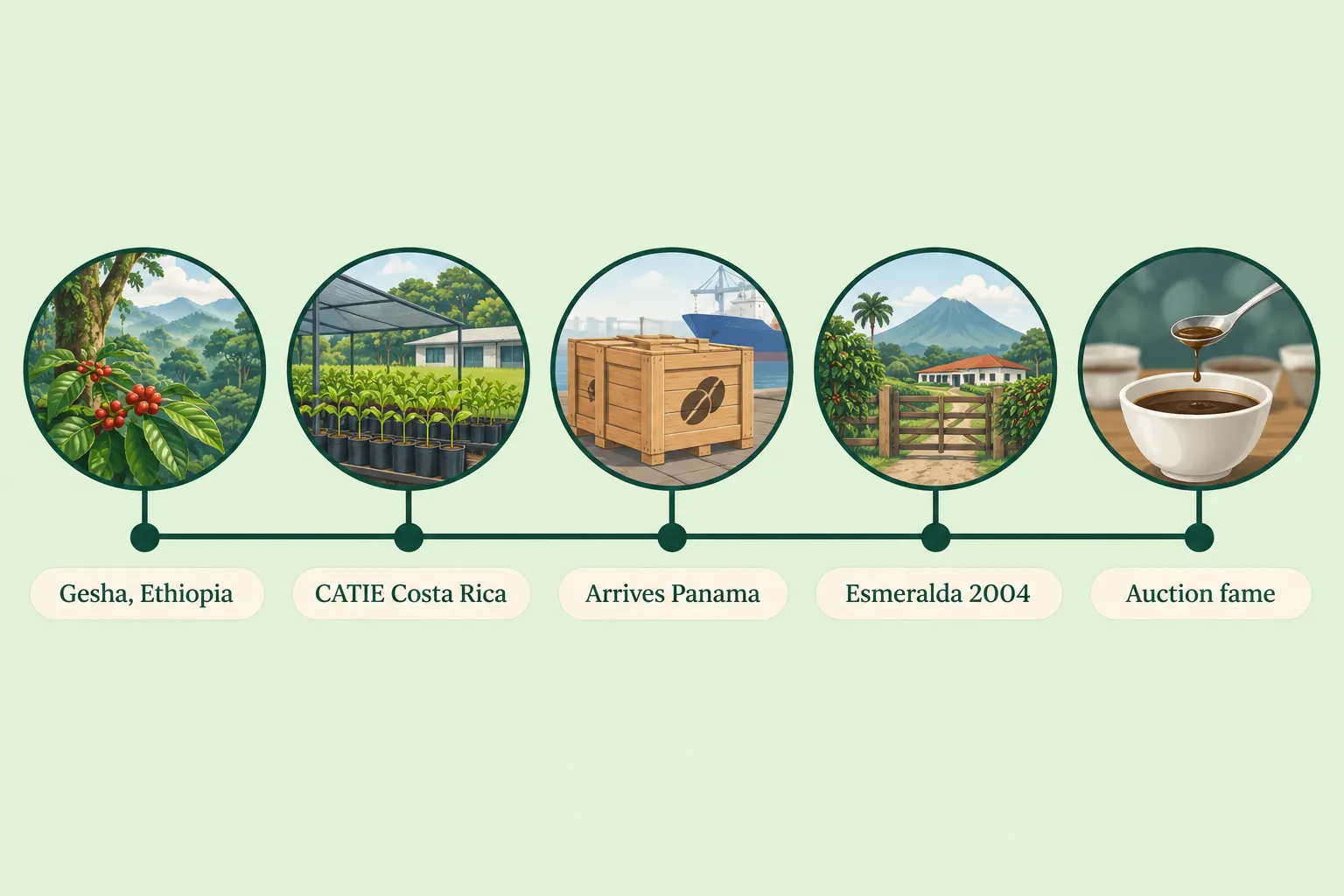
- The variety is Ethiopian, from the Gesha area, routed through Costa Rica's CATIE research collection before Panama made it famous in 2004 .
Geisha coffee: what it actually is
Geisha coffee (also spelled gesha coffee) is a specific arabica variety, not a region, a roast style, or a brand. Trees are tall and lanky, produce fewer cherries per hectare than common Central American cultivars like Caturra and Catuai, and need high elevation and a cool, misty climate to show their best character.
That genetic identity is the whole argument. Two farms on the same mountain, same altitude, same processing method, will still taste different if one plants Caturra and the other plants Geisha. Published cupping descriptions for Panama geisha coffee repeatedly name jasmine, bergamot, citrus, and tropical fruit with a light, tea-like body .
The spelling varies because the name was transliterated from Ethiopian place names. Gesha is closer to the original. Geisha stuck in the market after Panama's early marketing, and most retailers now use both.
Decision rule: if a bag says "Geisha blend" without naming a farm, a country, and a harvest year, treat it as flavored marketing until proven otherwise.
Why is geisha coffee expensive?
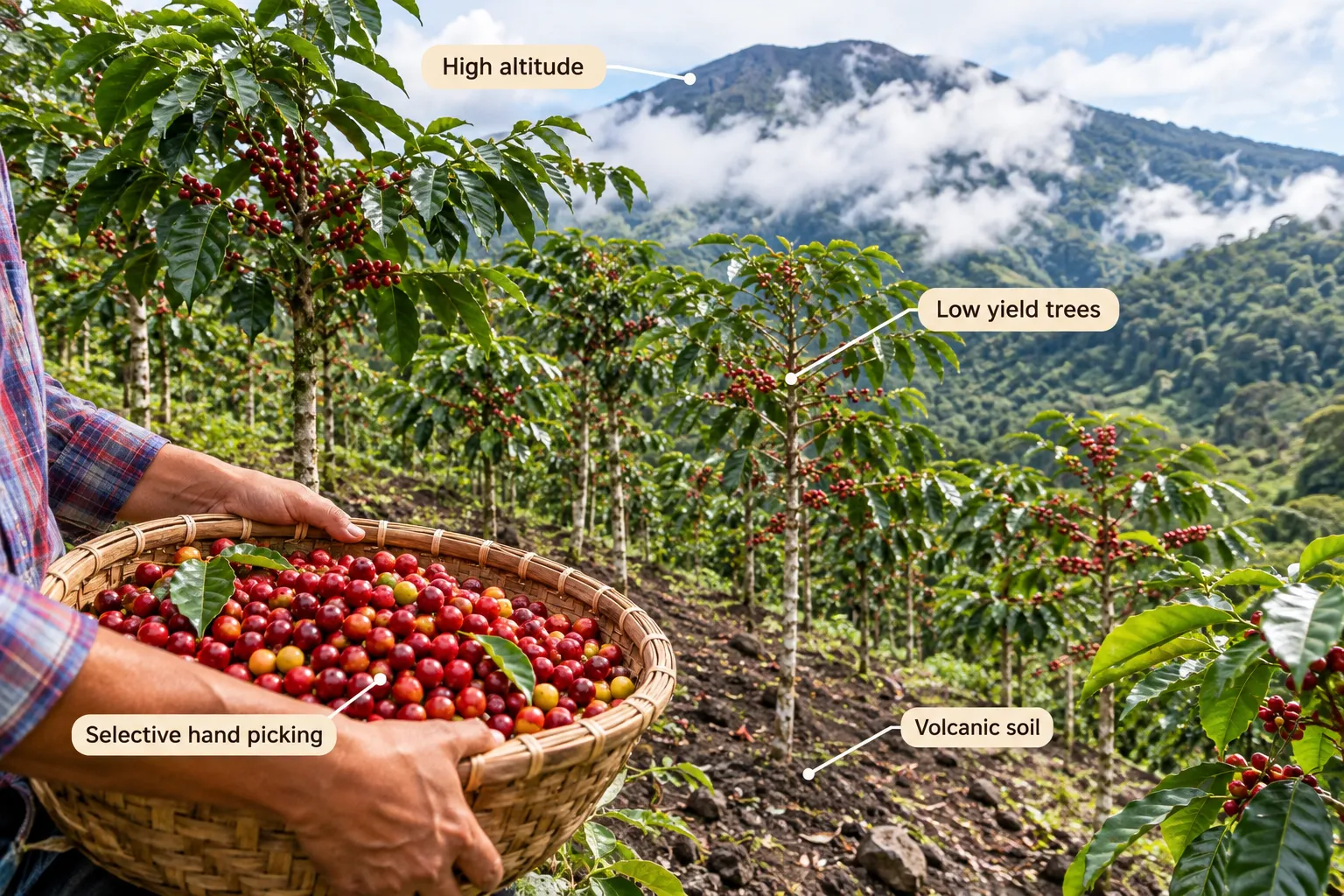
Five things stack on top of each other: low yield per tree, a narrow band of altitude and climate where the variety performs, labor-intensive selective picking, careful processing with small margins for error, and a competitive auction system that concentrates global demand onto a few dozen lots a year.
Take the yield problem first. A farmer who plants Geisha instead of Caturra accepts fewer kilograms from the same hectare, plus a more fragile tree. That is a real opportunity cost, and the price has to cover it before anything else.
Then add the auction. The Best of Panama auction is a filter, not a market average. In 2026 the Specialty Coffee Association of Panama ran 50 lots of 15 kg each in front of 83 bidders from 21 countries, with 29 buyers from 11 countries taking lots home . When that many well-funded roasters chase 750 kilograms of coffee, the clearing price has very little to do with production cost.
Here is the part most price articles miss. The auction result is a reported high-water mark for a selected sample. It is not the price of Panamanian coffee, and it is not even the price of most geisha coffee. All 40 Geisha lots in 2026 cleared $1,500/kg, which is extraordinary, but those lots were pre-screened by a jury .
| Price driver | What it does to cost | Why it matters to your cup |
|---|---|---|
| Low yield per tree | Fewer kg per hectare | Farmer needs a higher per-kg price to break even |
| Altitude and microclimate | Limits where it grows well | Supply cannot scale with demand |
| Selective hand harvest | Multiple passes, ripe cherries only | Higher labor cost, cleaner sweetness |
| Careful processing | Small batches, close monitoring | Floral aromatics survive to the bag |
| Auction demand | Global bidding on tiny lots | Headline prices detached from cost |
What does geisha coffee taste like compared to regular coffee?
Published descriptions from roasters and competition reports consistently list jasmine, bergamot, citrus, stone fruit, and tropical fruit, with a light body that several writers compare to tea . Sey Coffee's 2026 Finca Sophia release is described with bergamot, mandarin, rose petal, and dark fruit . Those are reported notes, not a Coffee Rank IQ tasting panel result.
Against a good Colombian or Guatemalan washed coffee, the difference most drinkers notice first is aroma intensity rather than flavor strength. The cup smells floral before it tastes like anything. Body is lighter. Acidity reads as sparkling citrus rather than apple or caramel.
Three honest caveats:
- A dark roast flattens the aromatics that justify the price. If you like dark roast coffee, geisha coffee is a poor use of money.
- Milk largely covers the floral character. Order it black.
- If you normally drink medium roast and add cream, your palate may read a geisha coffee as thin and sour. That is a preference mismatch, not a defect.
Sey's director of brand strategy, Doug Cohen, frames the $200 cup as a sensory event: clean palate, drink it slowly, pay attention to how the flavor changes as it cools . That framing matters, because the price is attached to a controlled tasting format rather than caffeine delivery.
A coffee this expensive is sold as an experience. Judge it like one, with a clean palate and no milk, or do not bother paying for it.
Where does geisha coffee come from?
The variety traces to the Gesha area of southwestern Ethiopia. Seed moved through research channels in the mid-20th century, reaching Central America by way of Costa Rica's CATIE collection in the 1960s, where it was initially planted for disease resistance rather than flavor . For decades, nobody made much of it.
Panama changed that. The Peterson family at Hacienda La Esmeralda in Boquete separated a block of Geisha trees growing on a cooler, higher parcel and entered the coffee in the 2004 Best of Panama competition. The jury scores and the resulting auction price turned a forgotten variety into the most famous name in specialty coffee.
That story is documented, but it is worth separating fact from folklore. The Petersons did not discover a secret coffee; they isolated a variety already present on their land and found out what it did at altitude. The commercial consequence was enormous. Seedlings spread through Boquete and Volcán, then across Colombia, Costa Rica, Honduras, Taiwan, and Ethiopia itself.
Today Panama's Chiriquí province, and Boquete in particular, remains the reference point. Volcanic soil, elevations above 1,600 meters, cool nights, and persistent mist slow cherry maturation, which coverage of the region credits for the variety's concentrated aromatics . If you want the broader background on growing regions, our coffee origins and bean selection guide covers how altitude and processing shape flavor across origins.
How much does geisha coffee cost per pound?
At retail, Panama geisha coffee generally runs $25 to $45 per 100g bag, which is roughly $113 to $204 per pound. Top-shelf competition lots from named estates sit higher: 2026 Best of Panama winning material from the Lamastus family has appeared at $49 to $69 per 100g at retail. Auction pricing is a separate universe entirely.
Use this to translate bag price into cup price. A standard pour over uses about 18g of coffee for a 300ml cup, so a 100g bag gives you about five and a half cups.
A $35 bag of 100g geisha coffee brewed at 18g per cup costs about $6.30 per cup at home. The same coffee served in a café, with labor, rent, waste, and a 20% brewing loss, lands near $20. Neither number is a scam. One includes a building.
The interactive calculator below lets you plug in a real bag price and see what your own cup costs.
Geisha coffee: cost per cup
Coffee Rank IQ | Better Coffee Starts With Better Answers
Home cost only. Café pricing adds labor, rent, and brewing loss, which is why the same beans reach $20 a cup across a counter.
Entry bag vs top-shelf bag vs auction lot
| Tier | Typical price | Approx. per cup | Who buys it |
|---|---|---|---|
| Entry Panama geisha, 100g | $25 to $35 | $4.50 to $6.30 | First-timers testing the variety |
| Competition-grade estate, 100g | $49 to $69 | $8.80 to $12.40 | Experienced home brewers |
| Café pour over, single serve | $12 to $25 | per cup as listed | Travelers and tasting-focused drinkers |
| Best of Panama 2026 winning lot | $18,004/kg | not a consumer purchase | Roasters, importers, JD.com |
| Sey x Finca Sophia 2026 | $6,325/kg wholesale | ~$200 served | Collectors and press |
Is geisha beans real or is it a marketing thing?
Both, and the two are separable. The variety is genetically distinct and verifiable, and competition juries scoring blind have ranked Panamanian Geisha at the top repeatedly, including the 96.25-point Elida Geisha Torre in 2026 . That is a real sensory difference measured under controlled conditions.
The marketing layer sits on top. Auction theater, celebrity buyers, and $200 tasting tours push the headline numbers far beyond anything a cupping score can justify. Sey's SEY World Coffee Tour launched in Los Angeles on October 17, 2026 and traveled to San Francisco before heading to London, Paris, Shanghai, and Seoul . That is hospitality and publicity, priced accordingly.
A fair summary: the variety earns a premium, and the top of the market earns a spectacle premium on top of that.
Common mistake: assuming any coffee labeled Geisha tastes like the auction lots. A poorly grown Geisha at 1,100 meters, over-roasted, tastes mediocre and still costs $30 a bag. The genetics set a ceiling, not a floor.
What makes geisha beans different from other specialty coffees?
The difference is varietal, not just processing or origin. Most specialty coffee price gaps come from processing method, farm reputation, or harvest timing. With geisha beans, the plant itself contributes a floral aromatic profile that other cultivars rarely produce at the same intensity.
Compare the usual levers:
- Processing method: a good natural-processed Ethiopian gets berry sweetness from fermentation. A washed Geisha gets floral aromatics from genetics, which survive a cleaner process.
- Altitude: most high-grown coffees gain acidity and density. Geisha at altitude gains aromatics on top of that.
- Roast date and roast level: light roasting preserves the aromatics. Our roundup of bright, fruity light roast coffees covers the same roast logic at friendlier prices.
Edge case: anaerobic and extended-fermentation Geisha lots can taste so fruity and funky that the varietal floral character disappears under the processing. If you are paying for Geisha, a washed or honey lot shows the variety more clearly.
Where can I buy geisha beans beans online?
Buy directly from roasters who publish the farm name, the variety, the elevation, the processing method, and a roast date. That combination is the single best filter available to a home buyer.
Reliable channels in the US:
- Competition-focused specialty roasters. Several subscription roasters release limited Geisha lots seasonally. Our reviews of the Onyx Coffee Lab subscription and the George Howell Coffee subscription cover two roasters that regularly list high-scoring single origin lots with full farm data.
- Farm direct storefronts. Several Boquete estates, including the Lamastus family and Hacienda La Esmeralda, sell roasted retail bags through their own sites.
- Green coffee importers if you roast at home and want 1 kg rather than 100g.
Skip grocery shelf "Geisha" with no origin data, and skip marketplace listings with no roast date. Check the current price across two or three roasters before committing, since Geisha stock moves fast after each harvest release.
Who should actually buy geisha beans, and is it worth it?
Buy it if you already drink light roast single origin coffee black, own a burr grinder, weigh your dose, and want to taste the upper end of what arabica can do. Skip it if you drink coffee with milk and sugar, use a blade grinder, or want a bean for everyday mornings.
A straightforward way to decide:
- Buy a 100g bag if you can name at least two flavors you tasted in your last bag of coffee.
- Wait if you have not yet dialed in grind size and brew ratio. The coffee will taste expensive and confusing.
- Buy the café cup instead if you want the experience once without a $40 commitment and a learning curve.
Is it worth $20 in a café? For a one-time, carefully brewed tasting with a clean palate, many drinkers say yes. As a repeat purchase, almost nobody should. For home brewing, a $30 bag that yields five excellent cups is a defensible splurge, roughly the cost of two café lattes.
How do you brew geisha beans at home?
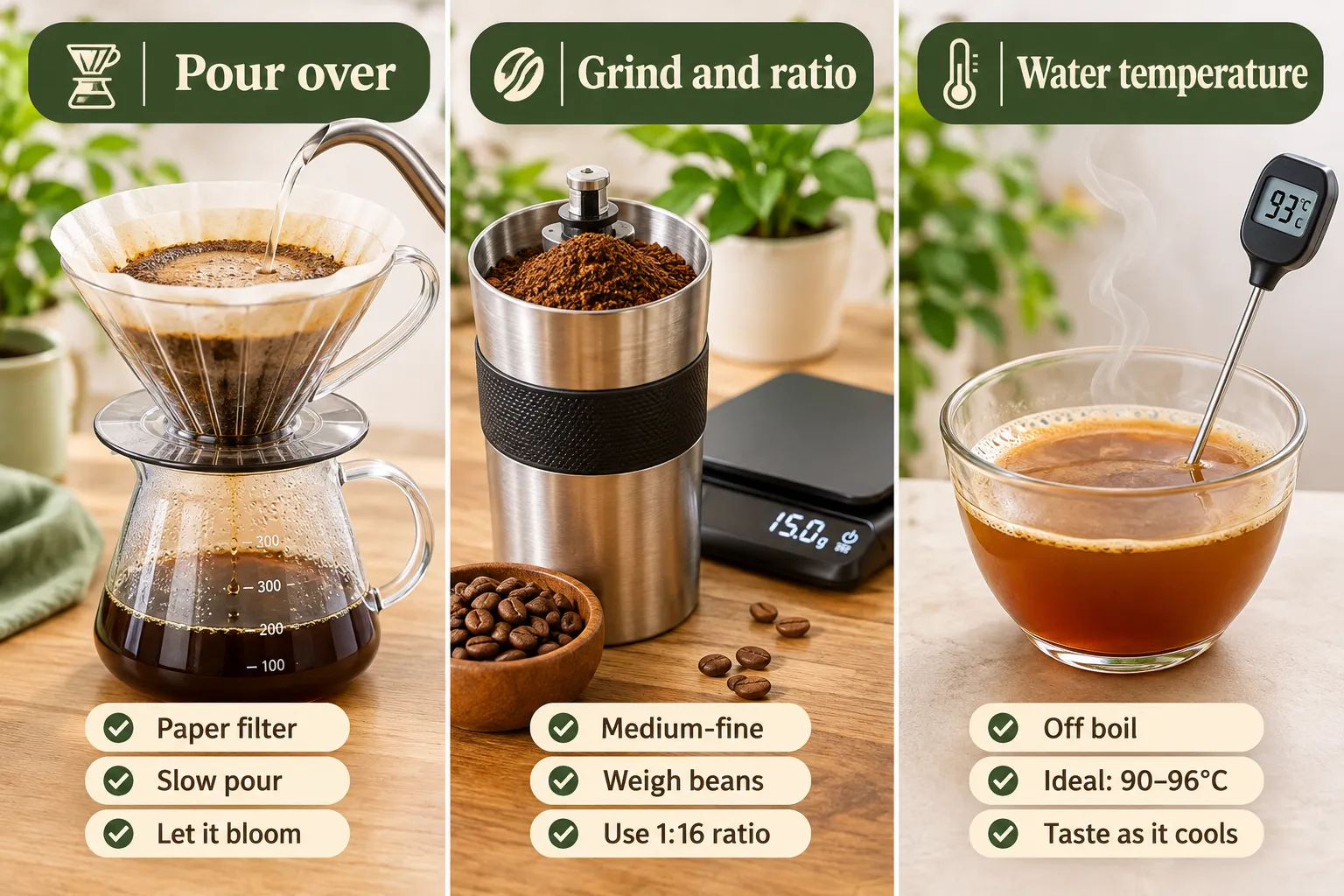
Use pour over, a medium-fine grind, a 1:16 brew ratio, and water at 200 to 205°F. Pour over with a paper filter gives the cleanest cup and shows the floral aromatics that justify the price. Immersion methods and espresso both work, but they mute the aromatics.
Pour over method
- Weigh 18g of whole beans. Grind medium-fine, slightly finer than drip, just before brewing.
- Heat water to 200 to 205°F. Our guide to coffee brewing temperature explains why the top of that band suits light roasts.
- Rinse the paper filter with hot water and discard the rinse.
- Bloom with 50g of water for 40 seconds. Light roasts degas slowly, so do not rush this.
- Pour in two or three stages to 290g total. Finish around 3:00 to 3:30.
- Taste it hot, then again at room temperature. The aromatics shift noticeably as it cools, which is exactly what Sey tells its guests to watch for .
Troubleshooting
- Thin and sour: grind finer or raise water temperature.
- Flat and papery: rinse the filter, and check the roast date. Geisha past six weeks loses the floral top notes fastest.
- Bitter: you ground too fine or your water is too hot for the roast.
- Muddy: your grinder is producing too many fines. A conical burr grinder solves more problems here than a new kettle.
For method-by-method differences, see our comparison of coffee brewing methods.
How do I know if geisha beans is authentic?
Authentic lots carry a paper trail: farm name, region, elevation in meters, variety stated as Geisha or Gesha, processing method, harvest year, and roast date. Missing any two of those is a reason to walk away.
Additional checks:
- Competition lots list the auction, the year, and often the cupping score. Best of Panama lots are traceable through SCAP's published results .
- Price sanity. Genuine Panama geisha beans under $15 per 100g is unlikely at 2026 prices. Colombian or Honduran Geisha can legitimately cost less.
- Bag size. Real Geisha is usually sold in 100g or 4oz bags, not 12oz. A 12oz bag at a 12oz price is a warning.
What to watch out for
- "Geisha blend." Blending a small percentage of Geisha into commodity coffee and charging a premium is legal and common. Read the percentage if one is listed. If none is listed, assume it is small.
- Stale lots. Geisha fades faster than it should for the money. No roast date, no sale.
- Hype pricing without provenance. A $60 bag with no farm name is worse value than a $30 bag with full traceability.
- Dark-roasted Geisha. Technically authentic, practically pointless.
Learning to read the label carefully pays off across every bean you buy, not just this one.
What are some cheaper alternatives to geisha beans?
If you want floral, tea-like, citrus-forward coffee without the Panama premium, start with washed Ethiopian coffees from Yirgacheffe or Guji, which typically run $18 to $25 per 12oz and deliver jasmine and bergamot character from a different genetic base.
Other options worth trying first:
- Geisha grown outside Panama. Colombian, Honduran, and Costa Rican Geisha lots often sell for $20 to $30 per 100g, with less of the Panama auction markup.
- Kenyan SL28 washed coffees. Blackcurrant and grapefruit acidity, usually $20 to $26 per 12oz.
- High-scoring washed Ethiopians from a quality roaster. Try a Heart Coffee Roasters subscription or an Olympia Coffee subscription for consistently light-roasted single origin rotations.
Practical order of spending: a decent burr grinder first, a scale second, better water third, and expensive beans last. Buying geisha beans before owning a burr grinder is like buying a vintage record with no turntable.
FAQ

Conclusion: the smart first geisha purchase
Buy one 100g bag of washed Panama geisha beans from a roaster that prints the farm name, elevation, processing method, and roast date. Expect to pay $25 to $45. That gives you about five and a half cups at an 18g dose, which is enough to dial in your grind, brew it twice properly, and share it once.
Brew it as pour over at 1:16 with water at 200 to 205°F, drink it black, and taste it again as it cools. If the jasmine and citrus land for you, the variety has earned its place in your rotation as an occasional purchase. If it reads thin, your money belongs in a better grinder, not a rarer bean.
Next step: compare roast dates and farm details across two roasters before you buy, and read the label the same way every time. Better Coffee Starts With Better Answers.