Best Manual Coffee Grinder for Pour Over, Espresso, and Travel
Quick Answer
The best manual coffee grinder for most home brewers in 2026 is the Comandante C40 MK4 Nitro Blade, which scored the highest grind consistency in CNN Underscored's testing, with 9.1 grams of a 15 gram dose landing in the target particle range. If you brew espresso at home, the 1Zpresso J-Ultra is the sharper pick, and if you just need something cheap and durable for camping, the JavaPresse Manual Burr Coffee Grinder covers that job for around $40. There is no single best manual coffee grinder for everyone. There is a best one for your brew method and your budget.
Key Takeaways
- The Comandante C40 MK4 Nitro Blade leads most 2026 expert rankings for grind consistency and cup quality, particularly for pour over.
- The 1Zpresso J-Ultra is the top pick among educators and reviewers for espresso, priced around $199 as of August 2026.
- The JavaPresse Manual Burr Coffee Grinder is a genuine best manual coffee grinder under 50 dollars, at roughly $40 with 18 settings.
- A manual burr grinder beats a blade grinder for every brew method because burrs cut particles to a consistent size instead of smashing them randomly.
- Manual grinders run silent and portable, which matters for travel, camping, and small kitchens, but they cost you time and forearm effort.
- Good hand grinders show low bean retention, averaging around 2.75% in Tom's Guide testing, so less coffee gets stuck inside between doses.
- The KINGrinder K6 gives near-premium consistency for less money, grinding a dose in about 30 seconds.
- Grind unevenly and your shot channels or your pour over tastes sour in the front, bitter in the back. Burr alignment and grind size fix most of it.
What Is a Manual Coffee Grinder and How Does It Work
A manual coffee grinder is a hand-cranked mill that uses two burrs, one fixed and one turning, to cut whole coffee beans into uniform particles without electricity. You load beans into a hopper, turn a handle, and the beans pass between the burrs on their way down to a catch cup.
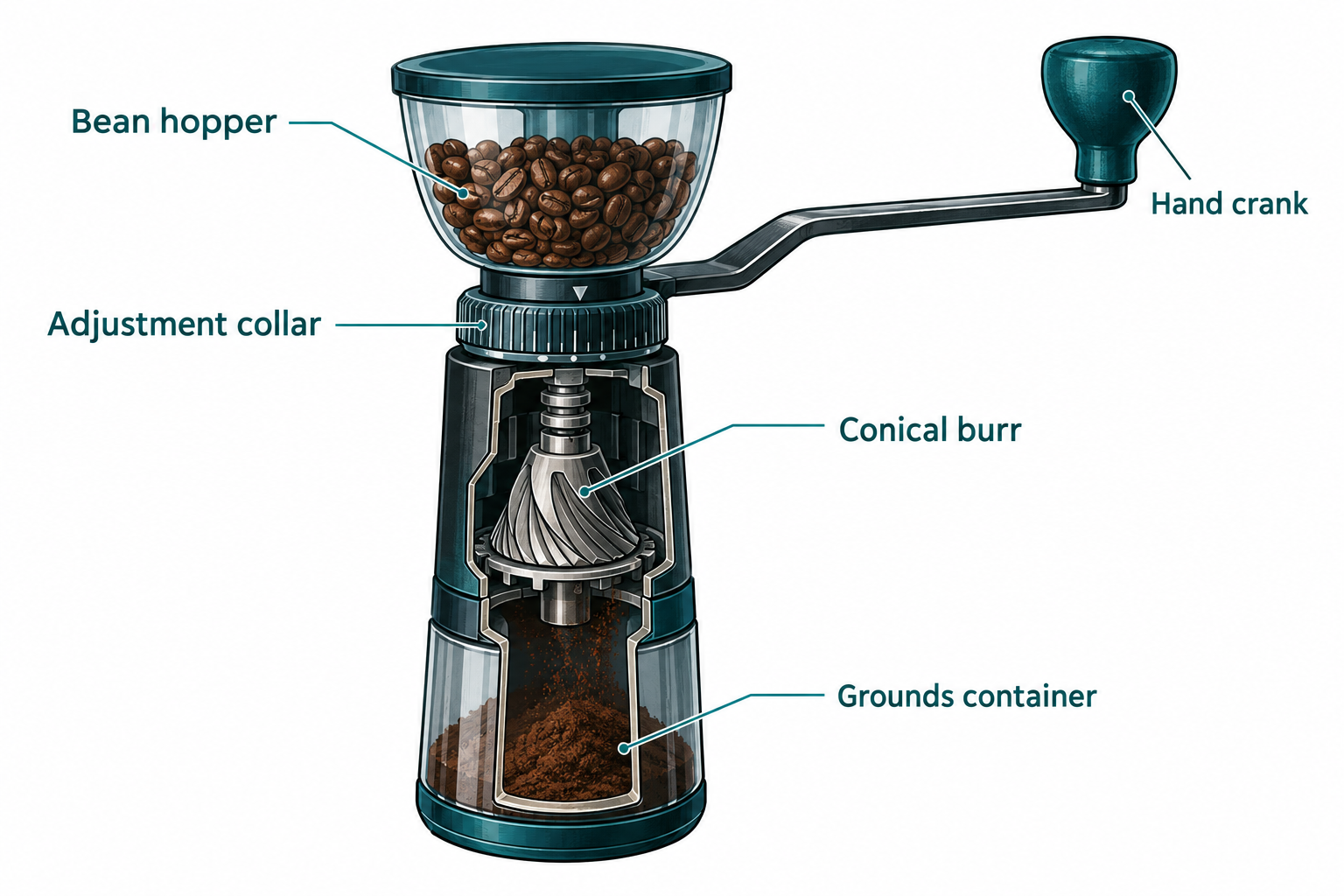
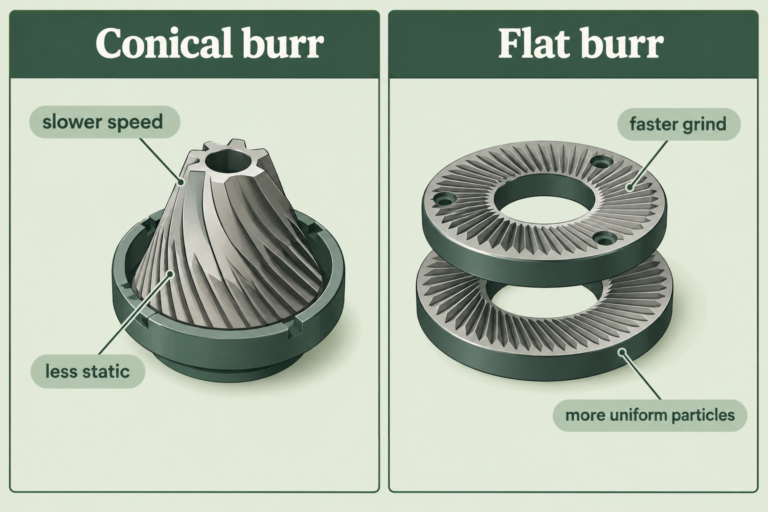
Inside the body sits a set of burrs, usually conical and made from stainless steel or ceramic. The gap between the two burr surfaces sets the grind size. Turn the adjustment collar to widen that gap for coarse grinds like french press, or tighten it for fine grinds like espresso.
Most modern hand coffee grinders use one of two adjustment systems:
- External adjustment: a dial or ring outside the body, changed before you load beans. Faster to reset between brew methods.
- Internal (stepped) adjustment: a click-based collar inside the burr chamber, common on 1Zpresso and Comandante models. Slower to switch, but the clicks give repeatable, numbered settings you can write down.
A well-built manual burr grinder holds its calibration for years. That is the entire pitch behind spending more on a premium hand grinder: you buy consistency once instead of fighting a wobbly burr every morning.
Best Manual Coffee Grinder: Top Picks by Buyer Type
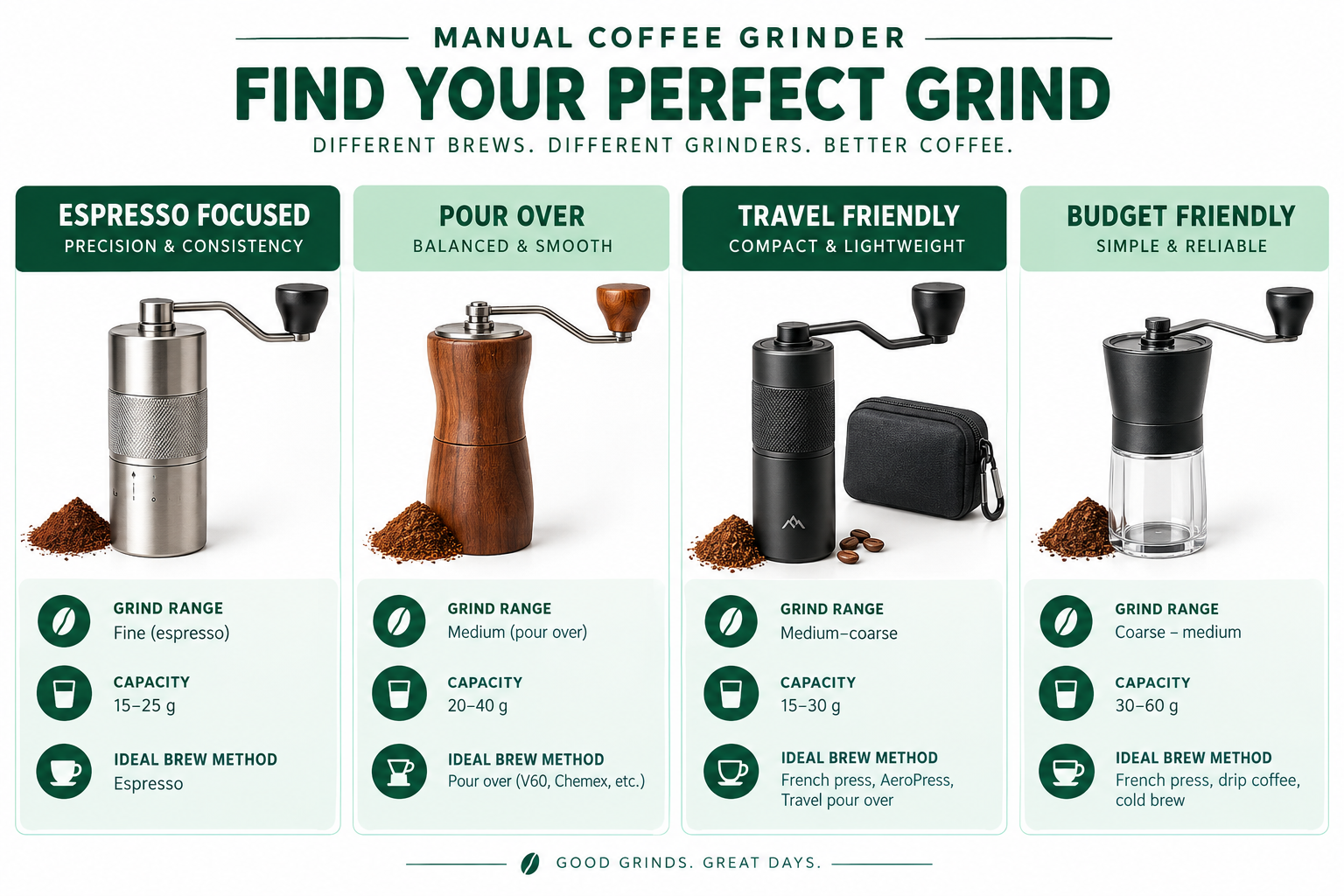
The best manual coffee grinder depends on what you brew most and how much you want to spend, not on brand reputation alone. Below is the quick verdict, followed by named picks for seven common buyer types with a comparison table you can scan in under a minute.
Quick verdict: buy the Comandante C40 MK4 Nitro Blade if pour over is your main brew and you want the reference-level grinder reviewers keep naming. Buy the 1Zpresso J-Ultra if espresso matters more. Buy the JavaPresse if you just want a cheap, reliable hand coffee grinder for camping or a starter kit.
| Grinder | Best for | Grind range | Capacity | Approx price | Verdict |
|---|---|---|---|---|---|
| Comandante C40 MK4 Nitro Blade | Pour over, all-round | Fine to coarse | ~40g | Premium | Highest measured consistency in CNN Underscored testing |
| 1Zpresso J-Ultra | Espresso | Very fine to medium | ~35g | ~$199 (Aug 2026) | Picked by coffee educators as the espresso specialist |
| 1Zpresso K-Ultra | Pour over and filter | Fine to coarse | ~35g | Premium | Named best overall by Coffeeness for filter brewing |
| 1Zpresso X-Ultra | Travel and pour over | Fine to coarse, 60 clicks | 30g, 590g weight | Mid-premium | Compact stainless build, highly adjustable |
| KINGrinder K6 | Value seekers | Fine to coarse | ~30g | Mid-range | Solid uniformity, roughly 30 second grind time |
| JavaPresse Manual Burr Grinder | Budget, camping | 18 settings | ~1/3 cup | ~$40 | Best manual coffee grinder under 50 dollars |
| Timemore Chestnut C2 | Beginners on a budget | Stepless | ~25g | Budget | Compact ceramic burr grinder, easy first upgrade from blade |
| 1Zpresso JX | Pour over enthusiasts | Fine to coarse | ~35g | Mid-range | External adjustment for quick switching between brew methods |
| Hario Skerton Pro | Casual daily use | Coarse to medium-fine | ~100g | Budget | Wide glass body, easy to clean, less precise at fine settings |
Compare the models against your actual grind size needs before you buy, especially if espresso is part of your routine.
Manual vs Electric Coffee Grinder: Which Is Better
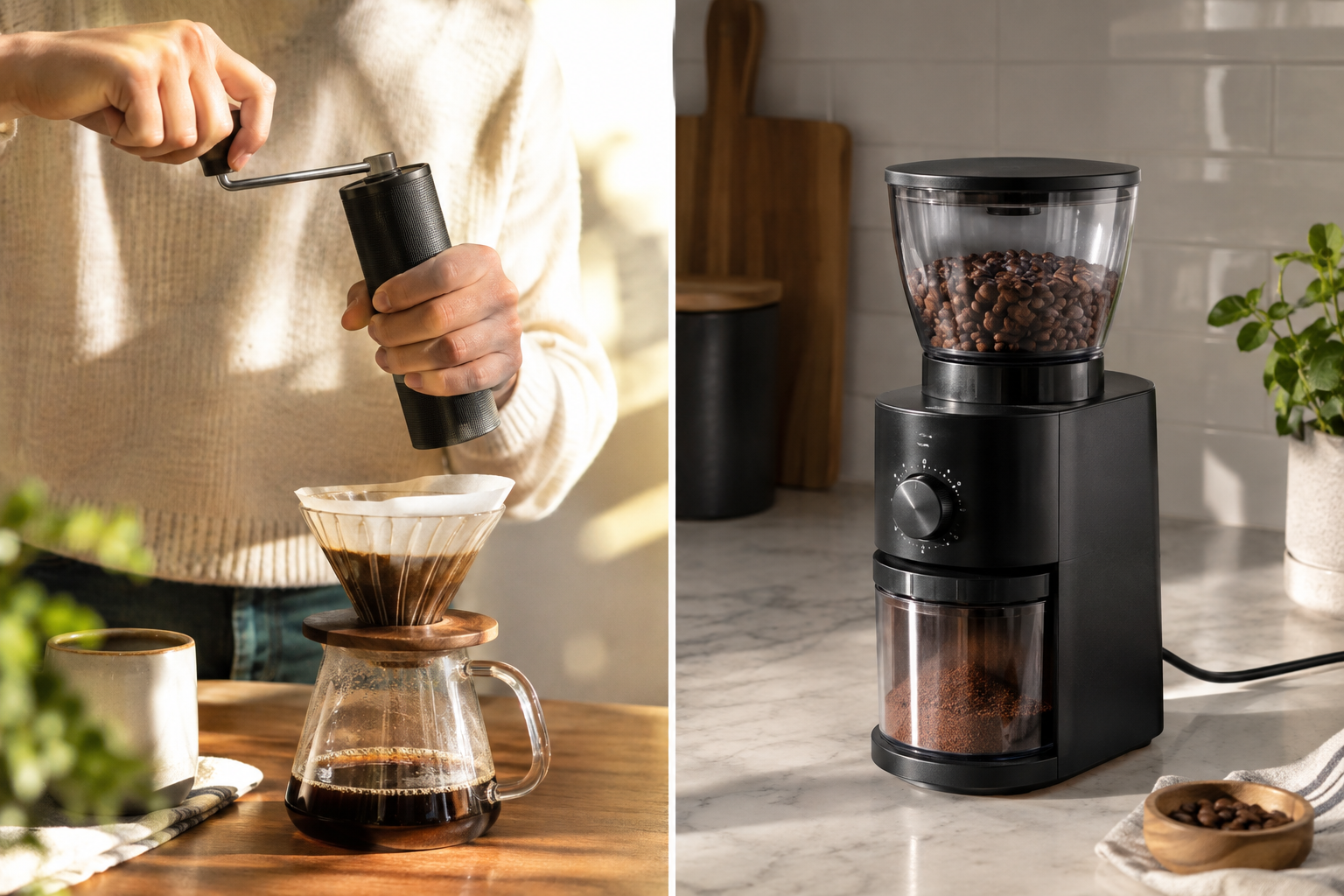
Neither wins outright. A manual grinder wins on cost, quiet operation, and portability. An electric grinder wins on speed and hands-free consistency once you have both dialed in.
Electric burr grinders under $150 often use lower quality burrs than a $70 to $150 manual burr grinder, so a good hand coffee grinder can actually out-perform a cheap electric one on cup quality. The tradeoff is time: a manual grinder takes 20 to 90 seconds of arm work per dose, while an electric grinder finishes in 5 to 15 seconds with zero effort.
Choose manual if:
- You make one to two cups a day and don't mind the short workout.
- Noise matters, in an apartment or shared kitchen, since hand grinders are nearly silent compared to electric motors.
- You travel or camp and need something that works without a wall outlet.
Choose electric if:
- You brew for a household of four or more each morning.
- You want single-button dosing for consistent espresso shots back to back.
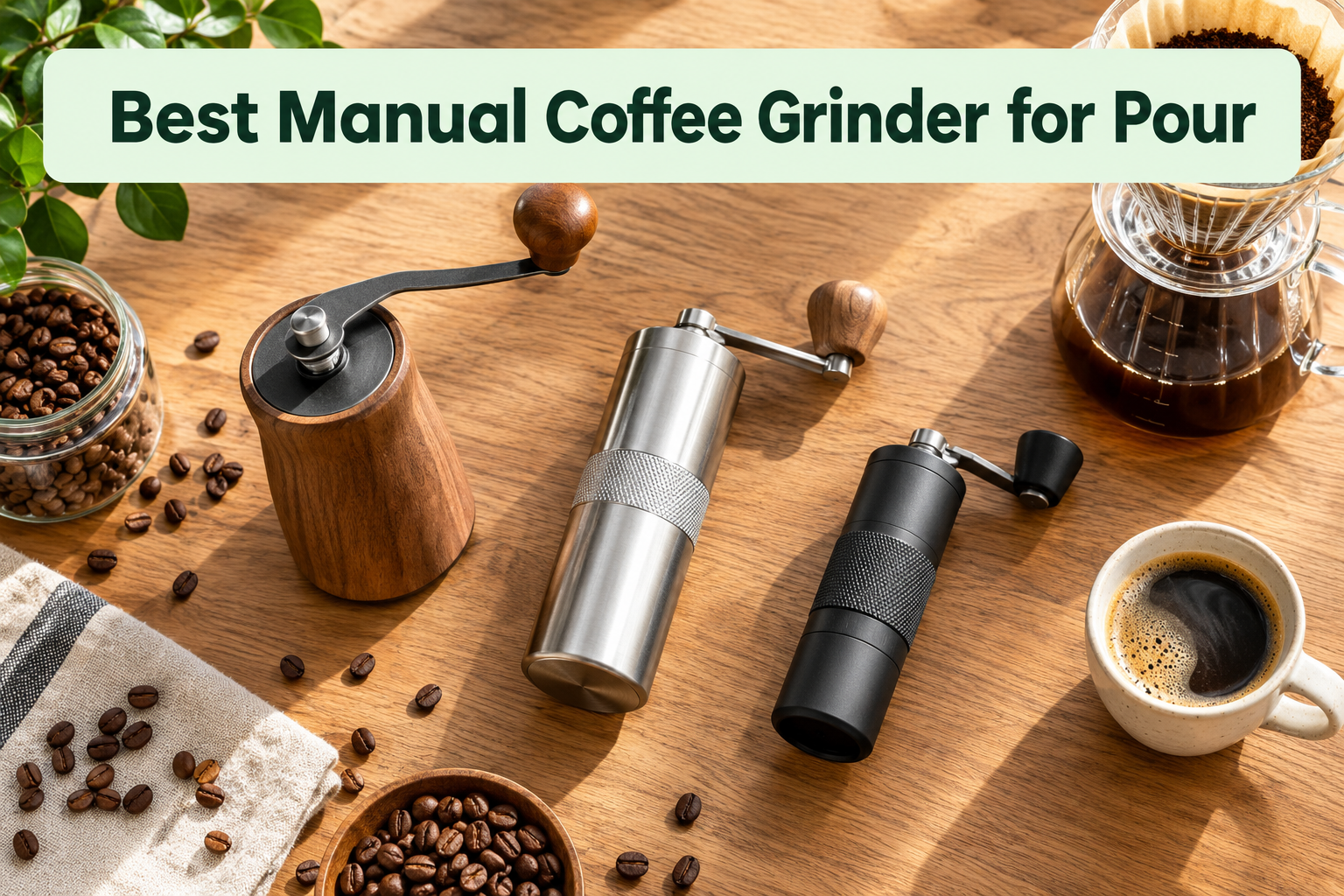
Best Manual Coffee Grinder for Pour Over
The best manual coffee grinder for pour over is the Comandante C40 MK4 Nitro Blade, based on its top grind consistency score in independent testing. Coffeeness calls it the overall best manual coffee grinder in its 2026 guide, citing build quality and cup quality for filter coffee specifically.
Pour over rewards even particle size more than any other brew method, because water flows through the bed at one steady rate. Uneven grinds create fast channels where water rushes past coffee without pulling flavor, next to dense clumps that over-extract and turn bitter. A UK grinder guide describes this class of premium hand grinder as "ridiculously consistent for filter coffee," and notes owners tend to keep one for life instead of upgrading again.
If the Comandante's price feels steep, the 1Zpresso K-Ultra and 1Zpresso JX manual coffee grinder both deliver strong pour over consistency at a lower cost, with external, quick-adjust collars that make dialing in a new bag of beans faster. If you are new to the method itself, read the beginner's guide to pour over coffee or the complete pour over guide before you commit to a grind setting.
Choose the Comandante if you brew pour over daily and want the grinder reviewers keep citing as the reference standard. Skip it if you mostly drink espresso, since a filter-tuned burr set is not the strongest match for fine espresso grinds.
Best Manual Coffee Grinder for Espresso
The best hand grinder for espresso is the 1Zpresso J-Ultra, priced around $199 as of August 2026, and named the espresso pick by coffee educators Asser Christensen and Lance Hedrick. HomeCoffeeExpert also names it their top overall grinder for home and travel use, which matters if you want one grinder to cover both espresso and pour over.
Espresso needs a much finer, narrower grind band than pour over, plus enough dose capacity for a proper puck. The J-Ultra's stepped adjustment gives numbered click settings, so once you find your shot's sweet spot you can write down the number and return to it after every bag change. That repeatability is the entire point of a dedicated espresso grinder.
Grind size for espresso also depends on your machine, your basket, and your bean's roast level. If you want the mechanics behind why fine espresso grinds behave the way they do, our guide on choosing the best grind for an espresso machine walks through the extraction math, and our espresso technique guide covers dosing and tamping to go with it.
Choose the J-Ultra if espresso is your main drink and you want click-repeatable settings. Skip it if you never pull shots, since its burr set is overkill for coarse french press grinds.
Best Manual Coffee Grinder for French Press
The best manual coffee grinder for french press does not need fine-grind precision, so a simpler, cheaper model works fine here. The Hario Skerton Pro and the JavaPresse both handle coarse settings well, since french press only needs even particle size, not razor-sharp fine adjustment.
French press uses full immersion brewing with a metal mesh filter, so a slightly coarser and more forgiving grind avoids sediment in the cup while still extracting fully. This is one brew method where a budget manual burr grinder genuinely competes with a $300 model, because the burr geometry differences matter far less at coarse settings than at fine espresso settings.
If you want to explore other immersion methods that share this same forgiving coarse-grind logic, read about making cold brew coffee at home, which uses an even coarser grind over a much longer steep time.
Best Manual Coffee Grinder for Travel: Portable Picks
The best manual coffee grinder for travel is small, sealed against bean spill, and durable enough for a backpack. The 1Zpresso X-Ultra fits this job well at roughly 17 by 12 by 5 centimeters and 590 grams, with 60 grind click settings packed into a compact stainless body.
For a cheaper travel option, the JavaPresse Manual Burr Coffee Grinder weighs little, holds about a third of a cup of beans, and uses a slim shape that is easy to grip on a train or in a tent. Homes & Gardens highlights this exact tradeoff: manual grinders are compact, lightweight, and mobile, which makes them a natural fit for small batches away from a kitchen outlet.
A few travel-specific checks before buying:
- Leak-proof lid: beans and grounds should stay sealed during transit.
- One-piece or nested design: fewer loose parts to lose in a bag.
- Weight under 400 grams: matters more for backpacking than for car camping.
Choose the X-Ultra if you want travel size without giving up fine adjustment. Choose the JavaPresse if budget matters more than precision on the road.
How Much Does a Good Manual Coffee Grinder Cost
A good manual coffee grinder costs anywhere from about $30 to $300, and the price mostly buys you burr quality, adjustment precision, and build materials, not brand prestige. Coffee Chronicler's 2026 testing found that even cheaper hand grinders often outperform sub-$100 electric grinders, as long as you accept the manual effort.
Rough price bands:
- Under $50: entry-level ceramic or steel burrs, fewer grind settings, workable for beginners. The JavaPresse sits here at about $40 with 18 settings.
- $50 to $120: better burr steel, smoother cranks, wider grind range. The Timemore Chestnut C2 and KINGrinder K6 land in this tier.
- $120 to $250: stepped click adjustment, dual-purpose espresso and filter capability. The 1Zpresso J-Ultra and JX manual coffee grinder sit here.
- $250 and up: premium materials and the tightest measured consistency, such as the Comandante C40 MK4 Nitro Blade.
Best Manual Coffee Grinder Under 50 Dollars
For a genuine best manual coffee grinder under 50 dollars, the JavaPresse Manual Burr Coffee Grinder is the clearest pick, at roughly $40 with 18 grind settings and a ceramic conical burr. It will not match a Comandante on consistency, but for drip, french press, or a first pour over attempt, it does the job without breaking a student budget.
Manual Coffee Grinder Burr vs Blade: Which One
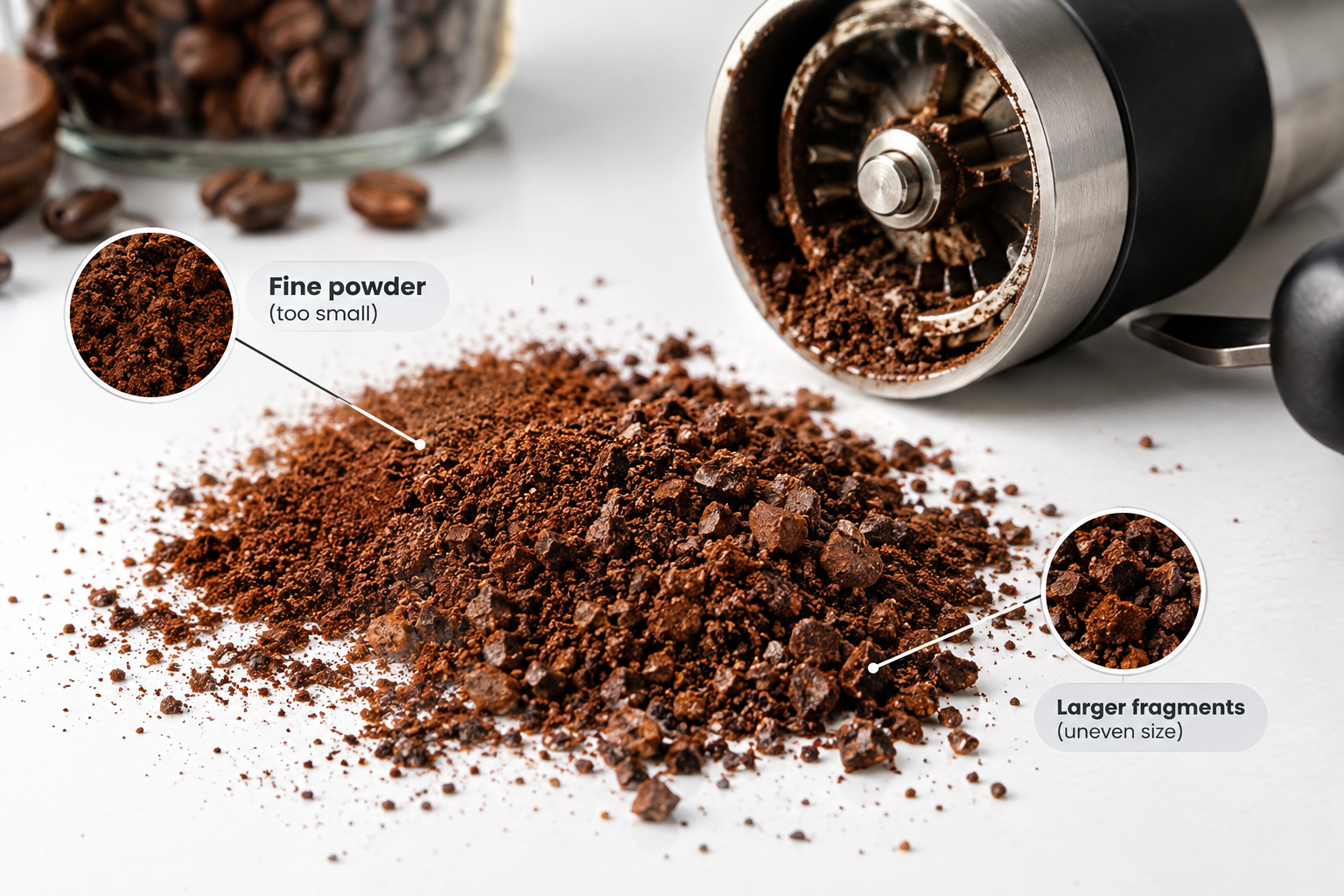
A manual burr grinder wins over a blade grinder for every brew method, because burrs cut beans into a controlled particle size while blades chop randomly into a mix of dust and chunks. This is not a close call. Blade grinders belong in spice cabinets, not coffee routines.
Blade grinders spin a small propeller-like blade at high speed, which pulverizes beans unevenly. Some particles turn to powder, others stay in large fragments. That uneven mix over-extracts the powder into bitterness while under-extracting the chunks into sourness, often in the same cup.
Burr grinders, manual or electric, pass beans between two matched surfaces set at a fixed gap. Every bean gets cut to roughly the same size before it drops out. That is why every grinder mentioned in this guide, from the budget JavaPresse to the premium Comandante, uses a burr set instead of a blade.
Who Should Use a Manual Coffee Grinder
A manual coffee grinder suits anyone who drinks one to three cups a day, values quiet mornings, or travels with their coffee habit. It suits less well anyone brewing for a full household or running a home espresso setup that demands rapid, back-to-back dosing.
Good fit:
- Solo or couple households making one to two pour overs a day.
- Renters and apartment dwellers who don't want a loud electric motor at 6am.
- Campers, RV owners, and frequent travelers.
- Anyone upgrading from a blade grinder on a tight budget.
Weaker fit:
- Cafes or households making five or more drinks back to back each morning.
- Anyone with hand or wrist conditions that make repetitive cranking painful.
Manual Coffee Grinder Common Mistakes Beginners Make
The most common mistake is buying based on grind range alone and ignoring dose capacity and burr material, which affect daily comfort more than the spec sheet suggests.
How to Choose the Right Manual Coffee Grinder Size
Match hopper capacity to your actual daily dose, not to the biggest number on the box. A 20 to 25 gram hopper suits a single pour over or one double espresso shot. If you brew for two people, look for 30 grams or more so you are not refilling mid-grind.
Manual Coffee Grinder Not Grinding Evenly: What to Do
Uneven grinds almost always trace back to loose burr alignment, stale grind residue stuck in the chamber, or beans that are too oily for the burr set. Disassemble the burr housing, brush out old grounds, check that the burr sits flush against its seat, and re-tighten the adjustment collar to a fresh, deliberate click setting. If the problem persists after cleaning, the burr itself may be worn and due for replacement, which is common after several years of daily use on budget models.
Manual Coffee Grinder Takes Too Long to Grind
If a grind is taking well past 60 to 90 seconds, the setting is probably too fine for your burr set, the beans are stale and hard, or the crank mechanism needs lubrication at the axle. Coarsen the setting by two or three clicks and time it again. A properly adjusted premium hand grinder should clear a 15 to 20 gram dose in 20 to 40 seconds without straining your wrist.
Other beginner errors worth naming directly:
- Storing beans in the grinder's hopper long-term, which lets oils gum up the burr chamber.
- Skipping the first few grinds after changing settings, which mixes old particle sizes into the new batch.
- Grinding far ahead of brewing instead of grinding right before, which lets aroma compounds escape before extraction even starts.
Manual Coffee Grinder Alternatives If You Don't Want Manual
If cranking a handle every morning isn't for you, an electric burr grinder in the $100 to $200 range gives you similar particle consistency with a button press instead of arm work. Look for models with stepless or fine-stepped adjustment and at least 30 grind settings, the same range that separates a good manual burr grinder from a mediocre one.
A second alternative is pre-ground coffee timed to your brew method, though you lose freshness fast since ground coffee starts losing aroma within days of grinding, not weeks. If you want to understand what changes when coffee is already ground before it reaches a machine, our piece on whether you can grind ground coffee for espresso explains the tradeoff in more detail. For picking beans that hold up well regardless of grinder choice, see our guide to choosing coffee beans for home brewing.
FAQ
Is a manual coffee grinder worth it over pre-ground coffee? Yes, for flavor. Ground coffee loses aroma compounds within days, while whole beans stay fresh for weeks when stored properly. A basic manual burr grinder under $50 already beats pre-ground coffee for a fresher cup.
Can one grinder handle both espresso and pour over well? Some can. The 1Zpresso J-Ultra and JX manual coffee grinder both cover a wide enough range for both methods, though a dedicated espresso grinder like the J-Ultra will edge out a filter-focused model on fine settings.
How long does a manual coffee grinder actually last? A well-built steel burr grinder, kept clean, can last many years of daily use. Coffeeblog's 2026 review calls this class of premium hand grinder a "buy once and keep for life" purchase.
Does bean retention matter in a manual grinder? Yes, for flavor consistency between batches. Tom's Guide measured average retention around 2.75% in a tested hand grinder, meaning very little old coffee mixes into your next dose.
What is the fastest manual coffee grinder to use? The KINGrinder K6 grinds a typical dose in about 30 seconds according to hands-on testing, competitive with premium models at a lower price.
Is a $40 manual grinder actually good enough for daily coffee? For drip, french press, and casual pour over, yes. The JavaPresse at roughly $40 with 18 settings covers those methods well. Espresso is where a budget grinder starts to show its limits.
Conclusion
The best manual coffee grinder for you comes down to one honest question: what do you actually brew most mornings? Pour over drinkers should point toward the Comandante C40 MK4 Nitro Blade or the 1Zpresso K-Ultra. Espresso drinkers should look at the 1Zpresso J-Ultra. Campers, travelers, and budget-first buyers should start with the JavaPresse or the Timemore Chestnut C2.
Whatever you pick, give the burr set five minutes of attention once a month: brush it out, check the alignment, and confirm your usual click setting still tastes right. That small habit is the real difference between a grinder that lasts five years and one that gets replaced in one. Check the current price on your shortlist before you decide, and read the brewing method notes above one more time if espresso and pour over are both on your morning list.
Better Coffee Starts With Better Answers.
Keep Exploring Coffee Rank IQ
- Coffee Rank IQ home: reviews, brewing guides, and coffee science
- Best Espresso Grinder: The Spec That Decides Your Shot
- Best Coffee Scale for Pour Over and Espresso…Timer Included
- Best Espresso Machine With Grinder Built In: 7 Picks
- Best Medium Roast Coffee for Drip, Pour Over, and Espresso
References
- www.nytimes.com/wirecutter/reviews/the-best-coffee-grinder
- www.cnn.com/cnn-underscored/reviews/best-manual-coffee-grinders
- www.foodnetwork.com/how-to/packages/shopping/product-reviews/best-coffee-grinders
- coffeechronicler.com/gear/grinders/manual/best-manual-coffee-grinder
- www.thewaytocoffee.com/best-manual-coffee-grinder
- www.driproast.com/best-manual-coffee-grinder
- www.goodhousekeeping.com/what-to-buy/g30986295/best-coffee-grinders
- www.homesandgardens.com/buying-guides/best-coffee-grinder
- www.tomsguide.com/best-picks/best-coffee-grinder
- www.coffeeness.de/en/best-manual-coffee-grinder