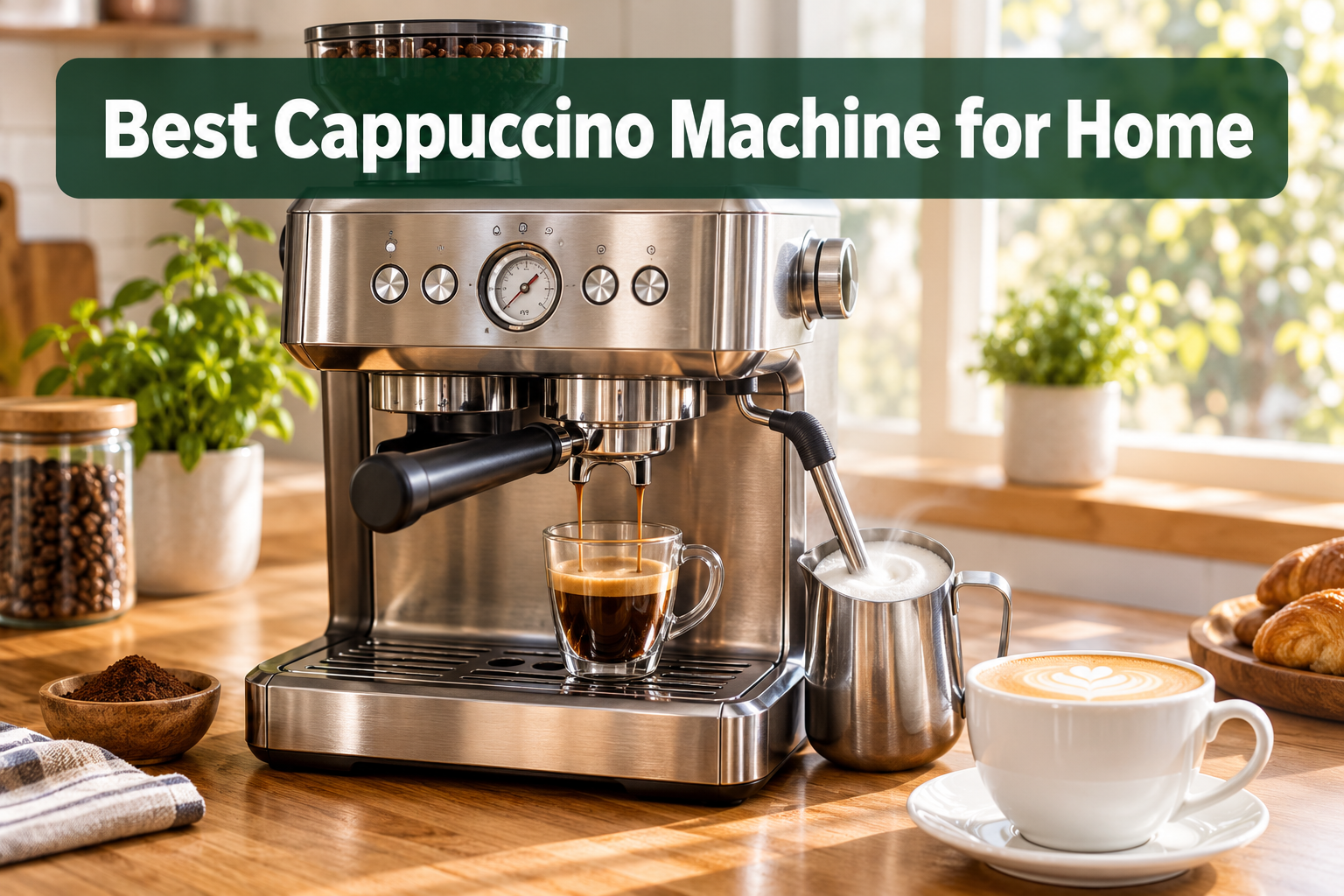
Best Cappuccino Machine for Home: The Steam Wand Decides
Quick Answer
The best cappuccino machine for home use is decided by one part: the steam wand. A machine with a weak or awkward wand will never produce café-quality microfoam, no matter how many one-touch buttons it has. For most home drinkers, the Breville Barista Express earns the top spot because it pairs a built-in grinder with a steam wand testers describe as consistent and easy to control. Buyers who want zero manual steaming should look at automatic milk frother machines like the Philips 3200 LatteGo instead.
Key Takeaways
- The steam wand, not the pump or the touchscreen, decides whether a cappuccino machine actually makes good cappuccinos at home.
- The best cappuccino machine for most first-time buyers is the Breville Barista Express because it combines a grinder, a 15-bar pump, and a wand rated highly in independent testing.
- A capable wand needs to spin a visible vortex in the milk, not just make bubbles.
- Panarello-style wands (with a plastic sleeve) are easier for beginners; bare commercial wands give more control once you learn technique.
- Under $500, buyers can choose between semi-automatic machines with real wands or bean-to-cup machines with automatic frothers.
- A cappuccino machine and an espresso machine are often the same base hardware; the difference is whether a usable steam system is included.
- Automatic milk frothers save time and cleanup but produce flatter foam than a well-used manual wand.
- Grinders matter almost as much as wands: pre-ground coffee stales fast and limits extraction quality.
- Most steam wand problems (weak steam, no froth, sputtering) trace back to water reservoir level, mineral buildup, or a clogged tip.
- A cappuccino machine can also make lattes, macchiatos, flat whites, Americanos, and hot chocolate; the wand and grouphead do the rest.
Best Cappuccino Machine for Home: Top Picks by Buyer Type
If you want the short version: match the machine to how much hands-on control you want, not to the biggest feature list. The best cappuccino machine for home use varies by budget, counter space, and how much you enjoy the process versus wanting a button to press.
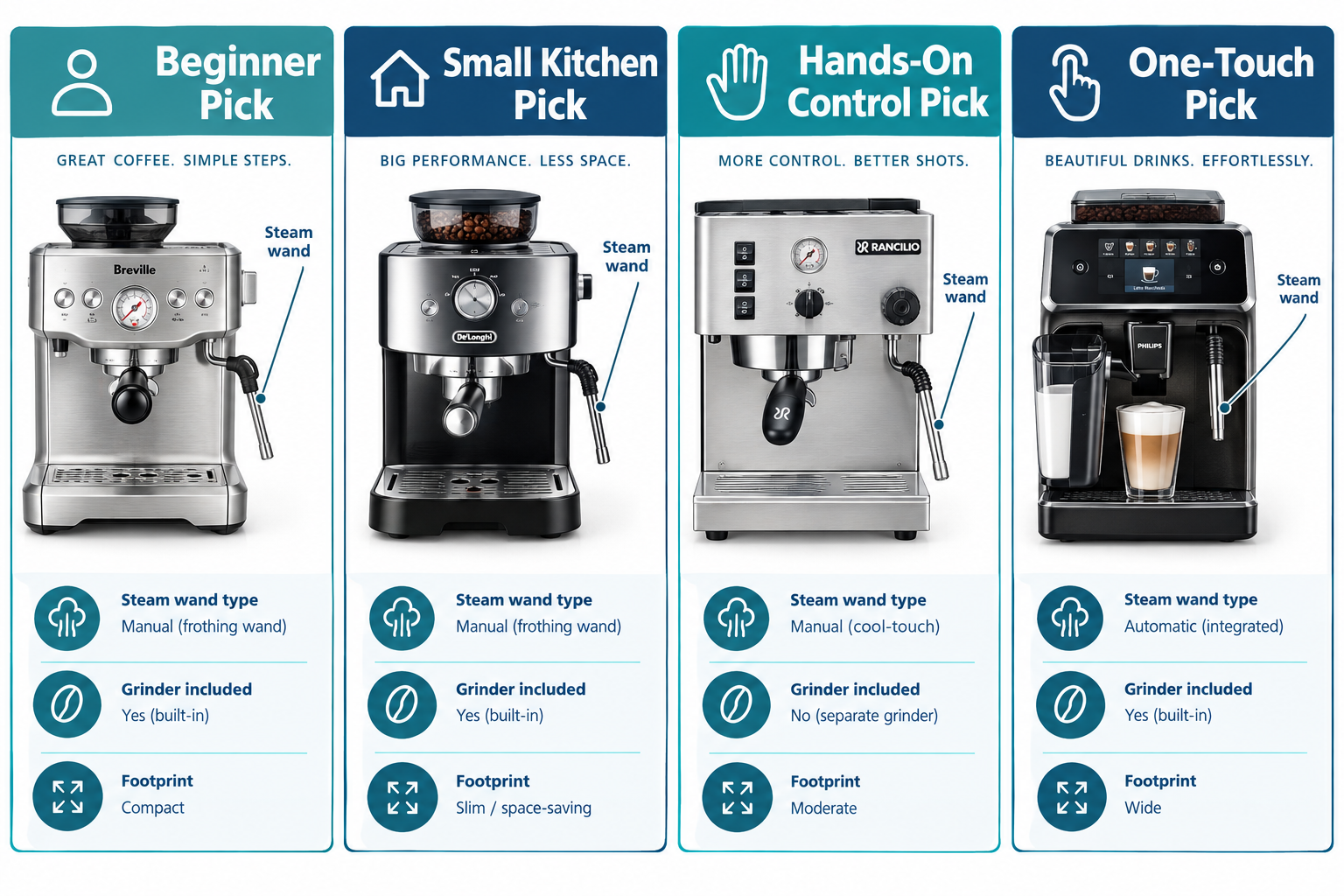
Here are seven buyer types and the machine built for each one.
| Buyer type | Machine | Steam wand | Built-in grinder | Typical price range |
|---|---|---|---|---|
| Best overall for home cappuccino | Breville Barista Express | Manual, rated "excellent" in testing | Yes | $700 to $750 |
| Best for tight counters and beginners | Breville Bambino Plus | Automatic milk system with manual override | No | $400 to $500 |
| Best manual wand for hands-on learners | Gaggia Classic Pro | Commercial-style manual wand | No | $450 to $500 |
| Best fully automatic bean-to-cup | De'Longhi Dinamica | One-touch automatic milk carafe | Yes | $900 to $1,200 |
| Best automatic milk frother, no learning curve | Philips 3200 LatteGo | Automatic, no-mess frother | Yes | $700 to $800 |
| Best pod-based, zero setup | Nespresso Lattissima | Automatic capsule-based frother | No | $250 to $400 |
| Best milk performance, premium tier | Terra Kaffe TK-02 | Integrated automatic steam system | Yes | $1,700 and up |
Price ranges are typical retail estimates as of this writing and change often. Check the current price before buying.
Who should skip what: skip the Breville Barista Express if you never want to touch a wand. Skip the Nespresso Lattissima if you want to grind fresh beans. Skip the Terra Kaffe TK-02 if $1,700 is outside your budget, since the Gaggia Classic Pro delivers a real manual wand for a third of the price.
What Makes a Good Cappuccino Machine
A good cappuccino machine gives you three things at once: a pump strong enough to pull a proper espresso shot, a steam system strong enough to texture milk into microfoam, and controls simple enough to repeat the result every morning.
Most buying guides rank pump pressure and programmable buttons first. That is backwards for cappuccino specifically. A 2026 test of home espresso machines found that the steam wand was the main differentiator among otherwise similar machines, and the top-rated unit had one of the thickest, most powerful frothers in the entire test group. Shot quality matters, but a flat, bubbly cappuccino ruins a good shot just as easily as a bad one.
Look for:
- Steam pressure and recovery time. A wand that takes 90 seconds to heat milk will test your patience daily.
- Wand angle and reach. It needs to clear your milk pitcher without you contorting your wrist.
- Adjustable steam control, not just an on/off switch.
- Consistent boiler or PID temperature control, which governs both the shot and the steam quality.
Decision rule: choose a manual-wand machine if you plan to make more than one cappuccino a day and want to improve your technique. Choose an automatic system if convenience matters more than café-level foam texture.
Cappuccino Machine vs Espresso Machine: What's Actually Different
A cappuccino machine and an espresso machine are usually the same base appliance. The real difference is whether the manufacturer includes a working steam wand and calls it out on the box.
Every cappuccino starts as an espresso shot topped with steamed milk. So any capable espresso machine with a steam wand can make a cappuccino, and any machine marketed as a "cappuccino machine" is really an espresso machine with a milk system built in or bolted on. This matters when comparing a best automatic espresso machine to a dedicated cappuccino unit: you are often paying for the same boiler and pump, with the milk hardware as the deciding line item.
The latte vs cappuccino machine question comes up for the same reason. Lattes and cappuccinos use identical hardware. The difference is the drink recipe: a cappuccino uses roughly equal parts espresso, steamed milk, and microfoam, while a latte uses more steamed milk and a thin foam cap. If a machine steams milk well enough for one, it steams milk well enough for the other.
Common mistake: assuming a "latte machine" and a "cappuccino machine" are different products. They are the same equipment, sold under different marketing names.
For a deeper breakdown of shot pulling and machine categories, read our buyers guide to choosing the best espresso machine for crafting drinks.
Best Cappuccino Machines Under $500
Under $500, you get a real choice between a manual steam wand and an automatic frother, but not both at premium quality. The two strongest picks in this range are the Breville Bambino Plus and the Gaggia Classic Pro.
The Breville Bambino Plus (around $400 to $500) uses an automatic milk system with a manual override switch, so beginners get a good result immediately and can graduate to manual control later. It has no built-in grinder, so budget for a separate burr grinder.
The Gaggia espresso machine line, specifically the Classic Pro (around $450 to $500), gives you a commercial-style manual wand for a fraction of what pro-style machines cost elsewhere. It rewards practice and punishes impatience. A 2026 buying guide highlights that machines in this price band increasingly add PID temperature controllers, giving more consistent steam output than older Gaggia designs offered.
Edge case: if your kitchen already has a good grinder, the Gaggia Classic Pro is the better dollar-for-dollar cappuccino tool. If you are starting from zero, the Bambino Plus's automatic assist closes the learning gap faster. Also worth checking: semi-automatics like the Casabrews Ultra, which pair a manual commercial wand with a real-time shot timer at a mid-range price point, giving hands-on control without the premium markup.
How to Steam Milk for Cappuccino
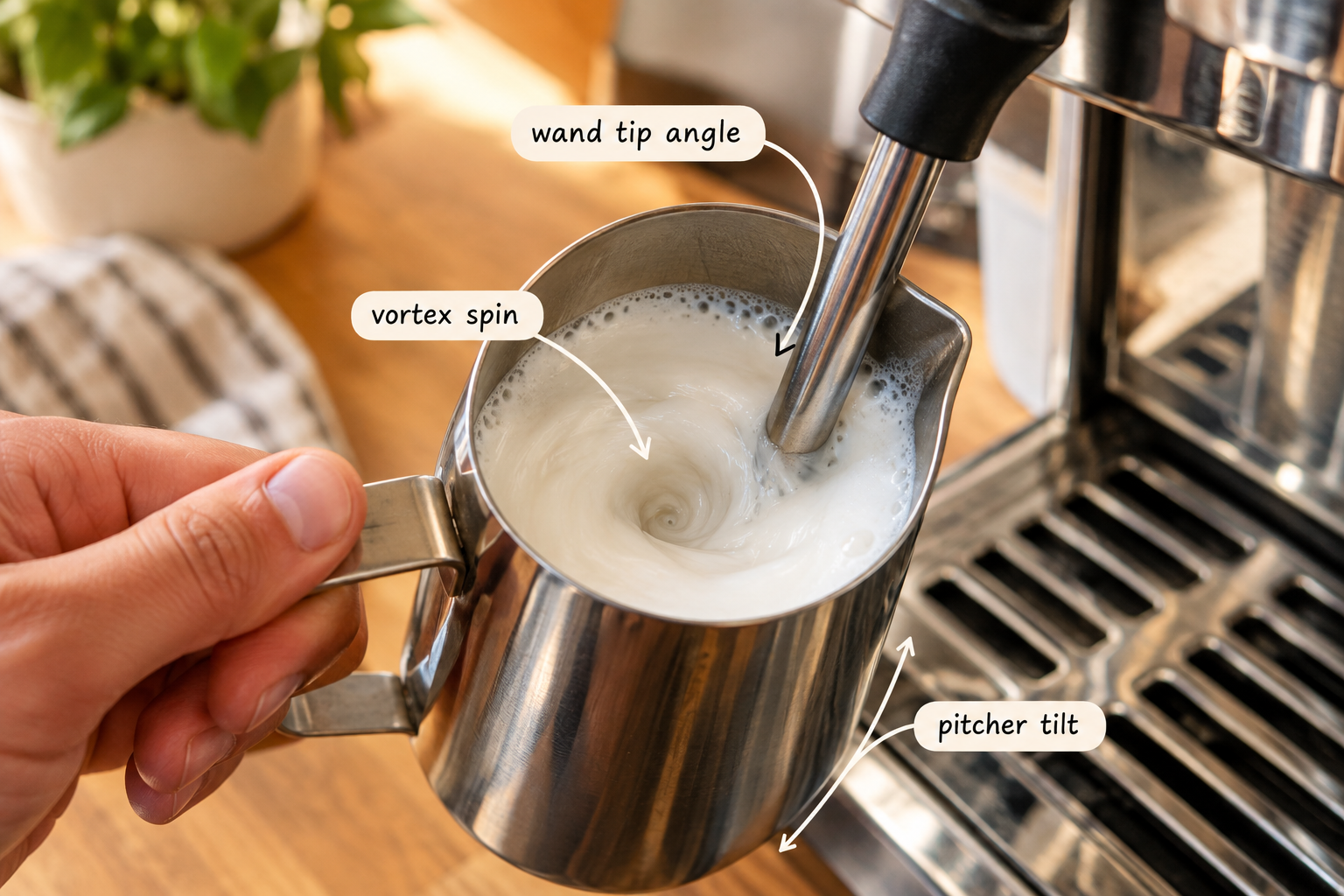
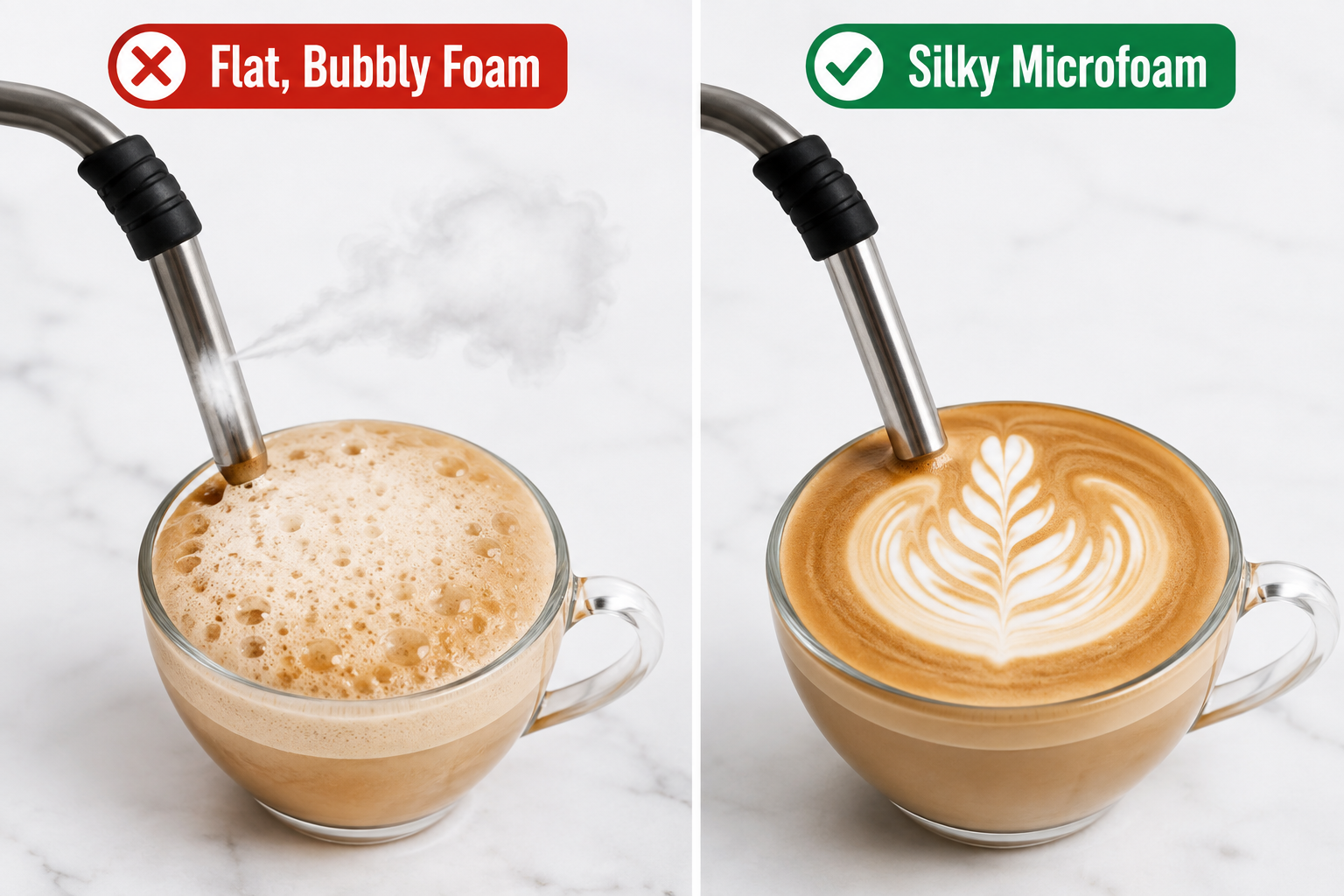
Good milk steaming produces microfoam: tiny, uniform bubbles that feel silky, not soapy. You get there by controlling wand depth and pitcher angle, not by cranking the steam knob to maximum.
Method:
- Fill a chilled stainless pitcher with cold milk, about one-third full.
- Submerge the wand tip just below the surface, off-center to create spin.
- Turn on full steam. You want a light hissing sound, not a screech.
- As the milk expands, lower the pitcher slightly to keep the tip near the surface, building foam.
- Once foam volume roughly doubles, submerge the tip deeper to heat the rest of the milk without adding more air.
- Stop at 140 to 150°F, before the milk scalds.
- Swirl the pitcher to fold the foam back into the milk, then pour.
The wand's job is to spin a vortex in the pitcher, pulling air into the milk in a controlled way. Without that vortex, you get big bubbles and a foam cap that separates from the liquid within a minute. For more on the mechanics, see our guide on the best ways to froth milk for your espresso drinks and our breakdown of the most popular milk steaming techniques.
Cappuccino Machine With Automatic Milk Frother vs Manual Wand
An automatic milk frother is faster and easier to clean, but a manual wand still produces denser, more café-like microfoam once you learn basic technique.
Automatic systems draw milk from a carafe or spout, heat it, and inject froth directly into the cup. The AIRMSEN 20-bar espresso machine with automatic milk frother is a good example, marketed as a home cappuccino maker that removes the steaming step entirely. You press a button, walk away, and get a passable cappuccino.
Manual wands demand a learning curve of maybe five to ten attempts before the technique clicks. Once it does, most home baristas prefer the wand because it lets them control foam density, temperature, and pour speed for latte art.
Choose automatic if: you make cappuccinos for guests occasionally and want a foolproof button. Choose manual if: you drink cappuccino daily and want the texture and speed that comes with practice. Reviews across the category generally agree that serious home users still prefer manual wands for finer control, even as automatic systems close the gap.
Breville vs De'Longhi Cappuccino Machines
Breville and De'Longhi split the home cappuccino market along a clear line: Breville leans toward semi-automatic machines with manual wands, while De'Longhi leans toward fully automatic bean-to-cup machines with one-touch milk systems.
A Breville espresso machine, whether the Barista Express, Barista Pro, or Bambino Plus, gives you a built-in grinder and a wand you operate by hand (with an automatic assist option on some models). This suits buyers who want a hands-on morning ritual and are willing to learn steaming technique.
A De'Longhi espresso machine like the Dinamica automates almost everything, including milk texturing through a sealed carafe system. A 2026 roundup of coffee machines for home users highlights De'Longhi's high-tech bean-to-cup lineup for offering more than 35 one-touch recipes, including cold foam for iced cappuccinos [13, unverified pricing not cited]. This suits buyers who want consistency over involvement.
Decision rule: pick Breville if you enjoy the process and want a grinder in the same footprint. Pick De'Longhi if you want to press one button and get the same cup every time, even if it costs more upfront.
Do I Need a Grinder With My Cappuccino Machine
Yes, unless the machine has one built in. Pre-ground coffee stales within days and produces flatter, less sweet espresso shots, which weakens the whole cappuccino.
Espresso extraction depends heavily on grind size consistency. A burr grinder gives you even particle size, which controls how fast water passes through the puck. Blade grinders, and pre-ground bags, produce uneven particles that lead to sour or bitter shots depending on which particles extract too fast or too slow.
Machines like the Breville Barista Express and the De'Longhi Dinamica solve this by including a built-in grinder. Machines like the Gaggia Classic Pro, Bambino Plus, and most Nespresso-style pod machines do not, so factor a separate grinder (or capsules) into your budget. For grind size guidance by machine type, see what is the best grind of coffee for an espresso machine.
Common mistake: buying a $500 machine and running it on stale supermarket pre-ground coffee. The machine cannot fix bad grind size or bad roast date.
Cappuccino Machine Steam Wand Not Steaming Milk Properly
Weak or sputtering steam almost always traces back to one of three causes: low water in the reservoir, a clogged wand tip, or mineral scale inside the boiler.
Troubleshooting checklist:
- Weak, wispy steam: check the water tank level first. Most machines need a near-full reservoir to build steam pressure.
- Sputtering or spitting: the wand tip has dried milk residue blocking the small holes. Soak the tip in warm water and clear holes with the pin tool that came with the machine.
- No steam at all after several seconds: the boiler likely needs descaling, especially in hard water areas. Scale buildup on the heating element slows steam production.
- Milk won't foam, only heats: the tip is submerged too deep, or the wand angle isn't creating a vortex. Reposition off-center near the surface.
- Steam smells burnt: old milk residue has cooked onto the tip. Purge the wand for a few seconds before and after every use.
A short metal pipe near the group head is all a wand really is, but its small holes and internal channel are precise enough that a little dried milk changes performance noticeably. Run a short steam purge immediately after every drink, every time, and most of these problems disappear before they start.
Best Cappuccino Machine for Beginners
The best cappuccino machine for beginners removes as many decisions as possible while still using real steam pressure, not a battery-powered whisk.
For most new buyers, the Breville Bambino Plus is the strongest starting point. Its automatic milk system produces a decent microfoam with a button press, and a manual switch lets you practice hand-steaming when you're ready. It also heats up in about three seconds, so you're not standing around waiting.
If a grinder in the same box matters more to you, the Breville Barista Express is still beginner-friendly despite its manual wand, because independent lab testing rates its steam output as consistent and forgiving compared to competitors in the same price range. Semi-automatic machines like this one strike a balance between hands-on control and forgiving operation, which is exactly what a first-time buyer needs.
Who should skip these: if you truly do not want to learn any steaming technique, a pod-based system like the Nespresso Lattissima removes the wand entirely. You trade flavor range for near-zero effort.
Cappuccino Machine for Small Kitchen Space
For tight counters, footprint and water tank access matter more than feature count. Measure the height above your machine's spot before buying anything, since many water tanks and bean hoppers refill from the top.
Compact options worth considering:
- Breville Bambino Plus: one of the smallest footprints in its category, with a compact wand and side-loading water tank.
- Philips 3200 LatteGo: a bean-to-cup machine with a slim automatic frother attachment (LatteGo) that removes for easy cleaning without external milk tubing taking up counter space.
- Nespresso Lattissima: the smallest overall footprint on this list, since it has no grinder or hopper.
Common mistake: buying a machine with a top-loading bean hopper or water tank, then discovering the kitchen cabinet above it blocks refills. Always check clearance, not just width and depth, before choosing a small-kitchen pick.
Is an Expensive Cappuccino Machine Worth It
An expensive cappuccino machine is worth it when the price buys a specific, identifiable improvement, such as a more powerful steam wand, PID temperature stability, or integrated grinding. It is not automatically worth it just because the brand name is familiar.
A premium example: the Terra Kaffe TK-02 is named a top-performing cappuccino maker in a 2026 feature specifically because of its milk output and overall cappuccino quality, not just its espresso shots. That is a real, testable difference, not a marketing claim.
Compare that to two machines with similar specs on paper but a large price gap. If the cheaper one has a plastic Panarello wand and the pricier one has a bare commercial-style wand capable of a tighter milk vortex, the price gap explains itself. If the only difference is a touchscreen instead of dials, that gap is harder to justify for cappuccino quality specifically.
Decision rule: pay more when the upgrade targets steam performance, temperature stability, or grinder quality. Be skeptical of price increases tied only to app connectivity or cosmetic finishes.
Common Mistakes When Using a Cappuccino Machine
Most cappuccino disappointments trace back to a handful of repeatable mistakes, not the machine itself.
- Using cold, stale milk straight from the back of the fridge. Fresher, colder milk foams better than milk close to its expiration date.
- Overfilling the pitcher. Milk expands significantly during steaming; a pitcher more than half full won't leave room to build foam.
- Skipping the purge. Steam that sits in the wand line without purging first can spit hot water into the milk.
- Ignoring grind size. A shot pulled from the wrong grind size throws off extraction time, which changes how the espresso balances against steamed milk.
- Letting foam sit too long before pouring. Microfoam separates from liquid milk within a minute or two, so pour promptly.
For a full walkthrough of the drink itself, our guide on the best ways to brew a perfect cappuccino covers ratio and pour technique in more detail.
Cappuccino Machine Maintenance and Cleaning Tips
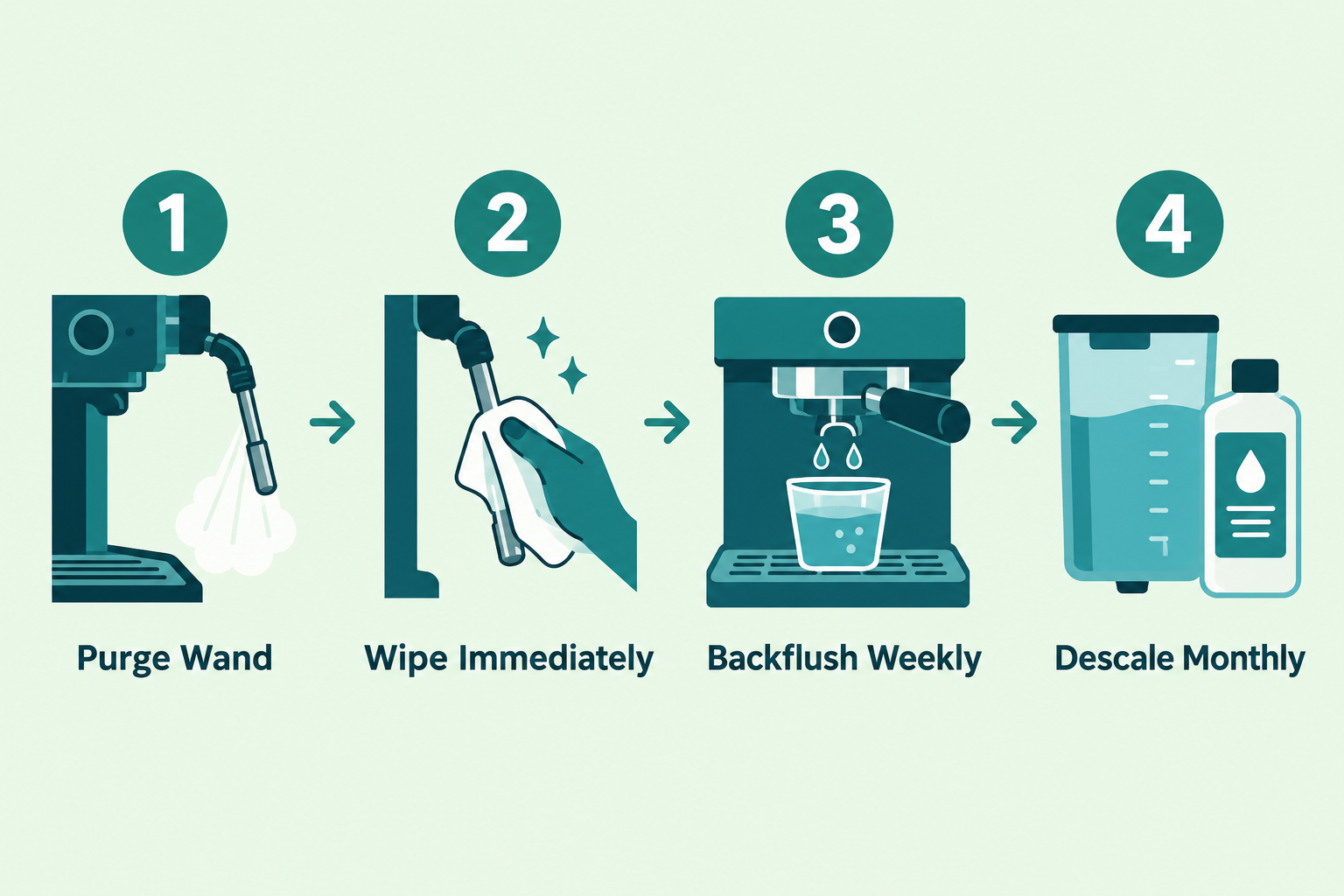
A cappuccino machine needs three routine tasks to keep steam output strong: wand purging after every use, weekly backflushing (for machines that support it), and monthly descaling.
Maintenance checklist:
- Purge the wand for a few seconds immediately after steaming, every time, to clear milk residue before it dries.
- Wipe the wand with a damp cloth right after purging, while residue is still soft.
- Backflush the group head weekly if your machine supports it, using the blind filter that came with it.
- Descale monthly, or every 60 to 90 uses, depending on your local water hardness.
- Empty and dry the drip tray daily to avoid mildew smell.
Skipping wand purging is the single most common cause of weak steam pressure over time, since dried milk narrows the tiny holes the wand relies on. For a deeper maintenance routine across machine types, read our advanced espresso machine maintenance tips and advanced espresso machine buying guide.
Can You Make Other Drinks With a Cappuccino Machine
Yes. Any machine capable of pulling an espresso shot and steaming milk can make most café drinks, not just cappuccino.
With the same hardware, you can make:
- Lattes: more steamed milk, thinner foam cap.
- Macchiatos: espresso with a small dollop of foam.
- Flat whites: espresso with denser, thinner-textured milk.
- Americanos: espresso diluted with hot water, no steaming needed.
- Mochas and hot chocolate: steamed milk with cocoa or chocolate syrup added.
The wand and grouphead do not care what the drink is called. The variable is your recipe: how much milk, how much foam, and how much water. For drink ratios and step-by-step recipes, see our best coffee recipes to try at home.
FAQ
What is the best cappuccino machine for home use overall? The Breville Barista Express is the most consistently recommended best cappuccino machine for home use, because it pairs a built-in grinder with a steam wand rated highly for consistency in independent testing.
Is a cappuccino machine the same as an espresso machine? Mostly yes. Any espresso machine with a working steam wand can make a cappuccino. The labeling difference usually just signals that the manufacturer highlights the milk system.
Do I need a separate grinder if my cappuccino machine doesn't have one? Yes, if you want fresh, consistent shots. Pre-ground coffee stales quickly and produces uneven extraction, which weakens both the espresso and the finished cappuccino.
Why is my steam wand not frothing milk anymore? Check the water reservoir first, then check for a clogged wand tip from dried milk, then consider descaling if steam has been weak for weeks rather than days.
Is an automatic milk frother as good as a manual steam wand? Automatic frothers are faster and easier but generally produce flatter foam than a manual wand used correctly. Choose automatic for convenience, manual for texture and control.
How much should I spend on a best cappuccino machine for home use? Budget $400 to $500 for a solid semi-automatic with a manual or assisted wand, $700 to $900 for a machine with a built-in grinder, and $900 and up for fully automatic bean-to-cup systems with one-touch milk.
Conclusion
The steam wand decides more of your cappuccino's quality than the pump, the touchscreen, or the brand name on the front panel. Buy for the wand first: check whether it spins a real vortex, how fast it heats, and whether cleaning it will actually happen on a Tuesday morning before work.
If you want one machine that handles both the shot and the milk without extra shopping, the Breville Barista Express remains the strongest all-around best cappuccino machine for home use. If convenience matters more than technique, an automatic frother machine like the Philips 3200 LatteGo removes the learning curve entirely.
Whichever you choose, practice the pour a few times before judging the machine. Better coffee starts with better answers, and in this case, the answer is standing right there on the side of the machine, waiting for you to learn it.
.cg-wrap{font-family:system-ui,-apple-system,”Segoe UI”,Roboto,sans-serif;max-width:640px;margin:0 auto;background:#F5FAF8;padding:18px;border-radius:10px} .cg-wrap h3{color:#14231D;margin:0 0 10px;font-size:18px} .cg-btns{display:flex;flex-wrap:wrap;gap:8px;margin-bottom:14px} .cg-btn{background:#1F6B4A;color:#fff;border:none;padding:8px 12px;border-radius:6px;cursor:pointer;font-size:13px} .cg-btn:hover{background:#145037} .cg-result{background:#E8F2EE;border-left:4px solid #61BDA1;padding:12px;border-radius:6px;color:#23372F;font-size:14px;min-height:60px} .cg-result b{color:#14231D}Find your best cappuccino machine match
Keep Exploring Coffee Rank IQ
- Coffee Rank IQ home: reviews, brewing guides, and coffee science
- Best Espresso Machine for Beginners: 7 Picks That Forgive Mistakes
- Best Super Automatic Espresso Machine: Read the Cleaning Specs First
- Best Semi Automatic Espresso Machine for Real Home Kitchens
- Best Espresso Machine Under 500: Where the Money Actually Goes
References
- acfc.org/best-cappuccino-machines
- www.coffeeness.de/en/best-cappuccino-maker
- www.tomsguide.com/home/coffee-makers/best-espresso-machines
- www.businessinsider.com/guides/kitchen/best-espresso-machines-reviewed
- www.findthisbest.com/best-coffee-makers/steam-wand
- www.theguardian.com/thefilter/2024/nov/21/best-coffee-machines
- www.techgearlab.com/topics/kitchen/best-espresso-machine
- ovencookguy.com/best-home-cappuccino-coffee-maker