
Is Decaf Coffee Bad for You? Research and Solvents
Quick answer
No, the evidence does not show that decaf coffee is bad for you. The largest human studies link decaf to the same neutral or slightly favorable health outcomes as regular coffee, and a 2025 Annals of Oncology analysis found a hazard ratio of 1.00 (95% CI 0.98 to 1.01) for total cancer per extra daily cup of decaf. The solvent question is real but small: the US limit for methylene chloride residue in roasted decaf is 10 parts per million, and independent testing of a few retail lots in 2026 reported levels around 84 to 89 parts per billion, roughly 1 percent of that ceiling.
Key takeaways
- 2 to 3 cups a day looked fine. Chieng and colleagues, writing in the European Journal of Preventive Cardiology in 2022 using UK Biobank data, reported that 2 to 3 daily cups of decaf were associated with about 14% lower all-cause mortality. Association, not proof.
- Cancer signal: essentially flat. The 2025 Annals of Oncology pooled analysis found 1.00 for total cancer per cup per day, 0.96 for colorectal cancer, 0.93 for aggressive prostate cancer.
- One unresolved flag. The same analysis saw a higher bladder cancer risk in men that the authors said needs further study. No methylene chloride link was demonstrated.
- The legal limit is 10 ppm for methylene chloride in decaffeinated roasted coffee under 21 CFR 173.255 .
- A 2026 advocacy report from GMO/Toxin Free USA tested a small number of Starbucks Medium Roast Decaf House Blend lots and reported 84 to 89 ppb methylene chloride, below the federal limit but higher than its January 2025 sample of 22 ppb .
- The FDA has not banned the solvent. Petition FAP 4A4839, filed December 2023, remained under review as of late 2026 .
- If you want zero solvent exposure, buy coffee labeled Swiss Water Process, CO2 process, or ethyl acetate (often sold as "sugarcane decaf") .
Is decaf coffee bad for you? What the research actually shows
Asking is decaf coffee bad for you is really asking two separate questions: does drinking it change your health outcomes, and does the way the caffeine was removed leave something harmful behind. The health data is the stronger of the two, and it is reassuring.
The mortality study. Chieng et al. analyzed UK Biobank participants and published in the European Journal of Preventive Cardiology in 2022. Decaf drinkers at 2 to 3 cups per day showed roughly 14% lower all-cause mortality than non-coffee drinkers, along with lower incident cardiovascular disease. The limitation matters: this was observational, self-reported intake at baseline, and overwhelmingly white British volunteers who tend to be healthier than the general population. People who drink decaf may differ from people who drink nothing in a dozen ways a questionnaire cannot capture.
The cancer study. A 2025 pooled analysis in Annals of Oncology measured risk per additional daily cup. Total cancer came out at a hazard ratio of 1.00, confidence interval 0.98 to 1.01, which is as close to "no association" as epidemiology gets. Colorectal cancer sat at 0.96 and aggressive prostate cancer at 0.93. An early lung cancer signal disappeared among never-smokers, which is the classic fingerprint of smoking confounding rather than a coffee effect. Bladder cancer in men stayed elevated and unexplained.
Observational studies show who gets sick, not why. Every number here describes a pattern in a population, not a promise about your body.
Diabetes. Multiple meta-analyses of prospective cohorts have found decaf consumption associated with lower type 2 diabetes incidence, in the same direction as caffeinated coffee. That points at the non-caffeine compounds, chlorogenic acids in particular, rather than the stimulant.
If you have a diagnosed heart rhythm problem, reflux, kidney disease, or you are on medication that interacts with coffee compounds, ask your doctor what fits your case. General population averages are a poor substitute for someone who has read your chart.
What solvents are used to make decaf coffee?
Four methods dominate commercial decaffeination: methylene chloride, ethyl acetate, pressurized carbon dioxide, and plain water with activated carbon filters . All four start the same way, by soaking or steaming green coffee so the caffeine becomes mobile.
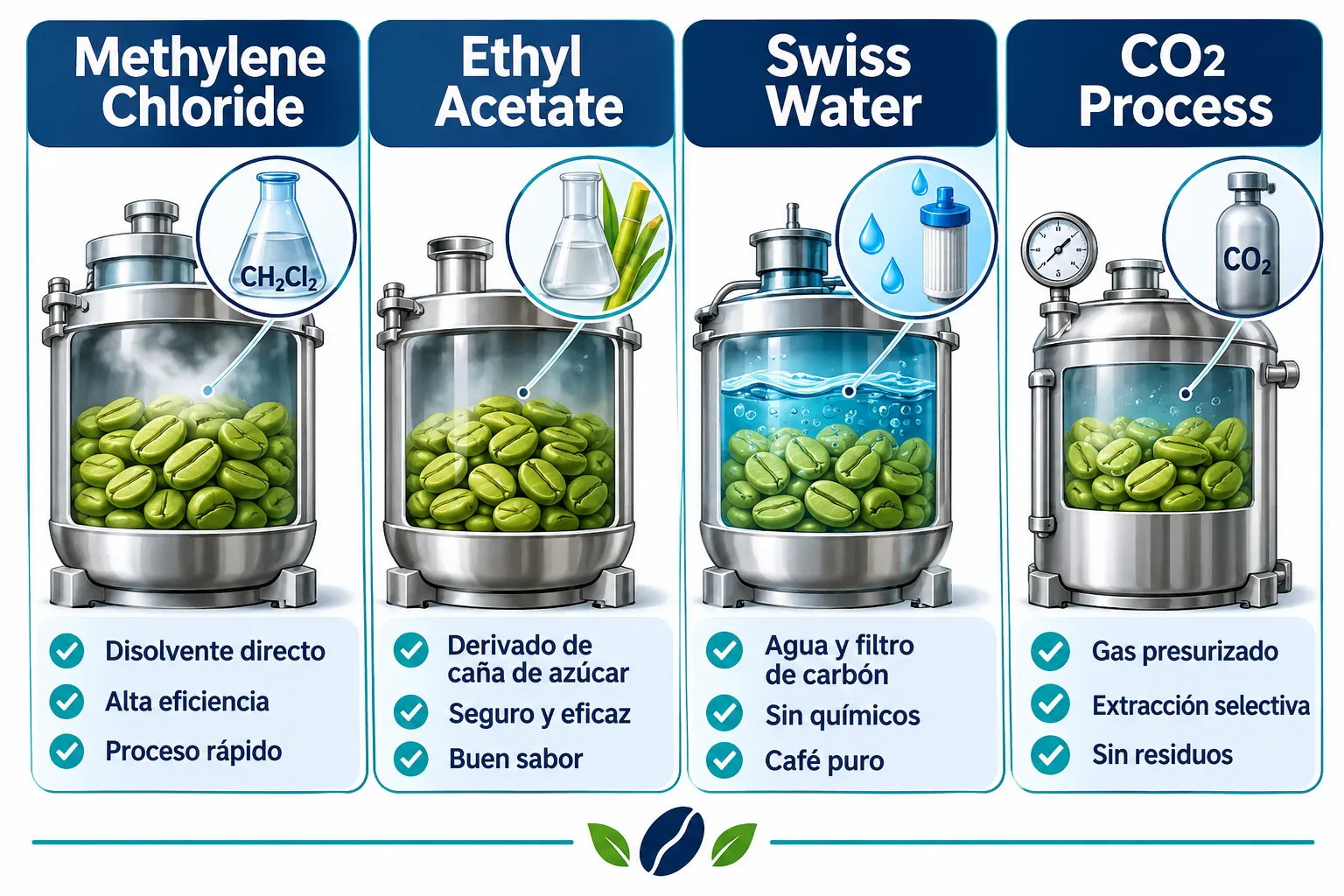
- Methylene chloride (dichloromethane). A solvent that binds caffeine selectively and leaves most flavor compounds alone, which is why processors like it. It boils at about 104°F, far below roasting temperatures, so most of it evaporates during steaming and roasting .
- Ethyl acetate. A compound found naturally in ripening fruit and often produced from sugarcane fermentation. Coffee processed this way is marketed as "natural decaf" or "sugarcane process," common in Colombia .
- Supercritical CO2. Carbon dioxide held under high pressure behaves like a liquid and pulls caffeine out. Expensive equipment, used mainly at scale .
- Swiss Water Process. No added solvent. Green beans soak in water saturated with coffee solubles, and the caffeine moves into a carbon filter while flavor compounds stay in solution .
Common mistake: assuming "naturally decaffeinated" on a bag means water process. It usually means ethyl acetate, because the compound occurs naturally. Read the back panel for the method name.
Here is the full comparison, including what each method costs you in flavor and price.
Decaffeination methods compared
| Method | Agent used | Solvent residue | Flavor effect | Typical cost |
|---|---|---|---|---|
| Methylene chloride | Chemical solvent | Legal cap 10 ppm; tested lots far lower | Good flavor retention | Lowest |
| Ethyl acetate | Sugarcane-derived ester | Trace; compound occurs in fruit | Slight sweetness, fruity edge | Low to medium |
| Swiss Water Process | Water + carbon filter | None added | Clean, can mute brightness | Higher |
| Supercritical CO2 | Pressurized carbon dioxide | None added | Strong flavor retention | Highest |
Residue limits per 21 CFR 173.255. Flavor and cost reflect general industry patterns, not a Coffee Rank IQ tasting panel.
Are the chemicals in decaf coffee harmful at the levels found in coffee?
At the residue levels reported in retail decaf, there is no human evidence of harm, but the regulatory picture is genuinely unsettled and that is why people keep asking is decaf coffee bad for you.
The facts, in order:
- The limit. 21 CFR 173.255 caps methylene chloride in decaffeinated roasted coffee and soluble coffee extract at 10 ppm, which is 0.001% .
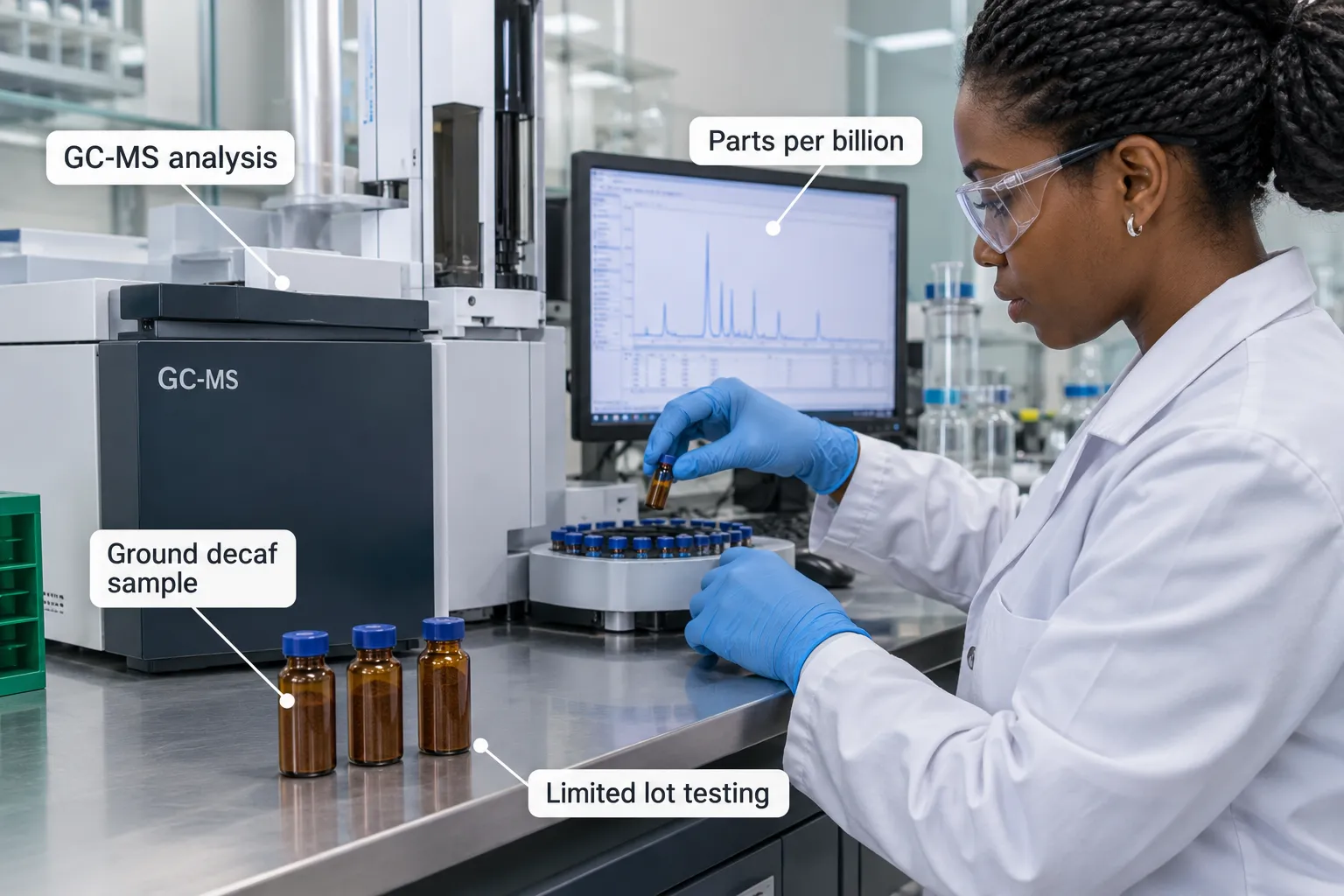
- What testing found. GMO/Toxin Free USA reported in September 2026 that lots of Starbucks Medium Roast Decaf House Blend tested at 84 to 89 ppb in April 2026 samples, up from 22 ppb in a January 2025 sample. The lab said it was ISO/IEC 17025 accredited and used gas chromatography mass spectrometry. Even the highest figure is under 1% of the 10 ppm ceiling .
- The same report flagged benzene and toluene, rising from 28 ppb to 159 to 170 ppb and from 87 ppb to 375 to 400 ppb respectively across those samples .
- The limitation. A handful of lots from one product line cannot describe average exposure across the decaf category, and chemical detection is not a health effect .
- Regulatory status. FDA petition FAP 4A4839, filed December 21, 2023, asks the agency to strike methylene chloride, benzene, ethylene dichloride, and trichloroethylene from food additive rules. The comment period reopened in May 2026 under docket FDA-2023-F-5684. No final decision had been announced by November 2026 .
- EPA's 2024 TSCA rule restricts methylene chloride in consumer and most commercial uses, but food additive authorization sits with the FDA, so coffee processing was not swept up by it .
Cancer researchers who have reviewed the question directly have concluded that the evidence does not support the claim that methylene chloride decaf raises cancer risk at these exposures . Several 2026 fact checks also pushed back on viral posts that conflated industrial solvent exposure with trace food residues .
The misconception worth correcting: methylene chloride decaf is not "coffee soaked in paint stripper that you then drink." The solvent contacts green beans, is driven off by steaming, and then meets roasting temperatures above 400°F. What survives is measured in parts per billion. Dose is the whole argument.
How much caffeine is actually in decaf coffee, and can it keep you awake?
Decaf is not caffeine free. US regulations treat coffee as decaffeinated when at least 97% of the caffeine has been removed, which leaves roughly 2 to 7 mg per 8 oz brewed cup, against about 95 mg for regular drip. Some retail samples have measured higher.
For most adults that amount is too small to affect sleep. The people who notice it are:
- Slow caffeine metabolizers, often carriers of certain CYP1A2 variants
- Anyone drinking three or four decafs after 8 p.m., which can total 20 mg or more
- People already sensitive enough that a square of dark chocolate registers
Decision rule: if decaf still keeps you awake, move your last cup to before 4 p.m. and check whether the real culprit is the warm liquid, the ritual, or something else in the evening. Our breakdown of the real caffeine milligrams in decaf coffee has the brand-by-brand numbers.
Can decaf coffee cause anxiety or jitteriness?
Rarely, and usually not from caffeine. At 2 to 7 mg per cup you are about 15 to 30 times below a standard dose. If you feel jittery after decaf, suspect sugar in a flavored drink, an empty stomach, or the expectation effect, which is well documented in placebo caffeine trials. Anyone switching from six regular cups to decaf may also be feeling caffeine withdrawal, which produces headache and irritability for a few days.
Is decaf coffee safe during pregnancy?
Decaf is generally considered the safer coffee choice in pregnancy because it keeps intake well under the advisory ceiling. ACOG advises keeping caffeine below 200 mg per day during pregnancy. At 2 to 7 mg per cup, decaf makes that easy.
On solvents, the FDA limit applies to all consumers including pregnant people, and no human study has linked trace methylene chloride in coffee to pregnancy outcomes. If that still bothers you, the fix is simple and costs a few dollars more: buy Swiss Water or CO2 processed decaf . Confirm your own plan with your obstetric provider, since advice shifts based on blood pressure, reflux, and anything else going on.
What are the health benefits of decaf coffee, and does it keep the antioxidants?
Yes, decaf keeps most of the non-caffeine compounds that make coffee interesting nutritionally, which is where the measured benefits of decaf coffee appear to come from.
- Chlorogenic acids. These polyphenols survive decaffeination, though processing and roasting reduce them somewhat compared with the same beans caffeinated. They are the leading candidate behind the diabetes associations.
- Melanoidins. Formed during roasting, unaffected by caffeine removal, and part of coffee's antioxidant capacity.
- Cafestol and kahweol. Diterpenes that raise LDL cholesterol and are present in unfiltered coffee regardless of caffeine. Paper filters trap most of them, which is one practical reason drip and pour over differ from a French press.
So "is decaf coffee healthy" has a defensible answer: it carries most of the compounds associated with favorable outcomes, minus the stimulant. What it does not do is deliver the caffeine-specific effects, including alertness, short-term performance gains, and the exercise benefits that show up in caffeine trials.
How much decaf coffee can you drink per day?
Most adults can drink decaf coffee every day without a defined upper limit, and the clearest benefit signal in the UK Biobank analysis sat at 2 to 3 cups daily. There is no caffeine ceiling to worry about, so the practical limits are different ones.
| What limits you | Why | Practical ceiling |
|---|---|---|
| Acid and reflux | Coffee relaxes the lower esophageal sphincter whatever the caffeine content | Stop at the point symptoms start |
| Cholesterol | Unfiltered brews carry diterpenes | Use a paper filter above 3 cups |
| Residual caffeine | 2 to 7 mg per cup adds up | Under 6 cups is trivially low |
| Additives | Cream and syrup, not the coffee | Count the calories, not the cups |
A reasonable default: two to four cups, filtered, with the last one early enough that you are not testing your own sleep. If you track what you drink, our guide to how many scoops of coffee per cup helps keep the brew ratio honest across the day.
Is decaf coffee easier on your stomach than regular coffee?
Often yes, but less than people expect, because caffeine is only one of coffee's stomach irritants. Caffeine stimulates gastric acid secretion, so removing it helps. Chlorogenic acids and N-alkanoyl-5-hydroxytryptamides also trigger acid production and stay in decaf.
What actually helps if coffee bothers your stomach:
- Switch to a darker roast, which contains more of the compound NMP and fewer of some irritants
- Try cold brew, which extracts fewer acids; see the beginner's guide to cold brew coffee
- Drink it with food rather than first thing
- Use a paper filter
Is decaf coffee bad for your teeth?
Decaf stains teeth about as much as regular coffee, because the staining comes from tannins and melanoidins, not caffeine. It is also acidic, with brewed coffee typically landing around pH 4.8 to 5.1, which can soften enamel over time.
Dentists generally suggest rinsing with water after coffee and waiting 30 minutes before brushing, since brushing softened enamel does more harm than good. Adding sugar is far worse for teeth than the coffee itself. Black decaf is roughly as hard on enamel as black regular coffee, and much gentler than soda.
Does water processed decaf taste better than solvent processed?
Not automatically. Bean quality, roast date, and brewing matter more than the decaffeination method, and that is the part most buyers get backwards.

What the methods tend to do:
- Swiss Water and CO2 remove caffeine gently and are the processes specialty roasters most often choose, so the underlying beans are usually better to begin with . That is a selection effect as much as a process effect.
- Ethyl acetate can leave a slight fruity sweetness that some roasters like and some find cloying .
- Methylene chloride is flavor-selective by design and is used on a lot of mass-market coffee, where older, cheaper beans do most of the damage to the cup .
The variable that beats all of this: roast date. Decaffeinated green coffee is more porous and stales faster than regular coffee. A bag roasted three weeks ago will taste flat no matter which process produced it. Buy small, buy recent, grind with a burr grinder just before brewing, and keep your water temperature around 200°F.
Which decaf has no chemicals, and what are the best decaf coffee brands to buy?
If you want to avoid added solvents entirely, look for these labels on the bag: Swiss Water Process, Mountain Water Process, CO2 process, or sugarcane / ethyl acetate if you count a naturally occurring ester as acceptable . Any bag that says only "decaffeinated" with no method named is most likely solvent processed, since water and CO2 processors pay to advertise the fact.
Practical shopping rules:
- Method named on the package, or skip it.
- Roast date printed, not a "best by" date twelve months out.
- Whole bean where possible, since decaf stales quickly.
- Single origin if you want to taste origin character; blends are fine for milk drinks.
For specific picks across price points, see our roundup of the best decaf coffee brands, and if you brew in a pod machine, the best decaf K-Cups that actually taste like coffee. Coffee Rank IQ earns affiliate commissions on some links in those guides, which does not change what gets recommended.
FAQ
Conclusion: what this means for your daily cup
Across the biggest available human datasets, decaf tracks with the same neutral to mildly favorable outcomes as regular coffee, and the solvent residues measured in retail products sit far below the legal limit. So the honest answer to is decaf coffee bad for you is no, with one open regulatory question and one unexplained bladder cancer signal that researchers have asked to study further. Associations stay associations. Nothing here treats, prevents, or cures anything.
Your next step takes thirty seconds. Turn your decaf bag over and look for the processing method. If it says Swiss Water, Mountain Water, CO2, or sugarcane, your solvent question is already answered. If it says nothing at all, and that bothers you, your next bag can fix it for a couple of dollars more. Then check the roast date, because a stale water process decaf still tastes worse than a fresh one from any method.
Better Coffee Starts With Better Answers.