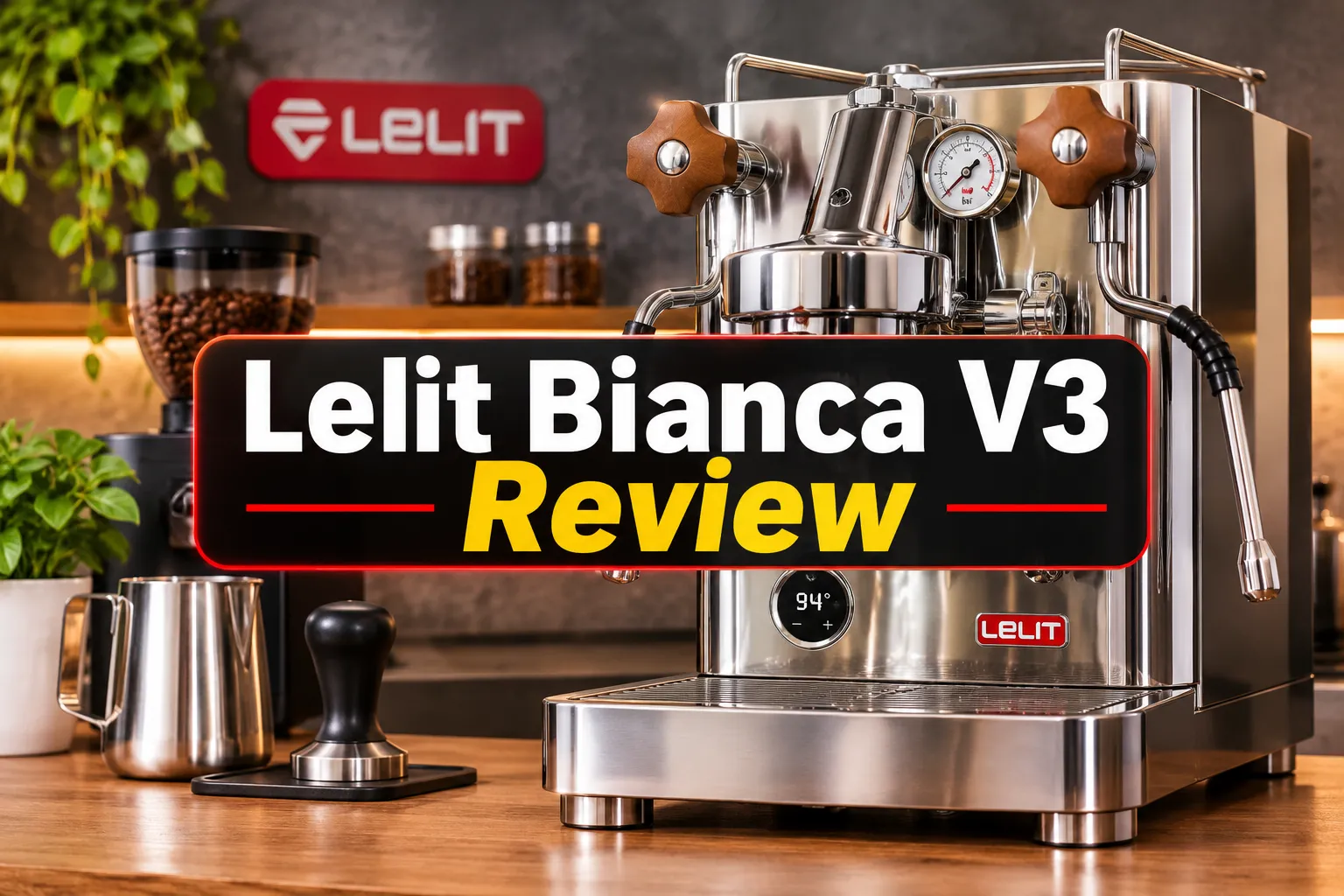
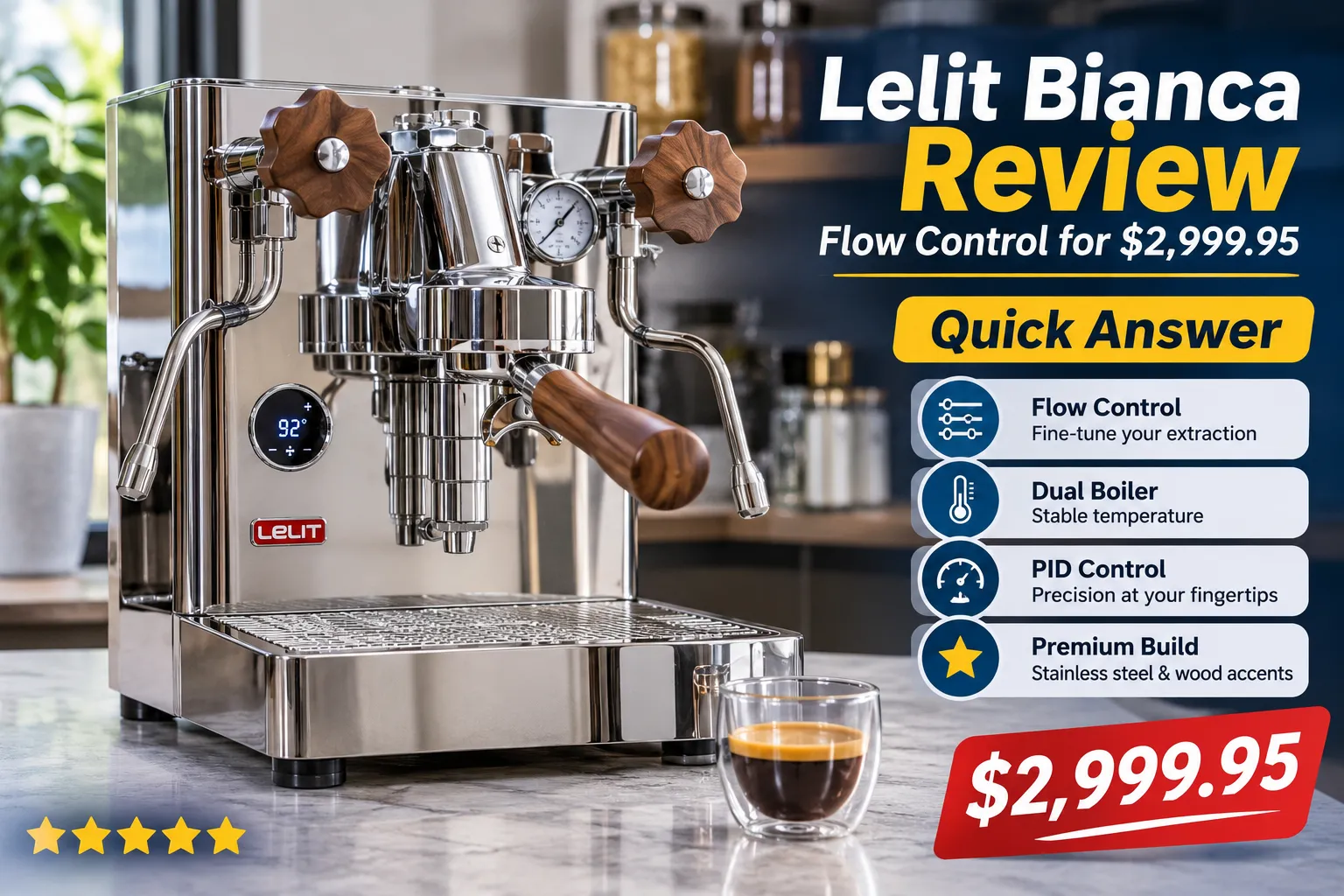
Lelit Bianca Review: Flow Control for $2,999.95
Quick answer
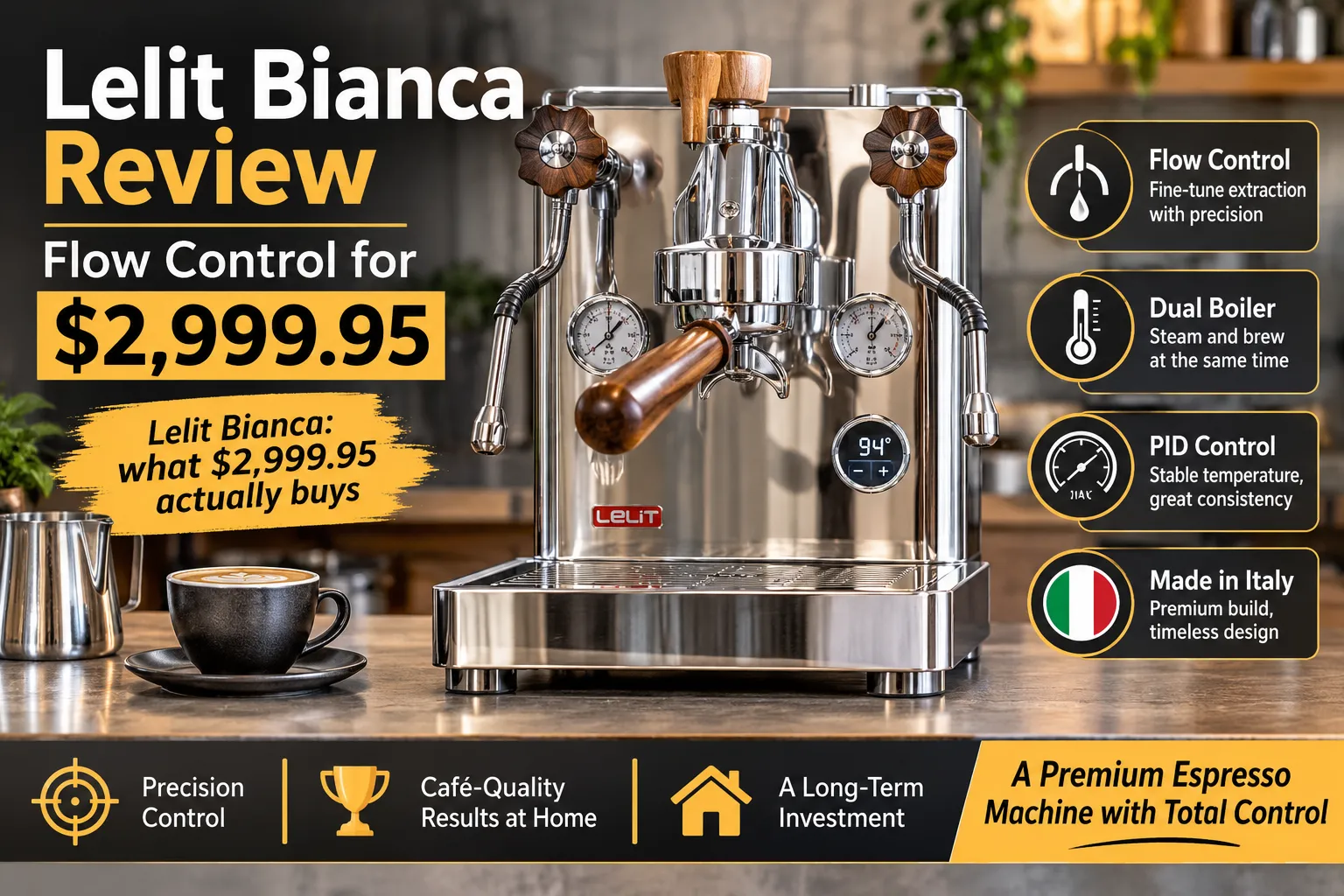
The Lelit Bianca is a dual boiler, E61 espresso machine with a mechanical flow-control paddle, listed at $2,999.95 on Lelit's US store and authorized dealers as of November 5, 2026 . Buy it if you want to change water flow mid-shot and chase sweetness from light roasts. Skip it if you want to press a button and walk away, because a standard dual boiler does that for less money. This review is based on published specifications, dealer listings, and independent reviewer measurements, not on our own bench testing.
Affiliate disclosure: Coffee Rank IQ earns commissions from some retailer links. Prices were checked November 5, 2026 and change without notice.
Key takeaways
- Price: $2,999.95 at Lelit US and authorized dealers in October and November 2026 . Chris' Coffee listed an open-box stainless V3 at $2,640 in late October 2026 .
- Boilers: 0.8 L brew boiler and 1.5 L steam boiler, both stainless and PID controlled, so you can pull and steam at the same time .
- Flow control is real, not marketing. The paddle moves a needle valve. Lance Hedrick's testing, summarized by CremaSpecs, recorded roughly 4 bar at low flow and 9 bar at full flow .
- The group runs cooler than the display. Tests cited by CremaSpecs found the group about 10 to 11°F below the shown brew-boiler temperature on some units, narrowing to 2°F after an hour of heat soak .
- Warm-up: Lelit claims under 24 minutes; reviewers saw a ready light near 15 minutes and a fully soaked E61 group at 20 to 30 minutes .
- Ease of use scored 2.9/10 in The Coffee Guru's specification-based evaluation, which gave the machine 6.9/10 overall .
- Steam is strong for a home machine: Kaffeemacher reportedly took 47 seconds to bring 200 g of water to 140°F .
What is flow control on an espresso machine and why does it matter?
Flow control lets you change how fast water enters the coffee puck while the shot is running. On the Bianca, a paddle on top of the E61 group turns a needle valve, which narrows or opens the water path. Less flow means lower pressure at the puck. More flow means more.
That matters because pressure is not a fixed good. A finely ground light roast packed into a basket resists water. Hit it with 9 bar immediately and the puck can crack or channel, which means water races through one weak spot and leaves the rest under-extracted. Start at low flow, around 4 bar, and the puck saturates evenly before full pressure arrives .
The second half of the shot matters too. Tapering flow near the end pulls fewer harsh, late-extraction compounds while the sweeter mid-shot sugars keep arriving. That is the practical argument for flow profiling: more control over where your extraction stops being pleasant.
Decision rule: if you buy one bag of medium-dark espresso blend every month and drink it with milk, flow control will rarely change your cup. If you buy single origin light roasts from three roasters a year and track roast date, it will.
Lelit Bianca: what $2,999.95 actually buys
The lelit bianca is a prosumer espresso machine built around a 58 mm commercial E61 group, two PID-controlled stainless boilers, and a mechanical paddle that gives live flow control during extraction . At $2,999.95 you are paying for the paddle and the dual boiler together, which is a combination most machines at this price do not offer in one chassis.
What comes in the box and on the chassis:
- 0.8 L brew boiler, 1.5 L steam boiler, both PID controlled, each with its own temperature display
- 58 mm E61 group with the flow paddle mounted on top
- Programmable pre-infusion, adjustable between 1 and 20 seconds
- 2.5 L reservoir with switchable direct plumb, plus a rotary pump configuration per dealer and reviewer descriptions
- Non-pressurized IMS baskets and walnut accents on the paddle, portafilter, and steam knobs
- Dimensions that need real counter depth, plus clearance above for the paddle swing
The Coffee Guru's specification-led scoring gave the machine 6.9/10 overall, with full marks for extraction hardware and low marks for ease of use and value . That split is the honest summary of this machine. The brewing side is excellent. The convenience side is deliberately absent.
If you are still deciding between categories rather than models, our guide on choosing the right coffee maker for your home covers the step before this one.
Five features we love on the Lelit Bianca
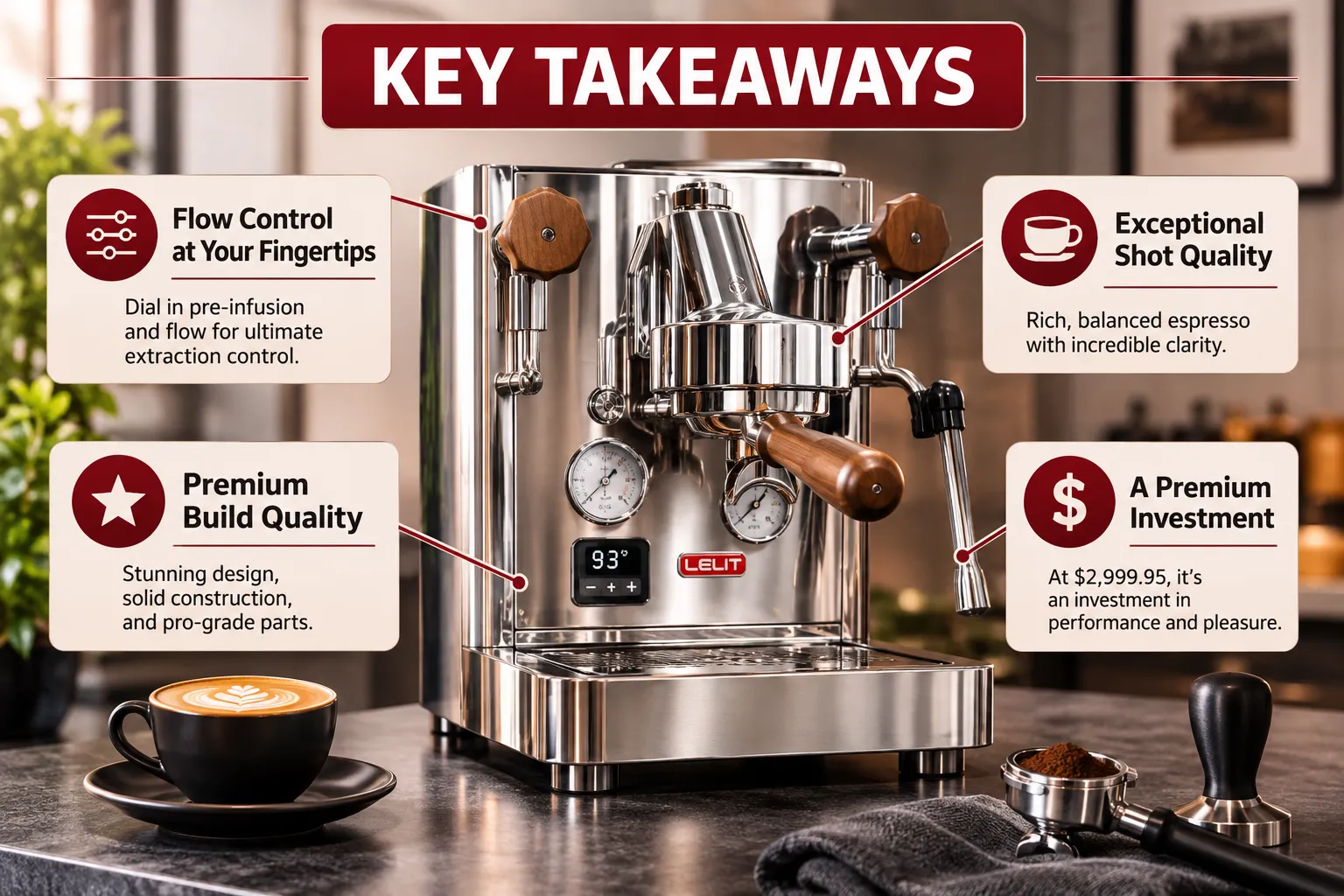
1. The paddle is mechanical, not a menu setting. You feel resistance change in your hand as the puck gives way. Programmable pre-infusion on a rival machine runs a script. The Bianca paddle responds to what is happening in the basket right now, which is why reviewers measured a live 4 to 9 bar range during a single shot .
2. Two independent PIDs. Set brew temperature for a washed Ethiopian in the morning and leave steam pressure alone. Both boilers display separately, so you are never guessing which number you changed .
3. Simultaneous brew and steam. Dual boiler espresso machine design means no waiting between the shot and the milk. Two cappuccinos back to back is a 90-second job, not a three-minute dance. Our notes on microfoam differences between flat whites and lattes explain why steam quality changes the drink more than most people expect.
4. Switchable water source. Run it off the 2.5 L reservoir now, plumb it in later if you move. That flexibility is rare at this price and it protects resale value.
5. Commercial 58 mm group and standard parts. Gaskets, shower screens, and baskets for the E61 are everywhere. You are not hostage to one proprietary supplier five years from now.
What to watch out for before you buy a Lelit Bianca
The honest friction list, in order of how often it bites new owners.
Displayed temperature is not group temperature. CremaSpecs summarized testing from Lance Hedrick and Kaffeemacher showing the group running roughly 10 to 11°F below the displayed brew-boiler reading on some units. A separate reviewer measured only 2°F of difference after an hour powered on . Translation: the number on screen is a starting point, and heat soak is the real variable.
Warm-up takes longer than the ready light suggests. Reviewers saw a ready indication near 15 minutes, acceptable shots around 17, and a properly soaked E61 group at 20 to 30 minutes, especially for light roasts . A smart plug on a timer solves this and costs about $15.
No grinder, no automatic milk. The Coffee Guru's 2.9/10 ease-of-use score reflects a machine that expects you to manage grind size, dose, puck prep, flow, and temperature yourself . Budget another $400 to $1,200 for a burr grinder that can keep up.
Counter footprint and overhead clearance. The paddle needs room to swing. Measure the gap between counter and cabinet before you order anything.
Noise and vibration. A rotary configuration is quieter than a vibration pump, but this is still a 60-pound machine with a pump and two boilers.
A beautiful machine gets your attention. A morning routine you actually keep is what makes it worth $2,999.95.
Is the Lelit Bianca worth the price for home use?
For the home brewer who enjoys experimenting, yes. For the person who wants a reliable latte before a 7:40 school run, no, and a cheaper standard dual boiler is the smarter buy.
Work out the value this way:
| If this describes you | Verdict |
|---|---|
| You already dial in by taste, weigh shots, and buy light single origin | Worth it. The paddle gives you a variable nothing else at this price offers |
| You pull two milk drinks a day from a medium blend | Skip. You will pay $700 to $900 extra for a control you rarely move |
| You want one machine for the next decade and like fixing things | Worth it. Standard E61 parts and serviceable layout |
| You want a built-in grinder and one-touch milk | Skip entirely. Wrong category of machine |
The Coffee Guru scored value low precisely because the price assumes you will use the manual controls . The machine is honest about this. The buyer has to be too.
Lelit Bianca vs Rocket, Profitec, ECM, and the La Marzocco Linea Mini
Direct answer: against Rocket and Profitec, the lelit bianca wins on flow control and loses on nothing important; against the La Marzocco Linea Mini, the Bianca wins on price and control while the Linea Mini wins on build mass, thermal stability, and dealer network.
| Machine | Approx. US price (Nov 2026) | Flow control | Best for |
|---|---|---|---|
| Lelit Bianca V3 | $2,999.95 list; $2,640 open box | Yes, mechanical paddle | Light roast experimenters |
| Profitec Pro 700 | Around $3,000 to $3,400, dealer dependent | Optional add-on kit | Set-and-forget dual boiler owners |
| ECM Synchronika | Around $3,400 to $3,900 | Optional add-on kit | Buyers prioritizing fit and finish |
| Rocket R58 / Appartamento | Roughly $2,000 (HX) to $3,900 (R58) | R58 Tune offers profiling | Classic Italian aesthetics |
| La Marzocco Linea Mini / Micra | Micra around $4,500; Linea Mini higher | Paddle on some configurations | Buyers wanting commercial lineage and service |
Prices other than the Bianca are ranges from dealer listings and vary by finish and promotion. Verify before purchase.
Lelit Bianca vs Profitec and ECM
The lelit bianca vs profitec comparison usually ends the same way: the Profitec Pro 700 is the better machine for someone who wants two boilers, a PID, and no new skills to learn. The Bianca is the better machine for someone who wants to move water pressure by hand. The Pro 700 and the ECM Synchronika both accept aftermarket flow-control kits, but you are then adding cost and installation to a machine that already costs more than the Bianca in most configurations.
Lelit Bianca vs La Marzocco Linea Mini
The Linea Mini is heavier, uses a saturated group derived from La Marzocco's commercial machines, and carries a service network built for cafés. It also costs considerably more, and Pro Coffee Gear's comparison of the Bianca against the Linea Micra and Rocket R58 Tune frames the choice as thermal stability and brand pedigree versus hands-on flow control at a lower price . For a home counter pulling six shots a day, the Bianca's thermal behavior is adequate once heat soaked. For sheer recovery under load, La Marzocco is the stronger engine.
Do I really need flow control, or is it a gimmick?
Flow control is not a gimmick, but it is optional for most drinkers. It changes the cup meaningfully on light and medium-light roasts and barely registers on dark roasts served with milk.
Here is the test that settles it. Think about your last six bags of coffee. If most of them listed a producer, an altitude, and a processing method, flow profiling will give you something to work with. If most of them said "espresso blend" on the front, your money buys more improvement in a grinder.
Common mistake: buying flow control and then leaving the paddle wide open for two years. If that sounds likely, a standard dual boiler saves you real money.
What shots can you pull on the Lelit Bianca that you couldn't pull on other machines?
Three profiles are practical on the Bianca and awkward or impossible on a fixed-pressure machine.
- Long low-pressure pre-infusion into a ramp. Hold the paddle near the 4 bar region for 15 to 25 seconds, then open to full flow . Useful for fine-ground light roasts that channel under immediate 9 bar.
- The declining pressure taper. Open to full flow, then slowly close the paddle across the back half. Shots finish sweeter because you cut off the late, drying extraction.
- The turbo-style high-flow short shot. Coarser grind, paddle wide open, higher yield in under 20 seconds. Clean and juicy rather than syrupy.
None of these require extra hardware. All of them require a grinder that can hold grind size steady and a scale. If you want the groundwork first, our guide to advanced espresso equipment essentials and maintenance covers the supporting kit.
How hard is it to learn the Lelit Bianca, and is it a good first machine?
Expect two to four weeks of regular practice before shots become consistent, and treat the paddle as a skill you add in month two rather than week one. It is a workable first machine for a patient learner with a good grinder, and a frustrating one for anyone who wants coffee immediately.
A sensible learning order:
- Weeks 1 to 2: paddle fully open, fixed dose, fixed temperature. Learn grind size and brew ratio only.
- Week 3: add programmable pre-infusion, 6 to 10 seconds, and note the difference.
- Week 4 onward: start using the paddle for low-flow pre-infusion. Change one variable per shot.
- Month 2: experiment with tapering the finish.
The Coffee Guru's 2.9/10 ease-of-use rating is not a criticism of the design, it reflects a semi-automatic machine with no grinder and no milk automation . If this is your first espresso setup, work through our guide to mastering espresso making alongside the first month.
Edge case: a true beginner who has never pulled a shot may be better served learning on a Gaggia Classic Pro for a year, then upgrading. Our Gaggia Classic Pro beginner's guide covers that path.
Lelit Bianca common problems and steam wand issues
Most reported Bianca complaints trace back to three things: heat soak, water quality, and gaskets. None of them are design defects, and all three have known fixes.
| Symptom | Likely cause | Fix |
|---|---|---|
| Sour, thin shots in the first 20 minutes | Group not heat soaked; group can read 10 to 11°F below display | Wait 25 to 30 minutes or use a timer plug; pull a blank flush shot |
| Weak or spitting steam | Boiler not at pressure, or wand tip scaled | Wait for the steam PID to settle; soak the tip in descaler overnight |
| Milk crusting inside the wand | Not purged immediately after steaming | Purge two seconds and wipe every single time, no exceptions |
| Water seeping from the group edge | Worn E61 group gasket | Replace the gasket, a sub-$20 part, every 9 to 18 months |
| Pressure drops mid-shot unexpectedly | Paddle bumped, or shower screen clogged | Check paddle position; clean the screen weekly |
| Pump noise or failure to fill | Reservoir low, or scale in the line | Refill, then review your water hardness |
Steam wand specifics: the Bianca's steam performance is good for home volumes. Kaffeemacher reportedly heated 200 g of water to 140°F in 47 seconds, and another test recorded milk-texturing times around 42 to 46 seconds depending on setting . If yours is slower than that, check steam boiler pressure first and tip scaling second. For texture practice, our advanced barista latte techniques piece covers wand angle and pitcher position.
How often should you maintain and descale a Lelit Bianca?
Backflush with water daily, backflush with espresso detergent weekly, replace the group gasket roughly annually, and descale only as hard as your water demands. With filtered or remineralized low-hardness water, descaling may be needed once a year or less. With untreated hard tap water, you may be looking at every three to four months, and scale is the single biggest killer of boiler machines.
A realistic schedule:
- Daily: water backflush, wipe and purge the steam wand, empty the drip tray
- Weekly: detergent backflush, clean the shower screen and basket, soak the portafilter
- Monthly: check reservoir and filter, inspect the group gasket edge
- Every 9 to 18 months: group gasket and shower screen replacement
- Annually or per water hardness: descale, or service a plumbed softener
The best descaling schedule is the one you avoid needing. Use water in the 50 to 100 ppm total hardness range, with some alkalinity for corrosion protection.
How long will a the Bianca last before needing repairs?
Expect small wear parts annually and the machine itself to remain serviceable for a decade or more with decent water, based on the longevity pattern of E61 dual boiler machines generally . Gaskets, shower screens, and steam valve seals are consumables. Boilers, the pump, and the group body are not, assuming scale is controlled.
CremaSpecs reported finding no matching CPSC recall for Lelit coffee machines as of October 15, 2026, while noting that the check relied on public CPSC records and that no UL or ETL listing was identified in the reviewed materials . Treat that as the absence of a recorded recall rather than a certification claim.
The practical longevity question is parts access. The Bianca uses a standard 58 mm E61 group, which means third-party gaskets, baskets, and screens are widely available. That alone makes it easier to keep running in year eight than a machine with proprietary fittings.
What is a cheaper alternative to the the Bianca?
Three real options, depending on which Bianca feature you care about.
- Want the dual boiler, not the paddle: a Profitec Pro 700 or a Rocket R58 at a dealer promotion, or an entry dual boiler from the models covered in dual boiler roundups . You lose live flow control and keep the thermal advantages.
- Want flow profiling on a budget: the Lelit Mara X or a heat-exchanger E61 with an aftermarket flow kit. Expect to spend roughly half the Bianca's price and accept slower back-to-back milk work .
- Want espresso quality with no hobby attached: spend $700 to $900 on a well-reviewed single boiler with PID and put the savings into a better grinder. The grinder usually improves the cup more than the machine does at that budget.
Decision rule: if your current grinder cost under $300, buy the grinder before you buy a $2,999.95 machine. The Bianca will show you every grinder flaw you currently have.
Pros and cons
Pros
- Genuine mechanical flow control, measured between roughly 4 and 9 bar during live shots
- Dual PID-controlled stainless boilers, 0.8 L brew and 1.5 L steam
- Simultaneous brewing and steaming with strong home-level steam power
- Switchable reservoir or direct plumb, with rotary configuration per dealer descriptions
- Standard 58 mm E61 group means cheap, available spare parts
- Programmable pre-infusion from 1 to 20 seconds
Cons
- $2,999.95 before a grinder, scale, tamper, or water treatment
- Ease of use scored 2.9/10 in a specification-based evaluation
- Displayed brew temperature can sit 10 to 11°F above actual group temperature before full heat soak
- 20 to 30 minutes to a properly soaked group, which needs a timer plug to be livable
- Large footprint plus overhead clearance for the paddle
- Value scored low for buyers who will not use manual controls
Who should buy the the Bianca, and who should skip it
Buy the the Bianca if you are an upgrader who enjoys experimenting, already owns a capable burr grinder, buys single origin coffee with a visible roast date, and finds a 25-minute warm-up acceptable in exchange for control over every second of extraction.
Skip the the Bianca if you want set-and-forget espresso. A standard dual boiler espresso machine delivers the same milk performance and similar shot quality on medium roasts for several hundred dollars less, and you will not miss a paddle you were never going to touch.
Skip it also if this is your first machine and you have not yet decided whether espresso is a hobby or a habit. Start cheaper. Upgrade with evidence.
Where can I buy a the Bianca and what does shipping cost?
The Bianca sells for $2,999.95 through Lelit's US store and authorized dealers including Chris' Coffee, JBC Coffee Roasters, and other specialty retailers, with color and stainless variants generally at the same price . Many specialty dealers include free ground shipping within the continental US on machines at this price, but freight to Alaska, Hawaii, and Canada is quoted separately. Confirm the shipping line at checkout before you commit.
Two things worth checking before you buy:
- Open-box stock. Chris' Coffee listed an open-box stainless V3 at $2,640 against the $2,999.95 regular price in late October 2026 . Confirm warranty terms on open-box units.
- Dealer trial and support. Some US retailers advertise extended trial periods and in-house technical support. A dealer who answers the phone in year three is worth more than $100 off in year one.
Buy from an authorized dealer. Grey-market units complicate warranty claims and parts sourcing.
→ Check the current price at your preferred authorized dealer, and compare the models against the Profitec Pro 700 and ECM Synchronika before deciding. More equipment analysis sits in our product reviews section.
FAQ

Conclusion
The the Bianca earns its $2,999.95 for one type of buyer: the upgrader who likes pulling a shot apart and putting it back together. The paddle is genuine mechanical flow control with a measured 4 to 9 bar working range, the two PID boilers let you brew and steam without waiting, and the standard E61 group keeps parts cheap for a decade . The costs are real too, a 2.9/10 ease-of-use score, a 25-minute practical warm-up, and a temperature display that needs interpreting rather than trusting .
If you want espresso without a hobby attached, buy a standard dual boiler and spend the savings on better beans and a better grinder.
Next step: measure your counter depth and the clearance above it, then price an open-box stainless Bianca against a Profitec Pro 700 at the same dealer. Whichever you choose, put a smart plug on it so the group is soaked before you are awake. Better Coffee Starts With Better Answers.