Cuban Coffee: How Cafecito Gets That Sweet Espuma
Quick Answer
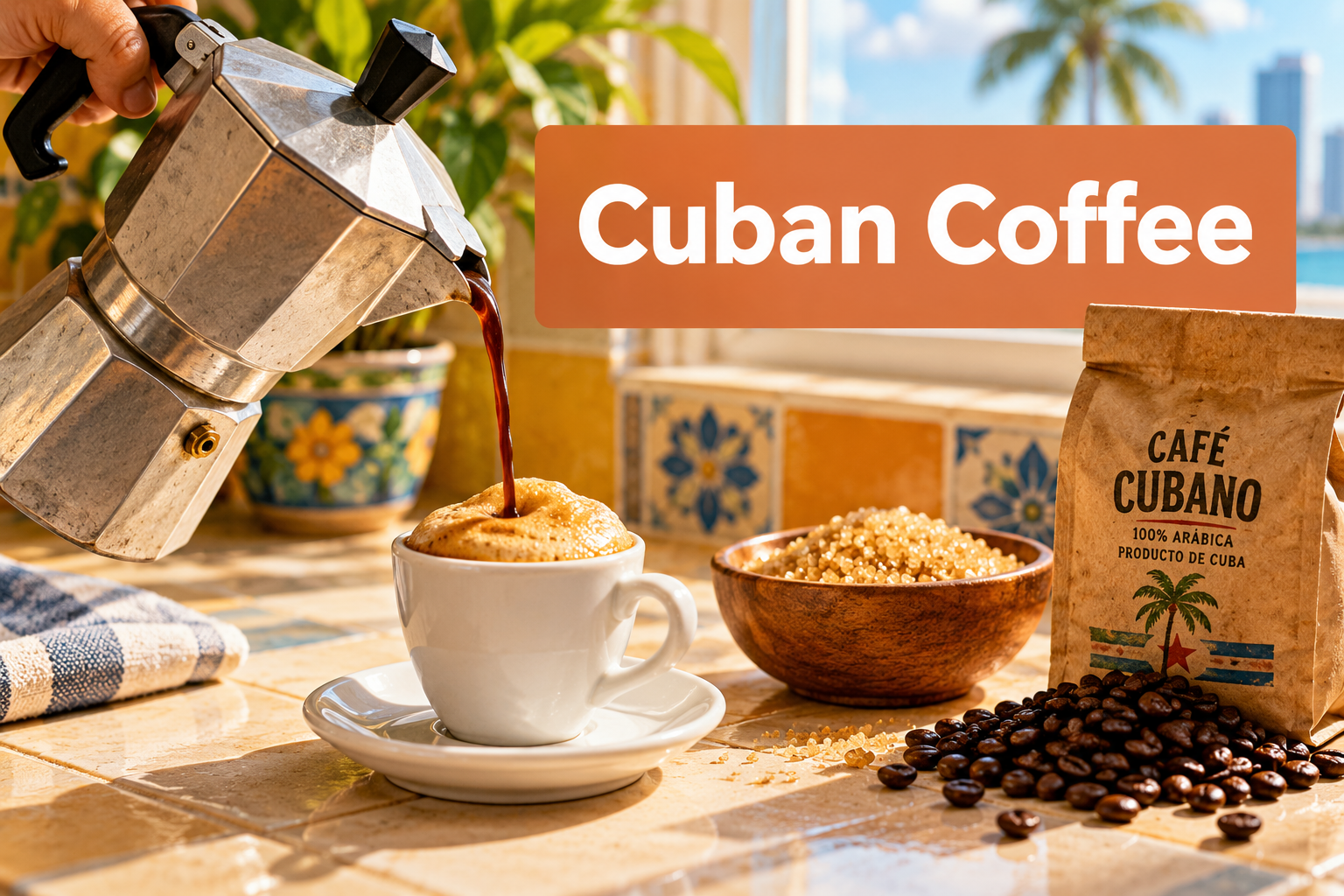
Cuban coffee gets its signature foam, called espuma or espumita, because the first few drops of dark, sugar-saturated espresso are whipped hard with sugar before the rest of the shot is added. That whipping traps air in a thick sugar-and-coffee emulsion, creating a pale, glossy layer that floats on top of the cup. Cuban coffee, or cafecito, is traditionally brewed from finely ground dark-roast arabica (often blended with robusta) and served sweeter and smaller than a standard American espresso shot.
Key Takeaways
- Espuma forms from whipping, not the machine. Sugar plus the first concentrated drops of coffee, beaten for about a minute, is what creates the foam on cuban coffee.
- Cafecito is not espresso with sugar stirred in. The sugar gets whipped into a foam before brewing finishes, which is the main mechanical difference.
- A moka pot works fine. You do not need an espresso machine; a Bialetti Moka Express or an Imusa stovetop pot produces the concentrated coffee espuma needs.
- Cuban coffee beans are usually dark-roast arabica or an arabica-robusta blend, ground fine, similar to espresso grind.
- Cafecito, colada, cortadito, and café con leche are related but different drinks, mainly separated by portion size and milk.
- Cuban coffee drinks 1-2 tablespoons of sugar per small serving, which is why it tastes noticeably sweeter than a plain espresso shot.
- Cuba's own coffee supply has been shrinking, with domestic production covering only a fraction of national demand in recent years.
- Fresh cuban coffee beans hold peak flavor for about 2-4 weeks after the roast date once ground, and closer to a few months whole bean if sealed well.
Cuban Coffee: What It Is and How It Differs From Espresso
Cuban coffee is a small, strong, very sweet coffee drink built around a shot of dark-roast espresso and a spoonful of whipped sugar foam. The base brewing method is close to Italian espresso, but the sugar treatment and the roast profile set it apart.
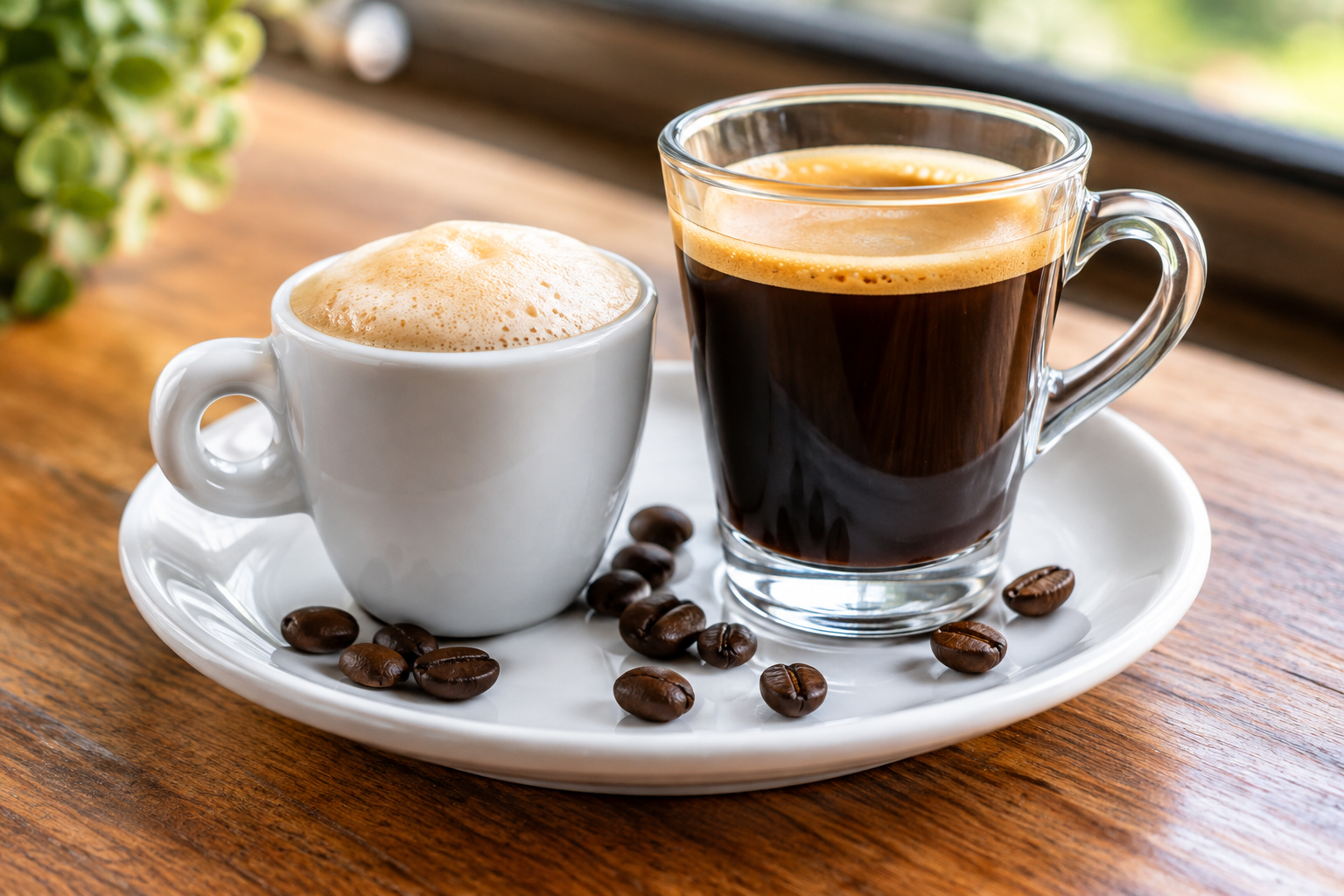
A standard espresso shot pulls hot water through 7 to 9 grams of finely ground coffee at pressure, producing a small, concentrated drink with a thin, reddish-brown crema on top. Cuban coffee, called cafecito, starts the same way, usually from a moka pot or espresso machine, but the brewer stops to catch the very first, most concentrated drops. Those drops get whipped with sugar into a thick foam before the rest of the shot is poured in.
The result tastes rounder and noticeably sweeter than plain espresso, with a lighter, creamier top layer instead of espresso's thin reddish crema. If you have ever compared the two side by side, the biggest giveaway is color: espresso crema looks tan and thin, while cuban coffee's espuma looks pale, thick, and almost meringue-like. For more on how espresso strength compares to drip coffee in general, see our breakdown of whether espresso is actually stronger than regular coffee.
Choose cuban coffee if you want a sweeter, smaller, more dessert-like coffee break. Choose straight espresso if you want to control sweetness yourself or you're pairing the shot with milk-forward drinks like a latte.
Why Does Cuban Coffee Have That Foam on Top? What Is Espuma?
Cuban coffee has foam on top because the sugar and the first, most concentrated coffee are physically whipped together, not because of anything special in the beans. That whipped layer is called espuma, or espumita when made in smaller batches.
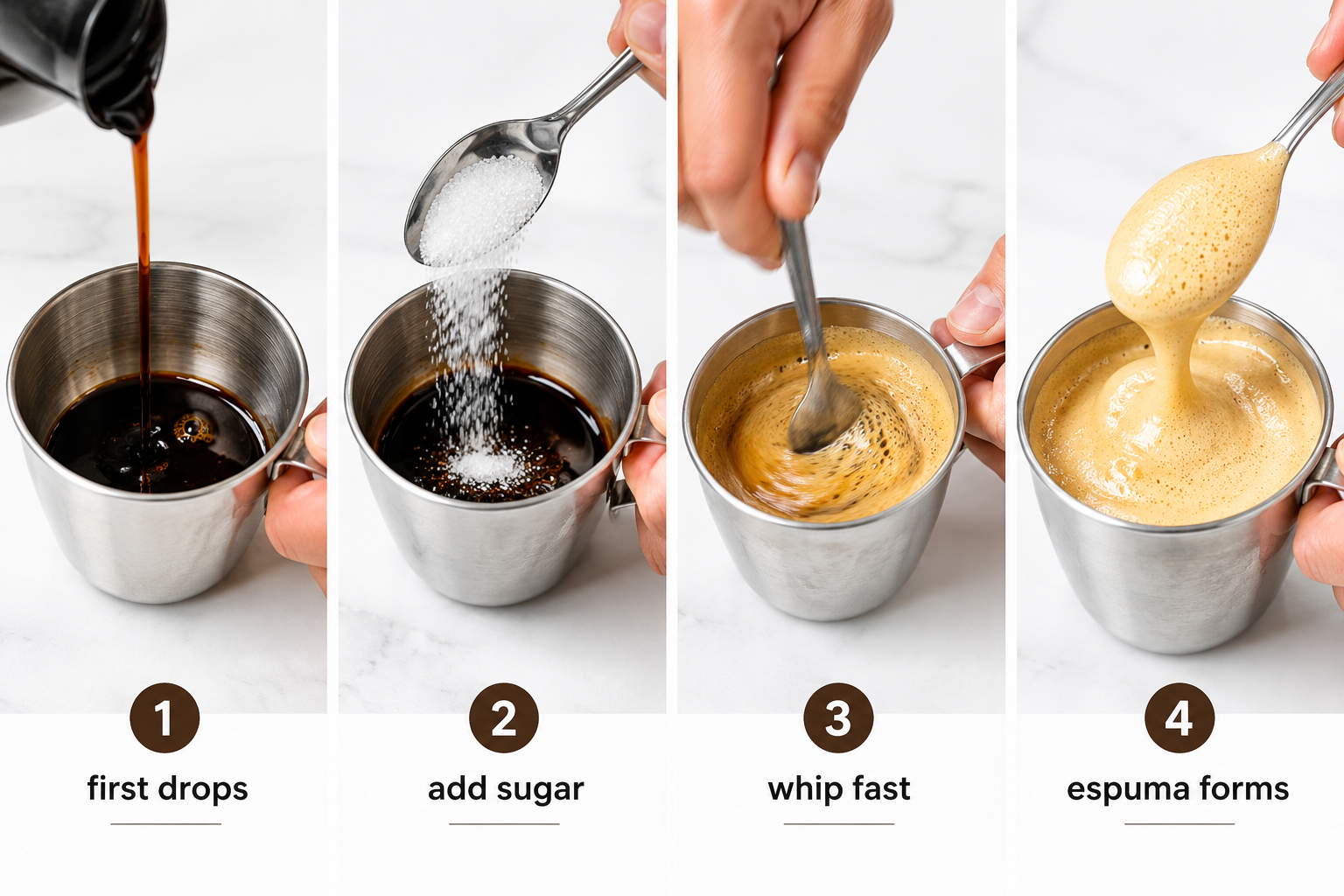
Here is the mechanism. The first coffee to drip from a moka pot or espresso machine is the hottest, most concentrated, and most oil-rich part of the brew. When that small amount, usually a tablespoon or so, gets poured over sugar and beaten with a spoon for roughly 60 to 90 seconds, the sugar dissolves into the coffee's natural oils and dissolved solids while air gets folded in mechanically. The mixture turns from a dark syrup into a pale tan, glossy foam that looks closer to whipped frosting than to coffee.
This is a physical process, similar to whipping egg whites or cream: agitation plus a sugar-oil base traps air bubbles and holds them in place. Once the espuma is made, the rest of the brewed coffee gets poured in gently so it sits underneath, and the foam floats to the top of the cup.
Common mistake: pouring all the coffee in before whipping. If you dump the full shot over the sugar, you dilute the concentration too much for the foam to hold, and you get sweet coffee with no espuma at all.
What Kind of Coffee Beans Do Cubans Use?
Cuban coffee is traditionally made from finely ground, dark-roasted arabica beans, sometimes blended with a small percentage of robusta for extra body and a stronger caffeine kick. The roast is pushed darker than a typical American espresso roast, which gives cafecito its heavier, slightly bittersweet backbone before the sugar goes in.
Historically, Cuba grew much of its own coffee in the eastern mountains, and government sources note the country still produces under 10,000 tons a year domestically, with roughly 90% of that coming from the eastern region. Cuban officials reported producing only 2,887 tons in the first half of 2025, about 23.7% of the planned harvest, against national demand estimated near 24,000 tons annually. That shortfall is serious enough that at least one roasting plant in Villa Clara has had to mix in corn, sorghum, and rice to stretch limited coffee supplies. Guantánamo province opened its 2026-2027 harvest across eight municipalities specifically to try to recover from a season officials called very low.
That domestic scarcity is part of why most cuban coffee sold in the United States today is grown elsewhere and roasted in a Cuban style rather than shipped from Cuba itself. If you want to understand how growing region and processing shape flavor before you even get to the cup, our guide to coffee origins is a good next stop, and a quality burr grinder explainer will help you hit the fine, even grind size cafecito needs.
Cuban coffee brands to know: Cafe Bustelo, Pilon, and La Llave are the three most common Cuban-style roasts on US grocery shelves, all sold pre-ground and dark-roasted for stovetop or espresso brewing.
How to Make Cuban Coffee at Home: The Cafecito Method
You can make cuban coffee at home with a stovetop moka pot, a few tablespoons of sugar, and about five minutes. The technique matters more than the equipment.
What you need:
- A moka pot (Bialetti Moka Express or an Imusa stovetop model both work well) or an espresso machine
- Finely ground, dark-roast Cuban-style coffee such as Cafe Bustelo or Pilon
- Raw cane or demerara sugar (roughly 1 to 1.5 tablespoons per small shot, or about 2 tablespoons for a full moka pot serving)
- A small metal or heatproof cup and a spoon
Method:
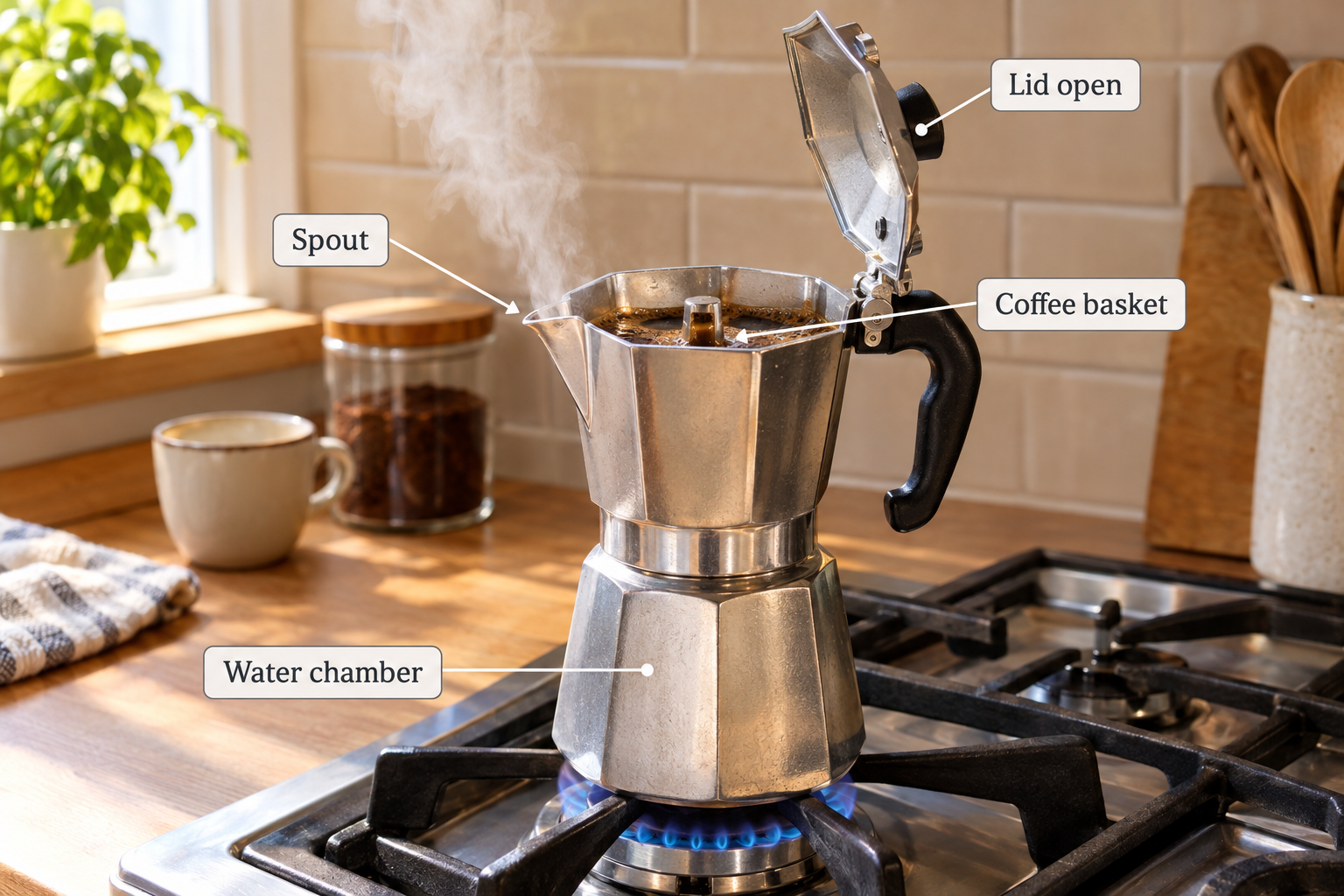
- Fill the moka pot's bottom chamber with water and pack the basket with finely ground coffee. Don't tamp it like espresso; just level it.
- Assemble the pot and set it on low to medium heat with the lid open so you can watch the coffee come through.
- As soon as the first dark, syrupy coffee appears, pour about a tablespoon of it into your cup over the sugar.
- Whip that mixture vigorously with a spoon for 60 to 90 seconds until it turns pale tan, thick, and glossy. This is your espumita.
- Let the rest of the pot finish brewing, then pour the remaining coffee slowly into the cup so it settles under the foam.
Decision rule: if you're brewing for one person, whip the foam directly in your serving cup. If you're making a colada coffee to share, whip the foam in a separate small cup first, then fold it into the shared thermal carafe so everyone gets some espuma in their pour.
For more general recipe technique across coffee styles, our step-by-step coffee recipe guide covers ratios and troubleshooting you can borrow for any cuban coffee recipe.
Can You Make Cuban Coffee Without an Espresso Machine? Do You Need Special Equipment?
Yes, you can make cuban coffee without an espresso machine, and most home cooks in Cuba and Miami never use one. A stovetop moka pot is the traditional cuban coffee maker, and it produces the concentrated coffee espuma requires just as well as a pump espresso machine.
The moka pot works by pushing steam pressure up through packed coffee grounds into an upper chamber, which concentrates flavor and oils in a way similar to espresso extraction, though at lower pressure. Bialetti's Moka Express is the classic version and the one most cafecito recipes reference. Imusa makes an aluminum stovetop model that is widely sold in Latin grocery stores and works just as well for home use.
If you don't own a moka pot either, you can still get close results with a strong pour-over or a stovetop espresso substitute brewed at a high coffee-to-water ratio, then whip the first small amount with sugar the same way. The foam will be slightly less thick because the coffee is less concentrated, but the technique still works. What you actually need is not an expensive machine, it's a spoon, sugar, and the willingness to whip for a full minute rather than a few quick stirs. Our roundup of practical brewing accessories covers small tools, including whisks and milk frothers, that can speed up the whipping step.
Beyond Cafecito: Colada, Cortadito, and Café con Leche
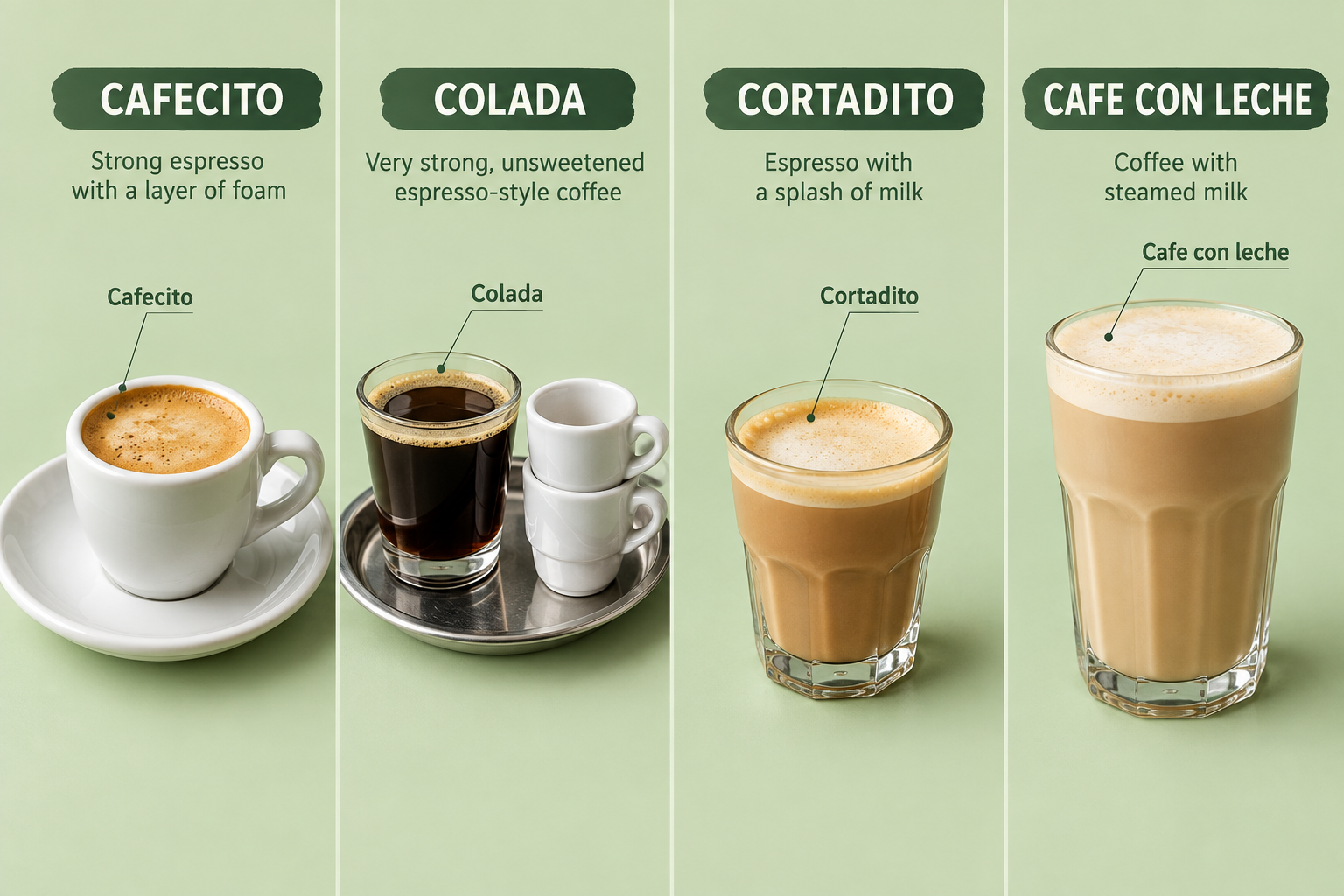
Cuban coffee is really a small family of drinks, and colada coffee, cortadito coffee, and café con leche are the most common relatives. Each one changes the ratio of coffee, sugar, and milk rather than the base brewing method.
- Cafecito: A single small shot with espuma on top, meant for one person.
- Colada coffee: A larger batch of the same sweet espresso, brewed with more grounds and poured into a thermal carafe with several small plastic cups (called "cositas") stacked on the lid, meant to be shared at work or with visitors.
- Cortadito coffee: Cuban espresso "cut" with a small amount of steamed or scalded milk, usually without much foam on top, similar in spirit to a Spanish cortado.
- Café con leche: Espresso mixed with an equal or greater amount of hot milk, closer to a small latte, usually served with buttered Cuban toast at breakfast.
Choose colada if you're serving a group. Choose cortadito or café con leche if you want milk but still want the sweetness cafecito is known for. If you're curious how sweetened, milk-based coffee drinks are classified more broadly, our explainer on what a sweet coffee with milk is called is a useful companion read.
Why Is Cuban Coffee So Sweet?
Cuban coffee tastes sweet because sugar is whipped directly into the espuma before the drink is finished, not added afterward to taste. A typical serving carries roughly 1 to 1.5 tablespoons of sugar in a shot that might be only 1 to 2 ounces total, which is a much higher sugar-to-liquid ratio than a splash of sugar stirred into a mug of drip coffee.
The dark roast used for cuban coffee also plays a role. Darker roasts read as more bitter on their own, and Cuban tradition leans into that bitterness by pairing it with a heavier hand of sugar rather than a lighter one, which is part of why cafecito tastes rounder and more dessert-like than a lightly sweetened cup of drip coffee. If you're comparing sweetness across coffee styles generally, our ranking of which coffee type is the sweetest puts cafecito's sugar load in context next to other popular sweet drinks.
Edge case: if you order cuban coffee at a Cuban restaurant and it arrives less sweet than expected, ask if they whipped it fresh. Some cafes premix sugar syrup for speed, which produces a thinner, less stable foam and a milder sweetness than a freshly whipped espumita.
Is Cuban Coffee Bad for You?
Cuban coffee is not inherently bad for you in moderate servings, but its sugar content is worth tracking if you drink it often. A single cafecito's sugar load, often 1 to 1.5 tablespoons per small shot, adds up quickly if you're having several a day the way some Cuban coffee traditions encourage.
The caffeine side is fairly modest per serving since a cafecito is small, similar in volume to a single espresso shot, but people who drink multiple cafecitos or a shared colada across a workday can still take in a meaningful amount of caffeine. If you're trying to figure out a sensible daily ceiling that accounts for both caffeine and sugar habits, our guide on how much coffee a day is considered healthy walks through the general guidance from health researchers.
Practical takeaway: enjoy cuban coffee as an occasional treat-sized pour rather than your all-day beverage, and consider cutting the sugar slightly at home if you're making cafecito daily. The espuma will still form with a bit less sugar; it just won't hold quite as thick or as long.
How Long Does Cuban Coffee Stay Fresh, and What's the Best Time to Drink It?
Ground cuban coffee stays at peak flavor for roughly 2 to 4 weeks after the roast date if kept sealed and away from light and moisture, while whole beans can hold flavor for a couple of months under the same conditions. Once brewed, cafecito is meant to be drunk immediately, since the espuma collapses within minutes as the foam loses its trapped air.
Cuban coffee is traditionally a quick, social drink rather than a slow sipper, which is part of why it's served in small portions. The best time to drink it follows Cuban custom closely: a cafecito or café con leche at breakfast, another cafecito mid-morning as a work break, and often a colada shared in the early afternoon around 3 or 4 o'clock, sometimes called the "cafecito break." Because each serving is small and sweet, it fits naturally into short pauses rather than replacing a full meal or a long reading session.
For keeping your beans in that ideal freshness window at home, our advanced coffee storage guide covers airtight containers and what actually degrades roasted coffee fastest, which matters even more with pre-ground Cuban roasts that oxidize faster than whole beans.
Where to Buy Cuban Coffee Near You (and What It Costs)
You can buy cuban coffee at most large US grocery chains, Latin markets, and online retailers, with Cafe Bustelo, Pilon, and La Llave sitting on shelves in the international or coffee aisle of nearly every major supermarket. Specialty roasters also sell Cuban-style blends built specifically for cafecito, such as Volcanica's Cafe Cubano Miami Espresso.
A typical 10-ounce can or bag of Cafe Bustelo, Pilon, or La Llave runs a modest, everyday grocery price, generally cheaper per cup than specialty single-origin bags because these are commercial dark-roast blends made for volume. Specialty Cuban-style roasts from smaller companies cost more per bag but are often fresher and roasted in smaller batches. Given that Cuba's own coffee production has struggled to meet even domestic demand in recent years, nearly all cuban coffee sold in the US today is grown outside Cuba, most commonly in Central or South America, and simply roasted and blended in the traditional Cuban style.
If you're outfitting a full home setup, pairing a Cuban-style bag with a reliable moka pot and a decent grinder is the most cost-effective way to make cafecito regularly rather than buying it out every day.
Frequently Asked Questions
Is cuban coffee stronger than regular coffee? Cuban coffee is stronger than drip coffee because it's brewed as espresso, concentrated and small in volume, but it isn't inherently stronger than a plain espresso shot of the same size. The sugar makes it taste bolder without adding extra caffeine.
Can I use a regular drip coffee maker for cafecito? A standard drip machine won't concentrate the coffee enough to whip a stable espuma. A moka pot, stovetop espresso maker, or pump espresso machine gives you the concentrated first drops the foam technique needs.
What sugar works best for cuban coffee's espumita? Raw cane sugar or demerara sugar is the traditional choice and produces the classic tan, glossy foam. White granulated sugar works in a pinch but can make a slightly lighter-colored espuma.
Is colada coffee the same as cafecito? No. Colada coffee is a larger, shared batch of the same sweet espresso, poured into a thermal carafe with small cups for multiple people, while cafecito is a single-serving shot.
Why did my cuban coffee espuma turn out thin or watery? The most common cause is pouring too much coffee over the sugar before whipping, which dilutes the mixture too fast for a stable foam to form. Whip only the first small, concentrated pour, then add the rest of the coffee afterward.
Do I need an espresso machine to get good espuma? No. A Bialetti Moka Express or an Imusa stovetop pot produces coffee concentrated enough for a proper espumita as long as you whip the first drops with sugar for about a minute.
Conclusion
Cuban coffee earns its sweetness and its foam from technique, not from any secret ingredient. Whip the first concentrated drops of dark, finely ground coffee with real cane sugar for a full minute, then let the rest of the brew settle underneath, and you get the same pale, glossy espuma that shows up in cafecito, colada, and cortadito across Cuban kitchens and Miami cafes.
If you're building a home setup, start simple: a moka pot or espresso machine, a bag of Cafe Bustelo, Pilon, or La Llave, raw sugar, and a spoon you don't mind using with some effort. Practice the whipping step a few times before you judge the results, since foam thickness improves fast once you get the timing right.
Better Coffee Starts With Better Answers. Try the method this week with whatever beans you have on hand, then upgrade your grinder or beans once you know what texture and sweetness you actually prefer.
| Drink | Serving size | Sugar | Foam (espuma) | Milk |
|---|---|---|---|---|
| Cafecito | 1-2 oz | 1-1.5 tbsp | Thick | None |
| Colada | Shared, 4-8 oz | Scaled up | Thick | None |
| Cortadito | 2-3 oz | Moderate | Light or none | A little, steamed |
| Cafe con leche | 6-8 oz | Light to moderate | None | Equal or more, hot |
| Regular espresso | 1-1.5 oz | None added | Thin crema | None |
Keep Exploring Coffee Rank IQ
- Coffee Rank IQ home: reviews, brewing guides, and coffee science
- Best Manual Coffee Grinder for Pour Over, Espresso, and Travel
- Best Coffee Scale for Pour Over and Espresso…Timer Included
- Drip Coffee vs Espresso: Caffeine, Flavor, and the Real Difference
- Best Medium Roast Coffee for Drip, Pour Over, and Espresso
References
- www.cubaheadlines.com/articles/337421
- www.cibercuba.com/noticias/2026-09-21-u1-e209395-s27061-nid340794-guantanamo-busca-cosecha-cafe-eficiente-tras
- oncubanews.com/en/cuba/economy/empty-coffee-cuban-customs-endangered
- www.expertcafe.be/en/guides/how-to-make-cuban-coffee
- brewtorials.com/recipes/cuban-cafecito
- www.roastycoffee.com/best-cuban-coffee-brands
- en.cibercuba.com/noticias/2026-09-18-u1-e43231-s27061-nid340609-anuncian-granma-venta-nueva-marca-cafe-cubano
- www.fluentincoffee.com/best-cuban-coffee
- cornercoffeestore.com/best-cuban-coffee-brands
- dropofdrink.com/best-cuban-coffee-brand