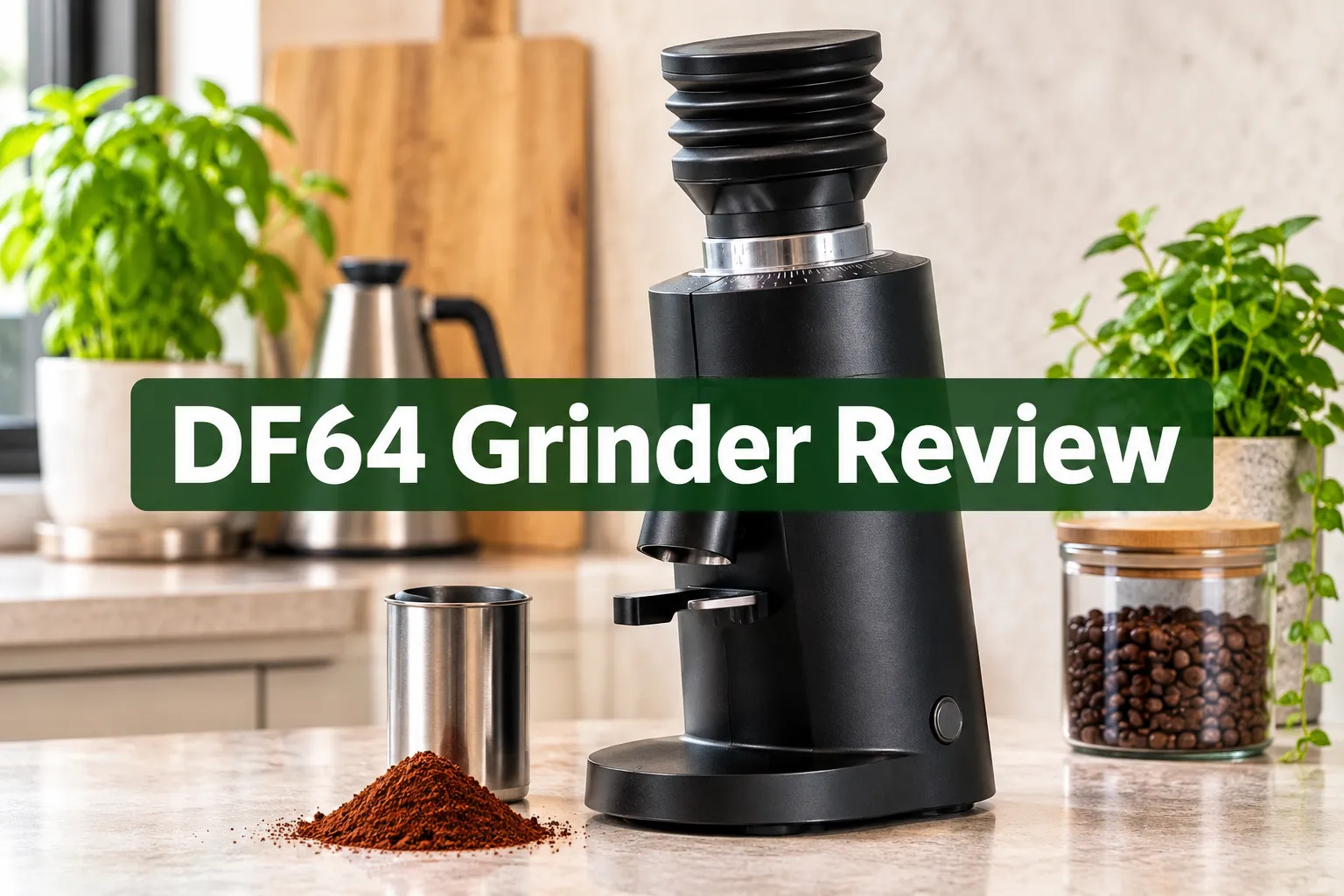
DF64 Grinder Review: Single Dosing for About $400
Quick Answer
The df64 grinder is a 64mm flat burr, single dose electric grinder that sells for roughly $389 to $399 in the US as of November 5, 2026 . It earns its price through very low grinder retention, a stepless grind adjustment collar, and a 64mm burr format that accepts dozens of aftermarket burr sets. Independent testing by Kaffeemacher measured less than 0.2 g of permanent retention and about 25 g ground in 10 seconds . Buy it if you are moving off a built-in grinder and mostly pull espresso. Skip it if pour over is your main brew method, or if you want something quiet.
Key Takeaways
- Price checked November 5, 2026: DF64 II listed at $399 on Amazon with 283 reviews; the official DF64 Gen 2 store price was $389 .
- Retention under 0.2 g in Kaffeemacher's independent measurements, which is the entire argument for a single dose grinder .
- 86.8 dB measured noise . Loud enough that a 6 a.m. shot will be heard through a bedroom door.
- 64mm flat burrs are an aftermarket standard. SSP, Gorilla Gear, Mazzer and Italmill sets fit, so a burr swap df64 project can change the cup without replacing the machine .
- Filter coffee is the weak spot. Tom's Grinder Lab found stock burrs produced flat, body-heavy pour over at coarse settings .
- The DF54 costs $229 on Amazon (3.8 stars, 686 reviews, 500+ bought in the past month, checked November 5, 2026) and is the honest budget answer for anyone grinding one or two drinks a day.
- Branding is messy. The same machine ships as Turin, MiiCoffee, DF64Coffee and retailer labels, with "V2" and "V2.5" names that are not standardized worldwide .
Affiliate disclosure: Coffee Rank IQ earns a commission if you buy through links on this page. Prices were checked November 5, 2026 and change often. This review is based on published specifications and documented third-party testing, not on hands-on testing by our team.
Df64 grinder: what you get for about $400
The df64 grinder is a counter-sized electric burr grinder built around a 64mm flat burr set, with a tiny single dose hopper instead of a bean bin. You weigh beans, pour them in, grind, and the machine empties itself. That is the whole idea.
A burr grinder crushes beans between two rotating steel discs set a fixed distance apart, which produces more even particles than a blade chopper. If you are still on a blade unit, the difference is larger than any bean upgrade you will make this year. Our explainer on burr versus blade grinders and what each does to the cup covers the mechanism.
Flat burrs, the kind in the df64 grinder, tend to produce a tighter particle size distribution than conical burrs at espresso settings. Kaffeemacher measured an espresso-setting X50 of 252 µm with 31% fines and described the distribution as competitive with much more expensive grinders . That number is protocol-dependent. Treat it as a reference point from one lab on one day, not a universal spec.
Grind adjustment is stepless, meaning there are no fixed clicks. You rotate a collar and the burrs move continuously, which is what espresso needs since a 2-second shot time difference can live inside a single click on a stepped grinder. Kaffeemacher found that half a dial division shifted extraction time by roughly 2 to 3 seconds . Useful control, but the markings are coarse enough that you should log your settings yourself.
Current Gen 2 listings add a revised plasma generator for static, an anti-popcorn insert, a metal dosing cup, a metal grind indicator, a redesigned declumper, and a better portafilter holder . Every one of those addresses a complaint about the original.
How does single dosing work on the df64 grinder
Single dosing means you grind exactly the beans you plan to brew, one dose at a time, instead of filling a hopper with a week of coffee. On the df64 grinder, the bellows hopper, anti-popcorn insert and low-retention exit path make that workflow practical.
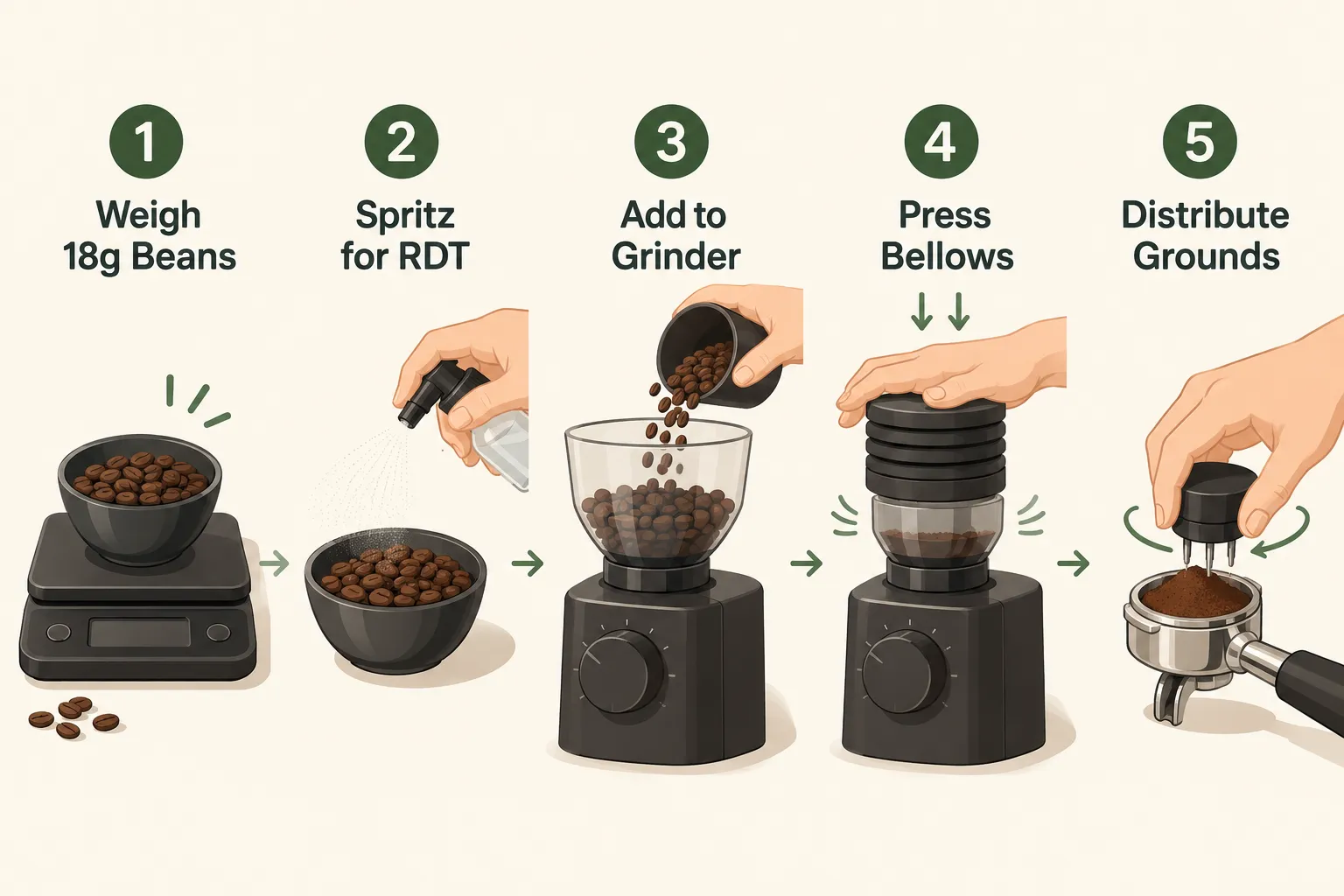
The routine, start to finish:
- Weigh the dose. 18 g for a standard double basket. Use a scale with 0.1 g resolution.
- Spritz the beans (optional). One light spray of water, known as the Ross Droplet Technique, cuts static. Tom's Grinder Lab reported that RDT was not routinely needed on the Gen 2 .
- Drop the beans in and run the grinder. Tom measured grind time under 12 seconds for a typical espresso dose ; Kaffeemacher recorded about 25 g in 10 seconds .
- Press the bellows two or three times. A puff of air pushes stray grounds out of the chute. Tom found bellows purging yielded under 0.1 g of extra grounds, which tells you how little was left behind .
- Distribute and tamp. The grounds land in a metal dosing cup, so you can swirl before dumping into the portafilter.
Why this matters: beans start losing aroma compounds within days of the roast date, and ground coffee stales in minutes. A hopper full of beans sitting under a warm motor is a slow leak of flavor. Single dosing espresso keeps everything sealed until the moment it is ground.
Common mistake: skipping the bellows and then wondering why your next shot tastes like yesterday's dark roast. Purge between bean changes, always.
Single dosing is not a flavor trick. It is a freshness and precision habit that the hardware simply makes less annoying.
How much does the df64 grinder actually cost in November 2026?
As of November 5, 2026, expect $389 to $399 in the US. A November 4, 2026 European price survey listed the Gen 2 at €389 to €399 delivered across Germany, the Netherlands, Poland, Estonia, Finland, Latvia and Lithuania .
DF64 II on Amazon: $399, 283 reviews.
DF64 Gen 2, official store listing: $389, in stock .
DF54 on Amazon: $229, 3.8 stars, 686 reviews, 500+ bought in the past month.
These are retailer prices, not manufacturer-set prices, and they move.
Budget for extras. A 0.1 g scale runs $25 to $60. A WDT distribution tool is $15 to $30. A spray bottle is $5. So the real landed cost of a df64 grinder setup is closer to $450.
Decision rule: if the total grinder spend pushes your espresso machine budget under about $400, buy the cheaper grinder first. A good grinder on a weak machine beats a great machine fed by a blade chopper, but a $229 DF54 paired with a decent machine beats a $399 grinder paired with a bad one.
Is the df64 grinder worth the money for home espresso?
For espresso drinkers pulling one to four shots a day, yes. Kaffeemacher concluded it was difficult to beat around €450 at the time of their review , and Which Grinder's November 2026 database records 3 of 3 recommending reviewers, with the caveat that some underlying reviews predate 2026 .
The value argument rests on three specifics.
Retention. Under 0.2 g permanent retention means the coffee you weigh in is almost exactly the coffee you get out. Grinders that hold 3 to 5 g force you to purge beans before every dose, which is both wasteful and inconsistent.
Speed. Under 12 seconds per dose . That matters more than it sounds on a weekday morning.
Upgrade path. 64mm is a widely supported aftermarket standard . Few grinders near $400 let you change the flavor character for $80 in burrs.
What you are not getting: a fancy display, a built-in scale, grind-by-weight, or a quiet motor. If you want one-touch drinks with no weighing, a machine with an integrated grinder is a better fit. Our roundup of espresso machines with a grinder built in covers that path.
Five features we love
1. The silicone bellows. Squeeze the top and air pushes trapped grounds through the chute. Tom's testing found bellows purging released less than 0.1 g . Payoff: bean changes without ghost flavors.
2. The anti-popcorn insert. A small restrictor that keeps beans from bouncing above the burrs at low dose levels. Payoff: a steadier feed rate and a more even grind on 15 to 18 g doses.
3. The stepless adjustment collar. Continuous movement, no clicks. Payoff: you can chase a 2-second shot time change instead of overshooting it .
4. The metal dosing cup and grind indicator. Replaced plastic parts that scratched and flexed. Payoff: the cup holds static better after a swirl and the indicator survives a year of twisting .
5. The 64mm burr platform. SSP, Gorilla Gear, Mazzer and Italmill all make compatible sets . Payoff: a burr swap df64 upgrade rather than a whole new purchase when your taste shifts.
Df64 grinder retention issues and how to fix them
Grinder retention on the Gen 2 is already low, under 0.2 g permanently in Kaffeemacher's measurement . Most retention complaints people post are really static complaints: grounds clinging to the chute or spraying onto the counter.
Fixes, in order of effort:
- Spritz the beans. One light spray of water before grinding collapses static charge. Costs nothing.
- Use the bellows properly. Three firm pumps, not one gentle squeeze.
- Tap the dosing cup before lifting it. Settles the grounds so they do not plume.
- Check the chute monthly. Oily dark roasts build a film that holds fines. A dry brush clears it.
- Verify the plasma generator is running. The Gen 2 uses a revised unit to neutralize static . If grounds suddenly start flying, that is the first thing to inspect.
Edge case: very oily dark roasts, the near-black beans with visible sheen, clog the declumper faster than medium roasts. If that is your usual coffee, plan on a brush-out every two weeks.
DF64 vs Niche Zero: which single dose grinder wins?
The df64 vs Niche comparison comes down to burr geometry and noise. The DF64 uses 64mm flat burrs; the Niche Zero uses a 63mm conical. Flats generally give a clearer, more separated espresso; conicals give a heavier, sweeter, more forgiving cup. The DF64 costs roughly $389 to $399 and the Niche Zero typically sells well above that.
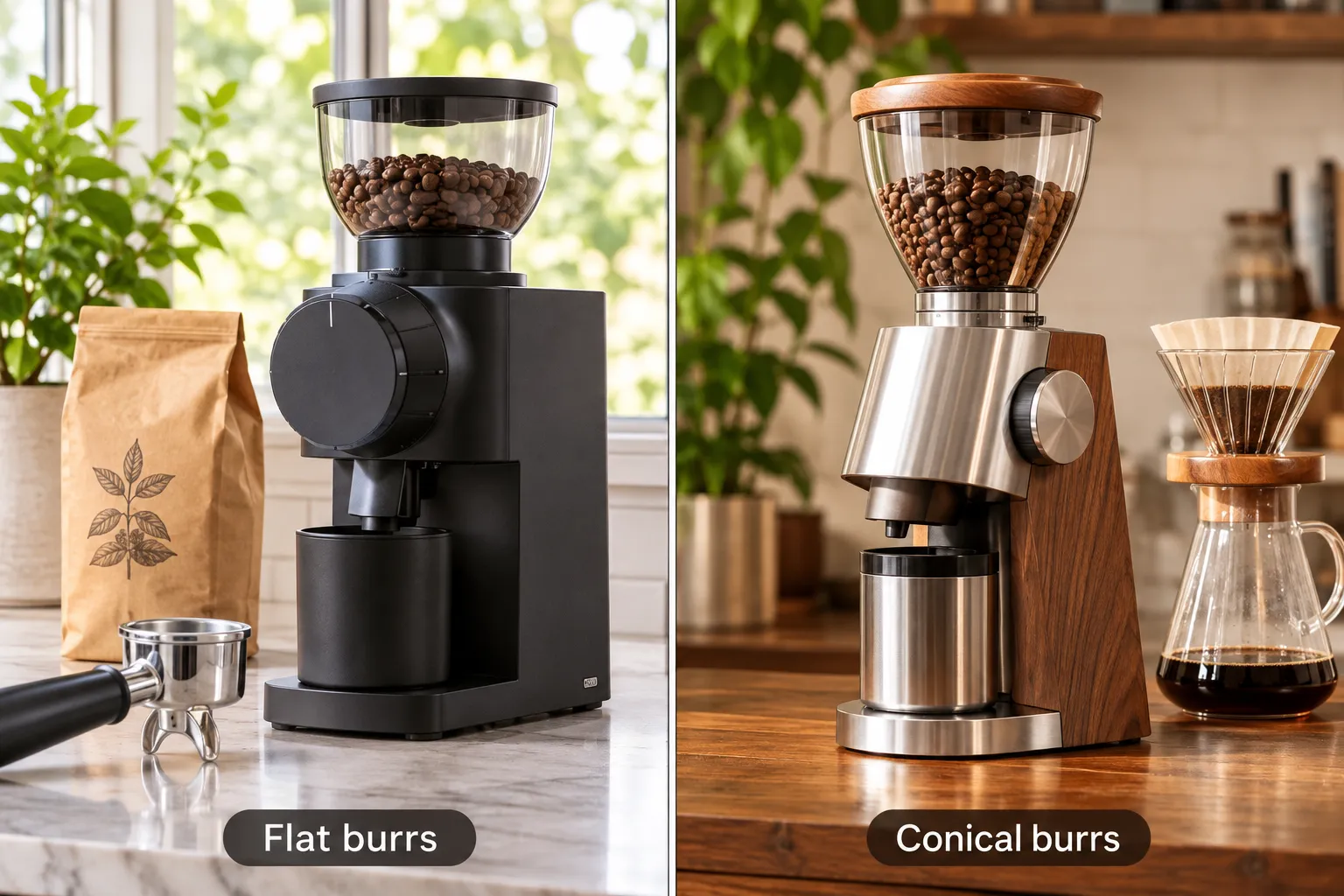
Choose the DF64 if you drink light to medium roasts as espresso, want clarity, and like the idea of swapping burrs later.
Choose the Niche Zero if you want near-silent operation, a simpler single-knob routine, and you mostly drink medium to dark roasts with milk.
If you want the wider field before deciding, our best espresso grinder guide ranks the options by budget.
Single dose grinders compared
US retailer prices checked November 5, 2026. Prices change frequently.
| Model | Price | Burrs | Best for | Main drawback |
|---|---|---|---|---|
| DF64 Gen 2 | $389 | 64mm flat | Espresso, burr upgrades | Loud; weak coarse filter |
| DF64 II (Amazon) | $399 | 64mm flat | Same hardware, faster shipping | Version labels vary |
| DF54 | $229 | 54mm flat | 1 to 2 drinks a day | Slower, less headroom |
| Niche Zero | Higher tier | 63mm conical | Quiet, sweet milk drinks | Costs well above $400 |
| Quality hand grinder | $100 to $250 | 38 to 48mm | Travel, 1 cup | Manual effort per dose |
Can you use the df64 grinder for filter coffee?
You can, but this is where expert opinion splits hardest. Tom's Grinder Lab, after a six-month review, found the stock burrs struggled at coarse filter settings and described the resulting cups as relatively flat and body-heavy . Which Grinder's database includes reviewers who report acceptable or improved pour over performance .
What explains the gap: the stock 64mm flat burr set is cut for espresso-range particle sizes. Push it coarse and the distribution widens, which mutes the clarity pour over is supposed to deliver.
Practical answers:
- Occasional pour over: fine. You will get a drinkable cup, just not a brilliant one.
- Daily pour over: fit a filter-oriented burr set, or keep a separate grinder. A good hand grinder handles one cup a day well, and our best manual coffee grinder picks cover the range.
- Cold brew: the coarsest settings work acceptably, since long steeping forgives uneven particles.
Is the df64 grinder good for light roast beans?
Yes, and this is one of its stronger arguments. Tom's Grinder Lab reported strong espresso results across light through dark roasts , and flat burrs generally handle dense light roasts better than entry-level conicals because the tighter particle distribution reduces channeling.
Light roast espresso needs finer grinding than dark roast, because the beans are denser and harder to extract. A 64mm flat burr with a 250-ish micron X50 at espresso settings has the fineness and the motor torque to get there without stalling.
Tip: if a light roast tastes sour and thin, grind finer before you touch water temperature. Sourness at the right brew ratio usually means under-extraction, and grind size is the fastest lever you have.
How loud is the df64 grinder?
Kaffeemacher measured 86.8 dB during grinding . That is in the same range as a kitchen blender or a loud hair dryer. Grinds last around 10 to 12 seconds , so total exposure is short, but it is not a quiet machine.
Real-world consequence: a 5:45 a.m. shot in a one-bedroom apartment will wake someone. Mitigations that actually help:
- Put a silicone mat or folded towel under the grinder to kill surface resonance.
- Grind into the metal dosing cup, not directly into a portafilter held in a metal fork.
- Move the grinder off a hollow cabinet and onto a solid counter section.
If silence is a dealbreaker, the Niche Zero and good hand grinders are both much quieter.
What are the best burr upgrades and is the timer mod worth it?
Upgrading burrs is the main reason people choose the 64mm platform over cheaper 54mm machines. Replacements fit the existing motor and chassis, so a burr swap df64 project costs a fraction of a new grinder .
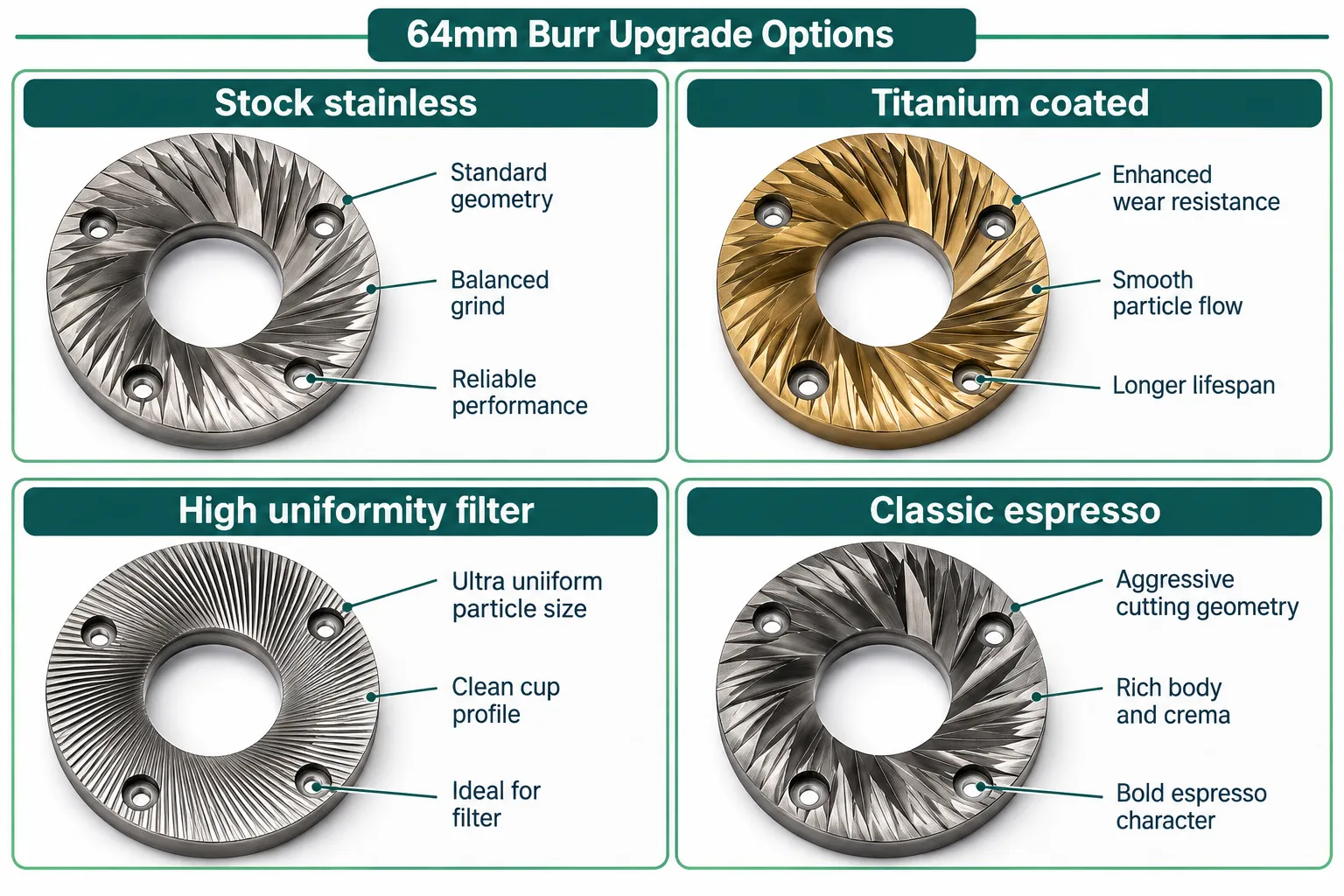
Burr options worth researching before you buy:
| Burr type | Character reported by makers | Best use |
|---|---|---|
| Stock stainless flat | Balanced, works across roast levels | All-round espresso |
| Titanium coated (TiCN) | Longer wear life, similar profile | High volume espresso |
| High-uniformity filter sets | Cleaner, more separated flavors | Pour over, light roasts |
| Classic Italian espresso sets | Heavier body, more texture | Milk drinks, darker roasts |
SSP, Gorilla Gear, Mazzer and Italmill are the commonly cited suppliers . Measure your burr mount and confirm your exact model before ordering; the badge on the front does not always tell you which revision you own.
Burr swap, step by step: unplug the grinder, remove the hopper and bellows, back the collar out to its coarsest setting, remove the upper burr carrier screws, lift the old burr, clean the seat with a dry brush, seat the new burr flat, torque the screws evenly in a cross pattern, then re-zero the grind by turning the collar until the burrs just chirp and backing off slightly.
The timer mod. Many owners add an inline digital timer relay so a single button press grinds for a set number of seconds. It is an aftermarket electrical modification, not a factory feature, and it typically voids the warranty. If you are not comfortable working with mains wiring, pay an electrician or skip it. A $30 scale and a stopwatch achieve the same consistency with zero risk, and weighing is more accurate than timing anyway since bean density changes with roast date.
What are good alternatives to the df64 grinder?
The three alternatives that matter at this price point are the DF54, the Niche Zero, and a quality hand grinder.
DF54 grinder, $229 (Amazon, checked November 5, 2026, 3.8 stars, 686 reviews). Same single dosing concept, 54mm flat burrs instead of 64mm. It is slower, has less thermal headroom for back-to-back shots, and has a thinner aftermarket burr supply. For one or two drinks a day it is the sensible buy, and the $170 you save can go toward beans or a better machine. The 3.8-star average is a reminder that quality control at this price is not uniform.
Niche Zero. Quieter, conical, costs meaningfully more. Right answer for milk-drink households that value a silent kitchen.
A good hand grinder. $100 to $250, silent, travels, and genuinely competitive for single-cup filter. Our guide to the VSSL JAVA hand grinder walks through what hand grinding actually involves daily.
If you would rather not own a separate grinder at all, coffee makers with built-in grinders solve a different problem, convenience, at the cost of grind precision.
Common mistakes people make with the df64 grinder
- Buying without checking the badge and spec. The same hardware sells as Turin, MiiCoffee, DF64Coffee and store-specific names, and "V2" or "V2.5" labels are not standardized worldwide . Confirm burr material, voltage, warranty provider and seller before ordering.
- Assuming red titanium burrs are included. Some retail configurations ship TiCN-coated burrs; others ship uncoated stainless . Read the actual listing.
- Skipping a scale. A single dose grinder without a 0.1 g scale is a stepless grinder you cannot reproduce.
- Chasing grind settings instead of logging them. Half a dial division can move shot time 2 to 3 seconds . Write down what works.
- Expecting great pour over out of the box. Stock burrs are espresso-leaning .
- Leaving beans in the hopper overnight. The hopper is a funnel, not storage. Keep beans in a sealed container away from heat.
Pros and cons
Pros
- Under 0.2 g permanent retention in independent testing
- Fast: about 25 g in 10 seconds , under 12 seconds per espresso dose
- Stepless adjustment with real espresso resolution
- 64mm aftermarket burr standard, so the grinder can be upgraded
- Metal dosing cup, metal indicator, anti-popcorn insert and plasma static control on Gen 2
- Strong espresso across light through dark roasts
Cons
- 86.8 dB measured . Loud for early mornings.
- Stock burrs underperform for coarse filter brewing
- Confusing branding and version naming across sellers
- Dial markings are coarse; you must log settings yourself
- Needs a scale, WDT tool and spray bottle to work properly, adding $45 to $90
- No grind-by-weight, no built-in timer from the factory
Who should buy the df64 grinder and who should skip it
Winner: the upgrader moving off a built-in grinder. If you own a decent espresso machine with a mediocre integrated grinder, or an all-in-one that cannot hit espresso fineness, the this single doser is the single biggest cup improvement available at this price. Low retention, espresso-grade fineness, and a burr upgrade path you will still be using in five years.
Also a good fit: light roast espresso drinkers, anyone who buys several bags at once and switches between them, and home baristas who enjoy adjusting variables.
Skip it if: pour over is your main method and you do not want to buy filter burrs . Skip it if noise is a problem in your home. Skip it if you want one-touch drinks with no weighing, in which case a super-automatic or a machine with an integrated grinder serves you better. And skip it if you brew one cup a day, where the $229 DF54 does the job for $170 less.
FAQ

Conclusion
The this single doser is the clearest $400 upgrade in home espresso right now, and the evidence behind that is specific: under 0.2 g retention, roughly 25 g ground in 10 seconds, strong espresso across roast levels, and a 64mm burr format you can change later . Its two honest weaknesses are coarse filter performance and 86.8 dB of noise .
Your next step: weigh how you actually drink coffee this week. If four or more of your drinks are espresso based, check the current price on the DF64 Gen 2 and budget another $45 for a 0.1 g scale and a WDT tool. If you pull one shot a day and mostly brew pour over, compare the models and start with the $229 DF54 or a hand grinder instead. Better coffee starts with better answers, and the right answer here depends entirely on what is in your cup tomorrow morning.