Moka Pot History: The 1933 Bialetti Story
Quick Answer
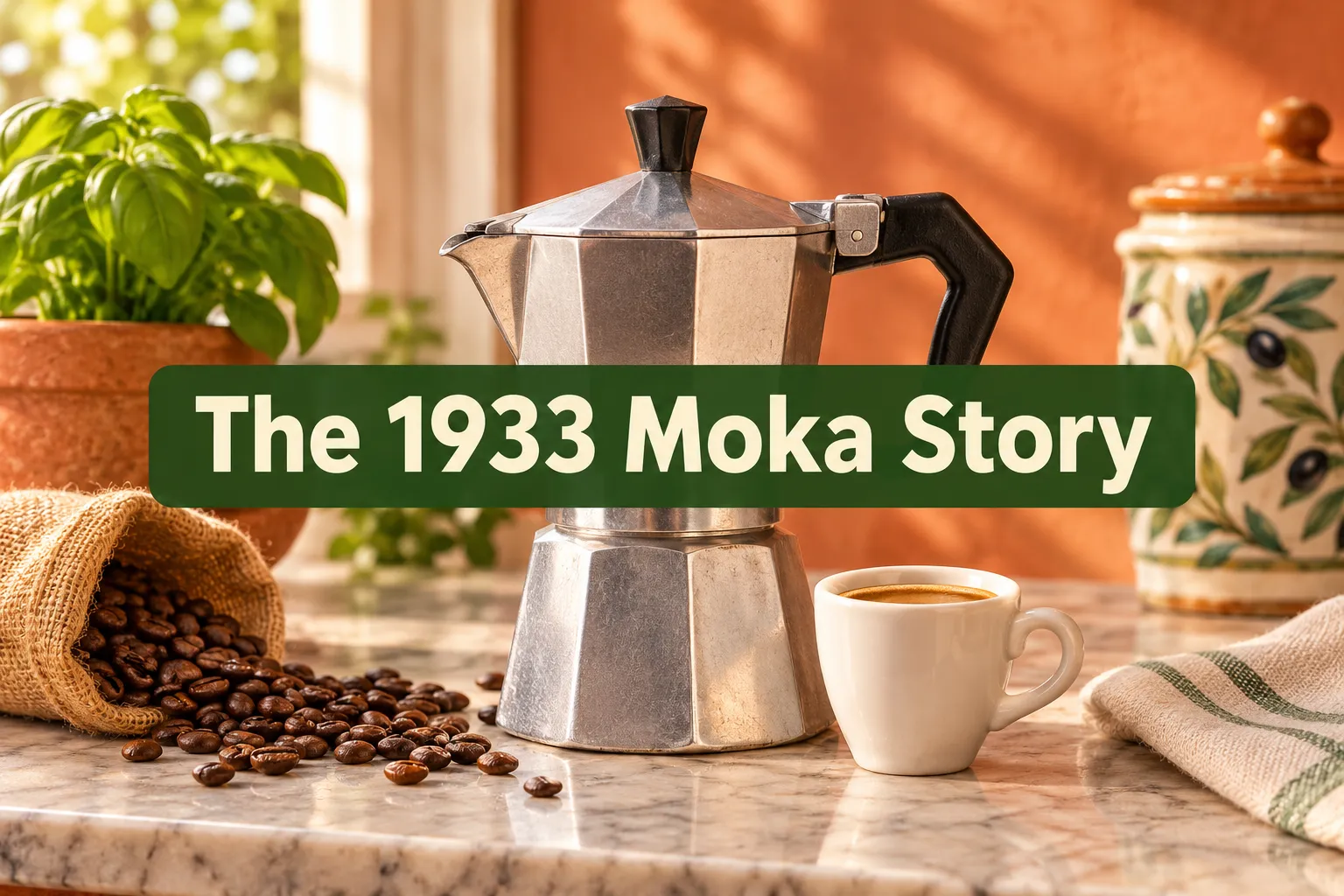
Alfonso Bialetti, an aluminum workshop owner in Crusinallo, northern Italy, launched the Moka Express in 1933 . That single date anchors all moka pot history: a three-chamber stovetop brewer that uses steam pressure to push hot water up through ground coffee. His son Renato turned it into a household object across Italy after World War II. The Museum of Modern Art dates the design to 1933 and keeps an aluminum and plastic example, roughly 21.3 by 18.7 by 11 centimeters, in its collection .
Key Takeaways
- Alfonso Bialetti founded his aluminum workshop in 1919 and launched the Moka Express in 1933 .
- The name Moka points to Mokha, Yemen, a historic coffee trading port .
- MoMA places the launch inside the Great Depression, when Italians cut back on café visits and wanted concentrated coffee at home .
- A moka pot brews at roughly 1 to 2 bar of pressure. Commercial espresso machines run at 9 bar or more . Different drink, different physics.
- Renato Bialetti, Alfonso's son, drove the postwar marketing that made the pot a national fixture .
- The octagonal aluminum body survives in current products. Bialetti's 2026 holiday range, launched November 4, 2026, put a candy-cane striped Moka Express at $59.99 for the 3-cup and $69.99 for the Mini Express on the date reported .
- The laundry-boiler inspiration story comes from Bialetti's own company account, so treat it as company history rather than independently documented fact .
Moka Pot History
Moka pot history begins with sheet aluminum, not coffee. Alfonso Bialetti had worked in France in the metals industry before setting up a semi-finished aluminum goods workshop in Crusinallo, near Omegna in Piedmont, in 1919 . He was a metalworker who happened to solve a coffee problem.
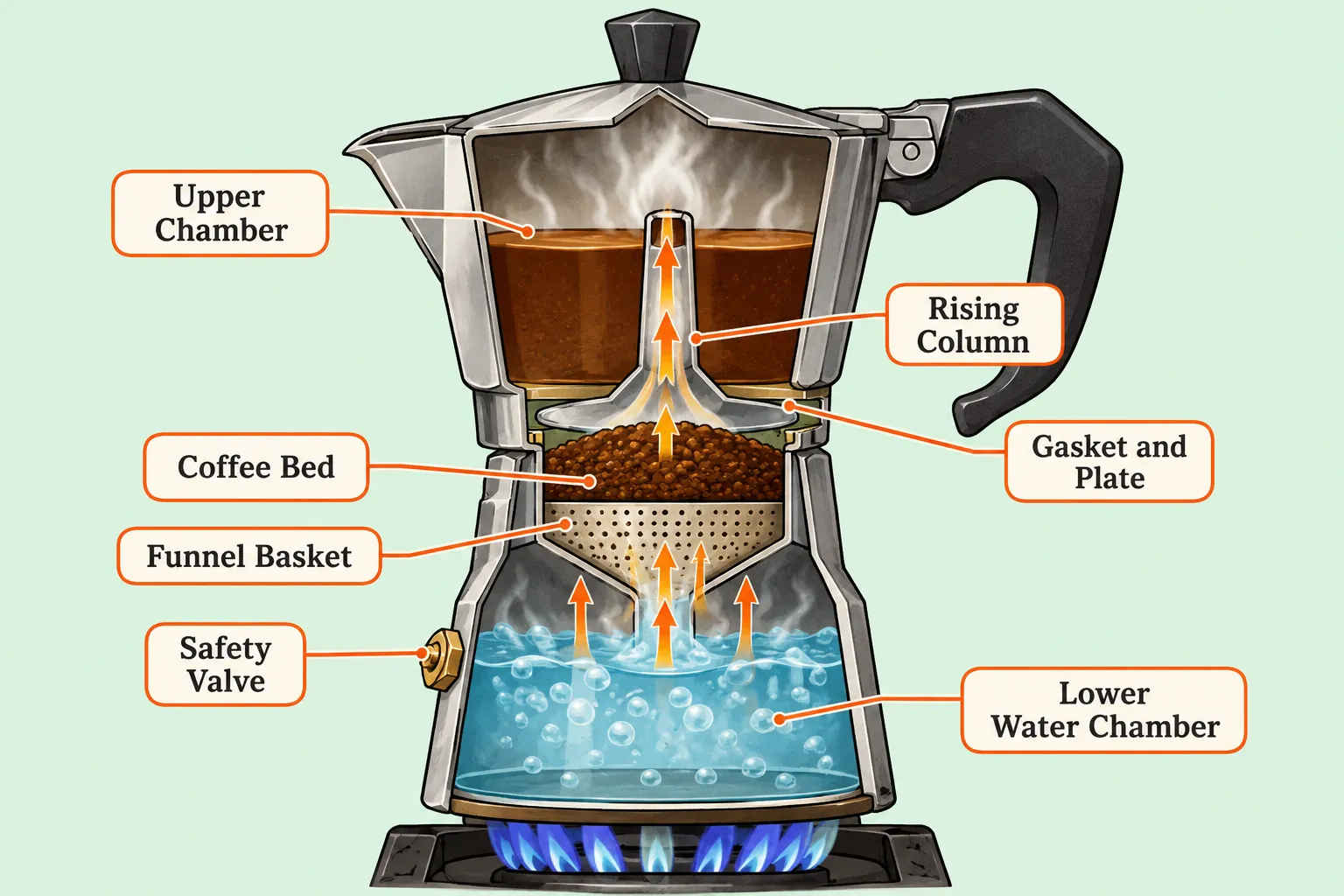
In 1933 he released the Moka Express: a faceted eight-sided pot in three parts. Water sits in the base. Ground coffee sits in a funnel-shaped basket above it. Brewed coffee collects in the top chamber .
The name came from Mokha in Yemen, long associated with coffee export . Naming a Piedmontese aluminum pot after a Yemeni port was a confident move, and it stuck.
Timing helped. MoMA's curatorial record notes the Moka arrived during the Great Depression, when visiting a bar for coffee became a luxury many Italian families trimmed . A one-time purchase that produced strong coffee at home answered a real household budget question.
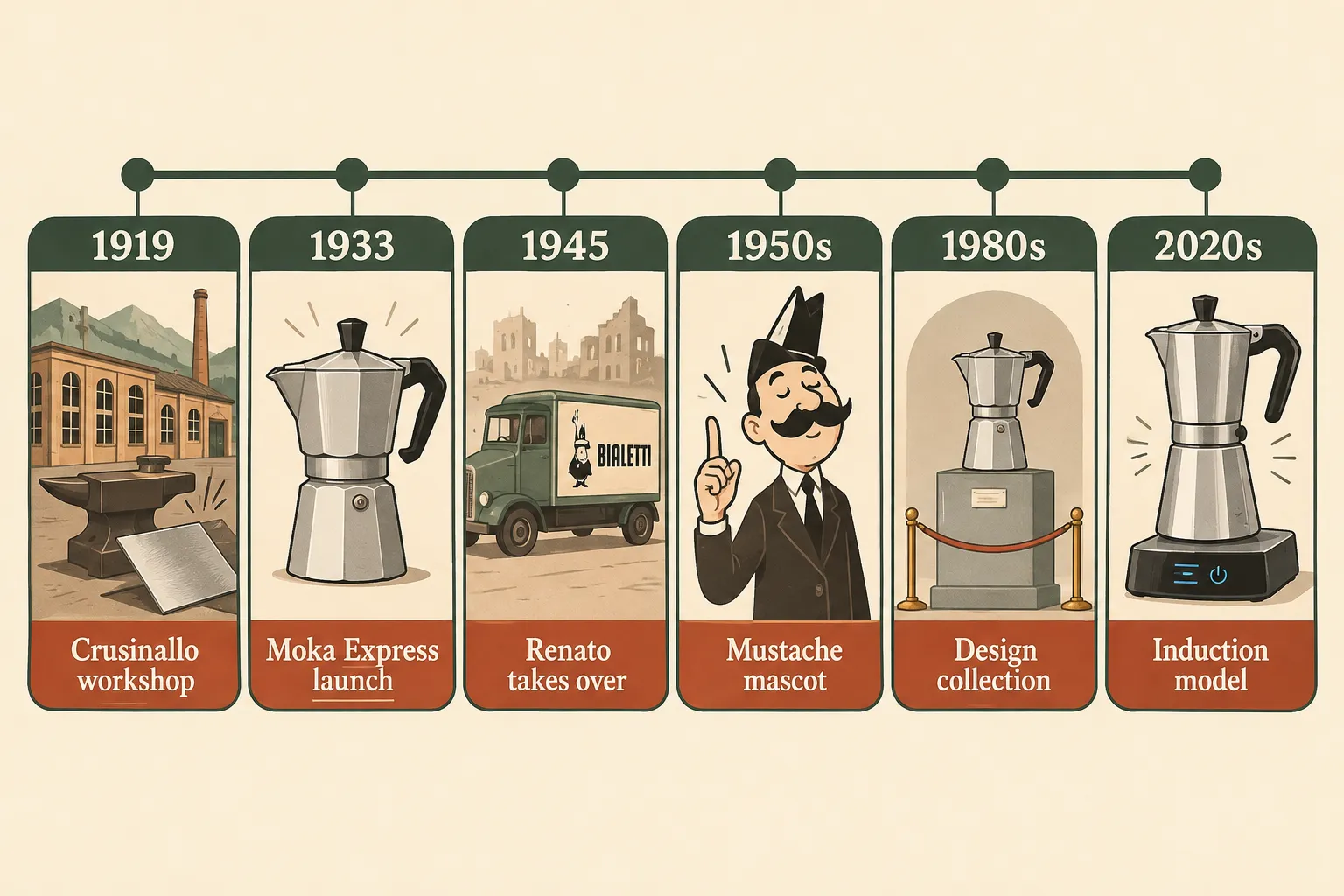
1919: the Crusinallo workshop
Alfonso Bialetti opens an aluminum semi-finished goods business in Crusinallo . No coffee yet. Just metal, dies, and a small northern Italian manufacturing town.
1933: the Moka Express arrives
The eight-sided pot launches. Early production was small and largely local, sold at markets and fairs rather than through national retail .
Postwar: Renato Bialetti scales it
Alfonso's son Renato took over the business and pushed the Moka Express into mass production and advertising. Bialetti's own history separates the two roles plainly: Alfonso invented it, Renato sold it to a country .
1950s: the little man with the mustache
The omino con i baffi, a cartoon man with a mustache and a raised index finger ordering one coffee, became the brand's mascot. He is widely credited to Italian cartoonist Paul Campani, reportedly drawn as a caricature of Renato himself. Bialetti presents the mascot as central to the Moka's identity . The Campani attribution and the caricature detail circulate widely in design writing, so treat them as reported rather than company-documented.
Design-object status
The Moka Express entered the Museum of Modern Art collection, credited to Alfonso Bialetti, dated 1933, listed in aluminum and plastic . That is the moment moka pot history stops being kitchenware history and becomes industrial design history.
2016: Renato's last container
Renato Bialetti died in February 2016. His ashes were interred in a large moka pot, a widely reported and photographed funeral in Omegna. Charming, slightly absurd, entirely on brand.
2020s: induction and seasonal editions
Bialetti now sells a Moka Induction with a stainless steel lower vessel bonded to an aluminum upper section, so the pot works on induction hobs. The classic all-aluminum model is intended for gas and conventional electric stovetops . In 2026 the company launched the "Cuor di Zucchero" holiday collection on November 4, keeping the octagonal silhouette and adding striped finishes, painted espresso cups, and tableware .
Who invented the moka pot and when?
Alfonso Bialetti invented the moka pot and launched it in 1933 from his workshop in Crusinallo, Italy . MoMA credits him as the designer and dates the work to 1933 . Renato Bialetti, his son, is often miscredited as the inventor because he ran the advertising that made the object famous after the war .
Short version for anyone asking who invented the moka pot: Alfonso made it, Renato made it unavoidable.
Why did Alfonso Bialetti invent the moka pot in 1933?
The documented pressures are economic and industrial. Italy was in the Depression, café coffee became an expense households questioned, and Bialetti already ran an aluminum workshop capable of casting a pressure-tight pot . He had the material, the tooling, and a market that wanted strong coffee without the bar price.
The legend, clearly labelled. Bialetti's own company literature says Alfonso watched his wife use a lessiveuse, a laundry boiler in which heated water rose through a central pipe and spread over the washing, and adapted that water movement to coffee . This is a company account, repeated for decades. It is plausible mechanically, and the lessiveuse was genuinely common. It is not independently documented by a contemporary record, so moka pot history writing should present it as the Bialetti family's story rather than a verified laboratory moment.
How does a moka pot actually work?
Heat turns water in the sealed lower chamber to steam. The steam raises pressure above the water line, and the only exit is up through the funnel basket of coffee and out the central spout into the upper chamber .
The sequence, in order:
- Fill the base with hot water to just below the safety valve.
- Seat the funnel basket, fill with medium-fine grounds, level the bed, do not tamp.
- Screw the top on firmly and set it on medium heat.
- Listen. A steady stream appears, then a gurgle as steam breaks through.
- Pull it off at the first gurgle and cool the base under the tap.
Decision rule: if your coffee tastes scorched and bitter, your heat was too high or you brewed past the gurgle. Start with hot water in the base to shorten the time the metal spends cooking the grounds.
A note on brew ratio: most 6-cup pots take roughly 15 to 17 grams of coffee and produce about 100 ml of concentrate. Our guide on how many scoops of coffee per cup covers dosing across brewer sizes.
Moka pot vs espresso machine: what is the difference?
Pressure. A moka pot operates around 1 to 2 bar, while pump espresso machines generally work at 9 bar or more, which produces finer extraction and the thick crema layer espresso drinkers expect .
| Moka pot | Pump espresso machine | |
|---|---|---|
| Brew pressure | about 1 to 2 bar | 9 bar or more |
| Crema | thin, pale, short-lived | thick and persistent |
| Grind size | medium-fine | fine, dialled per shot |
| Typical outlay | tens of dollars | hundreds to thousands |
| Temperature control | stove dial and attention | PID or thermoblock |
If you are weighing a $200 to $3,000 machine purchase, our espresso equipment buyer's guide compares the categories properly. Compare the models before you buy a moka pot expecting flat whites.
Is a moka pot the same as stovetop espresso? Can it make real espresso?
"Stovetop espresso" is a marketing nickname, not a technical description. The moka pot makes strong, concentrated coffee at roughly a fifth to a ninth of espresso pressure, so it cannot meet the pressure definition of espresso .
What you get is genuinely good on its own terms: syrupy, low-acid, chocolatey in most dark and medium roasts, heavy enough to carry milk. It will not produce the dense crema that espresso extraction and crema depends on, and it will not pull a reliable base for latte art.
Stovetop espresso history is really moka pot history under a friendlier name. The nickname survives because it sells.
What were Italians brewing before the moka pot?
Before 1933, Italian home coffee ran on the napoletana flip pot, simple decoction in a pan, and percolator-style vessels. Concentrated coffee was mostly a bar product, made on steam-driven commercial machines installed in cafés.
That split matters. The Moka Express closed a gap: a household object that made something recognizably closer to bar coffee. Italian coffee history has a before and after here, and the line runs through 1933 .
Why use a moka pot instead of a French press?
Choose a moka pot when you want concentrate for milk drinks or a small intense cup. Choose a French press when you want a full 500 ml mug of body-heavy, less intense coffee.
- Moka pot: 1 to 2 bar pressure, roughly 100 ml output per 6-cup pot, metal filtration, concentrated and syrupy.
- French press: no pressure, full immersion, 4 minute steep, metal mesh filter, more sediment and oils, larger volume.
If the bigger brewer suits your mornings better, see our picks for the best French press models.
Is a moka pot safe to use?
Yes, when the safety valve is clear, the rubber gasket is intact, and you never fill water above the valve. Those are the three things that matter. The valve exists to release pressure if the coffee bed clogs.

Common safety errors:
- Tamping the grounds, which blocks flow and raises pressure.
- Filling water over the valve line, so the valve cannot vent.
- Running a cracked or hardened gasket, which leaks steam.
- Leaving an empty pot on the burner after brewing.
Aluminum pots are not dishwasher safe. Detergent and heat strip the protective oxide layer and pit the metal. Choose a stainless steel model if your household insists on the dishwasher.
How do you clean and maintain a moka pot?
Rinse all three parts with hot water and dry them straight away. No soap, no dishwasher, no scouring pads on aluminum.
Maintenance schedule worth following:
- Every brew: empty the puck, rinse, dry fully before reassembly. Store it unscrewed so the gasket does not compress.
- Monthly: check the gasket for cracks, poke the safety valve gently to confirm the pin moves.
- Every 6 to 12 months: replace the gasket and filter plate. They cost a few dollars and fix most leaking and weak-brew complaints.
Common mistake: scrubbing the inside of the upper chamber to a mirror shine. The thin coffee oil film is harmless and the abrasion is not.
What is the best moka pot brand today besides Bialetti?
Bialetti remains the reference, but it is not the only credible option. Alessi sells design-forward Italian pots at a premium, and Italian manufacturers including Pedrini and Grosche produce aluminum and stainless models at a range of prices. Stainless steel pots from several brands suit induction hobs and dishwasher-heavy kitchens.
Decision rule:
- Gas or electric coil stove, classic look: aluminum Bialetti Moka Express.
- Induction hob: Bialetti Moka Induction or a full stainless pot .
- Dishwasher household: stainless steel, always.
- Gift or display piece: a design brand or a seasonal Bialetti edition .
Check the current price before committing, since seasonal collections carry a design premium. Bialetti's 2026 holiday 3-cup Moka Express was listed at $59.99 and the Mini Express at $69.99 on the date reported , while plain aluminum models typically sell for much less.
Has the moka pot design changed since 1933?
The silhouette has barely moved. The eight-sided body, the stepped shoulder, the angled handle, and the three-chamber layout all survive in current Bialetti products, including the 2026 holiday release .
What has changed:
- Materials: stainless steel versions, induction-compatible bonded bases .
- Handles: bakelite replaced by modern heat-resistant polymers.
- Sizes: 1-cup through 18-cup variants.
- Finishes: colors, prints, and seasonal collections .
The engineering is the same because the physics is the same. Low-pressure steam percolation does not need a new geometry.
Moka pot history at a glance
Tap any milestone for detail
Sources: MoMA collection record; Bialetti company history; Comunicaffe (2026).
FAQ

Conclusion
The octagonal shape never changed because it never needed to. The facets stiffen thin cast aluminum against internal pressure, spread stove heat evenly around the base, and give a wrench or a hand something to grip. Alfonso Bialetti solved a metal problem and a coffee problem with the same decision in 1933, and every retelling of moka pot history runs into that same conclusion: the object was finished when it shipped.
Three next steps worth taking:
- Check your gasket and safety valve tonight. Most weak or bitter moka coffee traces back to a hardened seal, not your beans.
- Match the pot to your stove before buying. Aluminum for gas and coil, bonded stainless for induction .
- If you want true espresso, buy an espresso machine. The moka pot is excellent at what it does and will never run 9 bar. Start with our beginner's guide to barista-quality espresso drinks to work out which category your mornings actually need.
Better Coffee Starts With Better Answers, and 93 years of moka pot history gives you a lot of them.