White Mocha Recipe: The 5 Minute Sauce That Makes It
The sauce is the whole drink
A good white mocha recipe lives or dies on two ingredients melted together: real white chocolate and cream, which gives you cocoa butter and dairy fat that no flavored syrup can fake.
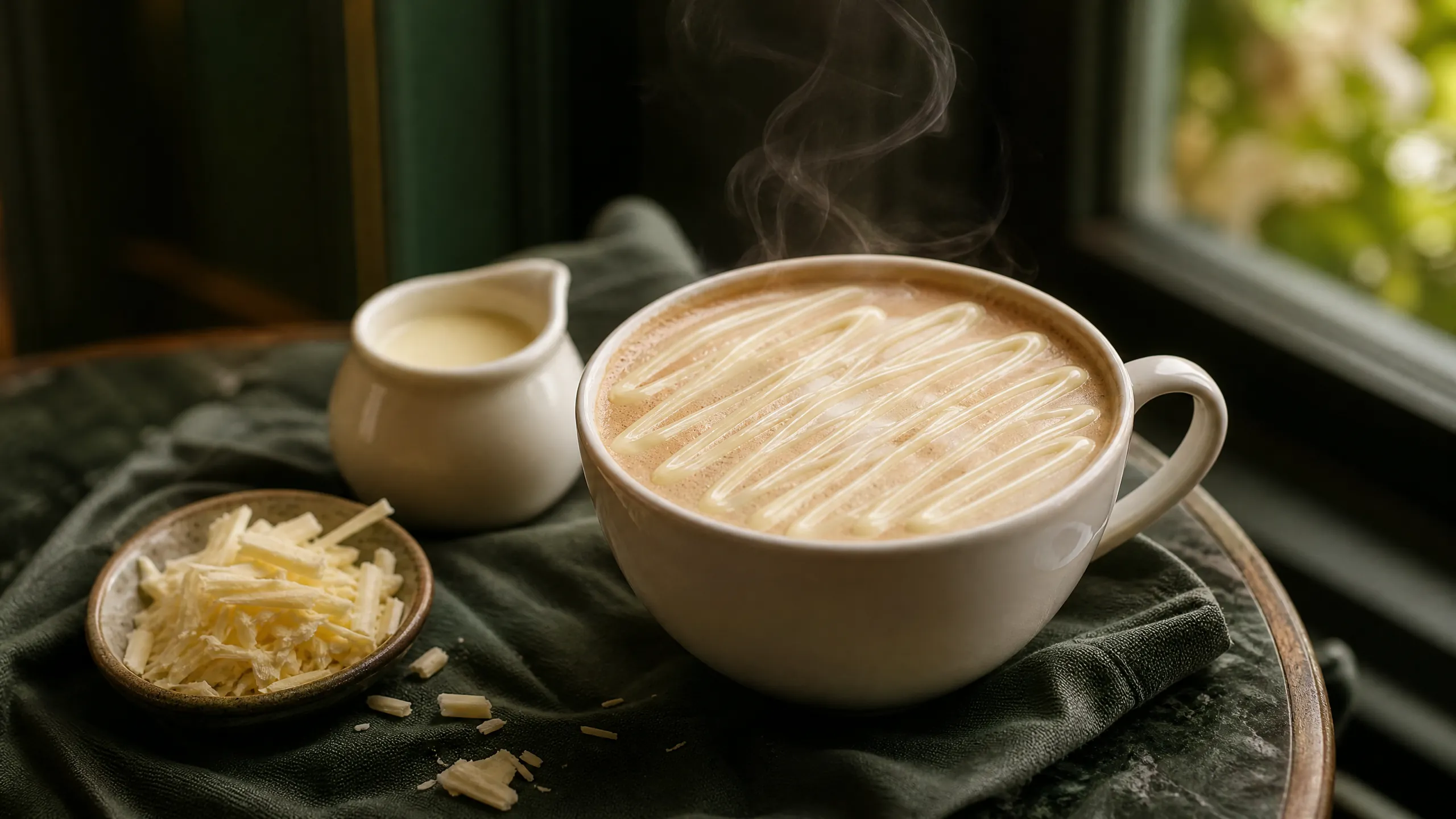
Starbucks does not pour syrup into its version. The company lists white chocolate mocha sauce as a separate component from espresso and milk, and that sauce contains sugar, condensed skim milk, coconut oil, and cocoa butter . Cocoa butter is the fat that makes the drink feel thick instead of thin and sugary. You can make a close equivalent on your stove in about five minutes with two ingredients and a whisk.
Key takeaways
- The 5 minute sauce is 100 g white chocolate plus 60 ml (¼ cup) heavy cream, melted off the heat, yielding roughly 8 servings at 2 tablespoons each.
- A standard hot white mocha build is 2 tablespoons sauce + 2 oz (60 ml) espresso + 6 to 8 oz (180 to 250 ml) steamed milk.
- Steam milk to 140 to 145°F (60 to 63°C). Past about 70°C the proteins turn eggy and the sweetness drops off.
- Starbucks lists its hot White Chocolate Mocha at 390 calories, 17 g fat, 46 g sugar in the referenced serving configuration, updated October 2026 .
- Homemade sauce costs roughly $0.35 to $0.55 per drink depending on the chocolate; the café version in most US markets runs several dollars.
- Grainy sauce almost always means overheated cream, not bad chocolate.
- Sauce keeps 2 weeks refrigerated in a sealed jar because of the dairy content.
This white mocha recipe keeps for a week once the sauce is in the fridge.
White mocha recipe
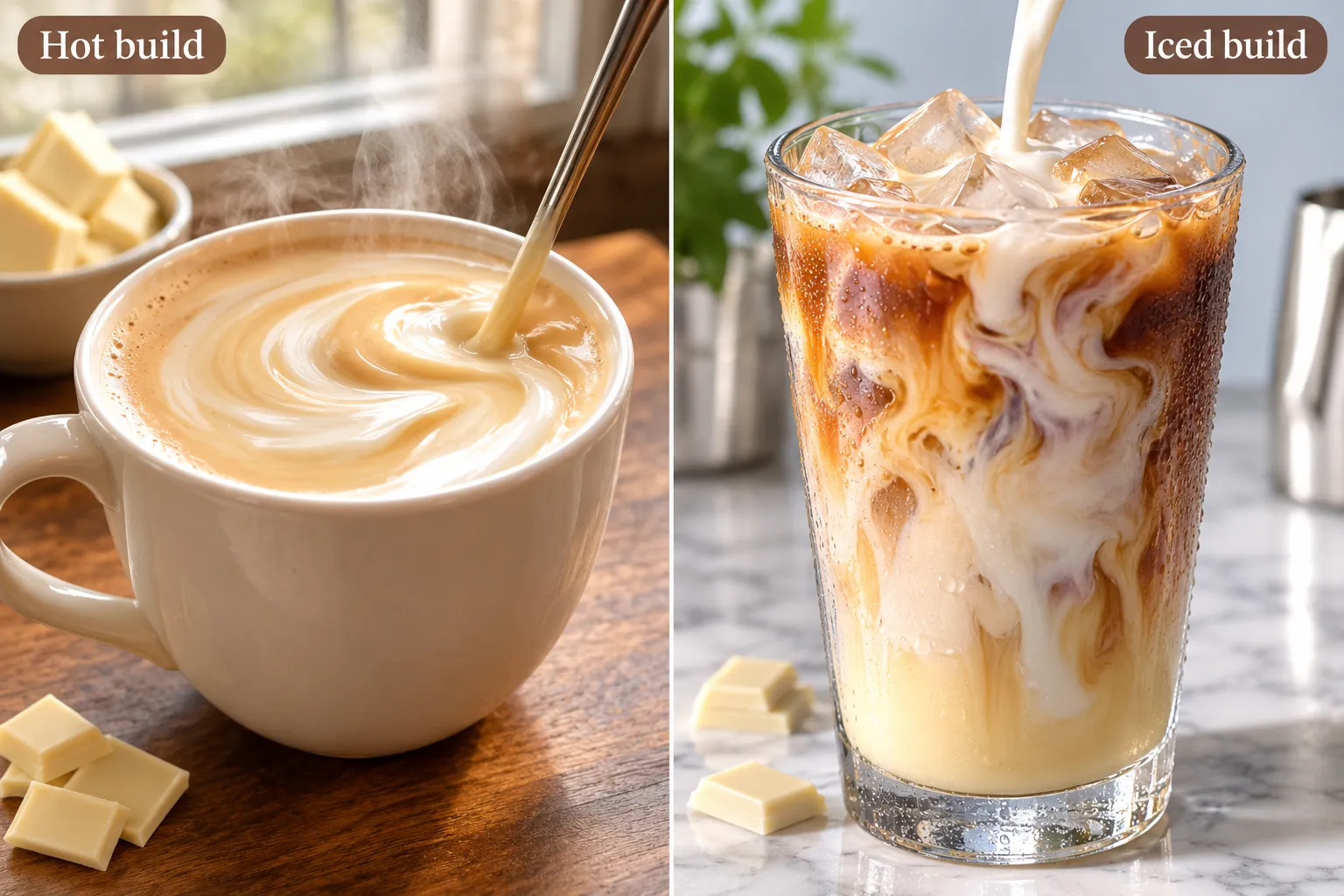
Here is the complete white mocha recipe, start to finish, written for a standard 12 oz mug.
Sauce (makes about 8 servings)
| Ingredient | Amount |
|---|---|
| White chocolate, chopped (28% cocoa butter or higher) | 100 g / 3.5 oz |
| Heavy cream or double cream | 60 ml / ¼ cup |
| Vanilla extract (optional) | ½ tsp |
| Fine salt | 1 small pinch |
Per drink
| Component | Hot | Iced |
|---|---|---|
| White mocha sauce | 2 tbsp | 2 tbsp |
| Espresso | 2 oz / 60 ml | 2 oz / 60 ml |
| Milk | 6 oz steamed | 8 oz cold |
| Ice | none | 1 cup, large cubes |
Steps
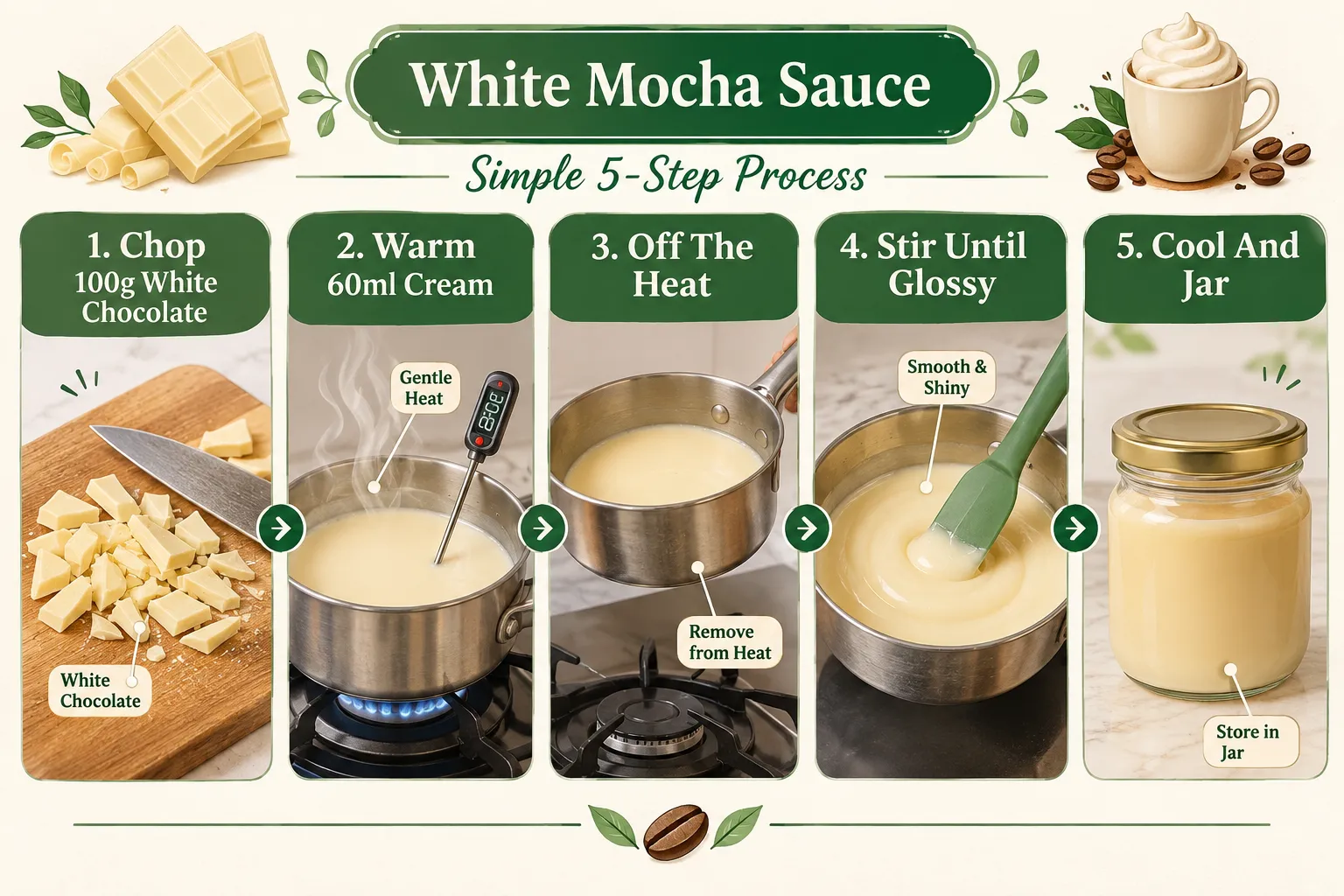
- Chop the white chocolate finely. Large chunks melt unevenly and that is where grain comes from.
- Heat the cream in a small saucepan until it steams and the edges just shimmer. Do not let it boil.
- Pull the pan off the burner. Add the chocolate. Wait 60 seconds without touching it.
- Stir slowly with a spatula until the mixture turns glossy and uniform. Add vanilla and salt.
- Pour 2 tablespoons into your mug. Pull or brew 2 oz of espresso directly onto the sauce and stir until it dissolves completely.
- Steam or froth 6 oz of milk to 140 to 145°F and pour it in, holding back the foam until the last second.
- Jar the remaining sauce and refrigerate.
That is the entire white mocha recipe. Starbucks At Home publishes a similar five minute sequence using 60 ml espresso, 250 ml milk, and 1 tablespoon of white chocolate syrup, with the order being syrup, espresso, frothed milk, toppings . The order matters: sauce under the espresso dissolves; sauce on top of milk sinks and sits.
A white mocha recipe is only as good as the chocolate you melt into it.
The 5 minute white chocolate sauce: exact ingredients and steps
The sauce is one part cream to roughly 1.7 parts chocolate by weight, melted with residual heat rather than direct heat.
Chocolate choice changes everything. FDA's standard of identity for white chocolate in the United States requires at least 20% cocoa butter, 3.5% milk fat, and 14% total milk solids, with no more than 55% nutritive carbohydrate sweeteners [21 standard, see note below]. Products labeled "white baking chips" often skip cocoa butter in favor of palm or coconut oil. They melt, but they melt waxy. Read the ingredient panel and pick a bar where cocoa butter appears before or near the top.
Richer variant. La Colombe's published version uses ½ cup white chocolate, ¼ cup heavy cream or whole milk, an optional 1 tablespoon of butter, and ½ teaspoon vanilla, melted gently and cooled slightly before use [15 per research notes]. The butter adds mouthfeel. It also makes the sauce set harder in the fridge, so warm it for 10 seconds before the next drink.
Three failure points and their fixes
- Cream too hot. Boiling cream shocks the cocoa butter and the emulsion splits into oily specks. Target steaming, around 180°F.
- Water contamination. A single drop of water from a wet spoon seizes white chocolate into paste. Dry everything.
- Stirring too fast. Whisking air into a warm chocolate emulsion creates bubbles that collapse into grit. Fold slowly.
If the sauce does split, add 1 teaspoon of warm cream and stir in one direction until it comes back together. It usually does.
Vegan version. Skip white chocolate entirely and build a sauce from 3 tablespoons cocoa butter, 3 tablespoons coconut cream, 3 tablespoons powdered sugar, and 2 tablespoons oat milk powder, melted and whisked. Cocoa butter is the flavor you actually associate with white chocolate, so keeping it is the trick. It is vegan, it is not technically white chocolate under the FDA definition, and it tastes close.
The iced white mocha recipe uses the same sauce, cold milk, no steam.
The full drink build: ratios for hot and iced versions
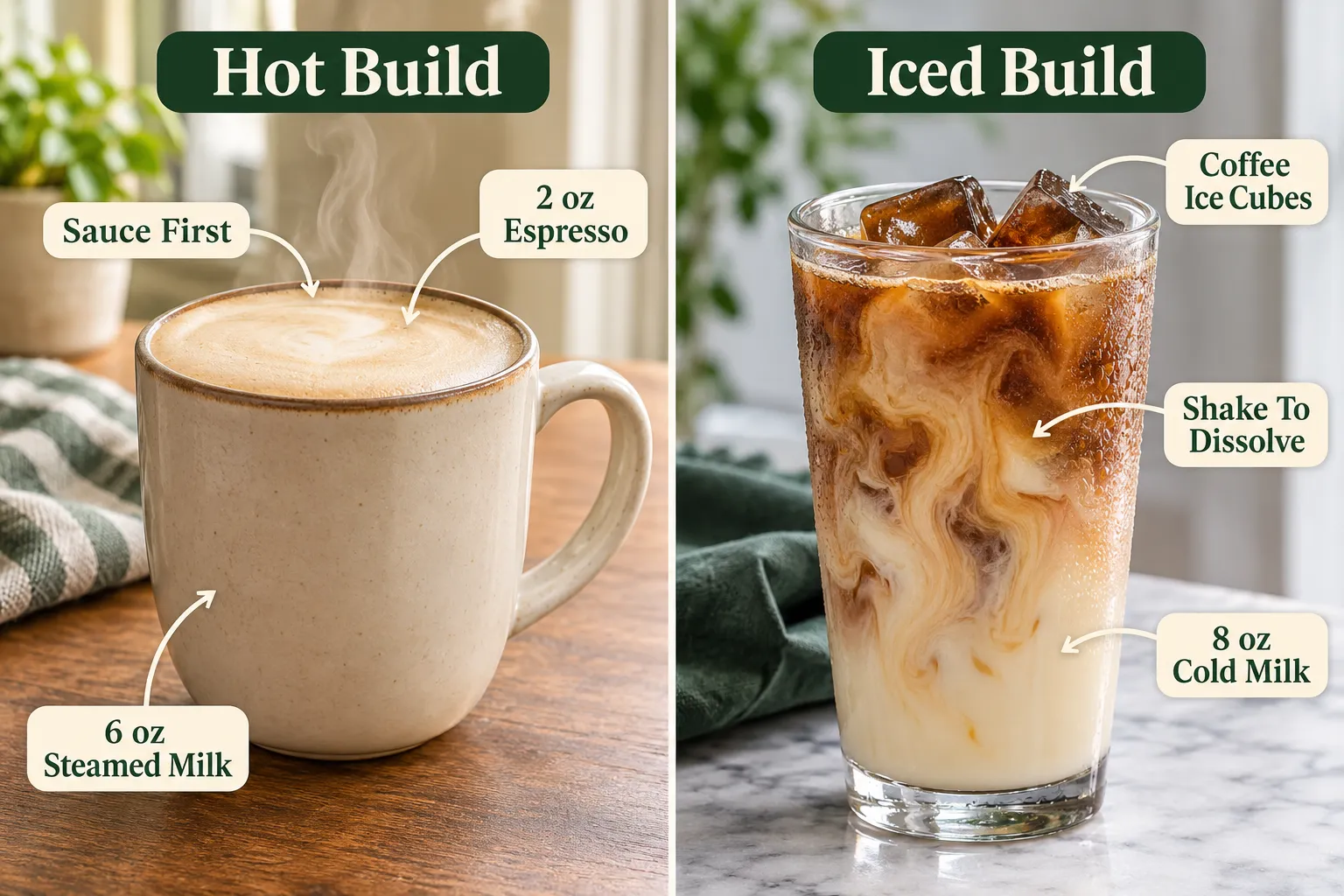
For hot, run 1 part sauce to 2 parts espresso to 6 parts steamed milk by volume. For iced, keep the sauce and espresso identical and raise the milk to 8 parts over large ice.
Hot, step by step
- 2 tbsp sauce in the bottom of a warmed 12 oz mug.
- 2 oz espresso poured straight on top. Stir 5 seconds.
- 6 oz whole milk steamed to 140 to 145°F, textured to roughly 0.2 inches of microfoam, which is the latte and flat white target Breville specifies for its machines [per research notes].
- Pour from low, then raise the pitcher to let foam settle on the surface.
- Optional sweetened whipped cream, which is what Starbucks lists on the standard hot build .
Iced, step by step
- 2 tbsp sauce plus 2 oz hot espresso in a cocktail shaker or jar. Shake 10 seconds so the sauce dissolves while the espresso is still hot. Cold sauce in cold milk never fully dissolves, which is the number one reason a homemade iced white mocha has sludge at the bottom.
- Fill a 16 oz glass with large ice cubes. Big cubes have less surface area and melt slower.
- Pour the espresso mixture over, then add 8 oz cold milk.
- Stir once from the bottom.
To stop watering down entirely, freeze leftover brewed coffee into an ice cube tray and use coffee ice. Same technique that saves an iced latte made at home.
No espresso machine? A moka pot, an AeroPress with a 1:4 brew ratio, or a long-steeped strong French press all work. Our walkthrough on making espresso without a machine covers the pressure tradeoffs. With instant coffee, dissolve 2 heaping teaspoons in 2 oz of hot water and use that as your espresso substitute. It is flatter in body, and the white chocolate fat covers a surprising amount of that gap.
Scale this white mocha recipe up for guests; the sauce doubles cleanly.
How is a white mocha different from a latte, cappuccino, or flat white?
A white mocha is a latte with white chocolate sauce added. The other three are defined purely by milk texture and ratio, with no chocolate at all.
- Latte: espresso plus steamed milk, thin foam cap, usually 8 to 16 oz.
- Cappuccino: roughly equal espresso, steamed milk, and a thick foam layer in a 5 to 6 oz cup. Drier and lighter.
- Flat white: smaller, typically 5 to 8 oz, with a higher coffee to milk ratio and dense microfoam folded through rather than sitting on top. Our breakdown of the microfoam difference between a flat white and a latte gets into the texture specifics.
- White mocha: latte build plus 2 tbsp sauce, so it carries added fat and about 20 to 25 g of extra sugar.
- Regular mocha: same idea with dark chocolate sauce, which brings bitterness that balances the sugar. White chocolate has no cocoa solids, so there is nothing bitter to offset the sweetness. That single fact explains most complaints about the drink.
Decision rule: if you want coffee flavor forward, make a flat white. If you want dessert that happens to contain espresso, make the white mocha recipe above.
One taste and the cafe version of this white mocha recipe loses its grip.
Does white mocha have caffeine, and how much?
Yes. Caffeine comes entirely from the espresso, since white chocolate contains no cocoa solids and therefore effectively no caffeine or theobromine.
A standard two-shot home build using 2 oz of espresso lands around 120 to 150 mg of caffeine, depending on the bean, dose, and grind size. One shot halves it. A café grande in the US is commonly built on two shots.
If you want the flavor at night, use decaf espresso or a decaf pod. The sauce behaves identically. Our roundup of decaf K-Cups that still taste like coffee is a reasonable starting point if you brew by pod.
Edge case worth knowing: cold brew concentrate usually carries more caffeine per ounce than espresso. Swapping it in one for one makes a stronger drink than you expect.
How bad is a white mocha nutritionally?
Starbucks lists its hot White Chocolate Mocha at 390 calories, 17 g fat, 47 g carbohydrates, 46 g sugar, and 13 g protein in the referenced serving configuration on its US nutrition page, updated in October 2026 . The iced version is listed at 390 calories, 20 g fat, 44 g carbohydrates, 42 g sugar, and 11 g protein .
Context: 46 g of sugar is more than the American Heart Association's recommended daily added sugar limit for most adults. Some of that is lactose from milk, but the sauce and whipped cream carry the bulk.
Your homemade white mocha recipe is adjustable in a way the café version is not:
- 1 tablespoon of sauce instead of 2 cuts roughly 10 to 12 g of sugar and still tastes clearly like white chocolate.
- Skip the whipped cream and you remove around 70 to 110 calories.
- Unsweetened almond milk instead of whole milk cuts another 70 to 90 calories per 8 oz, though it also removes the protein and some body.
More ideas in our guide on ordering coffee more healthily.
Can you make a white mocha with oat or almond milk?
Yes, with one caveat: barista-formulated oat milk steams and holds foam far better than standard oat milk, and almond milk is the hardest of the common alternatives to texture.
- Oat (barista blend): the closest match. Steams to real microfoam, adds its own sweetness, pairs well with white chocolate. First choice.
- Soy (barista blend): holds foam well, slightly beany against white chocolate but workable.
- Almond: thin, prone to large bubbles, and it can separate when it hits hot acidic espresso. Pour the espresso into the sauce first, then add the milk, and steam no higher than 140°F.
- Coconut: strong flavor that actually complements cocoa butter. Low protein means weak foam.
For a fully vegan white mocha recipe, pair barista oat milk with the cocoa butter sauce described earlier. Check the chocolate label either way, because most white chocolate contains milk solids by definition.
Why does homemade white mocha go grainy or separate?
Grain comes from heat, water, or dilution, in that order of likelihood. The sauce is an emulsion of cocoa butter, milk solids, and sugar, and all three failure modes break it.
Diagnostic table
| What you see | Likely cause | Fix |
|---|---|---|
| Specks in the finished sauce | Cream boiled | Remelt gently with 1 tsp warm cream |
| Stiff grainy paste in the pan | Water drop contamination | Start over, dry all tools |
| Sludge at the bottom of an iced drink | Sauce added to cold liquid | Dissolve sauce in hot espresso first |
| Oily film on top of the mug | Sauce overheated in microwave | Warm the jar in a bowl of hot water instead |
| Sauce solid in the fridge | Normal | 15 seconds in warm water, stir |
Storage: because the sauce contains dairy, keep it refrigerated in a sealed glass jar and use it within about 2 weeks. Discard it if it smells sour or the surface looks separated and will not come back with stirring. A finished drink should be consumed the same day; refrigerated leftovers lose foam and taste flat within hours.
The mistake most people make and the fix
The common mistake is using white chocolate chips instead of a cocoa butter bar, then compensating for the waxy result with more sugar.
Baking chips are formulated to hold their shape in a 350°F oven. That stability comes from stabilizers and cheaper fats with higher melting points, which is exactly the opposite of what a sauce needs. They produce a sauce that coats your tongue in a dull film and never fully integrates with the milk.
The fix, in order of impact:
- Buy a white chocolate bar with cocoa butter listed in the first two ingredients.
- Weigh the chocolate rather than guessing by volume. 100 g is accurate; "half a cup of chips" varies by 20%.
- Add the pinch of salt. It is the cheapest correction for over-sweetness available, because salt suppresses perceived bitterness and sharpens the dairy notes.
- Pull your espresso a touch longer, or use a darker roast. More coffee intensity balances the sugar from the other direction.
- Cut the sauce to 1½ tablespoons before you decide the drink is too sweet.
Second most common mistake: scalding the milk. Common café guidance puts latte milk around 55 to 65°C (130 to 150°F), with Breville advising roughly 140 to 145°F. Above about 70°C, milk proteins denature and you get cooked, faintly sulfurous notes along with reduced perceived sweetness. A $10 probe thermometer fixes this permanently. More general improvements in our guide on how to make coffee taste better.
White mocha vs regular mocha vs the café version: cost per drink
Homemade runs well under a dollar per drink in ingredients. The calculator below lets you plug in your own grocery prices and café price to see the gap.
White mocha: cost per drink
| Line | Per drink |
|---|---|
| Sauce (2 tbsp, batch of 8) | – |
| Milk and espresso | – |
| Home total | – |
| Cafe total | – |
The flavor comparison matters as much as the money. A regular mocha built with 70% dark chocolate sauce lands drier and more bitter at the same sugar level. The white version reads sweeter because there are no cocoa solids providing contrast. Ready-to-drink bottles sit somewhere else again: a US bottled Starbucks White Chocolate Mocha Frappuccino listing showed 300 calories and 55 g carbohydrates per 13.7 oz bottle , and a UK 220 ml Holiday Edition iced coffee was listed by Sainsbury's at £2.20 on November 4 to 5, 2026, providing 61 kcal and 8.6 g sugar per 100 ml .
Sourced numbers worth knowing
390 calories, 46 g sugar. Starbucks' US nutrition listing for the hot White Chocolate Mocha in the referenced serving configuration, page updated October 2026 .
390 calories, 20 g fat, 42 g sugar. The iced version per the same source, showing the two builds are close but not identical .
£2.20 for 220 ml. Sainsbury's listing for the Starbucks White Chocolate Mocha Iced Coffee Holiday Edition, November 4 to 5, 2026, at 61 kcal and 8.6 g sugar per 100 ml, which works out to roughly 134 kcal and 18.9 g sugar per bottle .
300 calories per 13.7 oz. A US retail listing for the bottled White Chocolate Mocha Frappuccino, dated October 27, 2026 .
60 ml espresso, 250 ml milk, 1 tbsp syrup, 5 minutes. Starbucks At Home's published home preparation, which uses syrup rather than sauce and confirms the five minute window .
Limitation worth stating plainly: Starbucks nutrition figures apply to a specific size and configuration with the default whipped cream and milk. Your homemade white mocha recipe will differ based on sauce volume, milk choice, and whether you add cream.
FAQ

Make the sauce once, drink it all week
The practical move is to make one 100 g batch of sauce on a Sunday, jar it, and stop thinking about it. That single jar covers eight drinks, costs under five dollars in ingredients, and removes the only genuinely fiddly step from the white mocha recipe. Everything after that is espresso and milk at the right temperature.
Next step: weigh out 100 g of a cocoa butter white chocolate bar, warm 60 ml of cream until it steams, and make the sauce tonight. Then grab a thermometer and hold your milk at 142°F. Those two changes account for most of the distance between a homemade white mocha and a café one.
For more drinks built on the same sauce-and-milk logic, browse our coffee recipes collection.
Better Coffee Starts With Better Answers.