Best Pour Over Coffee Maker: Drippers vs Machines Compared
Quick Answer
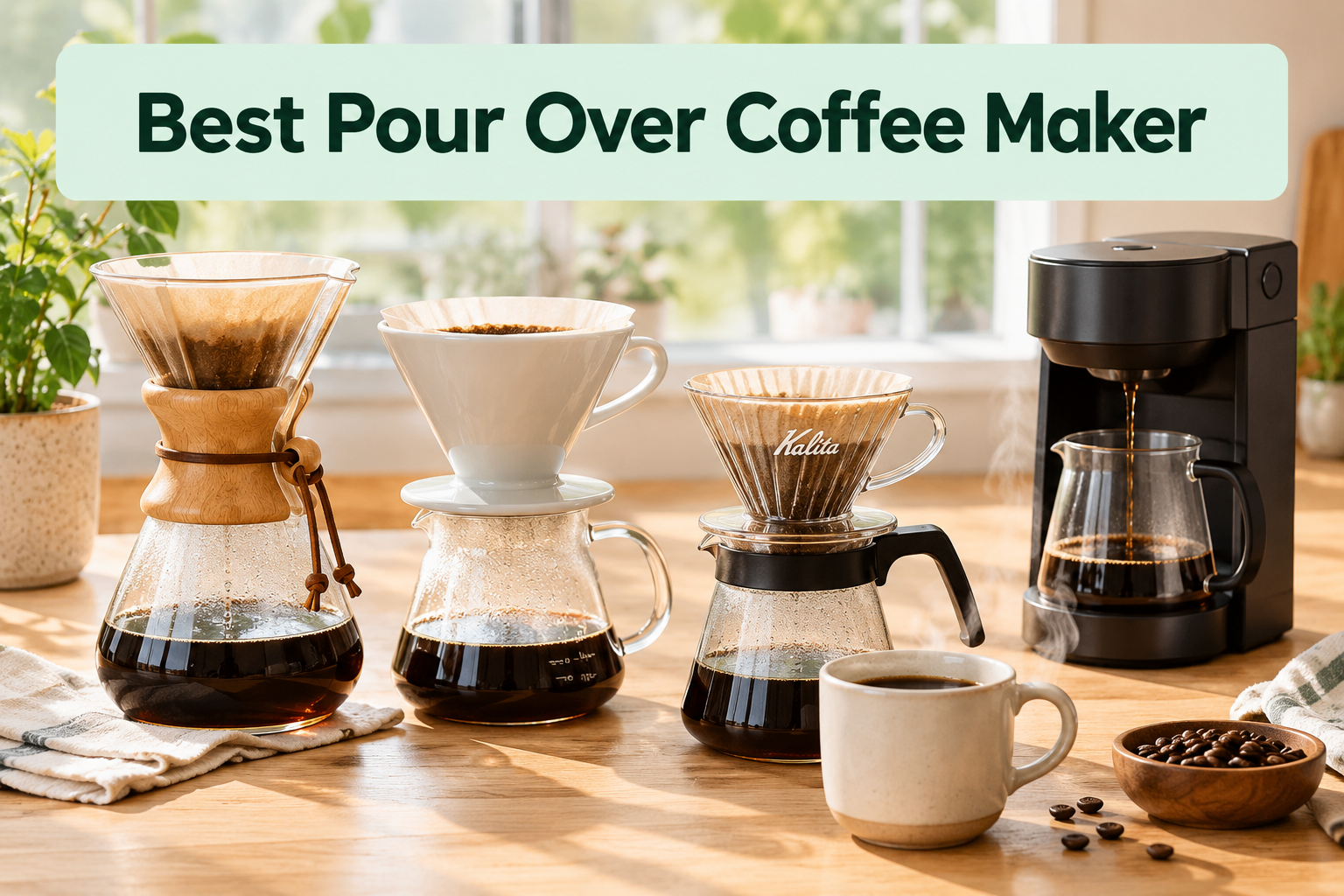
The best pour over coffee maker depends on how much control you want over your own hands. For most people who enjoy the ritual, the Hario V60 02 gives the sharpest cup and the most room to experiment. If you want a countertop that looks as good as it brews, the Chemex Classic 6-Cup remains the benchmark manual option. If you want hands-off consistency, the Fellow Aiden and Cosori Juni automate the pour for you, at a much higher price than any dripper.
Key takeaways:
- A manual pour over dripper costs $10 to $50. An automatic pour over coffee maker runs $45 to $600 depending on features.
- The Chemex Classic 6-Cup is widely named the best pour over coffee maker for its glass build and roughly 5-minute brew, though it is not SCA certified as of 2026.
- The Fellow Aiden earned SCA certification in 2024 and adapts from single cup to full pot brewing.
- Flat-bottom drippers like the Kalita Wave extract more evenly than cone drippers, making them more forgiving for new brewers.
- A standard brew ratio is 1:15, meaning 15 grams of water for every gram of coffee.
- You do not need a gooseneck kettle to brew pour over coffee, but it makes pour control much easier.
- Paper filters remove more oils than metal filters, giving a cleaner, lighter cup.
Best pour over coffee maker: quick verdict by buyer type
The right pour over coffee maker changes depending on who is buying it, not just what is on sale. Below are seven common buyers and the pick that fits each one, based on published specs and current reviews rather than a single universal answer.
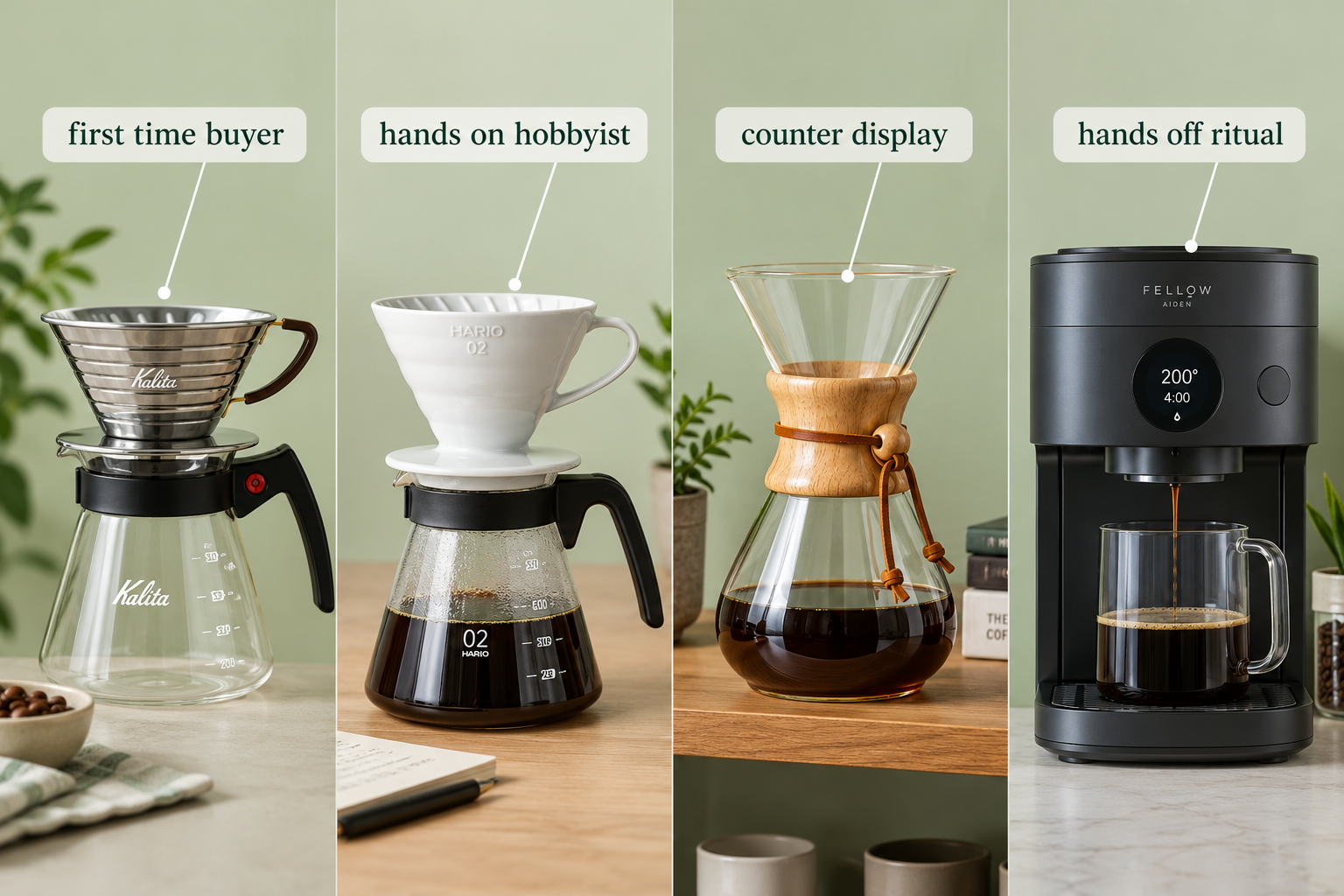
- First-time buyer who wants zero guesswork: The Clever Dripper (around $35) combines immersion brewing with a pour over filter, which makes it close to foolproof for a first cup.
- Hands-on hobbyist who wants full control: The Hario V60 02 rewards attention to grind size, pour speed, and water temperature. Coffeecorner rates it 9.2/10 for overall control, though it punishes sloppy technique.
- Someone who wants a display piece that also brews well: The Chemex Classic 6-Cup, made of non-porous borosilicate glass, is the pick Forbes Vetted names best pour over coffee maker for looks and cup clarity combined.
- Busy professional who wants consistency without the ritual: The Fellow Aiden or Cosori Juni automate bloom, pour pattern, and temperature so the cup tastes close to hand-poured with none of the standing around.
- Budget shopper testing automatic brewing for the first time: The Tru Automatic Pour Over Coffee Maker costs about $45.99 and offers digital programmability at low financial risk.
- Camper or frequent traveler: A lightweight plastic or collapsible V60-style dripper with no power cord or fragile carafe.
- Tech-forward single-cup drinker: The xBloom Studio ($599) includes a built-in grinder and a scale accurate to 0.1 grams for one precise 12-ounce cup.
If you're still deciding between brewing styles altogether, our beginners guide to pour over coffee walks through the basic gear list before you spend a dollar.
What is a pour over coffee maker and how does it work
A pour over coffee maker is a filter cone or basket that sits above a cup or carafe. Hot water passes through ground coffee and a paper or metal filter once, pulled by gravity, then drains into the vessel below.
The process has three stages:
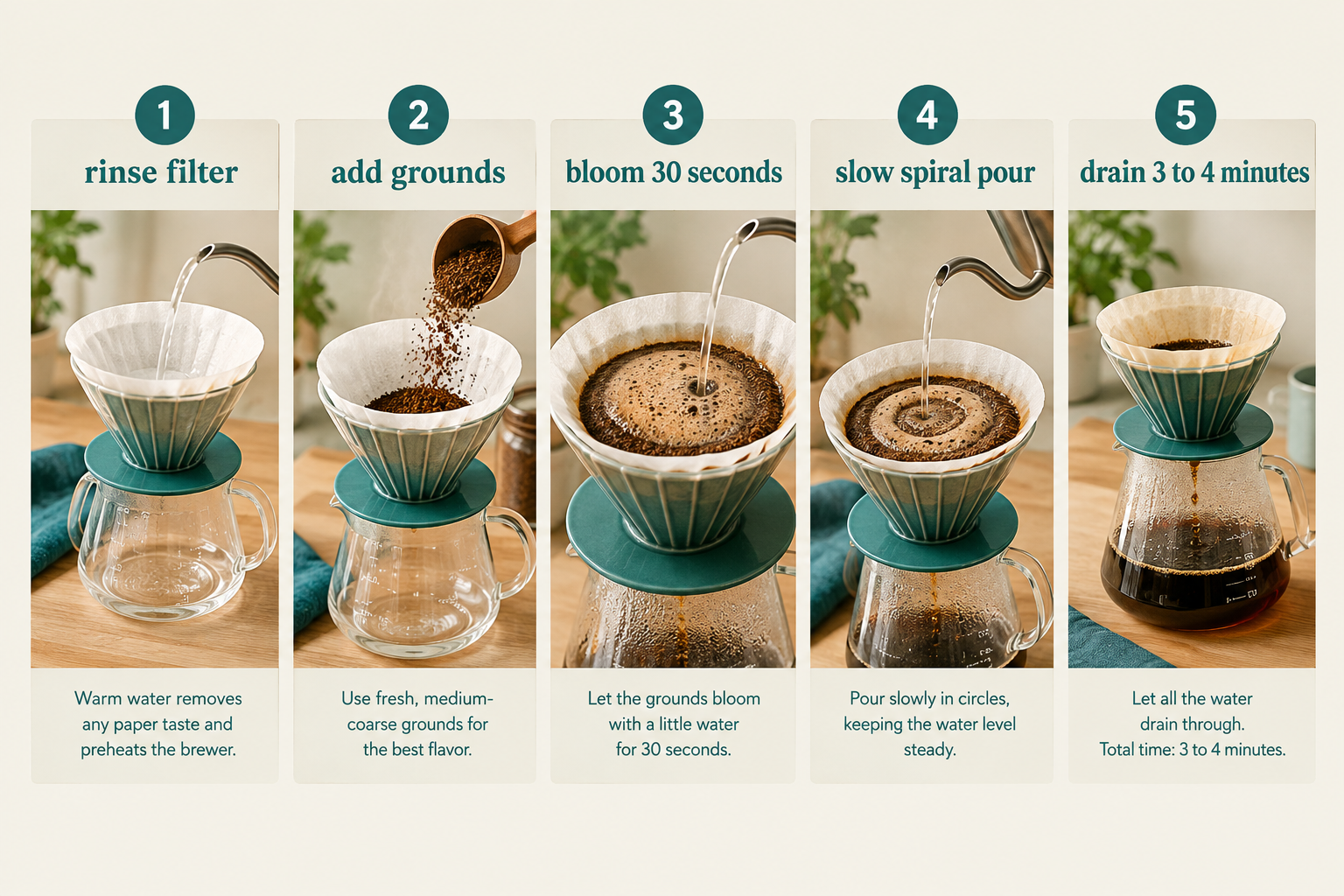
- Bloom. A small amount of hot water (roughly twice the weight of the coffee) saturates the grounds for 30 to 45 seconds. This releases trapped carbon dioxide from roasting, which would otherwise block even water flow.
- Main pour. Water is added in slow stages or a steady spiral, keeping the grounds submerged without overflowing the filter.
- Drawdown. The remaining water drains through, finishing the extraction.
A full brew typically takes 3 to 5 minutes for a cone dripper, slightly longer for flat-bottom brewers like the Kalita Wave. That timing matters. Extraction, the process of pulling flavor and caffeine compounds out of ground coffee, keeps developing the entire time water touches grounds. Too fast and the cup runs weak and sour. Too slow and it turns bitter and muddy.
Read the full beginners guide to using a pour over coffee maker for a walkthrough with grind size and timing benchmarks.
Manual pour over dripper vs automatic pour over machine: what actually changes
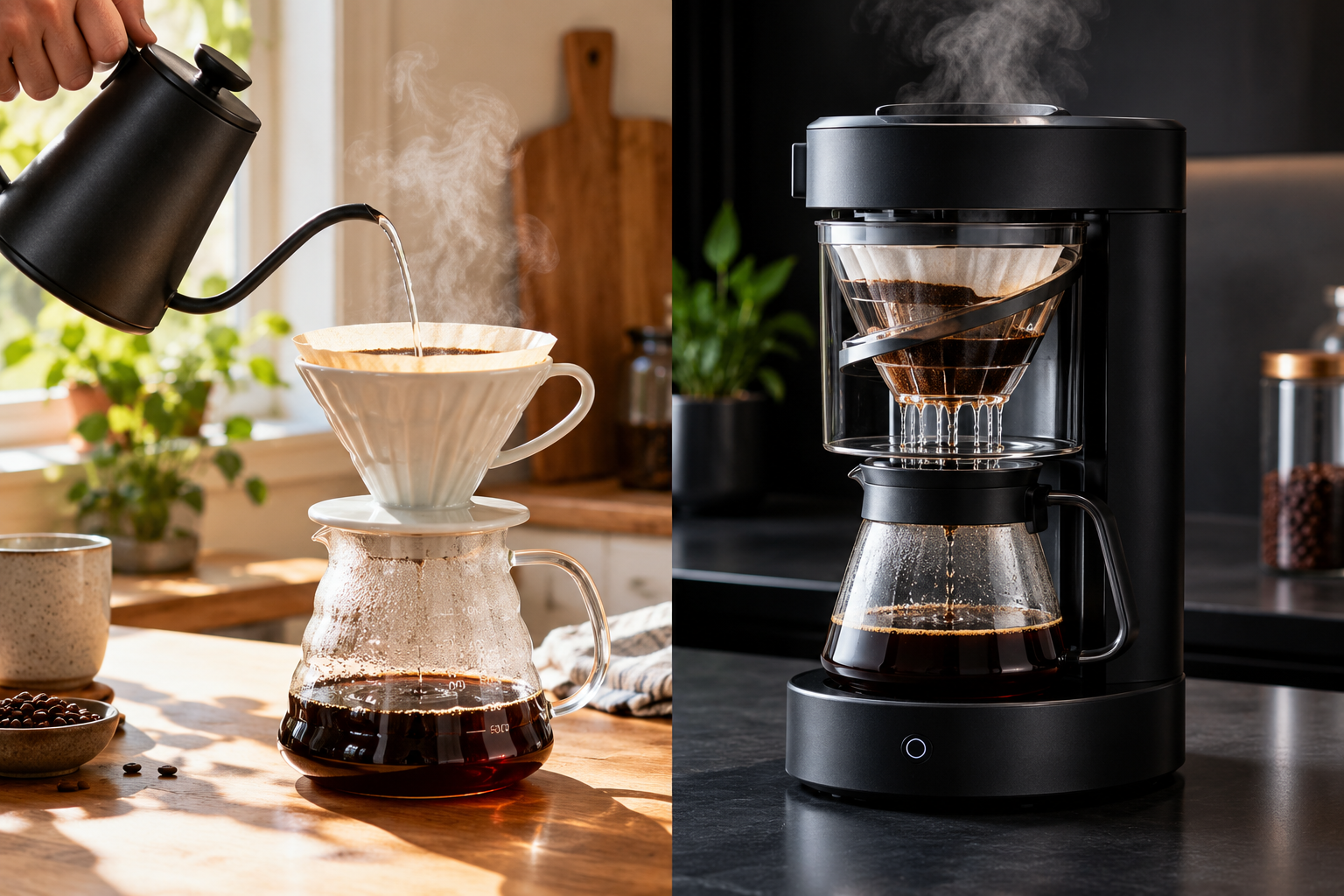
A manual pour over dripper needs your hand on the kettle for the whole brew. An automatic pour over machine does the pouring, timing, and often the temperature control for you, usually for four to ten times the price.
The real differences:
| Factor | Manual dripper | Automatic pour over machine |
|---|---|---|
| Price range | $10 to $50 | $45 to $600 |
| Skill required | Grind, pour rhythm, timing all matter | Machine handles pour pattern and bloom |
| Consistency | Varies with technique | Repeatable cup after cup |
| Counter footprint | Small, no cord | Larger, needs an outlet |
| Cleanup | Rinse and dry | Filter basket plus occasional descaling |
The Cosori Juni uses a rotating glass filter basket that circles under a fixed showerhead, mimicking the motion of a hand pour. The Fellow Aiden goes further, adjusting its basket to brew anywhere from one cup to a full pot with the same machine. Business Insider's September 2026 testing describes the Cosori Juni's output as "tasty, subtle coffee that feels closer to hand-poured" than typical drip machines, which is a meaningful claim since most automatic drip makers spray water evenly rather than pour it in stages.
Choose a manual dripper if you enjoy the process and don't mind standing at the counter for five minutes. Choose an automatic pour over machine if you want the flavor profile of pour over without the daily routine.
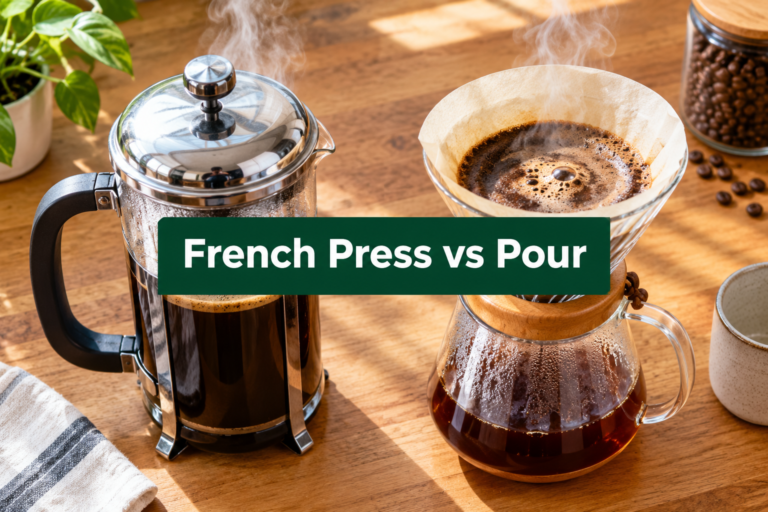
Pour over vs French press vs AeroPress: which is best
Pour over, French press, and AeroPress all brew with hot water and ground coffee, but they use different physics to get there, and that changes the cup.
- Pour over filters water through grounds once, using gravity. The result is typically a clean, bright cup with less sediment. A paper filter also removes most of the coffee's natural oils.
- French press is an immersion method: grounds sit in water for 4 minutes, then a metal mesh plunger separates the liquid. It keeps more oils and fine particles, producing a heavier, fuller body.
- AeroPress combines immersion and pressure. Grounds steep briefly, then a plunger forces water through a small paper or metal filter, closer to a very short pour over with extra pressure.
Pick pour over if you want clarity and the ability to taste subtle differences between single origin beans. Pick French press if you prefer body and don't mind a slightly muddier finish. Pick AeroPress if you want speed, portability, and a cup that sits between the other two. None of the three is objectively better, they solve different mornings.
Ceramic vs glass vs stainless steel pour over dripper: does material change the taste
Dripper material affects heat retention more than flavor directly, and heat retention affects extraction consistency during the brew.
- Ceramic holds heat well once warmed, which keeps water temperature more stable through the pour. TechGearLab notes the ceramic V60 retains heat effectively across a full brew. It is heavier and can crack if dropped.
- Glass, as used in the Chemex, is non-porous, doesn't absorb odors or oils from previous brews, and shows the coffee bed clearly. It loses heat a little faster than ceramic and is more fragile.
- Stainless steel is close to indestructible and travels well, but loses heat fastest of the three, which can leave a cup slightly under-extracted if the water starts too cool.
Choose ceramic for the most stable brewing temperature at home. Choose glass if you want a non-porous, easy-to-clean carafe with visible brewing. Choose stainless steel for camping, travel, or a household with kids who drop things.
Ranked: the best pour over coffee maker and machine picks, compared
Here is how the named models line up on capacity, material, and what makes each one worth considering, drawing on published specs and 2026 buying guides rather than a single test kitchen.
| Model | Type | Capacity | Material | Standout detail |
|---|---|---|---|---|
| Chemex Classic 6-Cup | Manual dripper | 6 cups | Borosilicate glass | Museum-grade design, ~5 min brew, not SCA certified |
| Hario V60 02 | Manual dripper | 1 to 4 cups | Ceramic, plastic, or metal | Fast-flow cone, highest control rating |
| Kalita Wave 185 | Manual dripper | 2 to 4 cups | Stainless steel or ceramic | Flat bottom evens out extraction |
| Clever Dripper | Manual hybrid | 1 to 4 cups | Plastic or ceramic | Immersion plus pour over, ~$35, nearly foolproof |
| Cosori Juni | Automatic machine | 6 cups | Glass filter basket | Rotating basket mimics hand pour, ~$299.99 |
| Fellow Aiden | Automatic machine | 1 to 10 cups | Stainless and plastic | SCA certified 2024, adjustable basket range |
| OXO Brew 8-Cup | Automatic machine | 8 cups | Plastic | SCA Golden Cup certified, automatic pre-wet |
| Bonavita Connoisseur 8-Cup | Automatic machine | 8 cups | Plastic and stainless | SCAA certified, ~$190, thermal carafe |
| xBloom Studio | Automatic machine | Single 12 oz cup | Metal and glass | Built-in grinder, 0.1g accurate scale, $599 |
The pattern across nearly every 2026 buying guide is consistent: the best pour over coffee maker for cup quality alone tends to be a manual dripper, while the best pour over coffee machine for convenience is a certified automatic model like the Fellow Aiden or OXO Brew.
How much does a good pour over coffee maker cost
A good manual pour over coffee maker costs between $10 and $50. A good automatic pour over coffee machine costs between $45 and $600, depending on certification, capacity, and extra features like a grinder or scale.
Rough price bands in 2026:
- Entry manual drippers (basic V60, plastic Melitta cone): $10 to $25
- Premium manual drippers (Chemex Classic, Kalita Wave, Clever Dripper): $30 to $50
- Entry automatic machines (Tru Automatic Pour Over): about $45.99
- Mid-range automatic machines (Bonavita Connoisseur, OXO Brew 8-Cup): $190 to $217
- Premium automatic machines (Cosori Juni, Fellow Aiden): $299.99 to $399.95
- Design and tech flagship machines (BALMUDA The Brew, xBloom Studio): $559.19 to $599
Common mistake: buying a $300 automatic machine before confirming you actually like the pour over flavor profile. A $35 Clever Dripper or a $20 V60 answers that question for a fraction of the cost.
Melitta vs Chemex vs Kalita Wave: which dripper is best
Melitta suits absolute simplicity and low cost, Chemex suits a clean cup with display appeal, and the Kalita Wave suits the most forgiving, evenly extracted brew of the three. There is no single winner, only a better fit per priority.
- Melitta popularized the cone-shaped paper filter dripper decades ago. It's inexpensive, widely available, and easy to replace. The cone shape and single small hole at the bottom mean pour speed matters less than with a V60, which makes it beginner-friendly but less adjustable.
- Chemex uses a proprietary thick paper filter and a glass carafe in one piece. Forbes Vetted's August 2026 guide names the Chemex Classic 6-Cup its best pour over coffee maker pick, citing the non-porous glass, roughly 5-minute brew time, and 1-year limited warranty. It is not SCA certified as of 2026, which matters if you care about that specific standard, though the cup quality has satisfied home brewers for over 80 years regardless.
- Kalita Wave has a flat, perforated bottom with three small holes instead of one. Tom's Guide describes this design as mixing coffee and water more evenly for longer, which produces a more consistent cup with less technique required than the V60.
Choose Melitta if budget and simplicity matter most. Choose Chemex if you want a glass carafe you can serve from directly. Choose Kalita Wave if you want the most forgiving flat-bottom brew.
Best pour over coffee maker for beginners, camping, and single-serve brewing
For beginners, the Clever Dripper or a plastic V60 removes the most guesswork. For camping or travel, a collapsible or stainless steel dripper with no cord or fragile glass is the safer pick. For single servings, the V60 02 and Kalita Wave 155 both scale down cleanly to one cup.
- Beginners benefit from a device that tolerates an uneven pour. The Clever Dripper's immersion-style brewing (grounds soak like a French press, then drain like a pour over) makes it close to foolproof. A basic plastic Melitta cone is the cheapest safety net.
- Camping and travel call for durability over design. Stainless steel or collapsible silicone drippers pack flat and survive a dropped backpack better than glass. Skip anything that needs a power outlet.
- One person vs a full pot changes which size dripper actually makes sense. The Hario V60 02 and Kalita Wave 155 are built for 1 to 2 cups. If your household drinks more, the Chemex 6-Cup or an automatic machine like the Fellow Aiden, which scales from a single cup to a full 10-cup pot on one machine, avoids buying two separate brewers.
Our complete beginners guide to pour over coffee covers grind size and water temperature for a first attempt, and if paper waste bothers you, the guide to the Cafellissimo paperless pour over dripper covers one of the more workable plastic-free options for daily brewing.
Do you need a gooseneck kettle, and can you use regular coffee filters
You do not need a gooseneck kettle for pour over coffee, but it makes the pour dramatically easier to control. Regular flat-bottom filters generally don't fit cone drippers correctly, and using the wrong filter shape is one of the most common causes of a messy or uneven brew.
Gooseneck kettle for pour over coffee: the narrow, curved spout lets you control water flow in a thin, steady stream instead of a wide splash. Without one, you can still brew with a regular kettle by pouring slowly and close to the grounds, but expect less consistency, especially with a V60 that rewards precise technique.
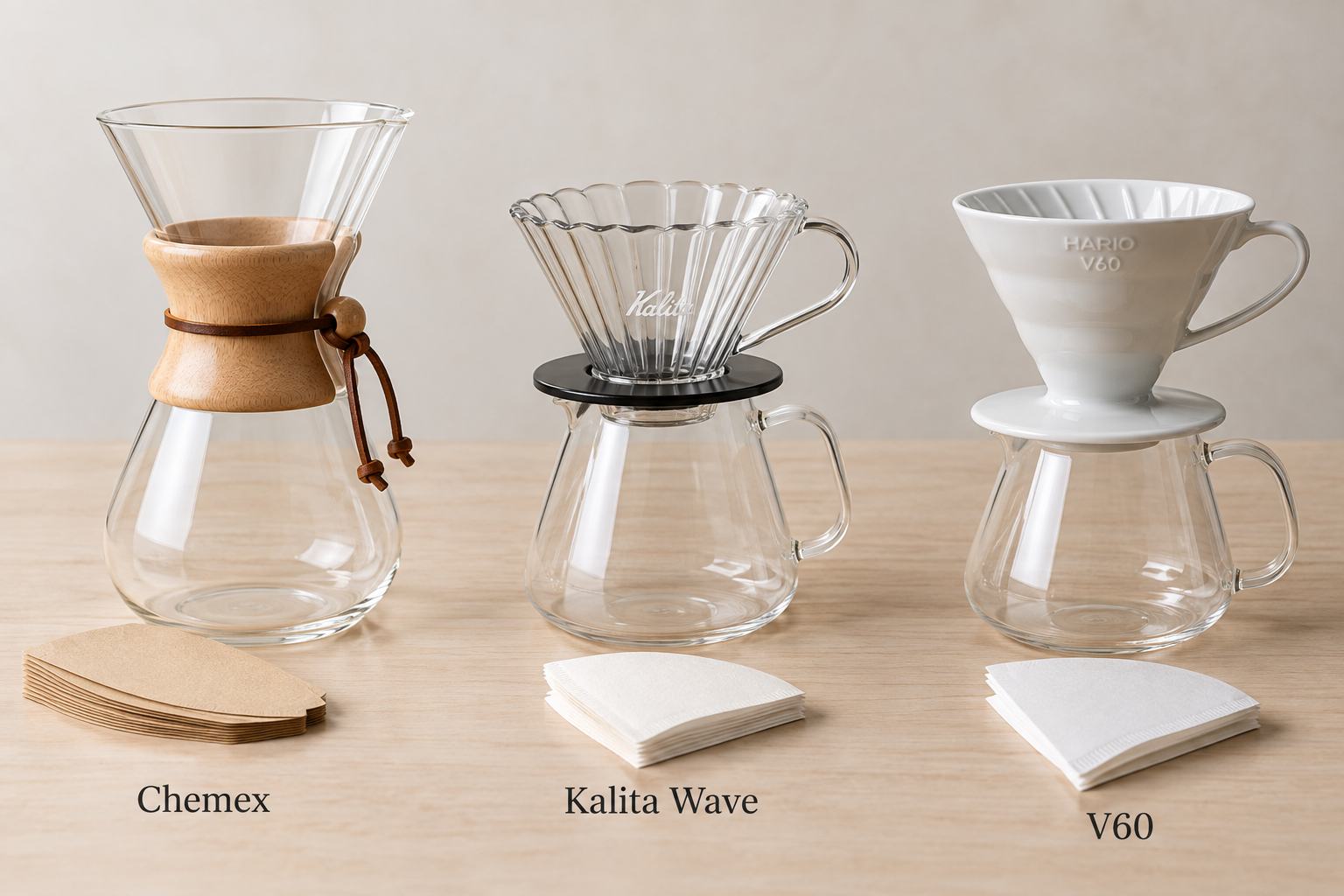
Filters: each dripper shape needs its matching filter.
- Cone drippers (V60, Melitta) need cone-shaped filters sized to that specific model.
- Flat-bottom drippers (Kalita Wave) need flat-bottom filters with matching perforations.
- Chemex needs its own thicker, proprietary filter paper, which also explains part of its cleaner cup.
A "regular" drip coffee filter (the round basket style from an electric drip machine) will not seat correctly in most pour over drippers and can collapse or channel water unevenly. If you're shopping for the best pour over coffee filter, stick to the shape stamped on the dripper's packaging rather than assuming filters are interchangeable.
For readers chasing the best plastic-free coffee maker setup, pair a ceramic or glass dripper with unbleached paper filters, or look at metal reusable filters, which cut paper waste entirely at the cost of a slightly heavier-bodied cup since more fine oils pass through.
Why is my pour over coffee bitter or weak
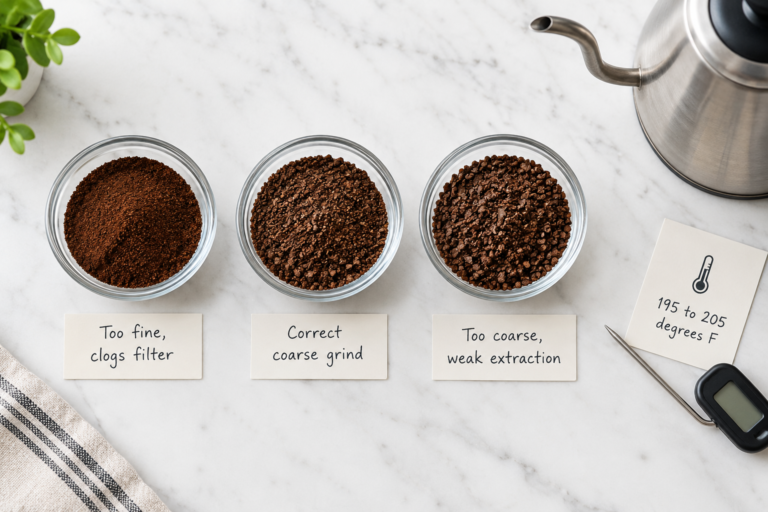
Bitter pour over coffee usually means over-extraction: too fine a grind, too much time, or water too hot. Weak pour over coffee usually means under-extraction: too coarse a grind, too little time, or a brew ratio with too much water for the coffee used.
Quick troubleshooting table:
| Symptom | Likely cause | Fix |
|---|---|---|
| Bitter, harsh finish | Grind too fine, water too hot, brew too slow | Coarsen grind slightly, use water at 195-205°F, pour a bit faster |
| Sour, weak, watery | Grind too coarse, water too cool, brew too fast | Fine-tune grind finer, confirm water near boiling, slow the pour |
| Uneven, muddy cup | Filter didn't rinse, poor bloom, off-center pour | Rinse filter first, bloom 30-45 seconds, pour in a steady spiral |
| Flat, one-note flavor | Stale beans or skipped bloom | Check roast date, always bloom before the main pour |
Common mistake: skipping the bloom step entirely. Without it, trapped carbon dioxide in freshly roasted grounds pushes water around unevenly, leaving pockets of both over- and under-extracted coffee in the same cup.
Edge case: if your coffee tastes fine one day and off the next with the exact same recipe, check your water temperature source. An electric kettle that's been sitting can drop several degrees between boils, which is enough to shift extraction noticeably.
If bitterness keeps showing up no matter what you adjust, our guide on best ways to perfect advanced coffee brewing goes deeper into ratio and grind troubleshooting than a single table can cover.
Pour Over Ratio Calculator
Based on a standard 1:15 coffee-to-water ratio.
FAQ
Is a pour over coffee maker better than a drip machine? Pour over gives more control over temperature, timing, and pour pattern, which usually produces a cleaner, brighter cup. A standard drip machine sprays water evenly and fast, trading some of that clarity for hands-off convenience. Neither is universally better, they suit different mornings.
How long does it take to make pour over coffee? A manual pour over brew typically takes 3 to 5 minutes from bloom to drawdown, depending on the dripper shape and grind size. Automatic pour over machines run on a similar timeline since they replicate the same pour and drain stages.
Can you use regular coffee filters in a pour over dripper? No, not reliably. Cone drippers need cone filters, flat-bottom drippers need flat filters, and Chemex needs its own thicker filter paper. A round drip-machine filter usually collapses or seats incorrectly in a pour over cone.
Do I need a gooseneck kettle for pour over coffee? It's not required, but it makes pouring a thin, steady stream far easier, which improves consistency, especially on a V60 that rewards precise pour control. A regular kettle works if you pour slowly and carefully.
What is the best pour over coffee maker for beginners? The Clever Dripper is one of the most forgiving options because it combines immersion brewing with a pour over filter, reducing technique errors. A basic plastic V60 or Melitta cone is also an inexpensive, low-risk starting point.
Is an automatic pour over machine worth the extra cost over a manual dripper? It depends on how much you value your own time. Automatic machines like the Fellow Aiden or Cosori Juni automate bloom and pour pattern for a consistent cup every time, but they cost roughly 6 to 15 times more than a quality manual dripper.
Conclusion
There is no single best pour over coffee maker, only the right one for how you actually drink coffee. If you like the process, a manual dripper like the Hario V60 or Chemex Classic 6-Cup gives you the most control for the least money. If you want the flavor without the standing around, an automatic pour over coffee machine like the Fellow Aiden or Cosori Juni gets close to a hand pour with a button press.
Start cheap if you're not sure yet. A $20 to $35 manual dripper answers whether you actually like this brewing style before you spend $300 on a machine to find out the same thing. Once you know, upgrading gets a lot easier to justify.
Keep Exploring Coffee Rank IQ
- Coffee Rank IQ home: reviews, brewing guides, and coffee science
- Best Cold Brew Coffee Maker: 6 Picks for Smooth Batches at Home
- Best Iced Coffee Maker: Brew-Over-Ice and Cold Brew Picks Compared
- Pour Over Coffee Ratio: The Number Baristas Start With
- Best Drip Coffee Maker: 7 Brewers Worth the Counter Space
References
- www.cnn.com/cnn-underscored/reviews/best-pour-over-coffee-maker
- www.forbes.com/sites/forbes-personal-shopper/article/best-coffee-makers
- brewgazette.com/best-automatic-pour-over-coffee-maker
- www.driproast.com/best-automatic-pour-over-coffee-machine
- www.businessinsider.com/guides/kitchen/best-coffee-makers
- www.driproast.com/the-best-pour-over-coffee-makers
- coffeecorner.com/gear/best/pour-over-coffee-makers
- www.tomsguide.com/home/best-pour-over-coffee-makers
- www.coffeeness.de/en/best-automatic-pour-over-coffee-maker
- coffeelighthouse.com/articles/best-automatic-pour-over-coffee-makers.html