

Flat White vs Latte: The Microfoam Detail Most Cafes Skip
Quick answer
A flat white uses less milk, a thinner layer of microfoam, and usually two espresso shots in a small cup, which makes it taste more like coffee. A latte uses more milk, a thicker foam cap, and often one shot in a larger cup, which makes it taste more like warm milk. The real difference in flat white vs latte comparisons isn't the shot count, it's how much air gets stretched into the milk and how thin that foam layer ends up on top.
Key takeaways
- Flat white vs latte comes down to milk volume, foam thickness, and how coffee-forward the final drink tastes.
- Microfoam in a flat white sits under a centimeter thick. A latte's foam cap often runs a centimeter or more.
- A traditional flat white uses a double shot in a 5 to 6 ounce cup. A latte typically fills 8 to 12 ounces.
- The flat white started in Australia and New Zealand in the 1980s, not Italy.
- Starbucks added the flat white to US menus in 2015, using a specific ristretto shot recipe.
- Cafes mess up flat whites most often by over-aerating the milk, which turns it into a small latte.
- Whole milk with 3.25 percent fat builds the tightest, glossiest microfoam.
- Calorie differences between the two drinks come mostly from milk volume, not the espresso.
Flat white vs latte: what's the difference
A flat white is a smaller, stronger drink built on a thin layer of microfoam, while a latte is a larger, milkier drink topped with a deeper foam cap. The espresso ratio stays similar, but the milk texture and pour volume change the whole experience.
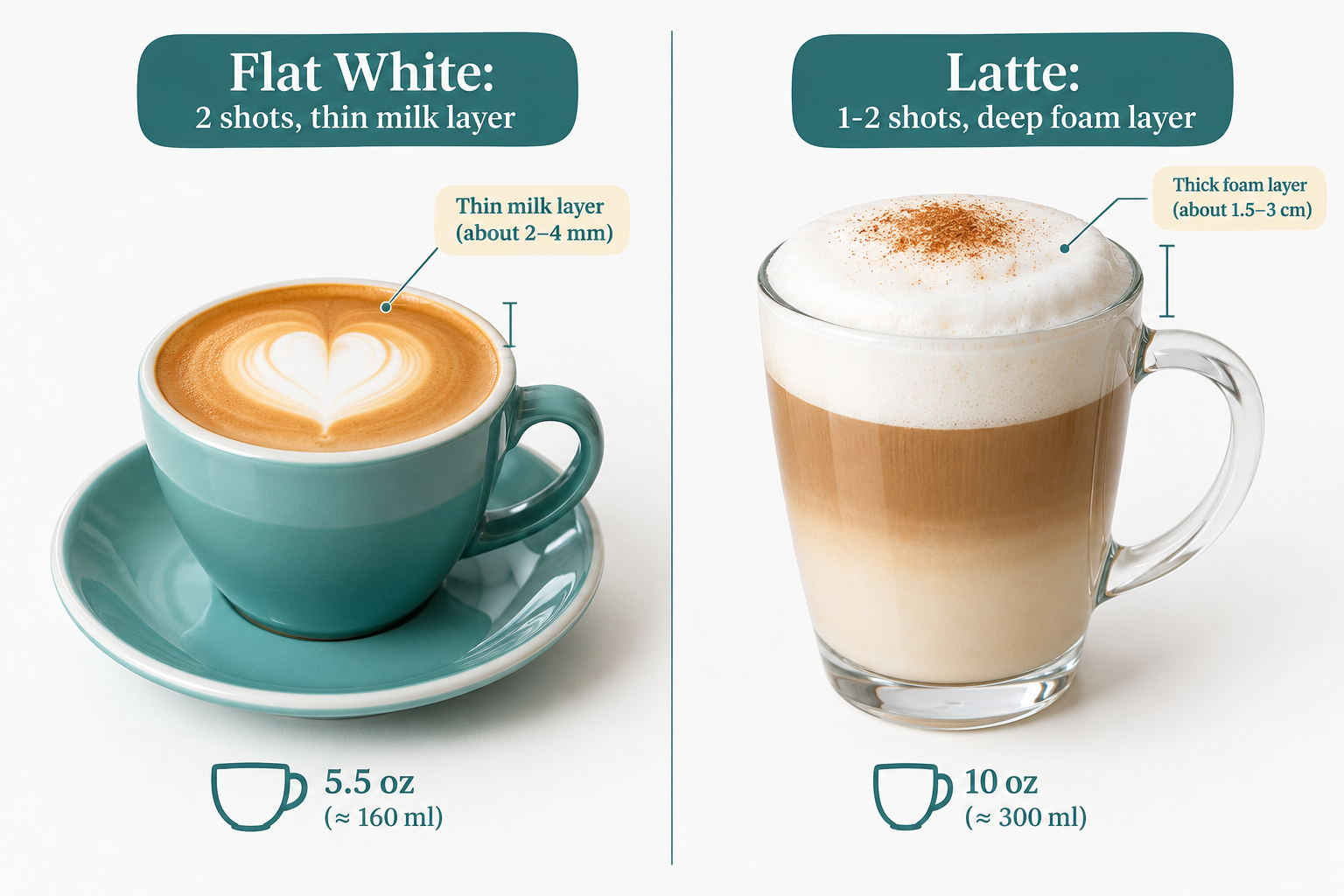
Here's what actually separates them, according to café guides and roasters that have started publishing standardized ratios in 2025 and 2026:
- Cup size. Flat white: 5 to 6 ounces. Latte: 8 to 12 ounces.
- Foam depth. Flat white: under 1 centimeter. Latte: 1 centimeter or more.
- Milk stretch. Flat white milk is stretched less, keeping bubbles small and tight. Latte milk is stretched more, building volume and a spoonable foam layer.
- Flavor balance. Flat white is coffee-forward. Latte is milk-forward.
Choose a flat white if you want the espresso to lead. Choose a latte if you want a softer, sweeter mouthfeel with more milk to balance the bitterness. That's the working answer to what's the difference between a flat white and a latte, and it holds across most café menus in the US today.
Why is microfoam important in a flat white
Microfoam is the thin, glossy layer of tiny bubbles that gives a flat white its silky texture without adding much volume. Without it, a flat white just becomes a small latte with the same thick foam cap, which defeats the entire point of the drink.
Microfoam forms when a steam wand introduces a small, controlled amount of air into cold milk, then breaks that air into bubbles so fine the milk looks glossy rather than foamy. Baristas measure success by sight and touch: the surface should look like wet paint, not shaving cream. Coffee Lab Advisor describes this glossy, close-grained texture as the main technical marker that separates a flat white from other milk drinks. Brewsift's side-by-side testing found the same pattern: flat white foam reads as "glossy microfoam," while latte foam reads as an "airier foam cap" with visibly bigger bubbles.
The practical result: microfoam integrates into the espresso instead of sitting on top of it. That's why a flat white tastes rounder and more even, while a latte can taste like two separate layers, milk on top and coffee underneath, until you stir it. Our guide on easy steps to creating a rich flat white walks through the pour technique that keeps microfoam intact from pitcher to cup.
How much milk is in a flat white vs latte
A flat white typically uses 4 to 5 ounces of steamed milk in a 5 to 6 ounce cup. A latte typically uses 6 to 10 ounces of steamed milk in an 8 to 12 ounce cup, depending on size ordered.
The gap looks small on paper but changes the drink completely:
| Drink | Typical cup size | Milk volume | Foam depth |
|---|---|---|---|
| Flat white | 5 to 6 oz | 4 to 5 oz | Under 1 cm |
| Latte | 8 to 12 oz | 6 to 10 oz | 1 cm or more |
| Cappuccino | 6 oz | 3 to 4 oz | 1.5 to 2 cm |
| Cortado | 4 oz | 2 oz | Minimal |
Sources: The Espresso Report and KitchenAid's brewing guides both list similar ranges for 2025 to 2026 standardized ratios. If a barista pours a flat white into a 12 ounce cup, you're not getting a flat white anymore, you're getting a latte with a different name on the cup sleeve.
Can you make a flat white with a regular espresso machine
Yes. Any espresso machine with a steam wand capable of texturing milk can make a flat white. The main requirement isn't the machine, it's controlling how much air goes into the milk during steaming.
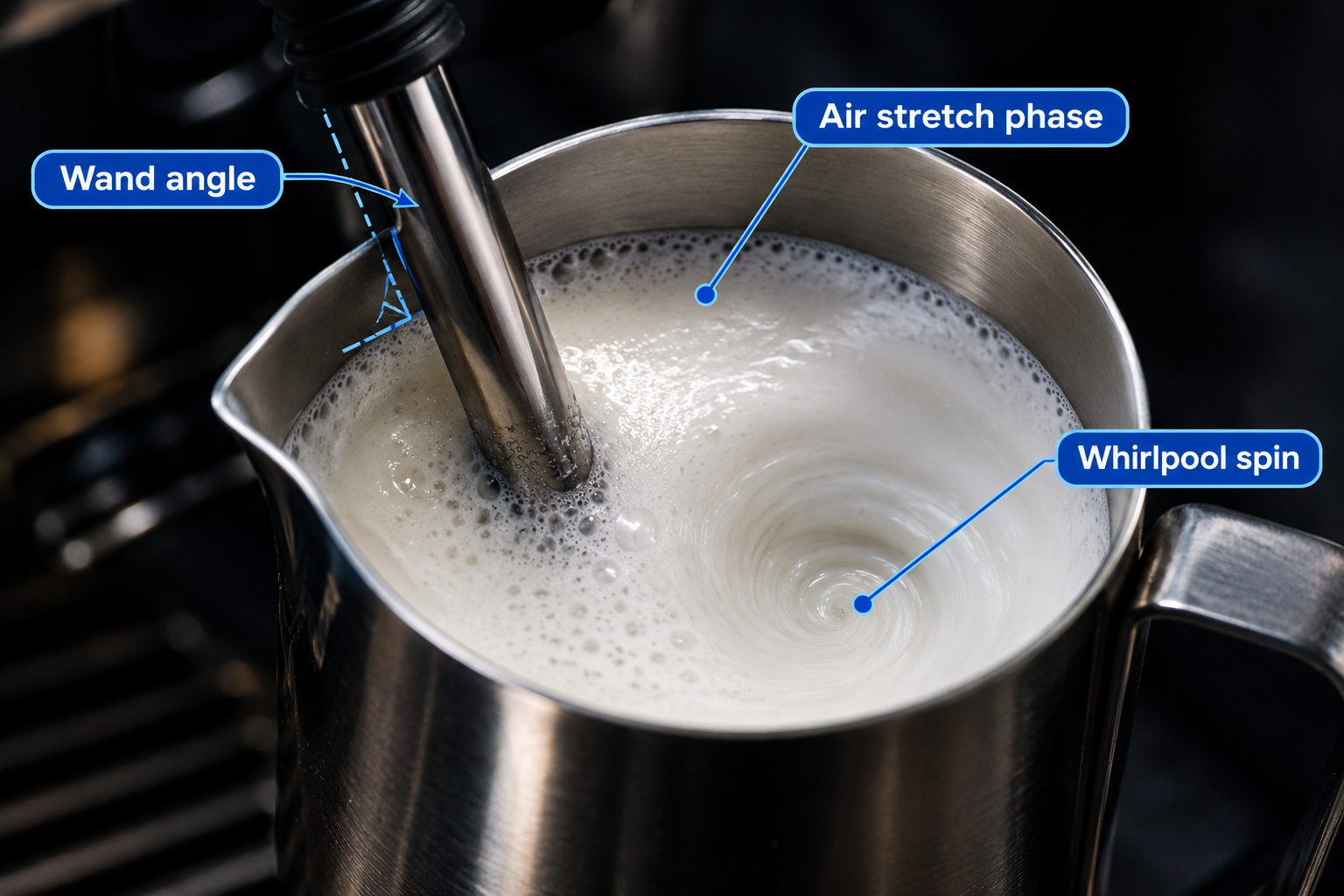
Entry-level and mid-range machines from brands like Breville handle this well because their steam wands give enough control to stretch milk gently instead of blasting it into big-bubble foam. What actually limits home flat whites is technique, not hardware:
- Espresso quality. A weak or over-extracted shot gets exposed fast in a small, milk-light drink. Grind size and dose matter more here than in a latte, where extra milk can hide flaws.
- Steam wand control. You need to keep the wand tip just under the milk surface for a few seconds of air stretch, then submerge it to spin the milk into a whirlpool.
- Pitcher size. A smaller pitcher (12 to 20 ounces) makes it easier to judge when you've stopped stretching air into a flat white's smaller milk volume.
If your machine can steam milk at all, you can make a flat white. Our most popular milk steaming techniques guide breaks down wand position step by step, and it applies whether you're working with a $300 machine or a $1,200 one.
What does microfoam actually taste like
Microfoam itself doesn't taste sweeter or richer than regular steamed milk. Tasting panels and café guides describe it as smoother and silkier in texture, not different in flavor, because the fine bubble structure changes mouthfeel more than taste.
The sensation comes from how evenly the tiny bubbles distribute fat and protein across your tongue. Airier foam, the kind you get in a badly steamed latte, tends to feel dry and separates quickly, leaving a thin film. Story of Coffee's tasting comparisons found flat white microfoam reads as "silky" and integrates into the espresso, while looser foam sits apart and tastes flatter by the time you reach the bottom of the cup.
If you want to notice the difference at home, steam two small batches of milk: one stretched heavily into big foam, one stretched briefly into microfoam. Taste them side by side with a spoon before adding coffee. The texture gap is obvious once you're paying attention to it.
Flat white vs latte: which one has more espresso
A flat white usually contains the same or slightly more espresso than a latte, because both commonly use a double shot, but the flat white's smaller milk volume makes that espresso taste stronger.
Standard shot counts by size:
- Flat white: Double shot (about 2 ounces of espresso) in 5 to 6 ounces of total drink.
- Latte, 8 oz: Single or double shot depending on the shop.
- Latte, 12 oz or larger: Usually double shot, sometimes more for larger sizes.
Some cafes, including certain Starbucks locations, build their flat white on ristretto shots, a shorter, more concentrated pull that uses less water for the same coffee dose. Ristretto shots taste denser and slightly sweeter than a standard shot, which fits the flat white's coffee-forward identity. So in a flat white vs latte comparison at equal shot counts, the flat white wins on intensity per sip, not necessarily on total caffeine.
How do cafes mess up flat whites
The most common mistake is over-aerating the milk, which builds foam depth closer to a latte or cappuccino instead of the thin microfoam a flat white needs. The second most common mistake is pouring into a cup that's too large, which dilutes the espresso-to-milk ratio.
Origin Coffee's technique breakdown points to timing as the real skill gap: baristas who don't count their air-stretch seconds tend to add too much air out of habit, since most training focuses on latte and cappuccino volume first. A few other repeat mistakes:
- Skipping the whirlpool spin. Without spinning the milk after the air stretch, bubbles stay large and uneven instead of breaking down into microfoam.
- Using cold cups. A cold ceramic cup pulls heat out of the drink fast, which can make thin microfoam collapse before you serve it.
- Treating it as a small latte on the register. Many point-of-sale systems still code flat whites as a latte variant, which trains new staff to pour it the same way.
If your flat white arrives looking like a mini latte with a thick foam dome, that's the tell. The milk was stretched for a latte, then poured into a smaller cup.
Is a flat white just a small latte
No. A flat white is not simply a smaller latte, even though the ingredients overlap. The espresso-to-milk ratio, the foam thickness, and the milk-stretch technique are all different, not just scaled down.
Expert Cafe's teaching framework calls this "the three milk decisions" bartenders make on every order: how much air to add, how hot to steam, and how much total milk to pour. A flat white and a small latte can start from the same espresso shot and still end up as different drinks because the milk decisions diverge at every step. Shrinking a latte recipe into a smaller cup without changing the air-stretch time just produces a small latte with less room for the foam to sit, which often overflows or looks sloppy.
Flat white origin: Australia vs Italy latte
The flat white originated in Australia and New Zealand in the 1980s, not Italy. The latte's foundation traces back to Italian espresso culture, though the American-style latte most US drinkers know was popularized later, largely through US café chains.
Baristas in Melbourne and Wellington get credit for developing the flat white as a reaction to overly milky cappuccinos, aiming for a drink where the espresso stayed audible under a thin, controlled layer of milk. The name itself describes the goal: flat foam, not a domed cap. Italy's contribution runs through espresso technique and the caffè latte concept (literally "milk coffee"), but the specific flat white format is an Australasian invention that later spread through UK and US specialty cafes in the 2000s and 2010s.
Starbucks added the flat white to its US menu nationally in 2015, using two ristretto shots and a specific steamed milk pour meant to echo the Australian original, though café regulars sometimes debate how closely that recipe matches the source. Whatever your opinion on that debate, the Starbucks flat white did more than any single event to put the drink on American radar.
Best milk for microfoam flat white
Whole milk with roughly 3.25 percent fat builds the tightest, glossiest microfoam because its protein and fat content stabilize small bubbles without collapsing them. Lower-fat milk foams up faster but the bubbles tend to be looser and less durable.
Comparison notes from café guides:
- Whole milk: Best microfoam texture, richest mouthfeel, most forgiving for beginners.
- 2 percent milk: Decent microfoam, slightly less body, faster to steam.
- Oat milk (barista blends): Can build workable microfoam if the blend contains added fat or gums, but results vary by brand.
- Skim milk: Foams the most volume, but bubbles are larger and less stable, closer to latte or cappuccino territory than flat white microfoam.
If you're steaming at home and your microfoam keeps collapsing before you pour, switching to whole milk is the single easiest fix. Our most popular milk frothing methods guide covers fat content and temperature targets in more detail.
Flat white or latte for beginners: which should I order
Order a latte if you're new to espresso drinks and want a gentler introduction, since the extra milk softens bitterness and acidity. Order a flat white once you know you like the taste of espresso and want it more present in the cup.
A simple decision rule:
- Choose a latte if: you usually add sugar or flavored syrup to coffee, you're still building a taste for straight espresso, or you want a bigger drink that lasts longer.
- Choose a flat white if: you already drink black coffee or espresso shots comfortably, you want a smaller and stronger drink, or you dislike thick foam caps.
There's no wrong answer here. If you're just starting out with home espresso, our beginners guide to making a delicious latte is a reasonable first project before attempting the tighter margin for error that flat white microfoam demands.
How do you steam milk for microfoam properly
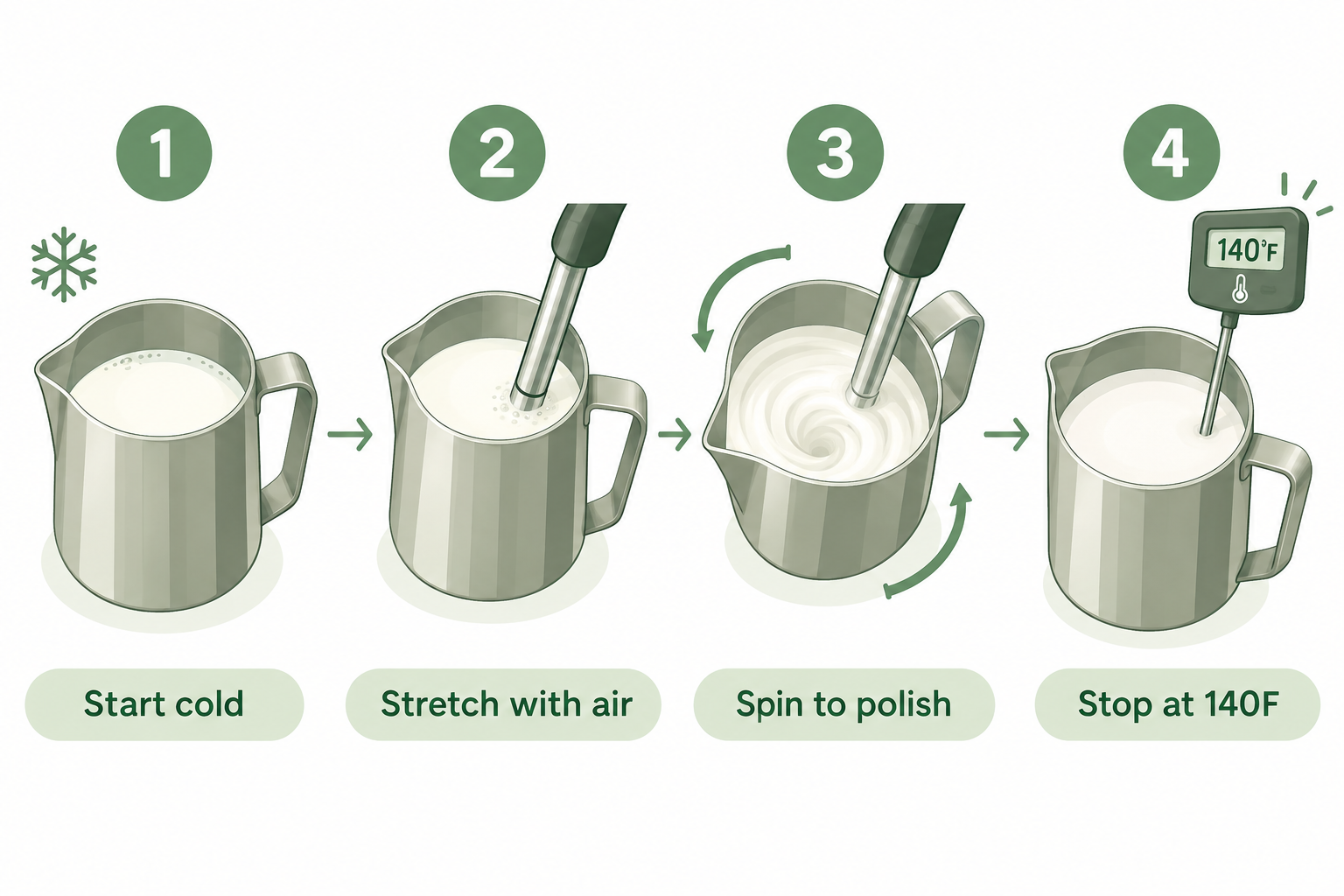
Proper microfoam comes from three steps done in order: stretch cold milk with a short burst of air near the surface, then submerge the wand tip to spin the milk into a whirlpool, then stop steaming once the pitcher feels warm to the touch, around 140°F.
Step by step:
- Start with cold milk, ideally straight from the fridge, in a pitcher filled about one-third full.
- Position the wand tip just under the surface and let it pull in air for 2 to 4 seconds. You'll hear a light hissing or "paper tearing" sound. This is the air-stretch phase that builds microfoam.
- Submerge the tip slightly deeper and angle the pitcher to create a whirlpool. This spins the larger bubbles into smaller, uniform ones, which is the step most home steamers skip.
- Watch the temperature. Stop around 140°F, before the milk feels too hot to hold your hand against the pitcher for more than a second.
- Tap and swirl the pitcher once before pouring to knock out any remaining large bubbles.
Common mistake: stretching air for too long. Ten seconds of air stretch builds latte-style foam volume, not flat white microfoam. Four seconds or less, followed by a longer whirlpool spin, is closer to the target. Our most popular advanced espresso tasting methods guide covers how to taste-test your results once you've got the pour down.
Flat white vs latte calories and nutrition
A flat white generally has fewer calories than a latte because it uses less milk, while the espresso itself contributes almost no calories either way. A typical 6 ounce whole milk flat white runs lower in calories than an equivalent 12 ounce whole milk latte, purely because of the milk volume difference.
Rough comparison using whole milk, no added sugar:
- Flat white (5 to 6 oz, whole milk): Lower calorie total, driven by roughly 4 to 5 ounces of milk.
- Latte (12 oz, whole milk): Higher calorie total, driven by 8 to 10 ounces of milk.
- Cappuccino (6 oz): Similar milk volume to a flat white, but more foam and less liquid milk, often landing between the two.
Switching to skim or oat milk lowers the calorie count for either drink, but changes the microfoam texture too, so there's a real tradeoff between calorie savings and mouthfeel. If calories matter more to you than texture, size and milk type will move the number far more than choosing flat white vs latte alone.
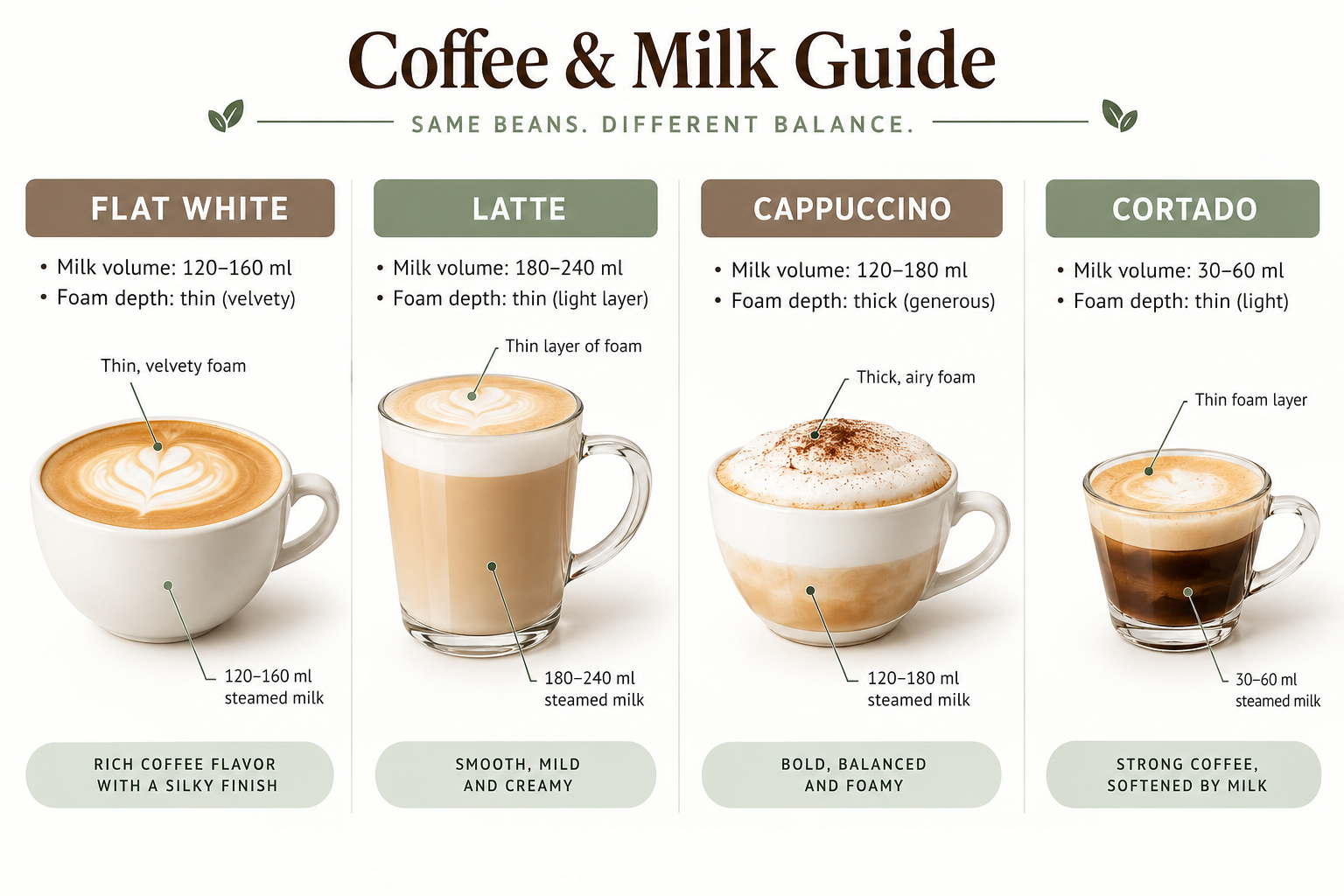
Flat white vs cappuccino vs latte vs cortado
These four drinks share the same espresso base but differ in milk volume and foam depth, which is the real axis to compare them on rather than treating them as interchangeable "milk coffee" names.
- Flat white vs cappuccino: Similar cup size, but cappuccino carries a thicker, drier foam cap (1.5 to 2 cm) while flat white stays under 1 cm of glossy microfoam.
- Flat white vs latte vs cappuccino: Ranked by foam depth, cappuccino has the most foam, latte is in the middle, flat white has the least, even though all three can start from a double shot.
- Flat white vs cortado: A cortado uses even less milk than a flat white, roughly 1:1 espresso to milk, with almost no foam layer, making it the strongest and smallest of the group.
For a fuller side-by-side including recipe steps, see our most basic coffee explainer, which starts from straight espresso before building up through milk drinks. If you want to build latte art skills on any of these bases, the advanced latte art guide covers pour technique for both thin and thick foam layers.
FAQ
What is a flat white, in one sentence? A flat white is a double shot of espresso topped with a thin layer of glossy microfoam in a small, 5 to 6 ounce cup, built to keep the coffee flavor forward.
Is a flat white stronger than a latte? It tastes stronger because it has less milk diluting the same or similar shot count, not because it necessarily contains more caffeine.
Does Starbucks flat white use ristretto shots? Yes, Starbucks builds its flat white on two ristretto shots, a more concentrated pour style, topped with steamed whole milk.
Can I make microfoam without a steam wand? You can get close with a milk frother or French press pump method, but wand steaming gives more control over air-stretch timing, which is the real skill behind microfoam.
What's the difference between a flat white and a cortado? A cortado uses less milk than a flat white and has almost no foam layer, making it smaller and more espresso-forward than either a flat white or a latte.
Why does my homemade flat white always come out like a latte? You're likely stretching too much air into the milk for too long. Cut the air-stretch phase to under 4 seconds and spend more time on the whirlpool spin instead.
Conclusion
The flat white vs latte debate isn't about which drink is better, it's about how much air and milk you want between you and the espresso. A flat white keeps the ratio tight and the foam thin, so the coffee does most of the talking. A latte gives the milk more room to round out the flavor and stretch the cup size. Once you understand that microfoam thickness, not shot count, is the real dividing line, ordering (or making) either drink gets a lot easier to get right.
If you're building a home setup around this, start with your steam wand technique before upgrading equipment. A better machine won't fix a ten-second air stretch. Practice the four-second stretch and whirlpool spin from this guide, taste the difference side by side, then decide which drink actually earns a permanent spot in your morning rotation.
Better Coffee Starts With Better Answers.
Flat white vs latte vs cappuccino vs cortado: quick reference
| Drink | Cup size | Foam depth | Best for |
|---|---|---|---|
| Flat white | 5 to 6 oz | Under 1 cm | Coffee-forward taste |
| Latte | 8 to 12 oz | 1 cm or more | Softer, milkier drink |
| Cappuccino | 6 oz | 1.5 to 2 cm | Dry foam texture fans |
| Cortado | 4 oz | Minimal | Strongest espresso taste |
Which drink matches your foam preference?
“+ “Foam depth: “+d.foam+”
“+ “Typical cup: “+d.cup+”
“+ “Character: “+d.note+ ““; } var btns=document.querySelectorAll(‘.cg-btn’); btns.forEach(function(b){ b.addEventListener(‘click’,function(){ btns.forEach(function(x){x.classList.remove(‘cg-active’)}); b.classList.add(‘cg-active’); render(b.getAttribute(‘data-drink’)); }); }); render(‘flat’);
Keep Exploring Coffee Rank IQ
- Coffee Rank IQ home: reviews, brewing guides, and coffee science
- Cappuccino vs Latte: Same Espresso, Very Different Cup
- Macchiato vs Latte: Why Your Order Tastes So Different
- How to Make an Iced Latte at Home Without Watery Regret
- Best Espresso Beans for Lattes, Straight Shots, and Budgets
References
- www.notanothersunday.com/blog/flat-white-vs-latte
- www.coffeelabadvisor.com/guides/what-is-a-flat-white
- theespressoreport.com/blog/flat-white-vs-latte
- myhomebarista.com/guides/what-is-a-flat-white
- www.expertcafe.be/en/guides/latte-vs-cappuccino-vs-flat-white-differences
- www.origincoffee.co.uk/blogs/journal/how-to-make-a-flat-white
- www.brewsift.com/blog/cappuccino-vs-latte-vs-flat-white
- www.storyofcoffee.net/learn/cappuccino-vs-latte-vs-flat-white
- www.kitchenaid.com/countertop-appliances/pinch-of-help/flat-white-vs-latte
- www.broroastery.com/What-is-a-flat-white-blog-eng-1786705230.html