Coffee on an Empty Stomach: What Actually Happens
Quick answer
For most healthy adults, coffee on an empty stomach is uncomfortable at worst, not dangerous. Coffee does stimulate stomach acid, and it can trigger heartburn in people who already have reflux. The one measured effect worth knowing: in a University of Bath trial published in the British Journal of Nutrition in 2020 (Smith and colleagues), strong black coffee taken before breakfast after a night of broken sleep raised the blood glucose response to that breakfast by roughly 50 percent in 29 healthy adults.
Key takeaways
- Coffee, decaf coffee, and pure caffeine all stimulate gastric secretion in human testing, and coffee produced more acid output than caffeine alone, which means non-caffeine compounds are involved [PubMed, 1976].
- A cross-sectional study of 8,013 healthy adults in Japan found no significant link between coffee intake and gastric ulcer, duodenal ulcer, or reflux esophagitis [PubMed, 2013].
- Gastroenterologist Asma Khapra of GastroHealth told Fox News Digital on November 2, 2026 that studies have not shown fasting coffee to cause major cortisol, blood sugar, or gut problems in most people .
- Gastroenterologist Douglas Weine, MD, lists the real symptoms as nausea, abdominal burning, heartburn, and an urgent trip to the bathroom .
- About 50 percent higher glucose response to breakfast after coffee following disrupted sleep, in 29 participants, University of Bath, 2020.
- The FDA's benchmark for most healthy adults is 400 mg of caffeine a day, roughly two to three 12 ounce coffees .
- The "wait 90 minutes after waking" rule is a reasonable habit, not a proven one. No study has shown that delaying caffeine improves energy, mood, or sleep.
Coffee on an empty stomach: what actually happens in your body
Within about 15 to 45 minutes of the first sip, caffeine reaches the bloodstream, stomach acid output rises, the hormone gastrin is released, and the colon often gets a nudge. None of that is damage. It is normal digestive machinery responding to a strong, acidic, bioactive drink.
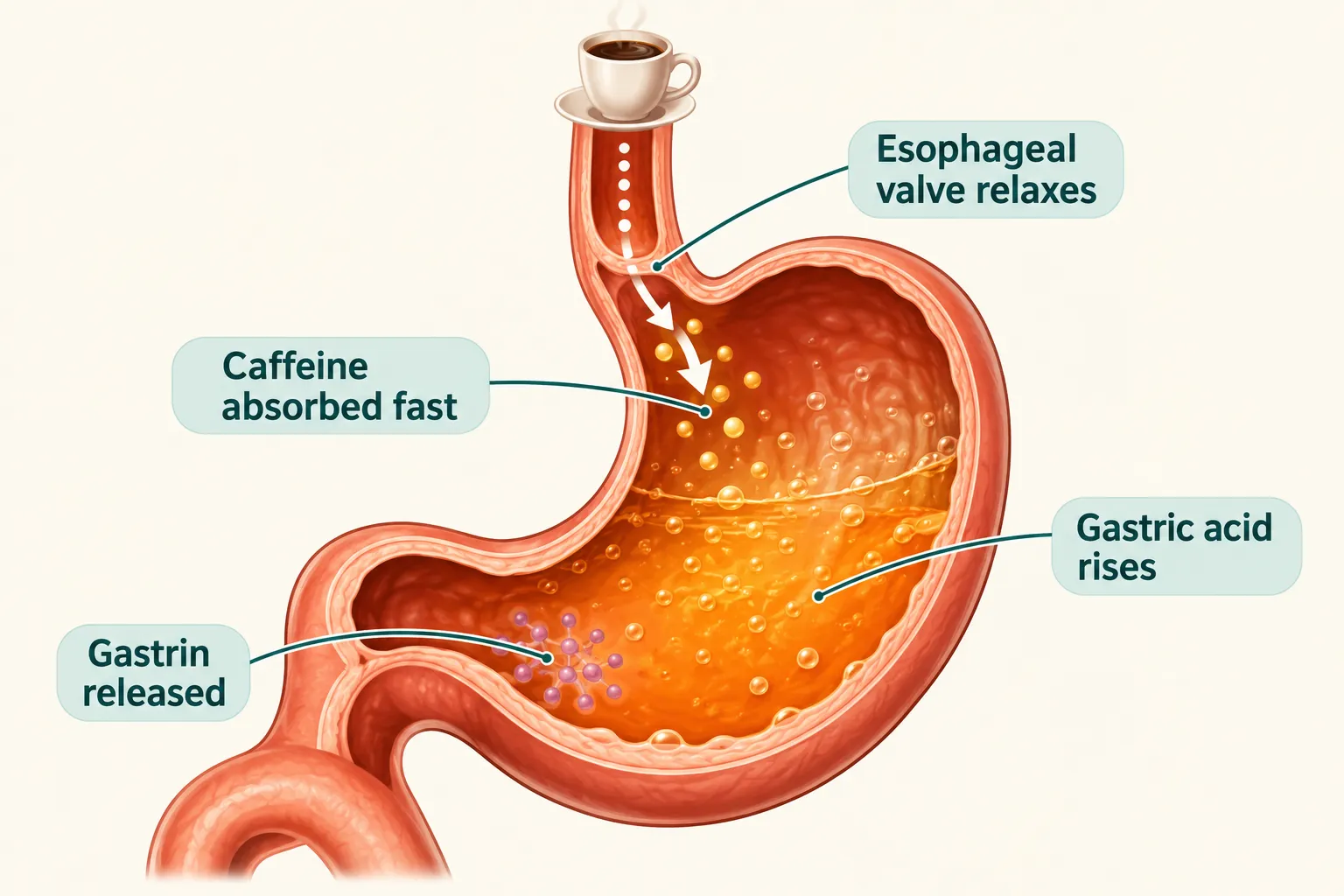
Human research indexed in PubMed in 1976 tested coffee, decaffeinated coffee, and pure caffeine on gastric secretion. All three stimulated it. Coffee and decaf produced greater acid secretion than caffeine alone, which points at chlorogenic acids and other roast compounds rather than caffeine by itself. That study was small and conducted under laboratory conditions decades ago, so treat it as a mechanism finding, not a prediction about your morning.
Three other things happen at once:
- Faster absorption. With no food in the stomach, caffeine hits peak blood levels sooner. Same dose, sharper curve.
- A colonic reflex. Coffee speeds up colon motility in many people, which is why the bathroom urge arrives before the email does.
- A modest cortisol bump. Morning cortisol is already climbing naturally. Caffeine adds to it, temporarily, and habitual drinkers blunt that response. One review summarized a study where people taking 300 or 600 mg of caffeine daily for five days no longer showed the morning cortisol response seen after abstinence.
The misconception worth correcting: people say coffee "burns a hole in your stomach lining." It does not. Acid stimulation is not erosion, and the large Japanese dataset below is the clearest evidence against that claim.
Why does coffee make me feel sick without eating first?
Nausea from coffee before breakfast usually comes from three things stacking: a fast caffeine spike with nothing to slow absorption, extra acid sloshing in an empty stomach, and low blood sugar if you skipped dinner or slept badly. It is a tolerance and timing problem, not an injury.
Dark roasts are not automatically gentler. Roast level changes chlorogenic acid content but also changes bitterness, and the acidity you taste is not the same thing as stomach acid. If a particular bag reliably makes you queasy, try a different processing method or origin before blaming the whole drink.
Quick example: someone drinking a double shot on four hours of sleep is taking a fast-absorbed dose into a system already running high on adrenaline. Nausea there is predictable. The same person, same shot, after oatmeal, usually feels nothing.
Decision rule: if the nausea appears within 20 minutes and fades after eating, it is absorption and acid. If it builds slowly over hours and comes with burning behind the breastbone, read the reflux section.
Can coffee on an empty stomach cause heartburn or acid reflux?
Yes, in susceptible people. Coffee can relax the lower esophageal sphincter, the muscular valve between the esophagus and the stomach, which makes it easier for acid to move upward. Cleveland Clinic calls the overall evidence mixed, while the US National Institute of Diabetes and Digestive and Kidney Diseases lists coffee and caffeine among common GERD triggers.
An older physiological study of 31 participants found heartburn was associated with lower baseline sphincter pressure, and 26 of the 31 symptomatic participants developed heartburn at the highest coffee dose. Small sample, controlled dosing, decades old. What it suggests is useful anyway: coffee-related heartburn tracks with pre-existing vulnerability rather than universal harm.
If you have diagnosed GERD, a hiatal hernia, gastritis, or an ulcer, this is a conversation for your gastroenterologist, not a blog. They can tell you whether to cut coffee, switch to a lower-acid preparation, or adjust medication timing.
Does coffee damage your stomach if you don't eat?
The best available population evidence says no. A cross-sectional study of 8,013 healthy people in Japan found no significant relationship between coffee consumption and gastric ulcer, duodenal ulcer, reflux esophagitis, or non-erosive reflux disease.
Two limitations matter. It was cross-sectional, so it measures association at one point in time and cannot establish cause. And it studied healthy people, so it says nothing about whether coffee aggravates symptoms in someone who already has GERD. Association is not causation, in either direction.
On long term stomach problems from drinking coffee without food, the honest answer is that nobody has run the trial. No high-quality randomized study has compared the same coffee consumed fasting versus after breakfast over years. What exists examines coffee, caffeine, reflux, cortisol, and glucose separately, usually in short-term studies with small samples.
Coffee before or after food: which is better?
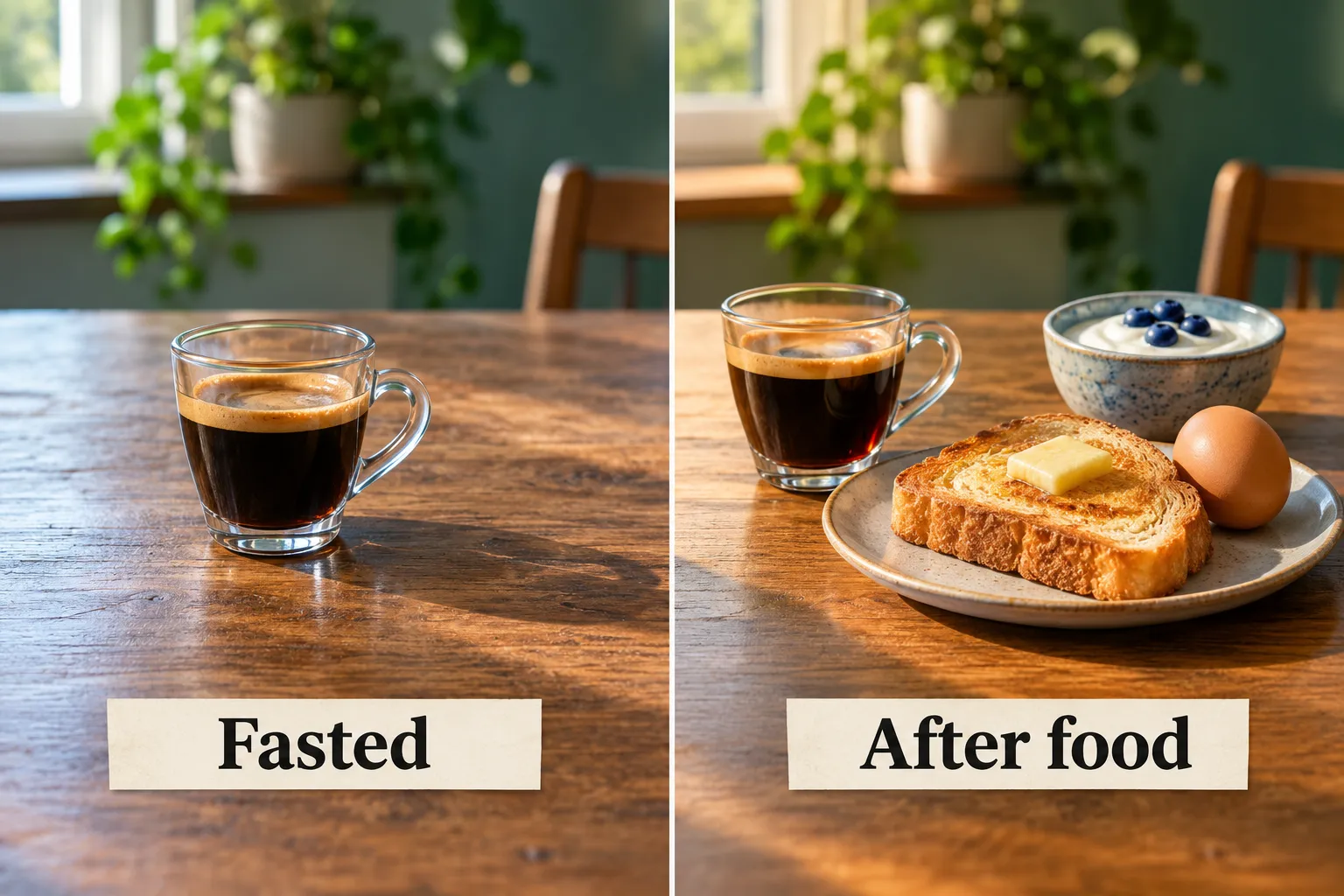
For most people, after food is slightly gentler on the stomach and steadier on blood sugar. For people who feel fine fasted, before food is not a health problem. The coffee blood sugar morning effect is the one real, measured reason to eat first.
The Bath trial is worth describing properly. Smith and colleagues, British Journal of Nutrition, 2020, tested 29 healthy men and women across three overnight conditions: normal sleep, a night of disrupted sleep, and disrupted sleep followed by strong black coffee (about 300 mg caffeine) 30 minutes before a sugary breakfast drink. Broken sleep alone did not meaningfully worsen the glucose response. Coffee before breakfast after broken sleep raised it by roughly 50 percent. Limitations: 29 participants, a single acute test, a liquid carbohydrate breakfast rather than real food, and no long-term outcomes measured.
| Scenario | Stomach comfort | Blood sugar | Best for |
|---|---|---|---|
| Black coffee, fasted, normal sleep | Fine for most; acid symptoms in reflux-prone drinkers | No major documented issue | Habitual drinkers with no gut symptoms |
| Black coffee, fasted, after broken sleep | More jitter and nausea reported | ~50% higher glucose response to breakfast (Bath, 2020) | Nobody, really. Eat first. |
| Coffee 20 to 30 min after breakfast | Gentlest option | Avoids the fasted glucose effect | Reflux, gastritis, insulin resistance, bad sleepers |
| Milk coffee, fasted (latte, cortado) | Often easier; milk buffers and dilutes | Some protein and fat slows absorption | People who want coffee before food anyway |
If milk drinks are new territory, our explainer on what a cortado is covers the small, milk-heavy format baristas reach for.
Why do I feel jittery or anxious when you drink coffee without food?
Jitters on an empty stomach come from fast caffeine absorption meeting a morning when cortisol and adrenaline are already elevated. Food slows absorption. No food means a steeper peak.
The empty stomach coffee cortisol story has been oversold online. Caffeine does increase cortisol secretion, and Dr. Weine described the extra rise as modest and temporary, with regular drinkers developing tolerance . Australian coverage from July 2026 made the sharper point: existing studies compare caffeine against placebo or look at time of day, and none demonstrate that drinking coffee before breakfast causes chronic cortisol problems .
What usually fixes jitters is dose, not timing:
- Cut the brew ratio. A 1:17 pour over tastes complete at a lower caffeine load than a 1:14 concentrate. See our pour over guide for the ratios.
- Check your total intake against the FDA's 400 mg daily benchmark . A single large cafe drip can carry 250 mg.
- Watch the half-life. Mayo Clinic and the AMA both flag afternoon caffeine as a sleep disruptor, and poor sleep makes the next morning's jitters worse .
How long after waking should you wait to drink coffee?
There is no proven number. Hackensack Meridian Health endocrinologist Dr. Aditi Cheng suggests roughly 60 to 90 minutes, reasoning that cortisol rises naturally after waking. An evidence review published this year noted that no study has shown delaying caffeine improves energy, mood, body composition, or sleep.
Treat it as a cheap experiment rather than a rule:
- Keep your normal coffee for one week and note energy and stomach comfort.
- The next week, push the first cup to 60 minutes after waking, with food.
- Compare. If nothing changed, go back to what you enjoy.
Common mistake: delaying coffee by 90 minutes and then drinking twice as much. Total dose beats timing almost every time.
What should you eat before coffee, and does milk help?
A small amount of protein, fat, or starch is enough. You do not need a full breakfast. Milk or cream genuinely helps some people, because it dilutes the brew, buffers acidity slightly, and adds fat and protein that slow gastric emptying.
Options that take under two minutes:
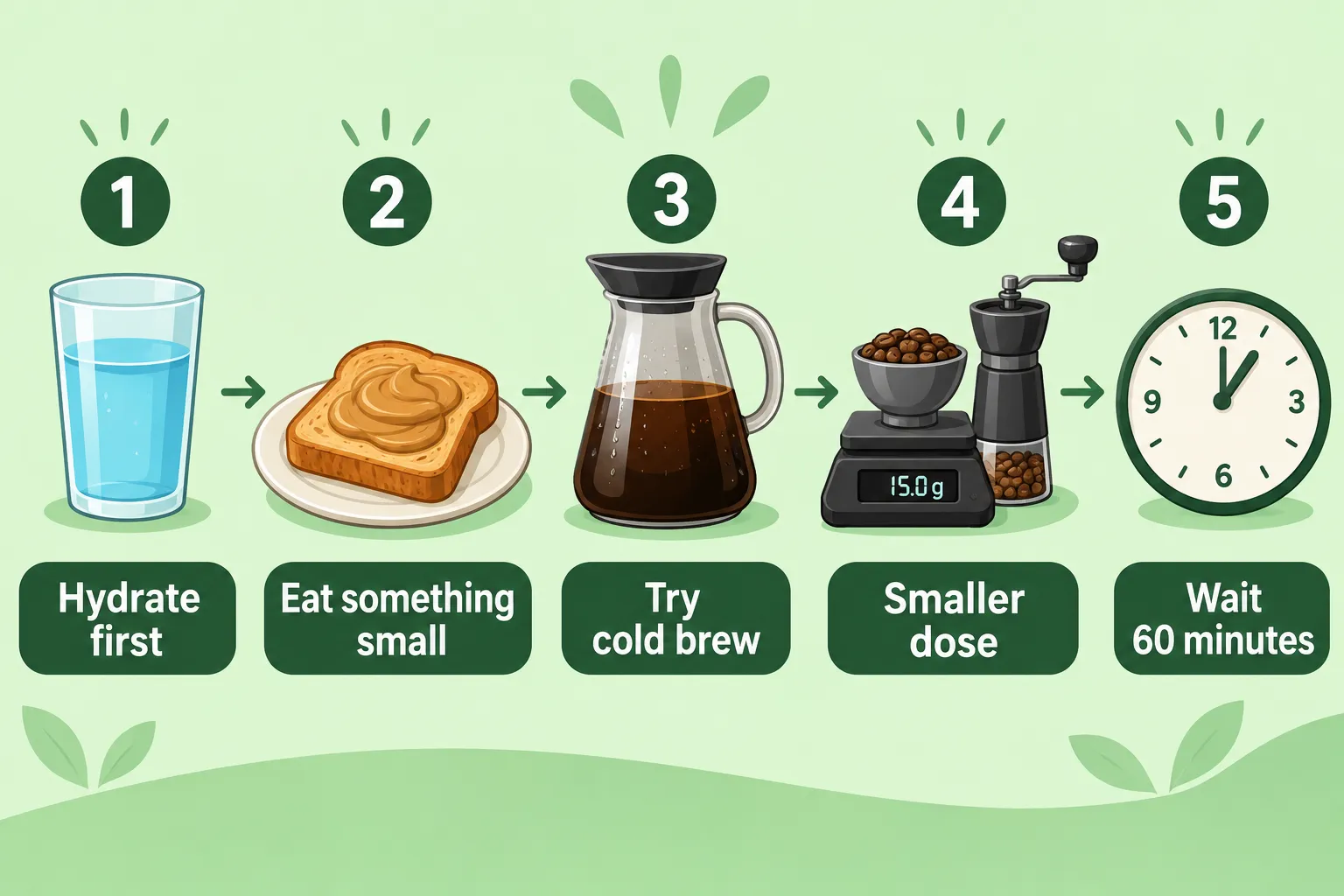
- A slice of wholegrain toast with peanut butter
- Plain yogurt or kefir, a few spoonfuls
- A banana and a handful of almonds
- A boiled egg from the fridge
- A glass of water first, which also answers the question in our piece on whether coffee dehydrates you
Milk caveat: if you are lactose intolerant, a latte on an empty stomach can produce exactly the bloating and cramping you blamed on coffee. Oat milk sidesteps that. Sugary syrups are a separate issue, and Dr. Khapra specifically flagged added sugar and cream as the variables that change the picture .
How to prevent coffee from upsetting your stomach
Change one variable at a time: food, dose, brew method, or timing. Most people fix it on the first or second attempt.
- Eat something small first. The highest-return change.
- Drop the dose. Use a scale. A 15 g dose instead of 22 g is a real reduction.
- Try cold brew. Long cold extraction produces a lower-acidity cup for many drinkers. Our cold brew beginner's guide covers ratios and steep times.
- Use a paper filter. Paper traps more of the oils that some drinkers find harsh.
- Lower the water temperature slightly. Around 195°F instead of 205°F pulls fewer bitter compounds. See coffee brewing temperature.
- Pick arabica over heavy robusta blends. Robusta carries roughly double the caffeine, as covered in our piece on the disadvantages of robusta coffee.
Reasonable alternatives if coffee before breakfast keeps going badly: a half-caff brew, a single shot cortado, green tea, matcha, or a proper decaf, which still contains a small amount of caffeine. Note that decaf still stimulated gastric secretion in the 1976 testing, so it solves the caffeine problem and only part of the acid one.
Should you eat before your coffee?
Who should avoid coffee before eating breakfast?
Four groups have a practical reason to eat first, and none of them involve the general population.
- People with diagnosed GERD, gastritis, or peptic ulcers. Coffee can aggravate existing symptoms. Ask your gastroenterologist about your specific case.
- People with insulin resistance, prediabetes, or type 2 diabetes. The Bath finding on fasted coffee and glucose is most relevant here, and your clinician should weigh in.
- Anyone on a night of poor sleep. Same reason, measured directly.
- People prone to anxiety or panic symptoms. The AMA notes caffeine can worsen anxiety and heart palpitations in sensitive people .
Pregnancy and heart conditions are a caffeine-total question rather than a timing question. The FDA and Mayo Clinic both treat daily intake as the number that matters .
FAQ
Conclusion
Coffee on an empty stomach is not the health hazard social media says it is, and it is not entirely neutral either. Acid goes up. Caffeine arrives faster. If you slept badly, your breakfast glucose response is measurably higher. Those are real effects with small, cheap fixes.
Your next step: for one week, eat something small before your first cup on days you slept poorly, and weigh your dose so you know what you are actually drinking. If the nausea or burning continues once food and dose are controlled, take it to a doctor rather than another brewing tweak. Better Coffee Starts With Better Answers, and the answer here is mostly reassuring.