
Is Instant Coffee Bad for You? The Biobank Numbers
Quick Answer
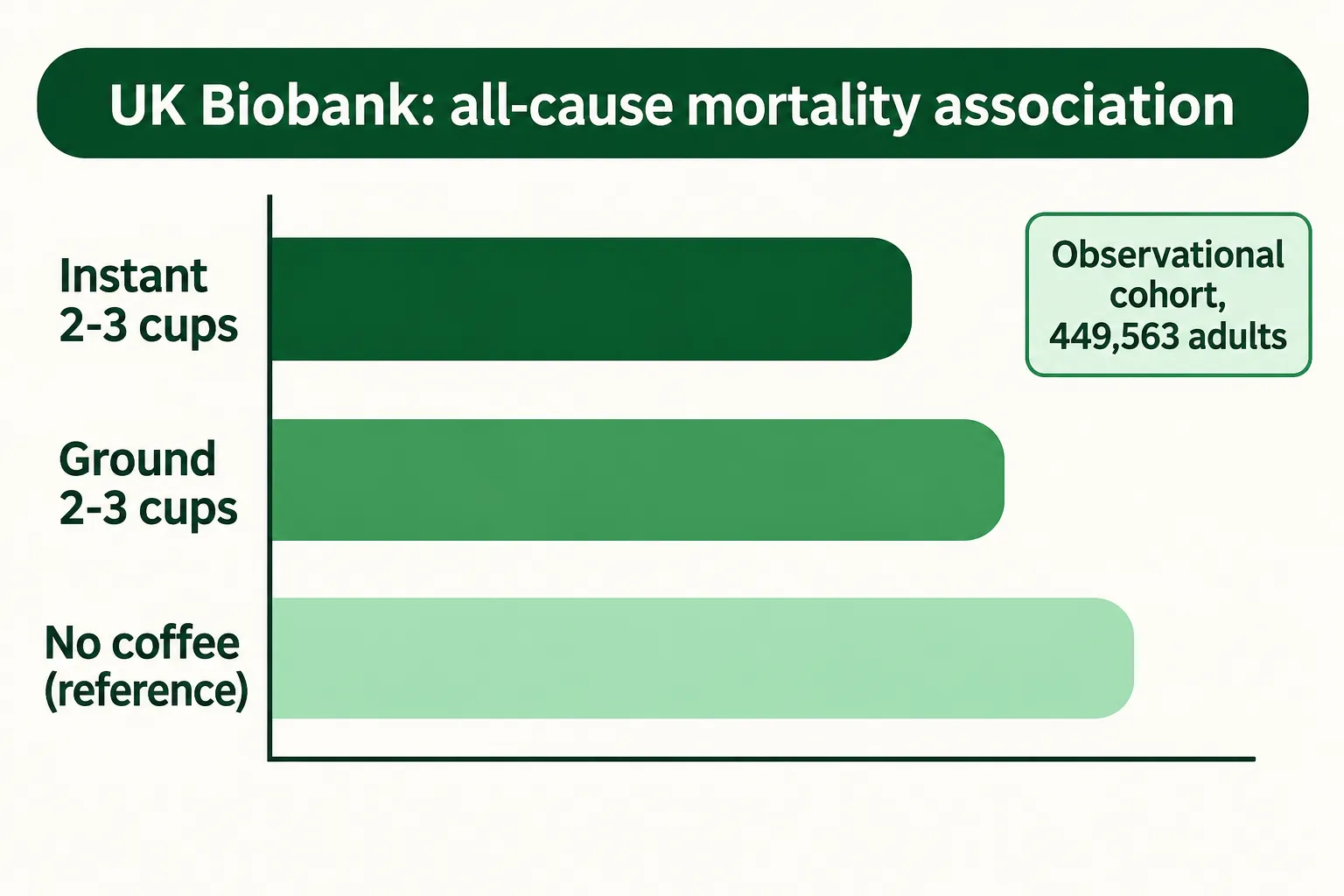
In the UK Biobank coffee subtype analysis of 449,563 adults, drinking 2 to 3 cups of instant coffee a day was associated with an 11% lower rate of death from any cause compared with drinking none (hazard ratio 0.89, 95% CI 0.86 to 0.93) . Ground coffee at a similar intake tracked with a larger reduction, so instant looks slightly less protective, not harmful. These are associations from an observational cohort, not proof that instant coffee causes anything.
Key Takeaways
- The headline number: instant coffee at 2 to 3 cups daily, HR 0.89 for all-cause mortality in UK Biobank, roughly 11% lower relative risk versus non-drinkers .
- Cohort size and follow-up: 449,563 participants, median age 58, 55.3% women, followed about 12.5 years .
- Arrhythmia: instant coffee's lowest observed risk was also at 2 to 3 cups daily (HR 0.88). Ground coffee's lowest was at 4 to 5 cups (HR 0.83) .
- Caffeine is not the whole story. An earlier UK Biobank analysis of 498,134 adults found lower mortality associations in both fast and slow genetic caffeine metabolizers .
- Acrylamide is real but formed during roasting, not when you stir granules into hot water, and the FDA says home brewing adds none .
- Caffeine per cup: roughly 60 to 80 mg for a typical teaspoon of instant, usually below a drip or pour over mug.
- Nobody has run a randomized trial proving instant coffee prevents disease. Everything above is correlation with adjustment, and residual confounding remains.
So, is instant coffee bad for you?
No. Based on the largest subtype analysis available, is instant coffee bad for you at ordinary intake? The UK Biobank data says the opposite direction: 2 to 3 cups a day sat with an 11% lower all-cause mortality rate than drinking none, and all three coffee categories studied (instant, ground, decaffeinated) were associated with lower incident cardiovascular disease around the same 2 to 3 cup mark .
That is the straight answer. Now the detail that makes it honest.
The analysis followed 449,563 UK Biobank participants, median age 58, 55.3% women, for a median of roughly 12.5 years . Coffee intake was self-reported at enrollment, which means a single snapshot stood in for more than a decade of habits. People change. Someone who reported three instant coffees in 2008 may have bought a burr grinder in 2013 and never touched a jar again.
The study also cannot separate instant coffee from the person drinking it. In the UK, instant drinkers skew differently from ground-coffee drinkers on income, smoking, diet, and exercise. The researchers adjusted for the usual suspects. Adjustment is not elimination.
)
So the defensible sentence is this: in a very large British cohort, moderate instant coffee drinking was associated with lower mortality and lower cardiovascular disease. Not caused. Associated.
If you have a heart rhythm condition, high blood pressure, an anxiety disorder, reflux, or you are on medication that interacts with caffeine, your doctor's advice beats a cohort study every time. Population averages do not know your chart.
What's actually in instant coffee?
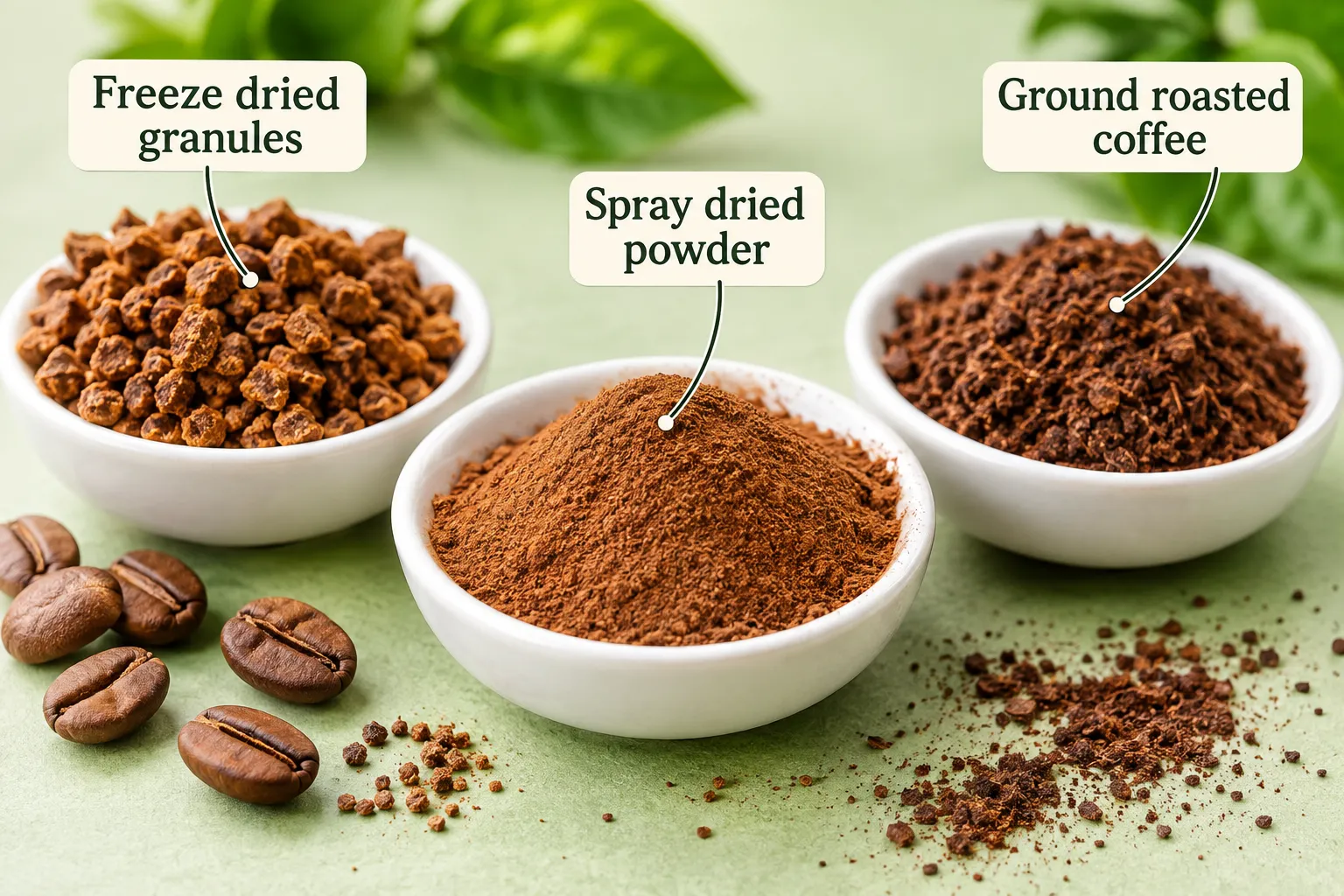
Instant coffee is brewed coffee with the water removed. That is the whole concept. Roasted beans are ground, extracted with hot water at industrial scale into a concentrate, then dried into granules or powder.
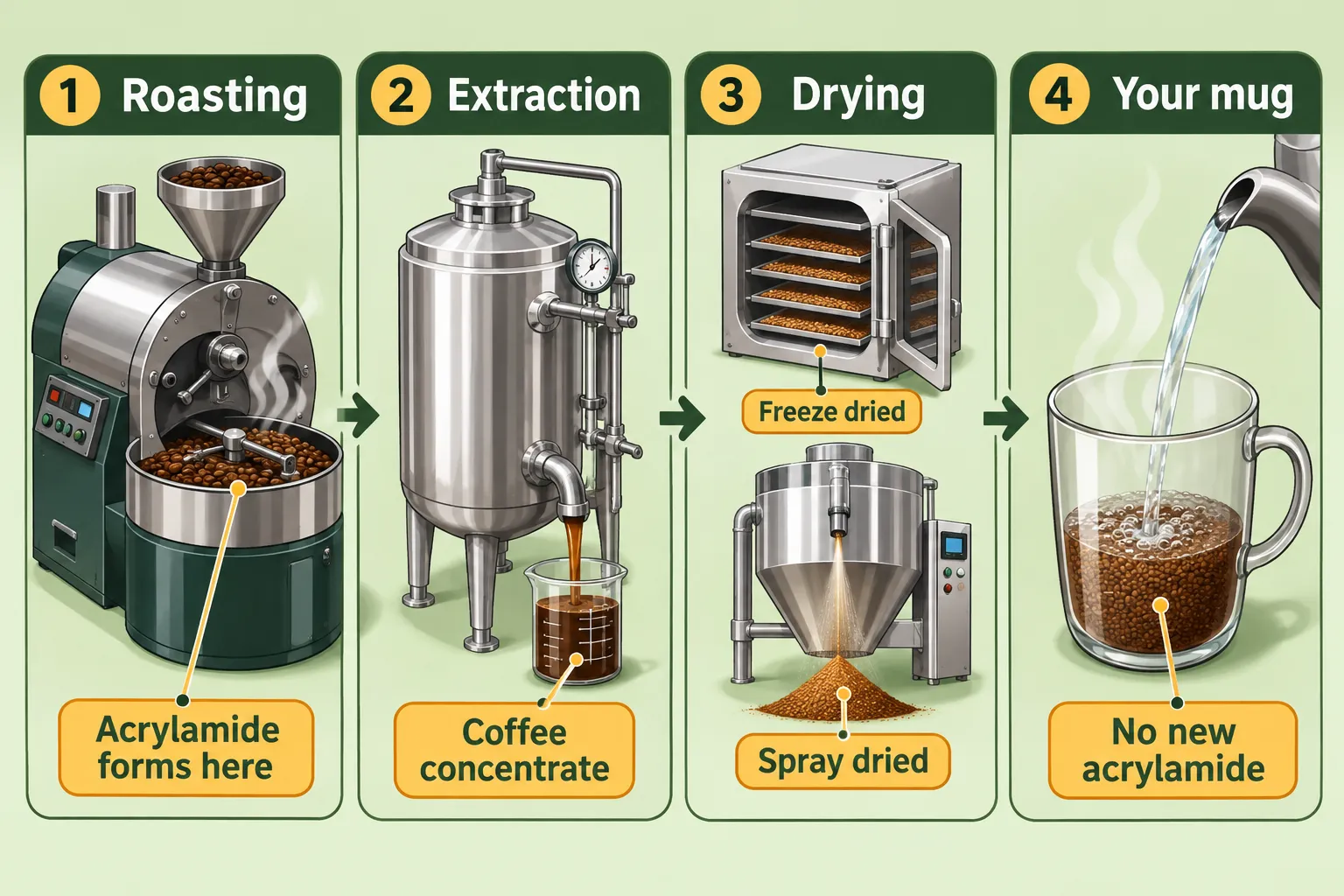
How instant coffee is made, in four stages:
- Roast. Green beans are roasted, usually darker than specialty filter roasts. Most large brands lean heavily on robusta, which is cheaper, higher in caffeine, and more bitter. Our piece on the drawbacks of robusta coffee explains the flavor tradeoff.
- Grind and extract. Coarse grounds meet hot water in percolation columns, often at higher temperatures and pressures than any home brewer would use, to pull out as much soluble material as possible.
- Concentrate. Water is removed until the liquid is a thick coffee extract.
- Dry. Either spray drying (the extract is misted into hot air and falls as fine powder) or freeze drying (the extract is frozen, broken into fragments, then the ice is removed under vacuum as vapor). Freeze dried coffee keeps more volatile aroma compounds because it never gets blasted with heat twice. It also costs more, which is why the better jars say "freeze dried" on the label.
What ends up in the jar: coffee solids, caffeine, chlorogenic acids and other polyphenols, melanoidins from roasting, a small amount of acrylamide, and sometimes added maltodextrin or coffee oil in cheaper blends. Plain instant coffee has essentially no calories, the same as black coffee generally.
Common mistake: assuming instant is a synthetic coffee-flavored product. It is not. It is coffee that was already brewed once.
Instant coffee vs ground coffee: which is healthier?
Ground coffee performed better in the UK Biobank numbers, but both beat drinking none. The gap is real and modest, and the reasons for it are not settled.
Here is how the subtypes compared in that analysis.
| Coffee type | Intake at lowest observed mortality risk | All-cause mortality HR | Lowest arrhythmia association |
|---|---|---|---|
| Instant coffee | 2 to 3 cups/day | 0.89 (95% CI 0.86 to 0.93) | HR 0.88 at 2 to 3 cups |
| Ground coffee | 2 to 3 cups/day | Stronger association than instant | HR 0.83 at 4 to 5 cups |
| Decaffeinated coffee | 2 to 3 cups/day | Lower CVD, weaker arrhythmia signal | Not significant |
| No coffee | Reference group | 1.00 | 1.00 |
Source: UK Biobank coffee subtype analysis, published July 2, 2025, 449,563 participants, ~12.5 year median follow-up . Hazard ratios are adjusted associations from an observational cohort.
)
Three plausible explanations for the instant coffee vs ground coffee gap, none of them confirmed:
- Compound differences. Harsh industrial extraction and the drying step may reduce some chlorogenic acids and aroma compounds relative to a fresh pour over.
- Dose. Instant drinkers in the cohort tended to report lower caffeine per cup.
- The drinker, not the drink. Ground coffee drinkers in UK Biobank differed on socioeconomic and lifestyle measures that no model fully captures.
Decision rule: if you already drink instant and enjoy it, the data gives you no reason to quit. If you are choosing a new habit from scratch and taste matters to you, ground wins on flavor and probably, slightly, on the numbers.
Does instant coffee have more caffeine than brewed?
No. A standard teaspoon of instant coffee delivers roughly 60 to 80 mg of caffeine, while an 8 oz cup of drip-brewed ground coffee typically lands closer to 95 mg. Instant coffee caffeine content per cup is usually lower, not higher.
The confusion comes from the granules themselves. Gram for gram, instant powder is concentrated, because the water is already gone. You just use far less of it. One teaspoon weighs about 2 grams. A drip brew uses 10 to 15 grams of ground coffee per cup.
Two things move the number:
- Robusta content. Robusta carries roughly twice the caffeine of arabica, and many mass-market instants use it.
- Your spoon. Heaped versus level is an easy 30% swing. Nobody measures instant on a scale, which is exactly why intake estimates in nutrition studies carry error bars.
Edge case: a double-heaped mug of a robusta-heavy instant can reach or pass a standard drip coffee. If you are caffeine sensitive, level the spoon.
Does instant coffee contain acrylamide or other harmful chemicals?
Yes, instant coffee contains acrylamide, and typically more per gram than roasted ground coffee, but ordinary intake stays far below the doses that caused cancer in animal studies. Acrylamide in coffee forms when sugars and the amino acid asparagine react during roasting, a browning reaction that also produces the color and much of the aroma.
Key facts worth holding onto:
- It forms during roasting, not brewing. The FDA states that coffee beans develop acrylamide when roasted and that brewing at home or in a restaurant does not create additional acrylamide . Stirring granules into hot water adds none.
- There is no consumer trick to remove it. The FDA says no consistently effective home method exists for coffee .
- Regulators separate hazard from demonstrated human risk. The FDA calls acrylamide a potential human health concern and has not set a maximum or action level for it in foods as of November 2026 . EFSA classifies it as a potential cancer risk because it is genotoxic in animal studies, while noting the human epidemiological evidence is limited and inconsistent.
- The EU uses benchmark levels, not legal limits. Commission Regulation (EU) 2017/2158 lists 400 µg/kg for roasted coffee and 850 µg/kg for instant coffee. Those are triggers for investigation and mitigation, not a line between safe and unsafe.
- Industry is working on it. On May 18, 2026, Kerry announced that EFSA had issued a positive scientific opinion on Acrylerase, an amidase enzyme for reducing acrylamide in coffee extracts used in instant coffee, with company-reported reductions of up to 90% without changing taste, aroma, or yield. That is a manufacturer claim about a specific enzyme, not evidence that the jar in your cupboard has been treated.
)
The honest framing: acrylamide is the single strongest argument anyone makes when asking is instant coffee bad for you, and it is a reasonable thing to track. It is also present in bread, roasted potatoes, breakfast cereal, and ground coffee. Coffee is not the main dietary source for most people, and roasting is what makes coffee taste like coffee.
What are the side effects of drinking instant coffee daily?
The side effects of daily instant coffee are the side effects of caffeine plus the acidity of coffee itself. Nothing in the instant format introduces a new category of problem.
What people actually report:
- Sleep disruption. Caffeine's half-life runs around 5 hours in most adults, longer in slow metabolizers and in people taking certain medications. A 4pm instant can still be working at 9pm.
- Jitteriness and raised heart rate at higher doses.
- Reflux or stomach irritation, particularly on an empty stomach. Darker roasts and robusta-heavy blends bother some people more.
- Dependence and withdrawal headaches if you stop abruptly after a daily habit.
- Frequent urination, a mild diuretic effect that tolerance reduces.
Not on the list: dehydration at normal intake, bone loss at normal intake, and stunted growth, which was never supported by evidence in the first place.
Common mistake: blaming the coffee when the real variable is the sugar and flavored creamer going in with it. A UK Biobank analysis of sweetened versus unsweetened coffee looked specifically at this question, and how you take your cup matters to the outcome .
Can instant coffee cause anxiety or jitteriness?
Yes, caffeine from any source can trigger anxiety symptoms, and instant coffee is no exception. The mechanism is caffeine blocking adenosine receptors and increasing adrenaline, which produces a physical state (fast heart, shallow breathing, restlessness) that the brain can read as anxiety.
Sensitivity varies a lot, partly through the CYP1A2 gene that controls how fast you clear caffeine. Slow metabolizers feel one cup for longer.
Practical adjustments that work:
- Drop to one level teaspoon per cup instead of a heaped one.
- Move your last caffeinated cup to before 2pm.
- Eat something first. Caffeine on an empty stomach hits faster and harder.
- Try half instant, half decaf instant in the same mug. It is an easy dose dial.
If anxiety symptoms persist after you cut caffeine, that is a conversation for your doctor, not a brewing problem.
Is it safe to drink instant coffee every day, and how much is too much?
Yes, daily instant coffee is safe for most healthy adults. The FDA considers 400 mg of caffeine per day (roughly 5 to 6 cups of instant at 70 mg each) not generally associated with negative effects in healthy adults. The UK Biobank associations were most favorable at 2 to 3 cups a day for instant .
A simple way to think about intake:
| Daily instant cups | Approx. caffeine | What the Biobank data showed |
|---|---|---|
| 1 cup | 60 to 80 mg | Lower mortality than non-drinkers, smaller effect |
| 2 to 3 cups | 120 to 240 mg | Lowest observed mortality (HR 0.89) and arrhythmia (HR 0.88) associations |
| 4 to 5 cups | 240 to 400 mg | Benefit association flattens for instant |
| 6+ cups | 400 mg+ | Above FDA's healthy-adult guidance; sleep and anxiety effects more likely |
Edge case: the curve in observational coffee research is J-shaped, so more is not better past a point. And heavy coffee drinkers in any cohort tend to differ from light drinkers in ways no model fully handles.
Use the free interactive estimator below to see where your own routine lands.
Instant coffee caffeine estimator
Rough daily caffeine from instant coffee, with FDA’s 400 mg healthy-adult reference.
Can pregnant women drink instant coffee?
Instant coffee is not off limits during pregnancy, but caffeine is limited. ACOG advises keeping caffeine under 200 mg a day during pregnancy, which works out to roughly two standard cups of instant. The NHS gives the same 200 mg figure.
Points that matter:
- Count all sources: tea, cola, energy drinks, chocolate, and some cold and headache medicines.
- Decaf instant is an easy swap for the second or third cup of the day.
- Acrylamide exposure from coffee is one part of total dietary acrylamide, and EFSA's advice for the general population applies to pregnancy too: vary the diet and avoid heavily over-browned starchy foods.
This is a case where you should confirm with your own obstetric provider rather than a blog, including ours.
Is decaf instant coffee better for you?
Decaf instant coffee is better if caffeine is your problem, and roughly neutral if it is not. In the UK Biobank subtype analysis, decaffeinated coffee was also associated with lower incident cardiovascular disease at 2 to 3 cups a day, but it did not show the arrhythmia benefit seen with caffeinated instant and ground coffee .
That split is actually useful evidence. If the cardiovascular association survived caffeine removal, something other than caffeine is likely involved, probably polyphenols. The earlier UK Biobank mortality analysis of 498,134 adults pointed the same way, finding inverse associations across coffee types and across genetically fast and slow caffeine metabolizers . That is an inference, not a proven mechanism.
Choose decaf instant if: you want evening coffee, you are pregnant and already at your caffeine limit, you have been told to reduce caffeine, or you get reliable jitters.
Which healthier instant coffee brands should you buy?
There is no instant coffee brand with clinical evidence that it is healthier than another. What you can reasonably prefer are freeze dried, 100% arabica, single origin instants with no added sugar, maltodextrin, or creamer.
Practical buying criteria:
- Freeze dried over spray dried. Better aroma retention and usually better beans.
- 100% arabica rather than robusta blends, for lower caffeine per gram and less bitterness.
- Short ingredient list. The word "coffee" should be the whole list.
- A stated roast date or batch date on specialty single-serve instants, same logic as whole bean.
- Skip 2-in-1 and 3-in-1 sachets if you are watching sugar. The added sugar is the health variable, not the coffee.
Our roundup of the best instant coffee worth drinking black covers specific named products, the ones that taste like actual coffee, and who each suits. Prices change, so check the current price before buying.
Affiliate disclosure: Coffee Rank IQ earns commission on some product links. That does not change which products we recommend or what we say about them.
What's a good alternative if you want to avoid instant coffee?
If you want to stop buying instant, the realistic replacements depend on how much time and counter space you have in the morning. None of them require a barista certificate.
- Pour over, 4 minutes. A cone, a filter, and hot water. Our flat bottom paper filter guide covers which filter shapes do what.
- French press, 5 minutes. Coarse grind, full immersion, no paper. Start with the French press coffee ratio.
- Cold brew, made Sunday for the week. Steep coarse grounds 12 to 18 hours, strain, dilute. Lower perceived acidity. See the beginner's guide to cold brew.
- Single serve pod machines if speed is the entire reason you bought instant in the first place.
- Better beans, whatever the method. If you are upgrading anyway, start with how to choose coffee beans.
Choose instant anyway if: you are camping, traveling, at the office, or you simply will not grind beans at 6:40am. A cup you actually drink beats a brewing method you abandon in three weeks.
Why do people say instant coffee is bad when Biobank studies show otherwise?
The gap between the reputation and the data comes from three things: acrylamide headlines, taste snobbery, and the assumption that processed means unhealthy.
The misconception stated plainly: many people believe instant coffee is a degraded, chemically-altered product that carries health risks ground coffee does not. The correction: instant coffee is brewed coffee with the water removed, its acrylamide content is higher per gram but still low in dietary terms, and the largest subtype cohort to date associated moderate instant drinking with lower mortality, not higher .
Taste is a legitimate complaint. Industrial extraction and drying strip volatile aroma compounds that make a fresh pour over smell the way it does. That is a flavor verdict, not a health verdict, and the two keep getting confused.
So when someone asks is instant coffee bad for you, the useful reply is: bad for flavor, fine for health at normal intake, and better than skipping coffee if the Biobank associations hold up.
The remaining honest caveat: no randomized trial has shown that instant coffee prevents disease, and a 2026 meta-analysis of coffee and heart failure noted that residual confounding and single-time-point exposure measurement remain limitations across much of this literature. Association is where the evidence stops.
FAQ
Conclusion: what this means for your daily cup
Two or three cups of instant coffee a day is a defensible habit. The UK Biobank subtype analysis of 449,563 adults put that exact intake at an 11% lower all-cause mortality association versus drinking none, and a 12% lower arrhythmia association . Ground coffee did better. Neither did worse than nothing.
Acrylamide is worth knowing about and not worth losing sleep over, especially since roasting creates it in every coffee you will ever drink, and the FDA has set no action level for it in foods as of November 2026 .
Your next step: level the spoon, skip the sugar, and stop the caffeine by 2pm for a week. If you still want better flavor in the mug after that, read our best instant coffee picks and switch to a freeze dried arabica. Better Coffee Starts With Better Answers, and the answer here is that your jar is fine.