Does Coffee Block Iron Absorption? The 39% Study, Explained
Quick Answer
Yes, and the number people quote comes from a 1983 isotope study: a cup of coffee drunk with a hamburger meal cut non-heme iron absorption by about 39%, while tea cut it by about 64% . The short version of does coffee block iron absorption: it reduces absorption of plant and supplement iron from the same meal, it barely touches heme iron from meat, and coffee drunk a full hour before eating had no measurable effect in that trial. Separate your cup from your iron by roughly an hour and most of the problem goes away. If you have been diagnosed with iron deficiency or anemia, follow your doctor's instructions, not a blog post.
Key Takeaways
- 39% reduction: Morck, Lynch and Cook (1983, American Journal of Clinical Nutrition) measured a 39% drop in non-heme iron absorption when coffee accompanied a hamburger meal .
- Tea was worse: the same study recorded roughly 64% inhibition with tea .
- Strength matters: absorption from a semi-purified test meal fell from 5.88% with water to 1.64% with drip coffee and 0.97% with instant coffee .
- Timing beats avoidance: coffee one hour before the meal showed little effect; coffee one hour after inhibited about as much as drinking it with the food .
- Supplements take the bigger hit: a 2023 randomized crossover trial at ETH Zurich in 34 iron-deficient women found 54% lower fractional absorption from a 100 mg ferrous fumarate dose taken with coffee versus water, and 66% lower when taken with a coffee-containing breakfast .
- Polyphenols, not caffeine: chlorogenic acids and related polyphenols bind non-heme iron in the gut into complexes you cannot absorb .
- Absorption is not body iron: a 39% drop at one meal is not a 39% drop in your ferritin. These were short-term absorption measurements, not long-term anemia outcomes .
Does coffee block iron absorption, and by how much?
Yes. In the original measurement, coffee with a meal reduced non-heme iron absorption by 39%, and the effect scaled with how strong the brew was .
That figure comes from Morck, Lynch and Cook, published in 1983 in the American Journal of Clinical Nutrition. The researchers used dual radioiron isotopes in iron-replete adult volunteers, which lets you tag the iron in a test meal and count how much actually crosses into the blood. Two main findings:
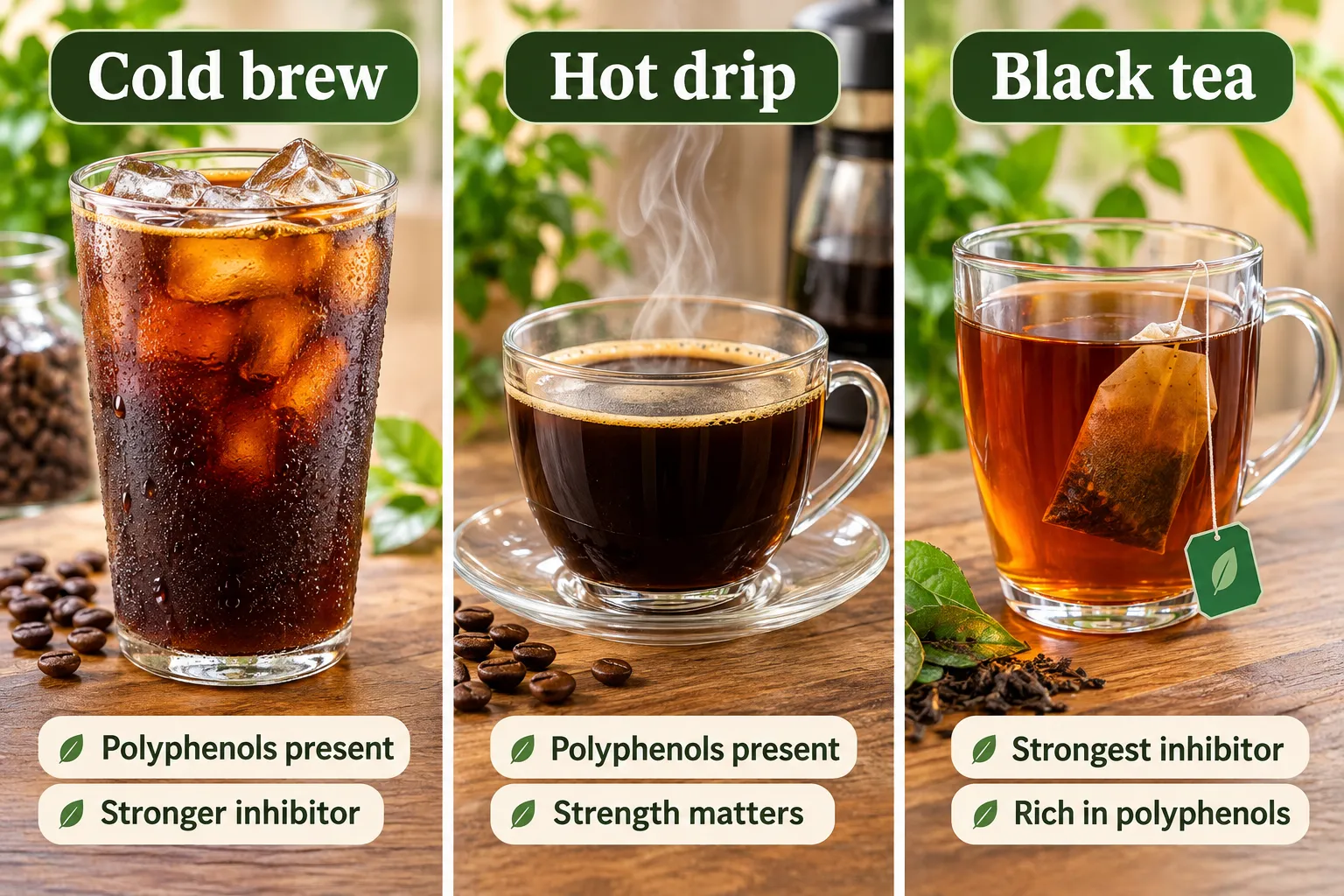
- With a hamburger meal, one cup of coffee cut absorption by about 39%. Tea cut it by about 64%.
- With a simpler semi-purified meal, absorption dropped from 5.88% on water to 1.64% with drip coffee and 0.97% with instant coffee .
So the answer to does coffee block iron absorption is a confident yes, with an asterisk the size of a saucer. It blocks non-heme iron, the form in beans, lentils, spinach, fortified cereal and most supplements. Heme iron from beef, lamb, fish and poultry travels a different absorption pathway and is far less affected by meal inhibitors .
The study's limitation is the one almost nobody repeats: it measured a single meal in people who already had adequate iron. It did not track hemoglobin, ferritin, or whether anyone became anemic.
What's the science behind coffee and iron absorption?
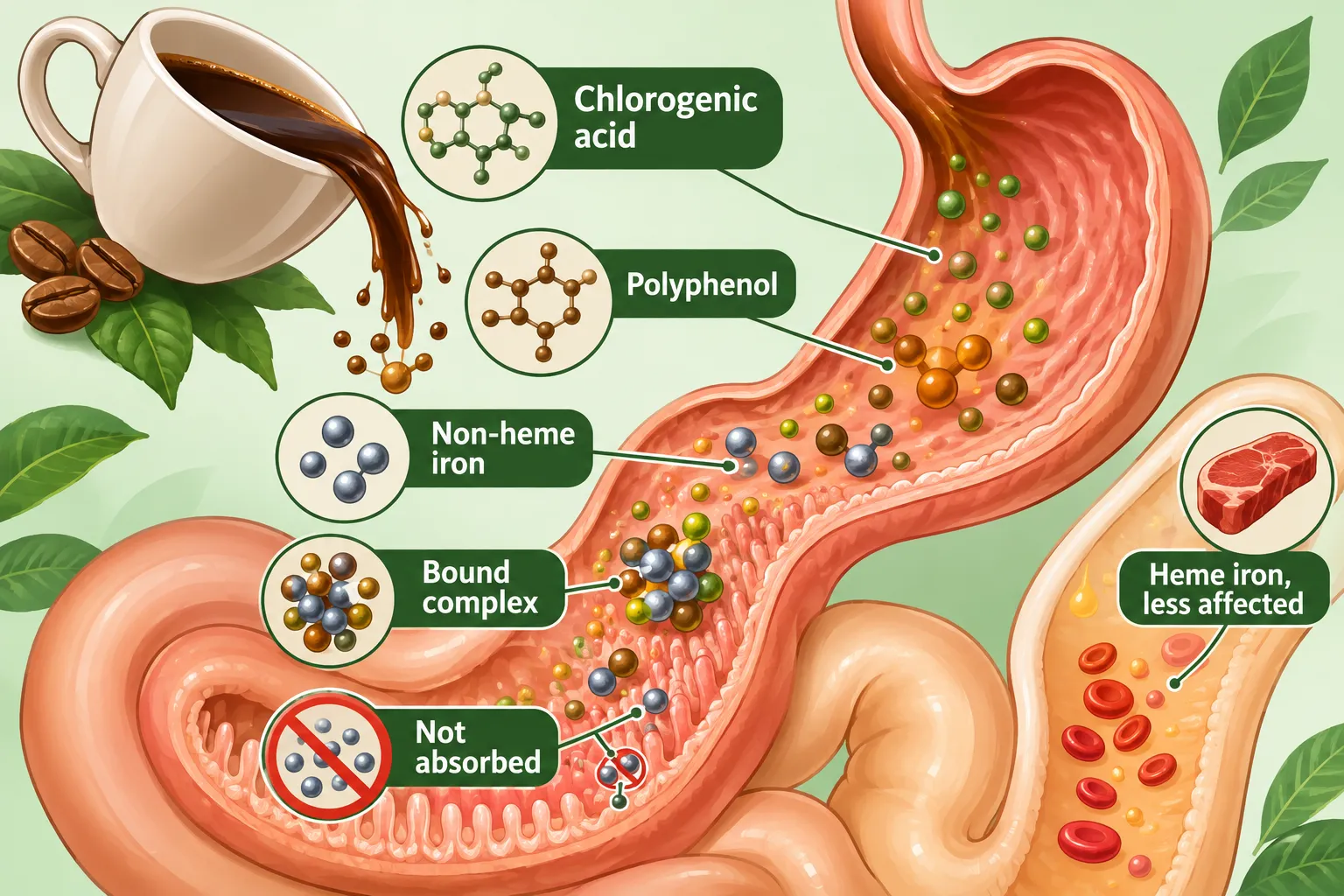
Polyphenols in coffee, especially chlorogenic acids, bind to non-heme iron in the digestive tract and form complexes your intestine cannot pull apart. Caffeine is largely a bystander.
The ETH Zurich team measured the polyphenol load directly: roughly 219 mg in a 150 mL serving of the coffee used in their trial . Those compounds meet iron in the stomach and upper small intestine and lock it into a poorly soluble form. Your gut then passes it along instead of absorbing it.
Three things follow from that mechanism, and they explain nearly every practical question below:
- Dose responds to polyphenol content. Stronger, larger, longer-extracted coffee carries more polyphenols. That matches the 1.64% versus 0.97% split between drip and instant in the 1983 data .
- It is a contact effect. No contact in the gut, no binding. That's why timing works.
- It is selective. Heme iron comes pre-packaged inside a porphyrin ring and does not interact with polyphenols the same way .
Vitamin C normally rescues non-heme iron absorption. In the ETH Zurich breakfast test it did not fully do so: absorption still fell 66% even with about 90 mg of vitamin C from orange juice alongside the supplement . That's a useful correction to the common advice that orange juice cancels out coffee.
Coffee doesn't destroy iron. It escorts it out of the building.
How much does coffee block iron absorption with supplements specifically?
More than it does with food. The 2023 ETH Zurich randomized crossover trial in 34 iron-deficient women found a 54% lower fractional absorption when a 100 mg ferrous fumarate tablet was taken with coffee instead of water, rising to 66% lower when taken with a coffee-containing breakfast .
Supplement iron is non-heme iron in a concentrated single dose, which makes it the most exposed form in the whole discussion. If you take iron at all, this trial is the one that matters more than the 1983 number.
A practical read on coffee with iron supplements: the tablet and the cup should not share a stomach.
- 39% drop in non-heme iron absorption, coffee with a hamburger meal, Morck/Lynch/Cook 1983
- 64% drop with tea in the same 1983 experiment
- 54% lower fractional absorption, 100 mg ferrous fumarate with coffee vs water, 34 iron-deficient women, ETH Zurich 2023
- 66% lower absorption when the same dose came with a coffee breakfast containing ~90 mg vitamin C
- 219 mg polyphenols measured in a 150 mL coffee serving in that trial
- 0.97% vs 5.88% absorption, instant coffee vs water, semi-purified meal, 1983
Does tea also block iron absorption like coffee does?
Yes, and in the 1983 study tea was the stronger inhibitor at roughly 64% versus coffee's 39% . Black tea is dense in tannins, a polyphenol family that binds non-heme iron efficiently.
What other drinks interfere? Anything polyphenol-heavy or calcium-heavy:
| Drink | Main inhibitor | Relative effect on non-heme iron |
|---|---|---|
| Black tea | Tannins | Strongest in the 1983 comparison, ~64% |
| Coffee (drip) | Chlorogenic acids | ~39% with a meal |
| Instant coffee | Chlorogenic acids | Slightly stronger than drip in the test meal |
| Milk | Calcium, casein | Moderate; calcium competes with iron uptake |
| Red wine | Tannins, polyphenols | Reduces non-heme iron absorption |
| Herbal tea (peppermint, chamomile) | Low polyphenol load | Minimal |
| Orange juice | Vitamin C | Increases absorption, but not enough to cancel coffee |
Decision rule: if the drink stains a white mug, assume it has polyphenols and keep it away from your iron.
Is decaf coffee better than regular coffee for iron absorption?
Only slightly, and not for the reason most people assume. The inhibitors are polyphenols, not caffeine, and decaffeination removes caffeine while leaving most chlorogenic acids behind .
Switching to decaf to protect your iron is a bit like switching to diet soda to protect your teeth. You removed the wrong ingredient. If you want the caffeine details, see our breakdown of how much caffeine is actually left in decaf coffee.
What does change the polyphenol load: serving size, brew strength and brew ratio. A 350 mL mug of strong drip carries more than a 60 mL espresso shot. If you compare formats, our guide to drip coffee versus espresso explains why concentration and total volume are different things.
What about iced coffee vs hot coffee for iron absorption?
Temperature is not the variable. Total polyphenols in the glass are. Iced coffee made from a strong cold brew concentrate can easily carry more polyphenols than a small hot cup, so it can inhibit at least as much.
Cold brew is extracted longer at lower temperature, which changes the acid profile and the flavor but still pulls plenty of chlorogenic acid compounds. If you brew your own, our beginner's guide to cold brew coffee covers the ratios that determine how concentrated your glass ends up.
Common mistake: assuming a tall iced latte is "lighter" because it tastes diluted. Check how many shots or how much concentrate went in before you decide.
Does milk in coffee make the iron blocking worse?
Probably a little. Calcium is the one dietary mineral shown to interfere with both heme and non-heme iron absorption, so a milky coffee adds a second inhibitor to the same cup .
That said, the polyphenols are doing the heavy lifting. Removing milk from a latte you drink with your iron tablet does not fix the problem. Moving the tablet does.
Edge case worth knowing: some milk proteins can bind polyphenols, which has led to speculation that milk might blunt the polyphenol effect while adding its own calcium effect. The net result in humans has not been cleanly quantified for coffee specifically, so treat any confident claim in either direction with suspicion.
How long should I wait after coffee to take iron supplements?
About one hour either side of the dose is the practical rule, and the 1983 data supports the "before" direction strongly.
In that study, coffee consumed one hour before the meal produced little reduction in iron absorption. Coffee consumed one hour after the meal inhibited about as much as drinking it with the food . The gut was still handling the iron when the polyphenols arrived.
So the answer to how long to wait after iron to drink coffee is the less forgiving half of the question. Waiting after is the direction that needs the full hour, and many clinicians suggest closer to two hours after an iron tablet to be comfortable .
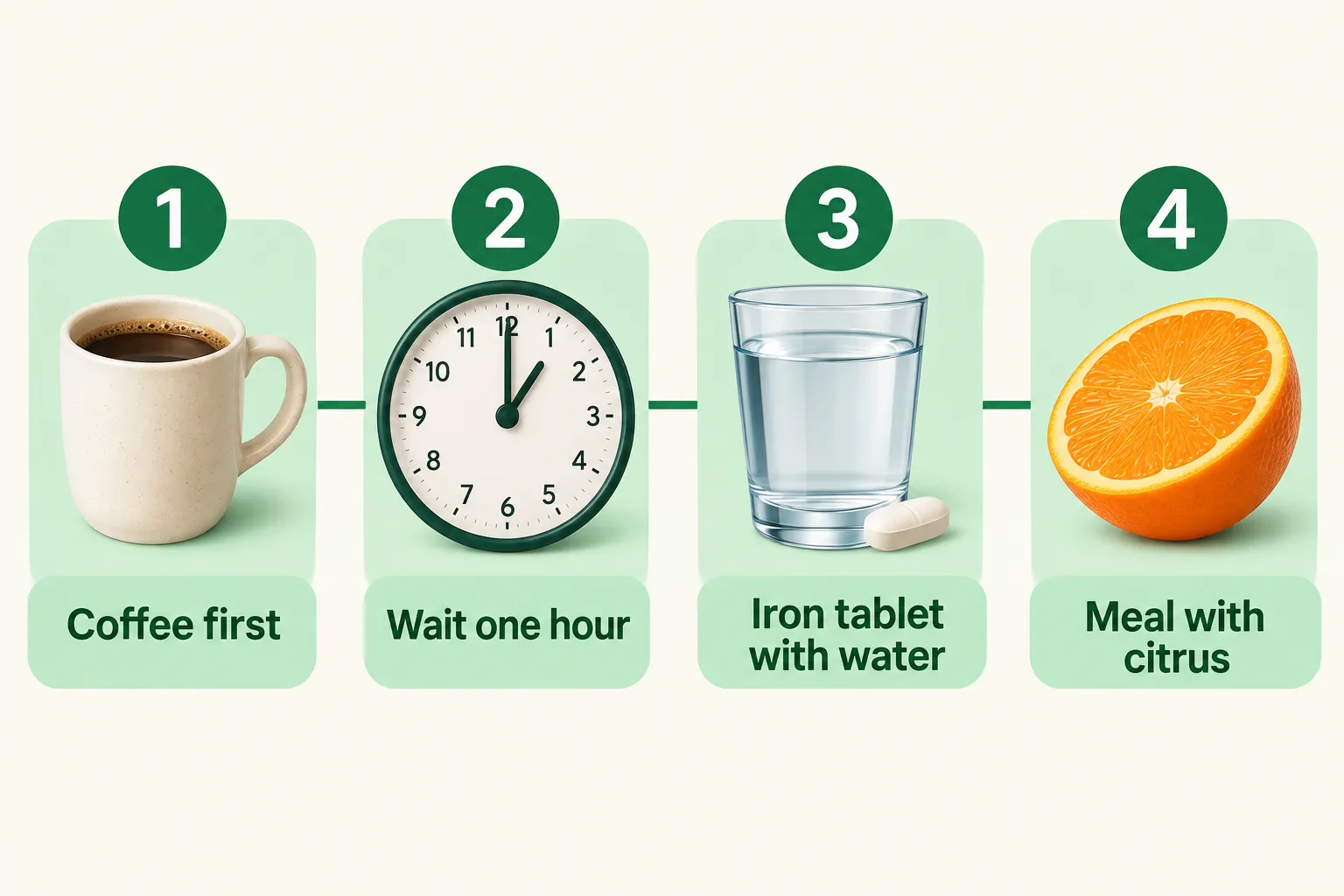
A workable morning order:
- Coffee on waking.
- Wait at least 60 minutes.
- Iron tablet with water, ideally on an emptyish stomach if your doctor agrees and your stomach tolerates it.
- Wait another 60 to 120 minutes before the next cup.
- Pair the tablet with a vitamin C source like citrus or bell pepper if your doctor recommends it .
What's the best time of day to take iron supplements to avoid coffee?
For most coffee drinkers, mid-afternoon or bedtime keeps the tablet furthest from the cup, since coffee intake clusters in the morning.
Some guidance also points to alternate-day dosing or a single daily dose rather than split doses, because the hormone hepcidin rises after an iron dose and temporarily reduces further absorption . That is a conversation for your clinician, not a self-prescription.
Choose your slot this way:
- You drink coffee only before 10am: take iron at 2pm or later.
- You drink coffee all day: take iron at bedtime, at least an hour after the last cup and any dairy.
- You take iron with food because of nausea: pick a meal you never pair with coffee, and add vitamin C.
If you are rethinking your overall intake anyway, our piece on whether one cup of coffee a day is good for you covers the broader picture.
Can you drink coffee if you have iron deficiency anemia?
Talk to your doctor. That is the honest answer, and it is not a dodge.
A diagnosis of iron deficiency anemia means your margin is already gone, and your treatment plan involves dose, timing, absorption and follow-up bloodwork that no article can manage for you. The conversation about coffee anemia risk is one to have with the person reading your ferritin results.
What the evidence supports generally: people being treated for iron deficiency have the most to gain from separating coffee from their supplement, because that is exactly the scenario the ETH Zurich trial tested, and the gap was 54% to 66% . Most clinicians do not ask patients to quit coffee. They ask them to move it.
Does the 39% study apply to everyone, or just certain people?
It applies least to the people who worry most about it. The volunteers in the 1983 study were iron-replete adults eating single test meals, so the result describes absorption at one sitting, not long-term iron status .
Does coffee block iron absorption enough to matter for you? Sort yourself into one of these groups:
Lower concern
- You eat meat, fish or poultry regularly, so much of your iron is heme iron .
- Your last blood panel showed normal ferritin and hemoglobin.
- You drink one or two cups, usually away from meals.
- Healthy bodies raise absorption efficiency when stores run low.
Higher concern
- You are vegetarian or vegan, so nearly all your iron is non-heme.
- You have heavy menstrual periods.
- You are pregnant or recently postpartum.
- You have celiac disease, IBD, or have had gastric surgery.
- You are taking prescribed iron .
Researchers writing in The Conversation in September 2026 made the same point from the opposite direction: polyphenol-containing foods reduce non-heme iron absorption in the short term, but short-term absorption studies do not automatically predict deficiency or failed treatment over months .
The misconception, stated plainly
The myth: coffee destroys 39% of the iron in your diet, so coffee drinkers are walking around iron-depleted.
The correction: the 39% figure describes absorption from one test meal, measured with isotopes, in iron-replete adults, in 1983 . It says nothing about your serum ferritin after six months. Your body adjusts absorption based on need, you eat other meals without coffee, and heme iron from meat mostly ignores the whole mechanism .
A second misconception worth killing: that decaf solves it. The polyphenols stay.
A third: that vitamin C neutralizes coffee. In the 2023 trial, about 90 mg of vitamin C from orange juice did not prevent a 66% reduction .
A compact timing calculator
Coffee and iron timing planner
Guide only, based on the 1983 timing findings and 2023 supplement trial. Follow your doctor’s instructions if you have diagnosed iron deficiency.
Suggested gap: ‘+g+’ hour(s). ‘+msg+’
Then wait about 1 hour after the iron before your next cup.’; });
What can I do to improve iron absorption if I love coffee?
Keep the coffee, move it, and build the rest of the meal in your favor. None of this requires giving up a single cup.
- Space it. One hour before iron is fine. One to two hours after is the gap that counts .
- Add vitamin C to the meal, not to the coffee. Citrus, peppers, tomatoes and strawberries help non-heme iron, even though they will not cancel coffee entirely .
- Include some heme iron if you eat meat. It is absorbed better and resists inhibitors .
- Cook in cast iron. Acidic foods pick up measurable iron from the pan.
- Soak or ferment legumes and grains to cut phytate, another non-heme iron inhibitor.
- Watch calcium stacking. A milky coffee plus a calcium supplement plus an iron tablet is the worst combination on this list .
- Keep the cup you enjoy. A weaker brew ratio is an option, but timing does more than dilution.
If part of your interest is cutting total intake, the honest arguments sit in our piece on why some people feel better without coffee.
FAQ
Conclusion
The 39% figure is real, specific and older than most people assume. It came from a 1983 isotope study of a hamburger meal, it describes non-heme iron only, and it depends heavily on when you drink the cup . The newer and more practical number is the 2023 ETH Zurich result: coffee alongside an iron tablet cut absorption by 54%, and alongside a coffee breakfast by 66% .
For your daily cup, the fix is scheduling, not sacrifice. Drink your coffee, wait roughly an hour, then take your iron with water and a vitamin C source.
Next step: look at your actual morning sequence this week. If your iron tablet and your mug currently sit on the counter at the same time, move one of them by sixty minutes. If you have diagnosed iron deficiency or anemia, bring that timing question to your doctor at your next appointment.
Better Coffee Starts With Better Answers.