Does Coffee Raise Cortisol? The 90 Minute Claim
Quick Answer
Yes, caffeine can raise cortisol, by roughly 30% in one controlled crossover study of 47 healthy young men given about 3.3 mg/kg of caffeine, with the rise appearing about 60 to 120 minutes after the dose. The catch: that response shrinks or disappears in people who drink coffee every day. And the popular advice to wait 90 minutes after waking has never been tested in a controlled trial . So the honest answer to "does coffee raise cortisol" is: in new or occasional users, measurably. In your average daily drinker, far less than the internet suggests.
Key Takeaways
- In a double-blind crossover study of 47 healthy young men, about 3.3 mg/kg of caffeine (roughly 2 to 3 cups) raised ACTH by up to 33% and cortisol by about 30%, peaking 60 to 120 minutes after the dose.
- In a separate controlled study of 96 healthy adults, the 9:00 a.m. cortisol response to caffeine was abolished after five days of 300 or 600 mg daily intake, while a 1:00 p.m. dose still produced a response. Responses were "reduced, but not eliminated" overall.
- No controlled trial has compared coffee at wake-up with coffee 90 minutes later while measuring alertness, energy crashes, or cortisol .
- A review published October 25, 2026 by psychologist Bogdanova found "no established cortisol-based requirement" to wait 60 to 90 minutes .
- A University of New South Wales explainer from February 26, 2026 noted there are no randomized trials comparing coffee on an empty stomach with coffee after food, and that habitual morning coffee did not meaningfully disrupt the cortisol rhythm in the evidence reviewed .
- The cortisol awakening response is real, rising over roughly the first 30 to 45 minutes after waking. A 2025 analysis of continuous cortisol data argued much of that rise was already underway during sleep, which weakens the case for timing coffee around it.
- Practical version: if you drink coffee daily, timing it precisely is a low-value habit. Sleep, total dose, and how late you drink matter more.
What is cortisol, and why should you care about it?
Cortisol is a steroid hormone made by the adrenal glands, two small structures sitting on top of your kidneys. It helps regulate blood sugar, blood pressure, inflammation, and alertness. It follows a daily rhythm: low around midnight, climbing through the second half of the night, highest in the early morning, then drifting down.
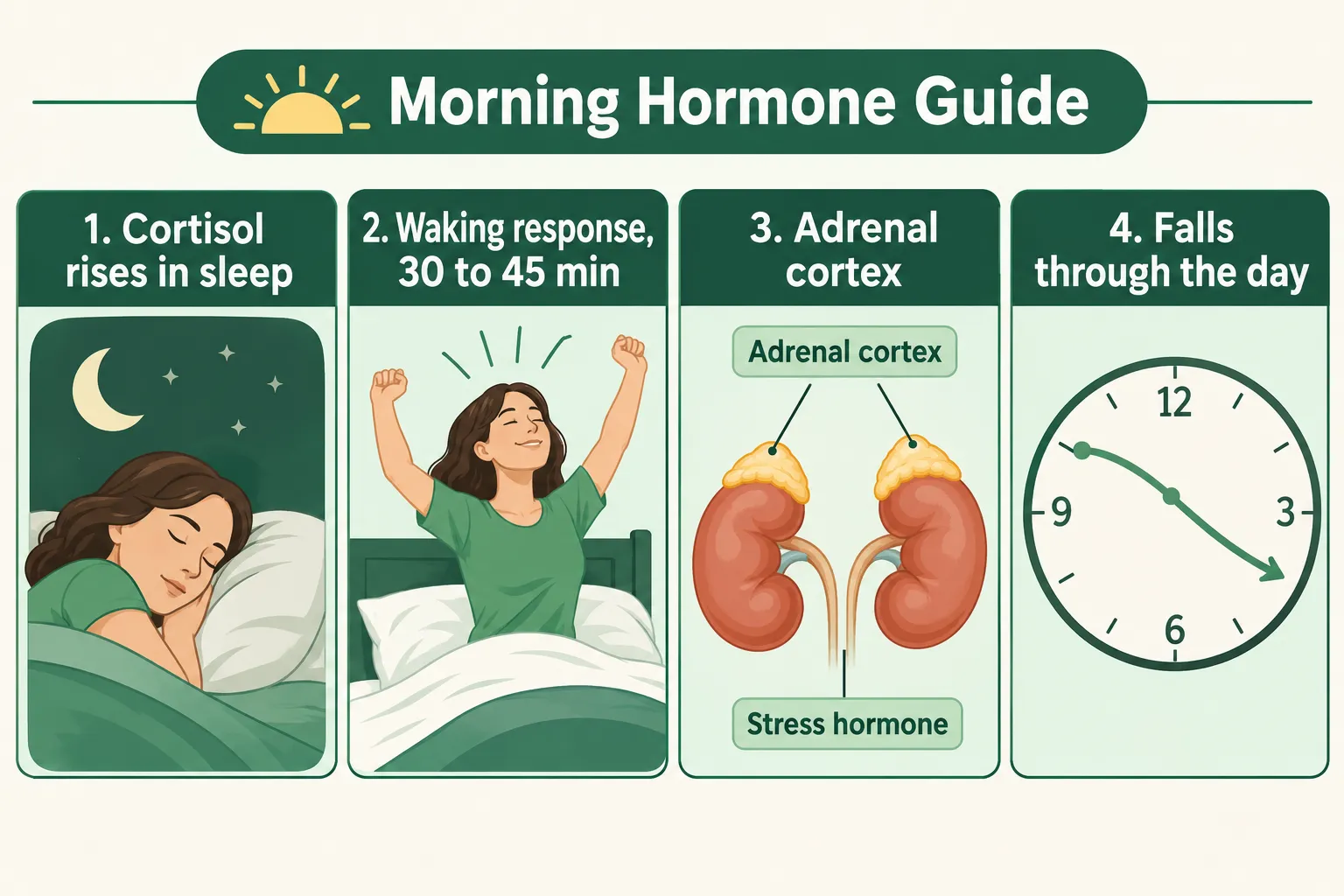
The part people fixate on is the cortisol awakening response (CAR), a further increase during roughly the first 30 to 45 minutes after you open your eyes. A 2025 review in Endocrine Reviews by Tobias Stalder, Henrik Oster, James Abelson and colleagues describes the CAR and how it is regulated. That review documents cortisol physiology. It does not recommend delaying coffee.
Worth saying plainly: cortisol is not a toxin. UNSW's February 2026 explainer makes the point that cortisol spikes are a normal part of being awake and functioning, and that a short rise is not evidence of a health problem .
Does coffee raise cortisol?
Does coffee raise cortisol? Yes, acutely, and the size of the effect depends almost entirely on whether you drink it regularly. That single variable explains most of the confusion online.
The two anchor pieces of evidence come from work by William Lovallo and colleagues at the University of Oklahoma Health Sciences Center, published in Psychosomatic Medicine in 2005 and 2006.
Study one (the dose effect). A double-blind, placebo-controlled crossover design in 47 healthy young men. Caffeine at about 3.3 mg/kg, roughly 2 to 3 cups of brewed coffee for an average adult, raised ACTH (the pituitary signal that tells the adrenals to release cortisol) by up to 33% and cortisol by around 30%. Cortisol rose approximately 60 to 120 minutes after dosing. Limitation: young men only, caffeine given as a controlled dose rather than as coffee on waking, and no comparison of timing.
Study two (the tolerance effect). 96 healthy adults received caffeine challenges after a period of abstinence, then again after five days of 300 or 600 mg daily caffeine. The morning 9:00 a.m. cortisol response was abolished after regular intake. A 1:00 p.m. dose still produced a response. The authors concluded cortisol responses were "reduced, but not eliminated" in daily consumers. Limitation: five days is short, and healthy volunteers may not reflect people with anxiety disorders or endocrine conditions.
Put together: coffee can raise your caffeine stress hormone response, but your body stops reacting the same way once coffee becomes a habit. The first-time drinker and the three-cups-a-day drinker are not running the same experiment.
So when someone asks "does coffee raise cortisol," the useful follow-up question is: for whom, on what schedule, and at what dose?
Is the 90 minute cortisol spike claim actually real?
The morning cortisol peak is real. The instruction to wait 90 minutes is not supported by a trial. Those are two separate claims, and social media keeps welding them together.

A coffee-industry evidence review published November 4, 2026 reported that no controlled trial has directly compared coffee immediately after waking with coffee 90 minutes later while measuring alertness, focus, energy crashes, or cortisol outcomes . A review by psychologist Bogdanova on October 25, 2026 reached the same place: there is "no established cortisol-based requirement" to wait 60 to 90 minutes, and the genuine morning rhythm should not be confused with an unproven timing prescription .
Health media keeps repeating the advice anyway, usually with the argument that caffeine "layers" on top of the cortisol awakening response . That is a plausible mechanism, not a measured outcome.
There is a deeper wrinkle. A 2025 review by Clara Velazquez Sanchez and Jeffrey Dalley examined continuous cortisol data and argued the post-waking rise may largely reflect a circadian climb that began during sleep, rather than waking itself triggering a fresh surge. If the morning increase is mostly circadian, the logic behind "wait 90 minutes after your feet hit the floor" gets thinner.
The misconception, stated plainly: people believe a 90-minute delay has been shown to reduce cortisol and prevent an afternoon crash. It has not been tested. The correction: the cortisol awakening response is documented; the 90-minute rule is an extrapolation from it.
Does coffee raise cortisol more on an empty stomach?
Probably not in a way anyone has measured. An October 8, 2026 evidence review found no randomized trial comparing coffee with breakfast against coffee without breakfast . UNSW reported the same gap in February 2026 .
What food does change is absorption speed. A meal, especially one with fat and protein, slows gastric emptying, so caffeine reaches peak blood levels a little later and a little flatter. Whether that meaningfully blunts a cortisol response has not been demonstrated.
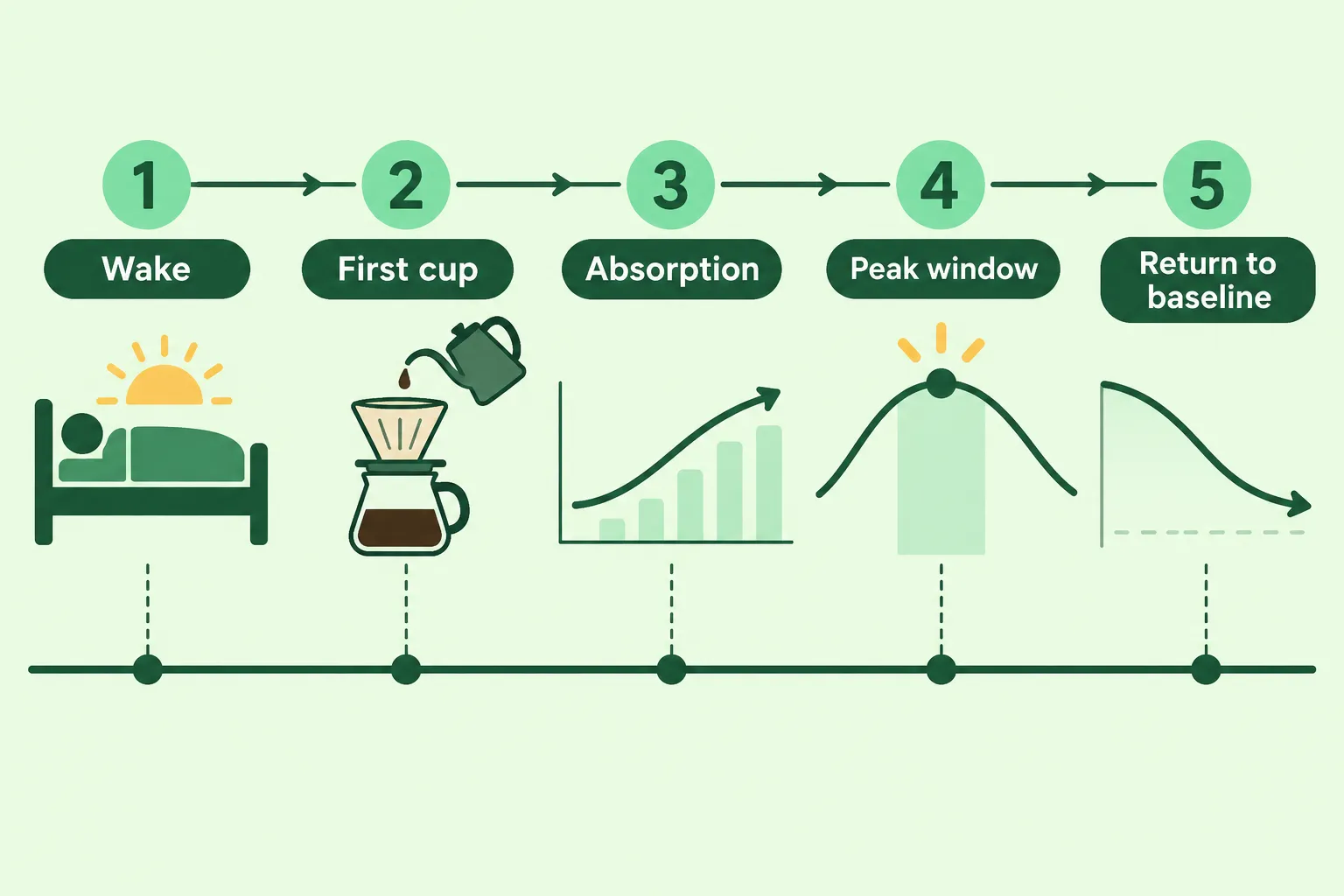
Decision rule: if black coffee on an empty stomach gives you jitters, nausea, or reflux, eat first. That is a symptom you can actually observe. Do not eat first because a hormone chart told you to.
How long does caffeine keep cortisol elevated?
In the Lovallo crossover study, cortisol elevation after caffeine appeared roughly 60 to 120 minutes post-dose. Caffeine itself has a half-life of about 4 to 6 hours in most healthy adults, meaning half of it is still circulating that long after your cup.
The cortisol bump is shorter than the alertness effect. The alertness effect is shorter than the sleep disruption risk. That last one is the part worth managing: caffeine late in the day pushes sleep quality down, and poor sleep is a far more reliable way to disturb your morning cortisol rhythm than the timing of your first cup.
Can you build a tolerance to coffee's cortisol effect?
Yes, and the evidence for that is stronger than the evidence for any timing rule. In the 96-adult study, the 9:00 a.m. cortisol response disappeared after five days of 300 or 600 mg daily caffeine. The afternoon response persisted.
Two practical consequences:
- If you drink coffee daily, your morning caffeine stress hormone response is likely already blunted.
- If you quit for a week and then drink three cups, you will probably get a sharper response again. Tolerance is reversible.
Common mistake: cycling off coffee on weekends to "reset tolerance," then wondering why Monday feels rough. Resetting tolerance restores the response you were trying to avoid, plus withdrawal headaches.
What time of day should you drink coffee?
There is no trial-backed clock time. The defensible rule concerns the back end of the day, not the front.
| Timing approach | Evidence behind it | Who it suits |
|---|---|---|
| Coffee right on waking | No trial shows harm; habitual drinkers show blunted morning cortisol response | Most daily drinkers with normal sleep |
| Wait 60 to 90 minutes | No controlled trial exists ; based on cortisol awakening response logic | People who simply prefer it, or who feel jittery on an empty stomach |
| Cut off caffeine 8 to 10 hours before bed | Supported by caffeine half-life of 4 to 6 hours and sleep research | Anyone with trouble falling asleep |
If you want a single change with a real payoff, move your last cup earlier, not your first cup later.
Does decaf coffee raise cortisol levels?
Decaf is very unlikely to produce a meaningful cortisol response, because the effect in the Lovallo work tracked caffeine dose. Decaf is not caffeine-free though. US-sold decaf typically retains a small residual amount per cup, which is why the exact milligrams matter if you are sensitive. We broke the numbers down in our guide to how much caffeine decaf actually contains.
Edge case: if you react to decaf, the likely culprits are the acidity, the volume of hot liquid, or expectation, not a hormone surge.
Does tea or energy drinks spike cortisol like coffee does?
The driver is the caffeine dose, not the drink. Rough per-serving caffeine, so you can compare like for like:
| Drink | Typical caffeine per serving | Cortisol implication |
|---|---|---|
| Brewed coffee, 8 oz | ~95 mg | Dose studied in caffeine-cortisol research |
| Espresso, single shot | ~63 mg | Smaller dose, faster to drink |
| Black tea, 8 oz | ~47 mg | Roughly half a coffee; smaller expected effect |
| Green tea, 8 oz | ~28 mg | Low dose; L-theanine may soften subjective jitter |
| Standard energy drink, 16 oz | ~160 mg | Often combined with sugar, which has its own metabolic effects |
Energy drinks are not special in hormone terms. They are usually just a larger caffeine dose delivered quickly, often with sugar alongside. A strong red eye coffee stacks a shot of espresso into drip coffee and lands in similar dose territory.
Is cortisol from coffee actually bad for your health?
A short, temporary cortisol rise in a healthy adult is not an established health risk. UNSW's February 2026 piece pushes back directly on the idea that normal cortisol spikes indicate a problem . Chronic hypercortisolism, such as Cushing's syndrome, is a diagnosed medical condition and has nothing to do with your morning pour over.
Association is not causation, and no study here shows coffee causing a disease through cortisol. Large observational studies of coffee drinkers generally find neutral to favorable health associations, which would be strange if a modest morning cortisol bump were doing damage.
If you have been diagnosed with an adrenal or pituitary condition, an anxiety disorder, uncontrolled hypertension, or you are pregnant, talk to your doctor about your caffeine intake. They can give you a number that fits your situation. Nothing in this article replaces that.
How much coffee per day is reasonable, and who should cut back?
Health authorities in the US generally place up to 400 mg of caffeine daily, about four 8 oz cups of brewed coffee, within a range that has not been linked to harm in healthy adults. Pregnancy guidance is lower, commonly 200 mg.
Consider cutting back if you:
- Have a diagnosed anxiety or panic disorder and notice symptoms worsen after coffee
- Take medications that interact with caffeine metabolism
- Are pregnant or breastfeeding
- Have uncontrolled high blood pressure or a cardiac arrhythmia
- Sleep badly and drink coffee after mid-afternoon
Reducing total intake is a bigger lever than rearranging the schedule. If you are trimming, these ideas for a healthier coffee order cover the add-ins too, and the case for taking a break from coffee entirely is worth reading if you suspect you are over-caffeinated.
How to lower caffeine load without giving up coffee
If cortisol sensitivity is a genuine concern for you, these steps have better reasoning behind them than any clock rule:
- Count your real dose. Add up every cup, shot, tea, and soda for three days. Most people underestimate.
- Set a cutoff time. Eight to ten hours before bed, based on caffeine's 4 to 6 hour half-life.
- Taper, don't quit cold. Drop one cup every three to four days to avoid withdrawal headaches.
- Swap one cup, not all of them. Half-caf, green tea, or a chicory or mushroom-based drink . Four Sigmatic-style blends are one documented option if you want lower-caffeine coffee alternatives with routine ideas.
- Fix sleep first. Short sleep raises next-day cortisol more reliably than a flat white does.
- Brew deliberately. A weighed brew ratio and a consistent grind size keep your dose stable instead of drifting upward over months.
Hydration gets dragged into this conversation too. It mostly does not belong there: see what the research says about coffee and dehydration.
FAQ
Conclusion
Does coffee raise cortisol? Acutely, yes, and most noticeably in people who do not drink it often. Does the 90-minute rule fix anything measurable? Nobody has run the study, and two separate 2026 reviews said so directly . The cortisol awakening response is real physiology. The waiting instruction attached to it is a hypothesis wearing a lab coat.
For your daily cup, the practical answer: drink it when you want it, keep your total under about 400 mg if you are a healthy adult, and protect your sleep by setting a hard afternoon cutoff.
Next step: for the next three days, write down every caffeinated drink and the time you had it. You will learn more about your own energy pattern from that notebook than from any 90-minute rule. Better Coffee Starts With Better Answers.
Below is a quick calculator to estimate your daily caffeine load and your suggested cutoff time.
Daily caffeine load and cutoff time
‘+note+’
Suggested last caffeine: ‘+cut+’ (9 hours before bed, based on a 4 to 6 hour half-life). Estimate only, not medical advice.’; }