
Does Coffee Have Fiber? Up to 0.75 g per Cup
Quick answer
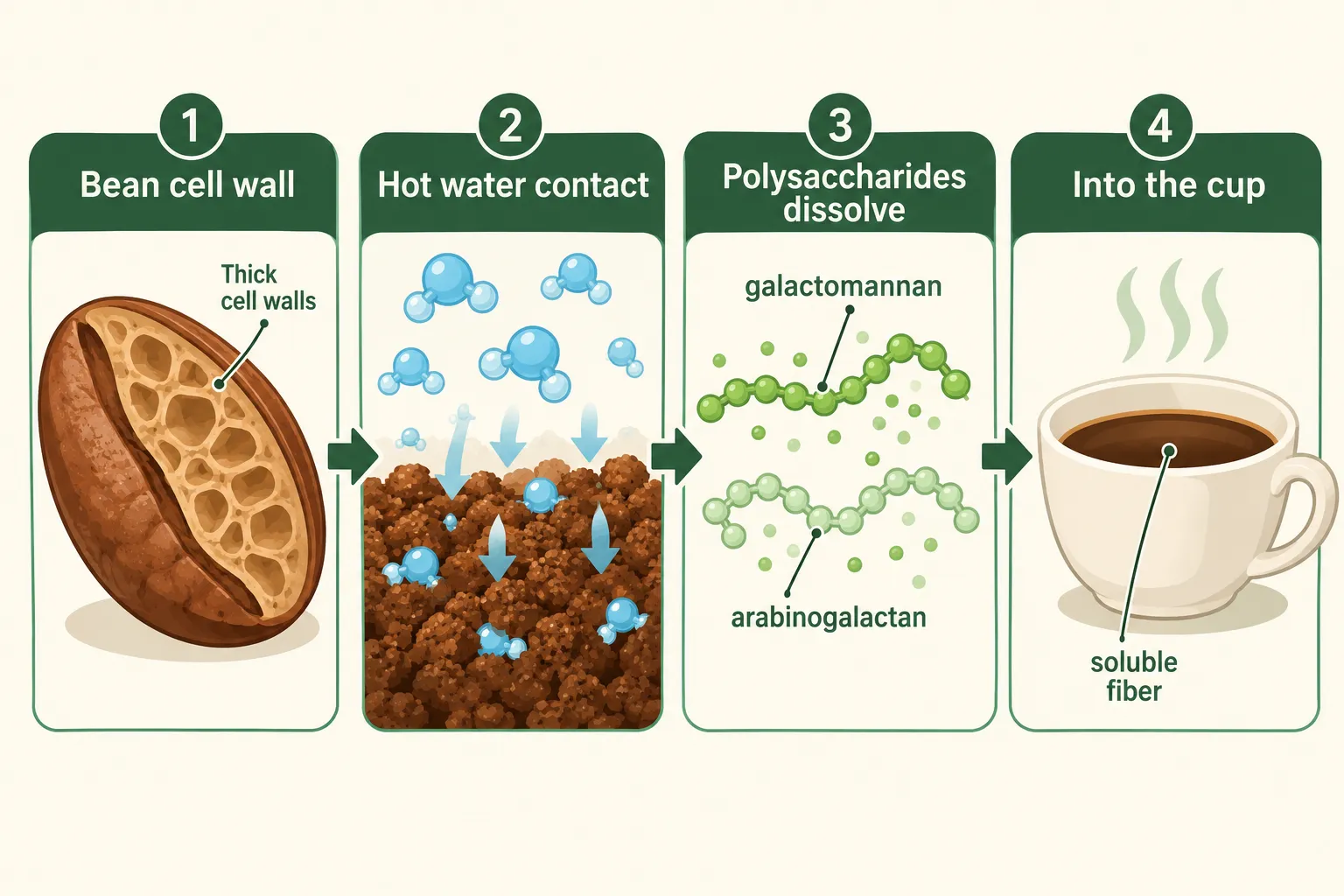
Yes. Brewed coffee contains soluble dietary fiber, measured at 0.47 to 0.75 grams per 100 mL by Elena Díaz-Rubio and Fulgencio Saura-Calixto of Spain's National Research Council, published in the Journal of Agricultural and Food Chemistry in 2007 . So a small cup delivers roughly half a gram to three quarters of a gram. That is real, and it is small next to the 25 to 38 grams of fiber most US adults are told to eat daily. The fiber is not an additive. It comes from the bean's own cell walls, mostly galactomannans and arabinogalactans that dissolve in hot water .
Does coffee have fiber? The short, sourced answer
Coffee has fiber because roasted coffee beans are plant cell walls, and hot water pulls some of those cell wall sugars into the cup as soluble polysaccharides. The research question "does coffee have fiber" was settled in a lab, not a marketing department.
Key takeaways
- Díaz-Rubio and Saura-Calixto measured 0.47 to 0.75 g of soluble fiber per 100 mL across instant, espresso, and filter coffee, 2007, Journal of Agricultural and Food Chemistry .
- Instant (freeze-dried) coffee sat at the top of that range, espresso around 0.65 g/100 mL, filter coffee around 0.47 g/100 mL, as summarized by Chemical & Engineering News in 2007 .
- A companion 2007 paper found roughly 0.5 g of soluble fiber in a 150 mL cup of filter coffee, with about 62% of the measured fraction being polysaccharides .
- The main molecules are galactomannans and arabinogalactans, nondigestible plant polysaccharides from the bean cell wall .
- Coffee fiber is 100% soluble. The insoluble fraction stays in the grounds or the filter.
- Against a 25 to 38 g daily fiber target, three cups of coffee contribute a couple of grams at best. Useful, not sufficient.
- Coffee silverskin, the papery roasting by-product, runs 58.1 to 60.3% total dietary fiber by weight, but that is a dry solid, not a drink .
How much fiber does one cup of coffee actually have?
Between about 0.2 g and 1.1 g, depending entirely on how much liquid is in the cup. The published figure is a concentration, not a serving, and that distinction is where most online summaries go wrong.
Run the arithmetic on the 2007 concentrations:
| Serving | Volume | Approximate soluble fiber |
|---|---|---|
| Single espresso | 30 mL | ~0.2 g |
| Double espresso | 60 mL | ~0.4 g |
| Small filter cup | 150 mL | ~0.5 g (measured directly) |
| US "cup" of filter coffee | 240 mL | ~1.1 g |
| Mug of instant | 240 mL | ~1.8 g at the top concentration |
The direct 150 mL measurement of roughly 0.5 g is the most defensible single number, because researchers measured it rather than scaling it .
)
Limitation worth stating plainly: this was a laboratory analysis of beverages using enzymatic treatment and dialysis, on a small set of commercial preparations. It was not a feeding study, and nobody has run a 2026 clinical trial re-measuring fiber in ordinary brewed coffee. Treat the numbers as careful chemistry, not as a nutrition label.
Does espresso have more or less fiber than regular brewed coffee?
Per 100 mL, espresso carries more. Per cup, filter coffee usually wins, because you drink far more of it.
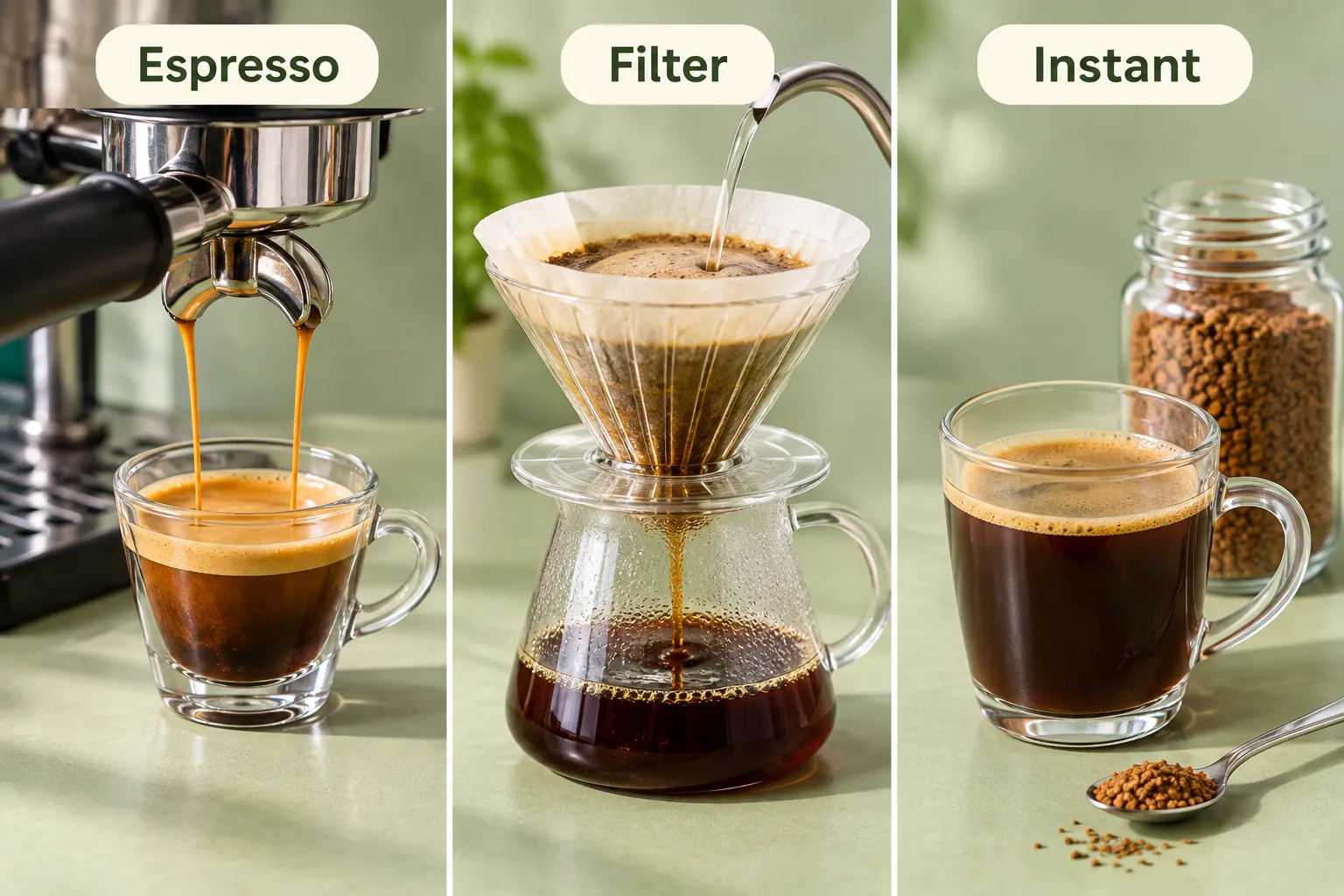
The 2007 comparison put espresso near 0.65 g/100 mL and filter coffee near 0.47 g/100 mL, with instant coffee highest at the 0.75 g end . Espresso is concentrated: a short shot pushes hot water through a fine grind size at pressure, dissolving more solids per millilitre. Then you drink 30 mL of it.
So the honest answer to "how much fiber is in espresso" is: a dense liquid, a tiny serving, roughly 0.2 g per shot.
)
Which type of coffee has the most fiber?
Instant coffee, by concentration. Freeze-dried and spray-dried coffee is made by brewing at industrial strength and removing the water, so the soluble polysaccharides concentrate along with everything else. Reconstituted strong, it reached the top of the measured range .
Decision rule: if total soluble fiber per drink is what you care about, a large mug of strong instant or a long filter brew beats a ristretto. If flavor is what you care about, that ranking inverts fast.
Do instant coffees have less fiber than brewed coffee?
No, and this is the counterintuitive part. Instant coffee measured at or above brewed coffee in the Díaz-Rubio work, which surprised the authors enough that the finding was covered by Scientific American and CBS News at the time .
Which coffee brands or types have the highest fiber content?
No peer-reviewed study has ranked named retail brands by naturally occurring fiber, so any brand league table you see online is invented. What the research supports is a ranking by preparation method, not by roaster. Robusta beans and darker roasts may differ in cell wall polysaccharide extraction, but published per-brand numbers do not exist.
One real exception: products with added fiber. Folgers announced a prebiotic coffee carrying 3 g of added fiber shipping in November 2026, and Starbucks bottled Coffee & Protein drinks list 5 g of prebiotic fiber alongside 22 g of protein. Those grams come from formulated ingredients, not from the bean.
Is the fiber in coffee soluble or insoluble?
Soluble, essentially all of it. Insoluble fiber is the structural, gritty material that does not dissolve, and in coffee it stays behind in the spent grounds or gets trapped by the paper filter.
The soluble fiber in coffee is dominated by two families of nondigestible polysaccharide:
- Galactomannans, chains of mannose with galactose branches, released from the bean cell wall during roasting and brewing.
- Arabinogalactans, branched polysaccharides also from the cell wall, often bound to protein.
Together they made up roughly 62% of the measured fiber fraction in the 2007 filter coffee analysis . Both resist human digestive enzymes and travel to the colon intact, which is the technical definition of dietary fiber.
Coffee galactomannans are the same class of molecule that gives a well extracted espresso part of its body. The texture and the fiber come from the same chemistry.
A 2026 review on coffee, the gut microbiome, and host metabolism noted that coffee-derived fiber may be fermentable by gut bacteria, while emphasizing that much of the newer evidence examined coffee by-products rather than ordinary brewed coffee. That is a mechanism worth watching, not a proven health effect in drinkers.
Does coffee fiber count toward your daily fiber needs?
Technically yes. Practically, barely. Coffee's soluble fiber is real dietary fiber by chemical definition, but the amount is small enough that no dietitian builds a plan around it.
US guidance puts adult fiber intake around 25 to 38 g per day depending on age and sex. Three 240 mL cups of filter coffee land somewhere near 3 g, under 10% of a 38 g target, and that assumes you scale the lab concentration cleanly to your mug.
Compare that with food:
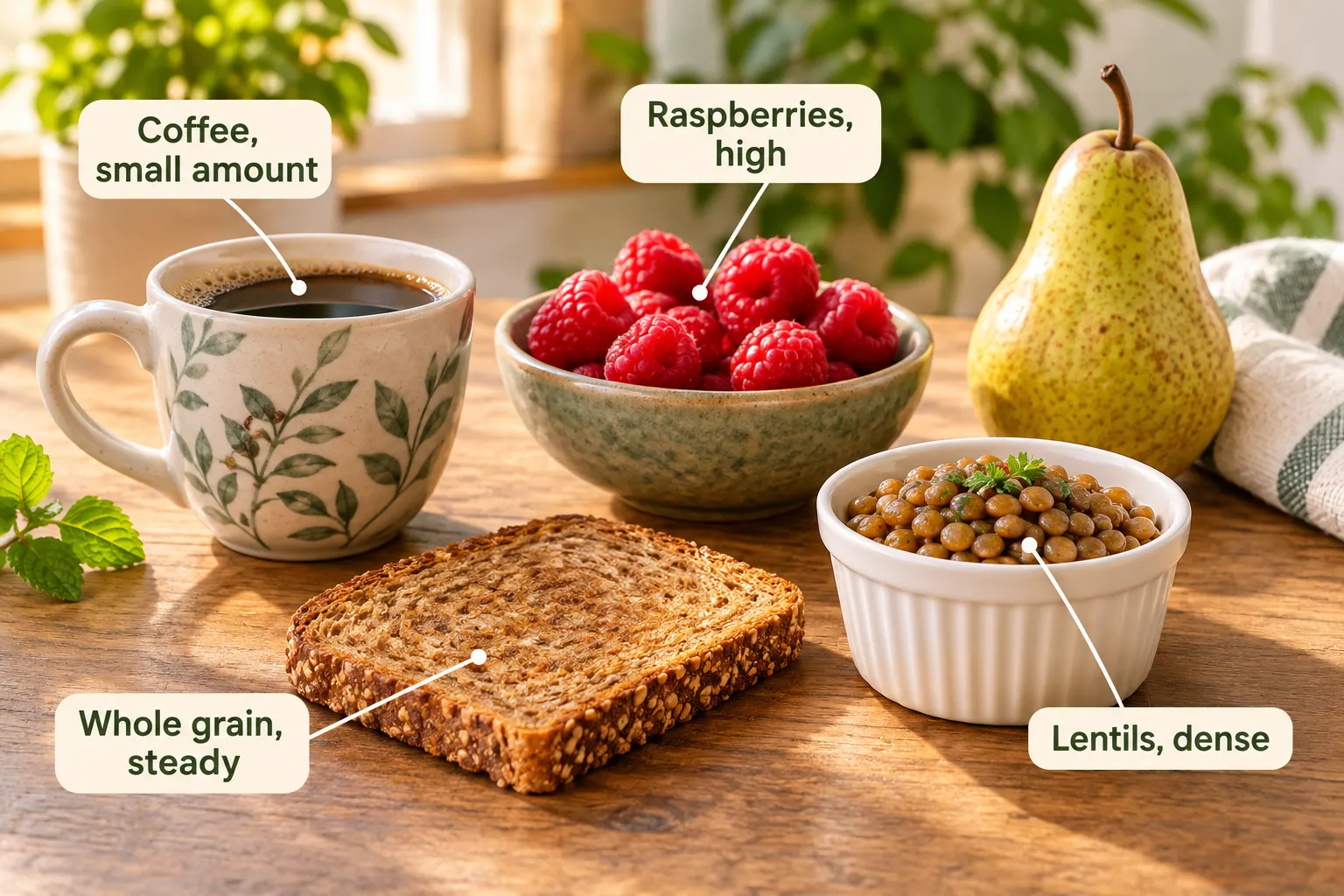
- One cup of raspberries: about 8 g
- One cup of cooked lentils: about 15 g
- One medium pear with skin: about 5 g
Can coffee alone help you meet your daily fiber requirements?
No. You would need to drink somewhere around 4 to 8 litres of coffee a day to hit a 25 to 38 g target, which is far past any sensible caffeine intake and well into territory where the caffeine itself becomes the problem. The arithmetic kills the idea before the biology does.
Why nutritionists say coffee isn't a reliable fiber source
Four reasons, each defensible:
- Dose. Half a gram per cup cannot move a 25 g target.
- Variability. Brew strength, brew ratio, grind size, and method change extraction, so your cup is not the lab's cup.
- No label verification. Coffee nutrition panels do not report fiber, so you cannot check.
- No outcome evidence. The 2007 studies measured chemistry in a beaker. No trial has shown that coffee's fiber produces the digestive or metabolic effects associated with eating 30 g of fiber from food.
If you have a diagnosed digestive condition, IBS, diverticular disease, or anything your doctor is managing, talk to them about fiber targets rather than adjusting coffee intake on your own. Coffee affects gut motility through more than its fiber.
)
Does decaf coffee have the same fiber, and do milk or cream change it?
Decaf should carry comparable soluble fiber, because decaffeination targets caffeine rather than cell wall polysaccharides. No study has published a direct decaf-versus-regular fiber comparison, so treat that as a reasonable inference rather than a measured fact. If you want the caffeine numbers instead, see our breakdown of how much caffeine is actually in decaf.
Does black coffee naturally have fiber, or does it come from additives?
Naturally. Nothing is added. Black coffee is water plus dissolved bean compounds, and some of those dissolved compounds are nondigestible polysaccharides. That is one of the more genuinely surprising coffee facts: a clear brown liquid with essentially zero calories still contains measurable dietary fiber.
Does adding milk or cream change the fiber content?
Dairy milk and cream contain no fiber, so they add none. They dilute the concentration per 100 mL without changing the total grams already in your cup.
Plant milks are different. Oat milk carries a small amount of beta-glucan fiber, and in November 2026 Oatly was reported to be launching oat milk products positioned around adding fiber to coffee routines, including a barista version and a low-sugar option. A splash in a latte adds a fraction of a gram at most, so read the carton rather than the headline.
How does coffee fiber compare to tea, juice, and other drinks?
Coffee sits above most clear beverages and well below anything containing pulp or whole fruit. Here is the comparison with named options:
| Drink | Approx. fiber per 240 mL | Where it comes from |
|---|---|---|
| Filter coffee | ~1.1 g (scaled from 0.47 g/100 mL) | Bean cell wall polysaccharides |
| Strong instant coffee | up to ~1.8 g (0.75 g/100 mL) | Concentrated soluble solids |
| Espresso (double, 60 mL) | ~0.4 g | High concentration, small volume |
| Brewed black tea | negligible, under 0.1 g | Leaf polyphenols, little polysaccharide |
| Clear apple juice | ~0 g | Pulp and skin filtered out |
| Orange juice with pulp | ~0.5 g | Suspended fruit pulp |
| Oat milk (fortified brands) | ~1-2 g, brand dependent | Oat beta-glucan |
Tea and juice figures are standard composition values rather than results from the coffee studies cited above. The coffee numbers are the ones backed by the 2007 measurements.
Can drinking more coffee help with constipation and digestion?
Coffee does stimulate colonic activity in many people, but the fiber is almost certainly not the reason. Half a gram is too little to act as a bulking agent.
What research has examined instead:
- Caffeine and motility. Coffee has been shown to increase colonic motor activity in some people, and decaf produces an effect too, which points to compounds beyond caffeine.
- Chlorogenic acids and gastric acid. These may trigger gastrocolic responses after drinking.
- Microbiome fermentation. The 2026 review on coffee and the gut microbiome raised fermentable coffee polysaccharides as a plausible mechanism, while noting most of the relevant data came from coffee by-products rather than brewed cups.
Association is not causation, and individual responses vary a lot. Some people get a reliable post-coffee urge; many do not. Nothing here should be read as a treatment for constipation. If it is persistent, that is a conversation for your doctor, not a brewing adjustment.
The misconception this article corrects
The claim circulating online is that coffee is a good source of fiber, sometimes stretched into "a few cups covers your daily fiber." That reading comes from people quoting 0.75 g per 100 mL without noticing the denominator, or from headlines like Scientific American's 2007 "Need Fiber? Have Some Coffee" .
The correction: coffee contains a measurable but minor amount of soluble fiber. The surprise is that it exists at all in a transparent beverage, not that it meaningfully feeds your daily requirement. Díaz-Rubio and Saura-Calixto themselves framed coffee as a contributor to total dietary fiber intake at population scale, since so many people drink it, not as a replacement for vegetables.
The second misconception is the silverskin confusion. Studies reporting 58 to 60% total dietary fiber are measuring coffee silverskin, the papery husk left after roasting, as a dry powder being studied for functional food use . That is not what is in your mug, and conflating the two inflates the number by a factor of hundreds.
Fiber per cup estimator
Estimate the fiber in your cup
Concentrations from Diaz-Rubio and Saura-Calixto, Journal of Agricultural and Food Chemistry, 2007. Cold brew value is an estimate, not a measured figure.
FAQ

Conclusion
Does coffee have fiber? Yes, and the number worth remembering is 0.47 to 0.75 grams per 100 mL, which means a small cup carries about half a gram of soluble fiber made of galactomannans and arabinogalactans from the bean's own cell walls . That is a genuinely surprising fact about a drink most people file under "water with caffeine," and it is also a rounding error against a 25 to 38 gram daily target.
What it means for your daily cup: keep drinking coffee for flavor, ritual, and the compounds it actually delivers in quantity. Get your fiber from beans you chew rather than beans you brew.
Next step: if the per-cup number matters to you, measure what you are actually drinking. Weigh your dose and water with a kitchen scale built for brewing, and dial in a consistent brew ratio so your cup stops being a guess. Better Coffee Starts With Better Answers.