Best Espresso Machine for Beginners: 7 Picks That Forgive Mistakes
Quick Answer
The best espresso machine for beginners is the Breville Bambino Plus for most first-time buyers, because it heats fast, holds a stable temperature, and steams milk automatically so one skill mistake does not ruin the drink. If you want a built-in grinder that also handles dosing and tamping for you, the Breville Barista Express Impress is the stronger pick. Budget shoppers under $300 should look at the De'Longhi Stilosa, and anyone who wants zero manual steps should choose the Café Affetto super-automatic.
Key Takeaways
- A forgiving beginner machine controls temperature and shot volume for you, so grind or tamp errors matter less.
- Expect to spend $150 to $700 for a solid entry level espresso machine; under $150 usually means a stovetop or capsule machine, not real espresso extraction.
- Semi-automatic machines teach you the craft. Super-automatic machines remove the craft in exchange for consistency.
- A built-in grinder is the single biggest upgrade for a beginner espresso machine, because pre-ground coffee stales fast and rarely matches the grind size espresso needs.
- The Breville Bambino Plus and Café Affetto both froth milk automatically, which removes the hardest manual skill for latte and cappuccino drinkers.
- Most people can pull a drinkable shot within a week and a consistently good one within a month of regular practice.
- A broken beginner machine is often a descaling or gasket problem, not a reason to replace the whole unit.
What Makes the Best Espresso Machine for Beginners
A good beginner machine is not the one with the most buttons. It is the one that keeps a mistake from turning into a wasted cup. That means stable water temperature, a pressurized filter basket that resists uneven tamping, and either an automatic shot stop or a clear timer so you are not guessing.
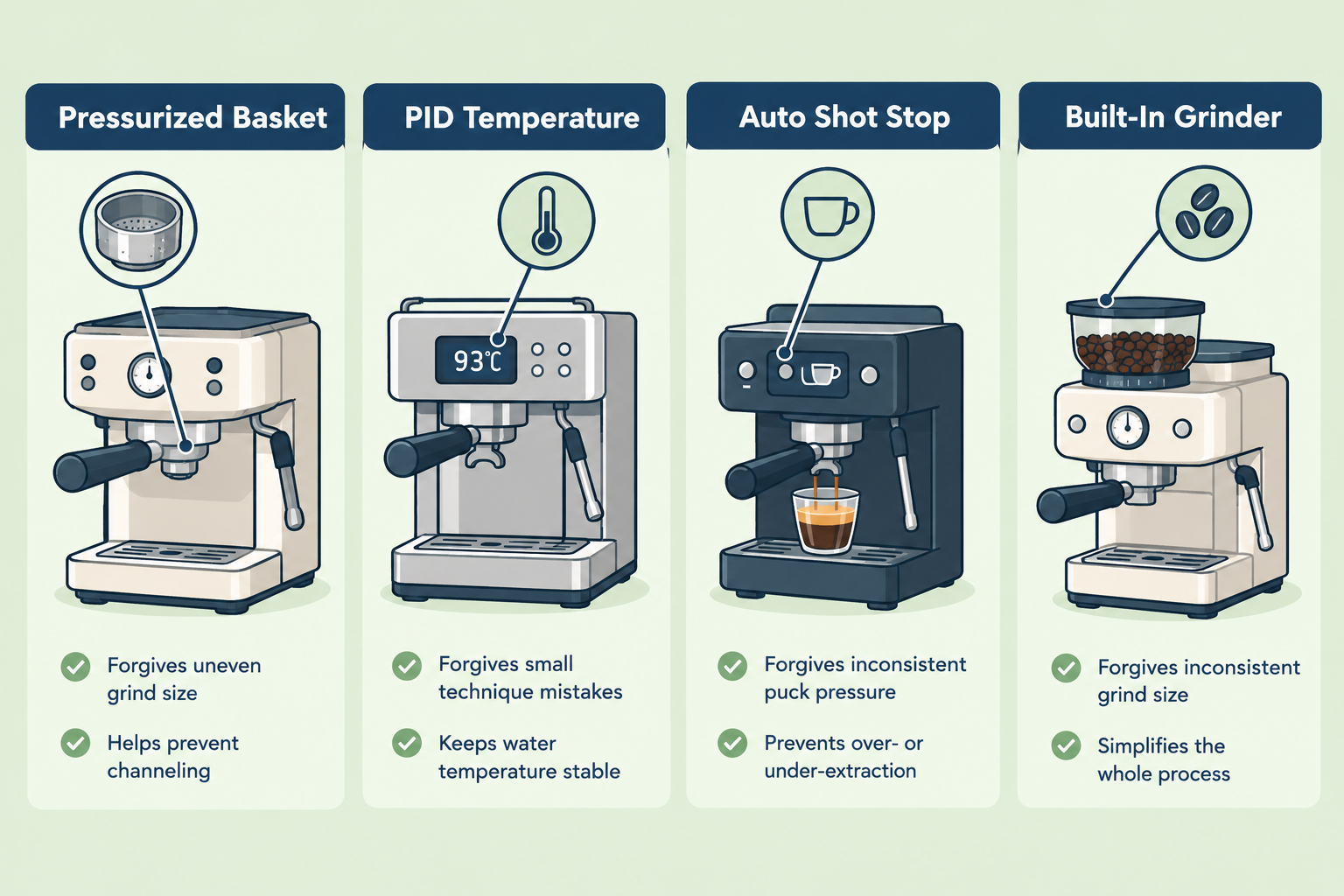
Several 2026 buyer's guides now rank beginner machines by forgiveness rather than by pure shot quality, asking how much a groggy first-time user can get wrong and still end up with something worth drinking. That framing matters because a $150 machine with a pressurized basket can mask a bad grind, while a $2,000 machine with a bottomless portafilter will show every mistake in the cup.
Four features do most of the forgiving:
- Pressurized filter basket. It compensates for uneven grind size and light tamping pressure, which is the number one beginner error.
- PID temperature control. A PID (proportional integral derivative controller) holds the water within a degree or two of target, instead of swinging the way older thermoblock machines do.
- Automatic shot stop. The machine cuts the pump at a preset volume, so you cannot walk away and pull a 90-second over-extracted shot by accident.
- Pre-infusion. A brief low-pressure soak before full pressure reduces channeling, which is when water finds a weak spot in the puck and rushes through it.
If you want the full breakdown of how these features interact with grind and dose, our buyer's guide to choosing the best espresso machine for crafting drinks covers the tradeoffs in more depth. For now, know this: the best espresso machine for beginners absorbs your first month of mistakes instead of punishing them.
How Much Should You Spend on Your First Espresso Machine
Plan to spend $150 to $700 for a real entry level espresso machine, with $300 to $500 as the sweet spot for a beginner espresso machine that includes useful safety features without a serious learning cliff.
Here is how the tiers actually break down:
- Under $150. You are buying a stovetop moka pot or a capsule machine, not a pump-driven espresso machine. Fine for convenience, not for learning real extraction. Our guide to using a stovetop espresso maker for beginners explains what that drink actually is.
- $150 to $300. Simple manual machines like the De'Longhi Stilosa enter here, with a steam wand and basic pump but no built-in grinder.
- $300 to $500. The best budget espresso machine range for beginners who want PID control, pre-infusion, and sometimes an integrated grinder.
- $500 to $700. All-in-one machines with a built-in conical burr grinder, assisted dosing, and stronger steam power. The best espresso machine under 500 usually lives right at the top of this range.
- $700 and up. Prosumer machines with commercial-style groupheads. Worth it once you already know what you want to change about your shots.
A higher price needs a reason. If a $600 machine costs twice as much as a $300 one, the difference should show up as a built-in grinder, a stronger boiler, or measurably better temperature stability, not just a nicer badge.
The 7 Best Espresso Machines for Beginners
Here are seven machines that fit different beginners, chosen for how well each one forgives a rough first month rather than for raw shot quality alone. Each pick names who it suits and who should look elsewhere.
| Machine | Best for | Price tier | Grinder included | Learning curve |
|---|---|---|---|---|
| Breville Bambino Plus | Overall beginner pick | $300 to $400 | No | Low |
| Breville Barista Express Impress | Assisted dosing and tamping | $700 to $800 | Yes | Low to moderate |
| Breville Barista Express (BES870XL) | Best value with grinder | $600 to $700 | Yes | Moderate |
| Café Affetto | Minimal cleanup, super automatic | Around $629 | Yes | Very low |
| De'Longhi Stilosa | Best budget under $300 | Around $150 | No | Moderate |
| Gaggia Classic Evo Pro | Growing into manual skills | $450 to $550 | No | Moderate to high |
| Ninja Luxe Cafe Mini Plus | Limited counter space | $300 to $400 | Yes | Low |
1. Breville Bambino Plus: Best Overall for Beginners
The Bambino Plus earns the top spot because it removes the two things beginners struggle with most: waiting for the machine to heat up and steaming milk by hand. It reaches brewing temperature in seconds thanks to Breville's ThermoJet heating system, and its automatic milk frother lets you set a texture and walk away.
Strengths: fast heat-up, automatic milk texturing, small footprint, PID-style temperature stability. Tradeoffs: no built-in grinder, so you will need a separate burr grinder and a place to store it. Skip it if: you want a single machine that grinds, doses, and brews without any extra gear. Check the current price before deciding, since Breville periodically updates the lineup.
2. Breville Barista Express Impress: Best for Assisted Dosing and Tamping
This model was named the top beginner pick in a 2026 Forbes roundup specifically because it automates the two most error-prone steps in making espresso: dosing the right amount of ground coffee and tamping it evenly. Its Precision Puck system doses and tamps for you, then displays a live extraction reading.
Strengths: integrated conical burr grinder, guided dosing and tamping, digital shot monitoring. Tradeoffs: higher price and a larger footprint than the plain Bambino. Skip it if: counter space is tight or your budget caps under $500.
3. Breville Barista Express (BES870XL): Best Value With a Grinder
The standard Barista Express remains one of the most reviewed espresso machines on the market, with more than 27,877 user reviews feeding a large body of troubleshooting advice that helps new owners fix their own mistakes instead of guessing. It pairs an integrated grinder, PID temperature control, and pre-infusion in one unit, which is why it still gets called the best entry-level espresso machine years after its release.
Strengths: built-in grinder, PID control, pre-infusion, huge community support. Tradeoffs: manual tamping means technique still matters more than on the Impress model. Skip it if: you want the machine to tamp for you. Choose the Impress instead.
4. Café Affetto: Best for Minimal Cleanup
The Café Affetto was named "Best for Beginners" in a Food Network product review, priced around $629 at the time of that review, largely because its automatic grinder and built-in cleaning cycle let new users get café-style drinks with almost no manual input.
Strengths: one-touch drink programs, automatic milk system, self-cleaning routine. Tradeoffs: less control over shot variables if you later want to fine-tune flavor. Skip it if: you are the type who wants to tinker. This machine is built for people who want to press a button and leave.
5. De'Longhi Stilosa: Best Budget Espresso Machine Under $300
Listed at about $150 in a Business Insider guide, the Stilosa is described as an entry-level manual machine for beginners comfortable with a manual steam wand who still want a simple way into real espresso. It is the clearest answer to "best espresso machines under 300 dollars" on this list.
Strengths: low price, compact size, real 15-bar pump pressure. Tradeoffs: no PID, no pre-infusion, and no grinder. Grind size and tamping matter more here than on any other pick. Skip it if: you want the machine to compensate for a rough grind. It will not.
6. Gaggia Classic Evo Pro: Best for Learning Real Skills
This is the one machine on the list built for growth rather than convenience. It has a commercial-style grouphead and fully manual controls, which means it teaches real technique instead of hiding behind automation. If you eventually want to move past beginner gear, this is a one-time purchase you can grow into rather than replace. Our guide on advancing your espresso making skills is a natural next stop once you own one of these.
Strengths: commercial-style grouphead, durable build, strong resale value. Tradeoffs: no forgiving features. Every mistake shows up in the cup. Skip it if: you want convenience over craft. Choose the Bambino Plus or Café Affetto instead.
7. Ninja Luxe Cafe Mini Plus: Best for Limited Counter Space
Tom's Guide named the Ninja Luxe Cafe Mini Plus its "Best for beginners" pick, pointing to its automated grind-size calibration and how it handles weighing, dosing, and grind adjustment so new users are not left guessing. Its narrow footprint also makes it one of the better answers to "best espresso machine if you have limited counter space."
Strengths: compact width, automatic grind calibration, guided workflow. Tradeoffs: smaller water tank and drip tray mean more frequent refills and empties. Skip it if: you brew for a household of four or more people every morning.
Semi Automatic vs Super Automatic Espresso Machine: Which Is Easier
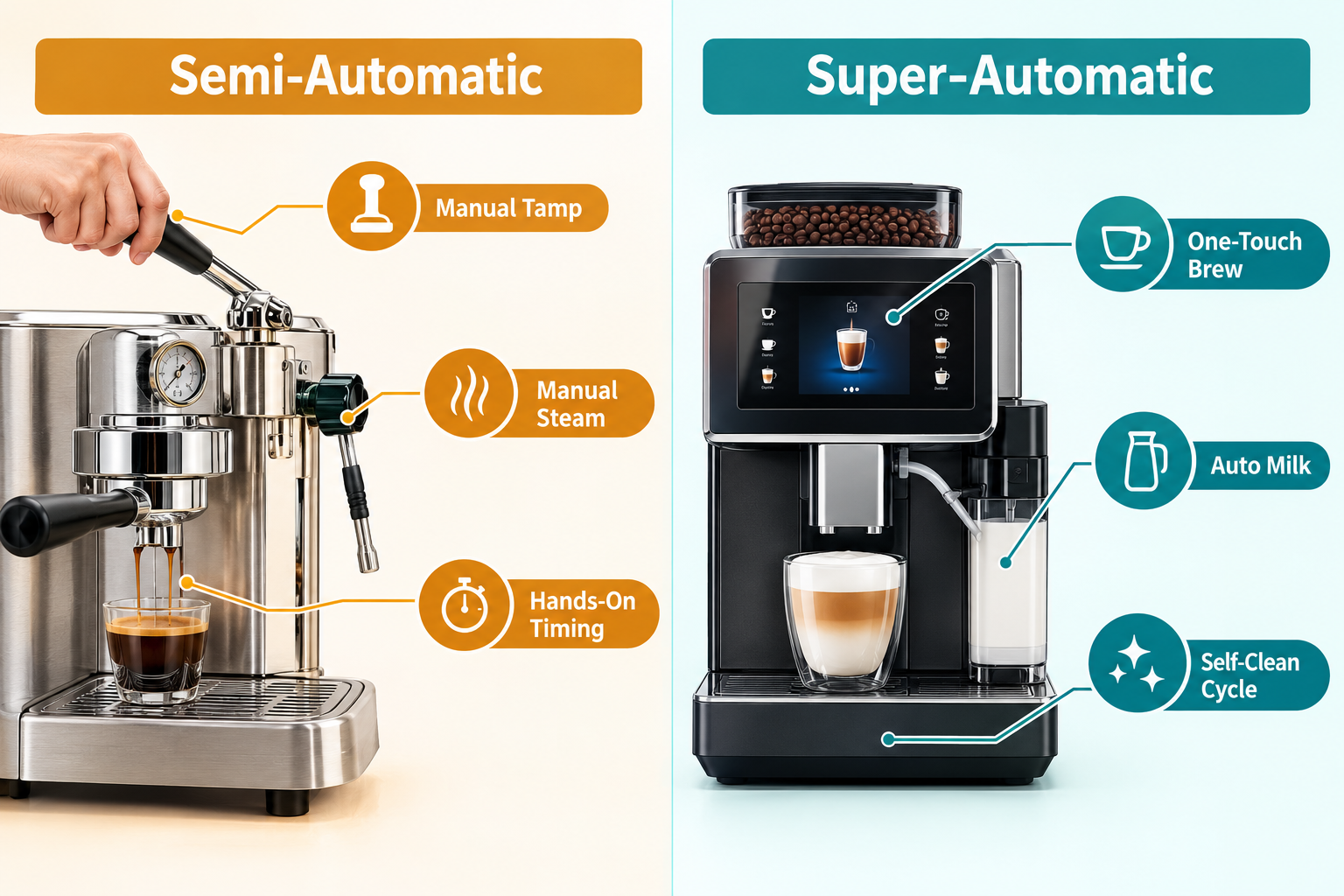
A semi-automatic espresso machine asks you to grind, dose, tamp, and time the shot yourself, with the machine only controlling water pressure and temperature. A super-automatic espresso machine does all of that with one button. For a true beginner who wants the fastest path to a decent drink, the super-automatic is easier. For someone who wants to actually learn espresso, the semi-automatic teaches more.
Good Housekeeping's coffee experts frame this as the first real decision a beginner needs to make, before comparing any specific model: do you want convenience, or do you want the craft process. Their advice is straightforward. Fully automatic machines "grind, tamp, brew, and froth with the push of a button," which suits people who mainly want a consistent drink fast. Manual and semi-automatic machines demand more hands-on involvement but reward you with more control and, eventually, better flavor once you know what you are doing.
Decision rule: choose a best automatic espresso machine like the Café Affetto if your morning routine has no room for troubleshooting. Choose a semi-automatic like the Gaggia Classic Evo Pro or the standard Barista Express if you enjoy the process itself and expect to keep upgrading your skills.
The Wirecutter's long-running espresso coverage adds a useful middle path here, recommending the Profitec Go for beginners who still want a semi-automatic machine but one that responds predictably to small grind and dose changes, since it lets you set a brewing temperature and see a clear cause-and-effect result. That kind of predictable feedback is exactly what separates a forgiving learning machine from a frustrating one.
Best Espresso Machines Under 300 Dollars and Under 500
Under $300, your realistic options are simple pump-driven machines without a built-in grinder, like the De'Longhi Stilosa at roughly $150. Under $500, you start seeing PID temperature control and pre-infusion, and a best espresso machine under 500 can occasionally include a basic integrated grinder if you shop carefully.
- Under $300: De'Longhi Stilosa, De'Longhi Dedica Arte. Manual steam wand, no grinder, real 15-bar pumps.
- $300 to $500: Breville Bambino Plus, Ninja Luxe Cafe Mini Plus. Automatic milk systems and, in the Ninja's case, an included grinder.
- $500 to $700: Breville Barista Express (BES870XL), Café Affetto. Full grinder integration and stronger steam performance.
Common mistake: buyers assume a higher price always means a better shot. It usually means more automation, not better flavor. A well-dialed-in $300 machine with fresh, correctly ground beans will beat a $700 machine running stale pre-ground coffee every time.
Can You Make Good Espresso With a Cheap Machine
Yes. A cheap machine limits your ceiling but does not prevent a genuinely good shot, as long as the grind is fresh and matched to the basket. Espresso quality depends more on grind size, dose, and freshness than on machine price once you are above the $150 pump-driven tier.
The single biggest lever on a budget machine is grind size. Pre-ground coffee is almost always too coarse for espresso and goes stale within days of opening the bag, which is why our piece on the best grind of coffee for an espresso machine is worth reading before you blame the machine for a sour or watery shot. A $150 Stilosa with a $150 dedicated burr grinder will consistently outperform a $150 Stilosa fed supermarket pre-ground coffee.
Edge case: if your cheap machine has no PID and no pre-infusion, expect more shot-to-shot variation even with a perfect grind. That variation is the tradeoff you accept at this price, not a sign the machine is broken.
Do You Need a Grinder With Your Espresso Machine
You need fresh, correctly ground coffee for good espresso, but the grinder does not have to be built into the machine. A separate burr grinder often gives you more control over grind size than the built-in grinder on an all-in-one beginner machine.
That said, a best espresso machine with grinder built in solves a real problem: one less thing to buy, store, and clean. The Breville Barista Express and Barista Express Impress both include a conical burr grinder tuned to their basket, which removes the guesswork of matching a separate grinder's settings to espresso fineness.
Choose a machine with a built-in grinder if: you are buying your very first setup and do not want to shop for two products at once. Choose a separate burr grinder if: you already own or plan to buy a grinder for pour-over or drip coffee too, since a good burr grinder serves both brewing methods. Coffee freshness matters more than most beginners expect; ground coffee loses aroma compounds within 15 to 30 minutes of grinding, which is why roast date and grind timing both belong on your buying checklist alongside the machine itself.
Best Espresso Machine for Limited Counter Space and Minimal Cleanup
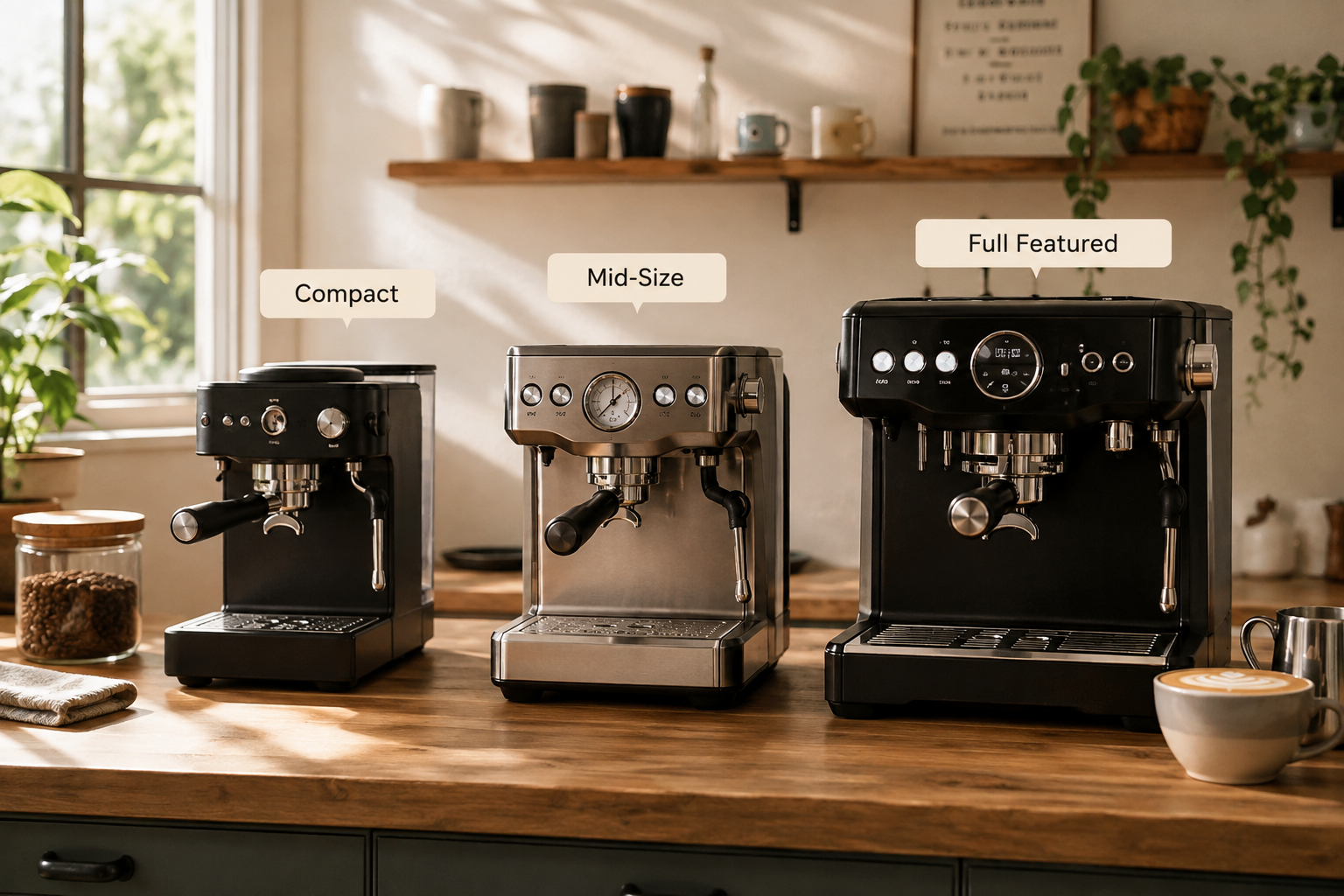
For tight counters, the Ninja Luxe Cafe Mini Plus and Breville Bambino Plus are the strongest picks on this list, both under 8 inches wide. For minimal cleanup, the Café Affetto's self-cleaning cycle and automatic grinder make it the easiest machine here to live with day to day.
Measure the space above your machine before you buy, not just the counter footprint. Several beginner machines need six or more inches of clearance to lift the water tank or bean hopper for refills, which is easy to miss when you are focused on width alone.
If daily maintenance worries you more than counter space, our guide on cleaning a coffee maker for beginners covers the descaling and rinsing habits that keep any machine, automatic or manual, running well past its first year.
Decision rule: if your kitchen has 10 inches of clear counter width and you hate wiping down a steam wand, go super-automatic. If you have less than 8 inches and do not mind a manual rinse, go compact semi-automatic.
Common Mistakes Beginners Make With Espresso Machines
The most common mistake is grinding too coarse and pulling a shot in under 20 seconds, which produces a sour, watery cup even on an expensive machine. The second most common mistake is skipping descaling, which shortens the life of any beginner espresso machine regardless of price.
Here is the full list worth checking against your own routine:
- Grind too coarse. A fast, thin shot under 20 seconds usually means the grind needs to go finer.
- Stale beans. Coffee bought more than four weeks past its roast date loses aroma and sweetness before it ever hits the portafilter.
- Skipping the purge. Not running a quick blank shot before pulling espresso leaves cooler water sitting in the group, which throws off temperature.
- Ignoring descaling. Mineral buildup from tap water clogs the boiler and steam wand over months, not days, which is why it feels like a sudden failure.
- Overfilling the milk pitcher. Milk expands as it steams; filling past a third of the pitcher leads to overflow and a mess on the counter.
- Not weighing the dose. Scooping by eye instead of weighing 18 to 20 grams of coffee is the fastest way to get inconsistent shots day to day.
Common mistake highlight: treating the first few shots as failures instead of data. A sour shot tells you to grind finer. A bitter, slow shot tells you to grind coarser. That feedback loop is the actual skill you are building.
How Long Does It Take to Learn an Espresso Machine
Most beginners pull a drinkable shot within their first week and a consistently good one within about a month of regular practice, roughly 20 to 30 shots. Machines with a shorter learning curve, like the Bambino Plus or Café Affetto, cut that timeline down because they remove entire skill steps like milk texturing or dosing.
What actually has the shortest learning curve, ranked by how much the machine does for you:
- Café Affetto (super-automatic, near-zero manual steps)
- Breville Bambino Plus (automatic milk, manual grind and tamp)
- Breville Barista Express Impress (assisted dosing and tamping)
- Ninja Luxe Cafe Mini Plus (automated grind calibration)
- Breville Barista Express (BES870XL) (manual tamping, built-in grinder)
- De'Longhi Stilosa (fully manual, no forgiving features)
- Gaggia Classic Evo Pro (fully manual, commercial-style grouphead)
Quick example: a reader starting with the Stilosa and a separate grinder should expect a rougher first two weeks of trial and error than a reader starting with the Barista Express Impress, purely because the Impress removes tamping as a variable to troubleshoot.
My Espresso Machine Broke: What Should I Do
Most beginner espresso machine problems are descaling, gasket, or clog issues, not full mechanical failures, so check those three things before assuming the machine needs replacing. A machine that stopped pulling pressure, is leaking from the portafilter, or takes far longer than usual to heat up almost always points to mineral buildup or a worn seal.
Start with these steps in order:
- Descale it. If you have not descaled in three months or 300 shots, do this first. It solves more "broken" machines than any other fix.
- Check the portafilter gasket. A leaking group head is often a $5 rubber gasket, not a $300 repair.
- Backflush the group. Coffee oil buildup can slow water flow and mimic a pump failure.
- Check the water reservoir seal. A machine that will not power on sometimes has a misseated tank triggering a safety sensor.
For a full walkthrough with model-specific fixes, our advanced espresso machine troubleshooting guide covers pump, boiler, and grinder problems in more detail than a beginner needs on day one but will save you a repair call later.
Edge case: if your machine is under warranty and the fix involves opening the boiler housing, stop and call the manufacturer instead. Opening a pressurized boiler yourself can void the warranty even if the fix would have worked.
How to Make Espresso at Home: A Simple First Method
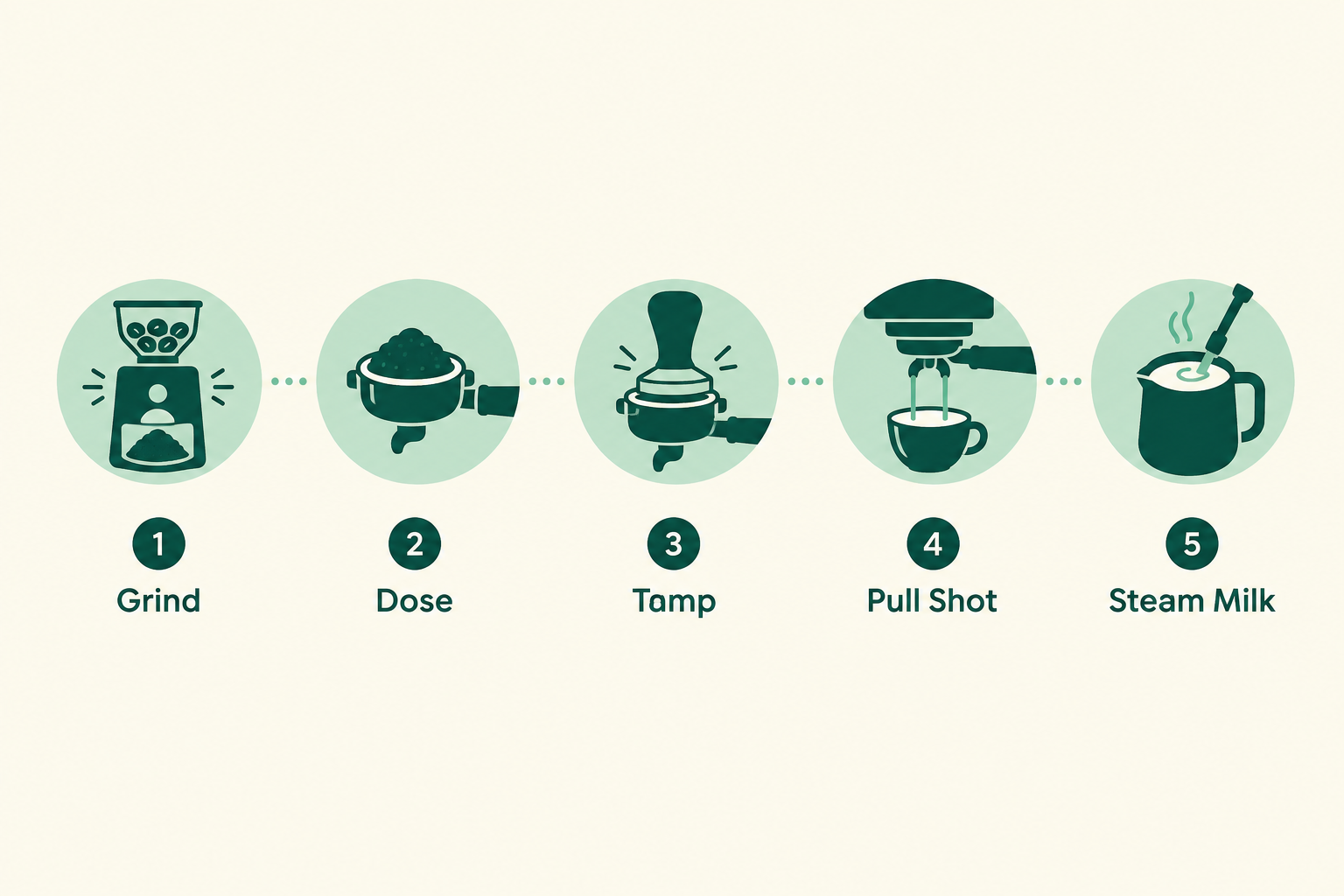
Learning how to make espresso at home starts with four things you control directly: dose, grind size, tamp pressure, and shot time. Aim for 18 to 20 grams of coffee ground fine enough that a 1:2 brew ratio (about 36 to 40 grams of liquid espresso) takes 25 to 30 seconds to pull.
- Grind fresh. Grind just before brewing. Espresso grind looks like fine table salt.
- Dose and level. Weigh 18 to 20 grams into the basket and level it with a finger sweep or distribution tool.
- Tamp evenly. Press straight down with firm, level pressure. Uneven tamping causes channeling.
- Pull the shot. Lock in the portafilter and start the shot. Target 25 to 30 seconds for a 1:2 ratio.
- Steam and pour. If making a milk drink, steam to about 150°F and pour.
This is the same basic method whether you own a $150 Stilosa or a $700 Barista Express Impress. The machine changes how much room you have for error, not the underlying process. For a slower walkthrough with troubleshooting at each step, read the beginner's guide to making the perfect cup of espresso.
FAQ
What is the best espresso machine for beginners overall? The Breville Bambino Plus is the strongest overall pick for most beginners because it heats quickly, holds temperature well, and steams milk automatically, which removes the hardest manual skill for latte drinkers.
Is a super-automatic espresso machine better for a total beginner? Yes, if convenience matters more than learning the craft. A super-automatic like the Café Affetto grinds, doses, brews, and cleans with one button, trading control for consistency.
Do I need to buy a separate grinder? Not if you choose a best espresso machine with grinder built in, like the Breville Barista Express. If you buy a machine without one, budget for a dedicated burr grinder since pre-ground coffee stales fast and rarely matches espresso fineness.
What is a realistic budget for my first espresso machine? Plan on $150 to $300 for a manual entry level espresso machine, or $300 to $700 for a beginner espresso machine with PID control, pre-infusion, or a built-in grinder.
How long until I can make a decent espresso at home? Most people pull a drinkable shot in the first week and a consistently good one after about 20 to 30 practice shots, roughly a month of regular use.
My new machine is not producing crema. What's wrong? Check the roast date first; beans older than four weeks lose the gas that creates crema. Then check grind size, since too coarse a grind extracts too fast to build pressure.
Conclusion
The best espresso machine for beginners is not the fanciest one on the counter. It is the one that turns your first month of mistakes into decent coffee instead of wasted beans. Start by deciding whether you want convenience (Café Affetto, Ninja Luxe Cafe Mini Plus) or craft (Gaggia Classic Evo Pro, standard Barista Express), then match your budget to a tier that includes real forgiving features like PID control and pre-infusion.
If you are still unsure, the Breville Bambino Plus remains the safest single recommendation on this list: fast, stable, and automatic enough to save your morning routine on a bad day. Whichever model you choose, spend your first few weeks tracking grind size and shot time instead of chasing a new machine. That habit will improve your coffee more than any upgrade will.
Compare the models above against your own kitchen space and morning routine, then check the current price before you buy. Better coffee starts with better answers, and now you have enough of them to choose well.
Keep Exploring Coffee Rank IQ
- Coffee Rank IQ home: reviews, brewing guides, and coffee science
- Best Super Automatic Espresso Machine: Read the Cleaning Specs First
- Best Semi Automatic Espresso Machine for Real Home Kitchens
- Best Espresso Machine Under 500: Where the Money Actually Goes
- Best Manual Espresso Machine: Flair, Cafelat, and Lever Picks
References
- www.forbes.com/sites/forbes-personal-shopper/article/best-espresso-machine
- www.nytimes.com/wirecutter/reviews/best-espresso-machine-grinder-and-accessories-for-beginners
- www.businessinsider.com/guides/kitchen/best-espresso-machines-reviewed
- www.foodnetwork.com/how-to/packages/shopping/product-reviews/best-espresso-machines
- www.reviewed.com/cooking/best-right-now/the-best-espresso-machines
- www.livingetc.com/buying-guides/the-9-best-espresso-machines-year-sleek-gadgets-that-give-your-kitchen-extra-style-points
- www.tomsguide.com/home/coffee-makers/best-espresso-machines
- www.goodhousekeeping.com/uk/product-reviews/electricals/g27255741/best-espresso-coffee-machines
- aafrc.org/best-espresso-machines-for-beginners