Mushroom Coffee: What Research Supports, What It Doesn’t
Quick Answer
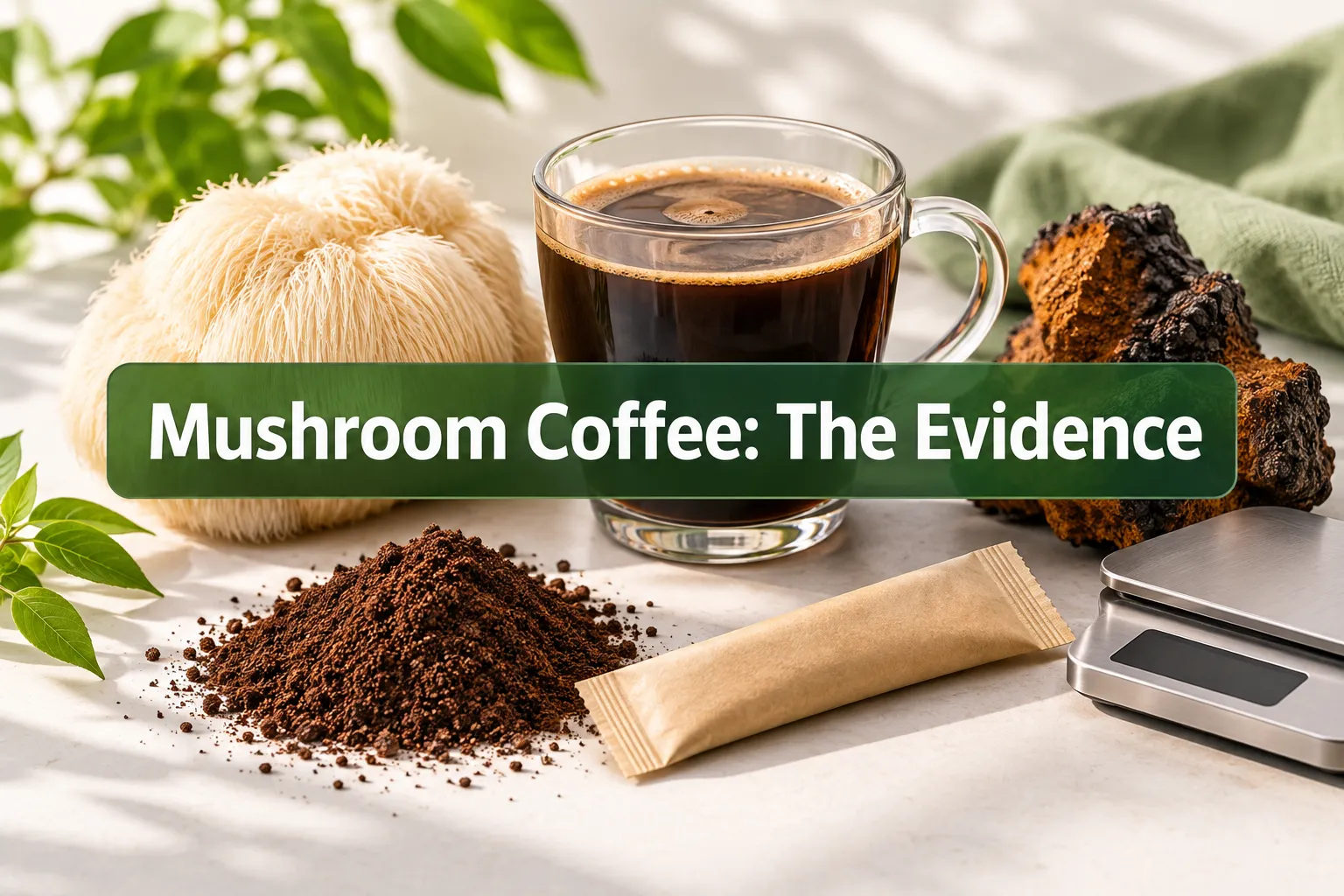
Mushroom coffee is ground coffee (usually instant) blended with dried mushroom extract powder, most often lion's mane, chaga, reishi, or cordyceps. Human research on those mushrooms exists but is small, inconsistent, and almost never tested in a brewed coffee format. Cleveland Clinic points out the obvious gap: nobody has shown the mushroom compounds survive processing and brewing at a dose that does anything. So the honest position is that mushroom coffee is a lower-caffeine coffee drink with interesting ingredients and thin direct evidence.
Key Takeaways
- Four mushrooms dominate the category: lion's mane, chaga, reishi, and cordyceps. Lion's mane has the most human trials, and even that body of work is tiny.
- A 2023 randomized double-blind pilot (PubMed ID 38004235) gave 1.8 g of lion's mane to 41 adults aged 18 to 45. Stroop task speed improved at 60 minutes. The 28-day stress result missed significance at p = 0.051.
- A 2025 randomized crossover trial (PubMed ID 40276537) with 18 adults on 3 g of a 10:1 fruiting-body extract found no overall cognitive or mood benefit. One pegboard task improved at 90 minutes.
- A four-week trial (PubMed ID 36582308) gave young adults 10 g/day of lion's mane in muffins and found no significant cognitive or metabolic effect.
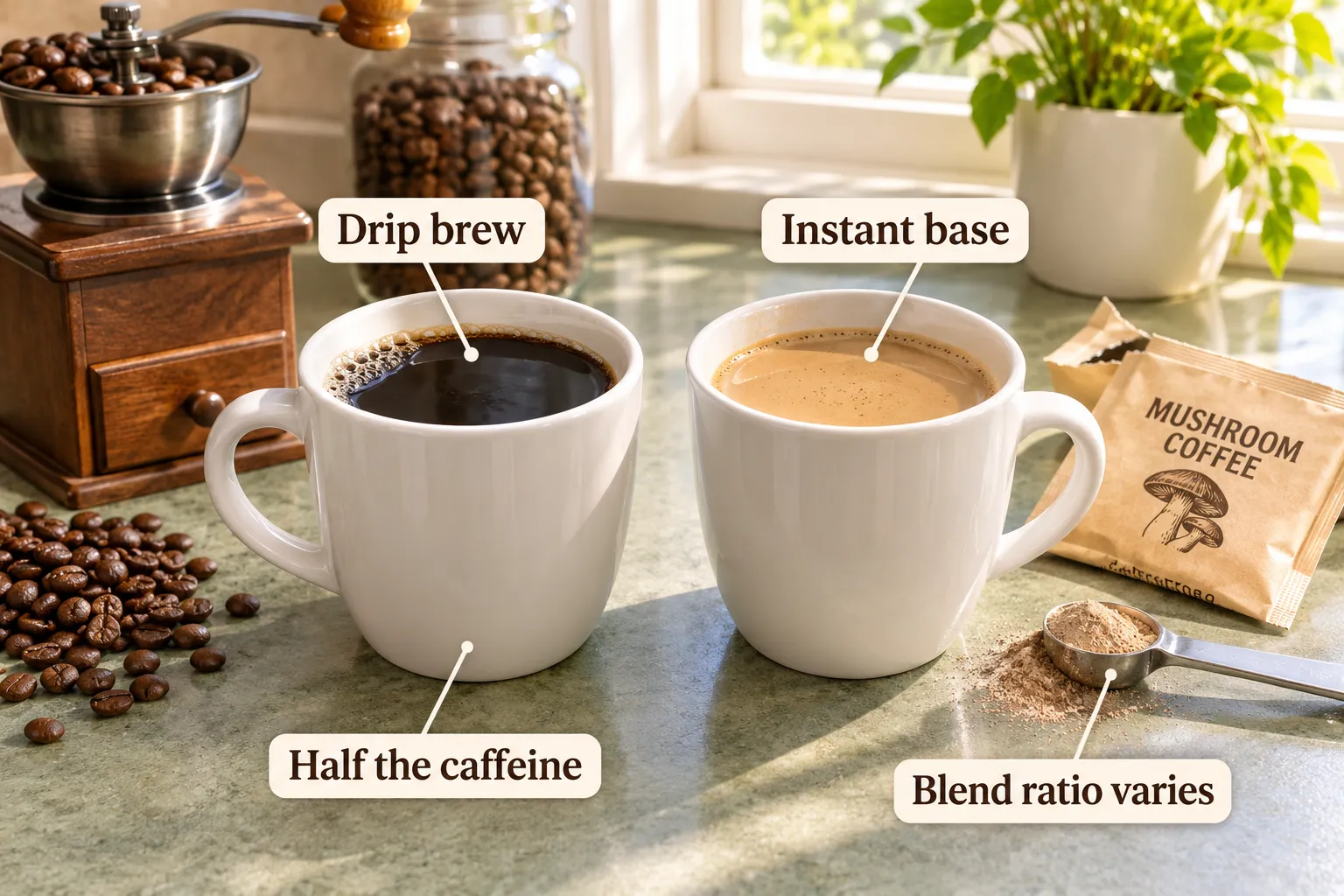
- Caffeine is usually about half a regular cup. Many blends land near 40 to 60 mg per serving versus roughly 95 mg in an 8 oz drip coffee.
- Cost runs high. OM Mushrooms' Focus Lion's Mane Coffee Booster listed at $24.99 for 30 servings ($0.83 each) and $45.99 for 60 ($0.77 each) in October 2026, on top of your normal coffee.
- An industry group formed on November 4, 2026. The Functional Mushroom Council, founded by Fungi Perfecti, Monterey Mushrooms, Aloha Medicinals and others, plans testing standards and marketplace surveys. Useful for quality control, not impartial proof of health effects.
What is mushroom coffee made of?
Mushroom coffee is a blend of coffee and dried mushroom extract powder, typically sold as instant sachets or a tub of soluble powder. A few products are whole bean or ground coffee with powder mixed in, and a growing number are "boosters" you stir into your own grounds.
A typical ingredient panel contains:
- Instant or spray-dried coffee, usually arabica, sometimes robusta for cost and caffeine. If you want the background on why that choice matters, read our breakdown of the disadvantages of robusta coffee.
- One to six mushroom extracts. RYZE markets a proprietary six-mushroom blend. Four Sigmatic sells single-mushroom sachets.
- Optional extras: MCT powder, cinnamon, cocoa, adaptogens like ashwagandha, natural flavoring.
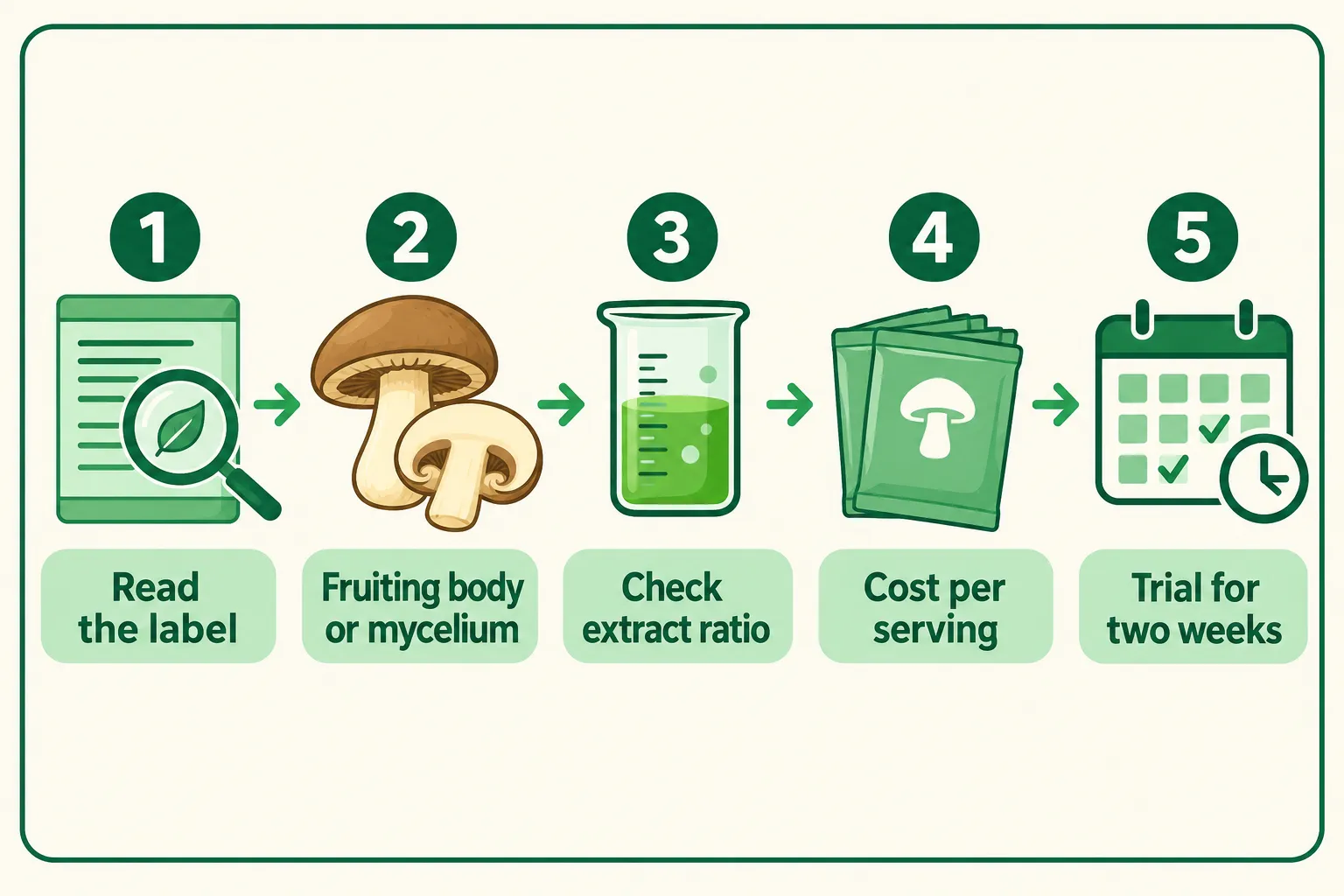
The detail that decides everything is whether the powder comes from fruiting body (the mushroom you would recognize) or mycelium on grain (the root-like network grown on rice or oats, harvested with the grain still attached). Mycelium-on-grain products carry a large share of starch from the growing substrate. Labels rarely tell you the split.
Second detail: extract ratio. A "10:1 extract" means ten parts raw mushroom reduced to one part powder. A product listing "lion's mane powder" with no ratio is likely dried mushroom, not concentrate.

Mushroom coffee: what the research actually supports
Mushroom coffee has almost no research on itself. The evidence everyone cites comes from studies on isolated mushroom extracts in capsules, powders, or baked goods, at doses and purities that may not match what's in the sachet. Cleveland Clinic makes the point directly: assuming benefits survive the processing, the heat, and the brewing is untested.
Here's the per-mushroom picture, stated plainly.
Lion's mane (Hericium erinaceus)
The most studied of the four in humans, and still thin.
- 2023 randomized, double-blind pilot (PubMed 38004235): 41 healthy adults, 18 to 45, given 1.8 g. A single dose improved Stroop task performance at 60 minutes. After 28 days, subjective stress showed only a trend toward reduction, p = 0.051, which is not statistically significant. Authors flagged the small sample.
- 2025 randomized crossover (PubMed 40276537): 18 healthy adults, 3 g of a standardized 10:1 fruiting-body extract. No significant change in global cognition or mood. One pegboard (manual dexterity) task improved at 90 minutes. Eighteen people is a pilot, not a verdict.
- Four-week trial (PubMed 36582308): 10 g/day delivered in mushroom-containing muffins to young adults. No significant effect on cognition or metabolic flexibility.
- September 2026 pilot (PubMed 42884628): 10 healthy adults, 2 g/day for four weeks of a certified organic product containing both mycelial biomass and fruiting body. No statistically significant change in executive function or plasma BDNF. Small-to-moderate effect sizes suggested signals worth a larger trial.
Read those four together. One positive acute finding, one near-miss, two nulls. That is not an established nootropic. It is an open question.
Also note the dose range: 1.8 g to 10 g per day. A sachet of lions mane coffee often supplies 0.5 g to 1.5 g of blend across several mushrooms. Even if the trials were conclusive, most products deliver less than the amount tested.
Chaga (Inonotus obliquus)
Chaga coffee is sold on antioxidant content. Chaga is genuinely rich in melanin and polyphenols in laboratory assays. Published human clinical trials are scarce, and the ones that exist are small and not focused on healthy coffee drinkers.
One practical caution matters more than the hype: chaga is high in oxalates. Case reports in the medical literature have linked heavy, prolonged chaga supplementation to kidney problems in individuals with existing risk. If you have had kidney stones or reduced kidney function, raise chaga with your doctor before making it a daily habit.
Reishi (Ganoderma lucidum)
Reishi appears in blends marketed for calm and sleep. Human research includes small trials on fatigue and quality of life, often in clinical populations rather than healthy adults, with variable extract preparations. Reviews of mushroom supplements, including the Center for Science in the Public Interest's assessment of whether mushroom supplements live up to the hype , land on the same conclusion: promising mechanisms, insufficient human evidence for consumer claims.
Reishi is also bitter. That is why it usually sits at a low dose in flavored blends.
Cordyceps (mostly Cordyceps militaris or CS-4)
Cordyceps carries the most sports-performance marketing. Small human exercise trials have reported modest improvements in measures like VO2 max or time to exhaustion, usually with multi-week supplementation and sample sizes in the dozens. Results are mixed, protocols differ, and wild Ophiocordyceps sinensis (the caterpillar fungus) is not what you are drinking. Commercial products use cultivated mycelium or militaris fruiting bodies.
Preclinical and in-vitro findings describe what a compound can do in a dish or a rodent. They do not establish what a sachet does in a human at breakfast.
Common mistake: citing a petri-dish study about nerve growth factor as if it predicts sharper focus in a person. Those are different claims with different evidence requirements.
Does mushroom coffee actually work scientifically?
Does mushroom coffee work? For a milder caffeine hit and a different flavor, yes, demonstrably. For cognition, stress, immunity, or energy beyond what caffeine provides, the published human evidence does not support confident claims.
Three structural problems sit between the ingredient research and your cup:
- Dose mismatch. Trials used 1.8 g to 10 g of a single extract. Many blends spread 1 g or less across several species.
- Form mismatch. Studies tested capsules, standardized extracts, or baked goods. Nobody randomized people to a brewed mushroom coffee against matched regular coffee and measured outcomes.
- Caffeine confound. Caffeine itself improves alertness and reaction time. Any uncontrolled "I feel sharper" report in a caffeinated product cannot be assigned to the mushrooms.
The regulatory language reflects this. Under FDA rules on structure/function claims, a supplement may say "supports focus" if the claim is truthful, substantiated, carries the standard disclaimer, and is notified to FDA within 30 days of marketing. That is a much lower bar than proving a clinical outcome. A label saying "supports focus" and a product proven to improve cognition are not the same thing.
The industry is aware of the gap. On November 4, 2026, FreshPlaza reported the formation of the Functional Mushroom Council, founded by Fungi Perfecti, M2 Ingredients, Monterey Mushrooms, Aloha Medicinals, Mycopia, and Far West Fungi. SupplySide Journal reported the group plans validated testing methods, marketplace surveys of products sold on platforms like Amazon, and possibly a seal for North American-grown ingredients. Worth watching. Also industry-funded, so treat its future output as quality-control data rather than independent proof.
Meanwhile the product pipeline keeps moving ahead of the science. NeonMind Biosciences completed an initial production run of four Ayurvedic mushroom coffees (FreshPlaza, November 4, 2026) with consumer testing still planned. Monterey Nutra presented mushroom coffee and tea concepts after doubling production capacity (Nutritional Outlook, October 12, 2026). M2 Ingredients introduced M2Brew for brewed-coffee applications. Formulation and flavor are improving faster than the trial data.
How much caffeine is in mushroom coffee?
Most mushroom coffee contains roughly half the caffeine of regular brewed coffee, commonly 40 to 60 mg per serving compared with about 95 mg in an 8 oz cup of drip coffee. Mushrooms contain no caffeine, so the reduction comes entirely from using less coffee per serving.
| Drink | Typical caffeine | Notes |
|---|---|---|
| Drip coffee, 8 oz | ~95 mg | USDA reference range, varies with brew ratio |
| Typical mushroom coffee sachet | ~40 to 60 mg | Brand-stated; verify on the label |
| Espresso, single shot | ~63 mg | Smaller volume, higher concentration |
| Instant coffee, 8 oz | ~60 mg | The base of most mushroom blends |
| Decaf drip, 8 oz | ~2 to 5 mg | See our piece on decaf’s real milligrams |
Mushroom coffee caffeine content varies enough that the label is the only reliable guide. Booster powders added to your own grounds change nothing about caffeine, since you still brew your usual dose.
If cutting caffeine is the actual goal, a half-caf drip or a smaller pour costs far less. Our explainer on whether decaf coffee still contains caffeine covers the numbers.
Mushroom coffee vs regular coffee: what actually differs?
the blend vs regular coffee comes down to three measurable differences: caffeine (roughly half), flavor (earthier, less acidic, usually instant-flat), and price per serving (two to five times higher). Everything else is marketing until better trials arrive.
| Factor | the blend | Regular coffee |
|---|---|---|
| Caffeine per serving | ~40 to 60 mg | ~95 mg (8 oz drip) |
| Base format | Mostly instant/soluble | Whole bean, ground, instant |
| Flavor control | Fixed by the blend | Grind size, brew ratio, water temperature all adjustable |
| Cost per serving | ~$0.77 to $2.50 | ~$0.25 to $0.75 for specialty whole bean |
| Evidence for added benefit | Small, mixed, mostly indirect | Large observational body on coffee itself |
| Acidity | Lower, reported by brands | Varies with roast and origin |
the blend benefits that do hold up under scrutiny: less caffeine, a smoother and less acidic cup for people who find coffee harsh, and convenience. That is a real product with a real audience. It just is not the audience the ads imply.
If you want a better cup rather than a functional one, the variables that reliably change flavor are grind size, brew ratio, water temperature, and roast date. Our pour over coffee ratio guide and best coffee grinder roundup cover more flavor change per dollar than any powder.
Decision rule: choose the blend if you want a lower-caffeine instant drink and you accept the evidence is preliminary. Choose regular coffee, brewed properly, if taste and cost are your priorities.
What are the side effects of the blend, and is it safe daily?
For most healthy adults, daily the blend appears well tolerated in short studies, with digestive upset the most commonly reported complaint. Long-term safety data in large populations does not exist, and "safe in ten people for four weeks" is not the same as "safe for years."
Reported and plausible issues:
- Digestive discomfort. Bloating, loose stools, or nausea, often from polysaccharides or from mycelium-on-grain starch.
- Allergic reactions. Mushroom allergy is real. Skin rash or itching warrants stopping.
- Chaga and oxalates. Relevant for anyone with kidney stones or reduced kidney function.
- Reishi and blood thinning. Some evidence suggests reishi may affect platelet function. Discuss it with your physician before surgery or if you take anticoagulants.
- Cordyceps and immune medication. Several of these mushrooms are promoted as immune-modulating, which is exactly why people on immunosuppressants should ask first.
- Supplement contamination risk. US dietary supplements are not pre-approved for safety or potency. Third-party testing (NSF, USP, Informed Choice) is the practical check.
Edge case: people with autoimmune conditions. The marketing says "immune support," which is vague by design. If your treatment plan involves suppressing immune activity, "support" is not obviously what you want.
Who should not drink the blend?
Skip it, or clear it with a clinician first, if you are pregnant or breastfeeding, taking anticoagulants or immunosuppressants, managing kidney disease or a history of stones, scheduled for surgery within two weeks, or allergic to fungi.
Can pregnant women drink the blend?
The conservative answer is no, unless an obstetrician approves the specific product. Medicinal mushroom extracts have not been studied for safety in pregnancy, and most product labels explicitly advise pregnant and nursing women to consult a healthcare provider. Caffeine limits during pregnancy (ACOG suggests under 200 mg daily) are easier to manage with a measured cup of regular coffee where you know the dose.
Can the blend help with anxiety and focus?
The evidence is too weak to say yes. The strongest signal is the 2023 lion's mane pilot, where 41 adults showed faster Stroop performance 60 minutes after a 1.8 g dose. The 28-day stress reduction in the same study missed statistical significance at p = 0.051. The 2025 crossover in 18 adults found no overall cognitive or mood change.
Three things worth understanding before you buy for focus:
- Lowering caffeine can reduce anxiety on its own. If you switch from 200 mg of coffee to 50 mg and feel calmer, caffeine reduction is the likely explanation, not mushrooms.
- Acute versus chronic effects differ. One positive 60-minute result does not predict a four-week benefit, and two four-week trials found nothing significant.
- Nobody has published a trial where the intervention was brewed the blend. The whole category rests on ingredient extrapolation.
the blend does not treat, prevent, or cure anxiety or any other condition, and no US regulator has authorized such a claim. If anxiety is affecting your life, that is a conversation for a doctor.
Common myths about the blend, debunked
Myth: the blend is clinically proven to improve memory. Correction: the human trials are pilots with 10 to 41 participants, results are mixed, and the two longest four-week studies found no significant cognitive benefit.
Myth: half the caffeine means it won't disrupt sleep. Correction: 50 mg of caffeine at 4 p.m. still has a half-life of roughly five hours in most adults. Less is less, not none.
Myth: all mushroom powders are equivalent. Correction: fruiting body versus mycelium on grain, extract ratio, and species differ enormously. The Functional Mushroom Council formed specifically because product standardization is poor.
Myth: it is an antioxidant upgrade over regular coffee. Correction: regular coffee is already one of the largest sources of dietary polyphenols in the US diet. Diluting coffee with mushroom powder does not obviously improve that. If antioxidant content is your concern, our guide to the healthiest coffee to drink covers the actual variables.
Myth: company claims equal validated results. Correction: OM Mushrooms says its process supplies five times more bioactive compounds than other brewed functional coffees. That is a manufacturer claim about compound content, not an independently verified clinical outcome.
How much does good the blend cost, and what are the cheaper alternatives?
Expect roughly $0.75 to $2.50 per serving. OM Mushrooms' Focus Lion's Mane Coffee Booster listed at $24.99 for 30 servings and $45.99 for 60 servings in October 2026, which works out to about $0.83 and $0.77 per serving, added on top of your existing coffee cost. Full-replacement sachet brands typically sit higher per cup.
The category is growing fast enough that market research firms publish dedicated reports on the blend and functional coffee demand , with the wider functional mushroom and mushroom drinks categories tracked separately . Growth forecasts describe commercial interest, not clinical validation.
the blend brands people actually buy
Only a hands-on review can judge taste, and this article is a research review, not a tasting. What can be stated is what each brand sells:
- RYZE uses a proprietary six-mushroom blend. On October 13, 2026, BevIndustry reported a limited-edition Pumpkin Spice Latte exclusive to Target nationwide, aimed at lowering the flavor barrier for new buyers. Ryze the blend is widely available and flavor-forward.
- Four Sigmatic sells single-mushroom sachets, which makes it easier to know what you are actually taking. Our piece on working Four Sigmatic the blend into a daily routine covers the practical side.
- OM Mushrooms sells the booster format described above, so you keep brewing your own beans.
Look for a stated species, fruiting body confirmation, a milligram dose per serving, an extract ratio, and third-party testing. Brands that publish all five are a minority.
Cheaper alternatives worth considering
- Buy plain lion's mane extract separately and stir it into coffee you already like. You control dose and bean quality.
- Half-caf drip for the caffeine reduction at near-zero added cost.
- Switch to better beans. A $20 bag of fresh single origin produces 15 to 20 cups. Compare options in our guide to choosing coffee beans for home brewing.
- Cold brew, which is lower in perceived acidity and often gentler on the stomach, a complaint the blend is frequently sold against.
- Chicory or barley blends for an earthy, low-caffeine cup at a fraction of the cost.
As an Amazon Associate, Coffee Rank IQ earns from qualifying purchases.
FAQ
Conclusion
For a home brewer, the practical read is this: the blend is a legitimate product with a legitimate niche, lower caffeine and a smoother cup, wrapped in health language the research has not caught up to. Four lion's mane trials in 10 to 41 people, producing one positive acute result, one near-miss, and two nulls, is not a foundation for memory or stress claims. Nobody has tested the brewed beverage itself.
If you want to try it anyway, do it with clear eyes. Buy one month of a single-mushroom product with a stated species, fruiting body sourcing, and a milligram dose. Keep your regular coffee as the comparison. Note sleep, afternoon energy, and stomach comfort for two weeks.
If what you actually want is a better cup, the money goes further on a burr grinder, fresher beans with a visible roast date, and a measured brew ratio. Start with our pour over brewing guide and change one variable at a time. Better Coffee Starts With Better Answers.
This article reviews published research and reported product information. It is not medical advice and does not claim that the blend treats, prevents, or cures any condition. Talk to your doctor before adding supplements, especially during pregnancy or alongside medication.