Coffee Before Workout: The Dose That Works
Quick Answer
Drink 3 to 6 mg of caffeine per kilogram of body weight about 45 to 60 minutes before training. For a 170 lb (77 kg) person that is roughly 230 to 460 mg, or about two to four 8 oz cups of regular brewed coffee. The International Society of Sports Nutrition's position stand on coffee and sports performance identifies that range as the one most consistently linked to better endurance, strength, and power, and it names coffee as an effective way to deliver the dose . Most people get the benefit at the low end. Doubling the dose does not double the result.
Key Takeaways
- The dose: 3 to 6 mg caffeine per kg body weight, per the ISSN position stand on coffee and sports performance .
- The timing: about 60 minutes before exercise, because plasma caffeine generally peaks 30 to 90 minutes after drinking.
- In cups: roughly two to four cups of typical brewed coffee for a 70 kg athlete, which works out to 210 to 420 mg .
- The ceiling: EFSA concluded that single doses up to 200 mg and daily intakes up to 400 mg do not raise safety concerns for healthy adults .
- The effect size is real but modest. Reviews of caffeine and exercise report small to moderate improvements, not dramatic ones .
- Start low. 3 mg/kg is the sensible default. Going above 6 mg/kg mostly adds jitters, a racing heart, and a worse night's sleep.
- Coffee beats most pre-workout powders on transparency of dose, cost, and the absence of stacked stimulants.
How much coffee should I drink before working out?
Take your body weight in kilograms and multiply by 3 for a starting dose, by 6 only if you are an experienced caffeine user. The ISSN position stand describes 3 to 6 mg/kg, taken roughly 60 minutes before exercise, as the range where performance effects show up most reliably, and it explicitly says coffee works as the delivery vehicle rather than requiring a pill or powder .
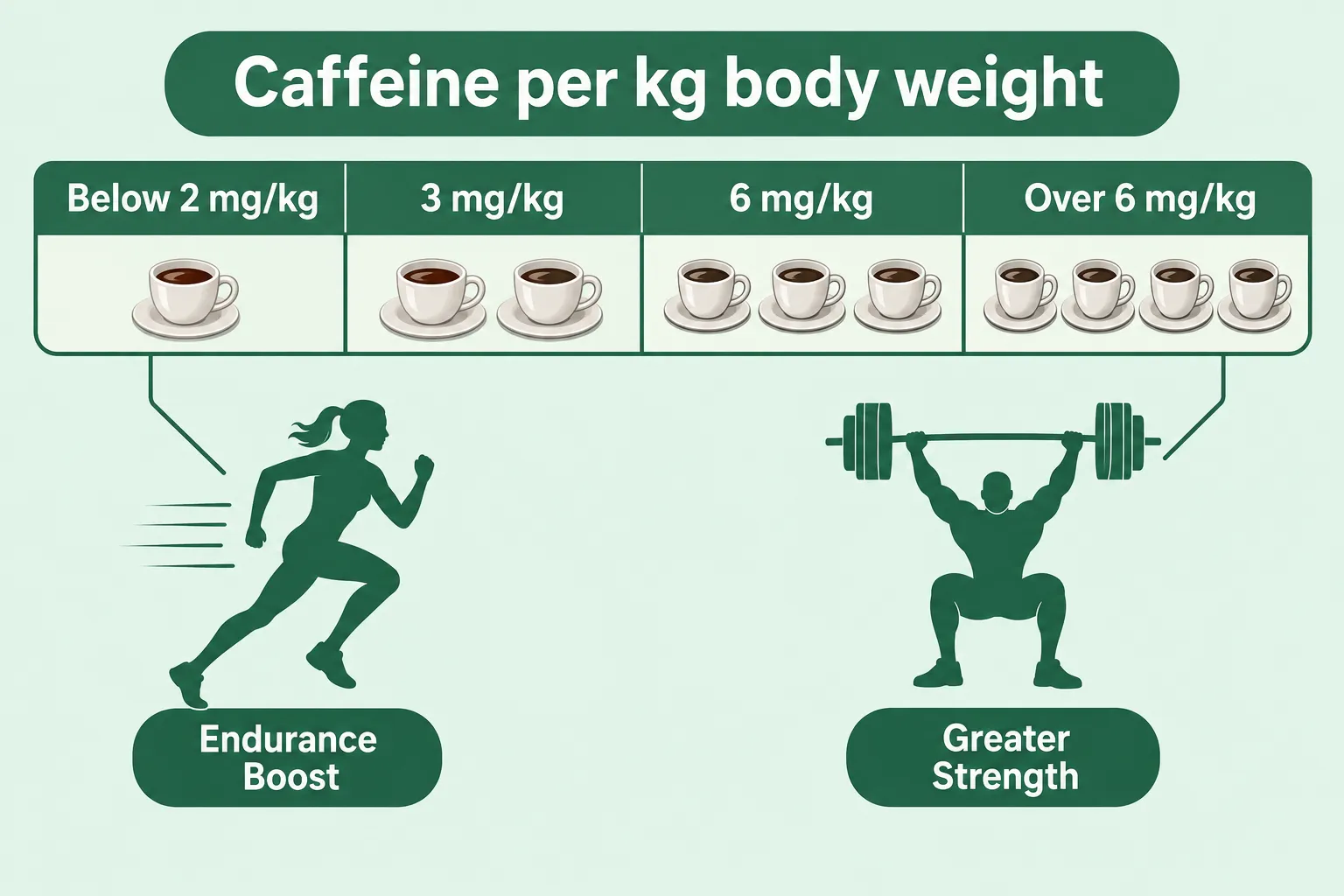
The cup conversion is where it gets slippery. An 8 oz cup of drip coffee is often estimated around 95 to 100 mg of caffeine, but that is an average, not a measurement of your cup. Grind size, brew ratio, bean variety, and water temperature all shift the number. Robusta can carry roughly double the caffeine of arabica by weight. A café 16 oz brewed coffee is frequently two to three standard cups in one lid.
| Body weight | 3 mg/kg (start here) | 6 mg/kg (upper range) | Approx. cups of brewed coffee |
|---|---|---|---|
| 130 lb (59 kg) | 177 mg | 354 mg | 2 to 3.5 |
| 150 lb (68 kg) | 204 mg | 408 mg | 2 to 4 |
| 170 lb (77 kg) | 231 mg | 462 mg | 2.5 to 4.5 |
| 200 lb (91 kg) | 273 mg | 546 mg | 3 to 5.5 |
Note the tension in that table. A 200 lb lifter aiming for 6 mg/kg lands at 546 mg, which sits well above the 400 mg daily figure EFSA considered unproblematic for healthy adults . The upper end of the sports range is not a target. It is a ceiling that most people should never touch, and for larger bodies it collides with ordinary safety guidance.
Decision rule: if you drink one cup most mornings, start at 3 mg/kg. If you already drink three or more cups daily, you are habituated and may need the middle of the range, but your baseline tolerance also means the acute boost is smaller.
Our calculator below does the arithmetic and flags when your result passes the 400 mg mark.
Pre-workout coffee dose calculator
Upper research range (6 mg/kg): ‘+hi+’ mg, about ‘+ch+’ cups.
Drink it 45 to 60 minutes before you start.’; if(hi>400){msg+=’
Coffee before workout: what the research actually shows
Caffeine before workout improves endurance, muscle strength, muscular endurance, power, and jumping performance, with the effect sizes generally small to moderate. The Operation Supplement Safety program run by the Uniformed Services University summarizes the same picture: caffeine is one of the few ergogenic aids with consistent human evidence behind it, with typical performance doses in the 3 to 6 mg/kg window .
The ISSN position stand on coffee and sports performance is the document most directly relevant to anyone brewing at home. It examined coffee specifically rather than anhydrous caffeine pills, and concluded that coffee delivers a performance benefit comparable to isolated caffeine when the dose matches . That matters because for decades the folk wisdom claimed chlorogenic acids in coffee blunted the effect. The position stand does not support that claim.
Limitations, stated plainly:
- Most trials used trained young men. Data on women, older adults, and recreational exercisers is thinner.
- Caffeine content in coffee was often estimated rather than measured, so the "two to four cups" translation carries real uncertainty .
- Responses vary by genotype, habitual intake, sleep debt, and what you ate that morning. Group averages hide individual non-responders.
- Performance labs measure time trials and one-rep maxes. They do not measure whether you enjoyed your Tuesday session.
A 3 mg/kg dose will probably buy you a few more reps or a slightly faster final mile. It will not turn a bad training block into a good one.
Does coffee actually help you exercise better, or is it placebo?
Both things are true, and the measurable effect survives blinding. Randomized placebo-controlled crossover trials, where participants do not know whether they received caffeine, still show improvements in aerobic endurance and perceived exertion. Expectation adds something on top, but it is not doing all the work .
The clearest mechanism is adenosine blockade. Adenosine builds up in the brain through the day and binds to receptors that make you feel tired. Caffeine is shaped closely enough to occupy those receptors without activating them, so the fatigue signal quiets down. Your legs are not stronger. Your nervous system is less willing to tell you to stop.
Two practical consequences follow:
- The biggest reported change in most trials is rating of perceived exertion. The same workload feels easier. That is often why the extra reps appear.
- Reaction time and alertness improve too, which is why caffeine before workout tends to help in sports with a skill or decision component, not just in time trials.
Common mistake: assuming a non-response means you need more. If 3 mg/kg does nothing noticeable, more caffeine usually produces side effects before it produces performance. Check your sleep first. Caffeine cannot replace a night you did not get.
How long before a workout should you drink coffee?
Drink it 45 to 60 minutes before you start moving. Caffeine absorbs from the gut quickly, and plasma concentration generally peaks somewhere between 30 and 90 minutes after you finish the cup, so a one-hour head start puts the peak close to your main working sets.
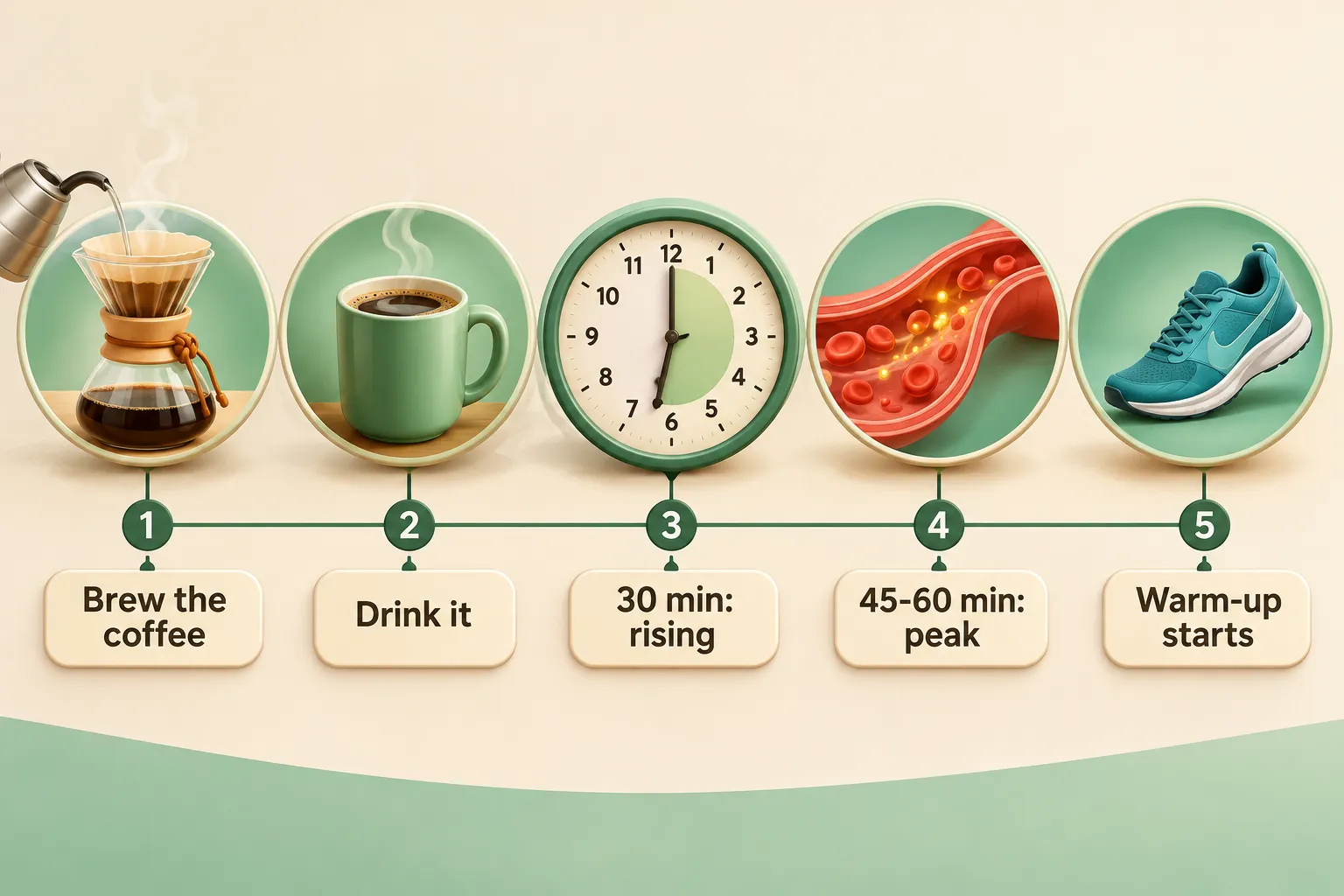
Adjust from there:
- Hot brewed coffee, empty stomach: absorption is faster, so 30 to 45 minutes can be enough.
- Coffee with a full breakfast: food slows gastric emptying, so lean toward 60 minutes.
- Iced coffee or cold brew: you often drink it faster and in a larger volume, which means more caffeine arriving sooner than you planned. Check the serving size.
- Long sessions over 90 minutes: a smaller second dose mid-session is an option used in endurance sport, but it stacks onto your daily total.
Half-life is the other half of the clock. Caffeine's elimination half-life in healthy adults is commonly cited around 3 to 5 hours, which means a 5 p.m. espresso still has meaningful caffeine circulating at 10 p.m.
Edge case: if your gym is a 20 minute drive away, brew at home and drink in the car park, not at the kitchen table before you pack your bag. The gap between "I finished the cup" and "I started the warm-up" is the number that matters.
What's the best time to have coffee before the gym, morning versus evening?
For morning workouts, coffee before workout is close to free performance. For evening workouts, the same dose can cost you sleep, and sleep is worth more than the extra reps.
Morning training (before 10 a.m.): caffeine arrives when adenosine pressure is lowest, so the alerting effect is less dramatic than people expect, but the performance effect holds. A single cup 45 minutes before works for most people.
Afternoon training (noon to 4 p.m.): likely the best window. You are past the morning cortisol peak, caffeine has time to clear before bed, and body temperature is near its daily high, which suits strength work.
Evening training (after 5 p.m.): this is where the trade-off bites. A 300 mg dose at 6 p.m. still leaves roughly 150 mg in circulation around 10 p.m. Sleep research consistently links evening caffeine to longer time to fall asleep and reduced deep sleep. If you train at night, either drop to a token 50 to 100 mg or skip it. Many evening lifters do better with a well-timed meal and a loud playlist.
Decision rule: set a personal cutoff of eight hours before bedtime. If your workout falls after that line, the coffee is costing more than it returns.
Coffee before cardio versus strength training: which benefits more?
Endurance exercise shows the most consistent benefit. Strength and power benefit too, but the effect is smaller and more variable between individuals.
| Activity | Typical caffeine effect | Practical dose | Notes |
|---|---|---|---|
| Endurance running, cycling, rowing | Most consistent; improved time to exhaustion and time-trial performance | 3 to 6 mg/kg | Strongest evidence base in the ISSN review |
| Maximal strength (1RM squat, bench) | Small positive effect, variable by person | 3 mg/kg | Perceived exertion drops more than force output rises |
| Muscular endurance (reps to failure) | Reliable small to moderate gain | 3 mg/kg | Often shows up as 1 to 2 extra reps |
| Power and jumping | Small positive effect | 3 mg/kg | Reaction time gains may help sport-specific tasks |
| Skill sports, team sports | Benefits to alertness and reaction time; sport-specific outcomes less certain | 3 mg/kg | Jitters can hurt fine motor control |
Caffeine strength training users should note one thing: the extra rep comes from a willingness to keep going, not from new muscle fiber recruitment you did not already have. That is still useful. Accumulated volume drives adaptation. Just do not mistake it for a change in your actual capacity.
Can caffeine make you dehydrated during workouts?
No, not at the doses in this article. The diuretic effect of caffeine in habitual coffee drinkers is small and offset by the water in the coffee itself, so a pre-workout cup counts toward your fluid intake rather than against it. We covered the research on this in detail in our breakdown of whether coffee dehydrates you.
Two caveats worth keeping:
- If you rarely drink caffeine, a large first dose can produce a noticeably increased need to urinate. Tolerance to the diuretic effect develops within a few days of regular intake.
- Coffee does not replace electrolytes. For sessions over an hour in heat, you still need sodium and plain water.
Common mistake: skipping water because "coffee is a liquid." Two cups of coffee is about 16 oz of fluid. That is not hydration for a 90 minute session in July.
Is coffee better than energy drinks or pre-workout supplements?
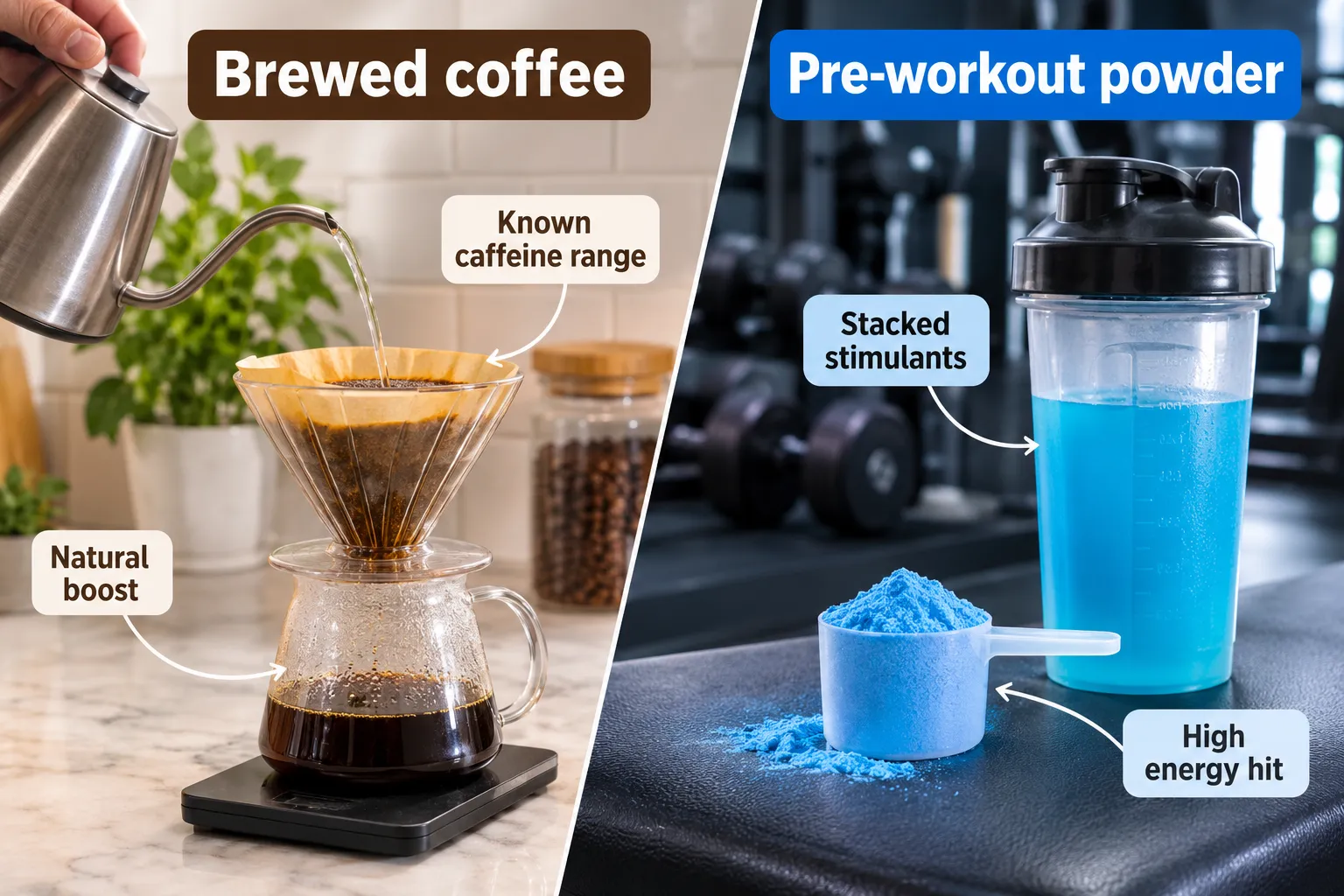
For most recreational lifters and runners, yes. Coffee delivers the same active compound at the same effective dose, costs less per serving, and contains one stimulant rather than five.
| Option | Typical caffeine | What else is in it | Dose transparency | Rough cost per serving |
|---|---|---|---|---|
| Home-brewed drip coffee | 80 to 120 mg per 8 oz | Chlorogenic acids, trace minerals | Estimated, varies by brew | Around $0.30 to $0.60 |
| Espresso-based drink | 60 to 150 mg | Milk, sugar if added | Varies by shot count | $3 to $6 at a café |
| Canned energy drink | 80 to 300 mg | Taurine, B vitamins, sugar or sweeteners | Usually printed on the can | $2 to $4 |
| Commercial pre-workout powder | 150 to 400 mg | Beta-alanine, citrulline, often extra stimulants | Printed, but proprietary blends obscure amounts | $1 to $2 |
The coffee versus pre workout supplements comparison turns on two issues. First, stacked stimulants. Several commercial powders combine high caffeine with additional stimulant compounds, and the FDA has issued specific guidance on highly concentrated caffeine in dietary supplements because of the hazard of large, poorly measured doses . Second, labeling. US rules do not uniformly require a precise milligram figure for caffeine, particularly where it occurs naturally, which makes some products harder to dose accurately than a cup of coffee you brewed yourself.
Choose a pre-workout powder if you want ingredients beyond caffeine, such as citrulline for blood flow, and you read the full label. Choose coffee if you want a known, moderate, inexpensive dose you can repeat daily without surprises. If you want the dose more consistent from day to day, a burr grinder and a fixed brew ratio do more for consistency than any supplement label.
Can you drink coffee on an empty stomach before working out?
Most people can, and the coffee reaches peak concentration faster without food. Some people get stomach discomfort, acid reflux, or lightheadedness, and for them a small carbohydrate snack 60 to 90 minutes earlier solves it without blunting the caffeine much.
Signs the empty-stomach approach is not working for you:
- Burning or sour sensation in the chest within 20 minutes
- Nausea during warm-up sets
- Shaky hands and a hollow feeling that improves after eating
Practical fixes: switch from a dark roast to a medium roast, try a pour over with a paper filter rather than a French press, since paper traps some oils, or add half a banana. For fasted morning cardio, black coffee is fine for most. For heavy lifting, food usually improves the session more than the caffeine does.
What happens if you drink too much coffee before exercise?
Above roughly 6 mg/kg the side effects grow faster than the performance benefit. Expect a racing or irregular-feeling heartbeat, shaky hands, anxiety, gut urgency, and a measurable hit to that night's sleep.
EFSA's assessment concluded that single doses up to 200 mg and habitual daily intakes up to 400 mg are not of safety concern for healthy adults in the general population . Sports doses deliberately exceed the single-dose figure, which is a trade-off worth understanding rather than ignoring. The FDA's guidance on highly concentrated caffeine exists because very large doses, especially from powders measured by eye, have caused serious harm .
Symptoms that mean stop and seek medical attention: chest pain, fainting, a heart rhythm that feels wrong and does not settle, or vomiting.
Common mistake: doubling the dose because last week's dose felt weak. Tolerance to the alerting effect builds within days. The fix is a lower baseline, not a higher spike. Some people cycle down to one cup a day for a week before an event.
Who shouldn't drink coffee before working out?
Skip or sharply limit pre-workout caffeine if you are pregnant, if you have a diagnosed heart rhythm disorder or uncontrolled high blood pressure, if you take medication that interacts with caffeine, or if you have an anxiety disorder that caffeine reliably worsens. EFSA's advice for pregnancy sits at 200 mg per day from all sources, which a single sports dose would exceed .
If you have any diagnosed cardiac, blood pressure, or anxiety condition, ask your doctor what caffeine level suits you before you start dosing by body weight. That is a conversation with your own numbers in it, not something a chart can settle.
Also worth reconsidering: adolescents, anyone already at the 400 mg daily ceiling from other sources, and people who train in the evening and already sleep badly.
Alternatives to coffee for pre-workout energy
If caffeine is off the table, the honest answer is that nothing matches it for evidence. These are what remain useful:
- Carbohydrate 60 to 90 minutes before. 30 to 60 g for sessions over an hour. The most reliable non-stimulant performance lever there is.
- Green tea or matcha. Roughly 30 to 70 mg caffeine per cup plus L-theanine, which many people find smooths the edge.
- Beetroot juice. Nitrate content has endurance evidence, typically taken 2 to 3 hours before.
- Creatine monohydrate. Not acute, but 3 to 5 g daily supports repeated high-intensity efforts over weeks.
- A 10 minute walk and a proper warm-up. Raises core temperature and heart rate without any pharmacology.
- Decaf coffee keeps the ritual, which for a lot of people is doing more than they think.
What's the best type of coffee to drink before exercise?
Black filter coffee from medium roast arabica, brewed at a known ratio, is the most predictable option. You know roughly how much coffee went in, nothing added slows digestion, and the caffeine arrives in a reasonable window.
Specifics that matter:
- Roast level: caffeine survives roasting largely intact. By weight, lighter roasts hold slightly more because darker beans lose mass. The difference is small compared with how much coffee you dose.
- Species: robusta carries roughly twice the caffeine of arabica, which is why some espresso blends hit harder. See our notes on robusta's trade-offs.
- Brew ratio: this is the lever most people ignore. A 1:15 ratio and a 1:18 ratio from the same beans give meaningfully different caffeine per cup. Our scoops per cup chart makes the measurement repeatable.
- Milk and sugar: fine if you tolerate them. A large milky latte sits heavier during intervals than black coffee does.
- Cold brew: often higher in caffeine per volume because concentrates are brewed strong. Dilute deliberately.
For a dose you can repeat, weigh the beans. Volume scoops drift with grind size and bean density. If you want help picking a bag, start with choosing coffee beans for home brewing.
The misconception worth correcting
The common belief is that stronger is better, and that a 300 mg pre-workout scoop must outperform a cup of coffee. It does not. The dose-response curve for caffeine and exercise flattens out in the 3 to 6 mg/kg band described by the ISSN position stand . Past that point, the added caffeine shows up as side effects rather than output.
The second misconception is that coffee is a weaker vehicle than caffeine pills because of other compounds in the brew. The ISSN review found coffee delivers comparable performance effects at matched doses . Your pour over is not a downgrade.
FAQ
Conclusion
For your daily cup, the practical version is short. Multiply your weight in kilograms by 3. Brew that much caffeine as black filter coffee, drink it 45 to 60 minutes before your warm-up, and keep your total daily intake under 400 mg. That single change does more than any amount of label-reading on a tub of powder.
Your next step: weigh your beans tomorrow morning instead of scooping them. Write down the grams of coffee, the grams of water, and how the session felt. Three sessions of that will tell you more about your own response than any study average can, because the number that matters is yours.
Better Coffee Starts With Better Answers.