
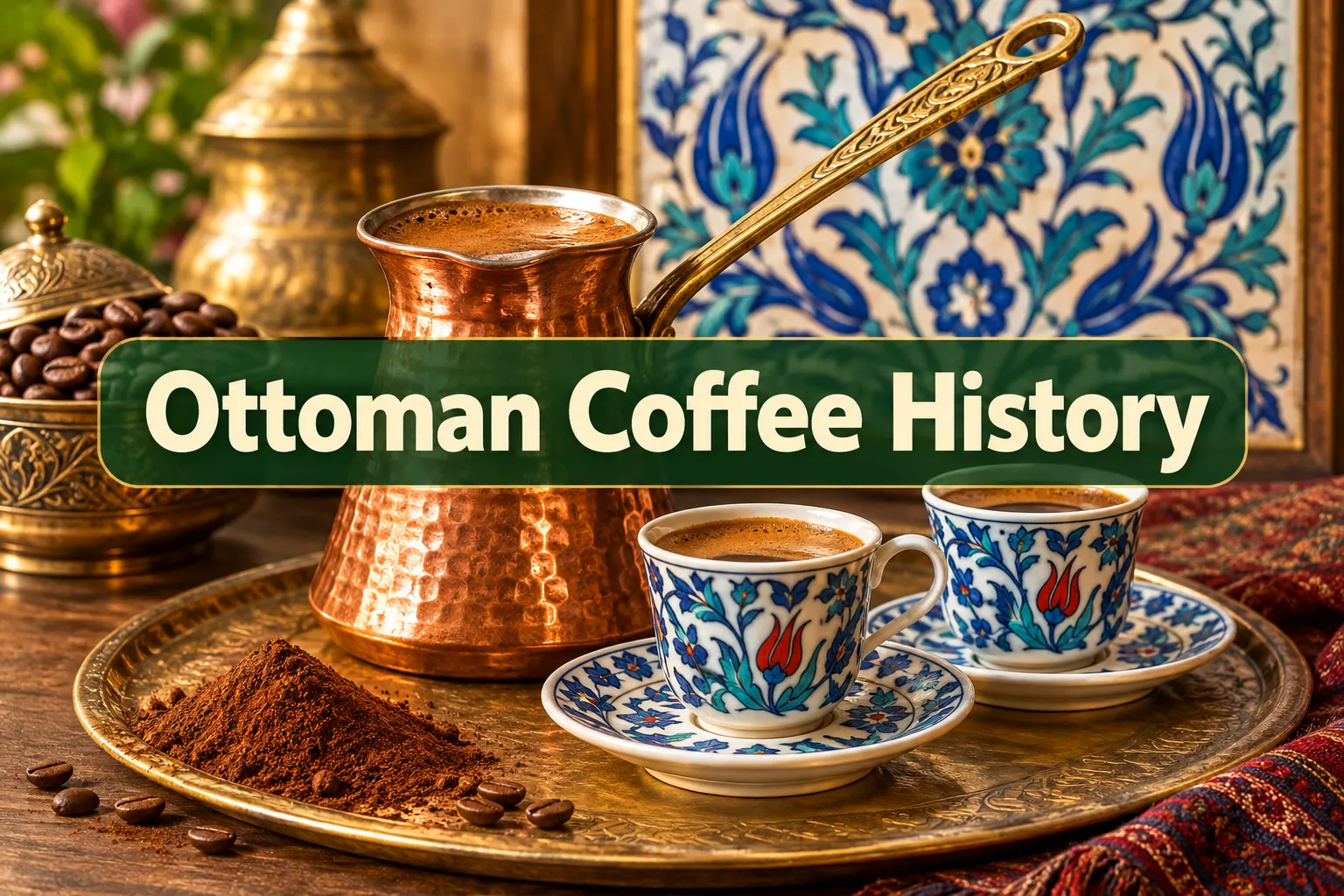
Ottoman Coffee: Bans, Coffeehouses and the Cezve
Quick Answer
Ottoman coffee is the finely powdered, unfiltered coffee simmered in a small long-handled pot called a cezve, served grounds and all in a tiny cup. It arrived in the empire in the 16th century by way of Yemen, got banned more than once because coffeehouses became places where people talked politics, and survived anyway. UNESCO added Turkish coffee culture to its Representative List of the Intangible Cultural Heritage of Humanity in 2013 . The drink most people call Turkish coffee today is the same method, under a newer name.
Key Takeaways
- Coffee reached the Ottoman Empire in the 16th century, with the traditional account crediting Özdemir Pasha, an Ottoman governor in Yemen under Süleyman the Magnificent .
- Istanbul's first institutional coffeehouses are placed in Tahtakale around 1554 to 1555, founded by Hakem of Aleppo and Şems of Damascus, per the chronicler Peçevî İbrahim . Some sources give 1551 or 1553, so treat the exact year as unsettled.
- The bans, most famously under Murad IV in the 1630s, targeted the coffeehouse as a political space more than the caffeine in the cup.
- A cezve is a small pot, wide at the base and narrow at the neck, made to build and hold foam.
- Ottoman coffee uses a grind finer than espresso, closer to flour, and no filter. Grounds in the cup are correct, not a mistake.
- Turkish coffee culture entered the UNESCO list in 2013 , and Adana's Coffee House Museum, open since January 2024, had drawn close to 50,000 visitors by January 2026 [sources below].
- A decent copper cezve usually runs around $20 to $45. A starter set listed in September 2026 bundled a 12 ounce cezve with coffee at roughly $40 to $60.
What is ottoman coffee and why is it called that?
Ottoman coffee is the preparation method that developed across the Ottoman Empire from the 16th century: coffee ground to a powder, combined with cold water and optional sugar in a cezve, heated slowly until foam rises, then poured unfiltered into small cups. The name points to the empire that standardized the method and spread it from Cairo to Sarajevo to Vienna.
The same drink is called Turkish coffee, Greek coffee, Bosnian coffee, Armenian coffee, and Arabic coffee depending on who is pouring. The method barely changes. The label changes with the border.
Calling it ottoman coffee is useful when you want to talk about the historical system rather than one modern nation's version of it. UNESCO frames Turkish coffee as a cultural system, a set of rituals around hospitality and conversation, rather than a beverage recipe .
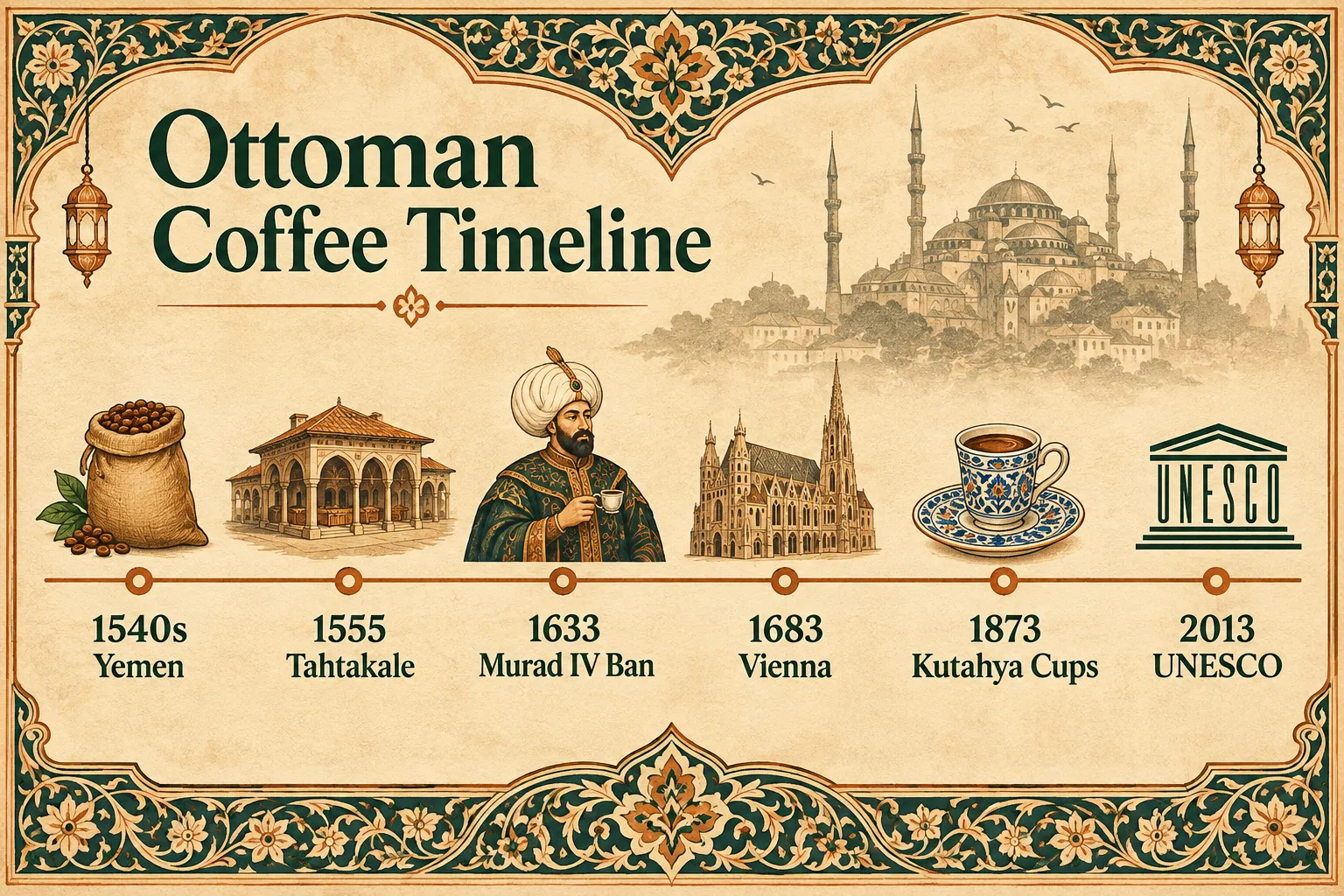
Ottoman coffee: a dated timeline from Yemen to UNESCO
The short version: Yemen to the palace in the 1540s, to Istanbul's public coffeehouses by the mid 1550s, into repeated bans through the 1600s, out to Europe, then onto a heritage list in 2013.
1540s: Yemen and the palace
The traditional origin story credits Özdemir Pasha, an Ottoman governor in Yemen, with encountering coffee there and helping introduce it to the imperial palace during the reign of Süleyman the Magnificent . UNESCO presents this as the conventional narrative rather than a sealed archival fact. Treat it as the received account.
Separately, there is a well-studied Sufi thread. Yemeni Sufi orders used coffee to stay awake through night devotions, which gave the drink an early religious and social function before it ever reached an Istanbul shopfront .
1554 to 1555: Tahtakale, Istanbul
Peçevî İbrahim, an Ottoman chronicler, records two men from Syria, Hakem of Aleppo and Şems of Damascus, opening coffeehouses in the Tahtakale district of Istanbul . His date corresponds to 962 AH, which lands roughly between late 1554 and late 1555. Other sources cite 1551 or 1553. The decade is solid. The year is not.
Late 1500s: the first religious objections
Debates ran over whether roasting coffee to carbon made it an intoxicant and therefore forbidden. Jurists disagreed. Coffeehouses stayed open, closed, and reopened. The legal arguments were real and documented, though the outcome kept favoring the coffee drinkers.
1633: Murad IV and the hardest crackdown
Sultan Murad IV ordered coffeehouses in Istanbul closed. The campaign ran alongside a tobacco ban and followed a catastrophic fire in the city. Accounts of the sultan walking the streets in disguise and executing offenders circulate widely, and this is where documented policy blurs into legend. The closures are recorded. The theatrical executions belong to a much shakier tier of storytelling.
1683 onward: coffee moves into Europe
Ottoman coffee reached Vienna, Venice, and beyond through trade and the aftermath of the 1683 siege. Europe filtered it, sweetened it differently, and eventually invented machines for it. The Ottoman method stayed intact at home.
2013: UNESCO recognition
Turkish coffee culture and tradition joined UNESCO's Representative List of the Intangible Cultural Heritage of Humanity . The listing covers the preparation, the serving, the hospitality, and the social setting, not just the recipe.
| Date | Event | Confidence |
|---|---|---|
| 16th century | Coffee enters the Ottoman Empire via Yemen | Documented |
| 1540s | Özdemir Pasha brings coffee to the palace | Traditional account |
| 1554 to 1555 | Hakem and Şems open Tahtakale coffeehouses | Chronicled, date debated |
| 1633 | Murad IV closes Istanbul coffeehouses | Documented |
| 1633 | Sultan executes drinkers in disguise | Legend |
| 2013 | UNESCO inscribes Turkish coffee culture | Documented |
Why was ottoman coffee banned in the Ottoman Empire?
Because of what happened around the cup. A coffeehouse gathered men outside the mosque, the home, and the workplace, and conversation there included rumor, satire, and criticism of the government. The coffee ban in the Ottoman Empire was crowd control dressed as moral policy.
A 2026 scholarly analysis describes Ottoman coffeehouses as public spaces that both reproduced existing social hierarchies and opened room for alternative urban sociability . That second part is exactly what worried authorities.
Three strands ran through the opposition:
- Religious. Some jurists argued roasted coffee counted as an intoxicating or harmful substance. The argument lost more often than it won.
- Political. Murad IV's 1630s closures came during a period of tight centralization, war, and a devastating Istanbul fire. Gathering places were suspect.
- Fiscal and moral. Gambling, tobacco, idleness, and lost work time all appeared in complaints.
The bans never held. Coffee was too useful socially and, once taxed, too useful financially.
What's the difference between ottoman and Turkish coffee?
Essentially nothing in the cup. Ottoman coffee describes the historical, empire-wide tradition. Turkish coffee describes the modern national continuation of that tradition, and it is the name UNESCO uses .
Choose the term this way: say ottoman coffee when writing about the 16th to 19th century coffeehouse world, Yemeni supply routes, or the bans. Say Turkish coffee when ordering one, buying beans, or referencing the 2013 UNESCO listing. Greek, Bosnian, and Armenian coffee are the same method under different flags, sometimes with small differences in sugar convention and cup size.
What is a cezve and how do you use it?
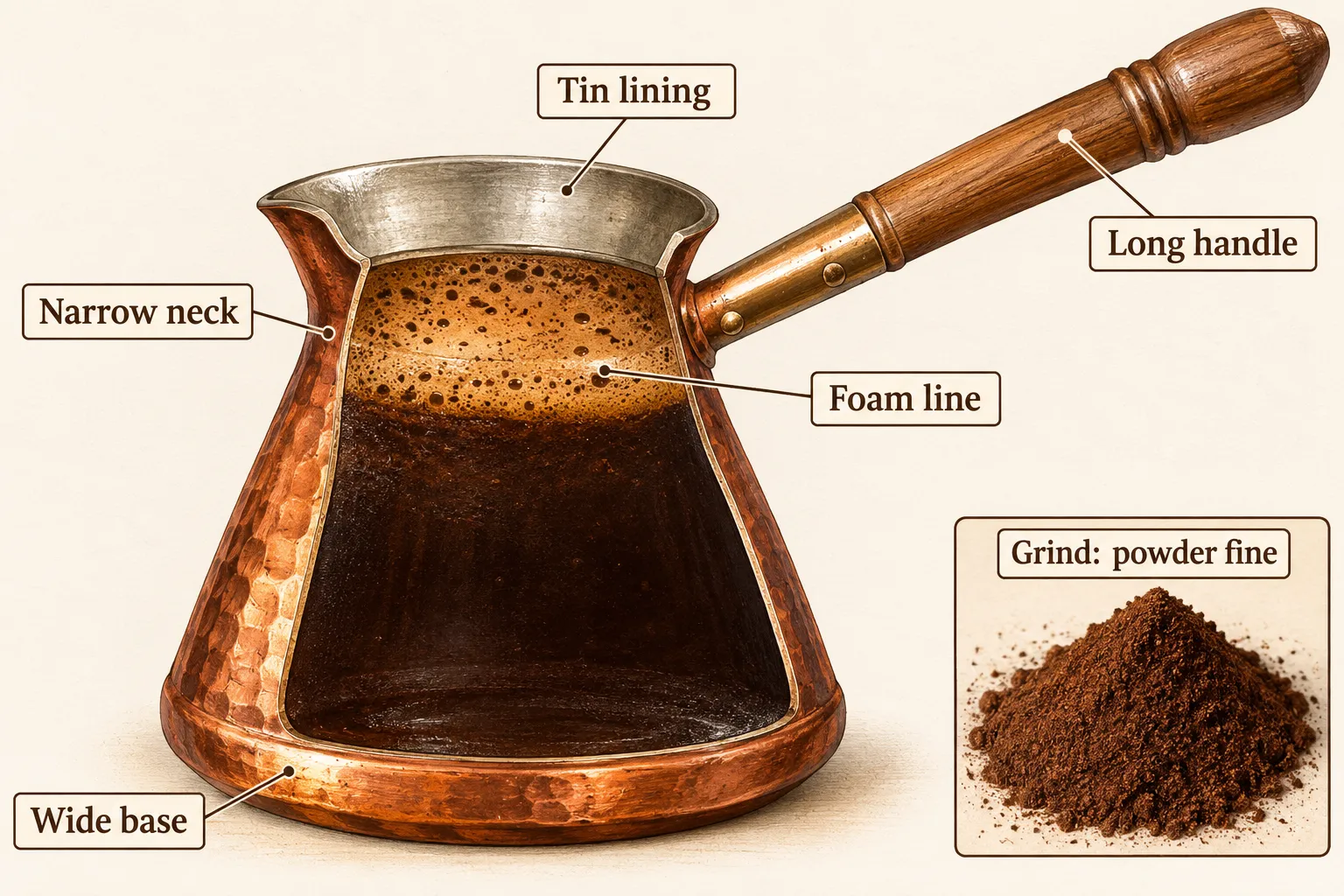
A cezve (pronounced roughly "jez-veh") is a small pot with a wide base, a narrow neck, a pouring lip, and a long handle. Turkish also calls it an ibrik. The shape is functional: the wide base takes heat evenly, and the narrow neck concentrates and holds the foam that defines a good cup.
Materials and what they change:
- Hammered copper with tin lining. The traditional build. Copper conducts heat fast, which gives you control. The tin lining needs eventual re-tinning, and copper is not induction compatible without a disc.
- Stainless steel. Dishwasher friendly, induction ready, slower and less responsive to heat changes.
- Brass. Heavy, slow, attractive, less common for daily use.
Size matters more than people expect. A cezve works best when filled no more than about three quarters full, so a two cup pot makes two cups, not four. Buy for your usual serving count.
How do you make ottoman coffee step by step?
Expect a small, intense cup with a layer of fine foam on top and a sediment bed at the bottom. Total time is about four minutes.
You need: a cezve, very finely ground coffee (powder fine, finer than espresso), cold water, sugar if you want it, and a small cup. A quality burr grinder that can reach a true powder setting matters here more than the pot does. Most blade grinders cannot get there, and many entry burr grinders bottom out before true Turkish fine.
- Measure cold. Use the serving cup to measure water into the cezve. One cup of water per serving.
- Add coffee and sugar. About one heaped teaspoon of coffee per cup, roughly 7 grams. Add sugar now, never later. Stir while cold until the grounds are wet.
- Stop stirring. Once it is on heat, leave it alone. Stirring breaks the foam.
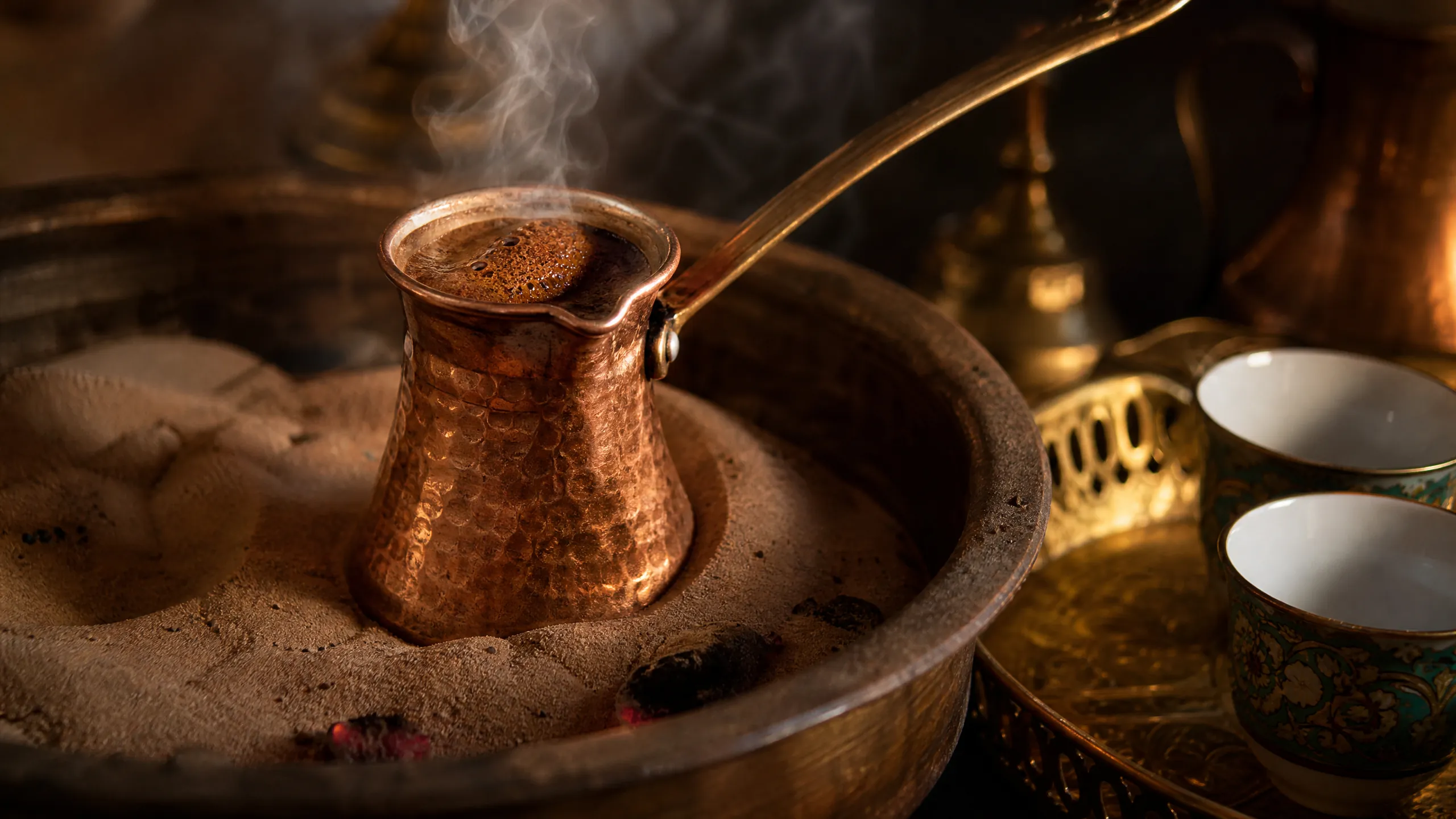
- Heat low and slow. Two to three minutes on low. Traditional cafés in Ankara use a bed of heated sand for even, adjustable heat.
- Catch the rise. Foam climbs the neck. Pull it off the heat just before it boils over.
- Split the foam. Spoon a little foam into each cup first, return the pot to heat for a few seconds, then pour the rest slowly.
- Rest it. Wait about a minute before drinking so the grounds settle.
Common mistake: letting it actually boil. A boil collapses the foam and pushes bitter compounds into the cup. The point is the approach to boiling, not the boil.
Edge case: if your grind is too coarse, the foam will be thin and the sediment gritty rather than silty. Grind finer before you change anything else.
Can you make ottoman coffee without a cezve?
Yes, with a small saucepan, though the result is less foamy. The narrow neck of a cezve concentrates foam into a tight layer. A wide pan spreads it thin.
Workarounds that get close:
- Use the smallest pan you own and tilt it slightly during the rise.
- A milk pitcher or small butter warmer with a pouring spout works reasonably well.
- A stovetop-friendly approach from our brewing method comparisons can help you decide whether this method suits your morning at all.
What will not work: an espresso machine, a drip brewer, or a French press. Those all filter, and filtering removes the body and the sediment that define the style. For a different unfiltered-adjacent tradition, Cuban cafecito builds its sweet espuma by a completely different mechanism.
What was life like in Ottoman coffeehouses?
Historian Ahmet Yaşar describes Ottoman coffeehouses as among the most important sites of adult male sociability in Istanbul from the mid 16th century onward, functioning as third spaces that were neither household nor formal workplace . Men sat on low benches, drank from small cups, and stayed for hours.
What actually happened in them:
- Backgammon and chess
- Storytellers and shadow puppet performances
- Poetry recitation and oral literature
- News circulation, which is the part that alarmed governments
- Tobacco, once it arrived, which doubled the official suspicion
Access was uneven. Scholarship notes that these spaces reproduced social hierarchies even while widening who could gather publicly . They were not egalitarian salons. They were neighborhood rooms with their own pecking orders.
Why is ottoman coffee served in tiny cups, and is sediment normal?
Two linked answers. The cup is small, usually about 60 to 90 ml, because the drink is concentrated, unfiltered, and meant to be sipped slowly over conversation. And yes, grounds in the cup are completely normal.
The sediment is structural to the style. Unfiltered coffee carries fine particles and oils that give the cup its weight and lingering finish. You drink roughly the top two thirds and leave the muddy bottom. Nobody is expected to drink the sludge.
That leftover bed also carries a fortune telling tradition. The cup is inverted onto the saucer, the grounds dry into patterns, and someone reads them. Treat this as cultural practice, not prediction.
How do you remove grounds from the empire’s brew without a filter?
You do not remove them. You manage them.
- Grind finer, not coarser. Fine particles settle faster and feel silkier.
- Let the cup rest 60 to 90 seconds after pouring.
- Pour slowly and steadily, keeping the cezve tilted so the sediment stays behind.
- Tap the base of the cup once on the saucer to help settling.
- Stop drinking when the liquid turns thick.
If sediment genuinely bothers you, this tradition may not be your morning drink. A stainless mesh filter for other methods gives body without the full mud.
Do you add cardamom, and how much?
Cardamom is traditional in Arab and some Ottoman-influenced preparations, and optional in modern Turkish practice. Use one lightly crushed green pod per two cups, or a pinch of ground cardamom, around a tenth of a teaspoon per cup.
Add it to the cezve with the coffee and cold water, not afterward. Grinding a pod together with the beans gives a more even, less spiky flavor than sprinkling powder on top.
Start low. Cardamom overwhelms a 60 ml cup very easily, and once it dominates, you are drinking spiced water with coffee in it. Mastic and a drop of rosewater appear in some regional versions.
Where can you buy an authentic cezve, and how much should it cost?
Expect to pay roughly $20 to $45 for a solid hand-hammered copper cezve with a tin lining, and $15 to $30 for stainless steel. Sets that bundle a pot, cups, and coffee cost more. One Turkish-coffee starter set listed in September 2026 included a 12 ounce cezve plus coffee blends at approximately $40 to $60 depending on package size. That is one retailer's listing, not a market average. Prices checked November 2026.
Affiliate disclosure: Coffee Rank IQ earns commissions on some retail links. Recommendations are based on documented product specifications and published sources, not on commission rates.
What to check before buying:
- Tin lining, stated clearly. Unlined copper in contact with acidic coffee is not what you want.
- Thickness. Very thin copper scorches and dents.
- Handle attachment. Riveted and wooden or brass. Avoid anything that looks glued.
- Capacity in cups, not ounces. Buy a 2 cup pot if you make two cups.
- Induction compatibility if you have an induction hob. Most copper cezves need a disc.
Skip machine-stamped souvenir pots with painted exteriors. The paint is for a shelf, not a flame. Also budget for a grinder that reaches Turkish fine; a capable manual grinder often does this better than a cheap electric one.
Is the empire’s brew still popular in Turkey today?
Very much so, and it is actively being presented as heritage. The Pera Museum in Istanbul is showing Coffee Break, a coffee-themed selection from the Suna and İnan Kıraç Foundation's Kütahya Tiles and Ceramics Collection, examining the empire’s brew rituals, public space, and how coffee culture shaped Kütahya ceramic production. The museum listing was updated November 6, 2026. A related guided program, "Coffee, Inspiration and Innovation," ran on September 25, 2026.
In Adana, the Coffee House Museum opened in January 2024 and had welcomed close to 50,000 visitors in its first two years as of January 2026. Its collection holds Ottoman and Republican-era cezves, cups, grinders, roasting pans, scales, and water jugs.
Ankara, designated 2026 Turkic World Tourism Capital, is promoting coffeehouses and cafés that brew in a cezve over heated sand as part of its gastronomic offer.
Younger Turkish drinkers also buy espresso and filter coffee. Both exist. The cezve did not lose.
FAQ

Conclusion
the empire’s brew survived religious objections, imperial bans, and five centuries of competing beverages because the thing being banned was never really the drink. It was the room. The cezve, the powdered grind, the small cup, and the hour of conversation all travelled together, and they still travel together in a Kadıköy café or an Adana museum case.
Next step: buy a tin-lined copper cezve sized to your usual serving count, get a grinder that genuinely reaches powder fine, and make one cup on low heat without stirring after it hits the flame. Watch for the foam. Pull it before the boil. That single technique decides whether you get a silky cup or a bitter one.
Better Coffee Starts With Better Answers.