
Does Coffee Stain Teeth? 6 Habits That Help
Quick Answer
Yes, coffee stains teeth, and a September 2026 laboratory study in the International Journal of Dental Hygiene put a number on it: after seven days of immersion, bovine enamel specimens exposed to black coffee with cream showed a mean color change (ΔE00) of 7.26, while coffee with Splenda hit 14.48. The stain is extrinsic, meaning it sits on the enamel surface rather than inside the tooth, which is why it responds to brushing, whitening toothpaste, and professional cleaning. Contact time matters more than cup count. Sipping one latte for three hours is harder on your smile than drinking it in fifteen minutes.
Key Takeaways
- Coffee stains are surface stains. The American Dental Association classifies coffee discoloration as extrinsic, alongside tea, red wine, cola and tobacco .
- Cream reduced staining in the lab. In the 2026 Kim et al. study of 60 bovine enamel specimens, cream produced the least discoloration (ΔE00 7.26 ± 2.34) and Splenda the most (14.48 ± 0.91).
- Time on the tooth is the biggest lever. Discoloration rose significantly with immersion time (β = 1.27, p < 0.001) in that same study.
- Coffee is a stainer, not a top eroder. A March 2026 BMC Oral Health comparison measured brewed coffee at roughly pH 5.18 and found sodas and energy drinks caused more enamel surface change.
- Don't brush straight after. Cleveland Clinic periodontist Sasha Ross, DMD, MS, recommends rinsing with tap water and waiting about 30 to 60 minutes before brushing .
- Medium roast stained most in one 2025 test. A Journal of Oral Science study of four coffees over 72 hours found medium roasts caused the greatest discoloration and light roasts the least, despite light roast having more chlorogenic acid.
- Whitening toothpaste helps maintain, not transform. Both tested formulas reduced coffee discoloration; the peroxide version edged out the abrasive one, but the difference was not statistically significant (p = 0.443).
Does Coffee Stain Teeth, and How Badly?
Yes. Does coffee stain teeth enough to notice? For most daily drinkers, yes, within weeks to months, though the shade shift is gradual and highly individual. The stain is cosmetic and surface-level in healthy enamel.
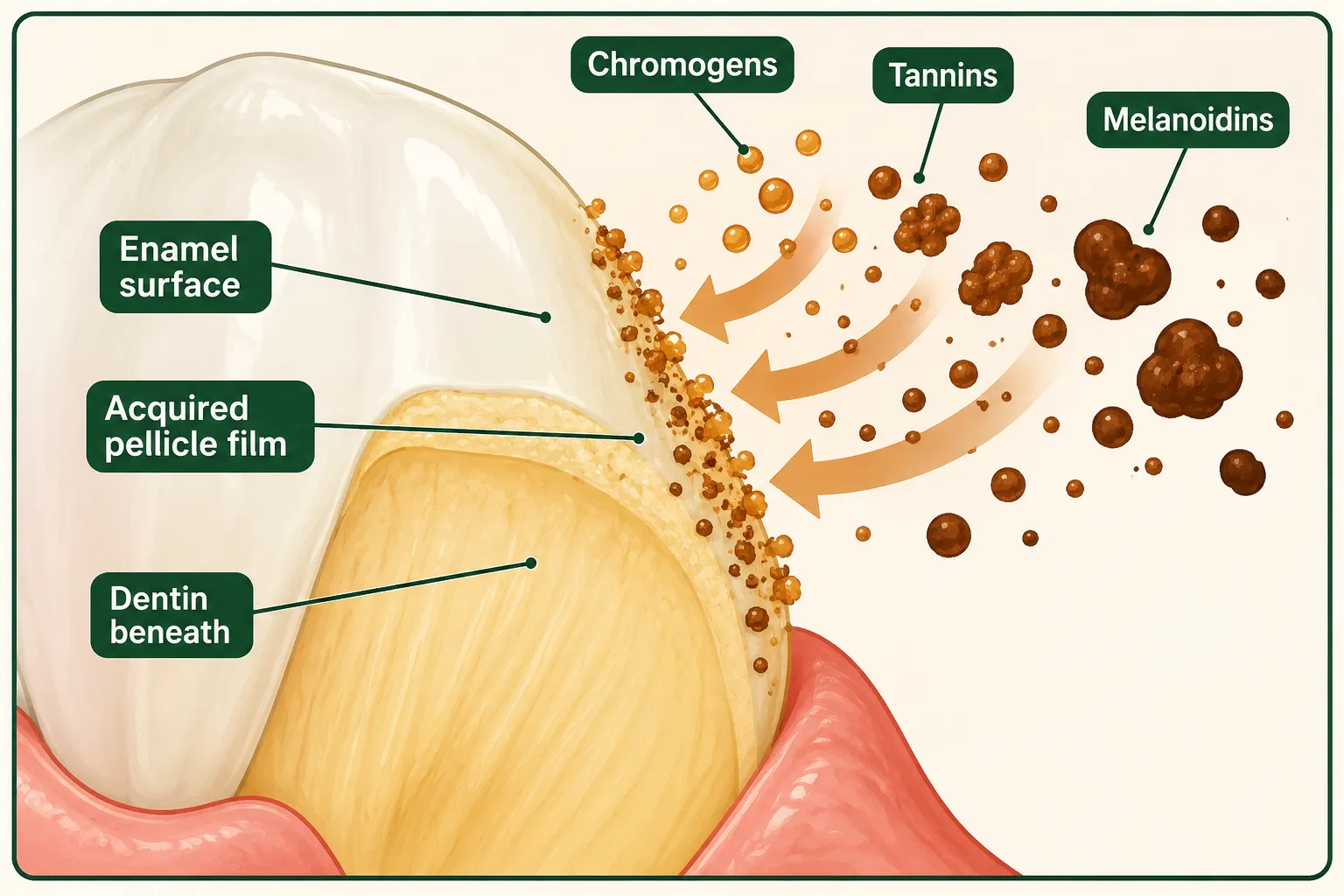
The misconception worth correcting right away: coffee does not stain teeth because it is dark. Color alone isn't the mechanism. Coffee carries chromogens (pigment molecules), tannins (plant polyphenols that help pigments stick), and melanoidins formed during roasting. These bind to the acquired enamel pellicle, a thin protein film that reforms on your teeth within minutes of brushing. Tannins and teeth are a sticky pairing by chemistry, not by shade.
A 2025 Journal of Oral Science study immersed bovine enamel in four coffee types for 72 hours and found the relationship between roast chemistry and staining was not linear. One Ethiopia Arabica sample reached a ΔE00 of 13.51 ± 4.63. Limitation worth stating plainly: bovine enamel in a beaker is not a living mouth with saliva, tongue movement, and daily brushing. Lab ΔE00 values show relative risk, not how your incisors will look in March.
)
How Does Coffee Actually Stain Teeth?
Coffee stains teeth when chromogens and tannins attach to the pellicle layer on enamel, then accumulate in microscopic surface roughness. Previously demineralized or scratched enamel collects more pigment.
Here's the sequence:
- Enamel acquires a pellicle. Saliva proteins coat the tooth within minutes of cleaning.
- Coffee arrives. Tannins bind to those proteins, acting as a bridge for pigment.
- Acid softens the surface. Brewed coffee sits near pH 5.18, mildly acidic .
- Pigment settles in. Rough or porous spots hold more color.
- Repeat exposure compounds it. Each cup adds a thin layer.
That fifth step explains why enamel staining looks like a slow fade rather than an overnight event.
Does Coffee Stain Permanently, or Can You Reverse It?
Extrinsic coffee teeth stains are generally reversible. The ADA notes surface stains can often be reduced mechanically through whitening toothpaste or a professional cleaning, while intrinsic discoloration inside enamel or dentin needs a different approach .
The honest caveat: enamel thins with age and grinding, letting yellower dentin show through. That part is not coffee's fault and whitening products handle it less predictably. If your teeth have darkened in a way that looks patchy, grey, or confined to one tooth, that's a question for a dentist, not a toothpaste aisle.
Which Type of Coffee Stains Teeth the Most?
Based on current laboratory evidence, sweetened black coffee stained most and coffee with cream stained least. Roast level did not follow the obvious rule.
| Coffee version | Lab result (ΔE00, 7 days) | What it means |
|---|---|---|
| Black coffee + cream | 7.26 ± 2.34 | Least discoloration in the 2026 Kim et al. test |
| Black coffee + stevia | Mid-range | Between cream and the artificial sweeteners |
| Black coffee + Splenda | 14.48 ± 0.91 | Greatest discoloration recorded |
| Ethiopia Arabica (72h) | 13.51 ± 4.63 | From the 2025 roast-level study |
In that 2025 roast comparison, medium roasts stained most and light roasts least. If you are choosing beans, the dental difference is small enough that flavor should still decide. Our guide on how to choose a coffee roast covers the taste side properly.
Coffee vs Tea: Which Stains Teeth Worse?
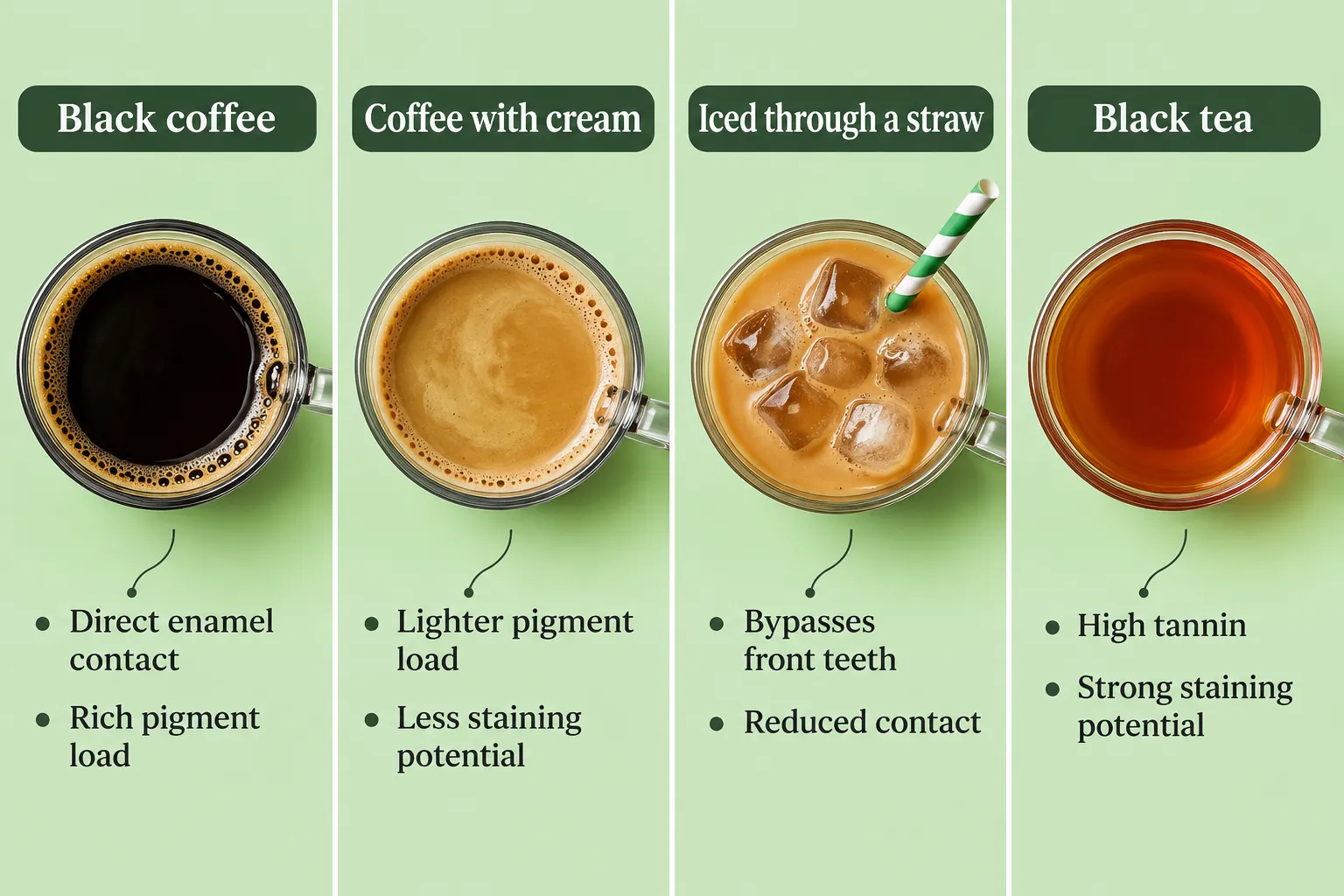
Black tea is generally considered at least as staining as coffee, because tea is higher in tannins, the polyphenols that help pigment grip the pellicle. The ADA lists both as common sources of extrinsic stain .
No single head-to-head trial settles this for every drinker. Practical read: if you switched from coffee to black tea expecting whiter teeth, you probably traded sideways. Green tea and white tea carry less visible pigment, though they still contain tannins.
Does Iced Coffee Stain Teeth Less Than Hot Coffee?
Not inherently. Pigment concentration drives staining, and cold brew is often served as a concentrate, so a strong iced coffee can carry plenty of chromogens. The practical advantage of iced coffee is delivery: you can drink it through a straw.
Coffee through a straw, positioned behind the front teeth, reduces contact with the visible enamel most people care about. The ADA's erosion guidance supports straw placement and warns against swishing or holding the drink in the mouth . A straw does nothing if you nurse the cup for two hours.
If cold brew is your routine, our cold brew at home guide covers dilution ratios, which also thins the pigment load.
)
How Long Does It Take Coffee to Stain Teeth?
There is no verified timeline in human studies, and anyone quoting "two weeks" is guessing. What the research does show is that discoloration increases with exposure time, measured at β = 1.27 (p < 0.001) across the seven-day immersion in the 2026 study.
Translated to a real mouth: a daily drinker who brushes twice, rinses after coffee, and gets cleanings twice a year may never see a dramatic shift. Someone sipping four refills across a workday without rinsing will see it sooner. Contact minutes, not cups, is the variable you control.
Are Some People More Prone to Coffee Stains?
Yes. Stain risk varies with enamel condition, saliva, and habits rather than willpower.
You're more susceptible if you have:
- Thinner or worn enamel, which shows dentin color and holds pigment in rough areas
- Dry mouth, often from medication, since saliva rinses pigment away
- Existing plaque buildup, a porous surface that grabs color fast
- Recent whitening treatment, when the pellicle is stripped and enamel is temporarily more absorbent
- Tobacco use, which compounds extrinsic staining
If you take a medication that dries your mouth or have a diagnosed dental condition, ask your dentist how it changes your staining risk. Generic advice stops being useful there.
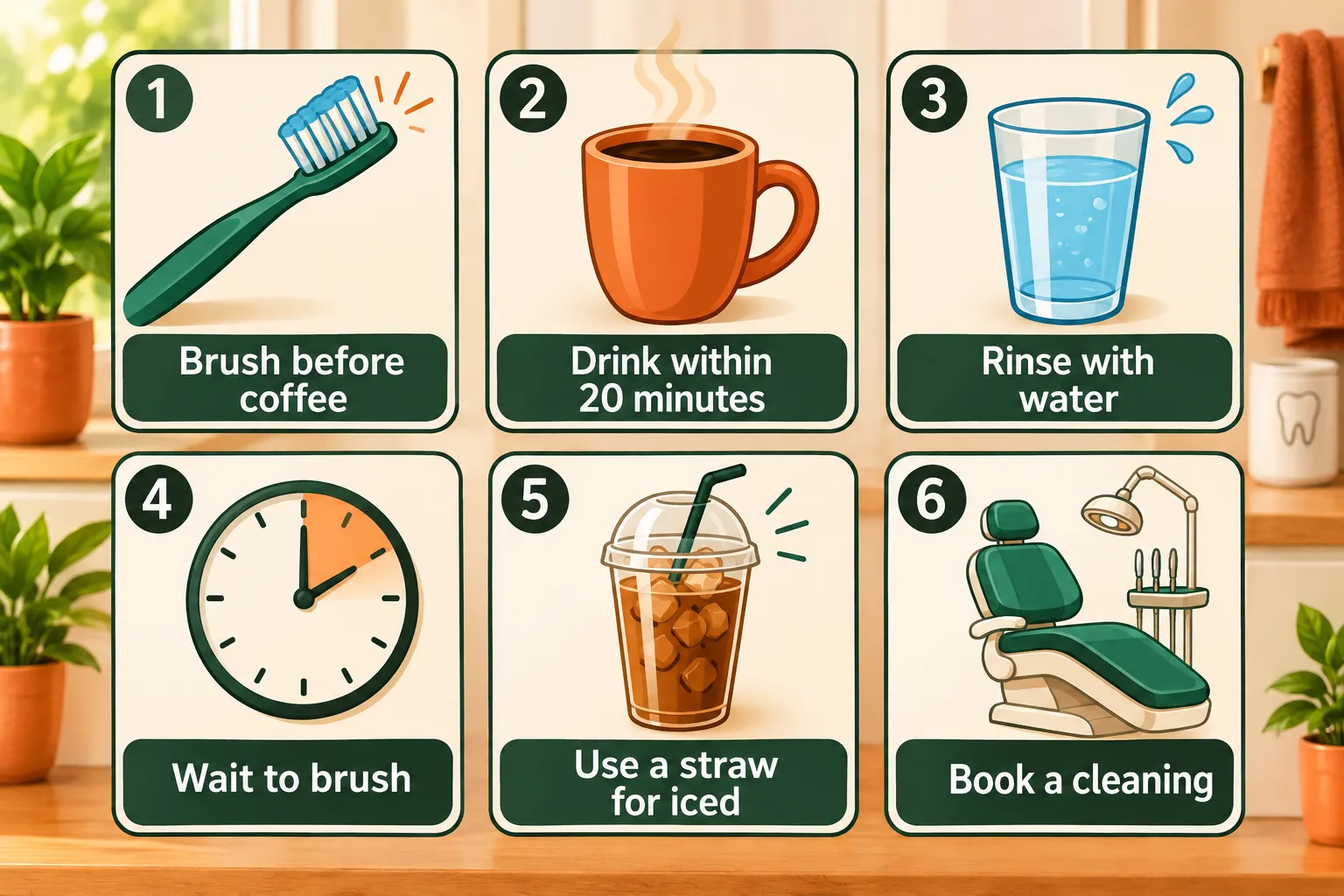
6 Habits That Help Prevent Coffee Stains on Teeth
These are the six habits with the clearest support in current dental guidance. None of them require giving up coffee, which would be a poor trade.
)
1. Brush before your coffee, not immediately after
A September 2026 dental-health advisory recommends removing overnight plaque before coffee exposure, since plaque holds pigment more readily than clean enamel . Brushing first also means you are not scrubbing acid-softened enamel.
2. Finish the cup within about 20 minutes
Cleveland Clinic's Sasha Ross specifically advises against prolonged sipping, because every extra minute gives acids and pigments more time to interact with teeth . Drink it while it's good anyway. A travel mug that holds temperature helps here, since lukewarm coffee is what turns a cup into a three-hour project.
3. Rinse with plain tap water afterward
The ADA's dental erosion guidance recommends plain water after acidic drinks, with no swishing or holding . Cleveland Clinic gives the same advice . One mouthful, swallow, done. This is the cheapest habit on the list.
4. Wait 30 to 60 minutes before brushing
Acid temporarily softens enamel, so immediate brushing can increase mechanical wear . Rinse first, then brush with a soft-bristled brush and fluoride toothpaste once saliva has restored the surface.
5. Use a straw for iced coffee, placed behind the front teeth
Straw position matters. Behind the incisors, pigment bypasses the enamel you see in photos. This applies mainly to iced drinks and cold brew, for obvious reasons.
6. Keep professional cleanings on the calendar
Extrinsic stain is what hygienists remove efficiently. Two cleanings a year handles accumulation that no at-home routine fully reaches, and it catches enamel problems earlier than a mirror does .
Habit stacking beats heroics. Rinsing after each cup costs five seconds and addresses the variable the research identifies as significant: contact time.
Can You Get Coffee Stains Off Teeth at Home?
Partly, yes, for surface stains. Whitening toothpaste and whitening strips both work on extrinsic coffee teeth stains, with realistic rather than dramatic results.
Whitening toothpaste. The 2026 Kim et al. study tested two formulations against coffee discoloration. Both reduced it. The hydrogen peroxide formula performed slightly better than the abrasive one, but the difference in the main brushing analysis was not statistically significant (p = 0.443). Read that as: either type maintains surface brightness; neither rebuilds tooth color.
Colgate announced an Optic White Pro Series update on September 14, 2026, claiming a 5% hydrogen peroxide complex, "visibly whiter teeth in three days," and removal of up to 15 years of deep-set stains in two weeks. Those are manufacturer marketing claims, not independent evidence that the product prevents future staining.
Whitening strips. Peroxide strips act on both surface and some deeper discoloration, which makes them more effective than toothpaste for established coffee staining. Sensitivity is the common side effect . Whitening for coffee drinkers works best as maintenance after a cleaning, not as a substitute for one.
Common mistake: abrasive DIY mixtures, especially baking soda plus lemon or activated charcoal paste, can roughen enamel. Rougher enamel holds more pigment later.
What About Decaf, Espresso, and Milk Drinks?
Decaf stains teeth too. Caffeine is not the pigment, so removing it changes nothing about chromogens or tannins. If you drink decaf, our breakdown of how much caffeine decaf actually contains covers the separate question of what's left in the cup.
Espresso is concentrated but served in a small volume and drunk fast, which limits contact time. A flat white dilutes pigment with milk. The 2026 lab data on cream points the same direction, with the firm limitation that bovine enamel in a beaker does not prove a latte protects your teeth clinically.
Sugar is the complicating factor in milk drinks. Sweetened coffee adds a cavity risk that plain coffee does not, and the Splenda result suggests additives interact with staining in ways researchers are still mapping.
Does Coffee Stain Veneers, Crowns and Bonding?
People who ask does coffee stain teeth are usually thinking about enamel. Dental work plays by different rules, and the differences matter if you have spent real money on your smile.
Porcelain veneers and crowns are glazed and non porous, so the surface itself shrugs off coffee better than natural enamel does. The weak point is the margin, the thin line of cement where the restoration meets your tooth. That seam can pick up color over the years, which is why a veneer can look great while a faint dark line creeps in at the gum. A hygienist can usually polish that line away during a routine cleaning, so mention it at your next visit instead of scrubbing at it yourself.
Composite bonding is a different story. The resin is slightly porous, and it takes on coffee color faster than enamel. If you had chips repaired or gaps closed with bonding and you drink two or three cups a day, expect the bonded spots to yellow ahead of the surrounding tooth.
One more wrinkle: whitening products lighten natural teeth and do nothing to porcelain or resin. Whiten around restorations without a plan and your dental work can end up darker than the teeth next to it. The fix is coordination, not more gel. Your dentist can polish or replace the restoration to match after the whitening settles.
So does coffee stain teeth that are mostly porcelain? Far more slowly, at the margins, and on a schedule a twice a year cleaning handles without drama.
The short version for anyone with mixed dental work: treat the natural teeth with the six habits above, let the hygienist handle the porcelain, and never start a whitening kit without telling your dentist what restorations you have and where they sit.
FAQ

Conclusion
Coffee stains teeth, the stain sits on the surface, and the strongest predictor in the available research is how long the liquid touches your enamel. That makes this a timing problem more than a coffee problem. Brush before your first cup, drink it within twenty minutes, rinse with tap water, wait half an hour before brushing again, use a straw for iced, and keep your cleanings booked.
Your next step this week: put a glass of water next to your coffee and drink it right after the last sip. One habit, five seconds, and it targets the exact variable the lab data flagged.
Better Coffee Starts With Better Answers. If you want your cup to taste better while you're at it, start with the pour over ratio guide.