Melitta Bentz: The 1908 Patent Behind Your Pour Over
Melitta Bentz registered a filter device in 1908, not the paper filter you buy today
A Dresden housewife named Melitta Bentz filed for utility-model protection on June 20, 1908, and the registration appeared in the Imperial Patent Gazette on July 8, 1908, on page 1,145 . What she protected was a specific object: a filter vessel with a curved, recessed underside and inclined drainage holes, used with a replaceable filtering layer . The familiar cone-shaped paper bag sitting in your dripper this morning came later, through separate patents in the 1930s . That gap between the popular story and the archive is the most interesting part of the whole history of coffee filter design, and it changes how you should read the "invented by a housewife" headline.

Key takeaways
- June 20, 1908: Melitta Bentz filed her utility model in Dresden; it was registered July 8, 1908 and published in the Imperial Patent Gazette, page 1,145 .
- The protected invention was a filter device with a recessed base and angled flow holes, not the general idea of pouring hot water through grounds .
- December 1908: Melitta and Hugo Bentz registered the business with starting capital recorded by the DPMA as 72 Reichspfennig, ordering 50 filters and 100 cartons of filter paper .
- 1909 Leipzig Trade Fair: they sold more than 1,200 filters .
- The original utility-model documents were lost during the Second World War .
- The modern shape arrived later: DE640946 covers the filter bag, and DE652010, issued in 1936, is tied to the oval tapered base used in the porcelain quick filter developed between 1932 and 1937 .
- The company still exists. Melitta Group reported first-half 2026 sales of €1.2 billion against €1.3 billion in the first half of 2025 .
Melitta Bentz: who she was and what she actually invented
Melitta Bentz (1873 to 1950) was a Dresden homemaker who solved a kitchen annoyance and then built a manufacturing company around the solution. The invention is usually dated to 1908, and the German Patent and Trade Mark Office holds the registration record . She is the reason the answer to "who invented the coffee filter" has a name, a city and a date attached to it rather than drifting into folklore.
)
The problem she was attacking is one you still taste occasionally. Before her filter, home coffee in Germany was commonly made by steeping grounds in water, often in a cloth bag or a perforated metal insert. Cloth bags held old oils and needed constant boiling. Metal mesh let fine particles through, so the last third of the cup turned gritty and bitter as the grounds kept extracting in the pot. Over-extraction means pulling too much bitter, drying material out of the grounds, and sitting grounds do exactly that.
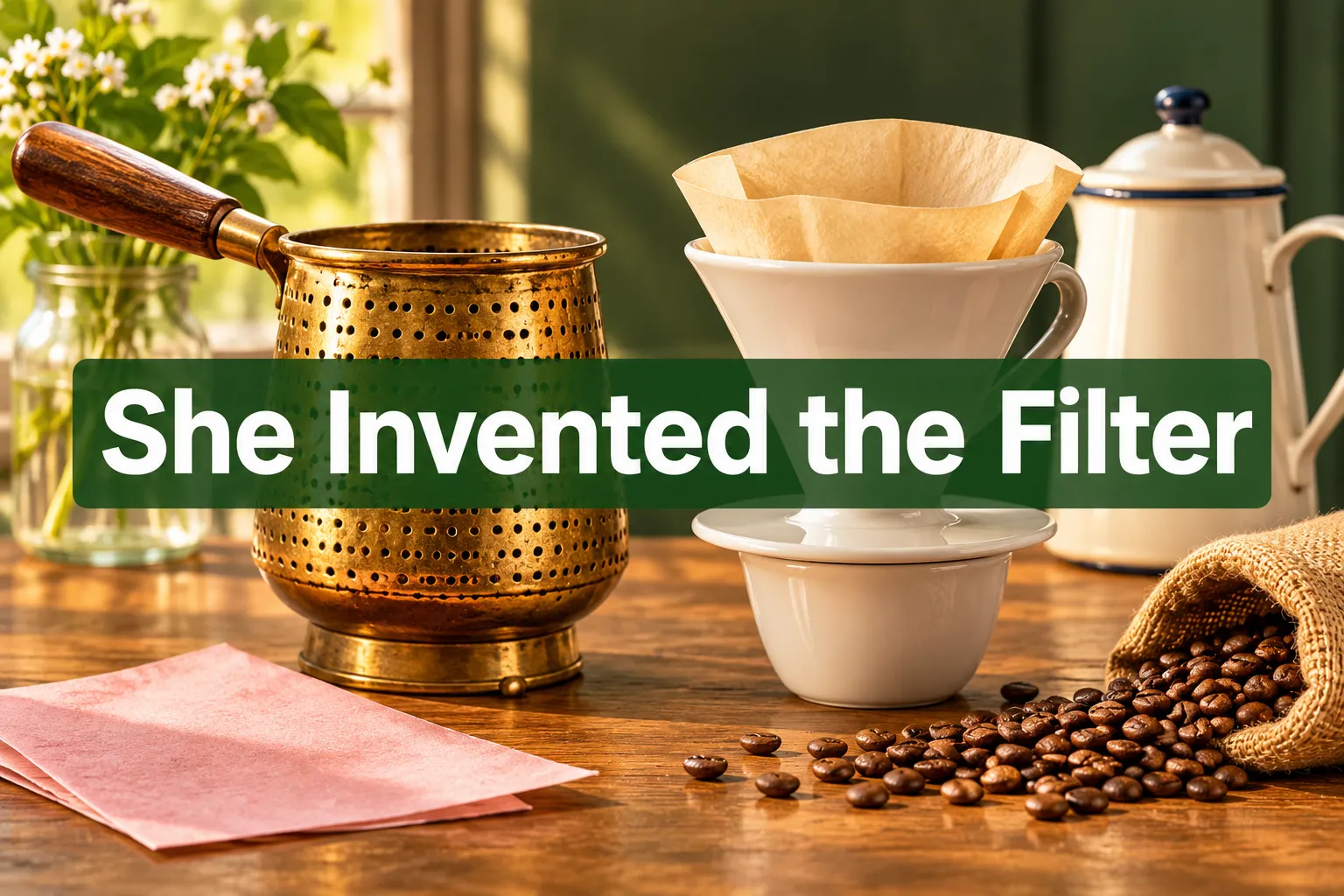
Her fix had two parts working together. First, a brass pot with holes punched in the bottom. Second, a sheet of blotting paper torn from her son's school exercise book, laid inside the pot as a disposable filtering layer . Blotting paper is absorbent, dense, and cheap. It stopped the fines. It also meant cleanup was a matter of lifting the paper out and throwing it away.
The Library of Congress, writing on July 8, 2026, for the invention's 118th anniversary, described the same mechanism: paper removes the grounds while letting the dissolved flavor compounds through. That separation is the whole point of the paper coffee filter invention. A filter that holds back solids but passes soluble coffee gives you a clear cup you can stop brewing on your own schedule.
One thing the DPMA record makes clear, and most retellings skip: the protected subject was the geometry. A curved and recessed underside, plus inclined holes rather than straight-down perforations, so liquid drained at a controlled rate instead of pooling or rushing . That is an engineering detail, and it is the reason the device worked better than a colander with a napkin in it.
Did Melitta Bentz actually start the Melitta company?
Yes. In December 1908, Melitta and Hugo Bentz registered the business in Dresden, with the DPMA recording starting capital of 72 Reichspfennig and an initial production run of 50 filters and 100 cartons of filter paper . She was the inventor and a founder, not a figure whose idea was bought out. The Melitta company history that follows, from a Dresden apartment to a group reporting €1.2 billion in half-year sales in 2026, starts with that registration .
Dated timeline from the Dresden kitchen to the cone on your counter
Here are the documented milestones, in order, with the sources attached.
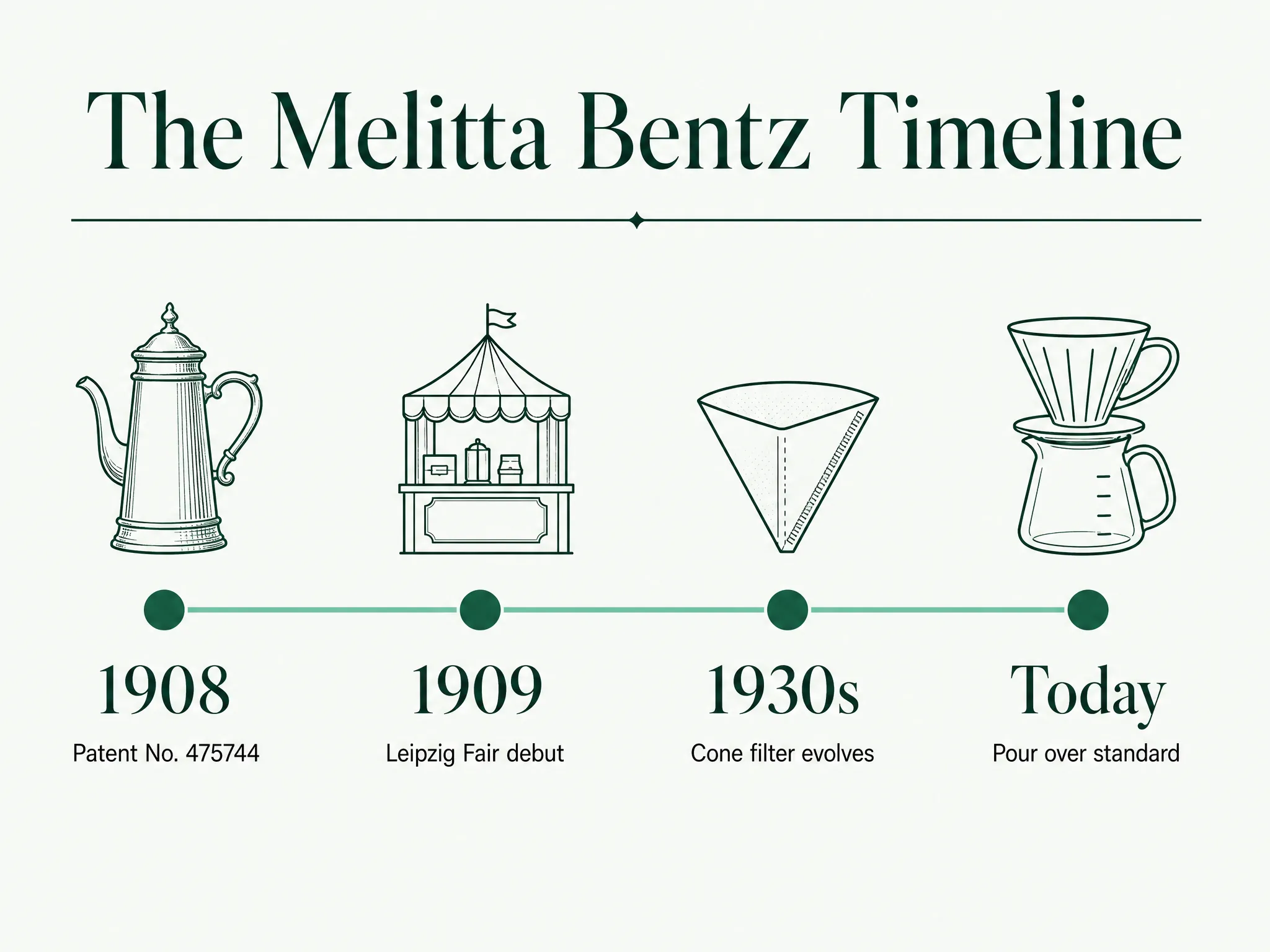
June 20, 1908: the filing in Dresden
Melitta Bentz submits her application for utility-model protection to the Imperial Patent Office . The subject is the filter device, described by the DPMA as having a curved, recessed underside and inclined flow holes .
July 8, 1908: registration and publication
The utility model is registered and published in the Imperial Patent Gazette on page 1,145 . This is the date the Library of Congress used for its 118th-anniversary piece in July 2026. The original documents were later lost in the Second World War, which is why the DPMA's reconstruction of the record matters .
December 1908: the business is registered
Melitta and Hugo Bentz register their company with 72 Reichspfennig of starting capital, arranging the production of 50 filters and 100 cartons of filter paper . That is a cautious first order, and a sensible one.
1909: the Leipzig Trade Fair
More than 1,200 filters are sold at the fair . For a product launched months earlier on pocket change, that is the moment it stops being a kitchen fix and starts being a business.
1932 to 1937: the shape changes
The family company develops a porcelain quick filter out of the earlier round metal filter . This period produced the tapered, oval-based form people now picture when they think "Melitta."
1936: DE652010 and the modern base
The DPMA identifies DE652010, issued in 1936, as the source of the oval, tapered filter base associated with the later Melitta form .
The filter bag's own patent: DE640946
The paper filter bag you buy in a box has a separate legal identity. The DPMA attributes it to DE640946, distinct from the 1908 utility model . "The 1908 patent behind your pour over" is a tidy headline, and it compresses at least three successive inventions.
2026: the company today
Melitta Group reported first-half 2026 sales of €1.2 billion, down from €1.3 billion a year earlier, with underlying growth of around 7% after adjusting for lower green-coffee prices, a business sale in Italy and a discontinued specialty-paper line. EBITDA sat just under €90 million, already matching the group's full-year 2025 figure .
What the record proves and what is just a good story
)
Separating the two is worth doing, because the legend version is repeated constantly and the documented version is more interesting anyway.
Documented by the DPMA and Melitta's own archive:
- The filing date of June 20, 1908, and registration on July 8, 1908, published in the Imperial Patent Gazette, page 1,145 .
- The protected subject: a filter with a curved, recessed underside and inclined flow holes .
- The December 1908 business registration, the 72 Reichspfennig capital, and the first order of 50 filters and 100 cartons of paper .
- More than 1,200 filters sold at the 1909 Leipzig Trade Fair .
- The later patents DE640946 and DE652010, and the 1932 to 1937 porcelain quick filter development .
- The loss of the original utility-model documents in the Second World War .
Widely repeated, loosely sourced, or simply wrong:
- "Melitta Bentz patented the paper coffee filter." She registered a utility model for a filter device. German utility-model protection and a full patent are different instruments, with different examination standards and different terms .
- "She invented pour over coffee." Pouring hot water over grounds predates 1908 comfortably. The pour over history she belongs to is about containment and drainage, not about the act of pouring.
- Precise, novelistic details of the morning she tore the page out. The blotting-paper-from-the-exercise-book account appears in the DPMA profile and the Library of Congress write-up, so the substance holds . Dialogue, weather and exact wording in some retellings do not come from any archive.
- "The 1908 patent protected the business for decades." It did not need to. The commercial advantage came from early distribution, the brand name, and the later 1930s patents covering the bag and the tapered base .
The archive version is better than the legend. A woman identified a drainage problem, specified a geometry that fixed it, registered it, and then spent 72 Reichspfennig proving people would buy it.
Was the 1908 filter really the start of pour over as we know it?
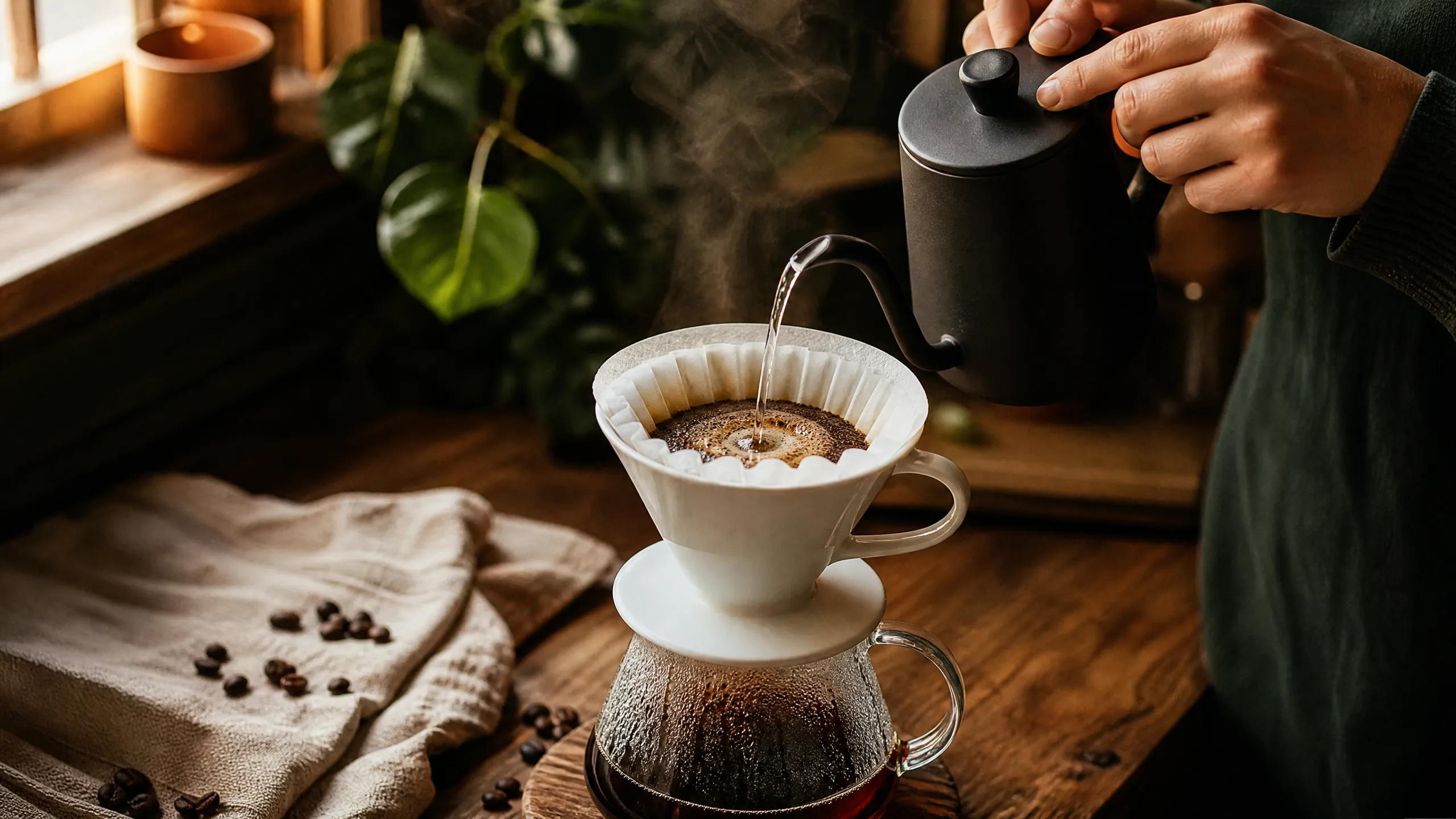
Partly. The 1908 device established the principle your dripper still uses, which is a disposable porous layer sitting above a controlled drainage path. The cone, the ribs, and the single hole or multiple holes in modern drippers are refinements of that same idea.
What Melitta Bentz did not establish is the brewing technique. The deliberate bloom, the 1:16 brew ratio, the gooseneck kettle and the 200°F water temperature advice are all later developments from specialty coffee culture. Her filter was a convenience device for ordinary households, judged on clarity and cleanup, not on extraction yield.
The through-line is physical. Paper traps fines and a good share of the coffee oils, which is why a paper-filtered cup tastes cleaner and lighter in body than an immersion brew. That difference is one of the practical things worth understanding before you buy equipment, and our beginners guide to pour over coffee walks through it with the modern gear in hand.
How does the Melitta Bentz pour over compare with a French press or a drip machine?
Different filters, different cups. Paper removes oils and fine particles, metal mesh does not, and an automatic drip machine uses the same paper principle with less control over the pour.
| Method | Filter | Typical cup character | Control | Cleanup |
|---|---|---|---|---|
| Cone pour over (Melitta style) | Paper | Clear, lighter body, aromatic top notes | High: pour rate, bloom, grind | Lift the paper, bin it |
| French press | Metal mesh | Heavier body, visible oils, some sediment | Low: steep time and grind only | Rinse the plunger, scoop grounds |
| Automatic drip | Paper (flat or cone) | Close to pour over, often flatter | Low to moderate | Empty the basket |
| Cold brew | Cloth or paper | Low acidity, sweet, thick | Time and ratio | Longest of the four |
Choose the pour over if you like tasting the difference between a Kenyan and a Colombian single origin. Choose the French press if you want body and do not want to stand over a kettle. The detailed side by side lives in our French press vs pour over comparison, and if your question is about filtered versus unfiltered coffee and cholesterol, read is drip coffee healthier than pour over rather than guessing.
Is the cone better than a drip machine? Better is the wrong frame. A cone gives you control over water temperature and pour pattern that a $40 machine does not. A good machine gives you four cups while you shower. If consistency matters more than control, the machine wins on most mornings, and our guide on choosing the right coffee maker for your home sorts that decision by household size and routine.
What does a Melitta Bentz style pour over setup cost in 2026?
Less than almost any other brewing upgrade. A plastic or ceramic cone and a box of filters is the cheapest route into better-tasting coffee that exists.
A realistic starting kit:
- Cone dripper. Plastic, ceramic or glass. The cheapest models cost a few dollars; porcelain versions run higher and hold heat better.
- Paper filters. Sold by size. A size 2 cone suits one to two cups; size 4 suits a larger carafe. Match the number on the box to the number on your dripper or the paper will fold badly and channel water down one side.
- A scale. The single biggest accuracy upgrade. Weighing beans and water beats scoops every time.
- A burr grinder. Burrs cut beans to an even size; blade grinders smash them into mixed fragments that over-extract and under-extract in the same brew.
- A kettle. A gooseneck helps, but a steady hand and a normal kettle will get you most of the way.
Prices move, so check the current price before you commit to any model. If you want a shortlist with the tradeoffs explained, see our roundup of the best pour over coffee maker options.
Decision rule: if you only have budget for one upgrade, buy the grinder, not the fancier dripper. Grind size consistency changes the cup more than cone material does.
Can you brew this way without buying Melitta's own equipment? Yes. Any cone and any correctly sized filter follow the same physics she registered in 1908. Paperless stainless drippers work too, though they pass more oils and fines, closer to a French press in body. Our walkthrough of the Cafellissimo paperless pour over dripper covers what changes when the paper comes out.
Does the method work with any grind size, and what goes wrong most often?
No, grind size is the variable that makes or breaks it. A cone pour over wants a medium grind, roughly the texture of table salt, and it punishes extremes in both directions.
Common mistakes, and the fix for each:
- Grind too fine. Water stalls, the bed floods, and the cup tastes harsh and drying. Go coarser one step.
- Grind too coarse. Water races through in under two minutes and the coffee tastes sour, thin and weak. Go finer.
- Boiling water straight onto the bed. Off-boil water scorches lighter roasts. Let the kettle rest 30 to 45 seconds; around 195°F to 205°F is the working range.
- Skipping the bloom. Pour twice the coffee's weight in water, wait 30 to 45 seconds, then continue. Fresh coffee releases carbon dioxide, and that gas pushes water away from the grounds if you do not let it escape.
- Guessing the ratio. Start at 1:16, which is 20 g of coffee to 320 g of water. Our pour over coffee ratio guide explains when to move off that number.
- Stale beans. Check the roast date on the bag. Coffee roasted four months ago will not bloom and will not taste like the tasting notes on the label.
- Wrong filter size. A size 4 paper crammed into a size 2 cone folds and channels.
Edge case: very light, dense roasts often need a finer grind and hotter water than a medium roast at the same ratio. If you are brewing a medium roast and want a forgiving starting point, our list of the best medium roast coffee for drip and pour over is the easier place to begin.
Who should brew this way, and who should skip it?
Brew this way if you drink one or two cups, enjoy a five-minute routine, and want to taste what a processing method or a single origin actually does to a cup. Skip it if you need four mugs at 6:40 a.m. while packing lunches.
Good fit:
- Solo drinkers and couples brewing one or two cups.
- Anyone comparing beans from a subscription and wanting a consistent, controllable baseline.
- People who want clarity and sweetness over heavy body.
- Travelers: a plastic cone and a few filters weigh almost nothing.
Poor fit:
- Households brewing a full pot on a schedule.
- Anyone who does not want to weigh or watch anything before breakfast.
- Drinkers who prefer the thick, oily mouthfeel of an immersion or espresso-based drink.
If you fall in the second group but still want paper-filtered clarity, an automatic machine with a cone basket splits the difference. The newer programmable units are covered in our piece on smart automatic pour over coffee makers.
Sourced figures behind the Melitta Bentz story
| Figure | Detail | Date | Source |
|---|---|---|---|
| June 20, 1908 | Utility-model application filed | 1908 | DPMA |
| July 8, 1908 | Registered, Imperial Patent Gazette p. 1,145 | 1908 | DPMA |
| 72 Reichspfennig | Starting capital at business registration | Dec 1908 | DPMA |
| 50 filters, 100 cartons | First production order | Dec 1908 | DPMA |
| 1,200+ filters | Sold at the Leipzig Trade Fair | 1909 | DPMA |
| DE652010 | Patent tied to the oval tapered filter base | 1936 | DPMA |
| €1.2 billion | Melitta Group first-half sales, vs €1.3bn in H1 2025 | H1 2026 | Melitta Group |
Two modern footnotes show where the filter business went. Melitta completed an automation upgrade of its coffee-filter-paper production using Valmet DNA control technology, aimed at production efficiency and quality control . And in May 2026 Melitta Professional launched the Cafina CT8plus, a fully automatic commercial machine handling up to four bean types and four milk or plant-based options, with an optional "Low Pressure Brew" setting that produces a filter-style coffee without crema . That setting is the 1908 idea wearing a touchscreen.
From Dresden 1908 to your cone filter
Tap any milestone for detail. Source: DPMA and Melitta Group.
FAQ

From a brass pot in Dresden to the cone on your counter
The line is direct and short. In 1908 Melitta registered a filter body with angled holes and a replaceable paper layer, because she was tired of grit and bitterness . The cone shape, the oval base and the pre-folded paper bag followed in the 1930s . Everything you do on a Saturday morning with a scale and a gooseneck kettle is a refinement of that one decision to put disposable paper between the grounds and the cup.
Your next step: weigh your coffee tomorrow. Twenty grams of beans, 320 grams of water, a medium grind, a 40-second bloom, water just off the boil. Compare that against whatever you did this morning. If the cup improves, keep the scale and work on the grinder next. If you want the numbers explained rather than just followed, read the pour over coffee ratio guide and adjust from there.
Better Coffee Starts With Better Answers, and this one has been sitting in a German archive since 1908.