
Is Coffee Bad for Your Kidneys? What Big Studies Found
Quick answer: is coffee bad for your kidneys?
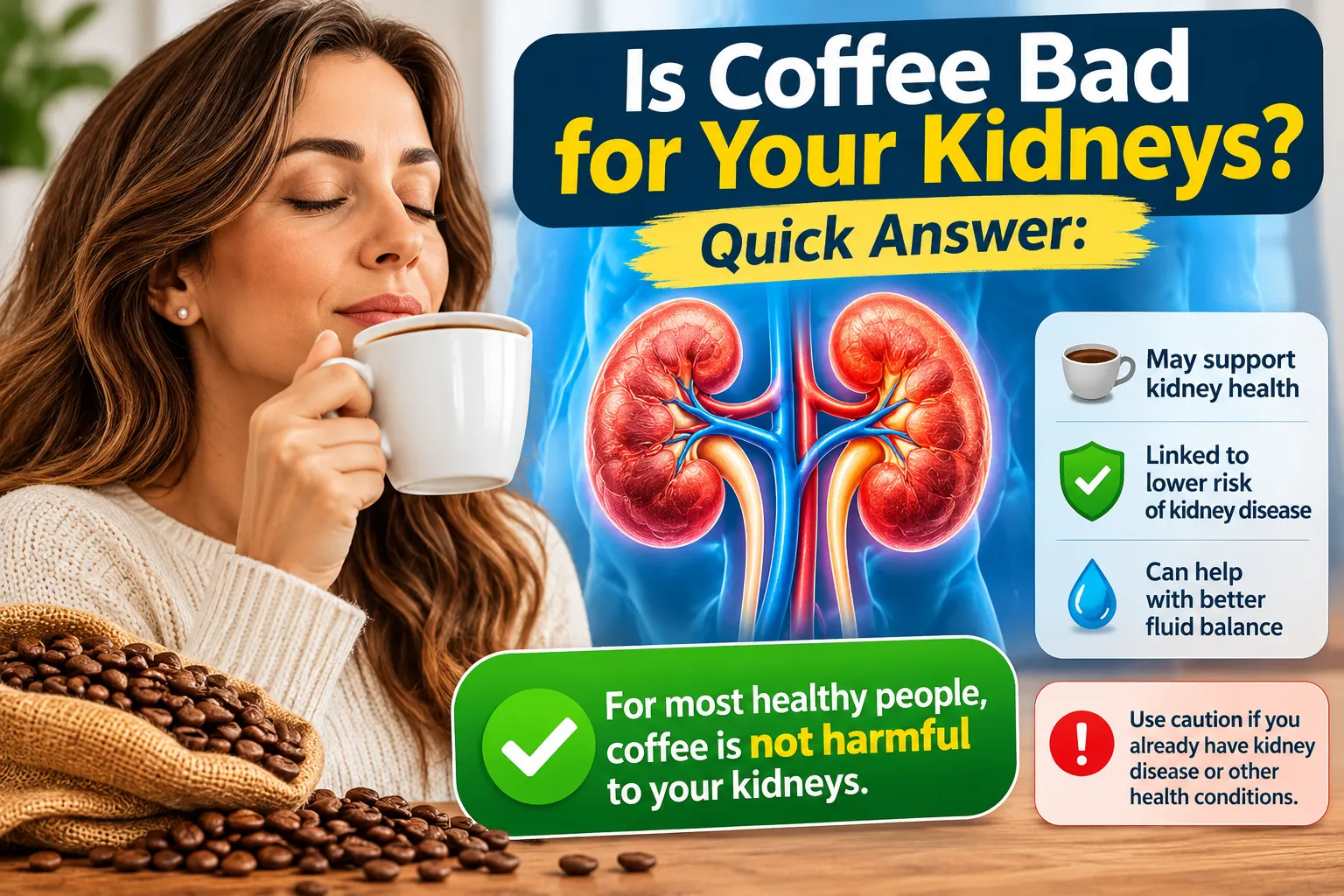
For most healthy adults, no. A systematic review of 59 Mendelian-randomisation studies published November 4, 2026 in Nutrition Research Reviews graded the evidence for coffee as "probable" for lower chronic kidney disease risk, higher eGFR, lower albuminuria, and lower kidney stone risk . A review in Nephrology Dialysis Transplantation (volume 41, issue 11, pages 1969 to 1977) reached a similar conclusion and called moderate intake relatively safe for most people who already have CKD . If you have diagnosed kidney disease, that general finding does not replace your nephrologist's instructions, and what you put in the coffee may matter more than the coffee.
Key takeaways
- The FDA's reference point is 400 mg of caffeine per day for most healthy adults, roughly two to three 12 oz coffees .
- The National Kidney Foundation (April 13, 2026) says fewer than three cups daily is generally considered safe for people with kidney disease, while three to four cups can add meaningful potassium .
- An 8 oz latte can carry about 328 mg potassium and 183 mg phosphorus, per the National Kidney Foundation's example, which is why coffee potassium is usually a dairy question .
- The 2026 NDT review found a dose-dependent association between coffee intake and lower CKD risk, while stating plainly that causal certainty is limited .
- A 2026 Swiss study of 232 recurrent stone patients and 168 controls linked the coffee-related compound 3-nonen-2-one to lower stone status, attributing roughly 59% of the estimated coffee-stone association to that pathway. The authors called it hypothesis-generating .
- The American Urological Association's stone target is urine output, not coffee: at least 2.5 litres per day for stone formers.
- Associations are not causation. None of this makes coffee a treatment for anything.
Is coffee bad for your kidneys?
The short version: current evidence does not support the idea that coffee harms healthy kidneys at normal intakes, and several large analyses point mildly the other way.
The question "is coffee bad for your kidneys" usually comes from a reasonable place. Coffee makes you urinate more. Caffeine nudges blood pressure up. Both sound like stress on an organ whose whole job is filtering blood. The research, though, keeps landing somewhere between neutral and modestly favourable.
Two 2026 reviews carry most of the weight. The Nephrology Dialysis Transplantation review by Bigotte Vieira, Nicolau, Curto, Magriço, McCausland and Neves, published online October 30, 2026, assessed coffee and CKD and reported a dose-dependent association with lower risk of developing CKD . The Cambridge review by Pham, Kassaw, Mulugeta, Zhou and Hyppönen pulled together 59 Mendelian-randomisation studies covering 160 health outcomes, and kidney outcomes were among the better-supported ones .
Here is the misconception worth correcting, because it shows up constantly: people assume coffee's diuretic effect means dehydration, and dehydration means kidney strain. Coffee is mostly water, and the fluid you drink in a cup of coffee counts toward your daily intake for most people. We covered the hydration evidence separately in does coffee dehydrate you. The kidney version of the myth fails for the same reason.
Does caffeine damage your kidneys or change creatinine levels?
No good evidence shows that ordinary caffeine intake damages kidney tissue in healthy adults, and the 2026 Cambridge review found probable evidence for higher eGFR in coffee drinkers . Caffeine's kidney function effects are mostly short-lived and measurable in urine, not in permanent damage.
What caffeine actually does, short term:
- Mildly increases urine volume for a few hours.
- Temporarily raises blood pressure, which matters because hypertension both causes and complicates CKD .
- Modestly increases urinary calcium excretion in some studies, which is one of the competing effects in the kidney stone literature .
On creatinine: a serum creatinine test reflects muscle turnover and filtration. Studies linking coffee to caffeine kidney function markers generally report stable or slightly better eGFR, not worse. One practical note that has nothing to do with coffee itself: if you are scheduled for a kidney blood test, follow whatever fasting or medication instructions your clinic gives you, because those instructions, not your cup, are what protect the accuracy of the result.
Decision rule: if your blood pressure is poorly controlled, the NKF suggests dropping below three cups a day and agreeing on a personal limit with your clinician . That is the one caffeine-related kidney risk with a clear mechanism behind it.
What do the big studies actually say about coffee and kidney health?
Three different study designs point the same direction, and each has a different weakness. That agreement is the strongest part of the case, and the weaknesses are the reason nobody is prescribing coffee.
| Study | What it examined | Finding | Main limitation |
|---|---|---|---|
| Nephrology Dialysis Transplantation review, 2026 (vol 41, issue 11, pp 1969 to 1977) | Coffee intake and CKD risk and progression | Dose-dependent association with lower CKD risk; moderate intake probably safe in CKD | Residual confounding, no definitive trials, varied coffee preparations |
| Nutrition Research Reviews systematic review, 2026, 59 Mendelian-randomisation studies, 160 outcomes | Genetically proxied coffee intake vs health outcomes | "Probable" evidence for lower CKD risk, higher eGFR, lower albuminuria, lower stone risk | Possible pleiotropy; many non-kidney benefits were not supported |
| Urolithiasis metabolite study, 2026, 232 recurrent stone patients, 168 controls | Urinary volatile metabolites, including 3-nonen-2-one | Compound linked to coffee intake and lower stone status; ~59% of the association mediated | Observational and cross-sectional; authors call it hypothesis-generating |
Mendelian randomisation deserves a one-line definition, since it carries a lot of this argument: it uses inherited genetic variants linked to coffee drinking as a stand-in for actual intake, which reduces the chance that lifestyle habits explain the result. It is not a trial. The Cambridge authors warned that genetic variants may influence kidney outcomes through routes other than coffee, a problem called pleiotropy .
Coffee drinkers also differ from non-drinkers in income, smoking, exercise and diet. Statistical adjustment never fully erases that. So the honest summary is: consistent, moderate, biologically plausible, and still an association.
Does coffee cause kidney stones?
Current evidence does not show coffee causing stones, and most large analyses associate higher coffee and caffeine intake with slightly lower stone risk. The 2026 Urolithiasis study offered a possible biological route rather than another correlation, identifying 3-nonen-2-one in urine as a coffee-linked compound that mediated about 59% of the estimated association in 232 recurrent stone patients versus 168 controls .
Why this stays unsettled:
- Volume helps. More urine dilutes calcium, oxalate and uric acid.
- Calcium works against it. Caffeine raises urinary calcium somewhat, which pushes risk the other way .
- Coffee oxalate is real but modest. Brewed coffee contains oxalate, the compound in calcium oxalate stones, though far less per serving than spinach, rhubarb or almonds. A 2024 review concluded the overall coffee-stone relationship remains uncertain and that coffee cannot easily be separated from total fluid intake and overall diet .
If you form stones, the number that matters is not cups of coffee. The American Urological Association's longstanding target is at least 2.5 litres of urine per day, and MedlinePlus frames it as roughly 2 litres. Coffee can count toward fluid, but it has never been tested as a replacement for a structured prevention plan built around your stone type.
Common mistake: adding three large iced coffees a day and calling it stone prevention. If they displace plain water, or arrive with 40 g of sugar, you have changed the wrong variable. Our iced coffee for beginners guide covers the unsweetened versions.
Can you drink coffee with chronic kidney disease, and how much is safe?
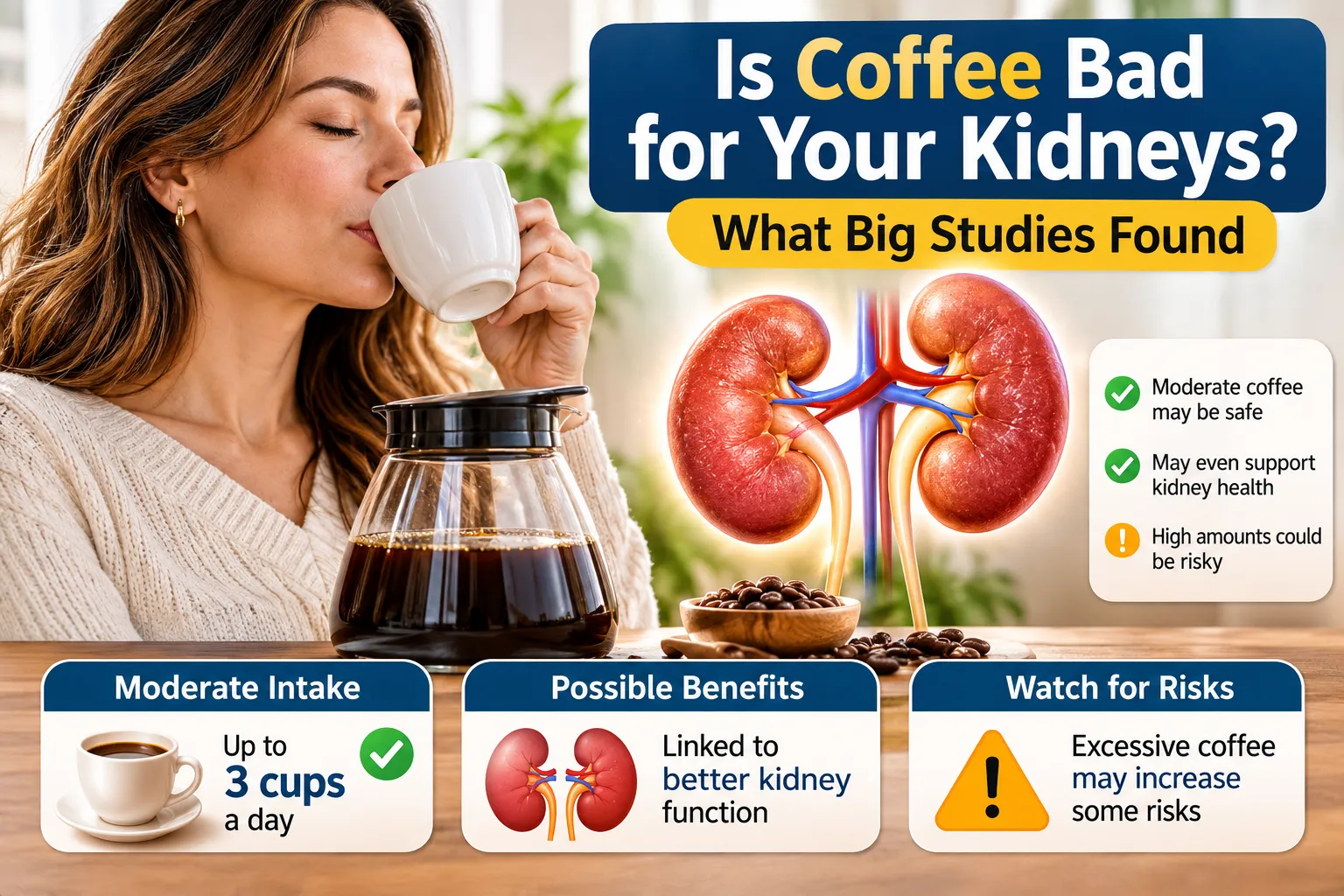
Usually yes, in moderation, but this is a question for your nephrologist and not for an article. The National Kidney Foundation's April 13, 2026 guidance states that fewer than three cups per day is generally considered safe for people with kidney disease, while three to four cups may contribute substantial potassium, especially with milk or creamer . The 2026 NDT review reached the same practical place: moderate consumption appears relatively safe for most people with CKD .
The detail that trips people up is coffee potassium. Black coffee contains a modest amount. A milky drink changes the arithmetic. The NKF's worked example of an 8 oz latte is about 328 mg potassium and 183 mg phosphorus, depending on preparation . Non-dairy creamers can also contain phosphate additives, which the body absorbs far more readily than the phosphorus in whole foods.
Interactive estimator below. It uses the NKF's latte figure as its reference point and is for rough orientation only, not a meal plan.
Daily coffee potassium estimator
Can too much coffee make kidney disease worse, and should you stop?
Do not stop on your own if you have been told your kidney function is impaired. Ask your nephrologist, because the answer depends on your stage, your potassium and phosphorus numbers, your blood pressure and your medications. Nothing on this page overrides that.
The realistic ways coffee could work against you in CKD:
- Blood pressure. Caffeine causes transient rises. If yours is poorly controlled, the NKF advises considering fewer than three cups daily .
- Potassium load from additives. Latte habits, not espresso, are the usual culprit .
- Phosphate additives in creamers, which are absorbed more completely than food phosphorus .
- Sleep disruption, which indirectly worsens blood pressure control.
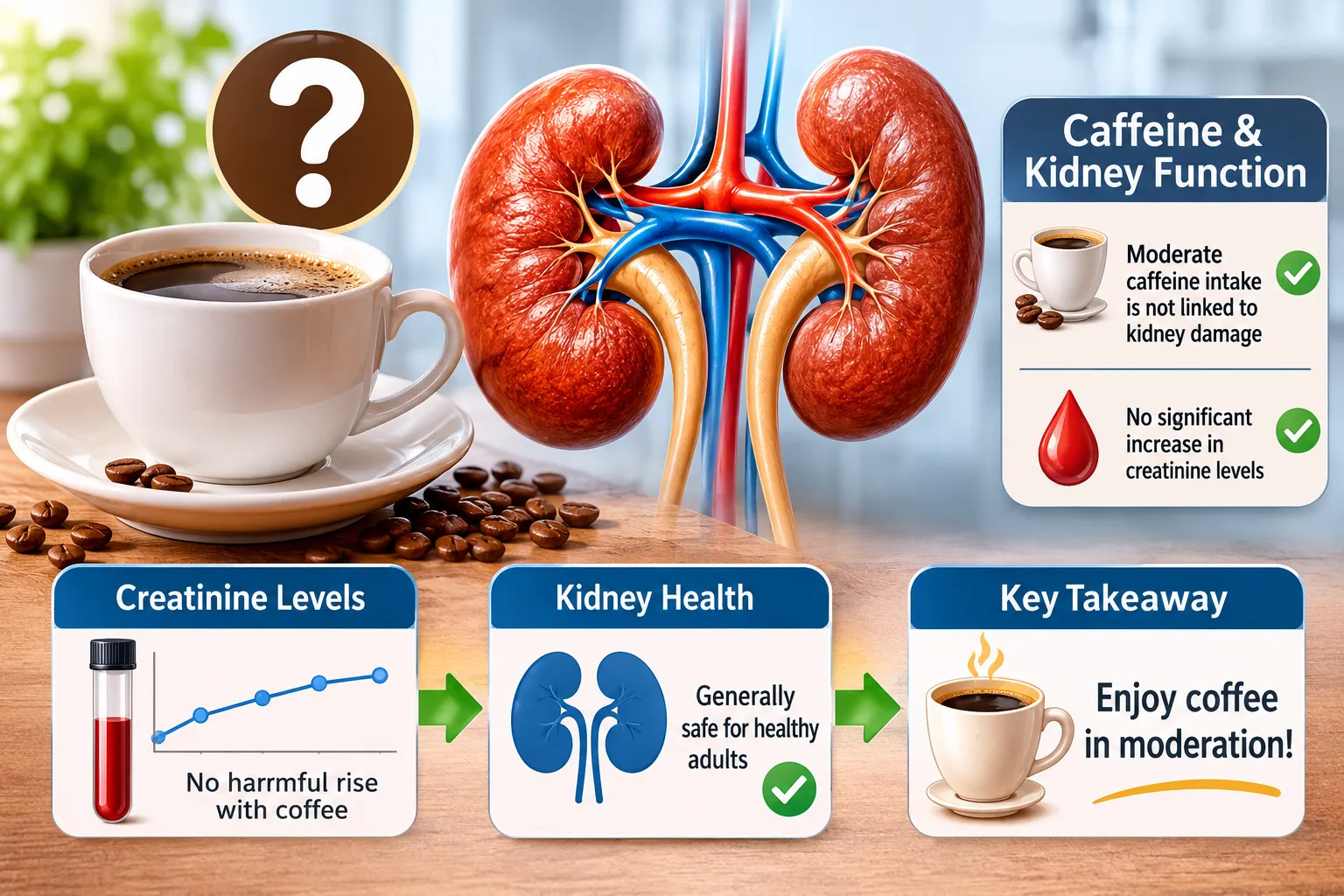
What the evidence does not show is coffee accelerating decline in kidney function at moderate intake. The 2026 NDT review specifically described moderate caffeine as probably safe in CKD while flagging confounding, metabolism differences and the absence of definitive clinical trials .
Is decaf coffee better for your kidneys?
For most healthy people, there is no established kidney advantage to decaf. It becomes the better choice in specific situations: poorly controlled hypertension, caffeine sensitivity, arrhythmia concerns, or a clinician-set caffeine limit.
Decaf still contains the same non-caffeine compounds that researchers suspect carry much of coffee's association with better kidney outcomes, including chlorogenic acids and other polyphenols. It also still contains coffee oxalate. What changes is the caffeine, typically down to a few milligrams per cup rather than 80 to 100.
Choose decaf if you want the drink and your doctor has capped your caffeine. Keep regular coffee if your blood pressure is controlled and you tolerate it. If you are switching, taste matters more than people expect, and our best decaf coffee roundup explains which processing methods preserve flavour.
Who should avoid coffee because of kidney problems?
A smaller group than the internet suggests. Full avoidance is rarely the standing advice; individual limits are.
Talk to a clinician before continuing or increasing coffee if you:
- Have CKD stage 4 or 5, or are on dialysis with a potassium restriction.
- Have poorly controlled high blood pressure .
- Have had a recent kidney transplant. Coffee is frequently allowed afterwards, but immunosuppressant levels, blood pressure and fluid targets are managed tightly in the early months, and caffeine should be cleared with your transplant team rather than assumed.
- Form recurrent stones and are following a prescribed dietary plan.
- Take medication your pharmacist flags for caffeine interaction.
Edge case worth naming: pre-mixed coffee drinks and energy-style canned coffees can carry sugar, phosphate additives and caffeine well above a brewed cup. The risk profile of a 300 mg caffeine canned coffee is not the same as a mug of filter coffee, even though both get called "coffee."
What should you drink instead of coffee for better kidney health?
Water, first and by a distance. Kidney friendly drinks are judged on what they avoid: added sugar, phosphate additives, excess potassium and large caffeine loads.
Reasonable options when you are cutting back:
- Plain water, enough to reach the urine-output target your clinician gives you, often framed as around 2 litres a day for stone prevention and up to 2.5 litres for recurrent stone formers.
- Water with lemon, sometimes suggested for stone formers because citrate can inhibit crystal formation. Discuss it with your urologist rather than self-dosing.
- Herbal infusions without added potassium-rich ingredients.
- Black or green tea, which carry less caffeine per cup than coffee but do contain oxalate.
- Half-caf blends or a smaller brew ratio, if the goal is simply less caffeine without losing the ritual.
If you are tapering, reducing the strength of your brew is easier than quitting outright. Adjusting grind size and brew ratio changes extraction and caffeine per cup, and our guide to coffee brewing explains how those variables interact. For a broader look at what makes one cup gentler than another, see what is the healthiest coffee to drink.
FAQ

Conclusion: what this means for your daily cup
If your kidneys are healthy, the current research gives you no reason to quit coffee, and a mild reason to keep enjoying it. Two 2026 reviews, one in Nephrology Dialysis Transplantation and one covering 59 Mendelian-randomisation studies, both point toward lower CKD risk and better filtration markers among coffee drinkers, with the researchers themselves stopping short of causation . So the honest answer to "is coffee bad for your kidneys" is: not at moderate intake, not for most people, and not in a way any large study has demonstrated.
If you have diagnosed kidney disease, the ceiling is the one your nephrologist sets, and the milk, creamer and sugar deserve as much attention as the caffeine.
Next step: for one week, log your cups and what goes in them, then drink a glass of water alongside each coffee. If you have CKD or form stones, bring that log to your next appointment. It turns a vague question into a specific one your clinician can actually answer. Better Coffee Starts With Better Answers.