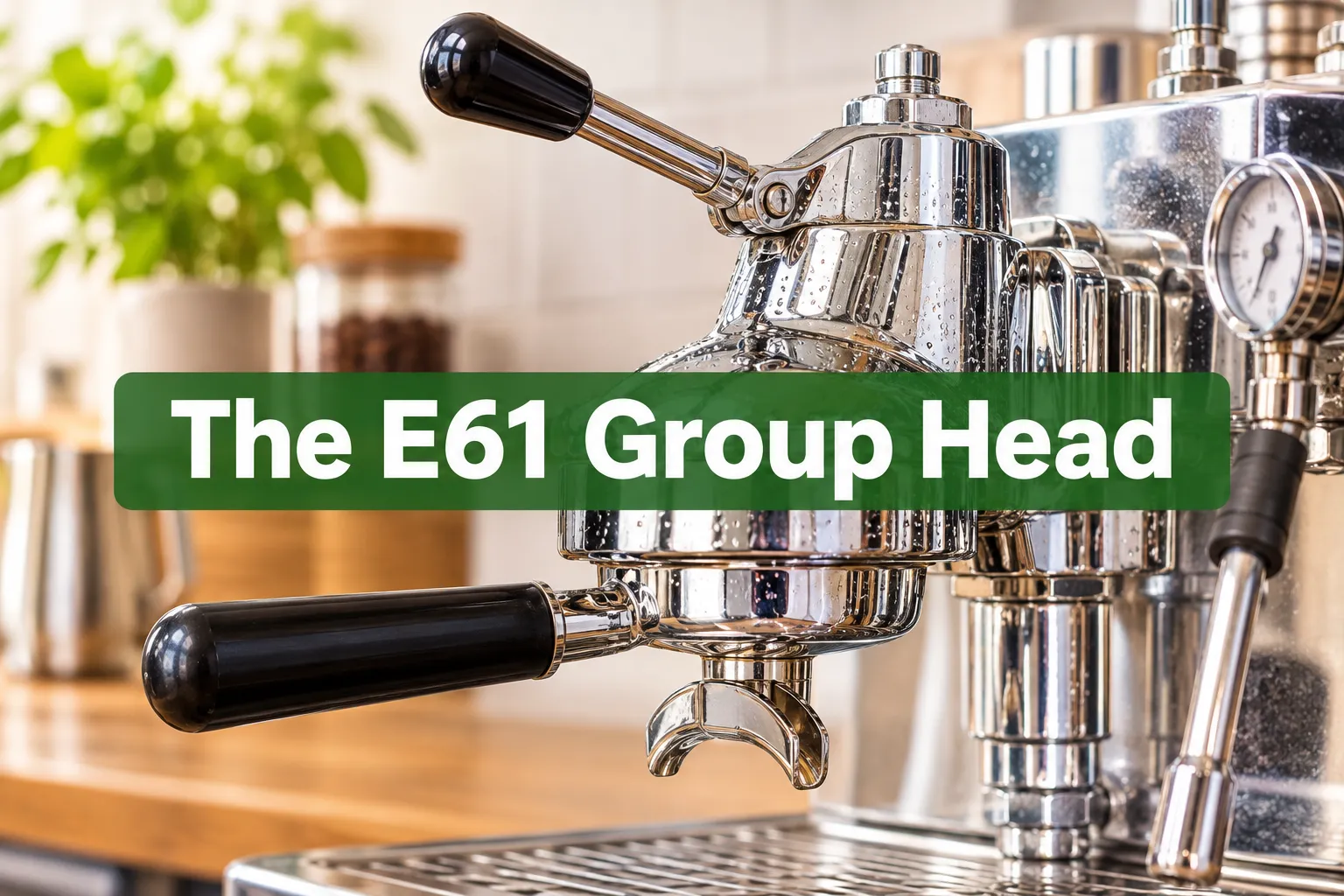
E61 Group Head: The 1961 Design Still Running
Quick Answer
The e61 group head is a heavy brass brewing assembly, introduced by Faema in 1961, that keeps espresso brew temperature steady using passive water circulation and gives you mechanical pre-infusion with a side lever. It is still built into machines from ECM, Rocket, Profitec, Lelit, Quick Mill, and Bezzera because the design works and parts are everywhere . The trade-offs are real: it needs 20 to 30 minutes to warm up, and the lever cam wants grease once or twice a year.
Key Takeaways
- Faema launched the E61 in 1961, engineered by Ernesto Valente, combining an electric pump, thermosiphon circulation, and automatic pre-infusion in one group .
- The name marks the year, tied to the total solar eclipse visible over Italy in February 1961. Treat the eclipse story as widely repeated company lore, not a lab-verified fact. It is not a 61 mm measurement; the portafilter is 58 mm.
- A typical e61 group head weighs over 4 kg of brass, which is why it holds temperature well and why it is slow to get there.
- Expect 20 to 30 minutes of warm-up on a standard machine without an active group heater.
- Current e61 espresso machine prices run roughly $1,200 to $3,500 in the US, with entry models like the Rocket Appartamento near the low end.
- A July 2, 2026 Clive Coffee comparison argues saturated groups are a different solution to the same thermal problem, not a straight upgrade over the e61 group head .
- 2026 machines increasingly pair the 1961 group with PID control, dual boilers, rotary pumps, and flow control (Lelit Bianca V3, ECM Synchronika II).
What is an e61 group head and how does it work?
The e61 group head is the brass block bolted to the front of an espresso machine where the portafilter locks in. Water enters it from the boiler, passes a valve system controlled by a side lever, soaks the coffee puck, and exits through the shower screen. A three-way valve releases pressure after the shot so the puck comes out dry.
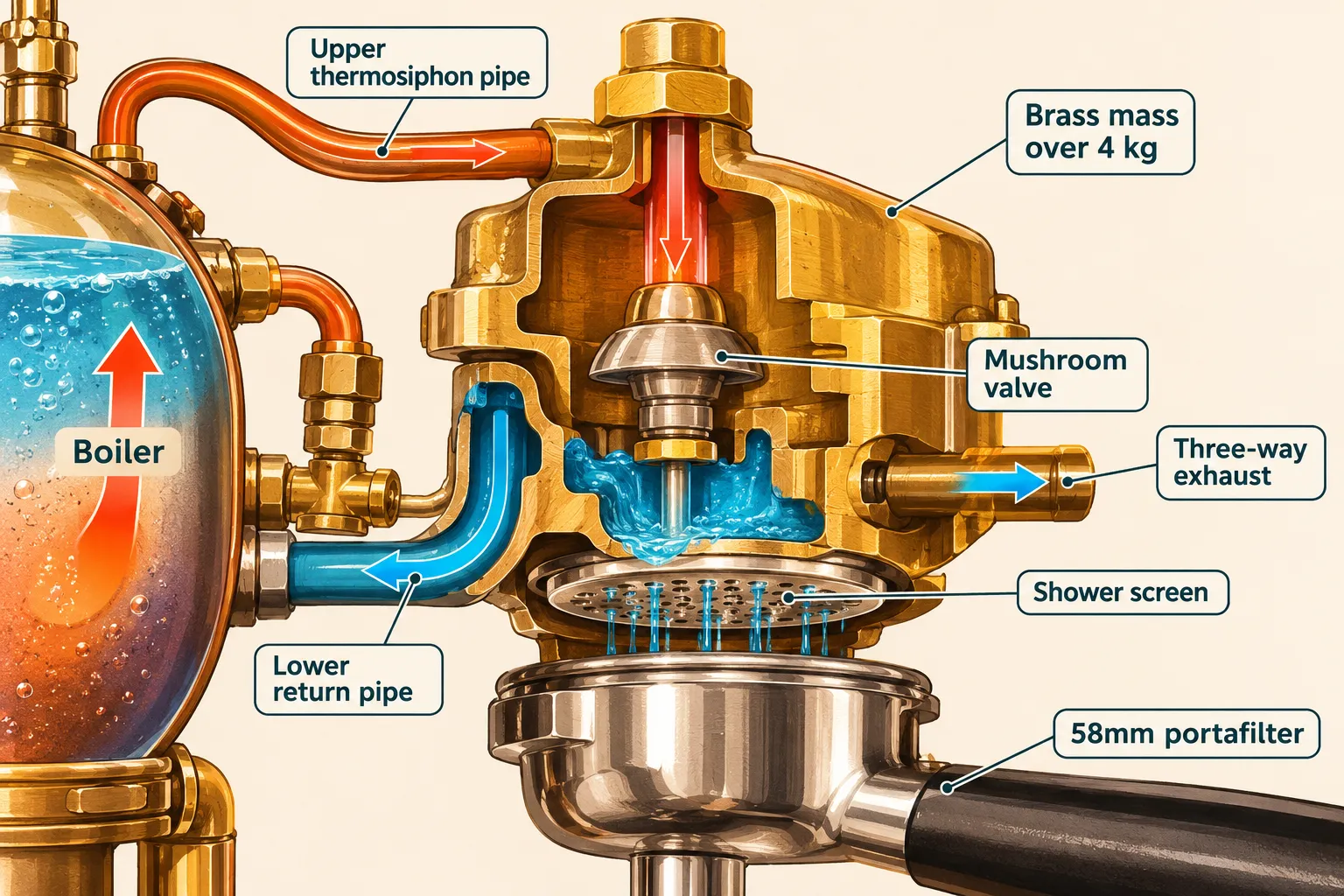
Three parts do the work:
- The brass body. Four-plus kilograms of metal acting as a heat battery . Brass holds warmth, so the temperature at the coffee does not swing much between shots.
- The thermosiphon loop. Two pipes connect the group to the boiler or heat exchanger. No pump drives this loop. Physics does.
- The lever and cam. Three positions: rest, pre-infusion, full extraction .
)
Nothing here is electronic. That is the quiet reason the e61 group head survived 65 years: a machine built in 2012 can be rebuilt in 2026 with gaskets costing less than a bag of good beans.
Why is it called the e61? What does that mean?
E61 stands for the year 1961, when Faema released the machine. Faema is widely reported to have named it after the total solar eclipse that crossed northern Italy on February 15, 1961. The eclipse happened. The naming link is repeated by nearly every manufacturer and retailer, including Kaffeemacher, but it comes from company storytelling rather than a surviving design document, so file it as strong tradition rather than proven record.
Two things it does not mean:
- It is not 61 millimeters. The associated basket and portafilter standard is 58 mm.
- It is not a brand. Faema never kept exclusive rights in practice, and the architecture spread across the industry .
Valente's actual contribution was integration. Three-way valves existed. Lever machines existed. He built a pump-driven group that performed automatic pre-infusion without the barista managing it .
How does the thermosiphon work, and why does warm-up take 20+ minutes?
A thermosiphon moves water with heat alone. Hot water in the boiler is less dense, so it rises through the upper pipe into the group head. As it cools inside the brass, it gets denser and sinks back through the lower pipe. The loop runs continuously whenever the machine is on, which is how a thermosiphon espresso system keeps the group within a workable band of the boiler temperature.
Now the warm-up problem. Water heats fast. Four kilograms of brass does not. Switch on a cold machine and the boiler reaches pressure in five minutes while the group head is still absorbing heat from that circulating water. Pull a shot at minute six and the brass steals temperature from your water mid-extraction. You get a sour, thin cup and blame the beans.
Decision rule: if your machine has no active group heater, give it 25 minutes. If you cannot wait, buy a smart plug and schedule it for 20 minutes before your alarm. That single $15 purchase fixes the biggest complaint people have about e61 group head machines.
Flushing a cup of water through the group after warm-up also helps on heat-exchanger models, where the water sitting in the exchanger can run hotter than the boiler.
A cold e61 is not a bad group head. It is an unfinished one.
What is e61 pre-infusion, and what is water saturation?
E61 preinfusion is the gentle wetting of the coffee puck before full pump pressure arrives. Lift the lever to the middle position and water enters the group at line pressure, typically 2 to 4 bar depending on your plumbing or the restricted flow from the pump path. The puck absorbs water, swells, and settles. Push the lever all the way up and the pump delivers 9 bar into an already-saturated bed.
Why that matters at the cup: dry coffee channels. Water finds the weakest path, blasts through it, and leaves the rest of the puck under-extracted. Pre-infusion equalizes the bed first, so extraction is more even. For light and medium roasts, that usually reads as more sweetness and less harsh edge.
Water saturation in group head language means something slightly different. A saturated group is one where the brew chamber sits inside, or is permanently fed by, the boiler itself, so the metal is literally surrounded by boiler water . The e61 is not saturated. It is heated indirectly by the thermosiphon loop. Both approaches target the same goal: group head temperature stability.
E61 vs other espresso machine group heads: which is better?
Neither wins outright. Saturated groups recover temperature faster and reach readiness sooner, which suits back-to-back shots. E61 groups give you mechanical pre-infusion, huge thermal inertia, and a parts ecosystem that spans dozens of brands . Thermoblock groups, found on most machines under $500, heat water on demand and are the least stable of the three .
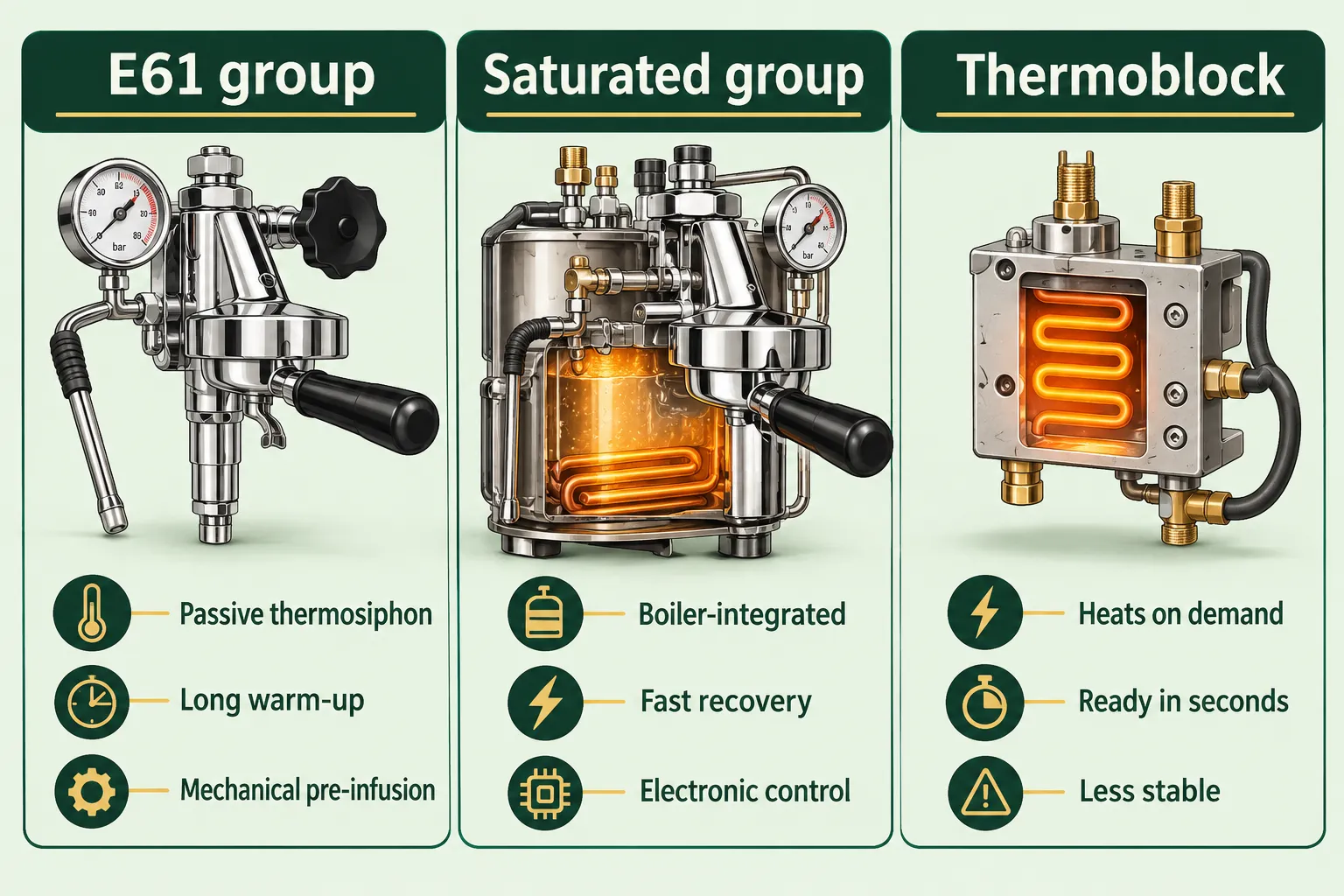
Group head comparison: E61, saturated, thermoblock
| Factor | E61 | Saturated | Thermoblock |
|---|---|---|---|
| Heat source | Passive thermosiphon from boiler | Group sits in boiler water | Heats water on demand |
| Warm-up | 20-30 min | 15-25 min | Under 2 min |
| Shot-to-shot stability | Good, slow to recover | Very good, fast recovery | Variable |
| Pre-infusion | Mechanical, built in | Usually electronic or none | Rarely offered |
| Maintenance | Gaskets, cam grease, backflush | Gaskets, backflush | Descale, few parts |
| Typical US price | Mid to high prosumer | High prosumer and up | Entry level |
General category guidance, not model-specific specs. Confirm figures with the manufacturer before buying.
)
E61 vs rotary pump: a comparison that is not a comparison
A rotary pump is not a group head type. It is the pump that feeds one. Rotary pumps are quieter, last longer, and can be plumbed to a water line; vibratory pumps are cheaper and smaller. Plenty of e61 espresso machine models use each. The ECM Synchronika and Profitec Pro 700 use rotary pumps with an e61 group head; the Rocket Appartamento uses a vibratory pump with the same group. Choose the pump for noise and plumbing, choose the group for thermal behavior and pre-infusion.
How much do e61 group head espresso machines cost?
Expect $1,200 to $3,500 for a new e61 machine in the US as of November 2026. Below that, you are in thermoblock and single-boiler territory. Above it, you are usually paying for dual boilers, flow control, and build finish rather than a different group.
| Tier | Approx. US price | What you get |
|---|---|---|
| Entry prosumer | $1,200 to $1,800 | Heat exchanger, vibratory pump, no PID |
| Mid prosumer | $1,800 to $2,600 | PID, better steam, rotary option |
| Upper prosumer | $2,600 to $3,500+ | Dual boiler, rotary pump, flow control |
Prices move. Check the current price before you commit, and budget separately for the grinder. A $2,000 machine fed by a $90 grinder will lose to a $900 machine fed by a $500 one. If you are still deciding, compare the models in our guide to the best espresso grinder.
What are the best espresso machines with e61 group heads?
The recurring names in 2026 e61 roundups are Rocket, ECM, Profitec, Lelit, Quick Mill, and Bezzera . Picking between them comes down to boiler layout and whether you want flow control.
- Rocket Appartamento. Compact footprint, heat exchanger, the usual starting point for people moving up from a Gaggia Classic.
- Profitec Pro 600 / Pro 700. Dual boiler, strong steam, serviceable layout.
- ECM Synchronika (and the Synchronika II). Dual boiler with rotary pump; the newer version adds flow control.
- Lelit Bianca V3. The e61 group head with a manual flow-control paddle, which turns a fixed pre-infusion platform into a profiling tool.
- Quick Mill and Bezzera. Long-running Italian builds with good parts support.
Choose this way: one milk drink a day, small counter, no plumbing? Heat exchanger, vibratory pump. Two or more milk drinks back to back, or you want to steam while brewing? Dual boiler. Want to chase light-roast clarity? Flow control.
Cross-shopping lower? Our best semi automatic espresso machine roundup covers the step below prosumer.
Is an e61 group head hard to use for beginners?
No, but it is less forgiving than a push-button machine, and the learning sits in the grinder, not the group. The lever has three positions and takes about two shots to understand. The actual difficulty is dialing in grind size and holding a consistent brew ratio.
Common beginner path: buy the machine, use a cheap grinder, get bitter or sour shots, blame the machine. The e61 group head will reward a good grinder and expose a bad one.
If you are starting from a single-boiler machine, our Gaggia Classic Pro beginner guide covers the fundamentals that carry over.
What are common mistakes people make with e61 machines?
- Pulling shots after 8 minutes. The boiler is ready. The brass is not.
- Never greasing the cam. The lever gets stiff, then grinds, then wears. Food-safe grease, once or twice a year.
- Skipping backflush. Oils build behind the shower screen and in the three-way valve. Blind-basket backflush weekly, with detergent monthly.
- Buying the machine and cheaping out on the grinder. The most common and most expensive mistake.
- Ignoring water hardness. Scale kills boilers and blocks thermosiphon pipes. Filter or use low-mineral water.
- Putting it under a low cabinet. The lever swings up. Measure the clearance above the machine before you buy.
E61 group head leaking: what should you do?
Most e61 leaks come from one of three places, and two are cheap fixes you can do at home. Unplug and depressurize the machine first.
- Drips from the portafilter rim during a shot. Worn group gasket. Replace it (around $5 to $15). Gaskets last roughly 9 to 18 months with daily use.
- Continuous dripping from the group after the shot. Debris or wear in the three-way valve, or a worn mushroom valve seal. A hard backflush sometimes clears it; otherwise it is a seal kit.
- Water under the machine or from the lever area. Lever shaft O-rings, or a loose thermosiphon pipe fitting. O-rings are inexpensive; the fitting needs a careful check for scale.
If a leak appears alongside dropping boiler pressure, stop and get it serviced. That pattern points past the group head.
How do you clean and maintain an e61 group head?
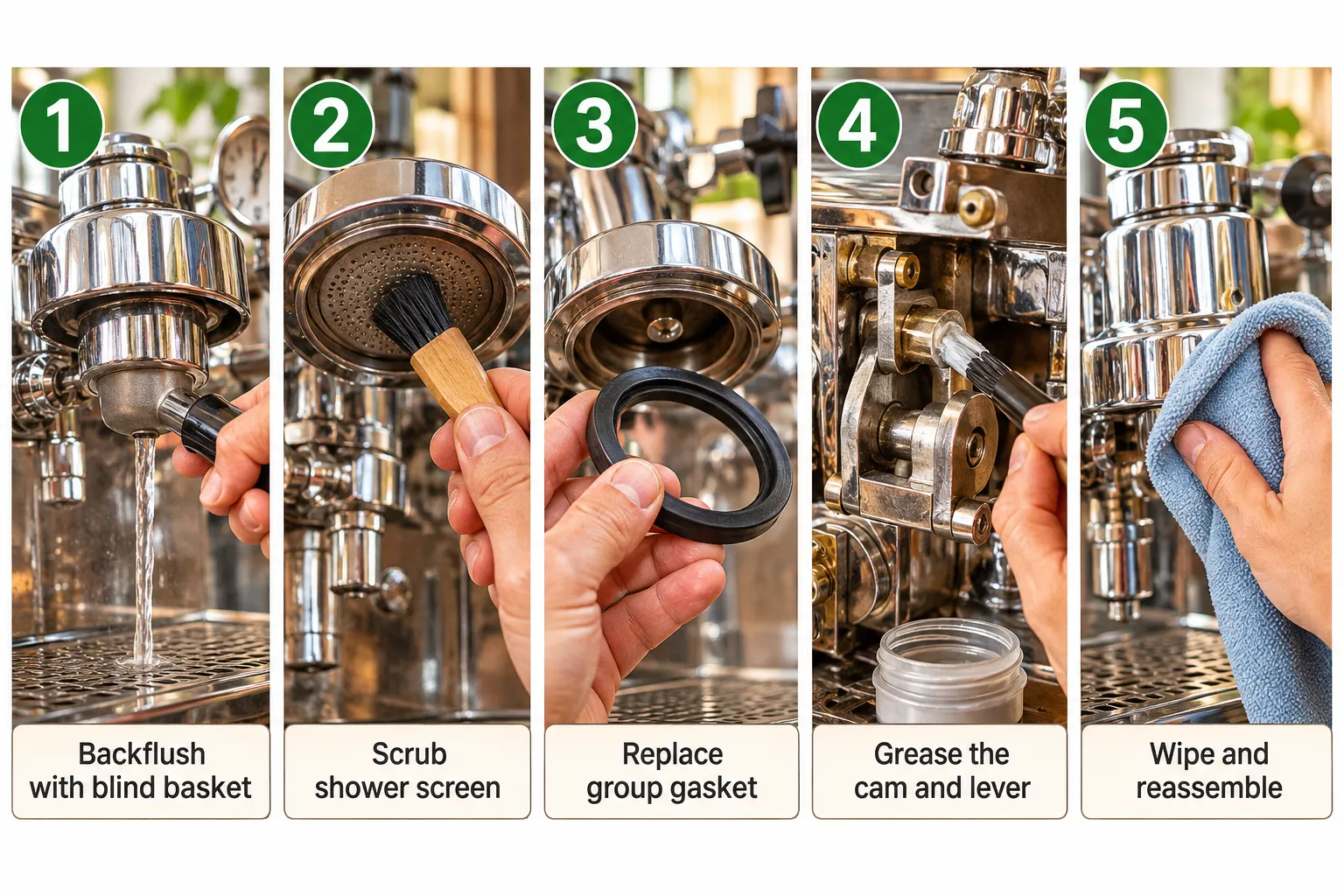
E61 maintenance is predictable and cheap, which is a large part of why the design lasted. Keep it to one weekly habit and one annual service.
)
Weekly: backflush with a blind basket, five cycles of water only. Wipe the shower screen with a group brush.
Monthly: backflush with espresso machine detergent, then rinse with five plain cycles. Remove and soak the shower screen and dispersion plate.
Every 9 to 18 months: replace the group gasket, inspect the shower screen, and apply food-safe grease to the lever cam.
Annually: check water filtration and descale according to your machine's manual and your water hardness.
Café-level routines go further; see our notes on advanced barista cleaning techniques and the broader espresso equipment maintenance guide.
Do you really need an e61, or is it hype? And what are the alternatives?
You need one if you want mechanical pre-infusion, repairable parts, and a machine you intend to keep for a decade. You do not need one if you make one coffee before work and resent waiting 25 minutes.
Honest cases against it:
- You want speed. A thermoblock or saturated-group machine with fast heat-up serves you better.
- Your counter is tight. The group is heavy and the lever needs vertical clearance.
- Your budget stops at $600. A good single-boiler machine plus a real burr grinder beats a stretched e61 purchase with a bad grinder every time.
Budget alternatives that still make good espresso: the Gaggia Classic Pro family, Breville's dual-boiler line, or a manual lever machine. Start with our best espresso machine under 500 list, and if you like the mechanical approach but not the price, look at the best manual espresso machine options.
FAQ

Conclusion
The the E61 suits the home brewer who wants a machine they can service, pre-infusion they do not have to program, and shot-to-shot consistency they can taste. It suits them less if mornings are rushed and counter space is scarce. Better coffee starts with better answers, and the honest answer here is that this 1961 design is still competitive because nothing about passive thermosiphon circulation or a heavy brass block has gone out of date.
Next step: before you shop, measure the vertical clearance above your counter, then set your grinder budget first. Compare the models once you know both numbers.