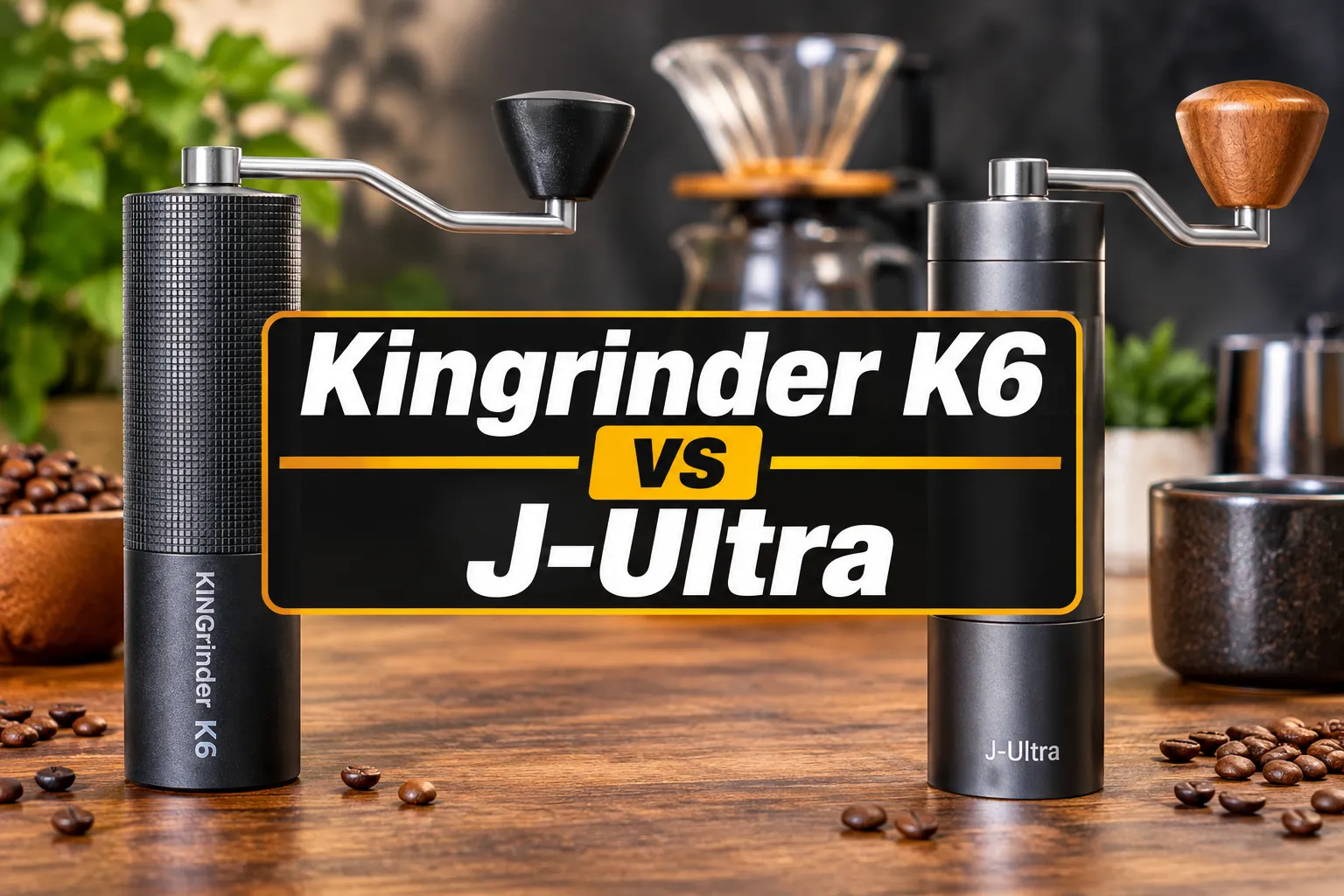
Kingrinder K6 Review: $109 Hand Grinder vs J-Ultra
Quick Answer
The Kingrinder K6 is a $109 all-metal manual grinder with stainless steel conical burrs, external numbered adjustment, and roughly 240 clicks of range, which makes it a legitimate single grinder for espresso, pour over, and French press . The $199 1Zpresso J-Ultra adjusts in 8 micron steps versus the K6's 16 microns, so it lands inside a narrow espresso window with fewer compromises . Buy the K6 if you brew filter most days and pull espresso a few times a week. Buy the J-Ultra if espresso is the main event and you change beans often. Prices checked November 5 to 6, 2026 and may move.
Affiliate disclosure: Coffee Rank IQ earns commission from qualifying purchases through retailer links. That never changes which grinder wins a comparison.
Key Takeaways
- The Kingrinder K6 was listed at $109 and the 1Zpresso J-Ultra at $199 on November 5 to 6, 2026, a gap of roughly $90, or about 83% more for the J-Ultra .
- Adjustment resolution is the real split: 16 microns per click on the K6, 8 microns per click on the J-Ultra .
- The K6 uses 60 clicks per rotation across about four rotations, roughly 240 total settings, per Amazon listings dated November 5, 2026 .
- Hopper capacity is reported inconsistently: KINGrinder's official page lists 25 to 30 g, Amazon listings say 30 to 35 g . Treat it as 25 to 35 g.
- Bean & Burr scored the J-Ultra 8.2/10 and the K6 7.6/10 in its November 6, 2026 comparison, with the K6 winning on value .
- Burr diameter for the K6 is not clearly published by KINGrinder; the J-Ultra's 48 mm burr is published by 1Zpresso .
- Cheaper fallback: the Kingrinder P2 around $55. Step up without leaving the brand: the K7 around $139 (Amazon, November 5, 2026).
What is the Kingrinder K6 and how does it work?
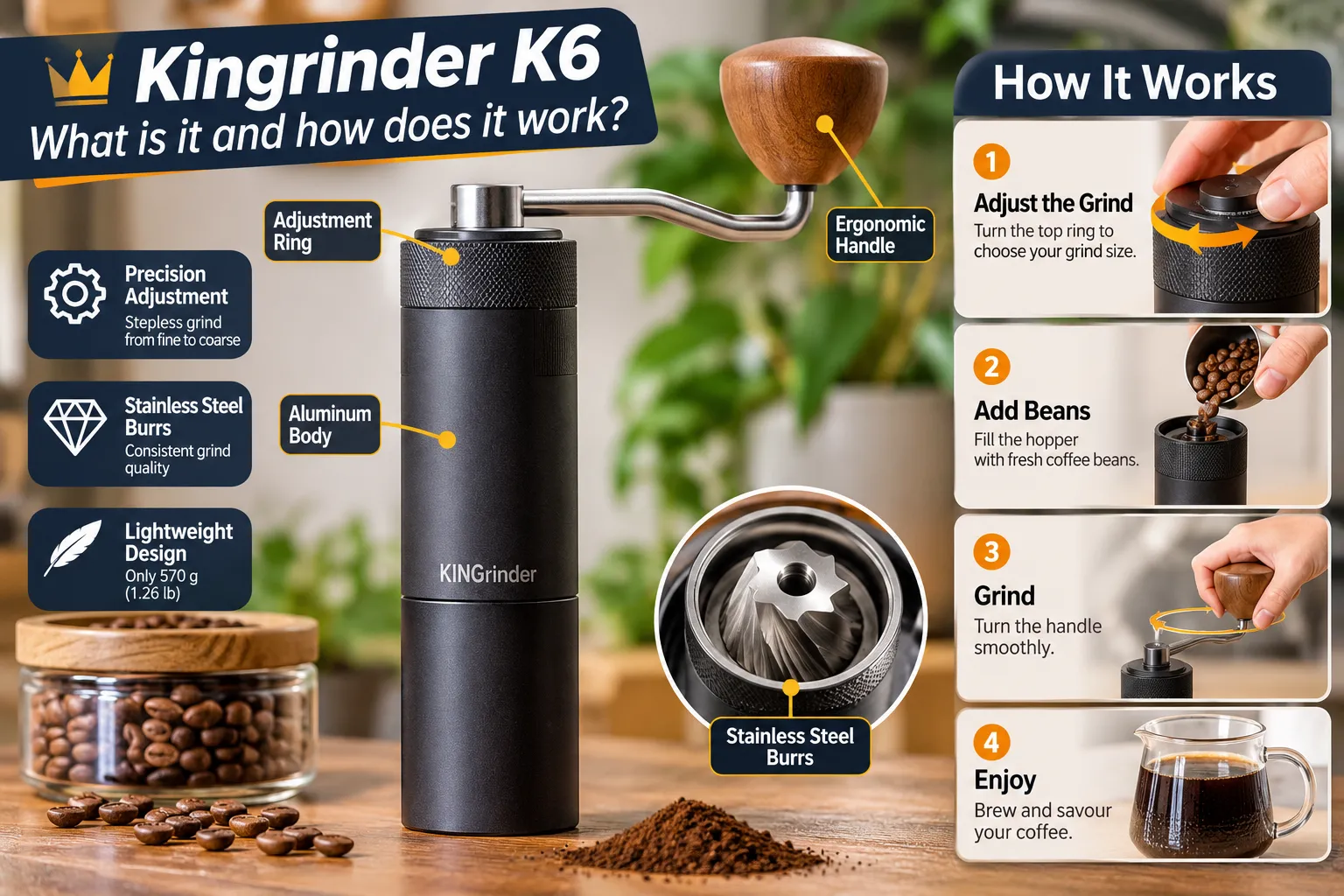
The Kingrinder K6 is a hand-cranked burr grinder with an aluminum body, a stainless steel conical burr set, and a numbered adjustment ring on the outside of the grinder near the base . You load whole beans into the top, turn the handle, and ground coffee falls into a magnetic catch cup underneath.

The mechanics are simple. Two burrs sit one inside the other. The outer burr is fixed, the inner one spins on a shaft driven by your handle, and beans get fractured into smaller and smaller pieces as they fall through the narrowing gap. A burr grinder produces particles of similar size, which is the whole point. A blade grinder chops at random and gives you dust alongside boulders, which is why extraction (the process of dissolving flavor compounds out of coffee grounds into water) turns bitter and sour at the same time. If that distinction is new to you, read the breakdown of burr versus blade grinders and what it means for your coffee maker.
What makes the K6 different from a $35 grinder is the external adjustment collar. You change grind size by turning a numbered ring on the outside while the grinder stays assembled. Each click is a documented step of 16 microns . You can write "22 clicks, V60" on a sticky note and return to it next week. Internal adjustment grinders make you pull the burr assembly apart and count by feel.
KINGrinder also lists tool-free disassembly and markets the K6 as a portable grinder for travel and camping .
Decision rule: if you only brew drip coffee at one grind setting forever, external adjustment is a convenience, not a necessity. If you own a V60, an AeroPress, and an espresso machine, the numbered dial is the feature you will touch every single morning.
Kingrinder K6 vs J-Ultra: which is better for your coffee?
The J-Ultra grinds espresso more precisely. The Kingrinder K6 covers more brew methods per dollar. Both statements are supported by published specifications, and which one matters depends entirely on what you drink.
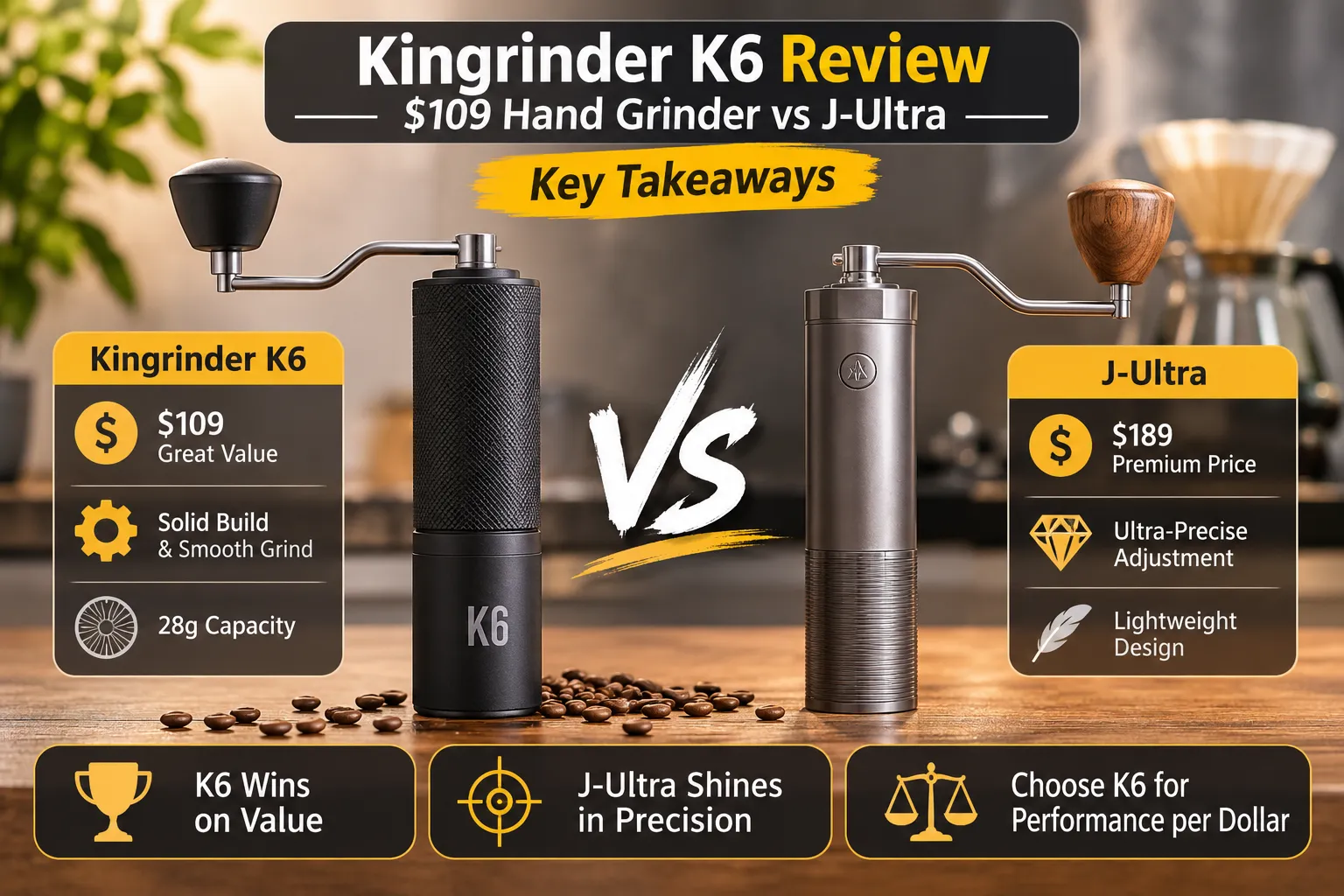
Here is the split in plain terms. Espresso has an unforgiving grind window. Move too coarse and water rushes through in 15 seconds, leaving a thin, sour shot. Move too fine and the shot chokes. The J-Ultra's 8 micron steps mean you get twice as many landing spots inside that window as the K6's 16 micron steps . The Espresso Report, in its October 17, 2026 assessment, names that resolution gap as the decisive difference for anyone pulling shots most days .
The counterargument from Bean & Burr, published November 6, 2026, is that the K6's stainless burrs and external adjustment deliver a large share of the J-Ultra's practical capability, and the gap only widens at the very fine end . That reads as a refinement upgrade rather than a different class of tool. Bean & Burr's editorial scores back it up: 8.2 for the J-Ultra, 7.6 for the K6, with the K6 ahead on value .
| Grinder | Price (Nov 5-6, 2026) | Step size | Adjustment | Best for |
|---|---|---|---|---|
| Kingrinder K6 | $109 | 16 microns | External, numbered | One grinder, all brew methods |
| 1Zpresso J-Ultra | $199 | 8 microns | External, 48 mm burr | Daily espresso, frequent bean changes |
| Kingrinder K7 | $139 | Finer than K6 | External, numbered | Espresso leaning, same brand |
| Kingrinder P2 | $55 | Coarser steps | Internal | Filter only, tight budget |
Prices from Amazon listings checked November 5, 2026 and comparison pages checked November 5-6, 2026 . Retailer prices change.
Winner by buyer: the K6 for the one-grinder household. The J-Ultra for the espresso-first buyer who swaps a new single origin into the hopper every two weeks.
Is the Kingrinder K6 worth $109?
For most home brewers building a $300 to $1,500 setup, yes. The K6 delivers stainless conical burrs, external numbered adjustment, an all-metal body, and roughly 240 settings at a price where many competitors still ship internal adjustment and plastic parts .
Think of it against the alternatives at the same money. A $109 electric grinder at that price is usually a flat-burr-free, low-RPM blade or a basic conical with a plastic hopper and heavy retention. The K6 spends its entire budget on the burr set and the adjustment mechanism, because it has no motor to pay for. That is the structural reason hand grinders outperform their price tier.
The honest limit: $109 does not buy a grinder that makes espresso dialing fast. It buys one that makes espresso dialing possible. If you weigh every shot and chase a 1:2 brew ratio in 28 seconds, the extra $90 for the J-Ultra buys you fewer wasted doses.
Common mistake: buying a $1,200 espresso machine and a $60 grinder. The grinder sets the ceiling on what the machine can produce. Our guide to choosing a coffee grinder by brew method and budget lays out the ratio most people should aim for.
Kingrinder K6 burr size and grind consistency: what's actually documented?
KINGrinder lists a stainless steel conical burr assembly for the K6 but does not clearly publish the burr diameter on its official product page . 1Zpresso publishes a 48 mm burr for the J-Ultra, though burr geometry and coating details are not clearly identified in the reviewed documentation .
That gap matters, and The Espresso Report explicitly warns against treating unverified burr-size figures circulating online as manufacturer specifications . Neither company has published independent particle size distribution data or sieve testing for this pairing. So any claim that one grinder produces "x percent fewer fines" is, at the time of writing, unsupported.
What can be said from published specs and editorial scoring:
- Both grinders use hardened stainless steel burrs, which hold an edge far longer than the cast or coated burrs in sub-$50 grinders .
- Bean & Burr rated the J-Ultra higher for consistency and build quality, the K6 higher for value, in its November 6, 2026 editorial comparison .
- The K6's advantage is range, roughly 240 clicks across four rotations, which covers Turkish fine through French press coarse in one tool .
Edge case: very light roasted Ethiopian beans are dense and hard. They stress any hand grinder's shaft bearings and slow your crank. If light roasts are your regular order, grind in two smaller batches rather than forcing 30 g at once.
Can you use the Kingrinder K6 for espresso?
Yes. The Kingrinder K6 grinds fine enough for espresso and holds that setting reliably, thanks to stainless burrs and external numbered adjustment . The limitation is precision between settings, not the ability to reach espresso fineness.
Here is what the 16 micron step size means in practice. Say your shot runs 22 seconds and you want 28. On the J-Ultra you move two clicks finer, 16 microns total, and land close. On the K6, one click is already 16 microns, and two clicks might overshoot into a choked shot. You then compensate with dose or yield instead of grind, which works but adds variables.
A workable K6 espresso routine:
- Start around 1.5 rotations from zero (roughly 90 clicks) for a medium roast.
- Dose 18 g, target 36 g out, time from first drip.
- Adjust one click at a time and pull two shots per setting before judging.
- Record the click number with the roast date of the bag. Beans grind differently as they age.
- When a new bag arrives, start at your last setting and expect a one to three click correction.
If espresso is genuinely the main thing you make, compare the hand grinders against motorized options in our espresso grinder roundup before committing to cranking every morning.
Decision rule: fewer than four espressos a week, K6. Daily doubles plus milk drinks for two people, J-Ultra or an electric.
Kingrinder K6 vs Comandante: how do they compare?
The Comandante C40 sits in a different price bracket, typically three to four times the K6's $109, and is widely treated as a filter-first reference grinder with a German-made steel burr set. The Kingrinder K6 competes on external numbered adjustment and espresso range rather than on burr pedigree.
Practical differences that affect a buying decision:
- Adjustment style. The C40 adjusts internally through its catch jar mechanism. The K6 adjusts externally while assembled, which is faster when switching between espresso and pour over in the same morning.
- Espresso suitability. The C40 is loved for filter and reaches espresso with an accessory axle. The K6 reaches espresso out of the box .
- Materials and resale. The Comandante's wood and steel construction holds value. The K6 is aluminum and priced as a working tool.
No independent sieve comparison between these two models appears in the sources reviewed here, so treat claims about one producing a "cleaner" cup as opinion rather than measurement. If you want more manual options across price tiers, see the best manual coffee grinder picks and the detailed VSSL JAVA hand grinder guide.
How long does it take to grind coffee with the Kingrinder K6?
Grind time depends on dose, roast level, and grind size. Coarse French press settings move fastest because the burrs release particles sooner. Espresso settings are slowest because the gap is tiny and every particle has to be worked down.
Rough expectations for a 20 g dose, based on how conical hand grinders behave generally:
| Brew method | Grind size | Relative effort |
|---|---|---|
| French press | Coarse | Fastest, light resistance |
| Pour over / V60 | Medium | Easy, steady crank |
| AeroPress | Medium-fine | Moderate |
| Moka pot | Fine | Noticeably heavier |
| Espresso | Very fine | Slowest, most arm effort |
These are directional, not measured results. Coffee Rank IQ has not conducted timed grinding trials on this model, and no published timing data appears in the sources cited here.
Practical note: the honest friction with any hand grinder is the arm work on espresso settings. If you need two 18 g espresso doses back to back at 7 a.m., the crank stops being charming by week three.
Kingrinder K6 handle comfort and durability: what to watch out for
The K6 ships with a folding handle on an aluminum body, which is good for packing into a bag and less good for leverage on hard, light roasted beans . Hand grinder handles are the most common long-term wear point because they absorb every bit of torque you apply.
Things worth knowing before you buy:
- Folding handles can develop play. A small amount of wobble at the hinge is normal on folding designs and is not usually a failure.
- Grip over long sessions. The knob is the contact point for several hundred rotations a week. Some owners add a silicone sleeve.
- Capacity confusion. KINGrinder's official page lists 25 to 30 g; Amazon listings claim 30 to 35 g . Plan around 25 to 30 g to avoid overfilling, which strains the handle.
- Stock availability. KINGrinder's own store listed the K6 at £99 and showed it out of stock when checked on October 2, 2026 . Retail listings remained active .
What to watch out for
- 16 micron steps make espresso dialing coarser than the J-Ultra's 8 .
- Burr diameter is not clearly published by the manufacturer .
- No independent grind distribution testing exists for this comparison .
- Aluminum body and folding handle are built for portability, not for 60 g daily batches.
- Direct-from-brand stock has been inconsistent.
Five features worth the money
1. External numbered adjustment ring. Change grind without disassembly and write the number down. This is the single biggest workflow difference between the K6 and cheaper grinders.
2. 60 clicks per rotation, about four rotations. Roughly 240 settings spanning espresso to French press in one tool . You do not need a second grinder for filter.
3. Stainless steel conical burrs. Hardened steel holds its cutting edge through years of home use and does not shed coating into your grounds .
4. Tool-free disassembly. The burr stack comes apart for cleaning without an Allen key, which means you will actually clean it .
5. All-metal, travel-ready body. Aluminum construction and a folding handle let the grinder go in a carry-on. A café-quality grind in an Airbnb is a real benefit, not a brochure line .
Best affordable hand grinder alternatives under $150
If the Kingrinder K6 is not the right fit, these are the credible neighbors at the time of checking on November 5, 2026.
- Kingrinder K7, around $139. Same brand, finer adjustment steps than the K6. The move for buyers who lean espresso but will not spend $199.
- Kingrinder P2, around $55. Internal adjustment, coarser steps. Fine for French press and drip, frustrating for espresso.
- 1Zpresso J-Ultra, $199. Over budget but the espresso benchmark here: 8 micron steps, stated 48 mm burr, 35 to 40 g magnetic catch cup, one-year limited warranty .
Choose this way: filter only on a tight budget, P2. One grinder for everything, K6. Espresso most days, stretch to the J-Ultra. For broader context across price bands, browse the product review archive.
the K6 vs electric grinders: pros and cons
A hand grinder trades time and effort for grind quality per dollar. A $109 the K6 spends nothing on a motor, so its burrs and adjustment mechanism are better than what $109 buys in an electric.
Hand grinder advantages
- Better burrs per dollar, because there is no motor in the budget.
- Silent. You can grind at 5 a.m. without waking anyone.
- Portable, no outlet required.
- Very low retention when cleaned, since gravity does most of the work.
Electric grinder advantages
- Speed, especially for espresso fineness and multiple doses.
- No arm fatigue, which matters for anyone with wrist or grip limitations.
- Hands-free while you heat water and prep the brewer.
Decision rule: more than two espresso doses per day, go electric. One or two brews, the K6 wins on value and quietness. If you want grinding built into the machine, compare the espresso machines with built-in grinders or the coffee makers with integrated grinders.
Using the the K6 for French press or pour over
This is where the K6 is easiest to recommend. Filter brewing has a wide grind window, so the 16 micron step size that limits espresso precision is irrelevant here.

Starting points to adjust from, counting clicks from fully closed:
- French press: coarse, near the top of the K6's range. Aim for sea-salt texture. Steep four minutes.
- Pour over (V60, Kalita): medium, roughly the middle of the range. Bloom with twice the coffee weight in water for 30 to 45 seconds, then pour in stages.
- AeroPress: medium-fine, between the two. Forgiving across a wide band.
- Cold brew: coarsest setting you have, 12 to 18 hour steep.
Pair any of these with a brew ratio of 1:16 by weight (60 g coffee per litre) and water at 93 to 96 C. If your pour over tastes thin and sour, go finer by three to five clicks. If it tastes dry and bitter, go coarser.
Common hand grinder mistakes to avoid
- Overfilling the hopper. Past 30 g you strain the shaft and slow everything down. Grind in two batches.
- Not zeroing before counting. Turn the dial fully closed, then count clicks open. Otherwise your notes are meaningless.
- Changing grind and dose at the same time. One variable per attempt or you learn nothing.
- Ignoring the roast date. Coffee rested 7 to 21 days behaves differently from day-two coffee. Your click number will drift.
- Cranking too fast. Fast, jerky turns can bind the burrs. Smooth and steady is quicker overall.
- Never cleaning it. Oil from dark roasts builds up and dulls the cut.
How to clean and maintain the the K6
Clean the K6 every two to four weeks with normal home use, and more often with oily dark roasts. KINGrinder designs the grinder for tool-free disassembly, so no Allen keys are needed .
Routine clean (5 minutes)
- Note your current click setting before touching the dial.
- Open the adjustment fully and separate the burr assembly.
- Brush the inner and outer burrs with a stiff dry brush. A hairdryer or air blower clears fines from the threads.
- Wipe the catch cup and hopper with a dry cloth.
- Reassemble, close the dial fully, then count back to your saved number.
Avoid: water on the burrs or shaft. Steel rusts, and trapped moisture turns coffee fines into cement. Avoid dishwashers entirely. Avoid oiling the burrs with anything.
Deep clean (every few months): run 15 g of uncooked rice or a commercial grinder cleaning tablet through at a medium setting, then discard the first dose of coffee afterward.
Pros and Cons
Pros
- $109 price with stainless conical burrs and external numbered adjustment
- About 240 settings covering espresso through French press
- All-metal body, folding handle, genuinely travel-friendly
- Tool-free disassembly for cleaning
- Strong value score in Bean & Burr's November 6, 2026 comparison
Cons
- 16 micron steps, double the J-Ultra's 8, so espresso dialing is coarser
- Burr diameter not clearly published by KINGrinder
- No independent particle-size data available for this comparison
- Conflicting capacity figures across listings, 25 to 35 g
- Arm effort at espresso settings adds up for multi-shot households
Who should buy the the K6, and who should skip it
Buy the the K6 if: you brew pour over, AeroPress, or French press most days, pull espresso occasionally, want one grinder instead of two, and value having a $109 tool that travels. This is the clear winner for the café escapee building a first serious home setup.
Buy the 1Zpresso J-Ultra instead if: espresso is your daily drink, you buy new single origin bags often, and you want 8 micron steps so dialing takes two shots instead of five . Worth the extra $90 for that buyer.
Skip hand grinders entirely if: you make three or more espresso drinks a day, share the machine with a household, or have wrist or grip limitations. Go electric.
Gift buyers: the K6 at $109 is a confident gift for someone who already owns a brewer and still grinds at the supermarket. The P2 at $55 is a safer budget option if they only use a French press.
FAQ

Conclusion
The the K6 earns its $109. Stainless conical burrs, an external numbered dial, and about 240 settings make it a single grinder that handles pour over on Tuesday and espresso on Sunday without a compromise you can taste in the filter cup . The 1Zpresso J-Ultra is genuinely better for espresso because of its 8 micron steps, and that refinement costs about 83% more . For the reader deciding between them, the question is not which grinder is better in the abstract. It is how many espressos you actually pull in a week.
Next step: count your espresso drinks over the next seven days. Four or fewer, check the current price on the the K6. Five or more, compare the models and look hard at the J-Ultra or an electric before you commit to cranking.
Better Coffee Starts With Better Answers.