Best Coffee for French Press: Roast, Origin, Grind
Quick Answer
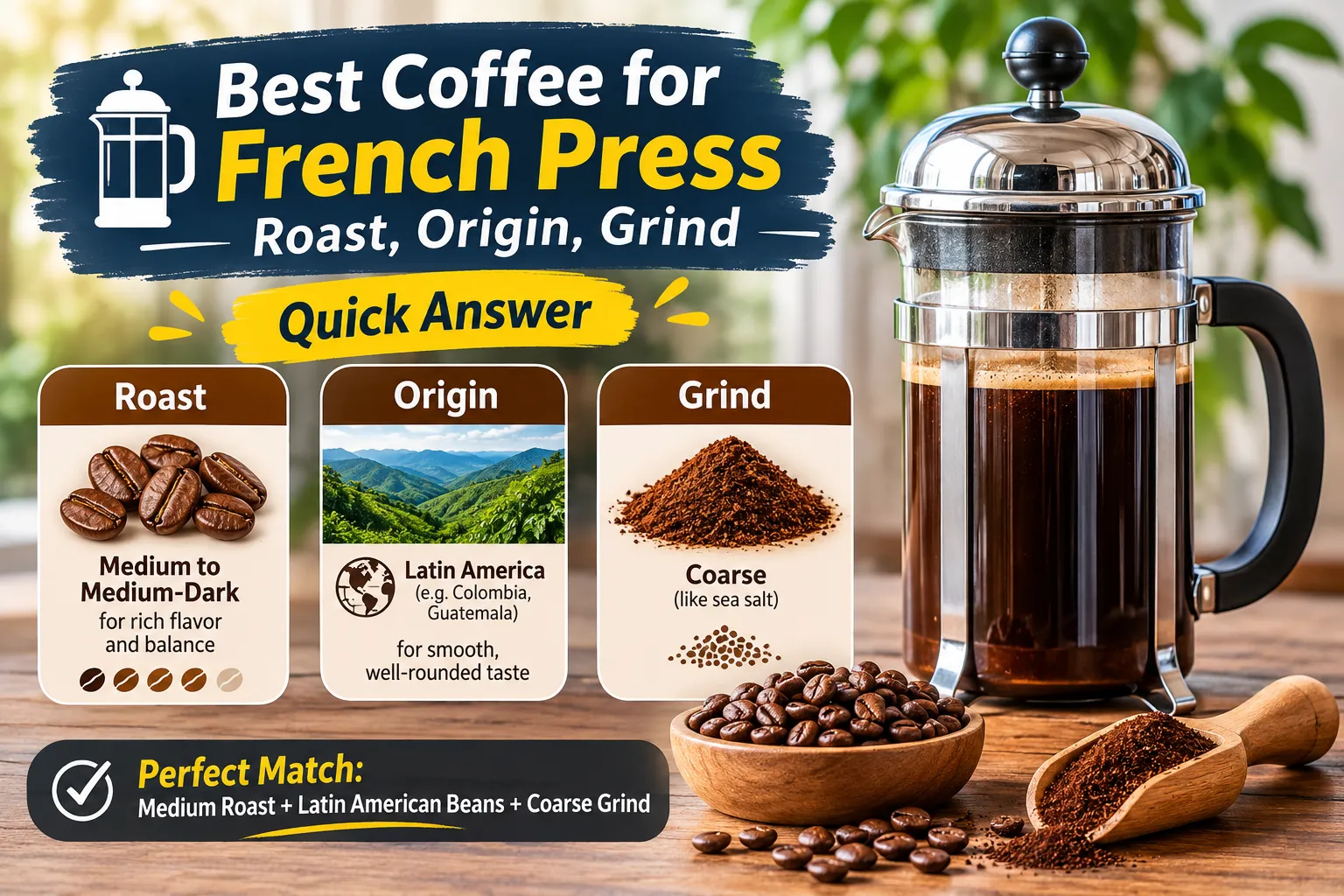
The best coffee for french press is a fresh medium to medium-dark roast, ground coarse like sea salt, brewed at a 1:15 ratio for about four minutes. The press uses a metal mesh filter instead of paper, so it keeps the oils and fine suspended solids a paper cone would trap. That single design choice is why bean selection shows up so clearly in the cup: syrupy medium-dark coffees gain body, while bright light roasts can read thin or muddy unless you adjust the grind and ratio .
Key Takeaways
- Medium to medium-dark roast is the safest default. Bean Box recommends it for French press because the beans have enough development for body without turning ashy during a four-minute immersion .
- Grind coarse, around sea-salt size. Fines slip through the mesh, oversteep, and turn the last third of the mug gritty and bitter .
- A burr grinder matters more than the bean. Burrs produce fewer fines and fewer boulders than blades, which is the difference between clean body and sludge .
- Indonesian and natural-process Brazilian coffees suit the press. Roasters publish notes like earthy, cocoa, nutty, and dried fruit for Sumatra, Sulawesi, Java, and Brazil .
- Budget: $14 to $24 per 12 oz bag of fresh specialty whole bean, checked November 6, 2026. Supermarket dark roast runs $8 to $12 per 12 oz.
- Steep four minutes, then decant. Leaving coffee on the grounds in the carafe keeps extracting and turns bitter within ten minutes.
- Pre-ground works, but only if it is labeled coarse. Standard "all-purpose" grind is too fine for full immersion brewing.
Best Coffee for French Press
The best coffee for french press is whole bean, roasted within the last three to four weeks, in a medium or medium-dark roast from a chocolate-and-nut leaning origin. That is the combination that gives the mesh filter something worth carrying: oils, sweetness, and a heavy texture that does not depend on acidity to stay interesting.
Here is why the filter drives the whole decision. A paper pour over filter adsorbs a large share of coffee's oils (diterpenes) and traps nearly all the fine particles. A French press mesh screen does neither. You get a cup with more suspended solids, more oil, heavier mouthfeel, and lower perceived clarity . Flavors that read as "rich" get richer. Flavors that read as "delicate" get buried.
So the best coffee for french press is not simply the highest-scoring bag on the shelf. It is the bag whose character survives, and improves, in a cloudy, oily, full-bodied cup.
Named picks by taste preference
All flavor descriptors below come from the roasters' own published notes, not from a tasting panel at this publication. Prices are typical US retail checked November 6, 2026 and move with the market.
| Coffee | Roast | Roaster’s listed notes | Typical price (Nov 6, 2026) | Best for |
|---|---|---|---|---|
| Peet’s Major Dickason’s Blend | Dark | Rich, complex, full body | $11 to $14 / 12 oz | Heavy body, milk drinkers |
| Kicking Horse Kick Ass | Dark | Chocolate malt, earthy, smoky | $13 to $17 / 10 oz | Bold, smoky preference |
| Sumatra Mandheling (various roasters) | Medium-dark | Earthy, herbal, syrupy, low acid | $15 to $22 / 12 oz | Classic press texture |
| Natural-process Brazil single origin | Medium | Cocoa, peanut, dried fruit | $16 to $20 / 12 oz | Sweet, nutty, forgiving |
| Washed Guatemala Antigua | Medium | Milk chocolate, orange, caramel | $17 to $24 / 12 oz | Balance with some brightness |
| Washed Ethiopia Yirgacheffe | Light | Floral, citrus, tea-like | $18 to $26 / 12 oz | Experienced brewers only [12 min steep tweaks] |
Five features that make a bag worth buying
- A printed roast date, not a "best by" date. Roast date tells you where the coffee sits in its life. Aim for 5 to 25 days past roast for press brewing.
- Whole bean only. Whole bean coffee for french press holds aroma compounds that start escaping within minutes of grinding.
- Named origin or named blend components. "Sumatra, wet-hulled, Aceh region" tells you what to expect. "100% Arabica" tells you almost nothing.
- Processing method on the label. Natural process usually means heavier sweetness and fruit; washed means cleaner and more acidic.
- A one-way degassing valve on the bag. It lets carbon dioxide out and keeps oxygen from getting in, which matters most for the oily darker roasts a press favors.
What to watch out for
- Oily, shiny dark beans clog grinders and go stale faster. Buy smaller bags more often.
- Flavored coffees (hazelnut, vanilla) leave residue on the mesh and the carafe. Scrub after every use or the next brew tastes like last week's.
- Pre-ground "French roast" is not the same as French press grind. The roast name is a coincidence.
- Supermarket bags without roast dates are often three to nine months old. They will brew, but muted.
What roast level works best for french press?
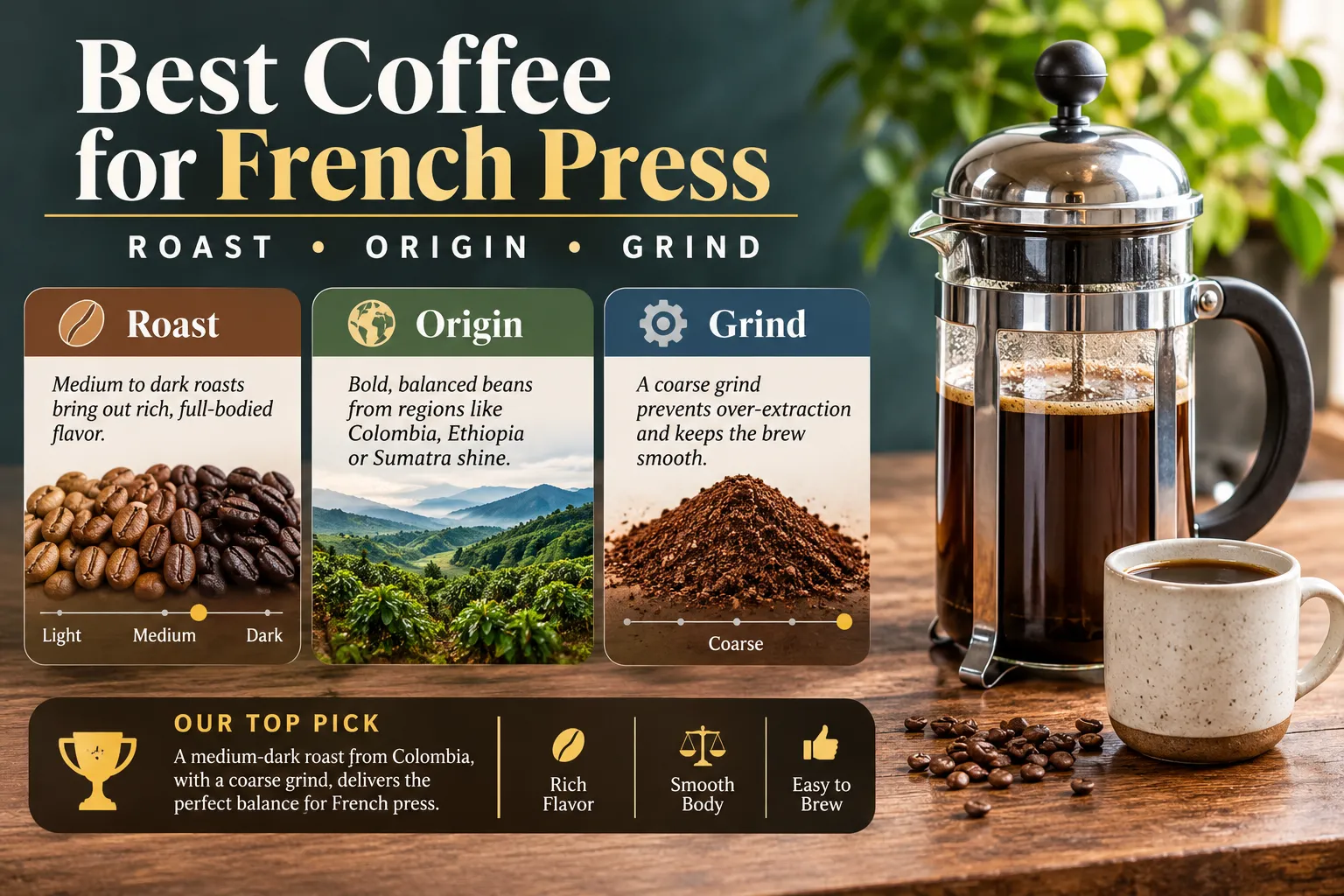
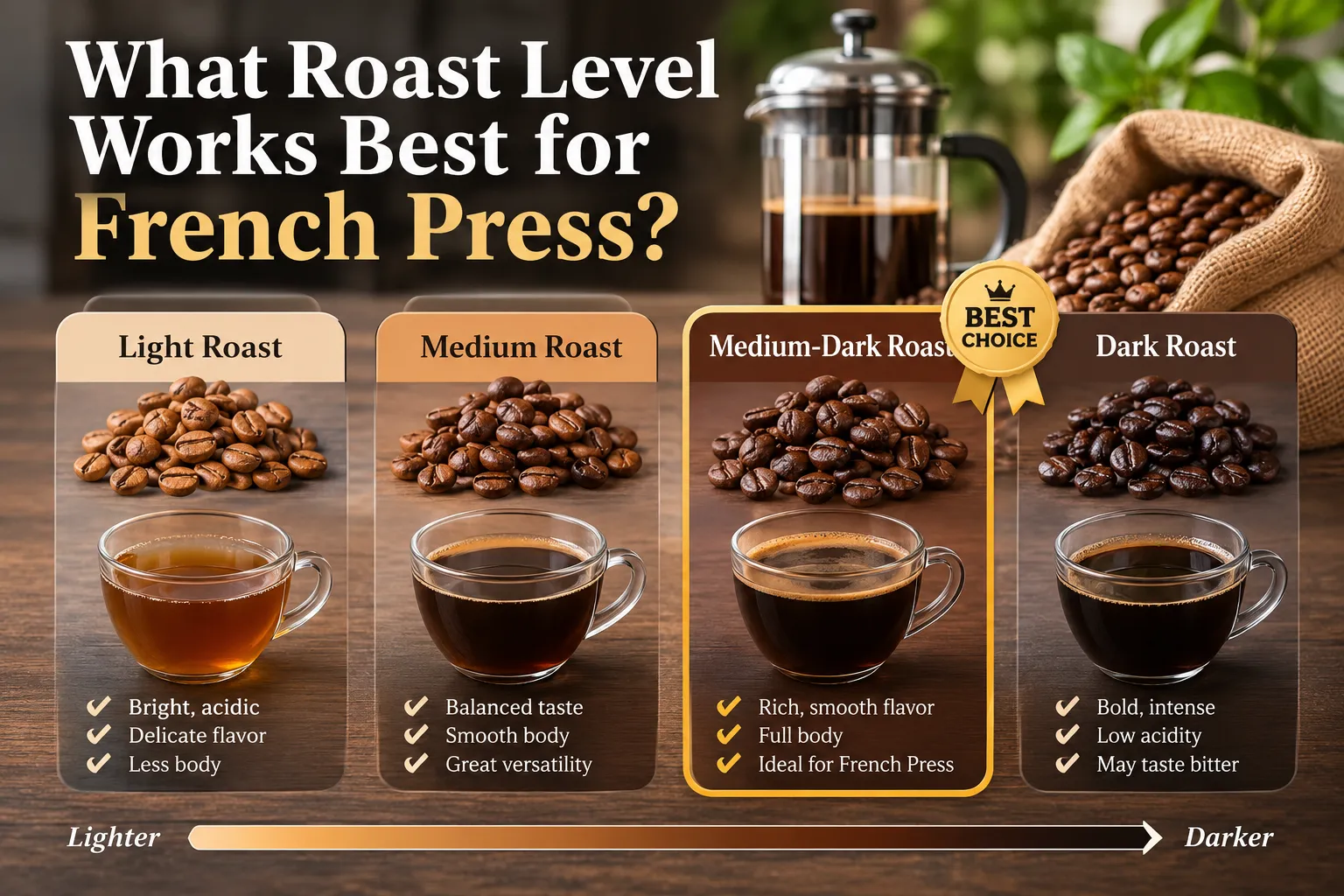
Medium to medium-dark is the best roast for french press for most drinkers, because those roasts carry enough sugar browning for body and sweetness while keeping some origin character intact . Dark roast is a valid choice for a specific preference, not a universal upgrade.
Dark roast or medium roast for french press
Choose dark roast if you want heavy body, low perceived acidity, smoky or bittersweet flavor, or a cup that will not disappear under oat milk. Sumatra Mandheling, Peet's Major Dickason's, and Kicking Horse Kick Ass all appear on current recommendation lists for exactly this profile . Read our guide to the best dark roast coffee for named options, and the notes on how to brew dark roast coffee if your dark cup keeps turning harsh.
Choose medium roast if you want sweetness plus some identifiable origin flavor, or if you are still dialing in your grind. Medium is the forgiving option: it has less soluble bitterness waiting to leak out when you oversteep by thirty seconds . Our best medium roast coffee guide covers specific bags.
Decision rule: if you drink your press coffee black and want to taste where it came from, go medium. If you add milk or sugar and want the coffee to punch through, go medium-dark or dark.
Where light roast fits
Light roast is not wrong in a press, but it is less forgiving. Floral Ethiopian and bright Kenyan coffees can taste thin, sharp, or underdeveloped when brewed at a conventional coarse grind and four-minute steep . The beans are denser and give up solubles more slowly.
If you want to brew a light roast in a press, change three things:
- Grind slightly finer (medium-coarse, closer to coarse sand than sea salt)
- Use water right off the boil, around 205°F
- Extend the steep to 5 to 6 minutes, or push the ratio to 1:14
That is extra work, which is precisely why light roast is the enthusiast's option here. If bright and fruity is your preference, a pour over may serve you better, and our best light roast coffee picks list bags worth that effort.
How coarse should I grind coffee for french press?
Grind coarse, roughly the size of coarse sea salt or breadcrumbs, with visible individual particles and no powdery dust. French press grind size is the single most common failure point because the mesh filter cannot catch what a paper filter would .
Coarse grind coffee works in full immersion brewing for two reasons. Larger particles have less surface area, so they extract more slowly over a long contact time. And they sit above the mesh instead of slipping through it.
Grind reference
| Brew method | Grind size | Visual comparison |
|---|---|---|
| Espresso | Fine | Powdered sugar |
| Drip / pour over | Medium | Table sand |
| French press | Coarse | Sea salt flakes |
| Cold brew | Extra coarse | Cracked peppercorn |
Grind consistency beats the number on the dial
Current brewing guidance consistently favors a burr grinder over a blade grinder for the press, because burrs produce fewer fines and fewer oversized boulders . Blades chop randomly: you end up with dust and chunks at the same time. The dust oversteeps and turns bitter while the chunks sit under-extracted. Both problems arrive in the same mug.
A decent hand grinder solves this for under $100. See our comparison of burr versus blade grinders and the roundup of the best manual coffee grinder options.
What if I don't have a burr grinder for french press?
You still have three workable options:
- Buy coffee pre-ground coarse for French press. Many roasters will grind to order for free at checkout. Grind it the day it ships and use the bag within two weeks.
- Use a blade grinder in short pulses, shaking between pulses, and stop early. Then sift out the dust with a kitchen strainer if you own one. Imperfect, but better than running it for thirty seconds straight.
- Compensate in the brew. With an inconsistent grind, shorten the steep to 3 minutes and decant immediately. You lose some extraction but avoid the bitter fines.
A burr grinder is still the upgrade with the biggest return per dollar for a press drinker. Compare options in our best coffee grinder guide.
Can you use pre-ground coffee in a french press?
Yes, if it is labeled coarse or French press grind. Standard "all-purpose" or drip-grind supermarket coffee is too fine: it passes through the mesh, keeps extracting after you plunge, and produces a gritty, bitter last third of the mug. If coarse pre-ground is not available, reduce your steep time to 2.5 to 3 minutes and pour the whole carafe out immediately.
Does coffee origin matter for french press brewing?
Origin matters more in a French press than in most other methods, because the mesh filter preserves the oils and body that carry origin character. Bean Box specifically favors Indonesian coffees, including Sumatra, Sulawesi, and Java, plus natural-process Brazilian coffees and chocolate-forward blends, for the press .
Those origins share a published flavor vocabulary from their roasters: earthy, syrupy, nutty, cocoa, dried fruit. Heavy, low-acid, sweet. Those descriptors describe what a press is naturally good at amplifying.
Origin quick reference
- Sumatra / Sulawesi / Java (Indonesia): roasters typically list earthy, herbal, cedar, syrupy body, very low acidity. The wet-hulled processing used in Sumatra is largely responsible for that profile.
- Brazil, natural process: cocoa, peanut, dried fruit, heavy sweetness. Extremely forgiving of brewing error.
- Guatemala / Colombia, washed: chocolate, caramel, orange or apple acidity. A middle path if you want some brightness without losing body.
- Ethiopia / Kenya: floral, berry, citrus, tea-like. Beautiful in a pour over, harder to pull off in a press.
Single origin vs coffee blends for french press
Blends usually win for everyday French press. A blend is assembled for consistency and body, often mixing a sweet Brazilian base with a heavier Central American or Indonesian component, and that construction suits immersion brewing. Single origin wins when you want to taste a specific place and are willing to adjust ratio and steep to get there.
Decision rule: buy a blend for your weekday mug and a single origin for the weekend when you are paying attention. If you are new to buying beans at all, start with our guide on how to choose the best coffee beans for home brewing.
Processing method deserves a line of its own. Natural (dry) processing leaves the fruit on the bean during drying and generally produces heavier sweetness and fruit. Washed processing strips the fruit first and gives a cleaner, more acidic cup. For a press, natural and honey processed coffees tend to be the safer bet.
Why does my french press coffee taste bitter, and how do I get rid of sediment?
Bitterness in a French press almost always traces back to three things: grind too fine, steep too long, or coffee left sitting on the grounds after plunging. Sediment traces back to the same first cause plus plunging too fast .

Fix bitterness in order
- Grind coarser. This fixes the majority of bitter press coffee. Fines over-extract first.
- Cut the steep to 4 minutes and time it. Our French press steep time guide covers how the window shifts by roast level.
- Decant everything immediately after plunging. Coffee left in the carafe keeps extracting. By minute ten it tastes noticeably harsher.
- Drop water temperature to 195 to 200°F for dark roasts. Boiling water on an oily dark roast scorches out ash.
- Check your ratio. Too little coffee for the water forces over-extraction of what is there. Start at 1:15 (about 60 g per liter) and read our French press coffee ratio guide.
Reduce sediment
- Plunge slowly, about 20 seconds from top to bottom. Fast plunging pushes fines through the mesh edges.
- Skim the crust. After the 4-minute steep, break the floating crust with a spoon, then skim off the foam and floating grounds before plunging.
- Let it rest 1 minute after plunging so the heaviest particles settle, then pour.
- Stop pouring at the last inch. That is where the sludge lives.
- Upgrade the filter. A double-mesh press like the Espro P7 traps substantially more fines. See our Espro P7 walkthrough.
How long do you steep coffee in a french press?
Four minutes is the standard steep for a medium or medium-dark roast at a coarse grind. Dark roasts extract faster: try 3 to 3.5 minutes. Light roasts extract slower: try 5 to 6 minutes. Always start the timer when the water hits the grounds, including the bloom.
Speaking of which: pour just enough water to wet the grounds, wait 30 seconds while the bed puffs up with escaping carbon dioxide, then add the rest. That bloom improves even extraction, and it is the step most home brewers skip.
French press vs pour over: which tastes better, and is french press healthier than drip?
Neither method is objectively better. A French press gives a heavier, oilier, rounder cup with more texture. A pour over gives a cleaner, brighter, more separated cup where individual flavors stand apart . The difference comes from the filter, not the skill level.
Choose French press if you like full body, drink dark or medium-dark roasts, want zero paper filters, and prefer a hands-off four minutes. Choose pour over if you like fruity light roasts, want clarity, and enjoy the ritual of pouring. Our full French press vs pour over comparison breaks down the variables, and the best pour over coffee maker roundup covers gear if you want both on the counter.
On health: French press coffee contains more cafestol and kahweol, the oily diterpenes that paper filters largely remove. Published research links high unfiltered coffee intake to modest increases in LDL cholesterol. That does not make press coffee dangerous, and the size of the effect depends on how much you drink daily. If you drink four or more mugs a day and track cholesterol, paper-filtered drip is the more conservative choice. For one or two mugs, the difference is small. Treat this as a reason to know the mechanism, not a reason to panic.
How much should I spend on good french press coffee?
Budget $14 to $24 per 12 oz bag of fresh specialty whole bean, which works out to roughly $0.70 to $1.20 per 16 oz mug at a 1:15 ratio. Prices checked November 6, 2026. Supermarket national-brand dark roast runs $8 to $12 per 12 oz and will still make a decent press cup if the roast date is recent, which it usually is not.
Sourced numbers worth knowing
of US adults drank specialty coffee the previous day, versus 42% for traditional coffee (National Coffee Association, June 2, 2026).
past-day specialty consumption reported in an October 2026 NCA update, from a survey of 1,850 US adults.
Arabica futures in early November 2026, with ICE-certified stocks near 225,068 bags on October 29, close to 27-year lows.
year-over-year increase in Brazilian shipments through October 22, 2026, roughly 3.30 million bags.
Those green coffee prices matter to you at the register. Specialty bag prices have followed the futures market upward through 2026, which is why a single-origin Ethiopian that cost $17 in 2024 often sits above $20 now.
Best coffee for french press on a budget
If $20 bags are not happening every week, three moves keep quality up:
- Buy 2 lb bags of a solid dark blend. Community Coffee Signature Blend and similar supermarket-plus options cost less per ounce. Our Community Coffee Signature Blend notes cover what the roaster lists.
- Store it properly. Oxygen, not time alone, kills coffee. An airtight valve container extends usable life by weeks. See the best coffee storage containers for fresh beans.
- Use a subscription for freshness, not prestige. Roast-to-order shipping beats a cheaper stale bag. Compare options in our coffee subscription comparison.
One more buying signal: roasters that name the farm, region, importer, and lot are operating traceable supply chains. The EU Deforestation Regulation requires exactly that kind of documentation for coffee entering the EU, and roasters building those systems tend to be the ones paying attention to quality too. Traceability is not a flavor guarantee, but it correlates with care.
Brewing calculator
French Press Dose & Steep Calculator
Pros and cons of French press as your main brewer
Pros
- Heavier body and more aroma oils than any paper-filtered method
- No paper filters to buy, store, or run out of
- Costs $25 to $80 for a good press, far below espresso gear
- Four hands-off minutes, easy to scale to 2 to 4 cups
- Forgiving of water temperature compared with espresso
Cons
- Sediment in the bottom of every mug, to some degree
- Demands a burr grinder for best results
- Unfiltered oils raise the LDL cholesterol question for heavy daily drinkers
- Loses heat quickly in glass models
- Cleanup involves wet grounds and a mesh screen, not a disposable filter
If the sediment and cleanup bother you, read our AeroPress vs French press comparison before buying another press.
Who should buy what
- The café escapee who drinks lattes: medium-dark blend, 1:12 ratio, press brewed strong and topped with steamed milk. Peet's Major Dickason's or a similar bold blend wins here.
- The black-coffee drinker who wants flavor: natural-process Brazil or a washed Guatemala, medium roast, 1:15, four minutes.
- The upgrader with a burr grinder already: single origin Sumatra or Sulawesi, medium-dark, to see what the mesh filter really does with body.
- The gift buyer: a quality press plus a 12 oz bag of a chocolate-forward blend and a $40 hand grinder. Browse the best French press models for the hardware side.
- Skip the press entirely if you mostly drink fruity light roasts black and value clarity. A pour over will make you happier.
FAQ

Conclusion
The best coffee for french press is a fresh medium to medium-dark roast from a chocolate, nutty, or earthy origin, ground coarse on a burr grinder, steeped four minutes at 1:15 and decanted straight away. The metal mesh filter makes that choice visible in a way drip never does. It carries oils and body, so coffees built on sweetness and texture reward you and delicate floral coffees often do not.
Your next step: buy one 12 oz bag with a printed roast date, weigh 33 g for 500 ml of water, and time the steep for exactly four minutes. If the cup tastes bitter, go coarser before changing anything else. Then check our French press coffee ratio guide to fine-tune strength to your taste.
Better Coffee Starts With Better Answers.
Affiliate disclosure: Coffee Rank IQ earns commission from some links on this page. Recommendations are based on published product specifications, roasters' own listed tasting notes, and documented brewing research. Prices were checked on November 6, 2026 and change frequently. Check the current price before buying.